Charles Feeney was a highly successful businessman; in fact, Forbes magazine listed him among the top 400 richest Americans, with a net worth of about $400 million. Still, he was a shabby dresser, wore a $15 watch, flew coach everywhere, and didn’t own a house or a car. That doesn’t sound like your typical multi-millionaire, but it turns out he was worth far less than estimated. Why? Because, over his career, he had been giving it all away.
Over the years, hospitals, schools, service groups, and others received random checks supporting their efforts. For a long time, no one knew where they came from, but eventually the truth surfaced. It was Charles Feeney. Until he was discovered, Charles Feeney had donated over $4 billion anonymously! By 2012, after his secret was revealed, he had given away $6 billion. There’s a biography about him: The Billionaire Who Wasn’t: How Chuck Feeney Made and Gave Away a Fortune Without Anyone Knowing. His actual net worth at that time was only 1% of the $400 million estimated by Forbes. When he died in 2023, he had nearly nothing except a rented two-bedroom apartment and a $15 watch. He had given $8 billion to those in need.
Jesus said, “Thus, when you give to the needy, sound no trumpet before you, as the hypocrites do in the synagogues and in the streets, that they may be praised by others. Truly, I say to you, they have received their reward. But when you give to the needy, do not let your left hand know what your right hand is doing, so that your giving may be in secret. And your Father who sees in secret will reward you.” Maimonides, the 12th-century Jewish rabbinic leader, taught that ”the highest form of giving was anonymous and selfless.” Both of these teachings seem to be lessons that Chuck Feeney sincerely practiced.
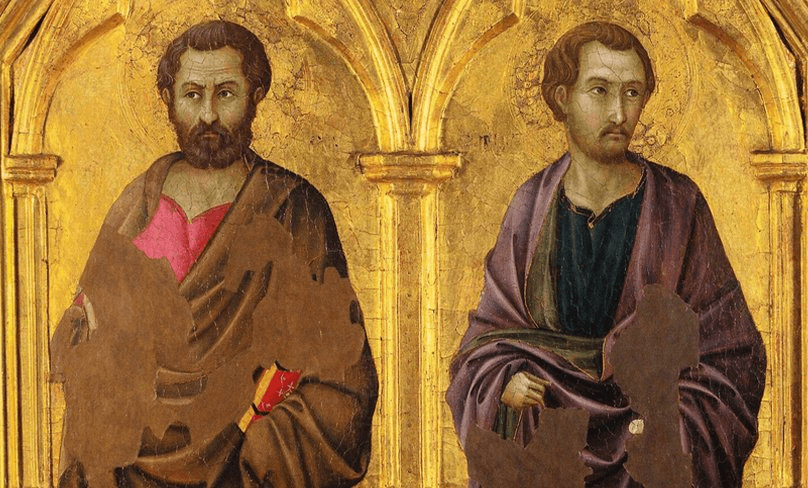
And Fr. John, I thought we were celebrating Saints Simon and Jude. Yes, we are, yet these two saints are as anonymous as Charles Feeney’s giving was for all those years. Simon is listed in all three of the synoptic Gospels (Matthew, Mark, and Luke), and Jude is named in the list of apostles in Luke’s Gospel and in the Book of Acts, but there is no agreement that he is the author of the epistle of Jude in the New Testament.
Legend has it that they preached in the area of Persia and eventually came together in Mesopotamia, where pagan priests martyred them for their faith. Apart from that, there’s nothing more.
The connection I see between Simon and Jude and someone like Charles Feeney is the fact that Simon and Jude, like Feeney, lived very anonymous lives and gave so much to advance the Gospel, yet, aside from being named occasionally on lists, there is silence. They sacrificed everything, even their very lives. Not for fame, but for the glory of God.
St. Josemaría Escrivá writes, “When you have finished your work, do your brother’s, helping him, for Christ’s sake, so tactfully and so naturally that no one—not even he—will realize that you are doing more than what in justice you ought. This, indeed, is virtue befitting a son of God!”
We are called to do the work of God, like Simon and Jude, like Charles Feeney, not for the praise of men, but for the glory of God.
The poet Robert Frost is reported to have said, “A jury consists of twelve persons chosen to decide who has the better lawyer.” With that in mind, I’ll let you judge if these lawyers won their case.
Q: “Now, Mrs. Johnson, how was your first marriage terminated?” A: “By death.” Q: “And by whose death was it terminated?”
Q: “Have you ever thought of committing involuntary manslaughter?”
Q: “Any suggestions as to what prevented this from being a murder trial instead of an attempted murder trial?” A: “The victim lived.”
Q: What was the first thing your husband said to you when he woke up that morning? A: He said, “Where am I, Cathy?” Q: And why did that upset you? A: My name is Susan.
Q: “Was it you or your younger brother who was killed in the war?”
Q: “Do you recall the time that you examined the body?” A: “The autopsy started around 8:30 p.m..” Q: “And Mr. Dennington was dead at the time?” A: “No, he was sitting on the table wondering why I was doing an autopsy.”
When it comes to asking questions, preschoolers take the prize. They average 300-390 questions per day. By the time children are nine, that number drops to about 140. As adults, I suppose we think we know all the answers because we only ask 25-30 questions per day.
Answers to some questions range from one word—yes/no—to entire volumes dedicated to a single answer. Other questions range from rhetorical to simple inquiries. For example, “Does Father John have a point?” Answer: Yes!
If you combine the texts of the New Testament, you’ll discover that Jesus asked a total of 307 questions. Today, he asked Bartimaeus, “What do you want me to do for you?” At other times, His questions become more difficult. “What are you looking for?” (John 1:38) “Why do you notice the splinter in your neighbor’s eye yet fail to see the wooden beam in your own eye?” (Matt 7:2) “Why are you terrified?” (Matt 8:26) “Why do you harbor evil thoughts?” (Matt 9:4) “Could you not watch for me one brief hour?” (Matt 26:40) “What are you thinking in your hearts?” (Luke 5:22) “What are you discussing as you walk along?” (Luke 24:17) Each of those is asked in a particular context, but even alone, in the context of our faith, they are good questions and not always so easy to answer.
On the other side, Jesus was asked 183 questions. Care to guess how many He answered? Three. You should think about that the next time someone seems to have all the answers.
Jesus asks us questions, and we ask Jesus questions, but I suspect that most of our questions fall in the category of requests for favors or healing. However, at the root of all we are asking, perhaps even subconsciously, is a more important question, and it is the same question we heard a few weeks ago in our Gospel reading—“Good Teacher, what must I do to inherit eternal life?” Even our craziest requests come back to this. “Jesus, will you help me pick the right numbers to win the lottery?” That sounds materialistic on the surface, but below the surface, it is a request for stability, fulfillment, the meeting of needs, and so on, all of which will be given on the last day—eternal life with God.
Jesus said, “Truly, truly, I say to you, whoever hears my word and believes him who sent me has eternal life. He does not come into judgment, but has passed from death to life.” Jesus also said, “All authority in heaven and on earth has been given to me. Go therefore and make disciples of all nations, baptizing them in the name of the Father and of the Son and of the Holy Spirit, teaching them to observe all that I have commanded you.”
So, we have a question that is being asked by believers and unbelievers, “What must I do to inherit eternal life?” Fortunately, we have the answer: faith in the Son of God, Jesus. And we have a command: “Go and share this Good News.
The Church has many secondary missions, but this going and proclaiming the Good News—that is, proclaiming the cross, the death and resurrection of Jesus, repentance, the forgiveness of sins, and eternal life, all of which can be summed up in those few words, “For God so loved the world”—this going and proclaiming the Good News far outweighs all the secondary missions/ministries combined, but… and there it is… we can preach by words all day long, yet, unless we also proclaim the Good News through those secondary missions/ministries, through our actions, then the message goes largely unheard.
You know the Scripture: “What good is it, my brothers and sisters, if someone says he has faith but does not have works? Can that faith save him? If a brother or sister is poorly clothed and lacking in daily food, and one of you says to them, ‘Go in peace, be warmed and filled,’ without giving them the things needed for the body, what good is that? So also faith by itself, if it does not have works, is dead.” (James 2:14-17)
Bottom line: we, the Church, must proclaim the Good News of Jesus Christ by word and deed. We can all agree on this, but there is a catch. To those who receive what we are offering, there is no charge. There is no cost for the message we share, and we do not charge for the works we perform; however, for us—the Church—the act of proclaiming by word and deed is not free.
I have joked with you about the two ways I can make you most uncomfortable. The first is for me to be silent. Silence makes us crazy. It shouldn’t, but it does. The second way I can make you uncomfortable and perhaps even have you tune me out is to talk about money and giving. Over the course of the last ten years, I’ve spoken to you many times about the need for silence in our lives, but I can count on one hand the number of times I’ve talked to you about money and giving. You have always been so generous with your gifts and pledges to the Church, and we are a financially healthy church, so I’ve never seen the need. Today, you are still as generous as always, and we are still a financially healthy church. That hasn’t changed. However, the needs of the world around us have, and they are greater than ever, and every indication is that it will only get worse. And it is to this world that we must proclaim through word and deed.
Not everyone has the gifts to proclaim by word, and many times, those who can proclaim by their deeds and actions are out working to provide for their own needs and the needs of their families. However, the Church is uniquely positioned to do both, but not without your financial assistance.
Our Presiding Bishop (for one more week), Michael Curry, is fond of saying we are the Episcopal Branch of the Jesus Movement. So, St. Matthew’s is the Episcopal Branch of the Jesus Movement in Enid, Oklahoma. Through our individual actions, we can do much, but through our collective actions, we have made and are making a considerable difference in our community. We feed people experiencing poverty, pay for student meals at the local schools, put books in the hands of children through our partnership with the Enid Public Library and the Dolly Parton Imagination Library, help build soccer complexes and tennis facilities that provide healthy activities for the youth of our community, and so much more. In addition, this year, we’re hoping to add the 5% Mission Tithe back into the budget so that our reach and proclamation of the Good News of Jesus Christ can be even greater. I don’t get really excited about asking you to help us pay the electric bill, but the ability to fulfill so many opportunities, to help so many individuals and organizations, and to proclaim the Good News in creative ways gets me going. However… we need your giving to help do these things.
Speaking through the Prophet Malachi, the Lord says, “Bring the full tithe into the storehouse, that there may be food in my house. And thereby put me to the test, says the Lord of hosts, if I will not open the windows of heaven for you and pour down for you a blessing until there is no more need.”
I am not preaching prosperity Gospel here; that is heresy, but the Lord says, “Test me on this. Bring your tithe into the church and watch what happens.”
Yes. This is the beginning of our annual pledge drive. Yes. You are going to hear more about giving, pledging, and tithing. Yes. You can tune it all out, but… don’t. Giving our time, talents, and treasures is as much a spiritual discipline as praying and worshipping. So, I ask you to read through the information that will be provided over the next week, then, next week, prayerfully consider and make your 2025 pledge. Together, in our community and maybe even further, we will proclaim the Good News and answer the question, “What must I do to inherit eternal life?”
Let us pray: Gracious Father, the owner of all things, we pause in reverence, acknowledging that everything we possess ultimately belongs to you. We open our hearts to the profound reality that we are only temporary stewards of your eternal treasures. Help us to embrace the responsibility and privilege of managing your blessings with diligence and integrity. Amen.


 Candle in a Cave