
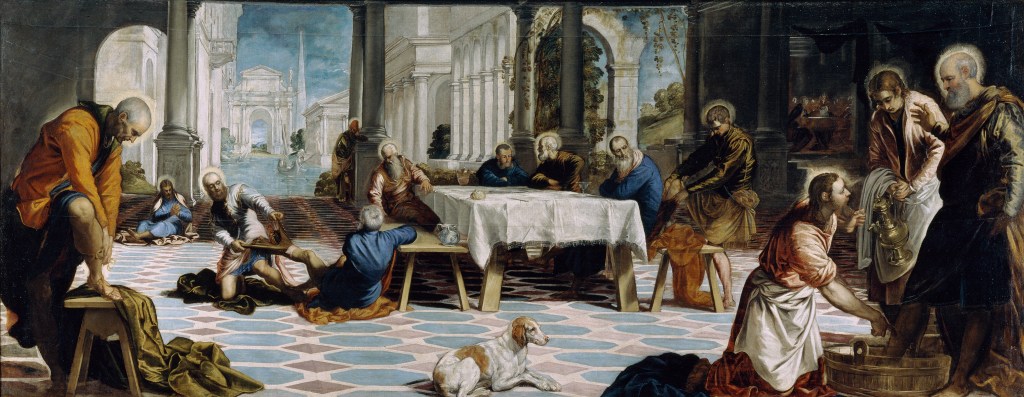
From The Dolorous Passion, chapter 7:
“Jesus, in the vestibule, told John to take a basin, and James a pitcher filled with water, with which they followed him into the room, where the chief steward had placed another empty basin.
“Jesus, on returning to his disciples in so humble a manner, addressed them a few words of reproach on the subject of the dispute which had arisen between them, and said among other things, that he himself was their servant, and that they were to sit down, for him to wash their feet. They sat down, therefore, in the same order as they had sat at table. Jesus went from one to the other, poured water from the basin which John carried on the feet of each, and then, taking the end of the towel wherewith he was girded, wiped them. Most loving and tender was the manner of our Lord while thus humbling himself at the feet of his Apostles.”
And then there was Peter. “‘You will never wash my feet.’ Jesus answered, ‘Unless I wash you, you have no share with me.’ Simon Peter said to him, ‘Lord, not my feet only but also my hands and my head!’”
It is easy to pick on Peter, but would we have acted any differently? Jesus is kneeling before you and says He’s about to wash your feet. What do you do? Yeah. Me too. “Lord, this is so far below You, and I am so unworthy of such an honor.” Yet, as with Peter, this act of washing the disciples’ feet points to something beyond itself.
Jesus says, “Unless I wash you, you have no share with me.” The term “share” can also be interpreted as “heritage” or “inheritance.” In the context of the Old Testament, the Lord speaks to Moses about the Israelites’ inheritance, which is the Land of Canaan, also known as the Promised Land. The Lord declares, “This is the land that shall fall to you for an inheritance, the land of Canaan as defined by its borders.” (Numbers 34:2) In the New Testament, we learn that Jesus will say to the righteous, “Come, you who are blessed by my Father, inherit the kingdom prepared for you from the foundation of the world.” (Matthew 25:34) Unless Jesus washes Peter’s feet, Peter will have no part in the New Promised Land, the very Kingdom of God.
However, remember what Jesus said before he washed their feet. He said, “You do not know now what I am doing, but later you will understand.” This indicates that foot washing is not only about humbly serving one another. It is also pointing to something greater than itself, and the Disciples would not understand until after the Resurrection. St. Paul says it plainly in his letter to the Philippians—“Being found in human form, [Jesus] humbled himself by becoming obedient to the point of death, even death on a cross.” (Philippians 2:8)
The washing of the Disciples’ feet is pointing to the cleansing of sin from their souls, but not just theirs “only but also for the sins of the whole world.” We, like Peter and everyone else who desires the Kingdom of God, must submit to the humility of Jesus and allow Him to wash our feet—allow Him to wash our souls, for “no one comes to the Father except through” Him, and these great acts He performed in the Upper Room and on the hill outside Jerusalem, upon the Cross.
Tonight, I invite you to come forward so that I can learn more about the humility of our Savior by washing your feet. However, remember that these acts serve as an example established by Jesus. Therefore, we are not only witnesses to them but also called to practice them. As Jesus tells us, “Very truly, I tell you, servants are not greater than their master, nor are messengers greater than the one who sent them. If you know these things, you are blessed if you do them.”
 Candle in a Cave