

When it comes to daily devotional books that you might read as part of a spiritual practice, we most often think of ones that are uplifting and joyful. Something to give a good start to the day. I’ve come across several that I quit pretty quickly, but some I get very involved with. Few are specific for priests, but there are a couple, and one that I discovered several months back is The Dignity and Duties of the Priest, by St. Alphonsus Liguori.
In the first few pages, I thought it would be inspiring and uplifting. There was a quote by St. John Chrysostom that was setting the tone—“Priests should be so holy that all may look to them as models of sanctity; because God has placed them on earth that they may live like angels, and be luminaries and teachers of virtue to all others.” I read that and began to feel good about my calling, but then it took a turn. A couple of pages later—“In a word, [the priest] that is not holy is unworthy to approach the altar, because by the stains that he brings with him, he contaminates the sanctuary of God. Let him not approach the altar, because he has a blemish, and he must not defile my sanctuary.” On the next page, a quote from Saint Augustine further illumines this: “To the Lord is more pleasing the barking of dogs than the prayer of such priests.”
It was such a wonderful book—and I mean that—but there were mornings when I would look at it and say, “You’ll get your turn. Give me a minute.” Then I would read and get smacked again—“At present, says the holy church, I am not persecuted by the pagans, for the tyrants have ceased, nor by the heretics, because there are no new heresies; but I am persecuted by the [priest], who by his scandals robs me of many souls.” For such a priest, Liguori tells us, “The end shall be, first, abandonment of God, and then the fire of hell.”
I kept reading—it actually changed my understanding of the priesthood—but I kept wanting him to throw me a bone. Give me some sign of hope, because there were times I felt convinced I had no chance of heaven.
Now imagine you are Jewish and living during the time leading up to the birth of Jesus. You attend synagogue every Sabbath. You understand the teachings of the Torah and sincerely want to follow them, but you find that every turn, you stumble over one aspect of the Law or another. The only way to enter God’s Kingdom is if you are without sin, but no sooner have you made the appropriate sacrifices at the Temple for the forgiveness of sins, you fall into another pit. You want to be holy, but there seems to be no hope.
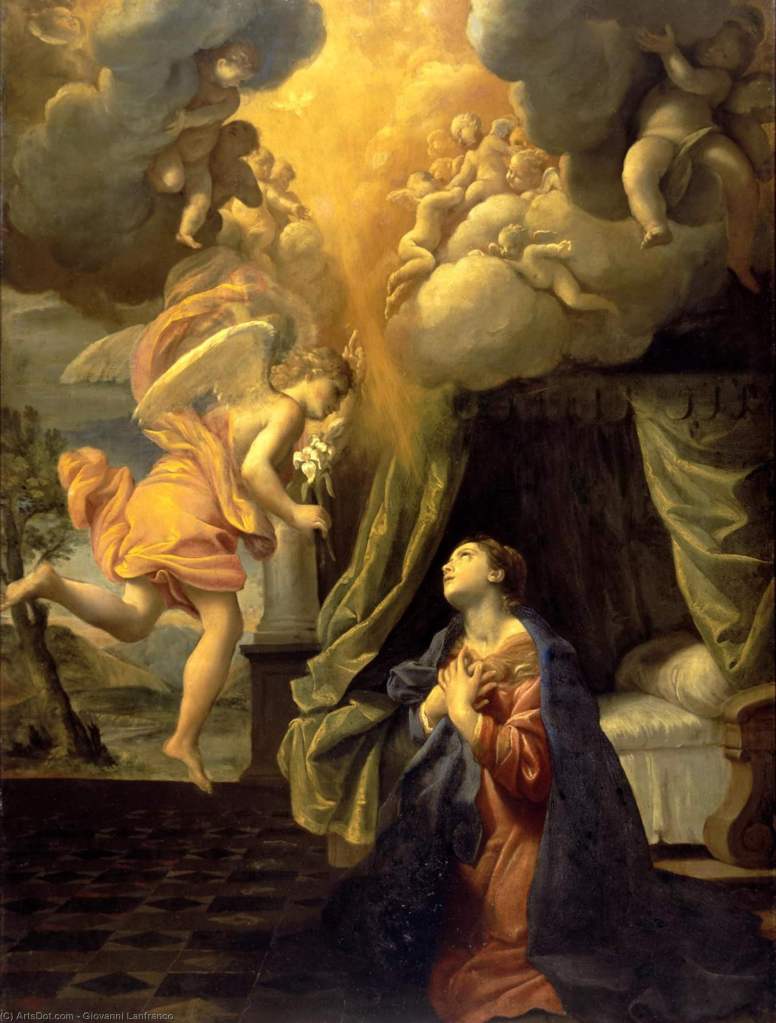
Now, imagine you’re living in the small city of Nazareth. One night, after a long, hard day, you’re making your way home. As you walk, you recall all the times you’ve failed God, and you understand the consequences of those failures. Yet, until you can return to the Temple again to make the necessary sacrifices, your salvation remains in question. In your fear and frustration, you stop along the way and lean against a wall just to have a moment of quiet. Then, you see a strange light begin to shine out of the window of the house you’re leaning against. Just as you’re about to move on, you hear the sweetest voice begin to speak, and it stops you in your tracks. You have no choice but to listen.
“Greetings, O favored one, the Lord is with you!” There’s a brief pause, then you hear, “Do not be afraid, Mary, for you have found favor with God. And behold, you will conceive in your womb and bear a son, and you shall call his name Jesus. He will be great and will be called the Son of the Most High. And the Lord God will give to him the throne of his father David, and he will reign over the house of Jacob forever, and of his kingdom there will be no end.”
Another pause, then you hear a young woman’s voice, “How will this be, since I am a virgin?”
The response comes immediately: “The Holy Spirit will come upon you, and the power of the Most High will overshadow you; therefore, the child to be born will be called holy—the Son of God. And behold, your relative Elizabeth in her old age has also conceived a son, and this is the sixth month with her who was called barren. For nothing will be impossible with God.”
Imagine you’re listening outside the window as all this happens. You realize that it is an angel of the Lord speaking to the girl. What he offers is not only salvation for the girl, but for the whole world—yourself included. The angel is offering the hope you are so desperately seeking. You know that through the Son of God, whom the angel is speaking about, you will receive forgiveness of sin, you will be given the freedom to serve and worship God without fear, and that you will be set free from the sting of death. In that moment, you understand all of this, but you also realize that everything depends on one thing—the young woman’s response.
St. Bernard of Clairvaux wrote in a sermon about that moment—a moment when all of creation held its breath, waiting for Mary to speak: “You have heard, O Virgin, that you will conceive and bear a son; you have heard that it will not be by man but by the Holy Spirit. The angel awaits an answer; it is time for him to return to God who sent him. We too are waiting, O Lady, for your word of compassion; the sentence of condemnation weighs heavily upon us…. Tearful Adam with his sorrowing family begs this of you, O loving Virgin, in their exile from Paradise. Abraham begs it, David begs it. All the other holy patriarchs, your ancestors, ask it of you, as they dwell in the country of the shadow of death. This is what the whole earth waits for.”—Mary, what is your answer? On one side is condemnation and death, and on the other is the forgiveness of sins and life eternal.
As I read Liguori’s book, I kept asking, “Is there any hope?” And for you, standing outside the window, listening to the angel’s words, you’ve asked the same question: “Is there any hope?” Yes, there is. The greatest of all hope. Why? Because “Mary said: Behold the handmaid of the Lord; be it done to me according to thy word.” Mary said yes, and Hope Incarnate, the very Word of God, the Son of God, Christ Jesus the Lord, was conceived in the Virgin’s womb.
There is often confusion about why the Blessed Virgin Mary is held in such high esteem, but the answer lies in those few words of hers, for all of salvation—ours, the world’s, all of creation—hinged on her response.
That great Archbishop of Canterbury from the 11th century, St. Anselm, said, “To Mary God gave his only-begotten Son, whom he loved as himself. Through Mary, God made himself a Son, not different but the same, by nature Son of God and Son of Mary. The whole universe was created by God, and God was born of Mary. God created all things, and Mary gave birth to God. The God who made all things gave himself form through Mary, and thus he made his own creation. He who could create all things from nothing would not remake his ruined creation without Mary.”
If I could accomplish one thing today, it would be to increase your devotion to the Blessed Virgin Mary. Our salvation is through Christ Jesus alone—no one comes to the Father except through Him—however, it was through Mary and her yes that Christ took on our flesh and, through that same flesh, was able to give us hope. As I’ve told you before, this hope we possess is not mere wishful thinking. Our hope in Christ Jesus is an unshakable knowledge and expectation of what the Father has promised all along. What is that promise? We read it in the:
“He has shown the strength of his arm,
he has scattered the proud in their conceit.
He has cast down the mighty from their thrones,
and has lifted up the lowly.
He has filled the hungry with good things,
and the rich he has sent away empty.
He has come to the help of his servant Israel,
for he has remembered his promise of mercy,
The promise he made to our fathers,
to Abraham and his children for ever.”
The Father has promised that we will be with Him in His Kingdom, where there will be no end, and it all started with Mary’s “Yes.”
Mary’s life is devoted to guiding us to her Son, our Savior, Jesus Christ. Offer your devotion to her. Respect her as Queen and mother, and through her intercessions, you will be drawn deeper into your relationship with the One True God.
Let us pray: Hail, holy Queen, Mother of mercy, hail, our life, our sweetness and our hope. To thee do we cry, poor banished children of Eve: to thee do we send up our sighs, mourning and weeping in this vale of tears. Turn then, most gracious Advocate, thine eyes of mercy toward us, and after this our exile, show unto us the blessed fruit of thy womb, Jesus, O merciful, O loving, O sweet Virgin Mary! Amen.
Pray for us, O Holy Mother of God, that we may be made worthy of the promises of Christ.
 Candle in a Cave