Sermon: Proper 21 RCL B – “No Lifeguard on Duty”


Little Johnny had gone to the beach with his family. After a short time, Johnny asked his mom if he could go swimming in the ocean. His mother said, “Certainly not. The sea’s too rough, there’s a terrible rip tide and a dangerous offshore current, this coast is infested with jellyfish and sharks, and there’s no lifeguard on duty.” Johnny said, “But Daddy’s gone swimming!” His mother, looking out over the water, replied nonchalantly, “I know, but he has excellent life insurance.”

Last week, as we discussed the Epistle of James, we concluded that we can work at avoiding the sting of sin by drawing near to God and walking in the light. St. James, in his Epistle, said to us, “Submit yourselves therefore to God. Resist the devil, and he will flee from you. Draw near to God, and he will draw near to you.” (James 4:7-8)

From this, a good question would be: How do I draw near to God? How do I walk in the light? We know that through prayer and study, we can accomplish this to some extent. However, the devil is crafty. Even in the beginning in the Garden of Eden, we are told, “Now the serpent—the devil—was more crafty than any other beast of the field that the Lord God had made.” (Genesis 3:1) So, even though we may watch and pray and study, the devil is still looking for ways to deceive us. One of the more successful tactics the serpent may take is not by deceiving us directly but by convincing us to deceive ourselves. This goes back to how we, at times, will dabble in our sins or negotiate with them. As we learned last week, you can’t sin just a little. You are either sinning or not. We deceive ourselves when we think otherwise. Unfortunately, we do this, and even though we may be praying and studying, we can become increasingly mired and stuck in the sin that is killing us. 

This is akin to the general confession we make almost every time we gather. On a Sunday, the general confession is the one that we make together following the Creed. It is beneficial, but there needs to be real accountability. Sure, I during the General Confession,I can confess to stealing, but no one is holding me accountable for that sin. No one is asking me to make restitution. No one is around to help me overcome the sin. I confessed the sin of stealing, but I’ve got no skin in the game. So, I am more likely to continue in that sin because I haven’t been “called out” on it and have likely deceived myself and justified my actions. What I really need is for someone to come along and say, “You need to stop stealing, and I’m going to….” Not be your taskmaster, not ride you day in and day out, not condemn you, bash you about the head and neck, none of that. No. What I need is someone to come alongside me and say, “You need to stop stealing, and I’m going to help you to stop deceiving yourself. I’m going to hold you accountable. I’m going to come alongside you and love you.”

This morning, we read the last two verses of the Epistle of St. James. “My brothers and sisters, if anyone among you wanders from the truth—falls into sin—and is brought back by another, you should know that whoever brings back a sinner from wandering will save the sinner’s soul from death and will cover a multitude of sins.” (James 5:19-20) 

We come alongside each other and help one another because to save our souls, we need one another. Jesus never sent the disciples out alone, always two-by-two, so he certainly doesn’t want us to go it alone, either. Why? The world we live in can be like rough seas; there can be terrible rip tides and dangerous offshore currents, jellyfish and sharks that can harm us, and there is no lifeguard on duty.” If we go out alone, any number of things can befall us, but if we have someone with us, the chances for our safety are much greater. 

As I’ve told you several times before, Christianity does not exist in an individual. Christianity exists in a community. A community of believers that support and care for one another. A community of believers who are, despite all their differences, friends. 

If you want warm and sappy, you can always look up quotes about friendship; those quotes often speak about chance encounters. “Friendship is the beautiful chance encounter that enriches our lives.” “In the randomness of life, meeting a friend is a chance worth cherishing.” “A true friend is a rare gem discovered by chance in the vast sea of humanity.” But what if the community we build here and the friends we make are not random chance? 

In The Four Loves, C.S. Lewis discusses this. “In friendship,” he writes, “We think we have chosen our peers. In reality, a few years’ difference in the dates of our births, a few more miles between certain houses, the choice of one university instead of another…the accident of a topic being raised or not raised at a first meeting—any of these chances might have kept us apart. But, for a Christian, there are, strictly speaking, no chances. A secret master of ceremonies has been at work. Christ, who said to the disciples, ‘Ye have not chosen me, but I have chosen you,’ can truly say to every group of Christian friends, ‘Ye have not chosen one another but I have chosen you for one another.’ The friendship is not a reward for our discriminating and good taste in finding one another out. It is the instrument by which God reveals to each of us the beauties of others.” (The Four Loves, p.89)

The author of Ecclesiastes confirms the need for these friendships. “Two are better than one, because they have a good reward for their toil. For if they fall, one will lift up his fellow. But woe to him who is alone when he falls and has not another to lift him up!” (Ecclesiastes 4:9-10)

There is no lifeguard on duty, so, for many reasons, we need one another, one of which is to hold one another accountable. 

Thomas à Kempis tells us, “God has so ordained, that we may learn to bear with one another’s burdens, for there is no person without fault, no person without burden, no person sufficient to themself nor wise enough. Hence, we must support one another, console one another, mutually help, counsel, and advise, for the measure of every person’s virtue is best revealed in time of adversity—adversity that does not weaken a person but rather shows what they are.” (Imitation of Christ 1.16)

How do we do this? Numerous times, the Bible provides us with instruction, and they all speak of gentleness, love, and humility. However, before you set out on such a task, I suggest you check yourself because, so often, when we seek to correct another person, our actions have little or nothing to do with these traits. Remember the cartoon that made the social media rounds? “You were a believer, yes. But you skipped the

not-being-a-jerk-about-it part.” So often, those things we want to correct in another person have absolutely nothing to do with them and everything to do with us. If you want to hold someone accountable, ensure your heart is in the right place. If you feel that it is, then don’t be a jerk. Go to that person and, with kind and gentle words, speak to them. And don’t do it from a place of superiority or even as a parent would talk to a child. Instead, speak to them as an equal, recognizing that you, too, are a sinner in need of a loving God and also recognizing that tomorrow, it will likely be you who is being spoken to for your sins.

If your heart is in the right place and you truly believe a person needs to be held accountable, correct them. Their very soul may depend on your words. But do so with genuine humility and love. 

Jesus said to His disciples, “I no longer call you servants, because a servant does not know his master’s business. Instead, I have called you friends, for everything that I learned from my Father I have made known to you.” (John 15:15)

Jesus calls us friends, so we must be true friends with one another, and the strength of a true friendship can withstand loving one another in such a way that we can hold each other accountable. 

In the novel It, my friend Stephen King wrote, “Maybe there aren’t any such things as good friends or bad friends – maybe there are just friends, people who stand by you when you’re hurt and who help you feel not so lonely. Maybe they’re always worth being scared for, and hoping for, and living for. Maybe worth dying for too, if that’s what has to be. No good friends. No bad friends. Only people you want, need to be with; people who build their houses in your heart.” (p.1,043)

I believe this is the kind of friendship that Jesus desires for us. Be that friend to one another. 

Let us pray:
Guardian Angel,
watch over those who have built houses in my heart.
Guard over them with every care
and make their way easy and their labors fruitful.
Dry their tears if they weep;
sanctify their joys;
raise their courage if they weaken;
restore their hope if they lose heart,
their health if they be ill,
truth if they err,
repentance if they fail.
Amen.

Sermon: Proper 20 RCL B – “Corruption”


Part of the time I was in college, I worked at a kennel. During the week, we would be about half full, but on the weekend, the place was usually booked up—200+ dogs, 20 cats, and the occasional bird, snake, lizard, or other family pet. It could be interesting and loud (part of the reason I say, “Huh,” so much.) 

There’s quite a bit to do when caring for so many animals, but there are also times when not much happening—even the dogs like an afternoon nap. However, the owner of the place was not big on employees just sitting about, so he was always good at finding something for us to do. On one occasion, he decided that a two-story house on the property needed to be painted, and the job fell on me. I can paint, so no problem, but before I could get at it, I had to remove the thick vines that had grown and covered one entire side of the house. 

I worked the lower levels with no problem, then hauled out the ladder and started on the upper level. It was in the middle of summer in Texas, and it was hot, dirty work, so I had peeled off my shirt, so I’m about fifteen feet up, wearing a pair of shorts and sneakers. This is when I yank on one particular vine, which erupts in a horde of yellow jackets. In my humble opinion, the yellow jacket is not one of God’s creations. It is of the devil, for sure. 

I make it about three feet down the ladder before I get stung.

That little yellow cuss got me on top of the head, so I reached up to swat it—and this is where the real satanic powers of the yellow jacket kick in; unlike a honey bee, a yellow jacket can sting you as many times as it likes. So, when I swat it off my head, it stings me on the hand. When it stings me on the hand, I slap it to my chest, hoping to be rid of it, and, yes, it stung me on the chest. I’ve no idea how I managed not to fall the remaining twelve feet off the ladder. 

I’ve had kidney stones, but I’m pretty sure those three stings were more painful. The pain is absolutely excruciating and all-encompassing. As many of you know, when a yellow jacket stings, you don’t just feel it at the site of the sting; your entire body is jolted, as with an intense electrical shock that courses all the way through. 

St. Augustine (he died in the year 430) had a young friend and student, Alypius. Alypius had gone to Rome to study and attempted to keep himself from falling into traps on the seedier side of the great city, so he stayed away from many of the events, including the battles of the gladiators in the Colosseum. However, one day, his friends dragged him there. Alypius said to them, “You may drag me there bodily, but do you imagine that you can make me watch the show and give my mind to it?”

As if to prove they could, they hauled him in. The entire time, Alypius kept his eyes tightly closed, never peaking. However, a battle took place, and at one point, a great cry arose from the onlookers. It was too much. Augustine reports, “So Alypius opened his eyes, and his soul was stabbed with a wound more deadly than any which the gladiator, whom he was so anxious to see, had received in his body. He fell, and fell more pitifully than the man whose fall had drawn that roar of excitement from the crowd. The din had pierced his ears and forced him to open his eyes, laying his soul open to receive the wound which struck it down.

“When he saw the blood, it was as though he had drunk a deep draught of savage passion. Instead of turning away, he fixed his eyes upon the scene and drank in all its frenzy, unaware of what he was doing. He reveled in the wickedness of the fighting and was drunk with the fascination of bloodshed. He was no longer the man who had come to the arena, but simply one of the crowd which he had joined, a fit companion for the friends who had brought him.” (Confessions, VI.8)

The yellow jacket sting is all-encompassing, but after a short time, the pain subsides. When, like Alypius, we open ourselves, our eyes, and our bodies to sin, that “sting” is also all-encompassing, but the effects do not subside. Not only that, but the “sting” of sin infects and corrupts the body and the soul. Like Alypius, once infected, we want more. We get caught up in the madness that is so satisfying for a moment but will eventually kill us if we do not repent.

Matthew, Chapter Five is the beginning of the Sermon on the Mount. It starts with the Beatitudes—blessed are the meek, blessed are the merciful, blessed are the peacemakers—and then continues with a litany of teachings on anger, lust, retaliation, and enemies. While speaking on lust, Jesus says something quite startling, “If your right eye causes you to sin, tear it out and throw it away. For it is better that you lose one of your members than that your whole body be thrown into hell. And if your right hand causes you to sin, cut it off and throw it away. For it is better that you lose one of your members than that your whole body go into hell.” (Matthew 5:29-30)

Now, we know that Jesus does not intend for us to pluck out an eye or cut off our hands. These are deliberate exaggerations, but they are exaggerations that describe how ruthlessly we are to deal with our sins. No dabbling. Sinning a little bit is like being a little bit pregnant. No negotiations. I’ve shared it with you before: if you dance with the devil, the devil doesn’t change. The devil changes you. Be rid of it. Why? Because once you open your eyes to evil, once you touch that which should not be touched, once you begin to sin, it is all-encompassing.

You may have noticed that all this month, our New Testament lesson has been from the Epistle of James. He frequently speaks of this idea of the beginning of sin leading to all-encompassing sin.

In chapter two, James, speaking of the Mosaic Law, says, “You do well if you really fulfill the royal law according to the scripture, ‘You shall love your neighbor as yourself. But if you show partiality, you commit sin and are convicted by the law as transgressors. For whoever keeps the whole law but fails in one point has become accountable for all of it.” (James 2:8-10) It starts small, showing partiality, but it leads to a complete abandonment of all the Law.

Further on, he writes, “How great a forest is set ablaze by a small fire! And the tongue is a fire. The tongue is placed among our members as a world of iniquity; it stains the whole body, sets on fire the cycle of nature, and is itself set on fire by hell.” (James 3:5b-6) How many relationships, be they between individuals, families, friends, and even nations, have been utterly ruined by the tongue? By hurtful words? James is saying, don’t let it start. Don’t give that sin a single spark; it may bring everything down.

We heard today, “Those conflicts and disputes among you, where do they come from? Do they not come from your cravings that are at war within you? You want something and do not have it; so you commit murder. And you covet something and cannot obtain it; so you engage in disputes and conflicts.” (James 4)1-2a) Look at the wars in the world. What brings them on? Peoples or governments wanting what belongs to another. Whether it be land or oil or bragging rights. The same can happen to us if we seek to take what others have.

What is the solution? How can we work to avoid the “sting” of sin and the all-encompassing pain that begins with a single stick but consumes body and soul? Jesus’ exaggeration of plucking out an eye or cutting off a hand is defined for us in the words we heard from James this morning: “Submit yourselves therefore to God. Resist the devil, and he will flee from you. Draw near to God, and he will draw near to you.” (James 4:7-8)

Jesus said, “The light has come into the world, and people loved the darkness rather than the light because their works were evil. For everyone who does wicked things hates the light and does not come to the light, lest his works should be exposed. But whoever does what is true comes to the light, so that it may be clearly seen that his works have been carried out in God.” (John 3:19-21)

We work at overcoming sin by resisting the works of darkness and the devil. Therefore, come into the Light and draw near to God, and the Light of God will draw near to you and embrace you. 

“‘O death, where is your victory?
    O death, where is your sting?’

The sting of death is sin, and the power of sin is the law. But thanks be to God, who gives us the victory through our Lord Jesus Christ.” (1 Corinthians 15:55-57) Amen.

Let us pray: Holy Michael, the Archangel, defend us in battle. Be our safeguard against the wickedness and snares of the devil. May God rebuke him, we humbly pray; and do you, O Prince of the heavenly host, by the power of God, cast into hell Satan and all the evil spirits who wander through the world seeking the ruin of souls. Amen.

Sermon: Proper 14 RCL B – “Miracles”

Photo by Shubhendu Mohanty on Unsplash

A guy is cycling through the country when he spots a sign that reads, “Talking Horse for Sale.” Intrigued, he goes to the stable to check it out. Not expecting much, he walks up to the horse and asks. “So, what have you done with your life?”

“I’ve led a full life,” the horse miraculously answers in a deep voice. “I was born in The Andes, where I herded for an entire village. Years later, I joined the mounted police force in New York and helped keep the city clean. And now, I spend my days giving free rides to underprivileged kids here in the country.”

The guy is flabbergasted. He turns to the horse’s owner and says, “This horse is a bonafide miracle! Why on earth would you want to get rid of such an incredible animal?”

The owner says, “Because he’s a liar! He never did any of that!”

“There are only two ways to live your life. One is as though nothing is a miracle. The other is as though everything is a miracle.” Albert Einstein

Are you a believer in miracles? Let’s find out. Take your red Book of Common Prayer and turn to page 461. What does it say at the bottom, next to the page number? “Ministration to the Sick.” Turn the page. Page 462. What does it say next to the page number? “At Time of Death.” Page 467. “At Time of Death.” And turn the page one more time. Page 468. What does it say? “Burial I.” If you believe in miracles, don’t you think at least one page between pages 467 and 468 is missing? One that says next to the page number, “Raising the Dead.” I’ve probably told you that before, probably about the same time I told you about the time there was a devastating drought in a farming community, so the town entire town gathered in a field to pray for rain, but only one little girl showed up with an umbrella. 

Perhaps the biggest problem is that we believe in miracles but don’t really believe they happen. We doubt. So, today, I’m going to ask you to set aside any doubt you might have for just a short time and believe that miracles do happen, in particular,  as they pertain to the Holy Eucharist, the bread and the wine, the Body and the Blood—the Blessed Sacrament. 

Garabandal is a small village in northern Spain and the site of a Marian apparition to four children. One of the girls, Conchita, was told by an angel that on July 18, 1962, he would give her communion from Heaven. There is a very grainy film of the event, but many witnesses. Conchita was kneeling, with her tongue out to receive as she would from a priest. Nothing was on her tongue. Then, the next moment, a host—the bread—appeared. She held it on her tongue for several minutes so that all could see. Miracle or sleight of hand—or tongue? You can pull that one up on the internet and see the film.

There are three very well-documented occurrences—and many other similar events—where the host (the bread) was found to be bleeding. According to the reports, these were medically examined, and it was shown that not only was it blood on the host, but that the host, in two of those cases, was cardiac tissue from the heart’s interior. In each case, the blood, some of which had not coagulated, even after an extended period of time, was found to be AB+. Just for fun, would you like to take a guess as to the blood type found on the Shroud of Turin? 

Some might just mark all this up as an ecclesiastical conspiracy theory, but remember, we’re setting aside our doubt for a short period and believing miracles really do occur. 

Last week, we discussed the various understandings of what happens with the bread and wine during the Eucharist. There was memorialism, consubstantiation, and transubstantiation. With memorialism, we said that the bread and wine remain bread and wine—nothing happens. In consubstantiation, the bread and wine truly become the Body and the Blood, but they maintain the outward appearance of bread and wine. And with transubstantiation, the bread and wine truly become the Body and Blood, and, regardless of appearance, are flesh and blood. 

You’ll also recall that when the bread and wine have been consecrated, they can be reserved in the Tabernacle. Our Tabernacle is the small cabinet under the red lamp. And some—myself included—believe it contains the Real Presence of Jesus. It is why we bow whenever we come before it.

In October 1995, St. John Paul II visited Baltimore. At one point during the visit, the Pope made a quick schedule change (I suppose being the Pope allows you to do that sort of thing.) Father Arthur Byrne wrote a brief article for the Garabandal Journal.

“On the evening of the last day of his October 1995 visit to the United States, John Paul II was scheduled to greet the seminarians at Saint Mary’s Seminary in Baltimore. It had been a very full day that began with a Mass at Oriole Park in Camden Yards, a parade through downtown streets, a visit to the Basilica of the Assumption, the first cathedral in the country, lunch at a local soup kitchen run by Catholic Charities; a prayer service at the Cathedral of Mary Our Queen in North Baltimore; and finally a quick stop at Saint Mary’s Seminary.

The schedule was tight, so the plan was simply to greet the seminarians while they stood outside on the steps. But the Pope made his way through their ranks and into the building. His plan was to first make a visit to the Blessed Sacrament [reserved in the Tabernacle in the chapel].

When his wishes were made known, security flew into action. They swept the building paying close attention to the chapel where the Pope would be praying. For this purpose, highly trained dogs were used to detect any person who might be present.

The dogs are trained to locate survivors in collapsed buildings after earthquakes and other disasters. These highly intelligent and eager dogs quickly went through the halls, offices, and classrooms and were then sent to the chapel. They went up and down the aisle, past the pews, and finally into the side chapel where the Blessed Sacrament is reserved.

Upon reaching the Tabernacle, the dogs sniffed, whined, pointed, and refused to leave, their attention riveted on the Tabernacle until called by their handlers. They were convinced that they discovered someone there.”

Did those dogs sense the Real Presence of Jesus in the Tabernacle, or had they gotten their wires crossed? You can pull up the pictures of the event on the internet. The internet doesn’t lie, after all.

Now, set aside your doubts for just a few more minutes. Jesus said, “I am the living bread that came down from heaven. Whoever eats of this bread will live forever; and the bread that I will give for the life of the world is my flesh.” 

“The bread that I will give for the life of the world is my flesh.” Setting your doubts aside… what if He meant it? What if each Sunday we come into this place where we worship and pray and then, right up there on the altar, witness a bonafide miracle? A miracle that at its very heart is our God saying to us, “I desire to become a part of you. A part of you spiritually, yes, but more importantly, a part of you physically, that we may be one.”  

What if the words we speak during the Eucharistic Prayer aren’t just part of some ritual but are, in fact, Heaven—Jesus—breaking into this world?  What if, when you come forward to receive communion, God is truly present—truly there, giving Himself to you? What if, when you receive Him in the Eucharist, He truly, physically becomes a part of you? Finally, if all those “what ifs” are true, then what are the implications for your life? 

Eight days following the resurrection, Jesus appeared to his disciples in the upper room, and “Thomas was with them. Although the doors were locked, Jesus came and stood among them and said, “Peace be with you.” Then he said to Thomas, “Put your finger here, and see my hands; and put out your hand, and place it in my side. Do not disbelieve—do not doubt—but believe.” I say to you, like Thomas when you put out your hands, you will touch Jesus. Do not disbelieve but believe.

Let us pray: Lord Jesus Christ, Son of the living God, Who, by the will of the Father, with the cooperation of the Holy Spirit, have by Your death given life to the world, deliver us by this Your Most Sacred Body and Blood from all our sins and from every evil. Make us always cling to Your commandments, and never permit us to be separated from You. Who with the same God the Father and the Holy Spirit, live and reign, world without end. Amen.

Sermon: Ignatius of Loyola

Ignatius of Loyola (as Superior General) by Francisco de Zurbarán

Born in 1491, Ignatius of Loyola began his life as a privileged young man.  In his autobiography, he writes, “Up to his twenty-sixth year, he was a man given over to the world’s vanities and special delight in the exercise of arms with a great and vain desire of winning glory.” That great desire for glory nearly cost him his life as he was severely injured in the battle of Pamplona in 1521. During this time of healing, he had a great spiritual awakening and understood that his life must be dedicated to the work of Jesus. No longer would he be a knight in the battles of the world, but he would become Christ’s knight in the battle for souls.

This dedication led him to write his Spiritual Exercises, a collection of prayers and exercises practiced over 30 days—a rather intense spiritual retreat if practiced fully. Next, following his education, he formed the Society of Jesus, the Jesuits, and became their first Superior General.

His prayers are some of the most beautiful. For example, to maintain his dedication to Christ, he wrote:

O my God, teach me to be generous,
teach me to serve you as I should,
to give without counting the cost,
to fight without fear of being wounded,
to work without seeking rest,
to labour without expecting any reward,
but the knowledge that I am doing your most holy will.

In our Gospel reading, we are told of one coming to Jesus and saying, “I will follow you, Lord; but let me first say farewell to those at my home.” Jesus told him, “No one who puts a hand to the plow and looks back is fit for the kingdom of God.”

I imagine it is the same with our modern farming equipment as it was with oxen in the time of Jesus: If you keep turning to look where you have been instead of where you are going, you will have rows as crooked as Louisiana politicians. You must stay focused on what is ahead, not behind.

The same is very true when Christ calls someone into his service. He calls us to abandon our former way of life and turn to him. Focus on him and him alone. If we are constantly looking back, wondering what we might have done, thinking of the temptations of our old life, or even dwelling on past sins that God has long since forgiven, then—as Jesus states later in Luke’s Gospel—one like this cannot be my disciple.

For us, Ignatius of Loyola is one who put his hand to the plow and appears to have never even considered looking back. He is an example to us of what unwavering faith and dedication to Christ and his Church can accomplish. May we learn from him and emulate his life in keeping our focus on the Master.

A few prayers are near to my heart: Ave Maria/Hail Mary, The prayer to St. Michael the Archangel, and the Anima Christi, Soul of Christ, by Ignatius. I’ll conclude with it. Let us pray:

Soul of Christ, sanctify me.
Body of Christ, save me.
Water from the side of Christ, wash me.
Passion of Christ, strengthen me.
Good Jesus, hear me.
Within the wounds, shelter me.
From turning away, keep me.
From the evil one, protect me.
At the hour of my death, call me.
Into your presence lead me
to praise you with all your saints.
Forever and ever.
Amen.

Sermon: Proper 12 RCL B – “The Boat”

Photo by Mickey O’neil on Unsplash

The report states that on Lake Isabella, in California, a couple were new to sailing. I’ve done a little sailing in the past and know that it requires a bit of instruction before you get out there on your own; however, with only a few hours, the couple purchased themselves a brand new 22-foot sailboat, invited friends, and headed out. Nothing went right. No matter how hard they tried, they couldn’t get the boat going. It was very sluggish in almost every maneuver, no matter how much wind was blowing or power they applied through the inboard motor. After about an hour of trying to make it go, they put into a nearby marina, thinking someone there could tell them what was wrong. A thorough topside check revealed everything was in perfect working condition. So, one of the marina guys jumped in the water to check underneath to see if perhaps the keel was not properly deployed or damaged. He came up choking on water, he was laughing so hard. Under the boat, still strapped securely in place, was the boat trailer! There was no problem with the boat. It was all operator error.

This is reportedly an urban legend, but a fella in Oregon says it really happened. The only difference, he didn’t have to get in the water. He could see the trailer’s license plate sticking up.

My friend St. Josemaría Escrivá wrote, “I never talk politics. I do not approve of committed Christians in the world forming a political-religious movement. That would be madness, even if it were motivated by a desire to spread the spirit of Christ in all the activities of men.” (Christ is Passing By, #153)

I happen to agree with that 100%. After almost a decade of preaching in this church, you may have noticed that I don’t fly anyone’s flag. If we were to fly a flag in this sanctuary, the only thing it would say is “Sinners in the hands of a Loving God,” because once you strip away all the rest, that is all that remains. As the Church and a Christian people, that is what we should be most concerned about. So today, I’m not planning on breaking my rule, but I would like to address how we engage in that realm of politics and what I believe the role of Christianity and the Church should be. If you all walk away unhappy with what I say, then I’ll feel like I did my job.

It begins by understanding truth. Is there such a thing as an ultimate truth? Yes. I’m sure some of you cross your fingers at specific points, but we speak what we believe as the ultimate truth when we confess our faith in the Creeds—“We believe in one God, the Father, the Almighty….” However, for many, the ultimate truth does not end there. We have what we believe are ultimate truths about everything from the abhorrent abomination of mint chocolate ice cream to questions of sexuality, end-of-life issues (euthanasia, assisted suicide, aging), immigration and refugees, the war in Ukraine, Israel, or Africa, etc.

The point is that we have the truth of our Creed, and then we have these other truths, which are often opinions or personal truths. This then leads to a great deal of the current strife we experience—if it is true for me, whether you agree with it or not, then it must unequivocally be true for you. If you disagree with me, which in many cases is the opinion or personal truth of the majority, you are a terrible person. When you say, “I’m going to remain silent,” well, then you are an evil person. This is also where Christianity comes in because Christians love this—someone will haul out the quote from Dietrich Bonhoeffer (even though he never said it): “Silence in the face of evil is itself evil: God will not hold us guiltless. Not to speak is to speak. Not to act is to act.” Therefore, if I speak an opinion or personal truth and you either a) disagree or b) do not stand up in support of my personal truth, then you’re going to hell. I say abortion is evil. You say that not supporting women’s rights is evil. Some choose to remain silent, so we both say they are evil. Ultimately, by calling someone evil, we are saying that God is on our side and we are the righteous. It is this arrogance that leads to heresies like the one we see on the rise today—Christian nationalism.

One of the great contemporary Anglican theologians, N.T. Wright states, “Christian nationalism is impoverished as it seeks a kingdom without a cross. It pursues a victory without mercy. It acclaims God’s love of power rather than the power of God’s love.” He then references our Gospel reading for today when he writes, “We must remember that Jesus refused those who wanted to ‘make him king’ by force just as much as he refused to become king by calling upon ‘twelve legions of angels.’ Jesus needs no army, arms, or armoured cavalry to bring about the kingdom of God. As such, we should resist Christian nationalism as giving a Christian facade to nakedly political, ethnocentric and impious ventures.”

Someone or some group begins to believe that they know the absolute truth, so they demand that this truth be not only believed by everyone but legislated and imposed on everyone. To make their case even more potent, they break the Second Commandment by taking the Lord’s Name in vain, claiming God is on their side. 

In the end, if we continue on this course, we will successfully destroy the nation and, worse, the Church. It is the hard lesson the German Lutherans learned as the Nazis began to rise to power—Christianity and government do not go together. It is why Jesus fled when they tried to make Him king. As the state is on the rise, it will make certain concessions to the Church to gain support; however, once the state has full power, it will expect the Church to make concessions to it, ultimately bringing the Church to a point where it will either compromise the Faith or be persecuted by the state they helped to build. You may be thinking, “Father John, you’ve been reading too many dystopian novels.” Maybe, but that’s not where this line of thought originates. It is coming from history. When the Church gets into bed with the state, it is always the Church that ends up getting short-sheeted.

Enough of that. What’s the point? If this is a problem, then what is the solution? 

The short version of a popular quote, generally attributed to G.K Chesterton, “We are all in the same boat.” The long version of that quote is, “We are all in the same boat in a stormy sea, and we owe each other a terrible loyalty.” However, today, it is popular to say, “We are all in the same storm but not the same boat.” It is then explained that some are in a little dingy without a paddle, others are on super yachts, and others ride around in aircraft carriers. At first, this appears to be a valid point, but it is also a lie. We are all in the same boat, but we’ve forgotten what Chesterton said, “We owe each other a terrible loyalty.” There is nothing wrong with the boat we are in, but someone forgot to detach the trailer. Our boat is good, but operator error is wreaking havoc, and we are the operator.

Whether in the Church or society, it is true (not opinion!), “The eye cannot say to the hand, ‘I don’t need you!’ And the head cannot say to the feet, ‘I don’t need you!’” (1 Corinthians 12:21) Our boat is fine, but so many seem to be under the impression that they’re the only ones in it. 

The storm on the rough waters has always been interpreted as life, and the boat has always represented the Church and our faith. The fantastic thing about that boat is that it has always accommodated and made room for everyone, including those who aren’t even Christian. Why? Because this boat is not of our making. It is of God’s making, and there is not a single person—not one—that our God desires to perish. Every person we allow in is a way of allowing Jesus in. You might not like them, you may disagree with everything they say, you may not want anything to do with them, but let them in the boat. Let Jesus in the boat. They are a child of God and you owe them a terrible loyalty. 

When the disciples saw Jesus walking on the water, they were terrified. Jesus said to them, “It is I; do not be afraid.” Some who walk up to the boat may be so different from us that we become afraid, but Jesus says the same thing to us, “Do not be afraid. Let them on the boat and we will all get safely to the other side.”

Let us pray: Lord Jesus, Son of God, our brother and our savior, we give you glory. Protect your Church and make us one. Send your Spirit to guide us and to lead us back to unity and love. Lord Jesus, we praise your holy name forever. Amen.

Sermon: Mary Magdalene

Judith with the Head of Holophernes, by Cristofano Allori, 1613

The Book of Judith can be found in the Apocrypha, which means, according to Article 6 of the 39 Articles, “The Church doth read for example of life and instruction of manners; but yet doth it not apply them to establish any doctrine.”

The book begins, “It was the twelfth year of Nebuchadnezzar who reigned over the Assyrians in the great city of Nineveh,” which rabbinical scholars state is equivalent to saying, “A long time ago in a galaxy far, far away….”  In other words, it is historical fiction but a great read.

Israel is under attack from the Assyrians in the north. On their way to Jerusalem, the Assyrians conquer everyone in their path, finally coming up against the Jewish city of Bethulia.

The general of the Assyrian army, Holofernes, is all for immediately marching in and conquering it. Still, the Edomites, who are with him, convince him to lay siege instead by cutting off the water supply. They do, and they wait.

After thirty-five days, the people of Bethulia are ready to surrender, but the mayor convinces them to wait five more days, saying that if God did not rescue them after 40 days, he would surrender.

It is then that Judith goes into action. She plans to save her people by whatever means necessary, and the plan requires her to get safely into the Assyrian camp. She will need to lie to do this, so she prays that she can lie well.  We heard part of it today, including the words, “King of all your creation, hear my prayer! Make my deceitful words bring wound and bruise on those who have planned cruel things against your covenant.”  

She is very beautiful, so to accentuate that beauty, she dresses seductively. Then, leaving the city with her maidservant, she allows herself to be taken captive. Because of her beauty, they do not harm her, and when she lies, saying she has information on how to defeat the Israelites, she is taken to Holofernes. Beautiful woman encounters lustful general. Care to guess what the general is thinking?  Yahtzee!  

Judith’s plan works, but she keeps the general’s desire at bay for several days. Eventually, she declares that she will give in to his wishes. He is so excited by the prospect that he celebrates. In fact, he celebrates so much with liquor that he passes out. Scripture picks up: “With that, she went up to the bedpost by Holofernes’ head and took down his scimitar; coming closer to the bed, she caught him by the hair and said, ‘Make me strong today, Lord God of Israel!’ Twice she struck at his neck with all her might and cut off his head.” Then, after escaping through the enemy camps, she returned to the city. She said to the people, “Praise God! Praise him! Praise the God who has not withdrawn his mercy from the House of Israel but has shattered our enemies by my hand tonight!” She then had them place the head of the general on the city gate, which struck fear into the hearts of the Assyrians, which led to great chaos. The Israelites used the chaos, attacked, and drove the Assyrians from their land. I think Judith would have made a good Marine.

Interestingly, this story is tied to the feast of St. Mary Magdalene, which we celebrate today. Why? Because they are both declaring a victory. Judith says, “Praise God! Praise him! Praise the God who has not withdrawn his mercy from the House of Israel but has shattered our enemies.” She is declaring salvation from an earthly enemy. Mary Magdalene says, “I have seen the Lord.” She declares salvation for us all—our salvation over sin and death. In essence, Mary is saying, “Praise God!  Praise Him! Praise the God who I have seen, who has conquered death, once and for all, and brought salvation to all God’s children.”

With her, we say, “Praise God for our salvation through Christ Jesus.”

Sermon: Proper 11 RCL B – “Come Away with Me”

Photo by Ante Hamersmit on Unsplash

Little Johnny got himself a drum for his birthday. It was one like the drummer boy in the infantry might have carried into battle, and Johnny loved his drum. He banged on the drum at home, and even worse; he would go up and down the neighborhood streets making all kinds of racket.  No amount of coaxing would get him to stop, and it was for lack of trying. 

One person told Johnny that he would if he continued to make so much noise, perforate his eardrums. This reasoning was too advanced for Johnny, who was neither a scientist nor a scholar.

A second person told Johnny that playing the drum was a special activity and should be carried out only on rare occasions. A third person offered the neighbors earplugs; a fourth gave Johnny a book; a fifth gave him meditation exercises to make him placid and docile. Nothing worked. Johnny banged away on his drum.

One day, Johnny’s grandpa came to town and wondered what all of the ruckus was about. He surveyed the situation, then went out to the garage. When he came back, he had a hammer and a chisel. He set them on the table in front of Johnny. As he turned to walk away, he said, “I wonder what’s on the inside of that drum?”

Grandpa was nominated for the Nobel Peace Prize.

You are familiar with the story of Elijah, but for a refresher… Elijah showed the strength of the Lord and put to shame the 450 priests of Baal. When the people saw this, they had those priests put to death. When Jezebel, the wife of King Ahab, heard this, she became furious and sent word to Elijah, essentially saying, “I’m coming for you.” Fearing for his life, Elijah ran. Scripture says he “went a day’s journey into the wilderness and came and sat down under a broom tree. And he asked that he might die, saying, ‘It is enough; now, O Lord, take away my life, for I am no better than my fathers.’” (1 Kings 19:4)

Elijah worked tirelessly to convince and convert the people and the king to cease their worship of Baal and follow God. He had performed miracles. He had preached. For his efforts, he received a death sentence. He had done all that he knew to do and was tired, so he said to God, “I’m done. I don’t care anymore. Kill me and let me rest.” 

The drum of Elijah’s life had been pounding and pounding. He had no peace, which drove him to the point of not caring. Not caring for his own life and not really caring anymore about what God had called him to.

We are told that when Elijah reached this point, he had just quit, lay down under a tree, and gone to sleep. After a while, an angel of the Lord came to him, woke him up, and gave him something to eat. Then Elijah slept a bit more. And after another while, the angel of the Lord came to him again, fixed a meal, and woke Elijah, saying, “Arise and eat, for the journey is too great for you.” Elijah did and then continued on his journey to Mt. Horeb, where he would encounter God in the still, small voice. There’s a funny meme that’s made its way around the internet. It reads, “This is your gentle reminder that one time in the Bible, Elijah was like, ‘God, I’m so mad! I want to die!’ So God said, ‘Here’s some food. Why don’t you have a nap?’ So Elijah slept, ate, and decided things weren’t so bad.” The conclusion, “Never underestimate the spiritual power of a nap and a snack.” 

The angel of the Lord said to Elijah, “Arise and eat, for the journey is too great for you.” Through the angel, the messenger, the Lord said, “All that you’ve been through really is too much. I understand that, but I need you to continue in this work, so for a time, quiet the drum of your life and rest for a minute.”

Last week, we spoke about desiring God above all things and how God makes Himself available to us when we do. The Lord says, “You will seek me and find me when you seek me with all your heart.” (Jeremiah 29:13) The Psalmist writes, “The Lord is near to all who call on him, to all who call on him in truth.” (Psalm 145:18) However, there are times in our lives when the drum is beating so quickly and so loudly that we say, “I desire you Lord, but I don’t have the time to seek you. The banging of the drum of my life is so “loud” that I can’t shout above all the racket to call on You.” Like Elijah, the journey is too much for us, and we may reach a point where we love God, but we just can’t find the energy to care.

Thomas Merton writes, “We live in a state of constant semi-attention to the sound of voices, music, traffic, or the generalized noise of what goes on all the time around us. This keeps us immersed in a flood of racket and words… Resigned and indifferent, we share semiconsciously in the mindless mind of Muzak and radio commercial which pass for ‘reality.’” 

The beat of the drum becomes so loud that it drives out everything else and makes us indifferent to many things, including God. This is the “demon of acedia, [defined as] the restless spiritual boredom and disgust with existence that would lure one from prayer into ultimately dissatisfying distractions… and eventually away from God.” (The New Ressourcement, “Thomas Aquinas, the ‘Nones,’ and the ‘Dones’”)

When the beat of the drum, the Muzak, life, the journey becomes too much, the acedia sets in, and we shut down and may even shut off our connection to God. When it happened to Elijah, God said, “Here, have a cookie. Take a nap. Find some silence and rest for a bit. You’ll feel better and then be able to continue.” He did, and it worked. Jesus did the same thing with His disciples after they had been going strong.

We do not know how long they were gone, but prior to our Gospel reading today, we know that Jesus sent the disciples out, two-by-two, and “they went out and proclaimed that people should repent.  And they cast out many demons and anointed with oil many who were sick and healed them.” (Mark 6:12-13) Today’s Gospel begins with their return from this mission trip, and Jesus says to them, “‘Come away to a deserted place all by yourselves and rest a while.’ For many were coming and going, and they had no leisure even to eat. And they went away in the boat to a deserted place by themselves.”

The Lord knew how loudly the drum had been beating in the disciples’ ears. He knew they were exhausted, so instead of allowing them to reach the used-up condition of Elijah, He said to them, “Come away to a quiet place with me. Let’s have a cookie, maybe take a nap, and ‘hang out’ for a while.” As with Elijah, who encountered God in the stillness of the mountain, the disciples were also able to have an encounter with Jesus in the stillness of that place. Sure, the crowds eventually find them, and they all have to go back to work, but for a time, like in the beginning, they were allowed to walk with God in the Garden—to be with one another and enjoy each other’s company and fellowship. In doing so, God was able to heal their weary bodies and souls.

When was the last time you just ‘hung out’ with God? When was the last time you went away to a quiet place and rested in Him? Jesus says, “Come to me, all who labor and are heavy laden, and I will give you rest.” (Matthew 11:28) This rest is a gift offered to us today—the gift of healing, renewal, and refreshment. Give yourself permission to stop. Grab a hammer and a chisel and go to work on that drum. Have a cookie, lie down in the green pasture beside the still waters, take a nap, and spend time being with God. By doing so, He will revive your soul. Like Elijah and the disciples, you can be renewed and then continue with the work He has set before you.

Edwina Gateley is a speaker and spiritual writer. She wrote the poem, Let Your God Love You. It makes for a beautiful prayer.

Let us pray: 

Be silent.
Be still.
Alone.
Empty
Before your God.
Say nothing.
Ask nothing.
Be silent.
Be still.
Let your God look upon you.
That is all.
God knows.
God understands.
God loves you
With an enormous love,
And only wants
To look upon you
With that love.
Quiet.
Still.
Be.

Let your God—
Love you.

(Psalms of a Laywoman, p.59)

Sermon: Great Vigil

Photo by zhang kaiyv on Unsplash

The words of the Exsultet, “This is the night, when…”

This is the night when the Church attempts to read all of Holy Scripture in one sitting.

This is the night when the choir and organist threaten to go on strike if I add one more piece of music.

This is the night when the parish administrator double-dog dares me to make one more change to the bulletin.

This is the night when the congregation asks, “Are we there yet?”

This is the night, the eve of our salvation when we enter into the darkness of the tomb and create a spark that becomes a flame that sets the whole world ablaze with the Light of Christ.  

This is the night when we baptize Nolan, and Crawford receives his first communion.

From the song, December, 1963, by Frankie Valli and the Four Seasons, “O, what a night!”

Of all the liturgies throughout the church year, this is the highest and most grand. It is the culmination of all the other days and festivals, from the Incarnation to the Transfiguration to Good Friday to Easter. On this night, we remember all that God has done for His people, we give thanks for what He has done for us, and we celebrate the bringing into the Kingdom those new members who receive the cleansing that comes through Baptism and the participation of others in Christ’s body by becoming one with Jesus through receiving the Holy Sacrament. O, what a night.

Tonight is a reminder that we are not alone in this world. It is a reminder that the Church Triumphant—those who have gone before us—and the Chruch Militant—we today—are bound together in love through baptism into Christ’s death and resurrection. That through Jesus’ giving of Himself, we truly become one with Him and each other.

I will not be long-winded tonight because everything you see and hear is a sermon. So, I’ll encourage you to be one in Christ Jesus. So many things seek to divide us, but the bonds of love are stronger than any of these, and the only way those bonds can be severed is if we intentionally cut them ourselves. 

You are Christ’s one holy catholic and apostolic Church. Let us receive Nolan into our family through her baptism and then participate with Crawford in his first communion. O, what a night.

“The candidate for Holy Baptism will now be presented.” BCP p.301.

Sermon: Easter Sunday 2024


Doc Pierre decided that he wanted to get into the ranching business, so he went out and purchased himself a bunch of cows and put them out on the pasture. He also knew he would need a bull, so he called up one of his hands, Ol’ Boudreaux, and gave him the plan. 

“Boudreaux,” he says, “I’m going out to find the bull. Once I’ve purchased one, you hook the trailer to that pick ‘em up truck of yours and come fetch it.”

“How will I know?” Bou asks.

Doc Pierre says, “I’ll send a telegram,” and it was all set.

Doc Pierre goes out searching for the bull with $5,000 in his pocket. He finds one for exactly $5,000. Hoping to lower the price, he asks the rancher if that is the best offer. “Well, I suppose I could let it go for $4,999.” Doc Pierre thinks it’s a good deal and takes him up on it. Then, he heads to Western Union to send the telegram to Boudreaux, but it is there that he learns it’ll cost him $1 per word, and all he’s got left is a $1. He thinks on it a moment, then writes out a one-word message to Boudreaux.

The telegraph operator looks at it questioningly, then back up to Doc Pierre. Doc Pierre nods in understanding and explains, “Boudreaux don’t read so good, so he’ll have to sound it out first. He’ll get the message.” The telegraph operator said OK and sent the one-word telegram: “Comfortable.”

About an hour later, Boudreaux showed up with the pick ‘em up truck and trailer.

Doc Pierre sent, “Comfortable,” and Boudreaux had to sound it out, “Come.. for… da… bull.”

Have you heard of response latency? It is defined as “The interval of time elapsing between a stimulus and a response.” (Source) You may not have heard of it, but you may have just experienced it. I told you what I hoped was a good joke, and hopefully, you laughed! However, there was a short period of time between the punch line and you getting the joke and laughing. The time between is the response latency. It is the time when you have all the necessary information, but not quite yet understanding. It is the time leading up to a moment of clarity or an “Aha!” moment or epiphany. Response latency.

Our Gospel reading this morning tells us that Mary Magdalene went to the tomb of Jesus, found the stone rolled away, and ran back and told Peter and John. Hearing this, the two disciples take off. John outruns Peter and arrives first. John stands just outside the tomb, but Peter—never really one for restraint—goes barging in. After gaining his courage, John follows. There, they discover the linen shroud that had covered Jesus’ body and the veil that had been over his face, but the body of Jesus is not there. 

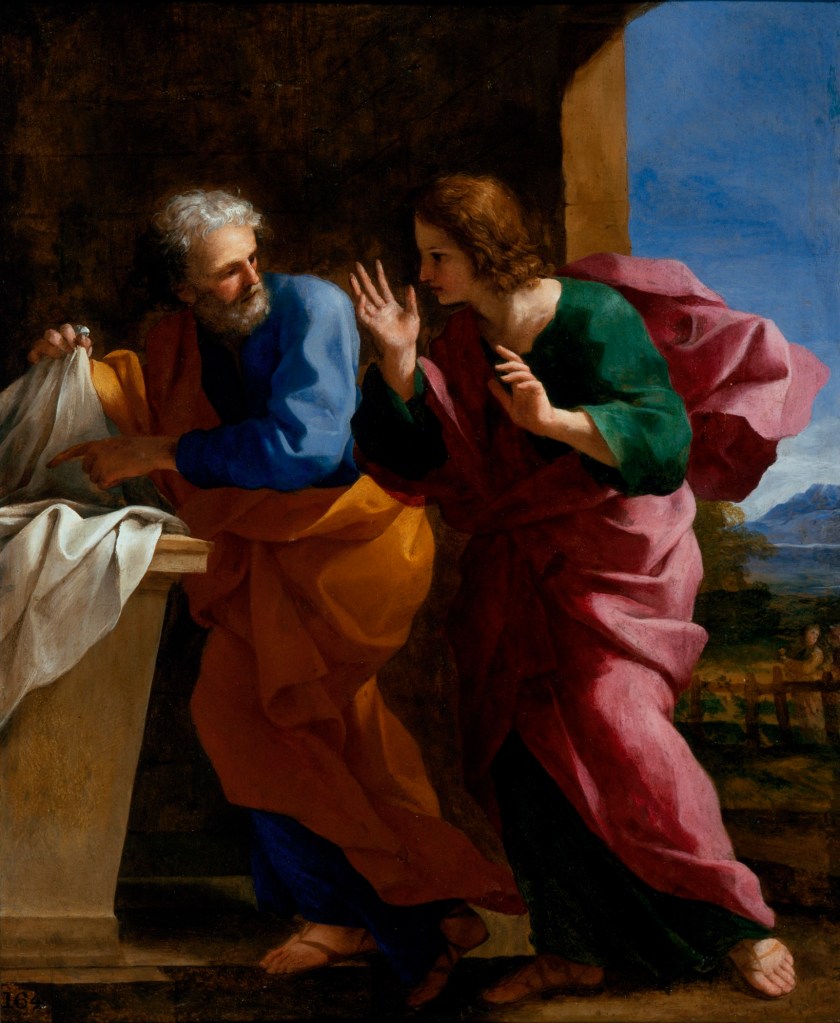
The image on the front of your bulletin depicts the scene. The painting St. John and St. Peter at Christ’s Tomb (c.1640) is by the Italian artist Giovanni Francesco Romanelli. Peter, on the left, is pointing at the shroud and seems to be staring off, trying to understand, but for John,  the response latency is ending. The pieces are falling into place. It is like he is holding up his hands to tell Peter to be quiet so that he can think. The reading tells us that the disciple whom Jesus loved, John, “saw and believed.” Romanelli captured that moment.

The reading then tells us that the two returned home, but Mary, who must have followed behind the footrace, remained. She leaned into the tomb and saw and spoke to the angels, then turning, she saw the gardener, not knowing it was Jesus. 

Now, this is an interpretation on my part, but the gardener was there all along, watching. Maybe he was out of sight, or maybe, in all the excitement and rushing about, all three saw him but more or less dismissed him. Either way, I believe the gardener, Jesus, was there watching this entire scene unfold. And I believe Jesus anxiously anticipated the end of John’s response latency when all the pieces came together. When they did, Jesus smiled and said to Himself, “That’s my boy.” Working behind John’s understanding is God’s grace.

St. John later tells us, “We love because he first loved us” (1 John 4:19), and St. Paul tells us, “For by grace you have been saved through faith. And this is not your own doing; it is the gift of God” (Ephesians 2:8). Believing in Jesus is a grace—a gift from God. Jesus anxiously anticipated all the pieces falling together for John to believe, but the reason this could happen for John was because God first loved John—God’s grace was given to John so that he might believe.

Today, we are the ones standing in the tomb. We are the ones seeing the shroud and other linen. Like John, we have all the teachings of the Prophets and all the words and deeds of Jesus at our disposal. In addition, we have the teachings of the Apostles, the Saints, and the Church. We have all the information. Question: have they fallen into place for you, or are you still in that time of response latency? If yes, if they’ve fallen into place, then have a passion for souls and pray that others may receive the light of the Gospel. If not, then pray for God’s grace, so that He might give you understanding.

“Early on the first day of the week, while it was still dark,” and before Mary Magdalene arrived at the tomb, Jesus rose from the dead—He is “the firstborn from the dead.” (Colossians 1:18) He did this out of His great love for us and accomplished it so that you and I might also be given eternal life with Him. 

This is your first day of the week. The empty tomb is before you. Pray that all the pieces, all the information falls into place and that God’s grace pours out upon you that you might believe and live.

In 1917, the Virgin Mary appeared six times to three young children near Fatima, Portugal. On the second appearance, she gave them a prayer that she asked to be added to the end of each decade of the Rosary. Whether you pray the Rosary or not, it is a prayer worth learning. It is known as the Fatima Prayer.

Let us pray: “Oh, my Jesus, forgive us our sins. Save us from the fires of Hell and lead all souls to Heaven, especially those in most need of Thy mercy. Amen.”