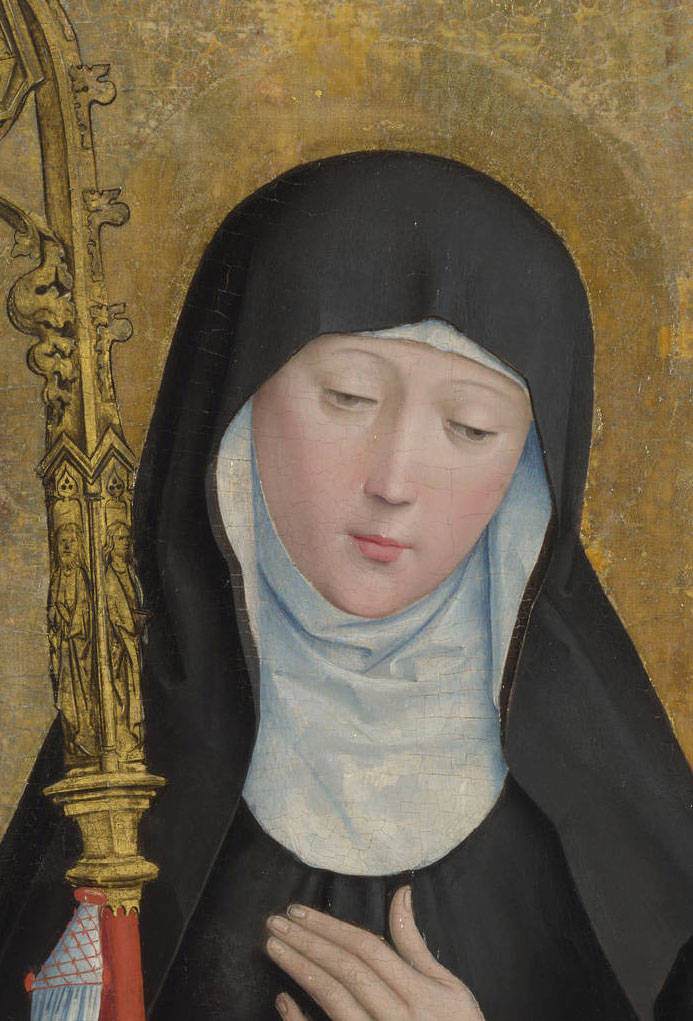
Most would agree that twins share a very special bond, and our Saint for today, Scholastica, helped prove that point. Her twin and only brother was none other than Saint Benedict.
They grew up in a wealthy family, yet early on they both felt a calling to a more austere, holy life. Benedict was the first to leave home and would eventually form a monastery based on his Rule—the Rule of St. Benedict. Witnessing such a life, Scholastica sought and received approval to form a convent, following the rule established by her brother. It was the first Benedictine Convent and was located about five miles from her brother’s monastery.
I’m certain they exchanged many letters, but as close as they were—in proximity and relationship—they only met once a year. Pope Saint Gregory the Great records their last meeting.
“Scholastica, the sister of Saint Benedict, had been consecrated to God from her earliest years. She was accustomed to visiting her brother once a year. He would come down to meet her at a place on the monastery property, not far outside the gate.
“One day she came as usual and her saintly brother went with some of his disciples; they spent the whole day praising God and talking of sacred things. As night fell they had supper together.
Their spiritual conversation went on and the hour grew late. The holy nun said to her brother: “Please do not leave me tonight; let us go on until morning talking about the delights of the spiritual life.” “Sister,” he replied, “what are you saying? I simply cannot stay outside my cell.”
“When she heard her brother refuse her request, the holy woman joined her hands on the table, laid her head on them and began to pray. As she raised her head from the table, there were such brilliant flashes of lightning, such great peals of thunder and such a heavy downpour of rain that neither Benedict nor his brethren could stir across the threshold of the place where they had been seated. Sadly he began to complain: “May God forgive you, sister. What have you done?” “Well,” she answered, “I asked you and you would not listen; so I asked my God and he did listen. So now go off, if you can, leave me and return to your monastery.”
Reluctant as he was to stay of his own will, he remained against his will. So it came about that they stayed awake the whole night, engrossed in their conversation about the spiritual life.
“It is not surprising that she was more effective than he, since as John says, God is love, it was absolutely right that she could do more, as she loved more.
“Three days later, Benedict was in his cell. Looking up to the sky, he saw his sister’s soul leave her body in the form of a dove, and fly up to the secret places of heaven. Rejoicing in her great glory, he thanked almighty God with hymns and words of praise. He then sent his brethren to bring her body to the monastery and lay it in the tomb he had prepared for himself.
“Their minds had always been united in God; their bodies were to share a common grave.”
St. Paul begins his famous passage on love by saying, “If I speak in the tongues of men or of angels, but do not have love, I am only a resounding gong or a clanging cymbal. If I have the gift of prophecy and can fathom all mysteries and all knowledge, and if I have a faith that can move mountains, but do not have love, I am nothing. If I give all I possess to the poor and give over my body to hardship that I may boast, but do not have love, I gain nothing… Love never fails.” And it did not fail Scholastica. She said, “I asked you [Benedict] and you would not listen; so I asked my God and he did listen.”
Through the pure love of God and her brother, Scholastica asked that God hear her prayer. God did. When you pray, ask yourself, “Am I asking out of pure love, or do I have some other motive?” I would suggest that by answering that question, you have a very good chance of knowing how God will answer your prayer.
A fable passed down for generations tells of an elderly man traveling with a boy and a donkey. As they walked through a village, the man led the donkey, and the boy walked behind. The townspeople called the old man a fool for not riding, so to please them, he climbed onto the animal’s back. When they reached the next village, the people said the old man was cruel to let the child walk while he rode. So, to please them, he got off, set the boy on the animal’s back, and continued on his way. In the third village, people accused the child of being lazy for making the old man walk, and someone suggested they both ride. So the man climbed on, and they set off again. In the fourth village, the townspeople were indignant at the cruelty to the donkey because he was made to carry two people. The frustrated man was last seen carrying the donkey down the road.
In the 1950s, the Polish-American psychologist Solomon Asch conducted a series of conformity experiments. The tests were simple, but the results were profound. Since then, the tests have been replicated numerous times. What doesn’t change are the results.
The test was administered to college men and billed as a vision/eyesight test, but it was much more.
Asch created an image with three vertical lines of varying length and labeled them A, B, and C. He then brought in a group of individuals and asked which of the three lines was the longest. Simple enough, but there was a twist. If there were eight individuals in the room being tested, seven of them—known as confederates—were in on the experiment. The odd man out was the subject. The questioning would then begin. “Which of the three lines is the longest?” The confederates always answered first, and the subject last.
At first, the confederates would give the correct answer, but after a few rounds, they would all intentionally choose the wrong answer.
You’ve got lines A, B, and C. A is the longest, and everyone chooses A. All is well. Then you are shown a new set of lines in which C is the longest, but all seven confederates say B is the longest. When it’s the subject’s turn to answer, and he plainly sees that C is the longest, how will he answer? Will the subject be truthful, regardless of what everybody else has said, and choose C (the longest), or will he cave to social pressure and go along with the confederates’ choice of B? Remember, the subject thinks this is a vision test, so there’s no pressure to “get along.” Nothing high-stakes about the choice. Yet, of all the subjects tested, only about 25% never conformed, giving in to social pressure. 75% conformed at least some of the time, and 33% gave in to peer pressure 100% of the time, even though the answer was clearly wrong.
The big question then is “Why?” Asch concluded there were several factors—a desire to be accepted, fear of being different, and conflict avoidance. People would rather be wrong than be ostracized.
Because the experiment was conducted on college students, Asch concluded, “The tendency to conformity in our society is so strong that reasonably intelligent and well-meaning young people are willing to call white black. This is a matter of concern. It raises questions about our ways of education and about the values that guide our conduct.”
He made that statement about young people, but I would be willing to make a substantial wager that it applies to us all. True? I believe so. Ever go along with something you didn’t feel was right, but participate because everybody else was doing it? Yeah. Everybody nod your head.
Social conformity exerts great pressure on us all, leading us to conform to the person others expect us to be rather than the person we truly are. This is a good thing when it comes to taking a bath or brushing your teeth. However, in other situations, it can take a very bad turn. Consider what happened to the average German citizen during the 1930s and the rise of Nazism.
A week or so ago, I came across a quote but was unable to identify the author. I liked it enough to include it in my journal. It is on the New Age side of things, but bear with me. It reads, “You will never be free until you realize this. It was never about what they think. It was always about whether you listen to yourself. We spend so much of life chasing approval, fitting into shapes that were never ours, walking paths paved by other people‘s expectations. But have you noticed? The more you chase what pleases them, the further you drift from what fulfills you. The universe gave you a compass, not in your pocket but in your chest. Your intuition is the echo of the cosmos whispering through you. And yet, how often do we trust our fear more than we trust that quiet knowing? Do not fear walking alone. Do not fear growing alone. Because to stand in your own light is to remember the truth.”
It sounds like Asch. We chase approval, fit into shapes that are not our own, and follow paths that are not ours—we conform. We chase or believe in things that don’t fulfill us, and have nothing to do with who we want to become, yet we do it to get along. Mustn’t go against the grain. However, within us is a voice that speaks truth. A voice that will guide us along a path that will fulfill us and even transform us into the person we were created to be.
Today, we read from St. Paul’s first letter to the Corinthians. He said, “For what human being knows what is truly human except the human spirit that is within? So also no one comprehends what is truly God’s except the Spirit of God. Now we have received not the spirit of the world, but the Spirit that is from God, so that we may understand the gifts bestowed on us by God.”
Paul is saying that no one can truly know another person simply by looking at them or even by being in relationship with them. A part remains hidden, perhaps even from themselves. Since that is true, if we can’t even know another person, then knowing God is even less possible, unless—and there is the key—unless we have the Spirit of God within. Through the Spirit, God chooses to reveal Himself to His children. Still, we live in the world, and the spirit of the world can influence our lives. It is this spirit that wants us to conform, to chase approval, walk paths that are not our own, and turn from God. Therefore, in his letter to the Romans, Paul writes, “I appeal to you therefore, brothers, by the mercies of God, to present your bodies as a living sacrifice, holy and acceptable to God, which is your spiritual worship. Do not be conformed to this world, but be transformed by the renewal of your mind, that by testing you may discern what is the will of God, what is good and acceptable and perfect.” (Romans 12:1-2)
Paul implores us not to listen to the spirit of this world but to look to the Compass within our chest, our soul, and to listen to the whisperings of God’s Holy Spirit. Such actions may bring on the feelings Asch described in his experiment, primarily fear of being different and of being ostracized, but “Fear not,” Jesus says. “You will not have to walk alone, for I am with you.”
Jesus says, “Don’t be afraid to be different. Why? Because I created you to be different. I created you to be the salt of the Earth. I set you on a path not to be conformed to this dark world but to be the light of the world. Therefore, ‘let your light shine before others, so that they may see your good works and give glory to your Father in heaven.’”
Will such a life make a difference?
In his experiments, Asch introduced a variable. What if one of the confederates dissented and chose the truth? In almost every case, the subject, seeing an ally—someone they could stand with—chose the truth. The truth doesn’t need a majority, just company.
If you become the light, you will give others the courage to do the same. You may or may not be able to change the world around you, but by living out the truth, by shining the light of Christ, by not conforming, by not ending up carrying the stupid donkey, and ultimately by living according to the Spirit of God, you will fulfill the will of God in your life (which, by the way, is far more important than winning the battle).
The author of Proverbs writes, “The way of the wicked is like deep darkness; they do not know over what they stumble.” “But the path of the righteous is like the light of dawn, which shines brighter and brighter until full day.” (Proverbs 4:19 & 18)
Walk the path of righteousness and be that light. It is why God, in His infinite wisdom, created you.
Let us pray (Hymnal 1982 #656 by John Keble): Blest are the pure in heart, for they shall see our God; the secret of the Lord is theirs, their soul is Christ’s abode.
The Lord, who left the heavens our life and peace to bring, to dwell in lowliness with us our pattern and our King;
He to the lowly soul will still himself impart and for his dwelling and his throne will choose the pure in heart.
Lord, we thy presence seek; may ours this blessing be; give us a pure and lowly heart, a temple fit for thee.
Today, Thursday, and Friday, we celebrate three martyrs. Today, we remember Manche Masemola, an Anglican woman from South Africa who, in 1928, was put to death by her parents at age 15 for converting to Christianity and refusing to renounce her faith. She was unbaptized, but she declared she would be baptized in her own blood. Tomorrow is the Feast Day of St. Agatha, who, in 251 AD, was put to death at age 19 for refusing to renounce her faith and marry a Roman prefect. Shortly before her death, she prayed, “You Lord, who have created and guarded me from my childhood, and made me to act with manly strength, have taken from me the love of the passing world, who kept my body from contamination, who made me overcome the torments of the executioner, the iron, the fire, and the chains, who gave me in torment the virtue of patience! Please accept my spirit now, for it is already time that I should leave this world by your command and reach your mercy.” She is the patron saint of breast cancer patients, which points to some of the torture she endured. And, finally, Friday is the Feast Day of St. Paul Miki and his companions, who were missionaries in Japan in the 1500s and were put to death for proclaiming the Good News. Before he died, he said, “The only reason for my being killed is that I have taught the doctrine of Christ. I certainly did teach the doctrine of Christ. I thank God it is for this reason I die.”
Those are three of the estimated 70 million Christian martyrs since the time of Christ. Even today, 5,000 to 10,000 people are estimated to be martyred each year—people who died for the same cause as Manche, Agatha, and Paul Miki.
On her feast day, Saint Methodius of Sicily spoke of Agatha. The words he shared are true for Agatha and for all who have stood upon the solid rock of their faith in Christ Jesus. Methodius writes, “The woman who invites us to this banquet is both a wife and virgin. To use the analogy of Paul, she is the bride who has been betrothed to one husband, Christ. A true virgin, she wore the glow of pure conscience and the crimson of the Lamb’s blood for her cosmetics. Again and again she meditated on the death of her eager lover. For her, Christ’s death was recent, his blood was still moist. Her robe is the mark of her faithful witness to Christ. It bears the indelible marks of his crimson blood and the shining threads of her eloquence. She offers to all who come after her these treasures of her eloquent confession.
“Agatha, the name of our saint, means “good.” She was truly good, for she lived as a child of God. She was also given as the gift of God, the source of all goodness to her bridegroom, Christ, and to us. For she grants us a share in her goodness.
“Agatha, her goodness coincides with her name and way of life. She won a good name by her noble deeds, and by her name she points to the nobility of those deeds. Agatha, her mere name wins all men over to her company. She teaches them by her example to hasten with her to the true Good. God alone.”
My prayer is that none of us ever has to experience what these and so many others have gone through. My prayer is that if we do, we can stand as firmly in our faith as they did. My prayer is that we can look to their lives and their deaths and find the courage to live our faith in the smallest of details. As St. Josemaría Escrivá tells us, “‘Great’ holiness consists in carrying out the ‘little duties’ of each moment.” (The Way, #817)
The study of wisdom in Scripture is fascinating, and I’d like to delve into it more deeply, but at its core is the fact that wisdom is a grace given to us by God in order to live according to God’s will. However, wisdom is only knowledge until it is applied. For example, “Knowledge is knowing that a tomato is a fruit. Wisdom is knowing not to put it in a fruit salad.” As author Terry Pratchett noted, “Wisdom comes from experience. Experience is often a result of a lack of wisdom.”
Our readings for today provide an excellent lesson on the application of wisdom and its absence, beginning with our Old Testament lesson. I’ll share with you a different translation of the lesson from Micah, as it will help clarify what is being said. The Lord says,
“Come, present [My] case before the mountains, And let the hills hear you pleading. Hear, you mountains, the case of the LORD You firm foundations of the earth! For the LORD has a case against His people, He has a suit against Israel. “My people! What wrong have I done you? What hardship have I caused you?”
Why is God pleading a case against His people, accusing them? Micah has outlined three major offenses elsewhere: social injustice and the oppression of the poor, the corruption of religious and political leaders (who were essentially the same people), and the worship of false gods. Micah cries out against all these sins, all of which arise from the people looking to their own understanding and wisdom and choosing what they believe is better over the wisdom of God and what God said is better. Therefore, God is not happy, and He is making a case against His people. At this point, God even challenges the people to make a case against Him, but before they attempt such a foolish endeavor, He reminds them of what He has already done for them, saying,
“Testify against Me. In fact, I brought you up from the land of Egypt, I redeemed you from the house of bondage, And I sent before you Moses, Aaron, and Miriam. ‘My people, Remember what Balak king of Moab Plotted against you, And how Balaam son of Beor Responded to him. [Recall your passage] From Shittim to Gilgalb— And you will recognize The gracious acts of the LORD.’”
We are familiar with the events in Egypt—how the Israelites were held in captivity for 400 years. Yet when God heard the cries of His people, He came to their rescue. He sent them “Let My People Go, Moses.” There were the ten plagues, the release, and the parting of the Red Sea. Then, at Mount Horeb, God gave them the Law, He gave them His wisdom, so they would know how to live and do so without excuse. This was God’s wisdom spelled out for the people; however, they sinned because they still relied on worldly wisdom, which cost them dearly, and they spent the next 40 years wandering in the desert. Finally, God allowed them into the Promised Land.
As they were going, they encountered many obstacles, including King Balak and the Moabites that Micah mentioned.
Balak had witnessed the Israelites’ progress through the lands and seen how they conquered all, and he was terrified. In an attempt to defeat them, he applied his version of wisdom and sent emissaries to Balaam. Balaam was a sorcerer of sorts, renowned for his ability to bless and to curse. Although not an Israelite, he could speak to God.
The emissaries of Balak came to him and asked him to curse the Israelites so that Balak’s armies could defeat them. Balaam spoke to the Lord, but the Lord said, “Don’t even think about it.” Two more times the emissaries asked Balaam to curse, and two more times God said, “No.” However, wanting to get paid and relying on his own wisdom, Balaam set out anyway, riding his donkey, to see these Israelites. It turned out the donkey was far wiser than Balaam.
As they were going, the donkey saw an angel of the Lord holding a sword that blocked their path, and the donkey turned aside. Balaam, unable to see the angel, beats the animal. After the third time and the third beating, donkey turns to Balaam and, impersonating Eddie Murphy, says to Balaam, “I just know that before this is over, I’m gonna need a whole lot of serious therapy.” (Shrek, 2001)
No, that’s not it. The donkey essentially says, “Fool, can’t you see that angel standing right there?” At which point the angel reveals himself. Long story short, Balaam blesses the Israelites instead of cursing them. He wises up for at least a moment. It is believed that Balak was later killed in battle, and we know that Balaam was executed for his treachery.
In His case against the Israelites, the Lord makes one final appeal to His wisdom and the good it brings when He says the people should remember what happened at their passage from “Shittim to Giglgal.” This is a reference to the miraculous crossing of the Jordan River, when the waters backed up, and the people crossed into the Promised Land on dry ground.
God accused the people because, using their own wisdom, they oppressed the poor, their religious and political leaders were corrupt, and the people worshiped false gods. God furthered His case by showing how good He had been to them by defeating those who would hold them captive, attempt to conquer them, or curse them. God demonstrated the foolishness of the “wisdom”—the wickedness—of these mortal kings and the people by showing how He had loved and protected them. How His way was so much better. Yet, the people were disobedient and sinned against Him and one another. The wisdom of God far exceeded the wisdom of the Israelites and their enemies, but the people were not obedient.
All this was a demonstration of what Paul, quoting Isaiah, said to the Corinthians. “I will destroy the wisdom of the wise, and the discernment of the discerning I will thwart.” Note that Paul is being sarcastic about the wisdom of the wise and the discerning. He is laughing at the “wise” who apply earthly wisdom instead of God’s.
So Paul asks, “Where is the one who is wise? Where is the scribe? Where is the debater of this age? Has not God made foolish the wisdom of the world?” Paul answers his own question by telling us that God has flipped the script. Those who think they are wise, He shows to be fools. “God chose what is foolish in the world to shame the wise; God chose what is weak in the world to shame the strong; God chose what is low and despised in the world, things that are not, to reduce to nothing things that are.” Just as He has always done, God is turning things upside down.
God chose a young peasant girl instead of the Emperor’s daughter. God chose a baby in a manger instead of a king in a palace. God chose 12 men—tax collectors, fishermen, ordinary sinners—instead of scholars to be His disciples. Finally, God chose to be enthroned on a cross instead of a throne of gold lined with soft cushions. God chose the foolish, the weak, the lowly, and the despised. The greatest act of foolishness was when God chose a Cross to defeat all His enemies. And, to the world around us, it is the greatest insanity when we do the same, choosing the cross so that we can defeat those who come against us, seeking to separate us from our God. How do we persevere in the face of this opposition? Micah explains,
“He has told you, O man, what is good, And what the LORD requires of you: Only to do justice And to love goodness, And to walk modestly with your God; Then will your name achieve wisdom.”
We achieve true wisdom when we choose the wisdom of God, when we choose the Cross and the ways of God, as exemplified in Jesus Christ. This is not the wisdom of the world or our own. In fact, it is quite the opposite. For it is not the way of the rich, the fat and happy, or the powerful. No. The wisdom of the Lord says,
“Blessed are the poor in spirit, for theirs is the kingdom of heaven. “Blessed are those who mourn, for they will be comforted. “Blessed…” and wise are those who live by these words of God.
“The message about the cross is foolishness to those who are perishing, but to us who are being saved, it is the power of God.” We are blessed when we live according to the wisdom of God.
Today, where do you find wisdom? In other words, what or who do you trust and place your faith in?
Do you place your faith in people—political or religious leaders? The Lord says,
“Cursed is he who trusts in man, Who makes mere flesh his strength, and turns his thoughts from the Lord.” (Jeremiah 17:5)
Do you put your faith in this world? Jesus says, “Do not lay up for yourselves treasures on earth, where moth and rust destroy, and where thieves break in and steal” (Matthew 6:19).
How about those idols of your own creation—your strength, your resources, position, talents? Jonah said,
“Those who pay regard to vain idols forsake their hope of steadfast love.” (Jonah 2:9)
You get the point. Blessed are the poor, the meek, the peacemaker. Blessed are those who seek and follow the wisdom of God. Jeremiah says,
“Blessed is the man who trusts in the Lord, whose trust is the Lord. He is like a tree planted by water, that sends out its roots by the stream, and does not fear when heat comes, for its leaves remain green, and is not anxious in the year of drought, for it does not cease to bear fruit.” (Jeremiah 17:7-8)
The world may view your trust and the wisdom you live by as foolishness, but it is the wisdom of God, given only to His beloved children. “Do not swerve to the right or to the left; turn your foot away from evil” (Proverbs 4:27), and choose the wisdom of God. It takes time to learn, but it is not hidden from anyone who seeks it. As St. James tells us, “If any of you lacks wisdom, let him ask God, who gives generously to all without reproach, and it will be given him.” (James 1:5)
Let us pray: (from St. Thomas Aquinas) Grant us, O Lord our God, a mind to know you, a heart to seek you, wisdom to find you, conduct pleasing to you, faithful perseverance in waiting for you, and a hope of finally embracing you. Amen.
G.K. Chesterton, in his biography of Thomas Aquinas, wrote, Aquinas “was called the Dumb Ox. He was the object, not merely of mockery, but of pity…[St. Albert the Great knew] that the dunce is not always a dunce.. his famous cry and prophecy [about Thomas] – “You can call him a Dumb Ox; I tell you this Dumb Ox shall bellow so loud that his bellowings will fill the world.”
Chesterton also says, Aquinas “would not be an Abbot; he would not be a Monk; he would not be a Prior or ruler in his own fraternity; he would not be a prominent or important Friar; he would be a Friar. It is as if Napoleon has insisted on remaining a private soldier all his life.”
Given the expanse of his mind, Thomas Aquinas could have done just about anything he chose. Instead, he chose to think deeply about his faith and then share with us what he learned.
An excerpt from one of those writings—The cross exemplifies every virtue
“Why did the Son of God have to suffer for us? There was a great need, and it can be considered in a twofold way: in the first place, as a remedy for sin, and secondly, as an example of how to act.
“It is a remedy, for, in the face of all the evils which we incur on account of our sins, we have found relief through the passion of Christ. Yet, it is no less an example, for the passion of Christ completely suffices to fashion our lives. Whoever wishes to live perfectly should do nothing but disdain what Christ disdained on the cross and desire what he desired, for the cross exemplifies every virtue.
“If you seek the example of love: Greater love than this no man has, than to lay down his life for his friends. Such a man was Christ on the cross. And if he gave his life for us, then it should not be difficult to bear whatever hardships arise for his sake.
“If you seek patience, you will find no better example than the cross. Great patience occurs in two ways: either when one patiently suffers much, or when one suffers things which one is able to avoid and yet does not avoid. Christ endured much on the cross, and did so patiently, because when he suffered he did not threaten; he was led like a sheep to the slaughter and he did not open his mouth. Therefore Christ’s patience on the cross was great. In patience let us run for the prize set before us, looking upon Jesus, the author and perfecter of our faith who, for the joy set before him, bore his cross and despised the shame.
“If you seek an example of humility, look upon the crucified one, for God wished to be judged by Pontius Pilate and to die.
“If you seek an example of obedience, follow him who became obedient to the Father even unto death. For just as by the disobedience of one man, namely, Adam, many were made sinners, so by the obedience of one man, many were made righteous.
“If you seek an example of despising earthly things, follow him who is the King of kings and the Lord of lords, in whom are hidden all the treasures of wisdom and knowledge. Upon the cross he was stripped, mocked, spat upon, struck, crowned with thorns, and given only vinegar and gall to drink.
“Do not be attached, therefore, to clothing and riches, because they divided my garments among themselves. Nor to honors, for he experienced harsh words and scourgings. Nor to greatness of rank, for weaving a crown of thorns they placed it on my head. Nor to anything delightful, for in my thirst they gave me vinegar to drink.”
He wrote over 20,000 pages (some estimates say up to 100,000), and the way we think about your faith is directly related to those writings. His influence is beyond measure. Even so, on December 6, 1273, Aquinas had a deeply moving religious experience. He never wrote of it.“[E]verything he had written,” shared a friend, “seemed like straw to him by comparison with what he had seen and what had been revealed to him. He believed that he had at last clearly seen what he had devoted his life to figuring out and, by comparison, all he had written seemed pale and dry. Now that he could no longer write, he wanted to die.” He died four months later on March 7, 1274. Perhaps, one day, we’ll learn what he learned.
Someone asked me why I don’t tell Boudreaux jokes anymore. Answer: There are only so many of them, and the ones remaining aren’t necessarily suitable for church. Which leaves me today with having to tell you one I’ve already told you, but it is in my top five.
One summer, no one living along the bayou could catch any fish except old Boudreaux. Knowing Boudreaux, the game warden thought something might be up, so he asked him how he did it. Boudreaux told the game warden he would take him fishing the next day and show him. Once they got to the middle of the lake, Boudreaux took out a stick of dynamite, lit it, and threw it into the water. After the explosion, fish started floating to the surface. Boudreaux took out a net and started scooping them up. When he had them all gathered, he looked back at the game warden, who was just sitting there with his mouth open, too stunned to even speak. Finally getting his wits back, the game warden started hollering at Boudreaux, “You can’t fish like that. It is so illegal that I’m hauling you into jail this very moment.” Boudreaux sat there for a moment, then he took out another stick of dynamite, lit it, and handed it to the game warden, asking, “You gonna fish or you gonna talk?”
Today, we read about Peter and some of the other fellas out fishing, but I’m guessing they weren’t prepared for what happened either. How their lives could be so radically changed and so quickly. Perhaps, as they were hauling in the day’s catch, they were making plans for a family outing after Synagogue on Saturday or thinking they needed to renegotiate the price of fish due to the increased fishing tax. Whatever they were thinking, I can’t imagine it included hearing the words, “Follow me,” and then following after some itinerant rabbi.
When you consider those events, can you imagine doing the same? The Gospel says they “immediately” followed him. One second you are a fisherman, and the next you are a disciple, crisscrossing the country, living rough, snatching a piece of grain from a field you are passing to have something to eat, and going through a pair of sandals every week. Sure, you are meeting new people, and there are the miracles—my goodness, the miracles—and you are listening to teachings that, for the first time in your life, allow you to come to an understanding of God. But there are also the more difficult parts. Some truly hate the rabbi you are following. After a while, there is even talk among some of them about finding a way to have him arrested or even put to death. After all, they did try to throw him off the cliff that one time. Then there was the time you thought you were going to die out on the sea when that great storm came up out of nowhere. As you huddled in fear, the rabbi slept in peace. When you cried out to him in your fear, he chastised you, then he chastised the storm, and the seas were calm. Thinking back on the day you met him and he said, “Follow me,” probably more than once a day, you ask yourself, “What the heck was I thinking?”
Years later, after witnessing his death and resurrection, you find yourself in prison, awaiting your execution. In the hours leading up to it, you reflect once again on those first words, “Follow me,” but you no longer wonder what you were thinking. Instead, you know within your very soul why you were chosen, why you were called: to serve His purposes. To be a fisher of men and to assist in ushering in the very Kingdom of God.
If you think back on your life, many of you probably remember the time when Jesus spoke those same words, “Follow me,” to you. For many, including me, we don’t know why we responded as we did, immediately dropping our old life and following him. For me, I don’t remember the date and time, but I remember the moment, and I have no way to describe it. Yet—in the twinkling of an eye—I stopped everything and followed him.
Like you and those first disciples, I have seen miracles—oh, yes, I have—I have seen lives transformed, and I have begun to learn more deeply about the things of God. But things weren’t always so good, and then I stuck with you lot. There are still days when I ask myself, “What the heck were you thinking?” (I also direct that question to God!) But I still remember the moment he said, “Follow me,” and I’m still amazed that he chose me.
What does all this have to do with today? As I thought about those first disciples and us, I was reminded of how similar we are to them in our lives and experiences. Individually and together, we experience times of great joy and great sadness, times of need and times of abundance, faith and doubt. Through faith and the knowledge imparted to our souls, we sit on the hillside listening to Jesus teach. We look over His shoulder as He reaches out to bring life where there was death. We see those who love Him and those who deride Him. We witness His brutal death, and we wait in the upper room with the other disciples for those three days, then rush to the tomb after Mary Magdalene tells us He has risen. In all these ups and downs, we may once again ask, “What was I thinking?” But then we remember: we have been chosen and we have a purpose. “You are a chosen race, a royal priesthood, a holy nation, God’s own people, in order that you may proclaim the mighty acts of him who called you out of darkness into his marvelous light.” (1 Peter 2:9) We have been chosen for this time and this place to be the Church and to be His witnesses. Today, I ask you to remember that all we do is because we have been chosen to follow Jesus and to be a great light in the darkness. We are the Church, and we have all been called to be fishers of men to assist in ushering in the very Kingdom of God.
Take some time to consider this: Jesus said to you, “Follow me.” If you’re listening to me today, there is a very good chance you did just that. So if that is the case, why did He call you? To what purpose have you been called into service in the Kingdom of God? When you begin to discern that calling, engage with it. Live it. St. Paul said in his letter to the Ephesians, “We are his workmanship, created in Christ Jesus for good works, which God prepared beforehand, that we should walk in them.” (2:10) And again, he says in his letter to the Philippians, “It is God who works in you, both to will and to work for his good pleasure.” (2:13)
Thomas Merton said, “If you want to identify me, ask me not where I live, or what I like to eat, or how I comb my hair, but ask me what I am living for, in detail, ask me what I think is keeping me from living fully for the thing I want to live for.”
You have been called by Jesus. You have responded that you will follow. Now ask yourself, “What am I living for in Christ Jesus and His Kingdom?” Are you going to fish or talk? In the words of the Captain of the Starship Enterprise, Jean-Luc Picard, “Engage.” Start fishing.
Let us pray: O Lord, our God, You called Your people to be Your Church. As they gather in Your Name, may they love, honor, and follow Your Son to eternal life in the Kingdom He promised. Let their worship always be sincere, and help them to find Your saving Love in the Church and its Sacraments. Fill with the Spirit of Christ those whom You call to live in the midst of the world and its concerns. Help them, by their work on earth, to build up Your eternal Kingdom. May they be effective witnesses to the Truth of the Gospel and make Your Church a living presence in the midst of the world. Increase the gifts You have given Your Church so that Your faithful people may continue to grow in holiness and in imitation of Your Beloved Son. In His name we pray. Amen.
In a small town, it was T-Ball season. The kids were ages 5-6, and there were only enough to form two teams, each with 17 kids. Each child played at the same time, and it was a bit of madness, but great fun for all.
A father tells about his son, who played on one team, and a girl named Tracy, who played on the other. Tracy wore Coke-bottle glasses and hearing aids. When she ran, her bad leg would lag behind her, and one arm would windmill wildly. Tracy wasn’t very good, but she had a lot of spirit. When she batted, she would hit the air, and she would hit the T, but very rarely would she connect with the ball. When she did, it might roll six inches. However, the coach and everyone else, on both sides, would yell, “Run, Tracy! Run!” And she did, but she would get thrown out at first. This was the case until the very last game of the season. Tracy got up to bat, and Tracy clobbered it, knocking it past all 17 infielders (the outfielders had gotten bored out there, as nothing ever made it to them). The stadium erupted, “Run, Tracy! Run!” She did. The other team could have easily thrown her out, but chose to fumble around with the ball so that Tracy could score an in-park home run.
The coaches got her to first base, then second, then third, but… the father picks up the story.
“Tracy started for home, and then it happened. During the pandemonium, no one had noticed the twelve-year-old geriatric mutt that had lazily settled itself down in front of the bleachers five feet from the third-base line. As Tracy rounded third, the dog, awakened by the screaming, sat up and wagged its tail at Tracy as she headed down the line. The tongue hung out, mouth pulled back in an unmistakable canine smile, and Tracy stopped, right there. Halfway home, thirty feet from a legitimate home run.
“She looked at the dog. Her coach called, ‘Come on, Tracy! Come on home!’ He went to his knees behind the plate, pleading. “The crowd cheered, “Go, Tracy, go! Go, Tracy, go!” She looked at all the adults, at her own parents shrieking and catching it all on video. She looked at the dog. The dog wagged its tail. She looked at her coach. She looked at home. She looked at the dog. Everything went to slow motion. She went for the dog! It was a moment of complete, stunned silence.
“And then, perhaps, not as loud, but deeper, longer, more heartfelt, we all applauded as Tracy fell to her knees to hug the dog.” (Dangerous Wonder, p.60)
For me, that seemed like a very simple explanation of life. We have goals. We put in the work required to achieve them. We execute the plan. We set out.
For many, once the plan is in motion, there may be a few hiccups or interruptions along the way, but when we are truly focused or involved, these do not deter us from achieving the goal.
For Tracy, the goal was to hit the ball and score a run. In many ways, we are doing just that. However, unlike Tracy, when we are focused and achieving, we may notice the smiling dog along the third base line, but that is all. We will not stop to hug the dog. We will score. We will win. Over time, we will be like everyone else in the stadium that day—we will not notice the twelve-year-old geriatric mutt, lazily settled along the third base line. He will fade into the background, but that won’t matter. We will have met our goal and succeeded.
It is funny, in a sad way, how, as we grow older, we no longer notice many things like that. We say we don’t have time or that we can’t be bothered by such trivial things as a “smiling mutt” in whatever form it may take. Places to be. People to see. Things… very important things to do.
Trouble is—at least how I see it—we spend our lives like that, always chasing something, then one day we wake up old, never having truly reached our preset goals and having missed so many opportunities to witness the wonders of this world because we were so intent on our goals that they faded into the background.
When was the last time you were brought to a dead stop in wonder? In amazement? When was the last time your heart paused at what was unfolding before you? If you have, instead of staying in the moment—taking time to hug the goofy dog—simply smile and move on to the next item on the agenda. Does the brief moment of wonder fade as quickly as it arrives?
Perhaps I’m just talking about my own life this morning, and I’m the only one caught in this trap, but I don’t like to think about the things I’ve missed because I was so focused on what I was chasing. I believe this is why I’ve started traveling over the last few years and want to continue doing so, which is largely a response to a quote attributed to Virgil: “Death twitched my ear, ‘Live,’ he says, ‘for I am coming.’” That was all the motivation I needed.
You say, “Well, Father John, that’s all nice and good, but what does that have to do with anything today?” My response is a story from the Gospels.
It has been a long day with Jesus and the disciples. After all, they have fed 5,000 men, plus women and children. Jesus sends the disciples on ahead while He stays behind to pray. The disciples get in the boat and begin to cross the sea, believing Jesus will do the same after a while. Scripture tells us, “The sea became rough because a strong wind was blowing. When they had rowed about three or four miles, they saw Jesus walking on the sea and coming near the boat, and they were frightened. But he said to them, ‘It is I; do not be afraid.’” Jesus was walking on the water.
Within your mind and within your soul, how do you feel about that—Jesus walking on the water? Does that create a sense of wonder at least as strong as Tracy’s when she saw the geriatric mutt, or do you just keep moving toward your goal? What if I told you that this same Jesus healed a man with leprosy, gave sight to a blind man, and, after a man had been dead for four days, raised him to life? Anything? How about this? Jesus, the very Son of God, was crucified, died, and was buried, then on the third day rose from the grave. Does that get your motor running, or have you heard it so many times that it has just become part of the background between third base and home plate?
We become so focused on achieving our goals that even the wonder and amazement of Jesus can fade into the background. We know those old stories by heart and we no longer give them the power to transform our lives or the world around us. The statement “Jesus rose from the dead” should level us, but instead we ask, “Got it. What’s next?”
Today in our Gospel reading, we have another scene with John the Baptist. Jesus is nearby, and John speaks of him. The next day, John is visiting with two of his disciples, Andrew and, although unnamed, we believe to be the Apostle John. The Baptist points to Jesus, and Andrew and John follow. Sensing them, Jesus turns and asks, “What are you looking for?” They respond, “Well, uh, we were, you know, a buh buh buy… where are you staying?” Jesus says, “Come and see.”
Jesus says, “You are searching for many things. You have goals in your life, things you want to accomplish. You’ve been working toward them, but stop. Come and see what I will show you.” Come and see what?
Defending the faith, St. Paul told the Corinthians what they would see.
“What no eye has seen, nor ear heard, nor the heart of man imagined, what God has prepared for those who love him.”
(1 Corinthians 2:9)
Come and see the wonders of our God, given to us in Christ Jesus our Lord. Come and see lives transformed. Come and see the healing of bodies, minds, and spirits. Come and see God and participate in His Kingdom. Come and see, and the list goes on.
This is our Annual Meeting Sunday. It is a time when I seek to articulate where I would like to see us go over the course of the next year. This year, it is for us to come and see the great events of Jesus again. To be struck with such a sense of wonder that our hearts well up with a joy that brings us to an even greater love and deeper service to our God.
By all means, have your goals and aspirations, but do not let Jesus become just another part of the background. Bring Him to the forefront. Allow Jesus the opportunity to stop you in your tracks in wonder and draw you into a deeper relationship with Him.
Let us pray: God, our Father, You redeemed us and made us Your children in Christ. Through Him, You have saved us from death and given us Your Divine life of grace. By becoming more like Jesus on earth, may we come to share His glory in Heaven. Give us the peace of Your kingdom, which this world does not give. By Your loving care, protect the good You have given us. Open our eyes to the wonders of Your Love that we may serve You with a willing heart. Amen.
A group of women was talking together. One woman said, “Our congregation is sometimes down to 30 or 40 on a Sunday.”
Another said, “That’s nothing. Sometimes our congregation is down to six or seven.”
A maiden lady in her seventies added her bit, “Why, it’s so bad in our church on Sundays that when the minister says ‘dearly beloved,’ it makes me blush.”
With today being a low Sunday—especially after the wedding last night—I’m delighted to see you all here. Hopefully, you won’t regret your decision after hearing a few verses of this poem by Lord Byron. The title: Darkness.
I had a dream, which was not all a dream. The bright sun was extinguish’d, and the stars Did wander darkling in the eternal space, Rayless, and pathless, and the icy earth Swung blind and blackening in the moonless air; Morn came and went—and came, and brought no day, And men forgot their passions in the dread Of this their desolation; and all hearts Were chill’d into a selfish prayer for light.
It goes on from there, and I can assure you it doesn’t get any cheerier. It describes a post-apocalyptic world where the sun and stars have “gone out,” and humanity consumes everything in an attempt to create light, but all is despair. In the dim light of their fires, famine overcomes them. The last remaining survivors come together and build a fire so they can see one another, but they die of fright when they do because of the horror they have become.
In the end,
The world was void, The populous and the powerful was a lump, Seasonless, herbless, treeless, manless, lifeless— A lump of death—a chaos of hard clay. (Source)
Can I just say “Merry Christmas”?
I’m not sure where Byron was in his head when he wrote that one, but the words of our Gospel kept coming to me as I read it. “The light shines in the darkness, and the darkness has not overcome it.”
In the days leading up to the birth of Jesus, the world’s inhabitants lived in spiritual darkness. We know that there had not been a prophet in the land for over 400 years, and the oppression of the Roman legions was steadily increasing. It seemed that all of God’s promises had proved false. The Prophet Isaiah writes,
“Justice is far from us, and righteousness does not overtake us; we hope for light, and behold, darkness, and for brightness, but we walk in gloom. We grope for the wall like the blind; we grope like those who have no eyes; we stumble at noon as in the twilight, among those in full vigor we are like dead men.” (Isaiah 59:9-10)
The people were horrified by what had become of their lives and their dreams. Just as in the poem, a famine plagued the earth—the people were starving for God, for a Redeemer, a Savior. So they prayed, they prayed for the light to come.
And so it was, on a dark night, over the region of Judea above the City of David, which is called Bethlehem, that God once more said, “Let there be light,” and the Light of the World was given to us. It was God giving Himself to us in the form of a Babe, lying in a manger and wrapped in swaddling clothes.
“In him was life, and the life was the light of men. The light shines in the darkness, and the darkness has not overcome it…. The true light, which gives light to everyone, was coming into the world.”
As we declare in the Nicene Creed, “For us and for our salvation he came down from heaven, by the power of the Holy Spirit he became incarnate from the Virgin Mary and was made man.”
The birth of Jesus, the Incarnation of God, was what this dark world had been waiting and praying for. Yet we often make the mistake of limiting the Incarnation of our Lord to a historical event—something that happened 2,000 or so years ago—and we fail to understand its power in this present dark world and in our lives. However, it is an error to limit the Incarnation to a specific time and place. The light that first shone in the world on that first Christmas still shines as brightly today as it did then. It still has the power to dispel the darkness and to bring about our redemption through the forgiveness of sins.
St. Paul confirms this in his second letter to the Corinthians: “For God, who said, ‘Let light shine out of darkness,’ has shone in our hearts to give the light of the knowledge of the glory of God in the face of Jesus Christ.” Through this shining into the darkness, God has qualified us—that is, enabled us—to share in the inheritance of the saints in light. He has delivered us from the domain of darkness and transferred us to the kingdom of his beloved Son, in whom we have redemption, the forgiveness of sins.” (Colossians 1:12-14) And, as St. John tells us, all who believe this and call on Jesus’ Name are given the right by God to become His children.
However, even with this understanding, we are still left with one very important question: Why? Why has God rescued us? Why has He forgiven us? Why has He given us power to become His children?
Why did God become incarnate? Holy Scripture gives one answer to these questions: “Because of his great love for us.” (Ephesians 2:4) Scripture says, “In this the love of God was made manifest among us, that God sent his only Son into the world, so that we might live through him. In this is love, not that we have loved God but that he loved us and sent his Son to be the propitiation for our sins.” (1 John 4:9-10) God loves us so much that He sent His one and only Son into the world to die for us.
As we enter these celebratory times of the year, our hearts are lifted, we experience the joy of God, and this is a wonderful blessing from Him. Still, we can never separate the birth of Christ, His incarnation, from His crucifixion. It was for this reason—this ultimate expression of God’s radical love—that Christ the Savior was born.
In a sermon, St. Augustine said, “The Lord was born in order to die; he died in order that we might live. The wood of the crib was a sign of the wood of the cross; the narrow manger foreshadowed the narrow tomb.” (Sermon 196)
An elderly priest tells a story from his youth. He says, “I thought Christmas Day would never come, as it seemed like eternity, but the day finally arrived. After a night of tossing and turning, I awoke early in the morning, then ran to the tree and looked under it to see what was there. As I looked, I found nothing under the tree, so I turned to my Father and asked, ‘Where is the gift that you said you gave me?’ He told me that my gift was not under the tree but on it.” The priest reports, “As I looked up, I heard these words, ‘Father, forgive them, for they know not what they do.’ The gift was Jesus, looking down on me from that old rugged tree, the Cross, with love in his eyes.”
On a dark night, over the region of Judea above the City of David, which is called Bethlehem, God once more said, “Let there be light,” and through the Blessed Virgin Mary, the Light of the World was given to us. Mary wrapped him in swaddling cloths and laid him in a manger. For us, for our salvation, and for our sake, and because of his great love, God became one of us.
Give thanks, for the true light, which gives light to everyone, has come into the world.
Let us pray: God of love, Father of all, the darkness that covered the earth has given way to the bright dawn of your Word made flesh. Make us a people of this light. Make us faithful to your Word, that we may bring your life to the waiting world. Grant this through Christ our Lord. Amen.
The first words of the Bible are “In the beginning God created the heavens and the earth,” and then, in very poetic language, the account of creation follows: light and darkness, the sun, moon, and stars, earth, land and sea, plants, animals, and finally humankind. This is God’s creation.
The Gospel of John begins with a similar phrase: “In the beginning…” However, it is not the creation account that follows, but what was before even that — “In the beginning was the Word.” Then comes another poetic passage about who the Word is and what he does.
But why do we hear these verses today? It becomes clear when we read, “And the Word became flesh and dwelt among us.” These words point to the child in the manger. They reveal who this newborn child truly is—a human child, but not only that. His origins go back further and deeper than ours. We are people begotten of men, but Jesus is “God from God, Light from Light,” as the Nicene Creed states. He is God’s own Son, who has become man, taken on flesh, our mortal humanity, and become one of us.
God became man; this is what we say about the Christ Child in the manger. That is the focus of today’s Gospel. When God became man, He brought with Him the divine light that shines in the darkness—a light that brightens every shadow and dark corner as brightly as the noonday sun.
Why? Because He knows that we often wander in darkness—darkness of sin, death, sickness, war, and much more. We can become lost in a harsh world we don’t understand. We seek answers even when we don’t know the questions. That is why the Word became flesh, why God became man. So He could shine His divine light into the darkness of this world and our hearts, so that we might know joy and so that we all might find our way home to Him.
History records for us an interesting footnote. It was during the dark winter of 1864 at Petersburg, Virginia, where Robert E. Lee’s Confederate army faced the Union divisions led by General Ulysses S. Grant. The war, now three and a half years old, had transitioned from glorious charges to the muddy realities of trench warfare. Late one evening, Major General George Pickett, one of Lee’s generals, received news that his wife had given birth to a healthy baby boy. Throughout the line, Southerners lit large bonfires to celebrate the event. These fires did not go unnoticed in the Northern camps, prompting a cautious Grant to send a reconnaissance patrol to investigate. The scouts returned with news that Pickett had a son, and that the fires were celebratory. Interestingly, Grant and Pickett had been classmates at West Point and knew each other well. To mark the occasion, Grant also ordered bonfires to be built.
What a strange night it was. Fires blazed on both sides of the lines for miles. No gunshots, no shouts, no fighting. Just light celebrating the birth of a child. But that didn’t last long. Soon, the fires died out, and darkness took over again—both of the night and of the war.
The good news of Christmas is that in the midst of great darkness, there came a light, and the darkness was not able to overcome the light. It was not just a temporary flicker; it was an eternal flame. We need to remember that. There are times, in both world events and our personal lives, when we feel the light of the world will be snuffed out. But the Christmas story affirms that no matter what happens, the light still shines.
The theologian Robert Alden wrote, “There is not enough darkness in all the world to put out the light of even one small candle.” That being true, then the divine light born in a manger in Bethlehem is more than adequate to dispel the darkness of this world eternally.