Sermon: Proper 7 RCL C – “Pigs”


[Place pig on front pew]

Last week, we discussed how we are bombarded with so much information—74 GB every day. It’s no wonder we can never find our keys. Their location gets pushed out to make room for something else.

This week, I would like to talk about stuff. Not in general kind of stuff, but the stuff that fills our houses. I came across some amazing facts on the topic.

I don’t know who collects this kind of data, but the LA Times reports that the average American home contains 300,000 items. This is probably why one out of every ten American homes rents off-site storage and why another 25% of those with two-car garages can’t fit even one car in them.

3.1% of the children in the world live in the USA, but they are responsible for 40% of worldwide toy sales, averaging 238 toys per child.

When it comes to shopping, we spend more on shoes, jewelry, and watches than on higher education. Women in the USA and Europe will, on average, spend 8 years of their lives shopping.

Currently, the 12 percent of the world’s population that lives in North America and Western Europe accounts for 60 percent of private consumption spending, while the one-third of the world’s population living in South Asia and sub-Saharan Africa accounts for only 3.2 percent. Of that consumption, Americans spend $1.2 trillion on nonessential items—things we don’t need.

We have all this and desire even more for ourselves, but what’s funny (not haha) is the fact that even with all we spend, on average, we only donate 1.9% to charitable organizations. (Source for above statistics)

You might say, “None of that is true.” However, if you’ve ever had to move or clean out someone else’s house, you know it’s pretty much spot on.

You all know that my dad died last summer, and we had to go in and clean out his apartment. Throughout his life, he lived in larger places, and each time he moved, he collected more and more stuff. Later in life, he had to downsize. As a result, the number of items he had collected over the years became fewer and fewer. In the years before he died, he had a small but comfortable apartment, and all that stuff was distilled down to what he cherished the most— a piece of art or a picture of him walking on the beach with my niece.

At first, the task of cleaning out was overwhelming. What to do with this or that? Eventually, my brother and I decided that everyone could take what they wanted, and we would give the rest to Goodwill. In the end, my brother had about a shoebox full of things, and I made it up to a paper box along with some pictures. Other family members did the same. When we finished, at least 95% of what my dad valued went to Goodwill. It held value for him but not for anyone else, and that’s OK.

It’s not that we didn’t love our dad; it’s just that he valued things that weren’t important to us. I know that when I’m gone, the same thing will happen. Someone will come and clean out my place. There may or may not be anything that anyone wants to keep. If I’m in Enid, I suspect 98% of what I consider valuable will end up at one of the thrift stores. It’s all just “stuff.” 

That pig right there represents the 98% of my stuff that will end up in the thrift store, but it holds value for me. What would I trade my stuff for? What would I not? Better question: Who would I trade my stuff for? Who would I not?

Our Gospel reading today is from Mark. (The image on the front of your bulletin depicts the same event, but from Matthew’s perspective. Mark says there was only one demoniac, but Matthew says there were two.) Jesus enters the lands of the Gentiles and encounters a man who lives in the tombs near the city. Upon seeing Jesus, the man cries out, “What have you to do with me, Jesus, Son of the Most High God? I beg you, do not torment me.” What follows is the classic order of an exorcism. Jesus commands the demon to come out of the man, eventually gaining the demon’s name. The demon says its name is Legion. A legion in the Roman army consisted of 6,000 soldiers, so the man is possessed by many demons. Knowing that Jesus can cast them back into the abyss, they beg to be sent into a nearby herd of pigs. The demons had brought insanity and chaos to the man’s life, and they do the same to the pigs upon entering them. It drives them to madness, and they drown themselves.

The pigs might disagree, but this would appear to be a happy ending. The man is freed from his demons and asks to follow Jesus. However, the pig herders rushed to town to report what had happened. Upon hearing the news, the townspeople came out and essentially said the same thing to Jesus as the demon had, “What have you to do with us, Jesus, Son of the Most High God? We beg you, go away. We don’t want you here.”

Having witnessed such a miracle, why would the people not welcome Jesus? Why did they send Him away?

There are a number of fringe thoughts on this. Some say they recognized the divine in Jesus, and everyone knows you really don’t want your gods walking around among you. There’s no telling what they’ll do. Closely related to this is the fear of the supernatural. We fear what we don’t understand. Both of these fears are likely part of the answer; however, most people agree that they asked Jesus to leave because He had deprived them of their stuff. 

Mark said it was a “large herd of swine,” and Jesus had just inflicted a huge economic blow through their deaths. Notice that when the townspeople arrived, they didn’t give thanks for the recovery of the demon-possessed man. They didn’t even mention him. No, it was their pigs, which impacted their stuff, that they were upset about. They showed more concern for material possessions than for the soul of a man.

In our lives, we place value on people just as we place value on stuff. Family, spouses, and children are—or should be—at the top of the list. Next come close friends, and, in some cases, friends of friends—I think church family falls into those two categories. Then we have people we don’t even know but feel connected to, such as public figures, celebrities, and the like. These are followed by acquaintances and fellow countrymen (which is naturally divided by our biases: race, religion, creed, etc.), and finally, everyone else. The way we respond to each of these individuals and groups reflects the value we place on them. A child who is sick with a fever will receive far more thought, consideration, compassion, and support than, say, the 279 people who were killed in the Air India crash or the 500K who have been killed in Russia’s war on Ukraine. Stalin summarized this by saying, “One death is a tragedy. A million is a statistic.” It comes down to the way we’re wired, mentally and emotionally.

From that list, who would I trade my stuff for? Who would I not? What part of my stuff is the soul of a loved one worth? What part of my stuff is the soul of someone on the other side of the world worth? 

For someone we love, we’d likely give it all, but what about that person on the other side of the planet? You don’t know them. Maybe they’re Muslim or Hindu. They look very different from you—hair, skin color, clothes. What is the value of their soul?

St. John Chrysostom wrote, “I am not about to mourn over many cities, or whole nations, yet shall I mourn over a soul which is of equal value with many such nations, yea even more precious…. For it is not the overthrow of a city which I mourn, nor the captivity of wicked men, but the desolation of a sacred soul, the destruction and effacement of a Christ-bearing temple.” (Two Exhortations to Theodore After His Fall)

There are many ministries of the Church, but it is the salvation of souls that is our singular calling. So, I’m not going to chastise you over stuff, I don’t know that I’ve got 300,000 items, but I’ve got plenty. I’m not going to ask you to go on mission trips around the world, proclaiming the Good News. I’m not even going to ask you to give money to support the work of spreading the Gospel. Instead, I’m going to ask you to find one person, one soul, and do exactly what Jesus, in our Gospel reading, asks the demoniac to do: “Return to your home, and declare how much God has done for you.” 

Within Judaism, there is a saying from the Mishnah, “Whoever saves a single life is considered to have saved the whole world.” (Mishnah Sanhedrin 4:5) Archbishop of Canterbury, Michael Ramsey, teaches us, “The one man, one woman, one child, are of infinite worth to God. … For the infinite worth of the one is the key to the Christian understanding of the many.” (The Christian Priest Today, 42)

“Return to your home, and declare how much God has done for you,” for the one soul you speak to is of infinite worth to our God.

Let us pray: Heavenly Father, pour forth your Holy Spirit to inspire us. Stir in our souls the desire to renew our faith and deepen our relationship with your Son, our Lord Jesus Christ, so that we might truly believe in and live the Good News. Open our hearts to hear the Gospel and grant us the confidence to proclaim the Good News to others. Pour out your Spirit, so that we might be strengthened to go forth and witness to the Gospel in our everyday lives through our words and actions. Amen.

Sermon: Epiphany 5 RCL B – “Secret”

Photo by Jason Rosewell on Unsplash

Charlie Brown heads up to the plate to bat. It is not pretty. “Strike one. Strike Two. STRIKE THREE,” calls the umpire. Chuck has struck out again and slumps over to the bench. 

Plopping down on the bench, he says, “Rats! I’ll never be a big-league player. I just don’t have it! All my life I’ve dreamed of playing in the big leagues, but I know I’ll never make it.” 

Lucy turns to console him. “Charlie Brown, you’re thinking too far ahead. What you need to do is set yourself more immediate goals.” 

He looks up. “Immediate goals?” 

Lucy says, “Yes. Start with this next inning when you go out to pitch. See if you can walk out on the mound without falling down!”

That little episode can teach us a couple of things. It is good to keep your friends around to offer support, but be sure to pick the right friends. It is also good to have goals in your life; just don’t tell anyone. The first one makes sense, but the second one seems a little questionable. Why wouldn’t you want to share your goals?

Many years back, I was a smoker. Picked it up casually in college and got stuck. Years later, I wanted to quit, so when I was ready, I announced—“I’m going to quit smoking.” Everyone was thrilled. They told me how great it was—talked about the money I would save, the health benefits, and all that jazz. I received a wealth of congratulations, support, and advice. All that was left to do was for me to quit smoking.

Problems: the simple announcement got me all the “atta boys” my mind needed. I hadn’t done anything, but I was the hero. Yay, me and I hadn’t done a thing. That night, I had the ritualistic last smoke and flushed the rest. The following morning, I woke up and asked, “What in the blue blazes were you thinking?” I had to go to work, and the pressure was on. Now, not only was I trying to do this for myself, but I had all these folks watching, which added pressure. Pressure of failure. Pressure of esteem. Pressure of doing the work. Pressure of pressure. When attempting to achieve a goal, added pressure is not what you need. And then, when I was having a good day, not even thinking about a smoke, someone would inevitably come up to me and ask, “How’s the no smoking thing going?” “Well,” I would say, at least in my mind, “it was going great UNTIL YOU BROUGHT IT UP!”

The bottom line is don’t tell people your goals. Just go to work. Then, one day, someone will ask you, “Didn’t you used to smoke?” “Have you lost weight?” “You wrote a book?” “When did you start your own business?” You’ve done the work, and now you can celebrate that work. Be selective in who you tell your business; remember, not everyone needs to know everything. Just do the work.

Last week, in our Gospel lesson, we read about Jesus healing the man possessed by the demon. Upon seeing Jesus, the demon cried out, “What have you to do with us, Jesus of Nazareth? Have you come to destroy us? I know who you are, the Holy One of God.” But Jesus rebuked him, saying, “Be silent, and come out of him!” A similar incident occurred in our Gospel reading today. Jesus “cured many who were sick with various diseases, and cast out many demons; and he would not permit the demons to speak, because they knew him.” Jesus did not allow the demons to say who He was, but the demons were not the only ones—those whom He heals will also be told to keep silent.

A leper came to Jesus and asked to be healed. Jesus does, but then “sternly charged him and sent him away at once, and said to him, ‘See that you say nothing to anyone, but go, show yourself to the priest and offer for your cleansing what Moses commanded, for a proof to them.’” (Mark 1:43-45) 

Demons, and those who were healed, are told to keep silent, but then Jesus also tells the Apostles not to speak of His true identity. Remember when He asked the Apostles, “Who do people say that I am?” They had several answers, but finally, Peter got the gold star, “You are the Christ.” Yet, instead of allowing Peter and the gang to spread the word, Jesus “strictly charged them to tell no one about him.” (Mark 8:27, 29b-30) 

Throughout his Gospel, Mark silences those who truly know who Jesus is. This is called the Markan or Messianic Secret, but why? If His purpose was to share the Good News of God, then why did Jesus want to keep it a secret?

Regarding our goals, we should be selective in who we tell our business, and remember, only some people need to know everything. We just need to do the work.

We have discussed that the Israelites were looking for a Messiah, but the Messiah they were looking for was a King like David—a warrior king—one who would vanquish their enemies and rule the land with righteousness. What no one was expecting was a Messiah like Jesus, who, in the end, would be crucified. They weren’t expecting that kind of Messiah, so they certainly wouldn’t accept it without some proof. Also, imagine the Roman military hearing about some wandering rabbi telling everyone He was the Messiah—the long-awaited King of the Jews. How long do you think they would’ve allowed Him to live? Jesus was selective in who knew the truth about Him, but He tried to keep others from finding out so that they would not interfere until He had met the objective.

Why silence the demons? They, of all creatures, could testify to the truth of who Jesus was. Then again, when’s the last time you heard of a demon telling the truth? To this day, the evil spirits lie about the person of Jesus so that many will not come to know that salvation is available to all.

Jesus also wanted His secret kept because the goal had yet to be met. He might be seen as a good teacher and a miracle worker, but until He died and rose again, He could not be seen as one who could save others from death. 

Instead of broadcasting His true nature, Jesus tried to keep it a secret so that He could do the work without these external pressures interfering or detracting. But then, Jesus breathed His last breath upon the Cross, and it all changed. “When the centurion, who stood facing [Jesus on His cross], saw that in this way he breathed his last, [the centurion said], ‘Truly this man was the Son of God.’” (Mark 15:39) And there was no one there to tell the centurion to keep quiet. A few days later, Jesus “appeared to the eleven…And he said to them, ‘Go into all the world and proclaim the gospel to the whole creation.’” It is finished. The work is done. Now, you have everything you need to demonstrate and tell the world who I am. Go and tell the world of all the great things God has done. Proclaim the message of the Good News and eternal life. 

So, the question I have for you this morning is this: the fact that Jesus is the Messiah, the Savior of the World, is no longer a secret, so why do we treat it as such? Jesus asked us to proclaim His secret, the Gospel, to all the world, but when given the opportunity, we are often silent. Why is that? You know the power of God working in your life and in the lives of others. Not the word of a few witnesses from 2,000 years ago, but things you’ve seen with your very eyes. Why is it so difficult to share?

When we hear Jesus command, “Go, and tell the world…,” we often translate that into missionary work—an intentional “going”/trip to proclaim. However, “Go” is also translated “as you are going.” As you are going about your life, tell the world—proclaim the Good News. Our lives are to be a proclamation of the Kingdom of God, but as we live our day-to-day lives, we are to proclaim with our lives and our mouths the Good News of Jesus.  

Tell the secret. Let the cat out of the bag. Bring to light. Spill the beans. Go public. Divulge… break out the thesaurus. However you would like to phrase it, share the Good News, and if you’re not comfortable in doing it just yet, then invite them to church—I think St. Matthew’s Episcopal Church is one of the best-kept secrets in Enid, Oklahoma (don’t tell anyone!) Please. Invite others, and we’ll do our best to help you proclaim the Good News to those you bring. It is the primary reason we are here. The Messianic Secret is out. Be one who tells it.

Let us pray: Glorious St. Mark, through the grace of God our Father, you became a great Evangelist, preaching the Good News of Christ. May you help us to know Him well so that we may faithfully live our lives as followers of Christ and, like you, proclaim the Good News of God in Christ. Amen.

Sermon: Boniface

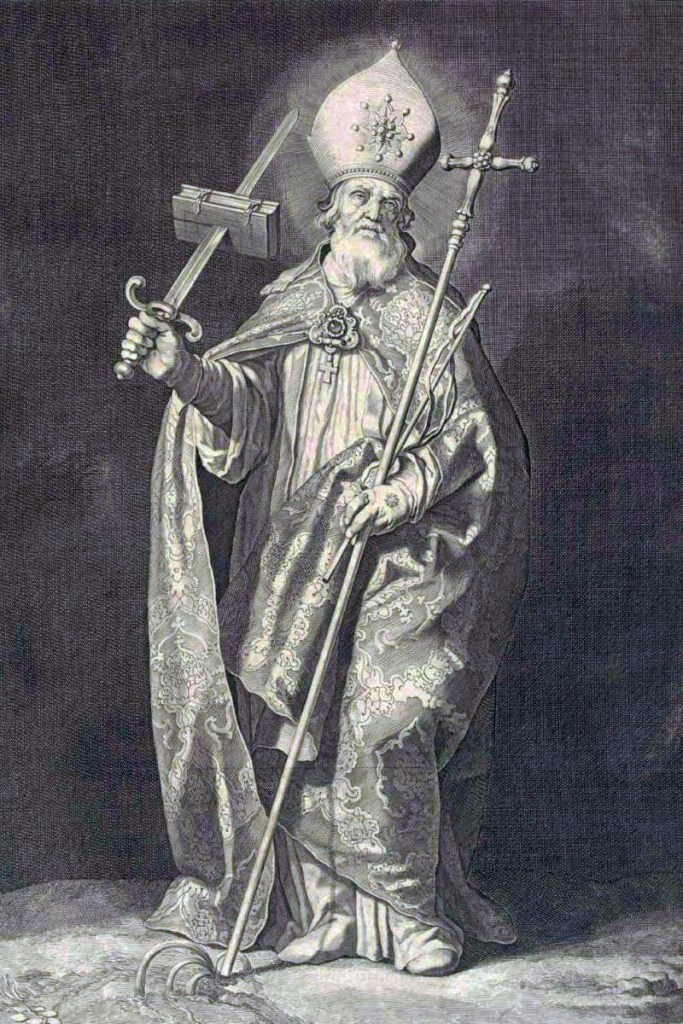
“Until well into the 20th century, prayer cards and other representations of Bonif­face typically portrayed him as an old bishop, with the accoutrements of his martyrdom: a book and a sword. These two symbols (sometimes combined into one, a book pierced with a dagger) came to emblematize him: the book reflected the Ragyndrudis Codex, regarded as a shield to ward off heathen axe blows, and the sword was a transformed version of that axe.” (source) The book is cleaved half in two as Boniface is reported to have been reading and Boniface held up the book to protect himself when his attacker charged him.

The Prophet Ezekiel was sent to the Israelites to warn them of the results should they not repent of the evil they were committing and return to the Lord.  By setting Ezekiel in this role of prophet, the Lord was making Ezekiel, a watchman over the people.  As a watchman, Ezekiel was responsible for communicating to the people God’s message.  Failure to share this message would make Ezekiel guilty of sin.

The Lord said to him, “If I say to the wicked, ‘You shall surely die,’ and you give them no warning, or speak to warn the wicked from their wicked way, in order to save their life, those wicked persons shall die for their iniquity; but their blood I will require at your hand.”  The opposite was also true, “But if you warn the wicked, and they do not turn from their wickedness, or from their wicked way, they shall die for their iniquity; but you will have saved your life.”  Essentially, if Ezekiel failed to communicate God’s warning to the people, Ezekiel would be guilty of murder for failing to tell the people how they could live.

In the Acts of the Apostles, Paul said, at every opportunity presented since I’ve been with you, “I testified to both Jews and Greeks about repentance toward God and faith toward our Lord Jesus.  Therefore,” he says, “I declare to you this day that I am not responsible for the blood of any of you, for I did not shrink from declaring to you the whole purpose of God.”  Like Ezekiel, he did the job God had called him to.  They have been warned, and it is now up to them to follow the Lord.

This commitment to fulfill God’s calling by delivering the message of salvation continued with Boniface, whom we celebrate today.

During the fifth century, the barbarian tribes overran most of Europe.  Not only did this put the Roman Empire out of business in that area, but also the Church, as the conquering armies established their pagan religions.  However, over time, the Church would return.  How?  Some of you may recall that it was Augustine, a European missionary who in 597 firmly established Christianity in England.  In 716, Boniface, the fruit of Augustine’s mission work, a Benedictine monk and English priest, went on a mission to barbarian Europe in Frisia—now Holland and Belgium—to re-establish Christianity in Europe following the barbarian invasion.  Boniface was successful and would later be named the Archbishop.  He would be martyred in 754 while preparing for the Confirmation of a thousand converts.

Just before His ascension, Jesus told his apostles that “repentance and forgiveness of sins are to be proclaimed in his name to all nations, beginning from Jerusalem.”  This was the commission that Boniface heard and fulfilled in his work in Europe, so their blood was not on his hands.  However, this commission that Jesus gave did not end with Boniface.  It has been passed on to us.  Like Paul, like Boniface, and like so many others, we have a responsibility to be prophets in our own time by speaking the word of God to the world around us.

The Lord will provide you with many opportunities to share the Good News.  When he does, consider Boniface and boldly declare the faith that is in you.