Have mercy on me, O God, according to your unfailing love; according to your great compassion blot out my transgressions. Wash away all my iniquity and cleanse me from my sin. For I know my transgressions, and my sin is always before me. Against you, you only, have I sinned and done what is evil in your sight, so that you are proved right when you speak and justified when you judge. Surely I was sinful at birth, sinful from the time my mother conceived me. Surely you desire truth in the inner parts; you teach me wisdom in the inmost place. Cleanse me with hyssop, and I will be clean; wash me, and I will be whiter than snow.
King David was on the roof of his house, looking out over the city and the land he ruled. As his eyes scanned the scene, he saw a woman on her roof—Bathsheba—who was naked and bathing. Watching her, he felt desire for her, and even though she was married, he devised a plan to have her.
Her husband, Uriah, was one of his soldiers, so he sent him to the front lines of a fierce battle where he would certainly be killed. He was, and after the appropriate mourning period, David had Bathsheba brought to him and married her.
The Lord saw David’s wickedness and sent Nathan the prophet to rebuke him for his sin. David confessed, and it is believed that David wrote the Psalm I shared with you during his time of penance. He cried out to the Lord, “Wash me, and I will be whiter than snow.”
From the very beginning of human history, when Adam and Eve were banished from the Garden of Eden, this cry has crossed the lips of all God’s children: “Wash me. Wash me from my sins so that I might be whiter than snow. So that I might be cleansed of my sins.”
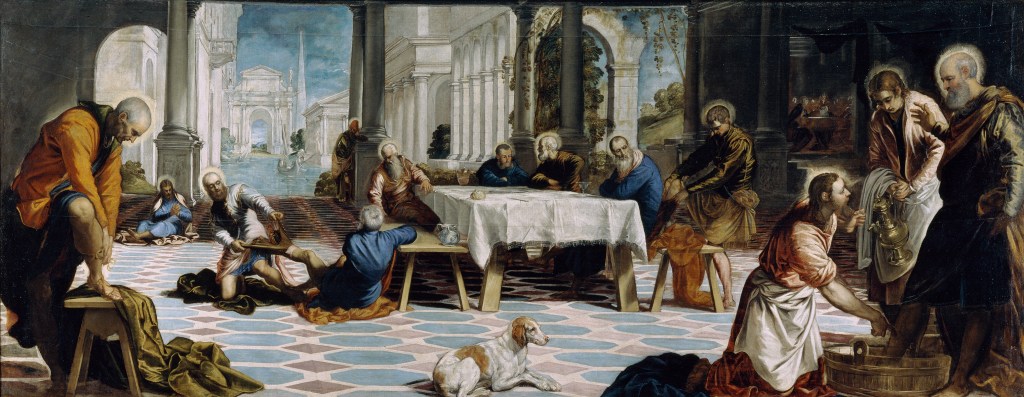
It’s always been this way; however, on the day ordained by God, Jesus opened the gates to a new path. On that day, Jesus began by taking on the role of a slave and washing the disciples’ feet. Peter objected, but Jesus insisted, “If you are to be a part of me, if you are to be where I am going, then you must allow me to wash your feet. You must allow me to cleanse you.”
Following the foot washing, scripture says, “While they were eating, Jesus took bread, gave thanks, broke it, and gave it to his disciples, saying, ‘Take and eat; this is my body.’ Then he took the cup, gave thanks, and offered it to them, saying, ‘Drink from it, all of you. This is my blood of the covenant, which is poured out for many for the forgiveness of sins.’”
It is fair to say that the disciples failed to understand the significance and connection between these two events, but after his crucifixion, they would come to realize that the footwashing was symbolic of the washing of their souls through the body and blood of Christ.
Jesus—God—humbled Himself to the role of a slave and washed their feet so that they might be outwardly clean. Jesus—God—humbled Himself to death on a cross so that their souls might be cleansed.
Today we celebrate the gift of the most Holy Eucharist. The symbolism of washing the feet points to the washing of our souls, and it is the answer to our cry, “Wash me, Lord. Wash me and I will be whiter than snow.”
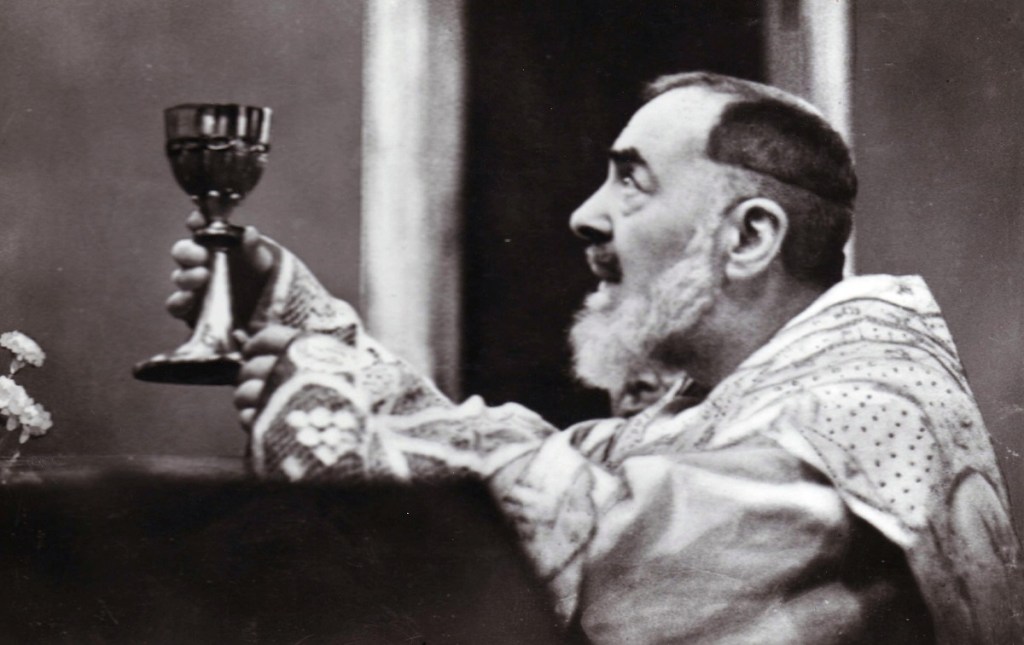
Yesterday was the feast day of St. Padre Pio. His life was remarkable for many reasons. He was a Capuchin Franciscan monk. He received the stigmata, losing a cup of blood per day; he heard thousands of confessions, and countless miracles have been recorded through his intercessions, both during his life and after his death. In 1947, he heard the confession of a young priest. In 2002, Padre Pio was canonized as a Saint by that same man, now called Pope John Paul II. He died in 1968 at the age of 81.
Today, I want to share just a few of the sayings of Padre Pio, but I’m going to reserve a bit of my time until after the Eucharist, because I want to share a prayer he wrote that is to be prayed at that time.
We are only capable of doing a little good. But God, in His goodness, has pity on us, is content with very little, and accepts the preparation of our hearts …. God is infinitely greater than our heart and this overcomes the whole world.
The demon has only one door by which to enter into our soul: the will; there are no secret doors. No sin is a sin if not committed with the will. When there is no action of the will, there is no sin, but only human weakness.
Remember that man has a mind, that he has a brain which serves him for reasoning, that he has a heart for feeling, he has a soul. The heart can be commanded by the head, but not the soul, so there must be a Supreme Being who commands the soul … it is impossible to exclude a Supreme Being.
The desire to be in eternal peace is good and holy, but you must moderate this with complete resignation to the divine will. It is better to do the divine will on earth, than to enjoy Paradise.
In a word: obedience is everything to me.
Before you sanctify others, think about sanctifying yourself.
And what man consider his most famous quote is one worth remembering—Pray, hope, and don´t worry. Worry is useless. God is merciful and will hear your prayer.
After Communion…
Stay with me, Lord, for it is necessary to have You present so that I do not forget You. You know how easily I abandon You.
Stay with me, Lord, because I am weak and I need Your strength, that I may not fall so often.
Stay with me, Lord, for You are my life, and without You, I am without fervor.
Stay with me, Lord, for You are my light, and without You, I am in darkness. Stay with me, Lord, to show me Your will.
Stay with me, Lord, so that I hear Your voice and follow You.
Stay with me, Lord, for I desire to love You very much, and always be in Your company.
Stay with me, Lord, if You wish me to be faithful to You.
Stay with me, Lord, for as poor as my soul is, I want it to be a place of consolation for You, a nest of love.
Stay with me, Jesus, for it is getting late and the day is coming to a close, and life passes; death, judgment, eternity approaches. It is necessary to renew my strength, so that I will not stop along the way and for that, I need You.
It is getting late and death approaches, I fear the darkness, the temptations, the dryness, the cross, the sorrows.
O how I need You, my Jesus, in this night of exile!
Stay with me tonight, Jesus, in life with all its dangers. I need You.
Let me recognize You as Your disciples did at the breaking of the bread, so that the Eucharistic Communion be the Light which disperses the darkness, the force which sustains me, the unique joy of my heart.
Stay with me, Lord, because at the hour of my death, I want to remain united to You, if not by communion, at least by grace and love.
Stay with me, Jesus, I do not ask for divine consolation, because I do not merit it, but the gift of Your Presence, oh yes, I ask this of You!
Stay with me, Lord, for it is You alone I look for, Your Love, Your Grace, Your Will, Your Heart, Your Spirit, because I love You and ask no other reward but to love You more and more.
With a firm love, I will love You with all my heart while on earth and continue to love You perfectly during all eternity. Amen.
A guy is cycling through the country when he spots a sign that reads, “Talking Horse for Sale.” Intrigued, he goes to the stable to check it out. Not expecting much, he walks up to the horse and asks. “So, what have you done with your life?”
“I’ve led a full life,” the horse miraculously answers in a deep voice. “I was born in The Andes, where I herded for an entire village. Years later, I joined the mounted police force in New York and helped keep the city clean. And now, I spend my days giving free rides to underprivileged kids here in the country.”
The guy is flabbergasted. He turns to the horse’s owner and says, “This horse is a bonafide miracle! Why on earth would you want to get rid of such an incredible animal?”
The owner says, “Because he’s a liar! He never did any of that!”
“There are only two ways to live your life. One is as though nothing is a miracle. The other is as though everything is a miracle.” Albert Einstein
Are you a believer in miracles? Let’s find out. Take your red Book of Common Prayer and turn to page 461. What does it say at the bottom, next to the page number? “Ministration to the Sick.” Turn the page. Page 462. What does it say next to the page number? “At Time of Death.” Page 467. “At Time of Death.” And turn the page one more time. Page 468. What does it say? “Burial I.” If you believe in miracles, don’t you think at least one page between pages 467 and 468 is missing? One that says next to the page number, “Raising the Dead.” I’ve probably told you that before, probably about the same time I told you about the time there was a devastating drought in a farming community, so the town entire town gathered in a field to pray for rain, but only one little girl showed up with an umbrella.
Perhaps the biggest problem is that we believe in miracles but don’t really believe they happen. We doubt. So, today, I’m going to ask you to set aside any doubt you might have for just a short time and believe that miracles do happen, in particular, as they pertain to the Holy Eucharist, the bread and the wine, the Body and the Blood—the Blessed Sacrament.
Garabandal is a small village in northern Spain and the site of a Marian apparition to four children. One of the girls, Conchita, was told by an angel that on July 18, 1962, he would give her communion from Heaven. There is a very grainy film of the event, but many witnesses. Conchita was kneeling, with her tongue out to receive as she would from a priest. Nothing was on her tongue. Then, the next moment, a host—the bread—appeared. She held it on her tongue for several minutes so that all could see. Miracle or sleight of hand—or tongue? You can pull that one up on the internet and see the film.
There are three very well-documented occurrences—and many other similar events—where the host (the bread) was found to be bleeding. According to the reports, these were medically examined, and it was shown that not only was it blood on the host, but that the host, in two of those cases, was cardiac tissue from the heart’s interior. In each case, the blood, some of which had not coagulated, even after an extended period of time, was found to be AB+. Just for fun, would you like to take a guess as to the blood type found on the Shroud of Turin?
Some might just mark all this up as an ecclesiastical conspiracy theory, but remember, we’re setting aside our doubt for a short period and believing miracles really do occur.
Last week, we discussed the various understandings of what happens with the bread and wine during the Eucharist. There was memorialism, consubstantiation, and transubstantiation. With memorialism, we said that the bread and wine remain bread and wine—nothing happens. In consubstantiation, the bread and wine truly become the Body and the Blood, but they maintain the outward appearance of bread and wine. And with transubstantiation, the bread and wine truly become the Body and Blood, and, regardless of appearance, are flesh and blood.
You’ll also recall that when the bread and wine have been consecrated, they can be reserved in the Tabernacle. Our Tabernacle is the small cabinet under the red lamp. And some—myself included—believe it contains the Real Presence of Jesus. It is why we bow whenever we come before it.
In October 1995, St. John Paul II visited Baltimore. At one point during the visit, the Pope made a quick schedule change (I suppose being the Pope allows you to do that sort of thing.) Father Arthur Byrne wrote a brief article for the Garabandal Journal.
“On the evening of the last day of his October 1995 visit to the United States, John Paul II was scheduled to greet the seminarians at Saint Mary’s Seminary in Baltimore. It had been a very full day that began with a Mass at Oriole Park in Camden Yards, a parade through downtown streets, a visit to the Basilica of the Assumption, the first cathedral in the country, lunch at a local soup kitchen run by Catholic Charities; a prayer service at the Cathedral of Mary Our Queen in North Baltimore; and finally a quick stop at Saint Mary’s Seminary.
The schedule was tight, so the plan was simply to greet the seminarians while they stood outside on the steps. But the Pope made his way through their ranks and into the building. His plan was to first make a visit to the Blessed Sacrament [reserved in the Tabernacle in the chapel].
When his wishes were made known, security flew into action. They swept the building paying close attention to the chapel where the Pope would be praying. For this purpose, highly trained dogs were used to detect any person who might be present.
The dogs are trained to locate survivors in collapsed buildings after earthquakes and other disasters. These highly intelligent and eager dogs quickly went through the halls, offices, and classrooms and were then sent to the chapel. They went up and down the aisle, past the pews, and finally into the side chapel where the Blessed Sacrament is reserved.
Upon reaching the Tabernacle, the dogs sniffed, whined, pointed, and refused to leave, their attention riveted on the Tabernacle until called by their handlers. They were convinced that they discovered someone there.”
Did those dogs sense the Real Presence of Jesus in the Tabernacle, or had they gotten their wires crossed? You can pull up the pictures of the event on the internet. The internet doesn’t lie, after all.
Now, set aside your doubts for just a few more minutes. Jesus said, “I am the living bread that came down from heaven. Whoever eats of this bread will live forever; and the bread that I will give for the life of the world is my flesh.”
“The bread that I will give for the life of the world is my flesh.” Setting your doubts aside… what if He meant it? What if each Sunday we come into this place where we worship and pray and then, right up there on the altar, witness a bonafide miracle? A miracle that at its very heart is our God saying to us, “I desire to become a part of you. A part of you spiritually, yes, but more importantly, a part of you physically, that we may be one.”
What if the words we speak during the Eucharistic Prayer aren’t just part of some ritual but are, in fact, Heaven—Jesus—breaking into this world? What if, when you come forward to receive communion, God is truly present—truly there, giving Himself to you? What if, when you receive Him in the Eucharist, He truly, physically becomes a part of you? Finally, if all those “what ifs” are true, then what are the implications for your life?
Eight days following the resurrection, Jesus appeared to his disciples in the upper room, and “Thomas was with them. Although the doors were locked, Jesus came and stood among them and said, “Peace be with you.” Then he said to Thomas, “Put your finger here, and see my hands; and put out your hand, and place it in my side. Do not disbelieve—do not doubt—but believe.” I say to you, like Thomas when you put out your hands, you will touch Jesus. Do not disbelieve but believe.
Let us pray: Lord Jesus Christ, Son of the living God, Who, by the will of the Father, with the cooperation of the Holy Spirit, have by Your death given life to the world, deliver us by this Your Most Sacred Body and Blood from all our sins and from every evil. Make us always cling to Your commandments, and never permit us to be separated from You. Who with the same God the Father and the Holy Spirit, live and reign, world without end. Amen.
The Lord said to Moses, “These you may eat, of all that are in the waters. Everything in the waters that has fins and scales, whether in the seas or in the rivers, you may eat. But anything in the seas or the rivers that does not have fins and scales, of the swarming creatures in the waters and of the living creatures that are in the waters, is detestable to you. You shall regard them as detestable; you shall not eat any of their flesh, and you shall detest their carcasses. Everything in the waters that does not have fins and scales is detestable to you.” (Leviticus 11:9-12)
With that, out went the crawfish boils, shrimp boils, clam bakes, raw oyster eating contests, shark steaks, unagi handroll, baked octopus, and the quintessential crustacean—lobster. Poor ol’ Moses had no idea what he was missing out on, or he might have asked for a revision.
Crawdads are considered a poor man’s lobster, yet they are tasty, but I’ll still take lobster when I can afford it. However, lobster did not always hold such a prestigious spot on fine dining menus, far from it. Early on, lobster was called the cockroach of the sea because it was so plentiful.
On the northeast coast, the Native People would not eat them but used them as fertilizer for soil. They were the food of the poor, prisoners, and indentured servants, and at one point, those servants in the state of Massachusetts sued to limit the number of meals with lobster they could be served in a week. The poor that ate them would hide the shells because it was an embarrassment to be so poor that you were forced to eat lobster. However, when the railroad came along, lobster was served on the trains, and those who had never had it before fell in love with it. As the market for the crustacean increased, the supply decreased, which is when, around 1950, the lobster meal began the transformation and became a sign of prestige and not poverty.
I pulled up the web page for the Cape Porpoise Lobster Company in Kennebunkport, Maine, and found that you can purchase a twelve-pack of 2 1/2-pound lobsters for only $651.20. That would make for some pretty expensive fertilizer.
Something so common that it was thought of as the cockroach of the sea transformed into one of the sumptuous delicacies.
Starting with this week’s Gospel lesson and continuing for three more Sundays, we will read from John’s Gospel—specifically, chapter six. By the end of the month, when you hear the Gospel, you’ll begin to think, Didn’t we read that one last week? The reason is that each of these lessons deals with two very common things that are also transformed into something far greater—bread and wine. Jesus said, “I am the bread of life. Whoever comes to me will never be hungry, and whoever believes in me will never be thirsty.”
Given the part of the country we live in, I suspect that most of you have bitten down on a grain of wheat. It is not the easiest thing to chew up, so somewhere along the way, somebody said, Why don’t we grind this up? Make it easier to chew. That worked out well, but someone else said, Sure is dry. Maybe add some water. That, too, worked out, so I can imagine someone mixing up their flour and water, but just as they were about to sit down and eat, they had to rush off on some errand, so they set their bowl down next to the fire. When they returned, they said, What is that delicious smell? And discovered they had baked the first loaf of bread. According to the smart people, we’ve been doing that for at least 30,000 years and probably longer, and in one form or another, bread is a staple of every culture.
Both bread and wine are signs of society because neither is something you can casually put together. It varies depending on the recipe, but a loaf of bread contains about one pound of flour. Given our modern farming techniques, you will need ten square feet to grow enough wheat to produce that much flour. That requires a knowledge of agriculture, tools, and the ability to cultivate the land and the crops. Making wine is similar. It takes 600 to 800 grapes to make a bottle of wine. So, for both bread and wine, you’ve got to work for it. Even so, in the time of Jesus, bread and wine were common food and drink. They were the basics, yet, as with the common lobster, Jesus came along and transformed the bread and wine and made what was common into the extraordinary—His Body and Blood.
This is what takes place each time we celebrate the Eucharist. We take the ordinary—bread and wine—and through the prayers of the priest, the common is transformed. St. Justin Martyr, writing in the second century, says, “Not as ordinary bread or as ordinary drink do we partake of them, but just as, through the word of God, our savior Jesus Christ became incarnate and took upon himself flesh and blood for our salvation, so, we have been taught, the food which has been made the Eucharist by the prayer of his word, and which nourishes our flesh and blood by assimilation, is both the flesh and blood of that Jesus who was made flesh.” And that is not an easy teaching or something that everyone will believe.
For the Jews, Jesus saying that the bread and wine were his body and blood was deeply offensive. The fact that Jesus encouraged them to eat and drink even more so. For us today, with all our science and ability to look at things down to the molecular level, the bread and wine becoming the body and blood is simply unscientific. This is why today, we have different ways of understanding what is taking place, which fall into three main categories: memorialism, consubstantiation, and transubstantiation.
The details of these can become quite tedious, but the simple explanation works out like this:
Memorialism is the belief that at the prayers of the Eucharist, nothing really happens. The bread and wine remain bread and wine. Jesus said, “Do this in remembrance of me,” so by receiving the bread and the wine, we only remember this act.
Consubstantiation is the belief that the bread and wine retain the form of bread and wine but have, in fact, truly become the body and blood of Christ. This transformation is the real presence of Christ. In remembering Him, we have made Him present. Some of you may recall your Confirmation class where we looked at the word remembrance, translated from the Greek anamnesis—to make truly present.
The third understanding, transubstantiation, goes one step further. It states that Jesus is truly present but that the bread and wine have been transformed and are no longer bread and wine but flesh and blood.
Memorialism is a protestant understanding of the Eucharist, and transubstantiation is the Roman Catholic understanding. Consubstantiation is the best explanation of what is happening, and most Episcopalians, but not all, fall into that category. Is it something you must believe before receiving communion? No. However, we must understand that something is “different” about the bread and wine we receive at communion. As Justyn Martyr said, following the prayers, it is no longer ordinary bread and ordinary wine. Something common has become something extraordinary. If it were not so, why would St. Paul say to us, “Whoever, therefore, eats the bread or drinks the cup of the Lord in an unworthy manner will be guilty concerning the body and blood of the Lord. Let a person examine himself, then, and so eat of the bread and drink of the cup. For anyone who eats and drinks without discerning the body eats and drinks judgment on himself.” (1 Corinthians 11:27-29) It is a mystery how, but something is different following the prayers.
How can we enter more deeply into this mystery of the Body and Blood? Paul says, “Now faith is the assurance of things hoped for, the conviction of things not seen.” (Hebrews 11:1) Seeing Christ in the bread and wine is not something I can teach you because it is a matter of faith. If you don’t believe, does that mean you don’t have any faith? No. Not at all. Should you receive communion if you don’t believe that the bread and wine become the body and blood? Of course, you should! But you should believe that it is not ordinary and that it is a gift given to you—not by me, not by the Church—but by Christ Jesus Himself.
Jesus said, “I am the bread of life,” and He gives you Himself in the bread and the wine so that He might become a part of you and you, Him, and so that we all may be one—so that we may be transformed from the common into the extraordinary in Him.
Let us pray: Grant, O merciful God, that your church, being gathered by your Holy Spirit into one, may show forth your power among all peoples, to the glory of your Name; through Jesus Christ our Lord, who lives and reigns with you and the Holy Spirit, one God, now and forever. Amen.
As a warning: I wrote this sermon in two sittings. The first bit came during the day on Wednesday. That night, I woke up at 1:55 a.m., and the second half was there. You may end up preferring that I don’t write sermons late at night.
Little Johnny’s family was having dinner with his mom and dad on Friday night at Granma’s house. Once seated around the table, little Johnny dug into the food immediately.
“Johnny!” his mother shouted. “You have to wait until we say a prayer.”
“No, we don’t,” Johnny replied.
“Of course we do,” his mother insisted, “we always say a prayer before eating at our house.”
“That’s at our house,” Johnny explained, “but this is Granma’s house. She knows how to cook.”
In almost all of the images of Jesus, he is portrayed as a very thin man, but I’m not sure how that is possible when you think of all the meals he attends in the Gospel of Luke. There are eight specifically mentioned and a few additional ones where it is implied. He’s having meals with tax collectors and sinners, Pharisees, Mary and Martha, Zacchaeus, the disciples, and more. All of which tells us of the significance of the meal and the breaking of bread together. It becomes even more important when we consider that the meal and gatherings like it were a source of entertainment and socializing. They couldn’t have a meal and quickly wash up the dishes (or just pile them up in the sink) and dash off to watch something on Netflix. The meal and the time spent together were important, so there was more significance placed around specific details that we don’t often consider, like who sits where and what their position at the table signifies. Perhaps the closest image of this comes from the artist Norman Rockwell with dad at the head of the table getting ready to carve the Thanksgiving turkey.
In our reading of Holy Scripture, we must also remember that one of the greatest gifts Jesus is going to give us is a meal, the Holy Eucharist, which was instituted at The Last Supper, so it is essential to have that meal in mind when reading about other meals in scripture. Today’s reading is no different. It began, “On one occasion when Jesus was going to the house of a leader of the Pharisees to eat a meal on the sabbath, they were watching him closely.” You may have noticed that we skipped verses two through six. They described the healing of a man on the Sabbath, then Jesus spoke to them about choosing the best seats: “When he noticed how the guests chose the places of honor, he told them a parable. ‘When you are invited by someone to a wedding banquet, do not sit down at the place of honor…’” What’s this all about, and how do you know where to sit?
Simon Kistemaker, in his book, The Parables, Understanding the Stories Jesus Told, explains. He writes, “Couches at a feast were arranged in the shape of an elongated horseshoe consisting of a number of tables. The man receiving the highest honor was at the head table, with second and third places to the left and right of this person. Every couch accommodated three people, with the middle man receiving the highest honor. The couch to the left of the head table was next in order of priority, and after that the couch to the right. Consequently, Jewish guests were governed by the social etiquette of the day to find the correct place at the table. However, if the privilege of choosing seats was given to the invited guest, they could very well display selfishness, conceit and pride. And this is exactly what happened at the house of the prominent Pharisee to which Jesus was invited.”
There are tables with long cushions to sit on. Each cushion will accommodate three individuals. The person who sits in the middle of the cushion is the most honored. The persons on the same cushion to the left and right of the one in the center are honored next. This may help further understand the request made by James and John’s mother in Matthew’s gospel: “Then the mother of the sons of Zebedee came up to [Jesus] with her sons, and kneeling before him she asked him for something. And he said to her, ‘What do you want?’ She said to him, ‘Say that these two sons of mine are to sit, one at your right hand and one at your left, in your kingdom.’” When asking for those seats, was she wanting her boys to be allowed to sit at the head table on the same cushion as Jesus?
Whatever the case, with the Pharisees, with James and John, in their pride, they were seeking to exalt themselves. Why? Very simple: they saw themselves as better than the others. Are they the only ones? Hardly. Consciously or subconsciously, we are all looking to elevate ourselves at the table, whether that be at the table of our personal lives (security, comfort, toys, etc.), our work lives (salary, position, promotion, recognition, etc.), and even in our faith (holiness, devotedness, service, and so on)—think of the story of the Pharisee and the publican praying in the Temple.
The Pharisee looked back and said, “I’m glad I’m not like that poor sinful schmuck.” He was elevating himself. He was taking a higher seat. So, with this teaching of Jesus in mind, we attempt to quell those desires. To take a more humble position, a lower seat. I think we all want to be that person, or we wouldn’t be here on a Sunday morning, but here’s a question: should we, as followers of Jesus, even seek to sit at the table? Jesus said, “Let the greatest among you become as the youngest, and the leader as one who serves. For who is the greater, one who reclines at table or one who serves? Is it not the one who reclines at table? But I am among you as the one who serves.”
Ok… so now we come to the 1:55 a.m. bit, and I won’t put you into it.
Hearing all this, I say, “OK. I won’t seek a seat at the table. I’ll be one who serves.” Jesus says, “That’s good,” but then he says, “Greater love has no one than this, that someone lay down his life for his friends.” So then I’m being asked to lay down my life, to give it all away in humble service to our God. If I can say “OK” to this, Jesus still doesn’t stop because he says, “Truly, truly, I say to you, unless a grain of wheat falls into the earth and dies, it remains alone; but if it dies, it bears much fruit.” So now Jesus is asking me to die to myself so that I might bear much fruit, many good works. Again, if I can say, “OK,” Jesus still isn’t done with me, for he says, “Whoever feeds on my flesh and drinks my blood has eternal life, and I will raise him up on the last day. For my flesh is true food, and my blood is true drink.” Do you see what Jesus is saying and what he is asking?
He who was seated on the cushion with Our Father in Heaven humbled himself through his incarnation, he became a servant to us all, he died, he rose, he ascended, and through the giving of the Holy Eucharist, the food for our souls, he became not only the servant at the table but the meal itself. That is the extent to which Jesus humbled himself. And what is so difficult us is that after humbling himself in such a way, he then turns and says, “Follow me.”
Jesus says, “You are jockeying for and squabbling over a good seat at the table, but you should be giving of yourself in the proclamation and building of the Kingdom of God to such an extent that you are like a meal that is being consumed.”
No more 1:55 a.m. sermon thoughts, please, because I’ll be honest: I don’t know how to live like that. For now, I’m falling back on Jesus’ statement to St. Paul, “My grace is sufficient for you,” but I can’t help but wonder what this kind of life we are all being called to would look like, even though I already know the answer: it would look like Jesus.
I don’t know that any of us will ever attain it, but it’d feel like an accomplishment if I could stop fretting over my seat at the table and be at peace. We all must start somewhere, so ask yourself, “How much do I truly resemble Jesus?” And then go to work because that’s what it means to become one of his disciples.
Let us pray: God, our Father, You redeemed us and made us Your children in Christ. Through Him, You have saved us from death and given us Your Divine life of grace. By becoming more like Jesus on earth, may we come to share His glory in Heaven. Give us the peace of Your kingdom, which this world does not give. By Your loving care, protect the good You have given us. Open our eyes to the wonders of Your Love that we may serve You with a willing heart. Amen.
A Rabbi was sitting next to an atheist on an airplane. Every few minutes, one of the Rabbi’s children or grandchildren would inquire about his needs for food, drink, or comfort. The atheist commented, “The respect your children and grandchildren show you is wonderful. Mine don’t show me that respect.” The Rabbi responded, “Think about it. To my children and grandchildren, I am one step closer in a chain of tradition to the time when God spoke to the whole Jewish people on Mount Sinai. To your children, you are one step closer to being an ape.”
When it comes to how we were created, whether you hold to the story of creation or the theory of evolution, it is still going to be a mystery. As the Psalmist states, “I praise [God] because I am fearfully and wonderfully made” and it all is a great mystery. Think about your breathing: maybe I’m just a bit on the weird side, but if I think about my breathing, about having to take a breath, then I find I have to keep thinking about it. It is like the automatic process stops, because I made it a conscious action rather than allowing it to remain a sub-conscious function. Speaking of our brains: our brains are able to process 11 million bits of information per second, of which only 40 to 50 can we be consciously aware. A lot happens in the background that we never give a thought to. Imagine if you had to make a conscious decisions to take every 22,000 breaths that a human averages every single day or the 100,000 times per day the heart beats… “beat, beat, beat, breathe, beat, beat…,” then Scarlett Johansson walks by “(fast) beat, beat, beat, beat, beat…. breathe.” I’m sure scientist can explain parts of it, but behind it all is a great mystery.
Today, we continue with the Bread of Heaven / Life discourse from John’s Gospel and in today’s verses we find some of the most difficult passages of Scripture (and I want to read this part for you again): Jesus said, “Very truly, I tell you, unless you eat the flesh of the Son of Man and drink his blood, you have no life in you. Those who eat my flesh and drink my blood have eternal life, and I will raise them up on the last day; for my flesh is true food and my blood is true drink. Those who eat my flesh and drink my blood abide in me, and I in them.” As we will read next week, this teaching was a show-stopper for many. Jesus goes too far. We’re not cannibals. We’re not vampires. And for the Jews, for meat to be kosher, there can be no blood. Jesus manages to offend everyone and he knows it, because he will ask, “Does this offend you?” I’ve no doubt that it still offends many today, but here is the truth: each Sunday when we partake of the Holy Eucharist, we truly receive the body and blood of Christ.
Over the years and still today, there are many who want to ease this teaching, to make it easier on the stomach, by stating that the bread and the wine are merely symbolic of the body and the blood, but it is our belief that this is an error. Why? Because Jesus did not say, “Take eat, this a symbol / representation of my body” or “Drink this wine (and he certainly didn’t use Welch’s!) Drink this wine and pretend it is my blood.” No. Jesus said, “This is my body… this is my blood.” Why? Because a symbol cannot bring you forgiveness of sins nor can a representation give you life eternal. If it is not the body and the blood, then we are simply participating in a charade. It is true, the consecrated bread and wine maintain their appearance, but through the Holy Spirit (at the epiclesis—when the priest holds his hands over the bread and the wine), they are no longer only bread and wine, but are transformed into the body and the blood.
We’ve discussed this before: Jesus told the disciples, at the institution of the Holy Eucharist on that first Maundy Thursday, to do these things “in remembrance of me.” That word remembrance is translated from the word anamnesis, which means to “make present.” “Take, eat: This is my Bod, which is given for you. Do this for the remembrance of me.” “Do this for the anamnesis of me… do this and make me present.” Not a representation or a memorial of me, but a making present. A true and real presence.
The big question: how does this happen? How does the bread and the wine become the body and the blood? How were we created? How does the mind work? How can you regulate your breathing or beating of your heart? How can we know the depths of the sea or the heights of the heavens? The astrophysicist Neil deGrasse Tyson said, “There’s no shame in admitting what you don’t know. The only shame is pretending you know all the answers.” How does the bread and the wine become the body and the blood? I don’t know. I only know that it does. How do I know that? Grace and faith. I’m going to let my friend Thomas à Kempis help me out here:
“God can do more than man can understand… Many have lost devotion because they wished to search into things beyond them. Faith is required of you, and a sincere life, not a lofty intellect nor a delving into the mysteries of God. If you neither know nor understand things beneath you, how can you comprehend what is above you? Submit yourself to God and humble reason to faith, and the light of understanding will be given you so far as it is good and necessary for you… Be not disturbed, dispute not in your mind, answer not the doubts sent by the devil, but believe the words of God, believe His saints and prophets and the evil enemy will flee from you…. Go forward, then, with sincere and unflinching faith, and with humble reverence approach this Sacrament. Whatever you cannot understand commit to the security of the all-powerful God, Who does not deceive you…. If all the works of God were such that human reason could easily grasp them, they would not be called wonderful or beyond the power of words to tell.” (TAK IOC Bk IV.18)
I don’t know how the bread and wine become the body and the blood, but through grace and faith in God we know that they do. We do not need to know how everything works in order to believe that they are true.
Finally, I know for some of you, I’m preaching to the choir, but I’m not so naïve as to believe that this teaching is contrary to what others of you hold to be true. Therefore, today I only ask that we all truly and faithfully meditate upon the words of Jesus and the teachings of the church and of those that have gone before us, for that act alone signifies that what we do in the Eucharist is far more than simply eating a wafer of bread and having a sip of wine.
Let us pray: Jesus, our God, You art infinitely good and perfect. We love You above all things and with all our hearts. We desire to receive You in Holy Communion that we may love You more and serve Thee better. Come to us and strengthen us, so that we may never be separated from You on earth and that we may live with You eternally in heaven. Amen.



 Candle in a Cave