Giovanni Battista Pittoni – The Penitent Magdalene
Throughout history, there have been some epic searches. Some have searched for the Garden of Eden, and others for the Fountain of Youth. Later, there would be a great quest for the Holy Grail (thankfully, Dan Brown uncovered that one for us). Then there was the Titanic (James Cameron sank it and found it). And, of course, Jimmy Hoffa, who everyone thought was buried under the Giants Stadium in New Jersey, but Hoffa was a no-show following the demolition. Amelia Earhart and the Devil’s Triangle—those two might be connected—Atlantis and Cleopatra’s tomb are all things we’ve searched for and continue to do so.
In our personal lives, we also search. We search for happiness, love, security, and much more. That actually probably depends on the day or even the hour, but we do search. Perhaps the greatest search in our lives is the search for meaning. Physician Viktor Frankl, author of Man’s Search for Meaning, writes: “Man’s search for meaning is the primary motivation in his life and not a ‘secondary rationalization’ of instinctual drives [those being security, food, etc]. The meaning is unique and specific in that it must and can be fulfilled by him alone, only then does it achieve a significance which will satisfy his own will to meaning.” He is postulating that there is a unique meaning to each person’s life, so your meaning of life may not be fulfilling to someone else.
Frankl continues, “It is a peculiarity of man that he can only live by looking to the future—sub specie aeternitatis. And this is his salvation during the most difficult moments of his existence, although he sometimes has to force their mind to the task.” (Source) He points to those who survived the concentration camps in Nazi Germany. Many of the survivors found some meaning in their lives, no matter how small, and that meaning gave them the strength and will to live for something and ultimately survive.
What is the connection between all of this and Mary Magdalene, whom we celebrate today?
Mary Magdalene stood weeping outside the tomb. One of the two angels said to her,“‘Woman, why are you weeping?’ She said to them, ‘They have taken away my Lord, and I do not know where they have laid him.’ When she had said this, she turned around and saw Jesus standing there, but she did not know that it was Jesus. Jesus said to her, ‘Woman, why are you weeping? Whom are you looking for?’”
“Whom are you looking for?” What are you searching for? Mary was searching for meaning and purpose in her life that would bring fulfillment. She believed she had found it in the person of Jesus, but then she saw Him so violently stretched out on the cross, and then she saw Him breathe His last. Her meaning in life had died. Then He called her name, and she saw the Resurrected Lord, at which point, her life took on even greater meaning, for she went and proclaimed to the disciples, “I have seen the Lord.”
The Lord has given us all meaning and purpose in our lives. He has seen fit to allow us to search for and find those things and people that bring us happiness. I believe it brings Him great joy to see us realizing our goals and fulfilling our purposes; however, these meanings and purposes, outside of the Resurrected Jesus, are dead. They are vain searches designed to satisfy our egos, and so, even when fulfilled, they leave us unsatisfied. St. Augustine was correct when, in the first paragraph of his Confessions, he wrote, “To praise you is the desire of man… You stir man to take pleasure in praising you, because you have made us for yourself, and our heart is restless until it rests in you.”
Jesus said, “Seek first the kingdom of God and his righteousness, and all these things will be added to you.” (Matthew 6:33) Search first for Jesus, our Resurrected Lord, and, like Mary Magdalene, in finding Him, you will find fulfillment in Him, and in all your life’s endeavors.
A woman decided to have her portrait painted. She said to the artist, “Paint me with diamond rings, a diamond necklace, emerald bracelets, a ruby brooch, and a gold Rolex.”
“But you are not wearing any of those things,” the artist replied.
“I know,” she said. “It’s in case I should die before my husband. I’m sure he will remarry right away, and I want his new wife to go crazy looking for the jewelry.”
The Golden Jubilee Diamond is the world’s largest cut and faceted diamond. It weighs 545.67 carats and is roughly the size of a golf ball. Its market value ranges from $4 million to $12 million, depending on the market. However, due to its color and clarity, it is not the most expensive diamond. That honor belongs to the Pink Star Diamond, which weighs 59.6 carats and sold for $71.2 million. Both diamonds were cut to maximize their carat weight.
When it comes to cutting diamonds, the round brilliant cut offers the most sparkle, with 57 or 58 facets. 57 if the bottom tip remains pointed, and 58 if the point is cut away. These facets are added to help the stone reflect and refract light, creating, in diamond terms, scintillation.
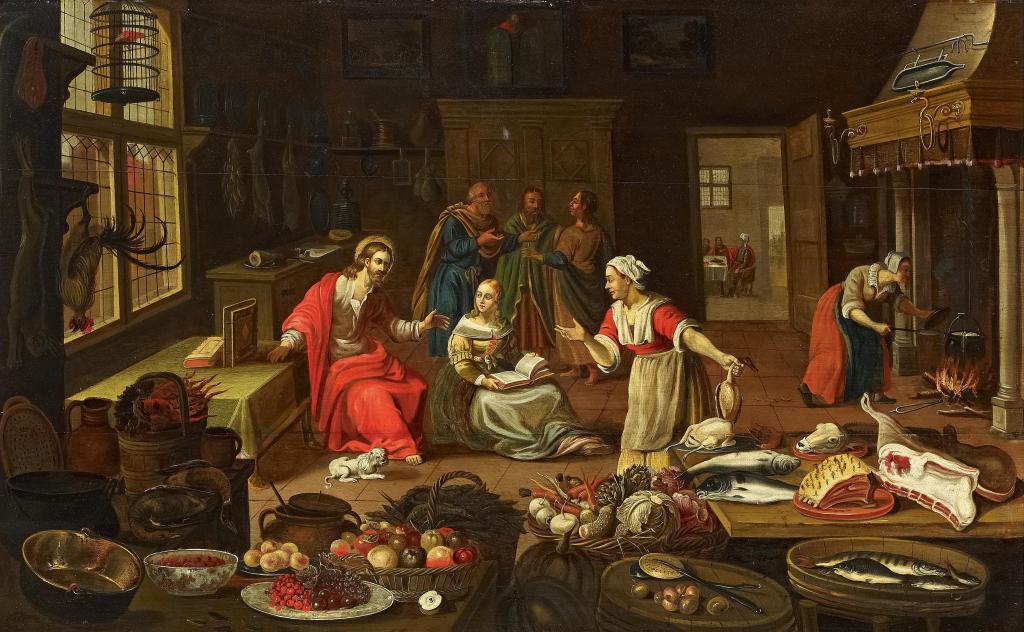
Perhaps a lot of unnecessary detail, but the point is that our Gospel reading today—the story of Mary and Martha—appears only in Luke’s Gospel and, when studied, proves to be scintillating in all its facets. There are many ways to interpret it, most of which are true, while some are just silly.
One facet, and perhaps the most apparent one, is the difference between the busy and the prayerful life. Martha is rushing around, taking care of all the chores, while Mary sits at Jesus’ feet, listening to His words. Jesus says that Mary has chosen the better way, so we might say that a contemplative life is preferable to a busy one. It’s a good message, and I have preached it before. However, it does not capture the fullness of what is transpiring.
To start with, if we claim that life is all about the contemplative, then no work gets done. We end up sitting around all day singing Kum ba Yah, letting someone else handle everything. That was similar to what happened in the time of Paul. Do you know what he said? “If anyone is not willing to work, let him not eat. For we hear that some among you walk in idleness, not busy at work, but busybodies. Now, such persons we command and encourage in the Lord Jesus Christ to do their work quietly and to earn their own living.” (2 Thessalonians 3:10-12) When Jesus says that Mary chose the better, he’s not saying that Martha chose the wrong. Something more is happening.
Another facet has us viewing this through a feminist lens, and I’m not being disrespectful when I say that. During the time of Jesus, within the Jewish home, there were only two places where men and women would mingle: outside or in the marital bedroom. The main public room—think of it as the living room—was the gathering place for visitors, but it was for men only. It was in this public room that Jesus was speaking. Yet, even though it was reserved for men, Mary was there, sitting with the men—the little hussy. She is not fulfilling her duty as a woman by cooking and cleaning. Not only that, she is also sitting in the place of a man. Yet, when Martha complains, Jesus says that Mary has chosen the better part. For some, this interpretation highlights how Jesus leveled the playing field for men and women. It can be viewed as a type of liberation for women, placing them on equal ground with men. Another good sermon, and one I’ve preached before, but even though it makes a good point, it doesn’t capture the bigger picture.
Another facet would be to take this same idea and apply it to how Jesus crossed all boundaries. By making the Gospel accessible to Mary and speaking to her so openly, it can go further to suggest that Jesus is willing to cross all boundaries—ethnic, social, political, cultural, and more—in order to bring the message of God’s love and redemption to everyone. An excellent point, and I’m sure at some point, I’ve preached it.
The ideas of elevating women or crossing boundaries are both valid understandings and teachings, but they are both lacking because they don’t address all aspects of what is happening.
One of the silly interpretations comes from some who suggest that Martha and Mary were deeply in love with Jesus, and that Martha’s jealousy stemmed from Mary’s physical closeness to Jesus. Just for the record, that is not a facet, I haven’t preached it, and I’m never going to.
As you examine these events, you’ll discover various other facets, but they are simply that, facets. So, this week, as I kept trying to grasp the message, I never felt truly satisfied with my understanding. I kept focusing on the individual characters—Mary, Martha, Jesus, the disciples—and realized I had been approaching it all wrong. Instead of seeking understanding through the facets, I needed to pull back and view the diamond as a whole.
I believe that this is what Luke was pointing to in the opening sentence: “As Jesus and his disciples went on their way, Jesus entered a certain village, where a woman named Martha welcomed him into her home.” To understand, we don’t focus on the individual characters; instead, we consider the home and what is inside.
There is Jesus, our King and Redeemer. Like Mary, we are called to sit at His feet, learn from Him, and allow Him to guide our lives. At the same time, we are to be like Martha — tending to our individual callings, whether that means being a homemaker, a priest, a clerk, a nurse, or whatever else Jesus has assigned us. In doing so, we find balance. Too much work and we neglect time with Jesus. Although sitting with Jesus is the best choice, we can’t spend all our lives just sitting; we must also do the work. Does that mean we’ve abandoned Jesus? No. He is still in the house. He is still available to us. He is working alongside us.
In the Gospel of John, at the Last Supper, Jesus speaks to the disciples and says, “Whoever has my commandments and keeps them…” (John 14:21). Clarification: What are Jesus’ commandments? He gave them to the disciples just a few minutes earlier: “A new commandment I give to you, that you love one another: just as I have loved you, you also are to love one another. By this all people will know that you are my disciples, if you have love for one another.” (John 13:34-35)
So, “‘Whoever has my commandments and keeps them—that is, whoever loves—he is the one who loves me. And he who loves me will be loved by my Father, and I will love him and manifest myself to him.’ Judas (not Iscariot) said to him, ‘Lord, how is it that you will manifest yourself to us and not to the world?’ Jesus answered him, ‘If anyone loves me, he will keep my word, and my Father will love him, and we will come to him and make our home with him.’” (John 14:21-23)
The events that occur in Martha’s home are an embodiment of Jesus’ words in the Gospel of John.
Our bodies and our souls are a home. Within our home, we work, play, rest, and pray. We live. If we keep the commandment of Jesus to love one another, He and the Father, that is, the Holy Spirit, will come to us and become part of our home. There, guided by the very Spirit of God, we will live a life that is pleasing to Him.
Pitting Mary against Martha is the wrong approach when admiring this diamond. The former archbishop of Turin expressed it well: “In our house, there is room for Martha and room for Mary, and we must occupy both places. We must be Mary because we are welcoming the Word, and we must be Martha because we are receiving the Son of Man.” We need to be Mary to learn about God’s love, and we need to be Martha to express that love to others. It’s not Mary or Martha, but Mary in Martha (cf. Sanctify Your Daily Life by Stefan Cardinal Wyszynski, p.100), and vice versa, with the Holy Spirit working in both.
When inviting the Holy Spirit into your home, don’t just give it access to the “spiritual” aspects of your life, but instead, allow it to roam freely throughout every room, so you will have access to and benefit from this Gift from God.
Let us pray: Come, O Divine Spirit, fill our hearts with Your heavenly fruits: charity, joy, peace, patience, long-suffering, kindness, goodness, faith, meekness, modesty, self-control, and chastity, so that we may never grow tired in serving God. Through continued faithful submission to Your inspiration, may we be found worthy to be united forever with You in the love of the Father and the Son. Amen.
Remember Otis Campbell? He was the town drunk on The Andy Griffith Show who would lock himself in jail rather than waiting for Andy or Barney to arrest him. Well, imagine another Otis-like character, let’s call him Boudreaux, who doesn’t turn himself in but gets arrested for the umpteenth time and has to appear before the same judge, each and every time. However, on this most recent occasion, he makes a rather unusual request of the judge.
“Your Honor,” Boudreaux says, “if you don’t mind, I would like to try myself and judge myself.”
With nothing to lose, the judge says, “OK, let’s hear it.”
Well, ol’ Boudreaux lets loose on himself. “Boudreaux, you are a low-down, no-good polecat of a man, who has abandoned every responsibility you ever had. You have spent your entire life thinking only of your own selfish desires. And now here you are, once again, throwing yourself on the mercy of this court. However, you will find no mercy today, because you do not deserve it.” Then, turning to the judge, he says, “Your Honor, I find myself guilty as charged, and I sentence myself to a $100.00 fine and 30 days in jail. And I pray that God will help me understand the wickedness of my ways.”
The judge nodded thoughtfully and said, “Boudreaux, I think you really mean it this time. I commend you for your righteousness. I’ll accept your judgment.”
At which, Boudreaux interrupted the judge and said, “Your Honor, I have one more thing. I suspend my sentence!”
Mercy. When we think of mercy, we often picture throwing ourselves on the mercy of the court. However, I doubt we often consider it as a Christian virtue, even though it is considered the greatest. St. Thomas Aquinas writes in his Summa Theologica, “Mercy is the greatest of the virtues, since it belongs to God to show mercy, and in this His omnipotence is manifested to the greatest degree.” And more simply, Pope Francis wrote, “Mercy is the very foundation of the Church’s life.” (Misericordiae Vultus, 2015) So, what is mercy?
Mercy comes from the Latin word misericordia, which literally means, “having a miserable heart.” Aquinas helps us understand more clearly what this means. He explains that there are two parts of mercy required for it to be considered a virtue—affective mercy and effective mercy.
Affective mercy is an emotional response—how something makes you feel. You see someone suffering in some way, and you feel sympathy or compassion for them. However, simply having sympathy is not a virtue. Consider the words of St. James: “What good is it, my brothers, if someone says he has faith but does not have works? Can that faith save him? If a brother or sister is poorly clothed and lacking in daily food, and one of you says to them, “Go in peace, be warmed and filled,” without giving them the things needed for the body, what good is that? So also faith by itself, if it does not have works, is dead.” (James 2:14-17) What good is it if someone has an emotional response to someone’s suffering but doesn’t act to ease that suffering? Affective mercy is good, but for it to be a true virtue, it must be accompanied by effective mercy.
Effective mercy is actually doing something about the suffering of others. Going back to James, “If a brother or sister is poorly clothed and lacking in daily food,” and you provide them with good clothing and give them something to eat, then you are acting and actually doing something about their suffering. However, effective mercy, action alone is not a virtue.
Remember the parable Jesus told about the persistent widow who kept coming to the judge seeking justice. Yet, the judge “neither feared God nor respected man.” (Luke 18:2b) The widow kept returning, but the judge didn’t care anything about her; however, he ended up giving her what she wanted, saying, “Though I neither fear God nor respect man, yet because this widow keeps bothering me, I will give her justice, so that she will not beat me down by her continual coming.” (Luke 18:4b-5) I don’t care anything about this widow, but so that she’ll leave me alone, I’ll give her what she wants. It’s like someone giving to a charity, not because they care about the cause but because they need a tax write-off. Affective mercy is action toward someone who is suffering, but without sympathy or compassion for them, it is not a virtue.
For mercy to be a virtue, it must be both effective and affective. Mercy as a virtue is defined by Aquinas “as the compassion in our hearts for another person’s misery, a compassion which drives us to do what we can to help him.” (Source)
The greatest act of mercy is witnessed in Christ upon the Cross. Through His compassion and sympathy for our fallen state, He submitted Himself to “death, even death on a cross.” And, from this example, we draw our inspiration.
Perhaps Shakespeare expressed it most eloquently when he gave the words to Portia in The Merchant of Venice.
“The quality of mercy is not strain’d, It droppeth as the gentle rain from heaven Upon the place beneath: it is twice blest; It blesseth him that gives and him that takes: ‘Tis mightiest in the mightiest: it becomes The throned monarch better than his crown; His sceptre shows the force of temporal power, The attribute to awe and majesty, Wherein doth sit the dread and fear of kings; But mercy is above this sceptred sway; It is enthroned in the hearts of kings, It is an attribute to God himself; And earthly power doth then show likest God’s When mercy seasons justice.” (Shakespeare, The Merchant of Venice, Act 4, Scene I)
Mercy is an attribute of God, and when we show mercy, combining affective and effective, we reflect God’s nature.
“Teacher, what must I do to inherit eternal life?”
“What is written in the law? What do you read there?”
“You shall love the Lord your God with all your heart, and with all your soul, and with all your strength, and with all your mind; and your neighbor as yourself.”
“You have given the right answer; do this, and you will live.”
“And who is my neighbor?”
The Parable of the Good Samaritan answers the question. Your neighbor is the one who shows mercy. Your neighbor is the one who feels compassion and sympathy for you and acts to help alleviate, if not all, then at least part of your suffering. Jesus says, if that is indeed how your neighbor acts towards you, “Go and do likewise.”
Yes, Jesus, I hear what you’re saying, but they are not like us. I mean, just look at them. They certainly don’t look or act like any of my neighbors.
Jesus says, “Did I stutter? Go and do likewise.”
From Thomas Merton, “Our job is to love others without stopping to inquire whether or not they are worthy. That is not our business and, in fact, it is nobody’s business. What we are asked to do is to love, and this love itself will render both ourselves and our neighbors worthy.” (Disputed Questions, p.122) Why are we not to put qualifiers on our love and who may or may not be our neighbor? In the same paragraph, Merton answers by referring to 1 John 4:19: “We love because [God] first loved us.” St. Paul says something similar in his letter to the Romans. “God shows his love for us in that while we were still sinners, Christ died for us.” (Romans 5:8)
God did not stop to question whether or not we were worthy of His love or whether or not He should show us mercy. He loved, and He was merciful. Go and do likewise.
As God’s beloved children, redeemed by the blood of His Son, this is what is required of us. The Prophet Micah writes,
“With what shall I come before the Lord, and bow myself before God on high? Shall I come before him with burnt offerings, with calves a year old?
Will the Lord be pleased with thousands of rams, with ten thousands of rivers of oil? Shall I give my firstborn for my transgression, the fruit of my body for the sin of my soul?”
He has told you, O man, what is good; and what does the Lord require of you but to do justice, and to love mercy* and to walk humbly with your God.”
If you feel sympathy and compassion for someone, then do something to help alleviate their suffering. This is how God loved us and how we should love others in return.
A prayer given to us by St. Ignatius. Let us pray: Dear Lord teach us to be generous; teach us to serve you as you deserve, to give and not to count the cost, to fight and not to heed the wounds, to toil and not to seek for rest, to labor and not to ask for reward, save that of knowing that we do your will. Amen.
* The ESV translates חֶסֶד as kindness, but the Hebrew is written וְאַהֲבַת חֶסֶד, which can rightly be translated as mercy andconveys the sense of undeserved compassion and covenantal faithfulness that Micah is emphasizing. All that to say, I like the ESV version, but tweaked it for what I believe is a better understanding.
This past Sunday, we read in our Gospel the words of Jesus: “The Lord appointed seventy others and sent them on ahead of him in pairs to every town and place where he himself intended to go. He said to them, ‘The harvest is plentiful, but the laborers are few; therefore ask the Lord of the harvest to send out laborers into his harvest.’”
In discussing this, we found that the Lord was appointing ambassadors. Those seventy and the disciples can be considered the first generation of ambassadors. Today, we honor Aquila and Priscilla, husband and wife, as second-generation ambassadors.
Around 40 A.D., Claudius was emperor, and at that time, disturbances erupted between the Christian-Jews and the Gentile Christians over the Messiahship of Jesus. The Roman historian Suetonius, lumping the two groups together, wrote that the Jews “were rioting on account of someone named Chrestus.” Emperor Claudius, caring nothing about the argument, resolved it by expelling all the Jews from Rome, two of them, Aquila and Priscilla. After the expulsion, they traveled about 750 miles to Corinth, where they continued their trade of tent making.
Perhaps because they heard him preach or because they shared the same trade of tent making, Priscilla and Aquila came into contact with Paul and became close companions in the work of the Gospel. Eighteen months later, the three traveled to Ephesus to continue God’s work, and shortly after, Paul went on to Antioch, but the couple remained in Ephesus. In writing to the Church in Corinth, Paul says in his closing, “The churches of Asia send you greetings. Aquila and Priscilla, together with the church in their house, send you hearty greetings in the Lord.” By mentioning them by name, Paul demonstrates the great esteem he had for them, and also tells us that Priscilla and Aquila started a church in their home. This was typical, as churches did not begin meeting in dedicated buildings until the third century.
The Acts of the Apostles also describe Aquila and Priscilla’s encounter with the Alexandrian Jew, Apollo. “He had been instructed in the way of the Lord. And being fervent in spirit, he spoke and taught accurately the things concerning Jesus, though he knew only the baptism of John.” So, after hearing him preach, Aquila and Priscilla “took him aside and explained to him the way of God more accurately.” Aquila and Priscilla were second-generation Christians, and by teaching Apollo, they helped raise up and train the next generation.
President Ronald Reagan said, “Freedom is never more than one generation away from extinction. We didn’t pass it to our children in the bloodstream. It must be fought for, protected, and handed on for them to do the same, or one day we will spend our sunset years telling our children and our children’s children what it was once like in the United States where men were free.” Replace the word ‘Freedom’ with ‘Christianity’ and you’ll have another truth.
Aquila and Priscilla returned to Rome, where they were eventually martyred for their faith, but they did not allow their faith to die with them. They serve as an example of what it means to be an apostolic church—a church that passes on the teachings and practices to the next generation, ensuring the faith of our fathers and mothers remains alive for all future generations.
Aquila and Priscilla are like the seventy Jesus sent out as ambassadors. So are we. Pass on your faith to the next generation so that the light of the Gospel may continue to shine in this dark world.
A lady was heading to London from New York to visit her kids and grandkids who lived there. When she reached the airline counter to check her bags, she presented her ticket to London. As she gave the agent her luggage, she said, “I’d like you to send my green suitcase to Hawaii and my red suitcase to Budapest.”
The confused agent said, “I’m sorry. You’re going to London. We can’t do that.”
Really? I’m so relieved to hear you say that because that’s exactly what you did to my luggage last year!
Traveling. There really is an art to traveling, and it’s not something you can easily learn from reading or watching a video on. You’ve just got to get out there and go, and see what the world has to offer.
Some of you may remember one of my first big trips to Portugal. There I was, standing in the bathroom with an espresso in one hand and a hairdryer in the other, attempting to dry my shirt. I’ve learned a few things since then, and packing as little as possible is one of the most important lessons.
For my last trip, I carried a light backpack that was about a third full and a small carry-on bag only three-quarters full. That was for ten days. I see people at airports and in hotels schlepping two large pieces of luggage and backpacks that are stuffed to zipper-popping extremes, and I wonder why. A travel blogger tries to answer that question.
“It all starts with fear. No, really. According to psychologists, overpacking is often rooted in loss aversion — our brain’s sneaky way of saying, ‘What if you need that third pair of heels in rural Tuscany?’” (Source)
Now, I’m happy to report that I’ve never even needed a single pair of heels, but you get the point. When we start packing, we think about the trip and then attempt to plan for every possible scenario, then pack accordingly. In the end, you end up with two steamer trunks and a hernia. Plus, you have all those belongings to maneuver through airports and on trains. There’s the worry of keeping up with it all, especially if you’re traveling alone, not to mention, will the green suitcase go to Hawaii and the red suitcase end up in Budapest. Ultimately, all that stuff and the worries that come with it are a huge distraction from the actual trip. The same travel blogger writes, “Packing light is a mindset shift, not a packing hack. It’s about choosing to be present, adaptable, and open to the unknown.” All the energy you save can then be used to enjoy the trip. You are free to be aware and open to what you set out to experience.
Our Gospel reading from last week began, “When the days drew near for Jesus to be taken up, he set his face to go to Jerusalem.” Jesus is headed to Jerusalem, and shortly after He arrives, He will be arrested and crucified, so He knows that He will not be coming this way again. So, today’s Gospel tells us that He appointed seventy others to go two-by-two to the places He would be passing through. He is asking them to prepare the groundwork so that when He arrives, He can get straight to work because time is short.
For their journey, Jesus gave them specific instructions, which began, “Go on your way. See, I am sending you out like lambs into the midst of wolves. Carry no purse, no bag, no sandals; and greet no one on the road.”
Jesus is sending ambassadors, and these are very similar instructions to those given to the twelve when He sent them out. “Carry no purse.” Do not carry any money with you. You are bringing a message of salvation, and those who hear and believe will provide for you. “Carry no bag” relates to this because Jesus is referring to the kind of bag often carried by beggars. They are not to be beggars; they are to be givers of God’s message. “Carry no sandals.” You are not to carry money, beg for money, or appear to have money. You are to be my ambassadors; therefore, you will go as I do.
These ambassadors of Jesus would appear very different from the Roman ambassadors people were accustomed to seeing. Roman ambassadors traveled with an entourage, including other officials, servants, and slaves. When they moved around, they rode in ornate carriages and dressed to the nines, wearing large rings as signs of their status and authority.
Jesus is sending these seventy to be His ambassadors, but He does not want them looking anything like these other ambassadors. He wants them to look like Him and travel light.
Following the resurrection, the Apostles continued this practice. In the Acts of the Apostles, Peter and John are walking to the Temple when a crippled man asks them for alms. Peter said to him, “I have no silver and gold, but what I do have I give to you. In the name of Jesus Christ of Nazareth, rise up and walk!” (Acts 3:6) Commenting on this, St. Ambrose writes, “It is as if he were saying, ‘You see in me a disciple of Christ, and you ask me for gold? [Jesus] gave us something much more valuable than gold, the power to act in his name. I do not have what Christ did not give me, but I do have what he did give me: In the name of Jesus Christ, arise and walk.’” And the man did.
The mission of the Apostles and the seventy, Jesus’ ambassadors, was always centered on the message of peace. Peace between God and His creation. Today, we are His ambassadors. We are the ones who are to bring this message to the world, and in doing so, we should also travel light.
In taking our trips and traveling light, the travel blogger tells us that we are “choosing to be present, adaptable, and open to the unknown.” The same idea applies to traveling light as Jesus’ ambassadors. We are not in it for the money. We are not seeking to gain anything for ourselves. Instead, relying solely on God, we seek to be present to a hurting world in all its circumstances and issues. We do this so that we might fulfill our roles as ambassadors of bringing God’s message of peace. This brings us to the last part of Jesus’ travel instructions—“Greet no one on the road.”
Whenever I sit down to write a sermon or a story, I usually manage fine with small interruptions that come along—someone dropping by, the phone ringing, or a text message or email coming in. However, I reach a point where I need to concentrate solely on the words. If I don’t, I lose the thread of what I’m trying to say. What to do? I pop in my headphones, play some instrumental music, and set my phone to DND—do not disturb. It’s not that I’m being rude and don’t want to have to deal with anybody, it’s just that when I do these things, all that remains are the words.
When Jesus told the seventy to “greet no one on the road,” He wasn’t asking them to be rude to those around them. He was saying, for a time, they needed to focus solely on one thing—the message of peace. If they got distracted, they would get sidetracked and eventually lose the thread of what He asked them to do.
Of all the issues the Church faces today, I believe this is one of the most significant. We are ambassadors for Christ. We have been given our mission, but we often get sidetracked and lose the thread of what we are supposed to be doing.
We are told, “The seventy-two returned with joy, saying, “Lord, even the demons are subject to us in your name!’ And he said to them, “I saw Satan fall like lightning from heaven. Behold, I have given you authority to tread on serpents and scorpions, and over all the power of the enemy, and nothing shall hurt you. Nevertheless, do not rejoice in this, that the spirits are subject to you, but rejoice that your names are written in heaven.” Rejoice that you have attained the Kingdom of God because you were obedient and fulfilled God’s purpose for your life—doing what you were supposed to be doing.
We are called to be the ambassadors of Christ, therefore, we are to look like Him and do the things He did in the way He did them. We are to remain focused and not get distracted by the various things happening around us. Finally, wherever we are, we are to announce God’s peace and bring the message, “The kingdom of God has come near to you.” Then, we create space, so that Jesus may enter, not just to announce peace but to bring peace—reconciliation with God.
Let us pray: O God, you have made of one blood all the peoples of the earth, and sent your blessed Son to preach peace to those who are far off and to those who are near: Grant that people everywhere may seek after you and find you; bring the nations into your fold; pour out your Spirit upon all flesh; and hasten the coming of your kingdom; through Jesus Christ our Lord. Amen.
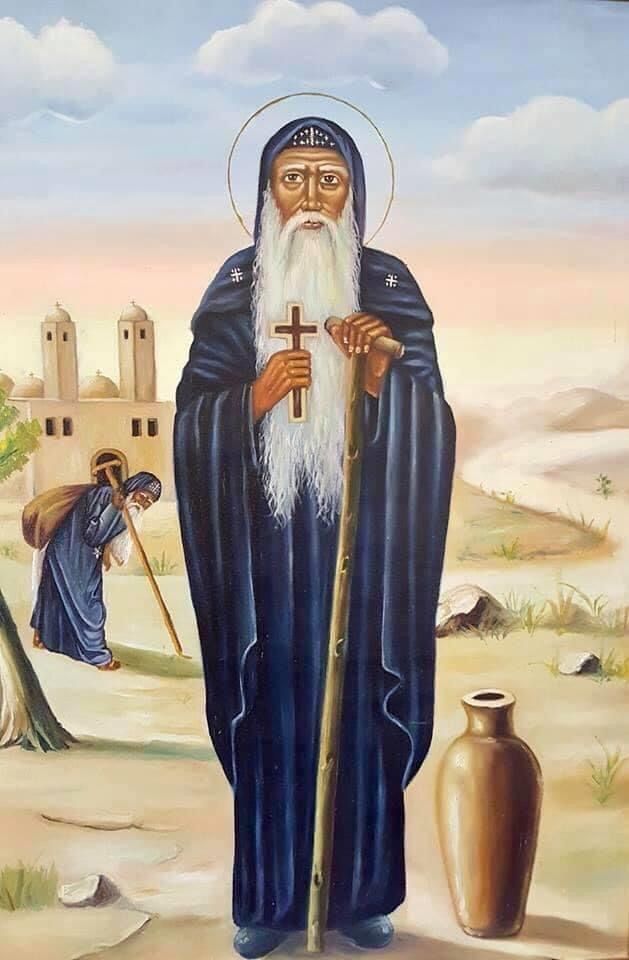
Moses the Black, an Ethiopian living in Egypt during the 4th century, was born a slave and later became a bandit. After years as a feared criminal, he repented and approached the doors of a desert monastery, weeping for his sins. Because of his past, the monks did not allow him entry, even afraid at the mention of his name. However, after some time, they received and accepted him.
Although a member of the monastery, his passions continued to wage a spiritual battle, so he sought the help of the elder Abba Isidore. Moses followed Isidore’s instructions, from eating just enough to sustain himself while remaining hungry at all times, to standing all night in prayer. At night, Moses was led by the ladder to take on the task of fetching water from the well for the other brothers, especially those who were older and lived farthest from the well.
One night, while drawing water, Moses felt a sharp blow to his back and was knocked into the well, where he lay until he was found the next morning when the other brothers discovered him. A year passed before he was fully recovered, and it was then that Isidore declared him to be clean of his demons and ordered him to be ordained a deacon. On the day of his ordination, the bishop clothed Moses in white robes and declared, “Now Abba Moses is entirely white!” Moses replied, “Only outwardly, for God knows that I am still dark within.”
Continuing to protest his worthiness to serve at the altar, the Bishop set out to test him and ordered the other clergy to drive Moses from the altar and the church. Moses accepted this without protest. Witnessing this and being convinced of Moses’ humility, the Bishop ordained him a priest, a role he faithfully served for fifteen years until his martyrdom in 400 AD.
Moses learned that the monastery would soon be attacked by bandits and encouraged the others to flee. All did, except for seven who remained with Moses. When he was urged to leave, he responded, “For many years already I have awaited the time when the words which my Master, the Lord Jesus Christ, should be fulfilled: “All who take up the sword, shall perish by the sword” (Mt. 26:52). (Source)
The good thief hanging on the cross to the right of Jesus rebuked the other thief, saying, “Do you not fear God, since you are under the same sentence of condemnation? And we indeed have been condemned justly, for we are getting what we deserve for our deeds, but this man has done nothing wrong.”
I don’t know why Moses chose to remain, knowing that staying would almost certainly be a death sentence. Perhaps he thought he could buy the others more time to escape if he put up a fight. Whatever the case, I wonder if he heard the words of the good thief as he waited, “We indeed have been condemned justly.” I also wonder if he heard the words of St. Paul, “Wretched man that I am! Who will deliver me from this body of death? Thanks be to God through Jesus Christ our Lord!” (Romans 7:24-25a)
We are all rightly condemned for our actions. Thanks be to God through Jesus Christ, our Lord! Through Him, we are saved. He remembers us and, on our last day, brings us into the eternal paradise of His kingdom.
You know him, but you probably don’t know him by name—Jonathan Goldsmith. A few facts about his life: his passport requires no photograph, his business card simply says ‘I’ll Call You,’ and he brought a knife to a gunfight—just to even the odds. He is The Most Interesting Man in the World, and from 2006 to 2016, he was often heard saying, “I don’t always drink beer, but when I do, I prefer Dos Equis.” Of course, the internet got hold of that, and the memes continue to explode.
I don’t always live dangerously, but when I do, I press send before proofreading.
I don’t always pass slow drivers, but when I do, I check to see if they look as stupid as they drive.
I don’t always “Whoop,” but when I do, there it is.
On days when I know I have a service or will be out and about doing priesty things, I wear my cassock and collar. It really does change the way people look at me and respond. When I’m dressed in regular street clothes, most folks just pass by. When I’m in the cassock and collar, most will speak. The cassock and collar identify me with the church, faith, and hopefully, God. I believe it’s important and helps people see “the church” in the world. The other day, I made a hospital visit, so I was in cassock and collar. On the way back to my car, a mom, a dad, and their four children were heading in. One of the boys looked over at me and then shouted, “Dad, it’s the Pope!” His dad corrected him and told him that I was a priest, but it made me think, “I don’t always wear a cassock and collar, but when I do, people think I’m the Pope!” How you doin’?
There are certain individuals, organizations, and ideas that hold a place of honor in our lives. When we see or think about them, we want to be associated with them. If we can’t necessarily be in a relationship with them, then we will seek ways to be identified with them. Can I just say, “Go, Thunder!” Score of 103-91. A few years ago, I attended an OSU basketball game, but it and the final against the Pacers were the only basketball games I’ve seen in at least a decade, if not more. Yet, when the Thunder won, I—and I’m sure every other Oklahoman—didn’t say, “The Thunder won!” Instead, it was, “WE won!” We won the national championship. Yes, indeed. The most difficult thing I did that entire evening was feeding myself, but WE won. We celebrate in the parade, we wear our gear, and we boast that we are champions.
No, I don’t believe that I’m the Pope, but I do closely associate and am aligned with the Church. My identity is deeply tied to it. This association, I pray that this connection also reflects my relationship and identity in God: Father, Son, and Holy Spirit.
Being associated and finding identity with the Church, God, and even the Thunder isn’t a bad thing. It brings joy, happiness, and, for the Church and God, a sense of purpose. It fulfills me. However, such connection and identity can sometimes lead to undesirable effects and actions.
In Luke’s Gospel, leading up to our reading today, the Apostles witnessed and experienced many exciting and miraculous events. They saw Jesus calm the storm, feed the 5,000, cast out demons, and heal the sick. Peter declared Jesus to be the Christ, and together with James and John, they witnessed the Transfiguration. Additionally, Jesus sent them out to do the same works He was doing: preaching, healing, and casting out demons. When they return, they report their successes. Because of their association and identification with Jesus, they also began to see themselves as closely linked with the One Jesus identified with—the Father. This, in itself, is a very good thing. They begin to understand that they are truly God’s children; however, after the Transfiguration, things take an unpleasant turn.
The Apostles begin to think that if they were with Jesus, they could sit in the seats of honor in the coming kingdom, which they still only understood as an earthly kingdom. They start arguing about who is the greatest, so that they can rule, not only over the kingdom but also over each other. Going even further, now that they were in so tight with Jesus and, through association, to the Father, they begin to see themselves having the same rights and powers that belong exclusively to God. When the Samaritan village turns away from Jesus, “James and John saw it, they said, ‘Lord, do you want us to command fire to come down from heaven and consume them?’”
Remember Abraham’s nephew, Lot. God had enough of the wickedness of Sodom and Gomorrah, so the “Lord rained down burning sulfur on Sodom and Gomorrah—from the Lord out of the heavens. Thus, he overthrew those cities and the entire plain, destroying all those living in the cities—and also the vegetation in the land.” When Abraham looked down from the mountains, “he saw dense smoke rising from the land, like smoke from a furnace.”
James and John believed they had the right to judge as only God can judge. They not only wanted to be associated with and identified with Jesus and the Father, but they also sought God’s power. They wanted to judge, rage against those they saw as God’s enemies, and exact vengeance on them. They wanted to play God.
I’m not surprised that the Scriptures tell us Jesus rebuked them, but I am actually quite surprised that the Scriptures didn’t say, “And Jesus looked at them in dismay and said, ‘Are ya stupid? Nobody can call down fire from Heaven. That’s the dumbest thing I’ve ever heard.’” Why didn’t He say that? Because maybe we can’t burn a place or person down like what happened at Sodom and Gomorrah, but we can and do call down fire in other ways.
We put on our Jesus gear. We’ve got the crosses we wear and the clothes with messages that proclaim our faith. We talk openly about our faith. We post messages on social media for all the world to see. And if there were a Jesus parade, we’d jump in and want to ride on the float. We want to be associated and identified with Jesus and our faith. Good. Keep it up. There are many ways to proclaim the Good News. But, like the Apostles, we can take this too far.
We can come to believe that because we are with Jesus, we are holy or even holier than others. We can come to believe that if someone opposes our beliefs, they are opposing God, and therefore must be silenced because they are wrong and evil. We may believe that if they fail to keep our standards (even though we fail to do so ourselves), they are weak and unloved by God. We can look at others and then to Jesus and ask, “Lord, do you want us to command fire to come down from heaven and consume them?” When we do this, we take on the exclusive powers of God, playing God ourselves. In doing so, our sins become greater than those we judge, and we are the ones who need rebuking.
However, there is a way for us to play God, and in doing so, we take on not just what we understand as the power of God, but God’s true nature, as witnessed in Jesus. For if we have seen Jesus, we have seen the Father. What do we see in Jesus? St. Paul summed it up for us in his letter to the Galatians that we read this morning. We see in Jesus “love, joy, peace, patience, kindness, generosity, faithfulness, gentleness, and self-control.” Through the Spirit of God, we have the power to live this life.
William Temple was the Archbishop of Canterbury in the early 1940s. He writes,
“It is no good giving me a play like Hamlet or King Lear and telling me to write a play like that. Shakespeare could do it—I can’t. And it is no good showing me a life like the life of Jesus and telling me to live a life like that. Jesus could do it—I can’t. But if the genius of Shakespeare could come and live in me, then I could write plays like this. And if the Spirit [of God] could come into me, then I could live a life like His.”
Children may think I’m the Pope, but I’m smart enough to know I’m not even close. However, I desire to be so closely associated with and identified with Jesus that I begin to resemble Him. This transforming work is accomplished through the Spirit of God living within, and the fruit of this work is “love, joy, peace, patience, kindness, generosity, faithfulness, gentleness, and self-control.” Therefore, we must invite God’s Holy Spirit to take up residence in our soul, in our entire being, so that we may be as He is.
If you want to play God, bring peace. If you want to play God, remain faithful. If you want to play God, show kindness. In this way, you will not only be associated with and identified with the Lord, but you will also become like the Lord.
Let us pray (by St. Augustine): Breathe into me, Holy Spirit, that my thoughts may all be holy. Move in me, Holy Spirit, that my work, too, may be holy. Attract my heart, Holy Spirit, that I may love only what is holy. Strengthen me, Holy Spirit, that I may defend all that is holy. Protect me, Holy Spirit, that I may always be holy. Amen.
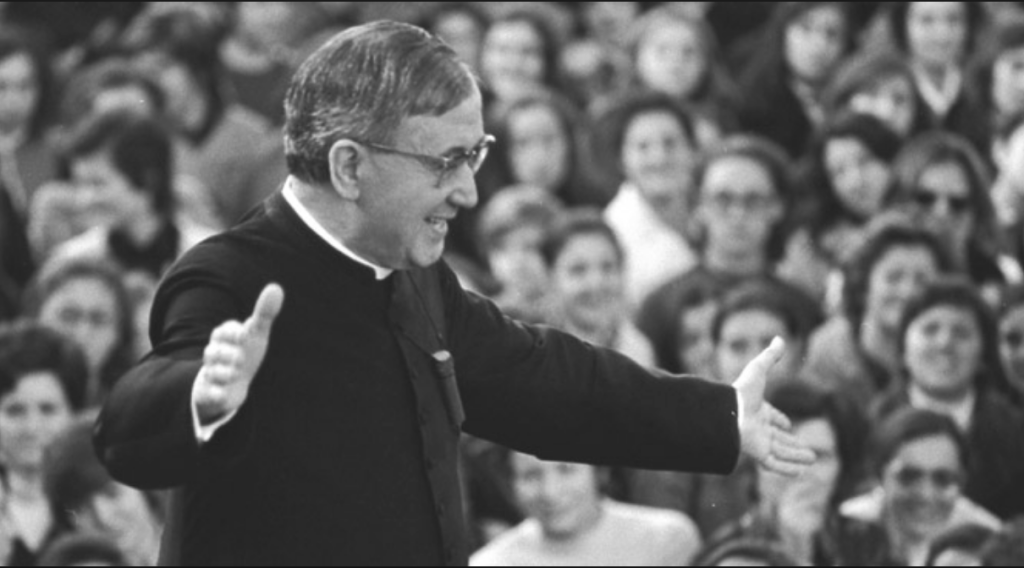
On October 6, 2002, one of the largest crowds ever to gather at the Vatican (with estimates reaching as high as 500,000) came to witness the canonization of one of my friends, Josemaría Escrivá. He is listed in our calendar of saints, but he is mine. His official feast day is tomorrow, June 26.
Pope John Paul II conducted the service and spoke fondly of the Saint and his close friend.
“Outstanding in the founder of Opus Dei was his love for the will of God. There is a sure criterion of holiness: faithfulness in fulfilling the divine will to its ultimate consequences. The Lord has a plan for each one of us; he entrusts each one with a mission on earth. The saint cannot even think of himself outside of God’s plan: he lives only to fulfill it.
“St. Josemaría was chosen by the Lord to proclaim the universal call to holiness and to indicate that everyday life, ordinary activities, are the way of sanctification. It might be said that he was the saint of the ordinary.
“In fact, he was convinced that for anyone who lives from the perspective of faith everything offers an opportunity for encounter with God, everything becomes a stimulus for prayer. From this point of view, daily life reveals an unsuspected grandeur. Holiness appears truly within the reach of all.”
“St. Josemaría was profoundly convinced that the Christian life entails a mission and an apostolate: We are in the world to save it with Christ.
“He loved the world passionately, with a redemptive love. Precisely for this reason his teachings have helped so many ordinary members of the faithful to discover the redemptive power of faith, its capacity to transform the earth.
“This is a message that has abundant and fruitful implications for the evangelizing mission of the Church. It fosters the Christianization of the world ‘from within,’ showing that there can be no conflict between the divine law and the demands of genuine human progress.
“This saintly priest taught that Christ must be the apex of all human activity. His message impels the Christian to act in places where the future of society is being shaped.
“From the laity’s active presence in all the professions and at the most advanced frontiers of development there can only come a positive contribution to the strengthening of that harmony between faith and culture, which is one of the greatest needs of our time.”
I’ve read what many consider his most popular book, The Way, a collection of 999 sayings, multiple times. Also, through the internet, I’ve heard him speak at various events. What stands out to me is the difference between the two. When he speaks to others, he is compassionate and supportive, but many of the sayings in The Way can be quite harsh at times. Regarding charity, he writes, “Your charity is presumptuous. From afar, you attract; you have light. From nearby, you repel; you lack warmth. What a pity!” (#459)
Many others are similar, and all the writings are clear and bold, which makes me think that The Way (and I have no way of proving this) was originally a collection of sayings to himself. Words he spoke to himself to bring correction to his own life in areas he thought necessary, and it is that type of self-examination/self-evaluation that would make a Saint. Ever seeking to improve in the eyes of God. Such honesty with oneself can sometimes be quite painful, but as the Proverbs tell us, “Iron sharpens iron” (27:17), and we can all use honesty in our own self-examination and evaluation so that we too become the saints God has called us all to be.











 Candle in a Cave