The dictionary defines wisdom as: “The quality of having experience, knowledge, and good judgment.” Therefore, wisdom is the intelligent application of knowledge gained through study and life. Knowledge tells me that my tongue will stick to a metal pole when it is -16 degrees. Wisdom tells me, “Don’t be an idiot and try it.”
When it comes to God, Proverbs 1:7 teaches us, “The fear of the LORD is the beginning of knowledge.” In this case, “fear,” is not defined as reading The Shining by Stephen King while you’re home alone, but is more accurately defined as reverence and awe, a recognition of who God is. So, a rewording of the Proverb could say, “The recognition of who God is brings knowledge.” The true wisdom that proceeds from this knowledge and is then put into practice is made evident in the life and teachings of Jesus. As we read in the Book of Wisdom “She [Wisdom] is a reflection of eternal light, a spotless mirror of the working of God, and an image of his goodness.” True Wisdom, the spotless reflection of God, is Jesus.
So how do we go from knowledge of God to wisdom through Jesus? It requires contemplation of God, and it is the deeper contemplation of God that is often referred to as mysticism.
The word mysticism from a negative perspective is seen as a new-age hocus pocus and from a positive perspective as something that is only achieved by some of the greater Saints, such as Teresa of Avila or John of the Cross. However, Evelyn Underhill, whom we celebrate today, teaches that the mystical life is attainable to anyone who nurtures such a life. In The Spiritual Life, she writes, “a spiritual life is simply a life in which all that we do comes from the centre, where we are anchored in God.” She teaches that a contemplative life, a mystic’s life is available to anyone who would place God at the center and strive for a deeper understanding of Him. Such a teaching is in line with what many others have said. For example, in Life and Holiness, Thomas Merton writes, “The spiritual life is not a life of quiet withdrawal, a hothouse growth of artificial ascetic practices beyond the reach of people living ordinary lives. It is in the ordinary duties and labors of life that the Christian can and should develop his spiritual union with God.” (Introduction)
Jesus said, “God is spirit, and those who worship him must worship in spirit and truth.” Jesus was saying, it is not about where you worship or how you worship; instead, worship is about spiritual union with God. Evelyn Underhill teaches that this union is available to us all, if—like anything else we want to be successful at—we dedicate ourselves and practice. Through practice, we can gain wisdom about the things and nature of God.
Take the knowledge you have of God—God is love, faithful, merciful, etc.—and by intentionally contemplating that knowledge, allow it to draw you into greater union with Him.
The first copy of a particular comic strip arrived in my email inbox on Saturday, May 28th while I was still in Italy. I’m guessing it was in the paper that morning. It was from Jean Mc. and it was a copy of the Hagar the Horrible comic strip. As you probably know, Hagar is the Viking that finds himself in various circumstances. In this instance, Hagar is visiting his doctor and says, “Guess where I’ve been for the last month!” The doctor replies, “Italy!” Hagar responds, “Great guess! Did I pick up an accent?” To which the doctor replies, “No, you picked up fifteen pounds!”
As I said, Jean was the first to send this to me but they just kept coming for the rest of the day. It got to the point that I was wondering if you all were trying to tell me something!
I spent a week in Florence and a week in Rome. There is truly something very special about Florence, but from many respects, Rome truly does feel like the center of the world.
Charles Dickens in Pictures from Italy writes, “It is a place that ‘grows upon you’ every day. There seems to be always something to find out in it. There are the most extraordinary alleys and by-ways to walk about in. You can lose your way (what a comfort that is, when you are idle!) twenty times a day, if you like; and turn up again, under the most unexpected and surprising difficulties. It abounds in the strangest contrasts; things that are picturesque, ugly, mean, magnificent, delightful, and offensive, break upon the view at every turn.” And that is so very true.
You can be walking down a very narrow street that the sun might find its way to shine down on for an hour a day and then walk out into a sun-filled piazza with a bubbling fountain at one end and a cathedral towering above you at the other. Across the street from a gelato shop, you will find the ruins, many feet below the current street level, of the courtyard where Caesar was assassinated. And then you can walk into some obscure church and find some of the greatest works of art ever created. In the end, you are so overwhelmed by it all that you’re more exhausted than you are awed.
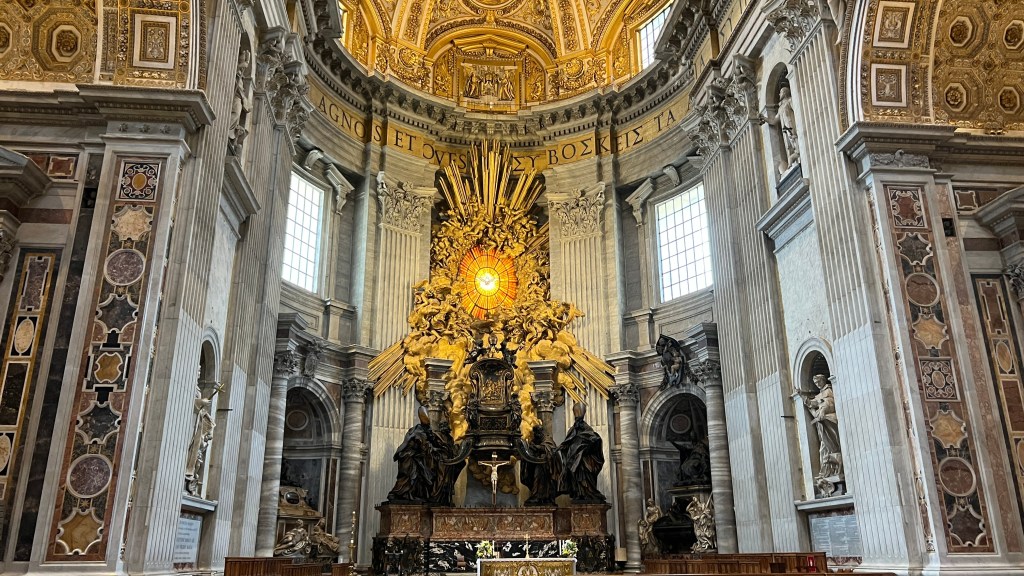
My advice to anyone who walks through these magnificent places: don’t forget to look up! The ceilings are as impressive (if not more so) as the surrounding walls and it was on one of the ceilings that I saw the one work of art that stopped me cold.
It was on the second floor of the Papal Palace in the Hall of Constantine, Constantine being the first Roman Emperor to legalize and convert to Christianity. The walls depict scenes in the life of Constantine and the Church, but the ceiling depicts another hall. In it stands a pedestal and on the pedestal is a crucifix. On the ground below and broken into many pieces is a statue of one of the old Roman gods. The fresco, by Tommaso Laureti, is called, The Triumph of Christianity. Not today, but you’re going to have to hear a sermon on that, but the point is that all of your senses are bombarded from every angle with light, color, sounds, smells… everything and it is amazing. Yet for me, all of that I was seeing was not what truly moved me. Let’s go back to Charles Dickens and his travels through Italy.
Dickens and his companions travel outside the old city walls to the Church of St. Sebastian. There they are met by a “gaunt Franciscan friar, with a wild bright eye” who was their guide through the catacombs that lie below the church. These catacombs have almost seven miles of tunnels where, in the early years, some 65,000 people were buried and of them, Dickens writes, “Graves, graves, graves; Graves of men, of women, of their little children, who ran crying to the persecutors, ‘We are Christians! We are Christians!’ that they might be murdered with their parents; Graves with the palm of martyrdom roughly cut into their stone boundaries, and little niches, made to hold a vessel of the martyrs’ blood.” It is at this point that Dicken’s Franciscan guide stops and says to them, “The Triumphs of the Faith are not above ground in our splendid Churches. They are here! Among the Martyrs’ Graves!” The faith of so many is not found in the vast buildings and treasures of art. Instead, the faith is found in the souls of God’s people, both the living and the dead, and I tell you about Dicken’s experience in this place because I also had the opportunity to walk through those very same catacombs. (I just finished reading Misery by Stephen King. The crazy lady in the book is Annie Wilkes and when Annie wants to say something is disgusting or creepy, she says it is “Oogy.”) Well, some may think this “oogy”, but as I was walking through those catacombs, I couldn’t help but trace my fingers through the niches where the bodies of the Saints once lay. I couldn’t stop from running my fingers along the walls touching what had been touched by so many faithful Christians who had come before me.
All the painted ceilings, great vaulted ceilings, domes, and masterpieces of art were truly overwhelming, but what truly moved my spirit was being so very near to these holy people and understanding that all that was above is built upon the foundation of those who were below.
I had the blessed opportunity to pray the Rosary at the tomb of one of my greatest heroes of the faith: St. Josemaría Escrivá. I touched this little medal of mine against his tomb, but as inspiring as it was to be in that place, it was so much more about being near to him and to greater holiness.
I had the opportunity to spend about thirty minutes in the Sistine Chapel. Before arriving, our guide helped us to understand what we were seeing and all that went into creating it. Amazing, but as I sat along the side staring up at the ceiling and the surrounding walls, I couldn’t help but think of all the great Saints that throughout the centuries had passed through this one place.
I saw the burial place of St. Paul and I saw a small niche in the catacombs below the Vatican above which, in Greek, was written, ΠΕΤΡΟΣ ΕΝΙ: “Peter is within” and in the niche was a small ossuary containing twenty-two bones of St. Peter. I confess, I cried, but it wasn’t just that place and those bones, it was more about being so near to one who had spoken to and learned from Jesus. One who had touched Jesus. So very close to the holy.
As Dicken’s Franciscan monk said, “The Triumphs of the Faith are not above ground…” they are here below, and it’s what is below that forms the foundation.
There was Escriva, but he was built upon the foundation of the martyrs at St. Sebastian and those like them, who were built upon the foundation of those greats who had passed through the Sistine Chapel, who were built upon the foundations of St. Peter and St. Paul. And what does Paul teach us about ourselves in his letter to the Ephesians? “You are no longer strangers and aliens, but you are fellow citizens with the saints and members of the household of God, built on the foundation of the apostles and prophets, Christ Jesus himself being the cornerstone in whom the whole structure, being joined together, grows into a holy temple in the Lord.” And St. Paul goes on to say, speaking to that church then and this church today, “In him… In Christ Jesus… you also are being built together into a dwelling place for God by the Spirit.”
Today is the celebration of the Holy Trinity and for me, all that I saw and experienced defined that last sentence and the workings of the Holy Trinity: the living and the dead who are in Christ Jesus are being built together into a church, the dwelling place of God—physically represented by the beautiful structures we build of marble and wood and bricks and spiritually represented by the communion of all the saints—and knit together by the very Spirit of God. Who we are is not only about what happened 2,000 years ago, but it is also about this building and the knitting together of all the saints including us today, and our role as a Christian people is to continue to build and form the foundation upon which others will build in the future, so that they might look upon our works and say, “The Triumphs of the Faith are here, found in those who built upon the solid foundation upon which we stand.”
Of all the greatest masterpieces and cathedrals, it is this foundation, this building, this cornerstone—Christ Jesus—which is the crowning jewel and you are one of the myriads of facets reflecting the light and glory of God: Father, Son, and Holy Spirit.
Let us pray: We pray You, almighty and eternal God! Who through Jesus Christ has revealed Your glory to all nations, to preserve the works of Your mercy, that Your Church, being spread throughout the whole world, may continue with unchanging faith in the confession of your name. Amen.
The religious community on the island of Iona was established in 563 a.d.
From Numbers 35: “The Lord spoke to Moses, saying: Speak to the Israelites, and say to them: When you cross the Jordan into the land of Canaan, then you shall select cities to be cities of refuge for you, so that a slayer who kills a person without intent may flee there. The cities shall be for you a refuge from the avenger, so that the slayer may not die until there is a trial before the congregation.”
This idea of a city or place of sanctuary has been quite common throughout the ages, eventually leading to the legal establishment of churches becoming sanctuaries for those who had committed crimes. So, a criminal who is being pursued could run to the church and seek asylum within, which could last up to 40 days. To forcibly remove someone who is in a sanctuary could lead to excommunication from the church.
As good Episcopalians, you probably already know this, as it is the red doors of our church that signify this church as a place of sanctuary, no longer against legal pursuit, but as a sign of spiritual asylum, away from the terrors of the world that continue to pursue us.
In the year 561, the friend of a monk sought out asylum in a monastery, a legal sanctuary, in Ireland for an accidental murder that he had committed. However, the king’s men who pursued the young man disregarded the right of sanctuary, went into the monastery and tore him from the arms of the monk who was assisting him, took him outside the walls, and put him to death. This event angered the monk to such an extent that he went out and raised an army of his own and attacked the king’s men, a battle that led to the death of 3,000 soldiers.
For his actions, the monk was to be excommunicated but instead was sent into exile, where his penance was to save the soul of one individual for every soldier that was killed. He and twelve of the others got into a boat and let it go where it would. It landed on an island that was twelve miles off the coast of Scotland. The island was three miles long and one mile wide. It is called Iona. The monk was Columba. He had some rough beginnings but would go on to be great, a lover of both men and animals.
Even though only a priest, many bishops and kings sought him out for advice, and the island of Iona became known as a sacred place. It is the burial place of 48 kings of Scotland, four kings of Ireland, and eight kings of Norway.
The last verse of John’s Gospel: “But there are also many other things that Jesus did; if every one of them were written down, I suppose that the world itself could not contain the books that would be written.” With regards to Columba and Iona, I suppose we could write enough books, but there are far too many events to discuss today.
In remembering the works of Columba, think about what the Prophet Isaiah wrote: “The spirit of the Lord God is upon me, because the Lord has anointed me.” Those words were written for Isaiah, for Jesus, for those like Columba, and for us as well, for the Spirit of the Lord is upon us and He has anointed us to go forth into the harvest, like those before us, to produce good fruit.
A man wants to enter an exclusive club, but he doesn’t know the password. Another man walks to the door and the doorman says 12, the man says 6, and is let in. Another man walks up and the doorman says 6, the man says 3, and is let in. Thinking he had heard enough, he walks up to the door and the doorman says 10, he says 5, and he isn’t let in. What should he have said?
I actually thought about not giving you the answer but then I figured you would spend the rest of the sermon trying to figure it out. The answer: three. Instead of doing math, you should have counted. The word twelve has six letters, the word six has three letters, and the word ten also has three.
Ever found yourself in one of those situations where you know you know the answer—what’s right/wrong, how something works, etc—only to discover that you didn’t know as much as you thought? I’ll answer that one for you: yes. You have found yourself in that very situation. We all have.
We can end up there for any number of reasons but we can become solidified in our thinking through what is known as confirmation bias. The easiest definition I came across says, “Confirmation bias happens when a person gives more weight to evidence that confirms their beliefs and undervalues evidence that could disprove it.” (Source) For example: I believe the earth is flat (for the record, I do not)… I believe the earth is flat and I can go out on the internet and other reliable sources (haha) and find data to support this belief. Not only can I find data, but I can also find other people who believe the earth is flat and so we all come together and form a community. Within that community, I find support and friendship. People who believe what I believe and who will further help me to prove my beliefs. We feed off one another. Confirmation bias.
Another example: Leave it to Beaver. Wally and Ward Cleaver are outside cooking on the barbecue. Wally turns to his dad and says, “Whenever we cook inside, Mom always does the cooking. But whenever we cook outside you always do it. How come?” To which Ward replies “Well it’s sort of traditional, I guess. You know they say a woman’s place is in the home and I suppose as long as she’s in the home she might as well be in the kitchen.” If I held that particular belief I suspect that my lifespan would be considerably less than it is presently, but if I did, I could go out and find all sorts of documentation supporting this attitude and belief, and all sorts of people who support this belief—men and women—and not only that, I can also go to the Bible and find many different texts to support this belief! You may try and counter my arguments and your arguments may be better than mine but confirmation bias rules the day. I’ve got documentation, statistics, my support group, and the Good Book itself backing me up. I believe… I know “X” to be true and you can’t change my mind.
Ultimately, these confirmation biases, with regard to our faith and our relationship with God and one another, cause us to put up barriers, barriers that deny those outside of our circle and even ourselves access to God. If you do not believe as I believe then you are cut off. If I do something that is outside of what I believe, then I am in danger of cutting myself off. In today’s Scripture readings, we see how this works. There were two examples of it in our lesson from the Acts of the Apostles and one in our Gospel. The first was Peter.
From our studies in the past, we know that for the Israelites, there were all sorts of laws governing food, and what was clean and unclean. They had their Law, traditions, teachings, etc. that would support them—confirmation bias—yet Peter saw a sheet descending that contained all sorts of animals, both clean and unclean and God said to Peter, “‘Get up, Peter; kill and eat.’ But Peter replied, ‘By no means, Lord; for nothing profane or unclean has ever entered my mouth.’” Peter knew what he knew and even though God Himself had just told Peter that it is OK, Peter had been so committed to his bias that he could not accept God’s words, so God corrected him, “What God has made clean, you must not call profane.” Peter had been holding onto a truth and even when God presented him with a new truth, he did not at first believe it. However, he did eventually come around to this new understanding/belief and was then able to apply it to other situations, specifically the gentiles, which leads to the second example.
Following the vision of the sheet, Peter was called by God to Joppa where he baptized the members of a family. Hearing this, we are told “when Peter went up to Jerusalem, the circumcised believers criticized him, saying, ‘Why did you go to uncircumcised men and eat with them?’” These “circumcised believers”, Jewish converts to Christianity, knew what they knew and were still under the impression that only Jews could be followers of Christ and receive the Holy Spirit. Within their community, this was a well-supported belief and they had all the confirmation they needed to uphold it, so they set up barriers to others, denying them access to God, but when Peter came along with new information and the truth, they heard and believed. “They praised God, saying, ‘Then God has given even to the Gentiles the repentance that leads to life.’”
The third example of the confirmation bias comes from our Gospel reading and it is of one who heard the truth but refused to believe: Judas. It seems that Judas had some very clear beliefs on whom the Messiah was going to be and Jesus did not fit the bill. Even though he was witness to the miracles and heard the teachings, these truths about God and who Jesus is had no effect on Judas and so instead of being transformed by these truths, he remained rigid in his beliefs, not only placing barriers before others but even denying himself access to God leading his spirit to such a place of despair that he went out and hanged himself.
The truth can set us free from those things that bind us but our stubborn hearts can lead us to death.
When we look more closely at the events we can begin to see ourselves. Are we ones like Peter who can have the truth spoken into our biases and allow that truth to break down the barriers of our lives or are we ones like Judas whose barriers are so unyielding that the truth cannot enter in and be heard? Do we hold to our beliefs like the “circumscribed believers” did originally or will we also allow the truth to break down barriers giving all who seek access to God?
Jesus commanded us to “love one another” and he said, “Behold, I make all things new.” For us to love one another and to live into this new creation, then we must tear down the barriers instead of fortifying the ones we have and erecting new ones. Even if someone is in error, it is not our job to deny them access to God because it is God who will speak the truth to them and correct them. Hear the truth, break down the barriers, and let God be God. He does not need us to protect him. If he did, then he wouldn’t be God.
If someone is in error and they hold some very strong beliefs—keeping in mind that you might be the one in error!—then no amount of arguing is going to persuade them otherwise and most likely, all your arguing will simply push them further away. So instead of “getting in their face,” show them God and allow His words and wisdom to open their eyes so that they may see and know the truth.
Let us pray: Loving Father, faith in Your Word is the way to wisdom. Help us to think about Your Divine Plan so that we may grow in the truth. Open our eyes to Your deeds, our ears to the sound of Your call, so that our every act may help us share in the life of Jesus. Give us the grace to live the example of the love of Jesus, which we celebrate in the Eucharist and see in the Gospel. Form in us the likeness of Your Son and deepen His Life within us. Amen.
We’ve been reading the second book of The Hawk and the Dove Trilogy by Penelope Wilcock and tonight we discussed book two, The Wounds of God. Father Peregrine writes a poem that scandalizes a fellow monk but it is a poem that speaks and elicits the passion of God’s love.
This vigil is long. What time I have sat here, Watching the candle flame’s Slow, passionate exploration kiss the night. The blind and gentle thrusting tongue of light Finds out the secrets of the dumb receptive dark. Her sensuous silence trembles with delight.
Saint Augustine and His Mother, Saint Monica (1846), by Ary Scheffer
St. Francis de Sales died in the year 1622 and although a bishop he is perhaps best known for his work as a spiritual director. His book, Introduction to the Devout Life, received criticism from the clergy because Francis believed that it wasn’t just the clergy or religious that could become saints, but the laity as well, which was a novel idea at the time.
In a collection of letters, The Consoling Thoughts of St. Francis de Sales, the first sentence of the 21st chapter, “How Much God Loves the Saints, Notwithstanding Their Defects and Imperfections”, Francis writes, “To every man, however holy he may be, there always remains some imperfection.” He goes on to say, “We do no injury to the saints when, in recounting their virtues, we relate their sins and defects; but, on the contrary, those who write their lives seem, for this reason, to do a great injury to mankind by concealing the sins and imperfections of the saints, under pretense of honoring them, not referring to the commencement of their lives, for fear of diminishing the esteem of their sanctity.” A bit further in the chapter he says, “Our miseries and weaknesses, however great they may be, ought not to discourage us, but ought rather to humble us and make us cast ourselves in the arms of divine mercy.” (Source) With that understanding, it is no wonder that the last word he is reported to have spoken was, “humility.”
Why this talk of St. Francis de Sales on the Feast of St. Monica?
Monica was the mother of the great theologian St. Augustine of Hippo. Much of what we understand about the Christian faith comes from his teachings/writings, but he attributes his faith to the prayers of his mother, as he says, “who for a little space was to my sight dead, and who had wept long years for me that in your[/God’s] sight I might live.” For her devotion to God and the prayers for her son, she is seen as a great and holy woman—and she is! Yet, as St. Francis de Sales wrote, “there always remains some imperfection.” Could such a great and holy woman have imperfections, she who is the patron saint of wives, mothers, conversion, and… alcoholics? Why alcoholics?
Augustine tells us in his Confessions, that in her family, Monica was the one assigned the chore of bringing the dinner wine up from the cellar. In secret, she innocently began wetting her lips with the wine but over the years the habit grew to her downing entire glasses of wine before coming up. A servant, much out of line, caught her in the act and referred to her as a “wine-bibber.” Monica was so taken aback that she stopped drinking from that day forward.
Does knowing this defect make her less of a Saint? Does it take away from her holiness or, as St. Francis de Sales asks, does “beholding the defects of the saints while admiring their lives, [allow us to] learn how great is the goodness of God, who forgave them.” Does it not also allow us to see that our own defects are not the end of us but are instead those things we must pray to overcome, and in the process of the struggle, allow them to teach us humility and compassion for others who struggle? Yes, our defects teach us to say to the Lord, “Your grace is sufficient for me, for your power is made perfect in my weakness.” (cf. 2 Cor. 12:9)
Monica and the lives of all the capital “S” Saints demonstrate to us that the path to holiness is not always smooth but that it is passable for those who are humble, confronting their own defects and persevering in the daily struggle to be holy as our Father in Heaven is holy.
He played Damien’s father in The Omen, he rode a Vespa through the streets of Rome with Audrey Hepburn in Roman Holiday, and in To Kill a Mockingbird, he told Jem, “Shoot all the bluejays you want, if you can hit ’em, but remember it’s a sin to kill a mockingbird.” The number of awards he won for his acting, including the Presidential Medal of Freedom, are too numerous to name. All that but there was a day when Gregory Peck was standing in line with a friend, waiting for a table in a crowded Los Angeles restaurant. They had been waiting for some time and the diners seemed to be taking their sweet time eating so new tables weren’t opening up. Peck and his friend were still back in the line a ways when Peck’s friend became impatient and said, “Why don’t you just tell the maitre d’ who you are?”
Gregory Peck responded with great wisdom. “If you have to tell them who you are, then you aren’t.”
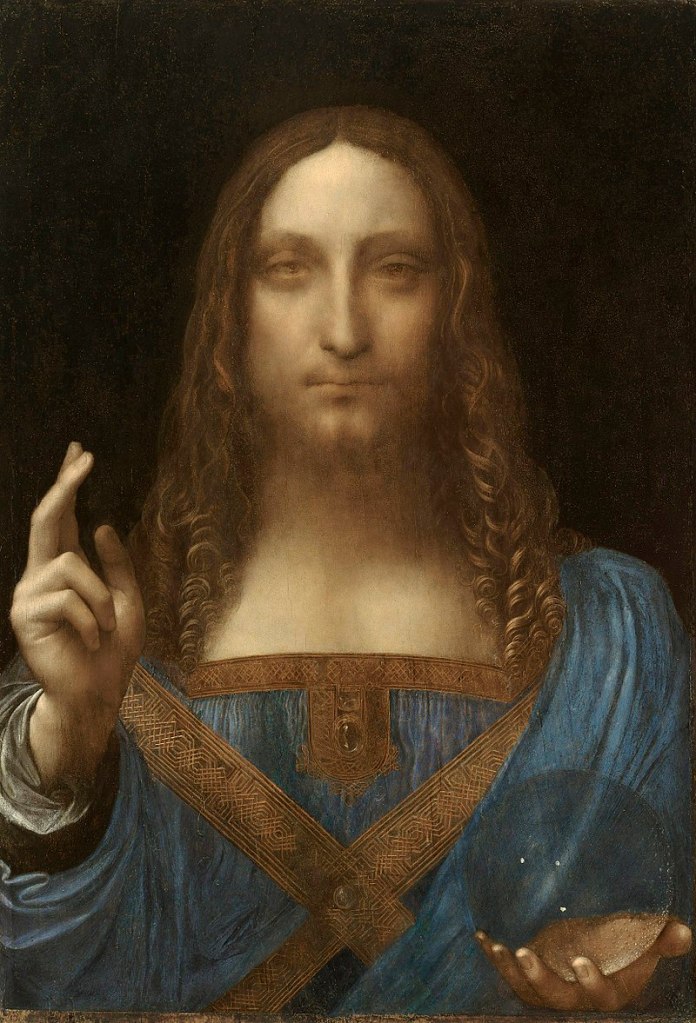
I don’t know if you all saw it or remember it, but the picture on the bulletin last week (it was Jesus by Leonardo da Vinci) generated a great many interesting comments during the coffee hour, some of which guaranteed eternal damnation for the speaker, but aside from that, Jackie Johnson asked an interesting question unrelated to the picture of Jesus. On the Friday following Easter, she had read the lesson in the Forward Day by Day that is also included in our Gospel today: “[Jesus] said to [the disciples], ‘Cast the net to the right side of the boat, and you will find some.’ So they cast it, and now they were not able to haul it in because there were so many fish. That disciple whom Jesus loved said to Peter, ‘It is the Lord!’”
The “disciple whom Jesus loved”: Jackie wanted to know who this person was and it is a good question.
There are five instances when the “disciple whom Jesus loved” appears in the Gospel of John. It doesn’t appear in any of the others. The first occurrence takes place at the Last Supper. Jesus tells the disciples that one of them will betray him. Peter wants to know who. “The disciple whom Jesus loved, was reclining next to him. Simon Peter motioned to this disciple and said, ‘Ask him which one he means.’ Leaning back against Jesus, [the disciple whom Jesus loved] asked him, “Lord, who is it?”
The second instance occurs at the foot of the cross. There are several women there including Mary, the mother of Jesus. Scripture says, “When Jesus saw his mother there, and the disciple whom he loved standing nearby, he said to her, ‘Woman, here is your son,’ and to the disciple [whom he loved], ‘Here is your mother.’ From that time on, this disciple took her into his home.”
Three days later, at the resurrection, Mary Magdalene discovered the empty tomb, “So she came running to Simon Peter and the other disciple, the one Jesus loved, and said, ‘They have taken the Lord out of the tomb, and we don’t know where they have put him!’” We know that Peter and this disciple then ran to the tomb to see for themselves.
Next is the occasion we read today: seeing Jesus on the beach, “the disciple whom Jesus loved said to Peter, ‘It is the Lord!’”
And the final occurrence is just a few verses on. Peter has been restored to Jesus after denying him three times and is now talking with him. Jesus has just told Peter how it is he will die, then “Peter turned and saw that the disciple whom Jesus loved was following them…. When Peter saw him, he asked, ‘Lord, what about him?’ Jesus answered, ‘If I want him to remain alive until I return, what is that to you? You must follow me.’”
The disciple whom Jesus loved: near to Jesus physically and spiritually and one who was also a close confidant. Remained with Jesus while Jesus was in pain. Was given Mary as his mother and was given to Mary as a child. Ran to see the empty tomb and be a witness to the resurrection. Recognized Jesus when all others were only focused on their daily life. Designated by Jesus to have a special purpose, even eternal life. Who was this disciple?
We know that it was the person who wrote what we know as The Gospel of John, because the second to last verse of the Gospel, referring to this disciple reads, “This is the disciple who is bearing witness about these things, and who has written these things, and we know that his testimony is true.” Even though it is called the Gospel of John, some believe that the disciple whom Jesus loved could possibly be Lazarus, whom Jesus raised from the dead, or Mary Magdalene, or James, the brother of John, or perhaps some unknown disciple, but this is all more modern scholarship and in my opinion, a gimmick for selling books. Those such as St. Augustine and others who were much closer to the time of Jesus have always named the disciple whom Jesus loved as being John the Apostle, the brother of James.
If that is the case, then why would John not just come out and say it? Maybe he just held the same opinion as Gregory Peck, “If you have to tell them who you are, then you aren’t.” Perhaps it was humility. Perhaps it was this or perhaps it was that. We don’t really know, but maybe it was the way he felt about himself in relationship to Jesus. He believed in his heart that he was a person who Jesus truly loved. Charles Spurgeon writes, “If [John] had any courage, if he had any faithfulness, if he had any depth of knowledge, it was because Jesus had loved these things into him. All the sweet flowers which bloomed in the garden of his heart were planted there by the hand of Christ’s love, so when he called himself ‘that disciple whom Jesus loved,’ he felt that he had gone to the root and bottom of the matter, and explained the main reason of his being what he was.” (Source)
John could think of no other way of understanding himself and the changes that had occurred in his life than to say that he was one whom Jesus loved. Did he think he was the only one? No. He wrote earlier in his Gospel, “when Jesus knew that his hour had come to depart out of this world to the Father, having loved his own who were in the world, he loved them to the end.” John did not believe that he was the only one Jesus loved. He knew that Jesus loved all those that had been given to him. So what if, in not naming himself but saying, “the disciple whom Jesus loved”, John was wanting others to see themselves also as ones whom Jesus loved? More specifically, what if John wanted us to see ourselves as the disciple whom Jesus loved and to realize that all the sweet flowers that bloom in our hearts are the result of Jesus’ love for us? What if, instead of trying to figure out who the disciple Jesus loved was, you come to realize that it is you? You are the disciple whom Jesus loves. You are the one who is near to Jesus physically and spiritually and who is a close confidant to him. You are the one who remains with Jesus while he is in pain. You are the one whose mother is Mary. You are a witness to the resurrection. You are one who recognizes Jesus when all others are focused on their daily lives. You have been given a special purpose by Jesus and you have the promise of eternal life. No, “What ifs?” You are the disciple whom Jesus loves.
Our Gospel tells us that Jesus built a fire beside the sea and then prepared breakfast for his disciples. When all was ready, “Jesus said to them, ‘Come and have breakfast.’” And then, “Jesus came and took the bread and gave it to them, and did the same with the fish.” As the disciple whom Jesus loves, you also are invited to this meal. To break bread with the one who loves and defines you. Gather around the fire of the Holy Spirit and enter into this great love and come to know yourself as the disciple whom Jesus loves.
Let us pray: God of Goodness, we come into your presence so aware of our human frailty and yet overwhelmed by your love for us. We thank you that there is no human experience that we might walk through where your love cannot reach us. If we climb the highest mountain you are there and yet if we find ourselves in the darkest valley of our lives, you are there. Teach us today to love you more. Help us to rest in that love that asks nothing more than the simple trusting heart of a child. Amen.
There is a painting that shows the charred debris of what had been a family’s sole possession. In front of this destroyed home, standing in deep snow, stood an old grandfather dressed only in his underclothes with a small boy who is clutching a pair of patched overalls. It was evident that the child was crying. Given the way they were dressed and the fact that nobody else was around you could tell they didn’t have anyone else or anything else except the clothes that were on their back and each other. No Red Cross person was going to drive up and offer them food, clothing, and shelter. Now, if you were the grandfather, what would you say to the weeping child to comfort him? All is lost. We’re done for. We’ll never make it. Or would you just start crying yourself?
The artist of this particular picture wasn’t much on despair, because beneath the picture were the words which the artist felt the old man was speaking to the boy. They were simple words, yet they presented a profound theology and philosophy of life that exhibited true hope. The grandfather said, “Hush child, God ain’t dead!”
From our Gospel, Jesus had appeared to the disciples, but Thomas wasn’t there. When the others tell him that they have seen the Lord, Thomas becomes upset and agitated, “I won’t believe the Lord is risen unless I see him myself and place my hand in his side.” Did he doubt the power of God? Did he not believe Jesus when he had said, “I will rise again?”
No. I don’t believe that was the way Thomas was looking at these events. Instead, I think Thomas had looked upon the blood-stained cross, he had seen or at least heard of the gaping wounds that had pierced Jesus’ body, he had placed all his hope in Jesus, and now without question, he knew Jesus was dead. All was lost. We’re done for. I can’t possibly believe that he is raised from the dead unless I see him myself, because I can’t get my hopes up again. I can’t be hurt like that again. Someone needed to lovingly turn to Thomas and say, “Hush child. God ain’t dead.”
In 1972, NASA launched the exploratory space probe Pioneer 10. According to Leon Jaroff in Time, the satellite’s primary mission was to reach Jupiter, photograph the planet and its moons, and beam data to earth about Jupiter’s magnetic field, radiation belts, and atmosphere. cScientists regarded this as a bold plan, for at that time no earth satellite had ever gone beyond Mars, and they feared the asteroid belt would destroy the satellite before it could reach its target.
But Pioneer 10 accomplished its mission and much, much more. Swinging past the giant planet in November 1973, Jupiter’s immense gravity hurled Pioneer 10 at a higher rate of speed toward the edge of the solar system. At one billion miles from the sun, Pioneer 10 passed Saturn. At some two billion miles, it hurtled past Uranus; Neptune at nearly three billion miles; Pluto at almost four billion miles. By 1997, twenty-five years after its launch, Pioneer 10 was more than six billion miles from the sun.
And despite that immense distance, Pioneer 10 continued to beam back radio signals to scientists on Earth. “Perhaps most remarkable,” writes Jaroff, “those signals emanate from an 8-watt transmitter, which radiates about as much power as a bedroom night light, and takes more than nine hours to reach Earth.”
The Little Satellite That Could was not qualified to do what it did. Engineers designed Pioneer 10 with a useful life of just three years. But it kept going and going. By simple longevity, its tiny 8-watt transmitter radio accomplished more than anyone thought possible. After more than 30 years, the venerable Pioneer 10 spacecraft sent its last signal to Earth on Jan. 23, 2003, having traveled 7.6 billion miles.
So it is when we offer ourselves to serve the Lord. God can work even through someone with 8-watt abilities. However, God cannot work through someone who quits.
That is not saying that there are no times when the wise decision is to quit. There are our bad habits. There are times when we realize that we are in the wrong. Sometimes it just makes sense not to continue in a direction and at other times it is a matter of coming to peace with a situation. There are all sorts of legitimate reasons for quitting a particular activity; however, fear, despair, disappointment, level of difficulty, and so on are not. Why? Because “God ain’t dead” and if God ain’t dead, then there is always hope.
Imagine, after trying something once, we say, “I’ll never do that again!” What about falling in love? What would happen after the first time you fall in love and had your heart broken you said, “I’ll never do that again.” What would you miss out on? How lonely would you be?
What if the first time you said a prayer and God answered by saying, “No.” How would things work out if you were to say, “I’ll never do that again?”
What if the Lord had not appeared before the disciples again and Thomas had remained in his denial? “I’ll never do that again. I’ll never believe unless I see him.”
In truth, we can find ourselves in similar situations all the time. It happens to us personally. It happens to us in our jobs. It can even happen in the church. Along with Thomas, we say, “All is lost. We are finished. I’ll never do this again. I quit.” But God responds, “Hush child. I’m not dead!” In other words, there is hope. What do we mean when we say, we have hope?
Václav Havel, the first president of Czechoslovakia following the fall of communism, wrote
“Either we have hope within us or we don’t. It is a dimension of the soul, and it is not particularly dependent upon some observation of the world. It is an orientation of the spirit, and of the heart. It transcends the world that is immediately experienced and is anchored somewhere beyond horizons. Hope is a deep and powerful sense and it is not the same as joy that things are going well or the willingness to invest in opportunities which are obviously headed for success. But rather, it is an ability to work for something because you believe in it. Hope is definitely not the same thing as optimism. It is not the conviction that something will turn out well, but the certainty that it makes sense regardless of results. It is hope, above all, which gives us the strength to live and to continually try new things.”
That is what we mean by hope. It is the kind of hope that declares, no matter the situation, “God’s not dead.” When I find myself in a position of losing hope, I recall a certain incident with Jesus. There was a father whose child was very sick. The father brought the child to Jesus’ disciples, but they could not heal the boy. Finally, Jesus arrives on the scene and the father says, “If you can do anything, take pity on us and help us.” Jesus responds, “‘If you can?’ Everything is possible for him who believes.” In other words, “Hush child. God ain’t dead.” Immediately the boy’s father exclaimed, “I do believe; help me overcome my unbelief!”
When you find yourself in times of losing hope then let that be your prayer, “‘I do believe. Help me overcome my unbelief.’ Help me to regain or to hold onto my hope that is in Christ Jesus the Risen Lord.” In the midst of that prayer remember—God ain’t dead!
Let us pray: O God, in whose image we all are made, give us hope that through the work of our hands, and with Jesus as our model, we may glorify you now and always. Amen.
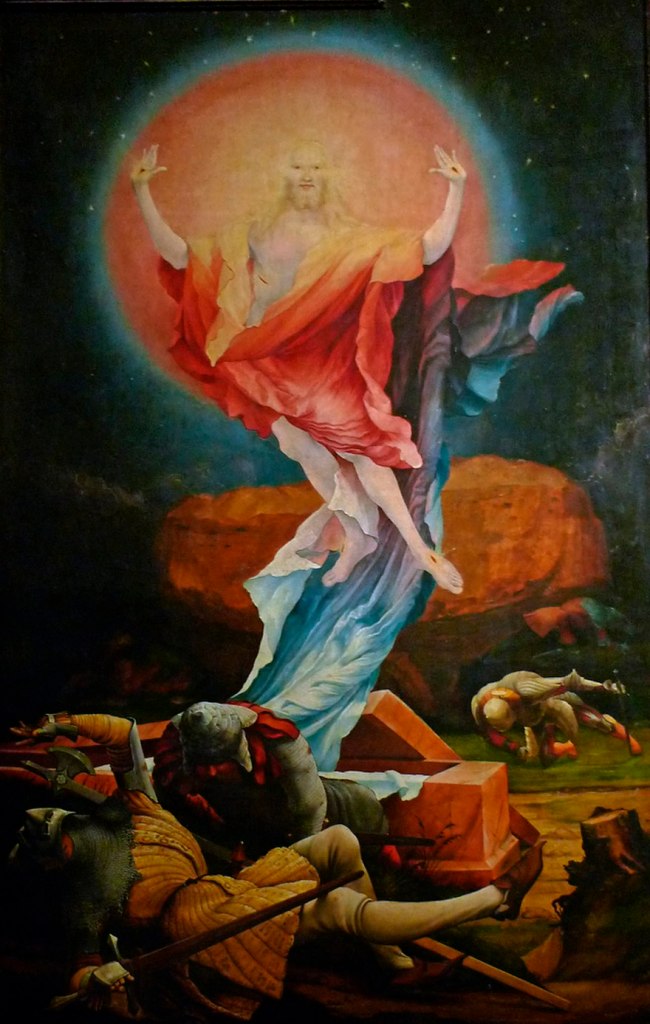
The Isenheim Altarpiece (1512–1516) by Matthias Grünewald (c. 1470 – 1528)
Mark Twain wrote, “No sinner is ever saved after the first twenty minutes of a sermon.” Today we’re here to put that theory to the test. No. Not really. If I hit the twenty-minute mark, you can tell me to shut up and sit down, but this is the Super Bowl and the World Series and the Stanley cup and the Master’s Golf Tournament of sermons all rolled into one. It’s the one I’m supposed to knock out at the park and wow everybody with. No pressure. None whatsoever.
In fretting over that, I’ve also thought about all the pessimism and skepticism in the world today and wondered how a few words of mine could make a difference. What can I say to you that will change anything? Not just that, but in order to be heard above the clamor of everything else, I’m going to need something to grab your attention. What could it be?
Well, if I just wanted to get a lot of attention, then I could stand up here and tell you that as a priest and as a church we really don’t believe that Jesus rose from the dead. That would get some attention. That would even get my bishop’s attention! The Facebook post would go off the charts and I’d probably even get a few “love letters” from people threatening to send me to meet Jesus. Yes. I could say that Jesus never rose from the dead and everyone would be up in arms, but if I say, “Jesus rose from the dead,” no one really gets excited. There are no angry posts on Facebook, the Bishop is not called, we can all go back home to our lives, and nothing and no one is actually changed. So the question is this: what would it take for this message—the Gospel of Jesus Christ, the love of God, and the resurrection to eternal life—what would it take for this message to actually change your life? Today’s Gospel reading helps us in the right direction.
Mary Magdalene went to the tomb. The stone was rolled away, so she runs and tells Peter and John who then get into a foot race to the tomb (John wins). They look inside and see that the tomb is empty and the cloth that Jesus had been wrapped in was set to one side. They saw all this, but they didn’t know what it meant, so what did they do? Our Gospel reading tells us, “Then the disciples returned to their homes.” They were probably confused more so than they ever had been. They were probably wondering who stole the body. They were also wondering how they could continue after the death of Jesus and wondering where do we go now? He’s dead. He’s gone. We’re here and everybody either hates us or thinks we’re freaks. The best thing we can do is just to go home. Go back to what we’re doing before we even knew the tomb was empty or even before we ever met him. For the most part that’s you and I. We hear this message, we know it intellectually, we read it every year. I would wager that most everyone is very well aware of this basic Christian message: “Christ has died. Christ has risen. Christ will come again.” It’s a very simple proclamation but so many hear it and then they just go back home. The message hasn’t changed their lives, but then we have the second part of our Gospel reading today.
Mary Magdalene has experienced the exact same thing as the disciples. She had witnessed the miracles and the teachings. She had been there for the trial, the crucifixion, the death, and the burial, but the one difference between the disciples and Mary is that on that morning, Mary heard Jesus call her name. She had a very real and personal encounter with the Risen Lord. And now everyone says, “Oh, Father John, you’re just preaching like an evangelical minister this morning! Going to tell me I need a personal relationship with Jesus Christ. Yes, you do. It’s true. But if that’s all I tell you then you’re just gonna go back home, not changed, so what is it you need to hear in order to believe this message of the Gospel so that you don’t just go back home unchanged?
If I was one of those really great passionate charismatic orators I might be able to tell you a story, give you an example, share my testimony about how God has changed my life or the life of so many others. I might even for a minute or for a day or season convince you to follow Jesus, but after doing this for almost twenty years I know that there isn’t anything I can preach that will ultimately turn a person’s heart. That was true even for Jesus. Judas heard every one of Jesus’ sermons and those sermons didn’t do him a lick of good. So what we do here on days like today is provide opportunities for souls to encounter God in hope that those souls won’t simply go home, but will instead stop and listen for God to speak their name just as he did with Mary.
When you decided to come to church this morning this is not what you were expecting to hear. You were probably expecting to hear Jesus Christ is risen today. Hallelujah. You would hear it then maybe go out to brunch, an Easter egg hunt, take a nap, but in the end, you would just go home. Would your life be changed? Would you stop everything to follow Jesus? I don’t know. But today, I don’t believe I can convince you, so instead of trying, I’m going to ask you to do something. I know, the preacher asking us to do something probably wants us to give money. Give Jesus $100 today and make a downpayment on that heavenly mansion. No. It’s nothing like that. Instead, I’m just asking that you go home and listen. Close yourself off in your room and sit quietly by yourself and say, “Speak Lord, for your servant is listening.” And then, listen. Listen for the voice of God. At first, you’ll probably think you’re crazy, but then somewhere in that silence, you will hear God speak your name and you will know that on the third day Jesus Christ rose from the dead and that all who call on his name will be saved to eternal life. You will know and you will be changed eternally.
Let us pray: For Your mercies’ sake, O Lord our God, tell us what You are to us. Say to our soul: “I am your salvation.” So speak that we may hear, O Lord; our hearts are listening; open our hearts that we may hear You, and say to our soul: “I am your salvation.” After hearing this word, may we come in haste to take hold of you. Amen.





 Candle in a Cave