The day before Ash Wednesday brings to an end the parades of Mardi Gras (French for ‘Fat Tuesday). Those celebrations likely have their history in some of the pagan festivals of Europe, but when those festivals came to France, they became more closely related to the Church. When they went to England, they became Shrove Tuesday or Pancake Day. Here, at St. Matthew’s, we get the best of both—and now that we’ve done it two years in a row, making it a time-honored tradition—we’ll have to call it Gumbo Day. When these festivals traveled south to the Caribbean and further into Brazil, they became known as Carnivale. Of all the names given, this one perhaps describes it best.
The word carnival comes from the combining of two Latin words: carnem (“flesh”) + levāre (“lighten, raise”)—carnem vale meaning, “Farewell to the flesh.” Farewell to those things that separate us from God. It is this definition that inspired Thomas Merton, in 1953, to write in his journal:
Carnivale, farewell to the flesh. It is a poor joke to be merry about leaving the flesh, as if we were to return to it once again. What would be the good of Lent, if it were only temporary?
Jesus nevertheless died in order to return to His flesh; in order to raise His own body glorious from the dead, and in order to raise our bodies with Him. “Unless the grain of wheat, falling into the ground, dies, itself remains alone.” So we cast off the flesh, not out of contempt, but in order to heal the flesh in the mercy of penance and restore it to the Spirit to which it belongs. And all creation waits in anguish for our victory and our bodies’ glory.
God wills us to recover all the joys of His created world in the Spirit, by denying ourselves what is really no joy—what only ends in the flesh. “The flesh profits nothing.” (A Year with Thomas Merton: Daily Meditations from His Journals, February 19)
“What would be the good of Lent if it were only temporary?” What would be the good of Lent if all the practices we establish for our lives in order to draw nearer to God during this season were cast off on Easter Sunday? What would be the good of Lent if we returned to Fat Tuesday lives?
One of the things I give up most Lents is social media—all that scrolling. I’m not sure how much time I spend on it, which tells me it is probably too much. I also know that I’ll pick it back up again after Easter. It is something I enjoy. That’s a Lenten practice that I think can be temporary, but what if I decided that I would also spend more time in prayer or more time reading the Word of God? Should that be temporary? “Oh, it’s just a Lent thing. Only temporary.” I’ll give a bit of time to God for a few weeks, but when the season is over, I can quit that silliness. That’s not how it is supposed to work. Our Lenten practices should bring about permanent changes, transformations in our lives.
“Remember that you are dust, and to dust, you shall return.” Remember that you are God’s, and your life with Him is not temporary. Let your Lenten practices become—not just something you are doing for a season, but instead, let them become a part of who you are.
I’m not sure who said it, but I came across this quote: “You know you’re a mom when you’ve been washing the same load of laundry for three days because you keep forgetting to put it in the dryer.” I suppose that can be true for all of us, but I’m happy to report that I can do laundry, and I know that I’m supposed to sort the colors. For me, that’s pretty easy. 90% of my laundry is black.
When it comes to laundry, we do a lot—on average, 7.4 loads per week. The average load contains 16 items, and the average household will wash approximately 6,000 items annually. If your water bill goes up, you can look to your washing machine. On average, you use 41 gallons of water per load, resulting in national annual water usage of 19 billion cubic meters. That’s enough water to fill 7,600,000 Olympic size swimming pools. All that to say, we do a lot of laundry, and no matter how much you do, there is always more in the waiting.
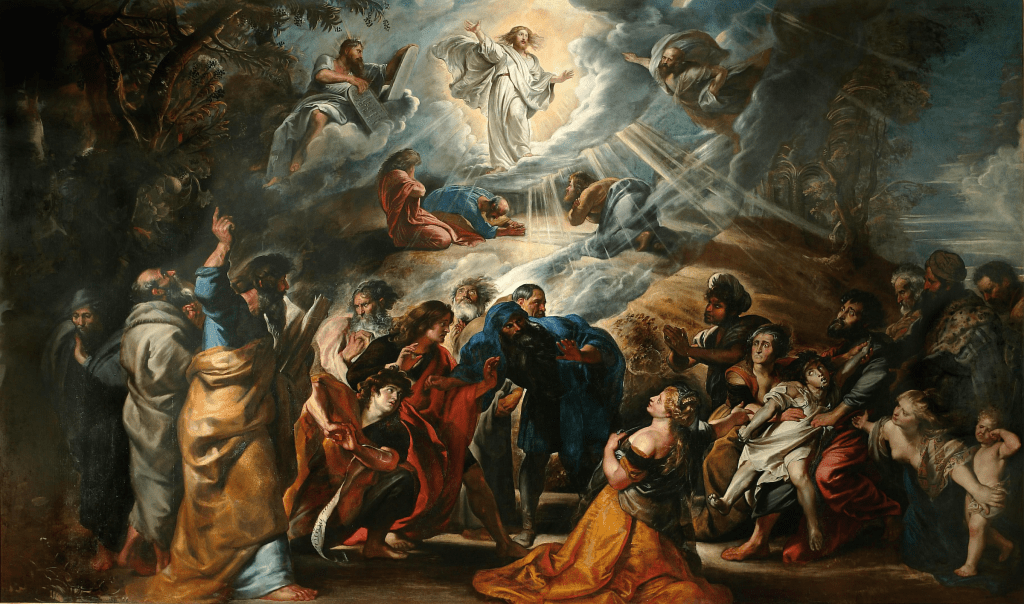
Today is the Sunday of the Transfiguration. It was a revealing of Jesus’ true nature. The light that the apostles witnessed was not a light from above but was instead the glory of God radiating outward from within Jesus. That glory is how we will one day not only see him but see ourselves when we are restored to our Father. As Jesus says, “Behold, I make all things new,” and this is what we will be when we are made new in Christ.
The only problem is that is then, and this is now. Then we radiate the glory of God, but now we have 7.4 loads of dirty laundry that have got to be washed. There is the Transfigured Lord, and there we will one day be, and there lays piles and piles of dirty laundry! How can the two possibly be reconciled in this life?! We ask that question as though we are the first to encounter such a predicament, but as we all know, that’s the way of history.
For example, those two men who were seen with Jesus on the mountaintop, Moses and Elijah. Moses was the great savior of the people from Egypt and the one who presented God’s law to the people. Moses went up on the mountain and witnessed the glory of the Lord. He saw Him in the burning bush. He saw God in the cloud. The glory of the Lord passed before Moses as he stood protected in a crevice in the mountain. Moses comes off the mountain; he is glowing with the glory of the Lord. God has given him the Ten Commandments, written on two stone tablets by God’s own hand, and what does Moses encounter when he gets down the mountain? The people have made a golden calf and are all dancing the hoochie coochie around it. He is literally radiating with the Glory of God, yet piles and piles of dirty laundry surround him.
The prophet Elijah was in fear for his life. The people were trying to kill him. The Lord said to him, “Go out and stand on the mountain in the presence of the LORD, for the LORD is about to pass by.” Scripture details the encounter, “Then a great and powerful wind tore the mountains apart and shattered the rocks before the LORD, but the LORD was not in the wind. After the wind, there was an earthquake, but the LORD was not in the earthquake. After the earthquake came a fire, but the LORD was not in the fire. And after the fire came a gentle whisper. When Elijah heard it, he pulled his cloak over his face and went out and stood at the mouth of the cave. Then a voice said to him, ‘What are you doing here, Elijah?’” Elijah climbed the mountain and encountered God in the still, small voice. He came down off the mountain and found himself back in the laundry room.
The same occurred with Jesus. He was transfigured, and as soon as he came down off the mountain, there were people calling to him for help. The apostles who had witnessed the Transfiguration would not be floating through life on angel wings when they came off the mountain. In just a few short weeks, they would witness the Transfigured Christ being arrested, beaten, and crucified. There is the mountain, the transfiguration of the Lord, the glory of the Lord all around, and no sooner than you think you have found the answer—finally gotten it right—then you crash back down again to what we so simply refer to as the “real world.”
However, even in the midst of that “real world,” you will never be the same because, in the Transfiguration, you have seen what is to come and what will be. Martin Luther King, Jr. referred to this in his famous speech. He declared, “I don’t know what will happen now. We’ve got some difficult days ahead. But it doesn’t matter with me now. Because I’ve been to the mountaintop. And I don’t mind. Like anybody, I would like to live a long life. Longevity has its place. But I’m not concerned about that now. I just want to do God’s will. And He’s allowed me to go up to the mountain. And I’ve looked over. And I’ve seen the promised land. I may not get there with you. But I want you to know that we, as a people, will get to the promised land. And I’m happy. I’m not worried about anything. I’m not fearing any man. Mine eyes have seen the glory of the coming of the Lord.”
We tend to say, “When I get all this laundry done, I will be with God. I’ll stop and pray when the ‘real world’ just isn’t so real.” Yet the Lord would have us understand that what we witness on the mountain is not something we leave there. Instead, we bring it with us. We cherish it. We allow the light of that one transfigured moment to penetrate every aspect of our lives. Not just as a dream of things to come but as a promise for today.
The theologian John Brodie wrote, “Oneness with ultimate reality [with God] is not an abstract idea; it is a spiritual experience of knowing that the timeless God is at the door inviting you to full union. It is an attentiveness to the present, a readiness, at every moment, to receive reality, to enjoy deeply even the simplest things.” In the words of the poet Paul Murray: ‘This moment, the grace of this one raptureless moment… the grace of this one joyfully ecstatic moment.’” It applies to every aspect of our life.
Consider how much time you spend worrying. Can you change yesterday? Can you change tomorrow? You are here. This—right now—is the time of your life. This is where you will encounter the immediate presence of God. You will have to do laundry—everything from turning the nasty socks right side out to dealing with all the other things, good and bad, that life has to throw at you, but there is this confidence in knowing that God is with us. Blessed Bonaventure instructs us wonderfully, “In the midst of our employments—in the midst of our daily lives—we ought to have God present to our minds, in imitation of the holy Angels who when they are sent to attend on us, quiet themselves of the function of this exterior ministry as never to be drawn from their interior attention to God.” The angels don’t allow things outside of themselves to draw them from the glory of God that is within. Here is a challenge for you: the next time you have some menial, tedious task to attend to—the next time you have to do laundry of any sort—perform it well, but do so with the glory of the Transfigured Lord in your heart and see what a difference it makes.
The Transfiguration is a glimpse. It is a sacred snapshot of what is to come, and it reminds us that whether we are on the mountain with God or in the laundry room with piles of dirty laundry—God is with us. The service of Evening Prayer contains one of the most ancient Christian hymns, the Phos hilaron, “O Gracious Light.” In it, we declare of God, “You are worthy at all times to be praised by happy voices, O Son of God, O Giver of life, and to be glorified through all the worlds.” At all times! Not just when we are in church for an hour on Sunday or when it is convenient, or when we are in the right mood, but at all times. At all times, we can know the glory of the Transfigured Lord. We can radiate his glory, not from above, but from within, and today be transfigured as he is.
Let us pray. Holy God, mighty and immortal, you are beyond our knowing, yet we see your glory in the face of Jesus Christ, whose compassion illumines the world. Transform us into the likeness of the love of Christ, who renewed our humanity so that we may share in his divinity, the same Jesus Christ, our Lord, who lives and reigns with you and the Holy Spirit. Amen.
I once heard of a farmer who had a complaining wife. From morning till night, she would complain about something or the other. He only got relief when he went to the farm with his donkey. One day as he was plowing, his wife brought him lunch. He put the donkey in the shade of a tree and began to have his lunch. Immediately, his wife began her complaining. Suddenly, the donkey lashed out with both hind feet, hit her, and killed her on the spot. At the funeral, the pastor noticed something odd.
When women would come, the farmer would listen for a minute and nod his head in agreement, but when men approached him, he would listen for a minute and shake his head in disagreement. This was so consistent that the pastor decided to ask him about it. After the burial, the pastor asked him why he nodded in agreement with the women but always shook his head in disagreement with all men. The farmer said, “The women would come up and says something nice about my wife — how she cooked, how good she was, and so on. I’d nod my head in agreement.” “And what about the men?” the pastor asked. “The men knew that the donkey killed my wife, and all they wanted to know was if my donkey was for sale.”
That’s a goofy way of putting it, but it does point out that we all have different ways of understanding the same set of circumstances or information. An article I was reading said that human beings have an “adaptive capacity to ‘construct their own reality’ and [this] is the way a person makes sense of things in the face of incomplete or ambiguous information…. Most of the time, we fill the gaps with our own biases, assumptions, beliefs, thoughts, ideas, and conclusions.” (Source) You look out and see a rainy day, and you may describe it as “Blah,” but if you ask a farmer, he’ll give you a very different answer. It is the same when it comes to interpreting Holy Scripture.
Consider this: a 2012 study from Gordon-Conwell Theological Seminary determined that there are roughly 43,000 Christian denominations and that this number would increase to 55,000 by 2025. They estimate that a new Christian denomination is formed every 10.5 hours. That’s more than two a day! (Source) So much for being “one body.” If you were to investigate why there are so many, I’m guessing that in many cases, the answer would be because of differences in interpreting and applying Holy Scripture. The problem, in this case, is a difference in hermeneutics. What is that?
In the next couple of days, Americans will spend $2.3 billion on flowers, and many of those flowers will be distributed by independent florists who are associated with FTD (Florists’ Transworld Delivery). They are the ones who link all these florists together and allow you to send flowers to people around the world.
In dealing with these florists, you may or may not have noticed the FTD logo: a man with wings on his feet (actually his sandals) and his hat. This is Hermes, one of the many Greek gods. He is supposed to be able to move quickly between humans and the other gods and act as a herald of the gods, bringing messages to us lowly creatures. Hermes was an interpreter of the messages of the gods. Picking up on this idea, Aristotle first used hermeneutics to describe the act of interpreting. There are so many different Christian denominations because we are all using different hermeneutics to understand Holy Scripture. This goes back to the fact that we all look at things differently—including Holy Scripture—with our own biases, assumptions, etc. Not only is this true within Christianity, but it is true in all religions, including Judaism.
When the Israelites received the Law, their teachers took it and gained a particular understanding of its meaning. However, even amongst them, there were differences. A different hermeneutic was applied, which is why, by the time of Jesus, there were Sadducees, Pharisees, and Essenes. Applying a hermeneutic to the Mosaic Law, the Sadducees were primarily concerned with the sacrificial system at the Temple and the application of the laws found only in the Torah. The Pharisees were focused on the Law and the intricate details of additional interpretation. They loved to argue. Modern Judaism is most closely related to the Pharisees’ understanding. And the Essenes, well, they were disgusted with both these other groups and went off and applied a rigorous hermeneutic—interpretation—of the Law. It was the three sects of Judaism that were their ‘denominations.’ Each uses a different hermeneutic for their interpretation of the Law. What does this have to do with anything today?
Today’s Gospel reading is broken down into four paragraphs. The first paragraph begins, “Jesus said, ‘You have heard that it was said to those of ancient times.…’” The second: “You have heard that it was said.….” The third: “It was also said.….” And the fourth: “Again, you have heard that it was said to those of ancient times.….”
Each of these statements is then followed by one of the Ten Commandments or, in the case of divorce, a broader view of the Commandment on adultery. For example, “You have heard that it was said to those of ancient times, ‘You shall not murder’; and ‘whoever murders shall be liable to judgment.’” However, in each of the four statements, Jesus adds, “But I say to you….” “You have heard that it was said, ‘You shall not commit adultery.’ But I say to you….” and he goes on from there.
The people have had the Law interpreted for them by one or all three denominations: Sadducees, Pharisees, or Essenes. Jesus was saying, You have heard it said ___, and this is your understanding, but… these teachers of yours are using the wrong hermeneutic. Their interpretation is wrong, and I am providing the correct interpretation, as God intended.
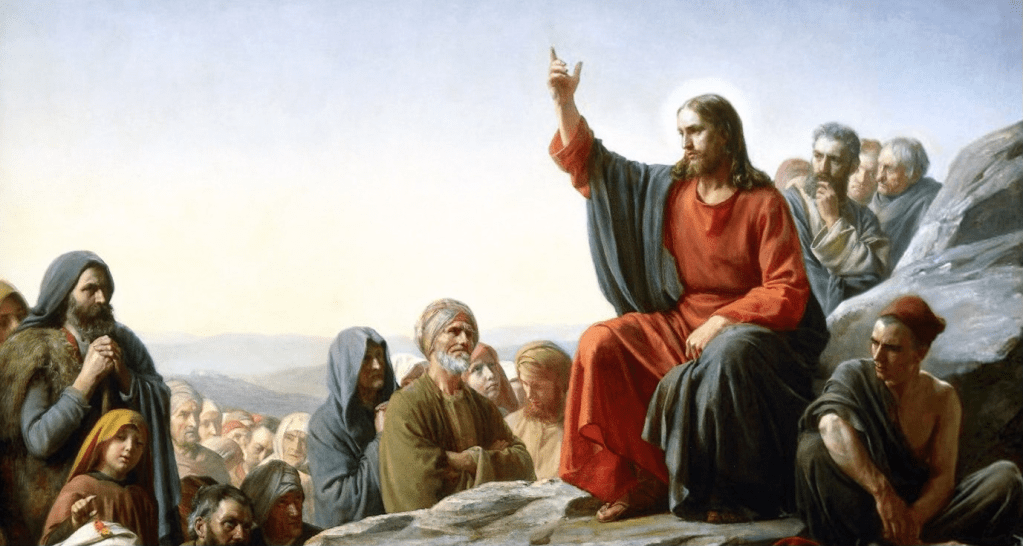
Last Sunday (and this Gospel lesson immediately follows last week’s and is still a part of the Sermon on the Mount), when Jesus said that he did not come to abolish the Mosaic Law but to fulfill it, what he was saying is that he came to bring the Mosaic Law to its intended meaning and conclusion, so these statements—“You have heard it said… but I say to you.”—are examples of how this fulfilling of the Law is accomplished.
It would be very easy to look at these teachings of Jesus as a new moral law. A law that replaces the old law, but notice, Jesus only went through some of the Ten Commandments, and he barely even touched on the further expansion of the Law that the Pharisees taught, so Jesus is trying to accomplish something else by this teaching. What could it be? I think N.T. Wright comes close to answering that. Wright says, “Throughout this chapter [chapter five of Matthew’s Gospel], Jesus is not just giving moral commands. He is unveiling a whole new way of being human.” And not only is Jesus unveiling a whole new way of being human, but he is also living it. And in living it, he is showing us how to live it.
Our hermeneutic, our understanding of God, is not limited to the text of Holy Scripture. And please don’t burn me at the stake or call the Bishop for saying this, but I would dare say that our primary hermeneutic is not the text at all. Instead, it is the life and person of Jesus Christ. We don’t seek to know God by only understanding the text. Yes, we can have an academic understanding of God by studying the text, but we can only know God by knowing His son, Jesus—by joining our lives with His.
Think of Jesus’ great priestly prayer the night before He was crucified. He prayed for his apostles and then said, “I do not ask for these only, but also for those who will believe in me through their word, that they may all be one, just as you, Father, are in me, and I in you, that they also may be in us, so that the world may believe that you have sent me… I in them and you in me, that they may become perfectly one.” Not one with the text, but one with Him.
When Jesus said, “…but I say to you…,” then we are to follow his teachings, but more importantly, we are to apply the idea of that teaching to every aspect of our lives so that we might discover that whole new way of being human for ourselves.
See the progression… Thou shall not commit murder. Don’t even become angry. Pray for your enemies. Turn the other cheek. Settle the argument. Give them your cloak. Love one another. That is what Jesus taught, and it is what he lived. To the letter. With Jesus as your hermeneutic—your understanding of God—go and live the same. This is the way to God.
Let us pray: Loving Father, faith in Your Word is the way to wisdom. Help us to think about Your Divine Plan so that we may grow in the truth. Open our eyes to Your deeds, our ears to the sound of Your call, so that our every act may help us share in the life of Jesus. Give us the grace to live the example of the love of Jesus, which we celebrate in the Eucharist and see in the Gospel. Form in us the likeness of Your Son and deepen His Life within ours. Amen.
Josephine Margaret Bakhita was born in Sudan in 1869. Around the time she was eight years old, Arab slave traders kidnaped her. Over the next eight years, she would be bought and sold at least twelve times, frequently being severely mistreated. She was eventually brought to Italy and, while her owners were away, was placed in the care of the Canossian Sisters in Venice, where she learned about God.
When her owners returned from their journey, Josephine refused to leave the convent, so the sisters put up a legal challenge to her removal. Through that process, it was discovered that Josephine had been sold into slavery after it had been outlawed in Sudan, so she was not legally enslaved and therefore given her freedom.
At that time, Josephine could have gone and made her way in the world, but instead chose to remain at the convent and was baptized. She would take her vows with the Canossian Daughters of Charity in 1896 and live the remainder of her life, forty-two years, at the convent in Schio, Vicenza, Italy, where she served as a cook and doorkeeper. She was affectionately known as Little Brown Sister and very respectfully called Black Mother.
She said, given the opportunity, instead of cursing her kidnappers, she would thank them, for had she remained in Sudan, she would never have come to know Jesus.
Today, in our Psalm (91), we prayed:
He who dwells in the shelter of the Most High, abides under the shadow of the Almighty. He shall say to the Lord, “You are my refuge and my stronghold, my God in whom I put my trust.” He shall deliver you from the snare of the hunter and from the deadly pestilence. He shall cover you with his pinions, and you shall find refuge under his wings.
I wonder what thoughts Josephine may have had when she first read those words. How she remembered taking refuge in the shelter of the convent, being released from the snare of slavery, and watched over by the sisters and her Loving God.
When asked about her loving God, she said that, as a child, “She had experienced in her heart without knowing who He was. Seeing the sun, the moon, and the stars, I said to myself: Who could be the Master of these beautiful things? And I felt a great desire to see him, to know Him, and to pay Him homage.” Having been a slave and had many masters, it is interesting that she referred to God as her Master. When asked about the hardships in her life, she would sweetly smile and reply, “As the Master desires.”
She died on this day in 1947. Her last words, “Our Lady, Our Lady!” On that day, we can say with assurance that her Master and ours said to her, “Well done, good and faithful servant; you have been faithful over a few things, I will make you ruler over many things. Enter into the joy of your lord.”
Several years ago, at a passion play, an incident occurred during Jesus carrying the cross. A man in the audience was heckling the character playing Jesus, throwing out jeers, taunts, and dares. Finally, the character could no longer tolerate the heckler; he dropped the cross, went over, and punched out the man. The director was aghast and, after the play, pulled the actor aside and told him in no uncertain terms that he was never to do that again. But the next night, the same heckler was back, and the same thing happened again. Jesus, this time, had to be restrained. The director called the actor in and gave him an ultimatum of quitting or keeping his composure. The young actor assured the director he would keep himself under control. On the third night, the heckler was present again and taunted even stronger than the two previous nights. The man playing Jesus rose to his full stature, gritted his teeth, and told the heckler, “I’ll see you right after the resurrection.”
Today our Gospel reading was from Matthew 5:13-20, and they are a part of the Sermon on the Mount, following immediately after the Beatitudes. Verses 13 through 15 of our reading, which speak of salt and light, make for good sermon material. Verse 20—“For I tell you unless your righteousness exceeds that of the scribes and Pharisees, you will never enter the kingdom of heaven.”—also makes for a good sermon, but verses 16 through 19… those are best left alone. What did they say?
Jesus said, “Do not think that I have come to abolish the law or the prophets; I have come not to abolish but to fulfill. For truly I tell you, until heaven and earth pass away, not one letter, not one stroke of a letter, will pass from the law until all is accomplished. Therefore, whoever breaks one of the least of these commandments, and teaches others to do the same, will be called least in the kingdom of heaven; but whoever does them and teaches them will be called great in the kingdom of heaven.”
You wouldn’t be the first if you were confused by the meaning of that statement. In fact, it is still up for debate, but perhaps we can come close, and it primarily hinges on our understanding of the word fulfill.
When we consider the word fulfill, we might think of fulfilling an order or fulfilling the requirements for something, but to fulfill can also mean “to bring to an end” (Merriam-Webster) or to bring “to its intended meaning.” (Word Biblical Commentary, p.106) When Jesus said that he did not come to abolish the Law but to fulfill it, he was saying that he came to bring the Law to its end by fulfilling it as it was intended. When Jesus spoke these words, the fulfillment was a work in process. It would not be completed until the Cross.
It was there, on the Cross, that every letter—every jot and tittle of the Law was fulfilled and completed in the life and teachings of Jesus. The Apostle Paul wrote, “For the commandments, ‘You shall not commit adultery, You shall not murder, You shall not steal, You shall not covet,’ and any other commandment, are summed up in this word: ‘You shall love your neighbor as yourself.’ Love does no wrong to a neighbor; therefore love is the fulfilling of the law.” (Romans 13:9-10) Love fulfills the Law, and there is no greater act of love than Christ giving Himself on the Cross that we might have life in him. It was then and there that the Law was brought to its intended end, but it was also there that you and I were called to a much higher standard because before he departed, Jesus gave us a new commandment so that we might be His true disciples. Jesus said, “A new commandment I give to you, that you love one another: just as I have loved you, you also are to love one another. By this all people will know that you are my disciples, if you have love for one another.” (John 13:34-35)
Jesus brought the Mosaic Law to its intended meaning, so he did not abolish it; he lived it—every jot and tittle—and He asks us to do the same. Jesus said, “I tell you, unless your righteousness exceeds that of the scribes and Pharisees, you will never enter the kingdom of heaven.” Jesus said, “The Pharisees lived the Law externally—they ‘clean the outside of the cup and the plate, but inside they are full of greed and self-indulgence.’ (Matthew 23:25b) The Pharisees were all show, but on the inside, not so good. So if like them, you only give lip service to this new commandment, then you are no better than they are.”
“No,” says Jesus. “You must fulfill the Law by loving one another as I have loved you. And ‘greater love has no one than this, that someone lay down his life for his friends.’” (John 15:13) That is the new standard. So… how ya doin’? Is that how you are living your life? Is that the Law you are fulfilling in your life? In answering this, most of us could probably agree with Ernestine, the telephone operator, Lili Tomlin, “If love is the answer, could you rephrase the question?” Yet, would Jesus have given us this mandate to love as he loves if it were impossible? And if it is, then why don’t we?
I won’t speak for you, but I will speak for myself. I don’t know how to love like that. I don’t even know if I have it within me, but I also know that’s the devil within giving me an excuse. A way out of applying my body and soul to live in such a way. If I can set aside those excuses, then why? Well, I can give you some philosophical explanation or discuss the heresy of Pelagianism or something along those lines. Still, if I am honest with myself, the answer to why I can’t love as Jesus loves is—deep down inside—I don’t want to. I want to want to, but I also want to live my life according to my rules. There is this war inside of me, and the good guys don’t always win. But… that does not give me permission to stop wanting it. To stop trying. As a disciple of Jesus, I have a standard set for my life, and that standard is Jesus, so He must always be my aim. Regardless of my successes and failures, I must never stop trying.
George Herbert wrote The Country Parson. Included at the beginning was a “Note to the Reader.” Here, Herbert writes, “I have resolved to set down the Form and Character of a true Pastor, that I may have a Mark to aim at: which also I will set as high as I can, since he shoots higher that threatens the Moon, than he that aims at a Tree. Not that I think, if a man do not all which is here expressed, he presently sins, and displeases God, but that it is a good strife to go as far as we can in pleasing of him, who hath done so much for us.” (The Classics of Western Spirituality edition, p.54) We aim for the stars. We aim for Jesus. There will be days when we come close to hitting the stars, and there will be days when—regardless of how hard we try, how many times we’ve been corrected with threats of losing everything, we will raise our fists and shout, “I’ll see you right after the resurrection.” On those days, the One who fulfilled and completed the Law will fulfill and complete our weak efforts through his grace and mercy. Those are the days when we get back on our feet, confess our sins, and try once more to fulfill the New Commandment to love as Jesus loves.
Let us pray: God, our Father, You redeemed us and made us Your children in Christ. Through Him, You have saved us from death and given us Your Divine life of grace. By becoming more like Jesus on earth, may we come to share His glory in Heaven. Give us the peace of Your kingdom, which this world does not give. By Your loving care, protect the good You have given us. Open our eyes to the wonders of Your Love that we may serve You with a willing heart. Amen.
A King had a male servant who, in all circumstances, always said to him; My king, do not be discouraged because everything God does is perfect, no mistakes.
One day, they went hunting, and a wild animal attacked the king; the servant managed to kill the animal but couldn’t prevent his majesty from losing a finger. Furious and without showing gratitude, the King said; if God were good, I would not have been attacked and lost one finger.
The servant replied, ‘despite all these things, I can only tell you that God is good and everything He does is perfect, He is never wrong.’ Outraged by the response, the king ordered the arrest of his servant. While being taken to prison, he told the king again that God is Good & Perfect. Another day, the king was left alone for another hunt and was captured by savages who used human beings for sacrifice.
On the altar, the savages found out that the king didn’t have one finger in place; he was released because he was considered not “complete” to be offered to the gods. On his return to the palace, he ordered the release of his servant and said; My friend, God was really good to me. I was almost killed, but I was let go for lack of a single finger.
But I have a question; If God is so good, why did He allow me to imprison you? His servant replied; My king, if I had not been put in prison, I would have gone with you and been sacrificed because I have no missing finger.
Finding the good in a good situation is easy, but how difficult is it to find the good in what is perceived as a bad situation?
These days, it is quite common to hear someone say, “I’m so blessed,” which is then followed by an explanation of why. “I’m so blessed because I have good health.” “I’m so blessed because I have a good job and nice things.” “I’m so blessed because ____.” But does this mean that the person with bad health is unemployed or ____ is not blessed? Or is it, when they think of the word “blessed,” we…
Have you ever seen the movie The Princess Bride? Vizzini is one of the semi-evil characters who occasionally comes up with excellent advice. For example, I can think of one world leader who could have benefitted from: “Never get involved in a land war in Asia,” but no one asked. Anyhow, Vizzini keeps using the word “inconceivable.” After the umpteenth, Inigo Montoya—he’s looking for the man with six fingers—says to Vizzini, “You keep using that word. I do not think it means what you think it means.” We keep using the word blessed, but I don’t think it means what we think it means because so often, when we say we are blessed, it is the equivalent of saying, “I’m so lucky.” However, being blessed and being lucky are two very separate things. To understand the true meaning of blessed, we must look for its use in Holy Scripture.
Consider the Israelites. Following the Exodus from Egypt, the Lord spoke to Moses as the people wandered in the desert. On one occasion, the Lord told Moses to speak to the people and say, “If you obey my voice and keep my covenant, you shall be my treasured possession out of all the peoples. Indeed, the whole earth is mine, but you shall be for me a priestly kingdom and a holy nation.” Put another way, “If you obey my commandments, you will be blessed, for I will set you apart from all the other nations of the earth. And in setting you apart, you will serve my purposes.” We hear it again in Deuteronomy, “For you are a people holy to the Lord your God; the Lord your God has chosen you out of all the peoples on earth to be his people, his treasured possession.” So, to be blessed is to be set apart for God’s purposes. To say you are blessed because you have good health is only half the equation. If you are blessed because you have good health, what is God’s purpose for your good health? If you are blessed because you have an excellent job with a good income, what is God’s purpose for blessing you with these things? But it doesn’t stop there because once you are set apart and discern God’s purpose, you must respond—you must fulfill the purpose.
The idea of being blessed applies to individuals, but it also applies to things. Think of the bread and the wine at the Eucharist. During the Eucharistic prayer, we bless/consecrate the bread and the wine for God’s purpose, that is, to become the Body and Blood of His Son so that we, God’s children, might have food for our souls.
Yet, bread and wine, a good job, and good health are easily identified as blessings, and if we discern God’s purposes, we can use these blessings for Him, but what about those things that are not so easily identified as blessings? Take, for example, the flea. Is there ever a time when a flea is a blessing?
We just finished reading and discussing The Hiding Place by Corrie Ten Boom in our Saints Book Club. She wrote about the life she and her family had before the Nazi invasion of Holland. She, her father, and her sister, Betsie, would eventually be arrested and placed in concentration camps. Upon their arrival at Ravensbruck, she and her sister were placed in temporary quarters, and the beds were covered with straw. They crawled into the bunks and were immediately covered in lice. It was miserable, but all the women came together, cut each other’s hair, and endured. After a time, they were moved into permanent quarters.
There, the sleeping arrangements were similar. Three layers of cots shoved closely together and covered in straw. Corrie and her sister were assigned to bunks on the second tier. She writes, “Suddenly I sat up, striking my head on the cross-slats above. Something had pinched my leg. ‘Fleas!’ I cried. ‘Betsie, the place is swarming with them.’”
They scrambled out, and just as Corrie seemed about to lose it, Betsie began to pray. She remembers a passage of Scripture they had read earlier in the day, “Give thanks in all circumstances.”
Praying, Betsie says, “Thank you for the fleas and for—.”
“The fleas!” Writes Corrie. This was too much. “Betsie, there’s no way even God can make me grateful for a flea.”
“Give thanks in all circumstances,” Betsie quoted. “It doesn’t say, ‘in pleasant circumstances.’ Fleas are part of this place where God has put us.”
Corrie wrote, “And so we stood between piers of bunks and gave thanks for fleas. But this time I was sure Betsie was wrong.”
While housed in this particular barrack, what they found to be so interesting, was the fact that neither the guards nor the supervisors entered the barracks to harass or even oversee them, which allowed them the opportunity to begin to hold prayer meetings inside the barracks with no interference. Soon they were ministering to so many women. Attitudes changed. What had been a place of total despair and self-reliance, and distrust turned into a place of hope, community, and faith. Why? Fleas. You see, Betsie later learned that the guards and the prisoner supervisors knew very well that the building was swarming with fleas, and no matter the need, they refused to put a foot inside for fear of being infected themselves.
Today in our Gospel, we read, “Blessed are the poor in spirit, for theirs is the kingdom of heaven. Blessed are those who mourn… the meek… those who hunger… the merciful… and more.” Betsie would have added, “Blessed are the fleas, for they shall bite the guards and keep them away.”
The lowly flea was created by God and blessed by God, and even it served God’s purpose.
We may not always easily see how we are blessed when we mourn, are meek, or are hungry. Still, if we will pray through those circumstances and discern, we begin to understand how all these things can serve God. When we mourn, we know the pain of so many and can seek to find ways to alleviate some of that pain. When we are meek, we can discern the position of many who are dispossessed and look for opportunities to love. When we are hungry, not only can we begin to understand those who go without food, but we can also translate that into those who hunger for God and then provide ways to feed both body and soul.
Are you blessed? As Betsie would remind us, we are blessed in all circumstances—the pleasant and the unpleasant—so let us discover how we might use all those blessings for God’s purposes.
Let us pray:
O Lord our God, Your grace has achieved for us all that You had spoken and promised. Grant us access to the place of Your peace. For You are our Lives, You are our Consoler, You are our life Remedy, You are our Standard of Victory. Blessed are we, O Lord, because we have known You! Blessed are we, because we have believed in You! Blessed are we, because we bear Your wounds and the sign of Your Blood on our countenances! Blessed are we, because You are our great hope! Blessed are we, because You are our God forever! Amen.
I had been working on a house, rewiring some outlets. The outlets were on the first floor, but the breaker box was down in the basement. For whatever reason, I could not get this one outlet to work from a switch on the wall, so I would make an adjustment, run downstairs, flip the breaker, run back upstairs, test the switch, and then when it still wouldn’t work, go through it all again.
I don’t know about you, but in the middle of these frustrating projects, I’ll get some less-than-brilliant idea and try something new. In this case, my less than brilliant idea: “I’m tired of going up and down the dang stairs. I can make these adjustments without flipping the breaker.” I was unsuccessful and quickly learned what it felt like to be hit with a cattle prod.
The cattle prod comes in many different forms. There is the electrical node on the end of a stick used to get cattle to move along, and the bark collar is working off that same principle—a rather unkind way of trying to teach a dog not to bark at everything. And then there is the ultimate cattle prod known as the police taser, which attempts to teach hardheaded individuals to stop what they are doing. These devices, especially the cattle prod, are descendants of the ox goad.
The ox goad is a long stick with a sharp metal point on one end. The farmer, behind a plow, would hold the point of the goad around the oxen’s ankles and use it to guide the animal: a tap on the left, go left. A tap on the right, go right. However, the ox—particularly the younger ones—were not accustomed to being harnessed and could become a bit stubborn, so a little prod with that sharp stick was a way to “goad” them and encourage them along. Not only that, but if the ox got out of hand and started kicking, they would prick themselves.
In our reading from Acts, Paul, speaking to King Agrippa, says, “I was traveling to Damascus with the authority and commission of the chief priests, when at midday along the road, your Excellency, I saw a light from heaven, brighter than the sun, shining around me and my companions. When we had all fallen to the ground, I heard a voice saying to me in the Hebrew language, ‘Saul, Saul, why are you persecuting me? It hurts you to kick against the goads.’” In other words, Jesus was saying to him, “Saul, Saul, why are you fighting against my church and me when you know in your heart that I am the Messiah? It hurts you to kick against the goads—it hurts you to continue to be stubborn and to doubt what you know is true.” Paul knew in his heart what the truth was, but he remained stubborn.
What is the root of such stubbornness, of failing to be obedient? Pride. And, like Paul, we can fall into the same error. We pray, “My will be done,” and not, “Thy will be done,” and we kick against the goads. We grab the live wire, even though we know better.
A wonderful saying from St. Josemaría Escrivá: “If obedience does not give you peace, it is because you are proud.” (The Way #620)
If we do not feel peace about our words or actions, if we feel the sharp prick of the goad in our spirit, then perhaps we need to consider whether or not we are being prideful, seeking our own will and our own ways instead of God’s; and then remember that the goading is not God’s way of punishing. His ways are teaching and loving, so that we may stay on the path of righteousness.
After a long dry sermon, the minister announced that there would be a brief meeting of the board immediately after the benediction. Following the services, a stranger was the first to meet the minister up front. “You must have misunderstood the announcement,” said the minister. “I announced a meeting of the board.”
“So I heard,” replied the stranger, “and if there was anyone here more bored than I was, I’d like to meet him.”
To be bored or boredom. A scientist, Winifred Gallagher, says, “[In the English language] boredom has no derivation: That is, it doesn’t come from any other word but was specially created. Moreover, the word didn’t appear in English until the later eighteenth century.” Someone was so bored that they sat around and created a word to express their boredom, and it began with them thinking about a “bore.” Not as a person but as a tool: an augur. A tool that goes round and round, drilling a hole.
Lord Byron, in Don Juan, made use of the new meaning:
“Society is now one polished horde,
Formed of two mighty tribes, the Bores and Bored.”
What’s interesting is that westerners are really the only societies that have this idea of boredom. For the rest of the world, tedium/boredom is just a part of life, so they don’t run around saying, “I’m so bored.” They accept that there are times when nothing is happening—and we think we’re the smart ones. Regardless, we get bored.
We get bored with our work, our hobbies, and our lives. We can even get bored in the relationships we are in. Why is that?
There are many studies on the topic, but much of it leads back to or rewords what is known as hedonic adaptation or the hedonic treadmill. Hedonic relates to those things experienced as pleasurable or unpleasant.
Think about falling in love. When you first fall in love, you’re always thinking about the person, you stay up late talking, you can’t wait to see them again, you worry over things like keeping them happy, how you look—is the hair nicely coiffed, the beer belly hidden, makeup perfect, and so forth. You pour all your energy into it. You are not bored, but the body and the mind cannot maintain this level of tension and enthusiasm. At some point, you will need sleep. You understand that she will eventually recognize that you don’t have a Jason Momoa body. You have other things that you must do, so the mind and the body work to bring all these emotions back down to a more manageable level, the status quo. When this happens… Liza Minnelli. Love Liza. She has a song, You’ve Let Yourself Go. A few of the stanzas:
And where’s that slender youth I knew I fear he’s grown an inch or two Not up and down my joy and pride But more precisely side to side
You never care the way you dress You stay unshaven, you look a mess The smallest thing is too much to do I even hold the door for you
You see the point. There’s all this excitement, but over time, you return to who you really are.
The hedonic treadmill demonstrates how this happens with those things that are pleasant and unpleasant. There are highs and lows, but our minds and bodies work to bring about more of an equilibrium between the two. When we hit that equilibrium, we say, “I’m so bored.” I’m bored with my job, my hobbies, my life, my relationship, etc., etc., etc. Put another way, you’ve lost your passion.
The boredom we experience in our relationships is not limited to our relationships with other people; we can also experience boredom in our relationship with God. It’s not that you no longer love God, but it can be like the Liza Minnelli song, you’ve let yourself go.
I wondered about this as I studied the calling of the Apostles. Jesus called Peter and Andrew, and we are told, “Immediately they left their nets and followed him.” It was similar to the calling of James and John, “Immediately they left the boat and their father, and followed him.” There it is, the new relationship—places to go. People to see. Excitement. Things to learn. Miracles to witness. The curve on the hedonic treadmill leaps, yet, after being with him for three years, things become boring. “Do we really have to go to Jerusalem again? We were just there.” “I mean, seriously, hasn’t he already healed one leper? Now ten more.” “Hey, Jesus, are we there yet? My feet hurt.” “Do you think you could make a nice Cabernet next time? I’m tired of this Chardonnay.”
That is not what happened. In fact, it would seem that it was just the opposite. The disciples became more intense and passionate as time passed, to the point of giving up their own lives for the sake of Jesus and the Gospel.
Andrew – crucified
Bartholomew – flayed
James – beheaded
Peter – crucified upside down
Philip – crucified
The list goes on, but living for the Gospel to such an extent that you are martyred in such a way is not the action of someone who is bored. These individuals were so passionately in love and relationship with God that they cared nothing for their own lives. It is this sense of passion that we need to kindle in our hearts—a passion for Jesus, God, and His Church.
Today we have our Annual Meeting. It is a bit like a stockholders’ meeting for a corporation. Those who own stock, the investors, gather with the board members and other executives. Then there are a series of presentations on what the corporation accomplished in the past twelve months, where they are financially, and what they expect for the future. However, at the end of it, no one at a stockholders’ meeting ever walks away, pumping their fists in the air and shouting, “Let’s do this! This is gonna be great!” Maybe they’re not to the point of being bored, but no one ever leaves those meetings feeling passionate about what’s ahead. Based on my twenty-plus years of Annual Meetings, I can assure you that no one walks away from them feeling passionate either. More likely, it’s, “Thank God that’s done for another year.” But…
For the last few years, my daily meditation (the first thing I read in the morning) has been from Bishop Robert Barron; however, this year, I switched to Thomas Merton (A Year with Thomas Merton: Daily Meditations from His Journals). The meditations are less than a page long, yet, almost every day has provided some excellent spiritual food for thought. At the top is January 12th. It has held my attention the longest. Merton writes: “I am obscurely convinced that there is a need in the world for something I can provide, and there is a need for me to provide it. True, someone else can do it, God does not need me. But I feel He is asking me to provide it…. The wonder of being brought, by God, around a corner and to realize a new road is opening up, perhaps—which He alone knows. And that there is no way of traveling it but in Christ and with Him. This is joy and peace—whatever happens.” (p.12)
“The wonder of being brought, by God, around a corner and to realize a new road is opening up….” It was that wonder and that realization that gave the Apostles the passion that never wained in their lives. It was never about, “We’ve done this before.” It was always, “What is God going to do next?” And not only that but also, “I get to be a part of it.”
God could have chosen anyone and any church to accomplish the work that He has called you as an individual to and us as a church, but He chose you, and He chose us. He doesn’t need us, but He wants us, and because God wants us, we should be deeply passionate about Him and this work.
The hedonic treadmill trundles on in many areas of our lives, but we must step off of it regarding our relationship with God. Restore your passion for God and let it burn as bright as the Holy Spirit will allow. The road that God is opening up before us is calling.
Let us pray: Heavenly Father, look upon our community of faith which is the Church of your Son, Jesus Christ. Help us to witness to his love by loving all our fellow creatures without exception. Under the leadership of our Bishop keep us faithful to Christ’s mission of calling all people to your service so that there may be one fold and one shepherd. We ask this through Christ, our Lord. Amen.
Mark Twain wrote, “I have found out that there ain’t no surer way to find out whether you like people or hate them than to travel with them.” I think this is probably true and, as most of you know, the day after Christmas, I went traveling again, but this time I went by myself and discovered that I’m not a bad travel companion.
I went to Portugal on this trip and spent most of my time in Lisbon. However, I was able to travel to several nearby locations, including Fatima, the site of perhaps the most significant Marian apparitions.
I left Monday morning and arrived in Lisbon three flights and roughly twenty-six hours later. I want to be able to sleep on planes, especially flights that long, but that is not the case. In addition, the host of the VRBO that I would be staying in gave me a great restaurant to have lunch in when I arrived, so I passed on the last meal offered on the flight. Bottom line: when I got to Lisbon, I hadn’t slept or had anything to eat in quite some time. From there, the situation began to decline.
I had purchased an international data plan for my phone so that I would have access to Google maps and the like, yet, when I arrived, it would not connect, even after I spent half an hour on the phone with the provider. It was at this point that no sleep and no food gave me my first stupid idea: “I can do this. No problem.”
My host told me the subway to take and what stop to get off at. How hard could that be? The only piece of information I forgot was that, at one point, I needed to switch trains. I rode that train and rode that train, and when it finally came to a stop, and everyone was getting off, a little older lady leaned down to me—and I must have been looking baffled at this point—and said, “This is the end of the line.” I said, “Thank you,” but what I thought was, “No…. kidding.” I then proceeded to make my second mistake: I got off the subway and rode the elevator to street level, the entire time thinking, “Surely I’ll be able to recognize something.” The problem: no Google maps or any map for that matter. In The Fellowship of the Rings by J.R.R. Tolkien, Gandalf writes a letter to Frodo and the letter includes a poem. A line from that poem reads, “All that is gold does not glitter, not all those who wander are lost.” I got off that train, and I was one who was not only wandering but also terribly lost and—no sleep, no food—did not have the sense to figure it out, so I found a spot in the shade and just stood there, staring blankly into a city I knew nothing about.
A wristwatch used to have only one function: tell the time. After a while, they added the date, then Seiko and the others added calculators, etc., and now, we have the Apple Watch and other similar devices that have more computing power than the first rocket to the moon. This little watch can do all sorts of things, but for the most, it is tied to your phone, so if your phone has no signal, your watch isn’t going to do much. If it is connected, then you’ll be able to get notifications on your watch.
As I stood there in the shade, staring blankly into that unknown city, my watch vibrated and dinged, and I was suddenly elated. That notification could mean only one thing: I had data services and could find my way out of this mess. However, specific functions on the watch work without data, one of which is the healthcare monitoring functions. Specifically, in this case, it was the heart rate monitor.
I raised my wrist, hoping to have a data-related message, but what I read was this: “High Heart Rate: your heart rate rose above 120 BPM while you seemed to be inactive for ten minutes.” You know you’re a little stressed when your watch tells you to chill out.
I took a deep breath and slowly walked around until I spotted a police officer. He didn’t speak a lick of English, but we were able to mime communicate enough that I could tell him where I was trying to get; when he realized where it was, I didn’t understand what he said, but it meant, “How in blue blazes did you get all the way over here?”
I asked, “How do I get there? Can I walk?” “No,” he said, wide-eyed. He then indicated he would get me to the train station; I said, “No. Taxi.” He then gently took me by the arm and led me to the street. Standing there with me, he flagged me a cab. He had a conversation with the taxi driver and told him where I needed to go. There was more to the conversation than this, but I didn’t understand any of it other than the grin, and the eye roll exchanged between them.
I don’t know either of these two individuals’ names, but the police officer I named Angel because, following a fifteen-minute taxi ride, I was deposited in the exact spot I needed to be.
For the duration of the trip, when I was out and about, I had no data services, but André, my VRBO host, was brilliant and helped me learn how to get around. After a thirteen-hour nap and some tasty food the following day, I set off into that remarkable city and had a brilliant time. I got lost a few more times and occasionally missed a train stop, but I really had no problem getting around after that first day.
St. Augustine of Hippo (d.430) was one of the greatest theologians the Church has known. One of his books is the City of God. In it, he writes of the City of Man and the City of God, where “the earthly city glories in itself, the Heavenly City glories in the Lord.” There are many other comparisons: “The earthly city was created by self-love reaching the point of contempt of God, the Heavenly City by the love of God carried as far contempt of self.” Although there are two cities, they are intertwined, just as in the parable of the wheat and the weeds that grow in the field together.
Augustine says that it is in this intertwined city that we live, and it is a place where, for the most part, “the strongest oppress the others because all follow after their own interests and lusts.” It is a city where it is easy to become lost, bouncing from one thing to another, never settled, anxious, and not truly knowing where you are going.
It was in such a city, such a time, that Jesus was born and lived. People wandered in the city, lost with no means of finding their way. Anxious, with no knowledge of how to calm their hearts and their souls. But then, like my angel in Lisbon, along came John the Baptist, who took them by the arm and directed them to the one… the only one, who could bring peace to their souls and get them to where they needed to be: “Here is the Lamb of God who takes away the sin of the world!” So, coming to Jesus, they asked, “Rabbi—teacher—where are you staying?” “Where are you staying? We are lost. How do we get there?” And Jesus responds, “Come and see.” Jesus says, “Come with me, and I will show you the way through this city. I will show you the path that leads to God, for not only can I show you the way, but I Am The Way.”
If you are anxious and lost in the city, there are many here who can help show you to the one who is the Way. If you know of someone who is lost, be a John the Baptist to them, be an Angel to them, and point them to the Lamb of God, who will give them safe passage through this City of Man to the Eternal City, the City of Our God.
While in Portugal, I had the opportunity to visit Fatima, the site of the great Marian Apparition. During one of the apparitions, the Virgin Mary gave the children a prayer she asked to be prayed at the end of each decade of the Rosary. It is brief but addresses our most profound need while we walk the streets of this City of Man. Let us pray: “O my Jesus, forgive us our sins, save us from the fires of hell, lead all souls to Heaven, especially those most in need of Thy mercy. Amen.”








 Candle in a Cave