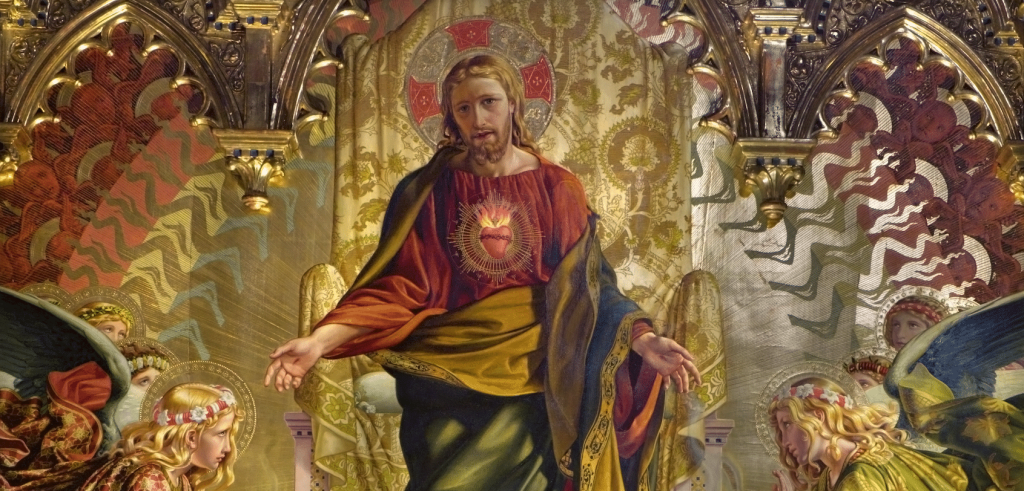
Within our sanctuary, by the altar, is the tabernacle. Above it, the red sanctuary lamp burns, indicating that the consecrated bread and wine—the body and blood of Our Lord—are present.
For some, the bread and wine (in many cases, grape juice) are only representations or symbols. For others, they hold a slightly higher place and point to something greater but remain bread and wine. For us, we believe that the bread and wine maintain the form of bread and wine but do, in fact, become the body and blood of Jesus, but is there any proof that this transformation has taken place? It is a question of faith, but I came across the following article that may get you thinking about it. (You’ll hear this again on a Sunday.)
“On the evening of the last day of his October 1995 visit to the United States, John Paul II was scheduled to greet the seminarians at Saint Mary’s Seminary in Baltimore. It had been a very full day that began with a Mass at Oriole Park in Camden Yards, a parade through downtown streets, a visit to the Basilica of the Assumption, the first cathedral in the country, lunch at a local soup kitchen run by Catholic Charities; a prayer service at the Cathedral of Mary Our Queen in North Baltimore; and finally a quick stop at Saint Mary’s Seminary.
The schedule was tight so the plan was simply to greet the seminarians while they stood outside on the steps. But the Pope made his way through their ranks and into the building. His plan was to first make a visit to the Blessed Sacrament.
When his wishes were made known, security flew into action. They swept the building paying close attention to the chapel where the Pope would be praying. For this purpose highly trained dogs were used to detect any person who might be present.
The dogs are trained to locate survivors in collapsed buildings after earthquakes and other disasters. These highly intelligent and eager dogs quickly went through the halls, offices and classrooms and were then sent to the chapel. They went up and down the aisle, past the pews and finally into the side chapel where the Blessed Sacrament is reserved.
Upon reaching the tabernacle, the dogs sniffed, whined, pointed, and refused to leave, their attention riveted on the tabernacle, until called by their handlers. They were convinced that they discovered someone there.
We Catholics know they were right—they found a real, living Person in the tabernacle!” (Source)
Today, in our Gospel reading, we hear the story of Jesus appearing to the disciples in the upper room. On that first visit, Thomas was absent. When the other disciples tell him about it… you know the story—Doubting Thomas. “Unless I see the mark of the nails in his hands and put my finger in the mark of the nails and my hand in his side, I will not believe.”
A week later, the Lord appears again, and Thomas is present. Jesus says to him, “Put your finger here and see my hands. Reach out your hand and put it in my side. Do not doubt but believe.” Thomas answered him, “My Lord and my God!”
“Upon reaching the tabernacle, the dogs sniffed, whined, pointed, and refused to leave, their attention riveted on the tabernacle, until called by their handlers. They were convinced that they discovered someone there.” I am convinced that if those dogs, while sitting in front of the tabernacle, could have spoken, they would have professed the same words as Thomas, “My Lord and my God!”
On this Eve of the Feast of St. Thomas, when you receive the Blessed Sacrament, recognize that hidden within is your Lord and your God and receive Him with great humility and thanksgiving.
On May 25, 1961, President John F. Kennedy made a speech to Congress titled Urgent National Needs. Among other items, he stated, “I believe this nation should commit itself to achieving the goal, before this decade is out, of landing a man on the moon and returning him safely to earth.” He concluded, “In a very real sense, it will not be one man going to the moon… it will be an entire nation. For all of us must work to put him there.” (Source)
In her book Resonate, Nancy Duarte picks up a part of the story. “Later in the 1960s, JFK was touring NASA headquarters and stopped to talk to a man with a mop. The president asked him, ‘What do you do?’ The janitor replied, ‘I’m putting the first man on the moon, sir.’ This janitor could have said, ‘I clean floors and empty trash.’ Instead, he saw his role as part of the bigger mission that was to fulfill the vision of the president. As far as he was concerned, he was making history.”
Growing up in Louisiana, I remember even there, we could have these cold and rainy Saturdays. A bit too unpleasant to be out, so my brother and I would set up a card table between our twin beds and put together a puzzle. Maybe 250/300 pieces. Nearing the end, we both wanted to place the last piece, so we took to hiding one (or, at least, I did). All the pieces but that one were in place, then you could snatch it out of your pocket and have the thrill of finishing the puzzle. However, there were other times when neither of us would hide a piece, but there would still be one missing, so we would crawl around on the floor searching and only give up once it was found. Why would we do that?
If it was a 300-piece puzzle of a deer in the woods and the piece missing was the head of the deer, I could understand it, but most of the time, it was some random bit of sky or a part of a tree. A piece that was missing but did not detract from the overall picture. You knew what it was. Yet, we would search, and I’m guessing you would too. It’s not that you can’t tell what the picture is supposed to be. It’s just that it is not complete. You look at the picture, and the only thing you can see is the hole where that missing piece belongs. Perhaps a minor part of the overall image, but without it….
Jesus said, “What do you think? If a man has a hundred sheep, and one of them has gone astray, does he not leave the ninety-nine on the mountains and go in search of the one that went astray? And if he finds it, truly, I say to you, he rejoices over it more than over the ninety-nine that never went astray.” (Matthew 18:12-13) The puzzle is incomplete without the one piece, and the flock is incomplete without the one sheep. Each piece and each sheep fulfill a purpose that completes the whole.
In the time of Jesus, we know that the people were looking for a Messiah, but they were also looking for the coming of a particular prophet. In the last book of the Old Testament, Malachi, and the second to last verse of that book, the Lord says through Malachi, “Behold, I will send you Elijah the prophet before the great and awesome day of the Lord comes.” (Malachi 4:5) The people were looking a Messiah and for Elijah. Why Elijah? In 2 Kings 2, we see that Elijah did not die but was carried away into Heaven by a whirlwind. The people were looking for Elijah, the great prophet, to return the same way he went. This is why, in our Gospel reading today, we read that “the Jews sent priests and Levites from Jerusalem to ask him, ‘Who are you?’ He confessed and did not deny it, but confessed, ‘I am not the Messiah.’ And they asked him, ‘What then? Are you Elijah?’ He said, ‘I am not.’ ‘Are you the prophet?’ He answered, ‘No.’” They were trying to ascertain whether or not John was the fulfillment of Malachi’s prophecy. Although John denies it, not believing that he is the Prophet, Jesus will say of John, “He is Elijah who is to come.” (Matthew 11:14b)
However, following John’s denial, the priests will say to John, “‘Who are you? Let us have an answer for those who sent us. What do you say about yourself?’ [John] said, ‘I am the voice of one crying out in the wilderness.’”
In the overall picture, John was unsure who he was, but when asked, “Who are you?” He knew his exact purpose and fulfilled that purpose, preparing the way for Jesus.
President Kennedy asked, “‘What do you do?’ The janitor replied, ‘I’m putting the first man on the moon, sir.’” The priests asked John the Baptist, “Who are you?” Put another way, the priests asked John, “What do you do?” And John said, “I am the voice of one crying out in the wilderness.” Question: what do you do? We are each a piece of the puzzle of God’s plan on earth. Without you—even if, like John, you are uncertain as to what part you play, and even if you think you’re a minor detail of the overall image—the picture is incomplete without you. What do you do? You can’t say, “I serve no purpose.” If you have a heartbeat, you serve a purpose, so what do you do?
If you already know or have an idea, then I pray you are fulfilling your purpose. If unsure, go through a discernment process, intentionally seeking out how God would like to use you. Once you discover it, go to work. What we cannot do is ignore our purpose, thinking someone else will do it. Our piece in the puzzle is as specific as John’s and even Jesus’. Therefore, our last words should be the same as Jesus’ last words, “It is finished.” We should be able to confidently speak those words, knowing that we have finished God’s will and His purposes in our lives.
The Lord says,
“Fear not, for I have redeemed you; I have called you by name, you are mine.” (Isaiah 43:1b)
You were the lost sheep. God went out and found you. Jesus redeemed you. You belong to God. He has a purpose for you. Discover it, and if you have, put it to use in His Kingdom. The work of His Kingdom and His Church needs you. We are making history, and you are a part of it.
Let us pray: Loving Father, faith in Your Word is the way to wisdom. Help us to think about Your Divine Plan so that we may grow in the truth. Open our eyes to Your deeds, our ears to the sound of Your call, so that our every act may help us share in the life of Jesus. Give us the grace to live the example of the love of Jesus, which we celebrate in the Eucharist and see in the Gospel. Form in us the likeness of Your Son and deepen His Life within us. Amen.
Fr. John Julian writes: “When a martyr lives and dies in Sicily, has a world-famous song written about her which is still sung 1500 years after her death [Santa Lucia], has her name included in the Canon of the Roman Mass, is listed in the oldest Christian Sacramentaries, has two churches dedicated to her in pagan England before the 8th century, is the most popular saint in Sweden and Norway, had her biography written by a member of the Saxon royal family, and a poem about her by John Donne, and whose feast day was originally the date of the winter solstice, she has to have been some remarkable lady! And such a person is Saint Lucy—the ever-popular Santa Lucia.” (Stars in a Dark World)
Legend has it that Lucy was born to a noble Sicilian family but secretly decided to remain a virgin and dedicate her life to Christ. Since her mother was unaware of this commitment, she promised Lucy to be married, but when Lucy finally told her of her intentions, her mother allowed Lucy to do as she pleased. However, the suitor was sorely disappointed; he was looking forward to a sizable dowry, so he became angry when the wedding was called off. He turned Lucy into the governor for being a Christian, which was illegal under the current emperor, Diocletian. Brought before the governor, she refused to recant her faith and was ordered to work in a brothel, but when the guards came to take her away, they could not move her from the spot she stood. It only gets gruesome from there, but she was put to death for her faith—a virgin martyr.
Using the old Julian calendar, her feast day, December 13th, was the winter equinox, which is the return of the light with longer days. Given that her name in Latin means light, you can understand why those in the far northern hemisphere would celebrate the Saint who brings the light and the lengthening of daylight to their short winter days. Such is her renown that in these Scandinavian countries, on this night, it is said that you may hear cattle speaking or see running water turn to wine. If, during this season, you have ever seen a young girl wearing a white dress with a red sash and crown of candles, then you have seen a representation of Santa Lucia.
It is a beautiful way to celebrate the season, but it and the equinox also remind us of the words from John’s prologue, “The true light, which enlightens everyone, was coming into the world.” We celebrate this same coming of the Light through our traditions and celebrations, from the lights on our trees to the candles of the Advent wreath—all of which point to the birth of our Savior and the light He brings into the world.
Santa Lucia’s Song speaks of this coming, so I’ll close with it:
Night walks with a heavy step Round yard and hearth, As the sun departs from earth, Shadows are brooding. There in our dark house, Walking with lit candles, Santa Lucia, Santa Lucia!
Night walks grand, yet silent, Now hear its gentle wings, In every room so hushed, Whispering like wings. Look, at our threshold stands, White-clad with light in her hair, Santa Lucia, Santa Lucia!
Darkness shall take flight soon, From earth’s valleys. So she speaks Wonderful words to us: A new day will rise again From the rosy sky… Santa Lucia, Santa Lucia!
Sixth graders and history do not always go well together. One budding historian wrote, “Ancient Egypt was inhabited by mummies and they all wrote in hydraulics. They lived in the Sarah Dessert. The climate of the Sarah is such that all the inhabitants have to live elsewhere.”
Another writes, “Writing at the same time as Shakespeare was Miguel Cervantes. He wrote Donkey Hote. The next great author was John Milton. Milton wrote Paradise Lost. Then his wife died and he wrote Paradise Regained.”
Finally, if you ask my Old Testament professor in seminary (we did not always see eye-to-eye), he would say that my answers to test questions were about as good as this, “Moses led the Hebrew slaves to the Red Sea where they made unleavened bread, which is bread made without any ingredients. Moses went up on Mount Cyanide to get the Ten Commandments. He died before he ever reached Canada.”
“What is history but a fable agreed upon.” (Bernard le Bovier de Fontenelle) Perhaps, but what many have repeated is true: history repeats itself, and there is a specific pattern, which Lord Byron summed up in Childe Harold’s Pilgrimage,
“There is the moral of all human tales: ‘Tis but the same rehearsal of the past, First Freedom, and then Glory—when that fails, Wealth, vice, corruption—barbarism at last. And History, with all her volumes vast, Hath but ONE page.” (Canto 04.108)
Regardless of the events, how they can be interpreted depends on who you ask. From the opening lines of A Tale of Two Cities by Charles Dickens (I know, I know… too many quotes):
“It was the best of times, it was the worst of times, it was the age of wisdom, it was the age of foolishness, it was the epoch of belief, it was the epoch of incredulity, it was the season of Light, it was the season of Darkness, it was the spring of hope, it was the winter of despair, we had everything before us, we had nothing before us, we were all going direct to Heaven, we were all going direct the other way.”
History is a peculiar thing. Some enjoy digging into it; others don’t remember what they had for breakfast and don’t care. And, I suspect for many, the history they most care about is their own, especially when you have more days behind you than before. At those times, we remember the good ol’ days when we were young and healthy, and the world seemed kinder and more innocent. Like pulling out old photographs and saying, “I remember when….” While looking at those photos, we can find ourselves longing for those days.
In our first lesson today, the Prophet Isaiah was “looking at some old photographs” and longing for those days.
Because of their sin, the Israelites had been conquered by the Babylonians and carried off into captivity. For 70 years, they were in exile. Now, Cyrus has conquered the Babylonians and allowed the Israelites to return, but things are not going well. There is infighting and turmoil, so Isaiah writes something of a Psalm, a lament. In doing so, Isaiah is looking at an old photograph. He is looking at where they are and longing for the past. In chapter 63, he says,
I will recount the steadfast love of the Lord, the praises of the Lord, according to all that the Lord has granted us, and the great goodness to the house of Israel that he has granted them according to his compassion, according to the abundance of his steadfast love. (v.7)
Isaiah then goes on to tell of the days of Moses—how the people had been captive in Egypt. How God had led the people through the divided waters of the sea and saved them, and how, finally,
Like livestock that go down into the valley, the Spirit of the Lord gave them rest. So you led your people, to make for yourself a glorious name. (v.14)
It is a glorious picture of the past, but now, Isaiah looks at their current circumstances. A world where the Lord is angry and has hidden His face from the people. How the Lord has allowed them to melt in the hands of their iniquities. So, looking at his old photograph, Isaiah says in chapter 64 (what we read today)
Oh that you would rend the heavens and come down, that the mountains might quake at your presence.
And a few lines further,
When you did awesome things that we did not look for, you came down, the mountains quaked at your presence.
Isaiah is looking at an old photograph. The days of God’s glory, and praying, “Lord, do that again. Come in great power and save your people, like you did in the days of Moses.”
Like the Israelites in Isaiah’s time, the Israelites in Jesus’ time were also occupied and oppressed. This time, it wasn’t the Babylonians but the Romans—an equally oppressive regime. So, like in the time of Isaiah, the people are once again looking for God to act in a mighty way to bring about their freedom. The question that was always before them was, “When will the Lord return to us and save us?” Early on in chapter 13 of Mark’s Gospel, Jesus remarked on that day, so the people immediately asked, “Tell us, when will these things be, and what will be the sign when all these things are about to be accomplished?” (v.4) The reading we heard today—darkened moon, heavens shaken, lesson of the fig tree—are all a part of Jesus’ answer. After saying all these things, He concludes, “Therefore stay awake—for you do not know when” these things will come to pass.
Amid tribulation, Isaiah held up a picture of the past and asked the Lord to return to the glory days. Jesus, on the other hand, amid tribulation, did not hold up a picture of the past. Jesus held up a picture of the future. Question: what did that picture show?
Father John, just read St. John’s Revelation! The seven seals being broken, the sky rolling up like a scroll, the star Wormwood crashing and bitter waters, death, blood, smoke, creatures that sting like scorpions, and things Stephen King couldn’t dream up on his wildest days. That’s the picture that Jesus held up of what is to come.
No. It is not. Not even close. Jesus held up a picture that showed a new heaven and, a new earth, and a holy city. A city where “the dwelling place of God is with man.” A city where God “will dwell with them, and they will be his people, and God himself will be with them as their God.” When there, God “will wipe away every tear from their eyes, and death shall be no more, neither shall there be mourning, nor crying, nor pain anymore, for the former things have passed away.” The picture of the future that Jesus showed the people was a place where all things are made new. (cf. Revelation 21:1-5)
Jesus told the people, and in doing so, He’s telling us all that is to take place, not so that we will be afraid and run hide in the mountains, but so that we will be prepared. Those will not be easy times for anyone—the righteous or the unrighteous. So Jesus tells us to remain vigilant in our faith and persevere until the end. As St Paul tells us, “Be on your guard; stand firm in the faith; be courageous; be strong. Do everything in love.” (1 Corinthians 16:13-14) Do these things and have life eternal.
Charles Dickens wrote, “It was the best of times, it was the worst of times.” And we can say with him, “These are the best of times, and these are the worst of times.” These are the best of times because Jesus has “conquered sin, put death to flight, and gave us the hope of everlasting life.” (BCP 835 #69) These are the worst of times because we are in the midst of what Jesus calls “birth pains.” (Mark 13:8) We are in the already and not yet; therefore, “clothe yourself with the Lord Jesus Christ” (Romans 13:14) and hold the picture of His future in your mind.
Let us pray: Come, King of all nations, source of Your Church’s unity and faith: save all humankind, Your own creation! Come, Lord Jesus, do not delay; give new courage to Your people who trust in Your love. By Your coming, raise us to the joy of Your Kingdom, where you live and reign with the Father and the Holy Spirit, one God, forever. Amen.
There was a priest who was such a golf addict that one Sunday, he called in sick and went golfing instead. An angel saw this and reported to God. “Let me handle this,” God said. The angel watched, but to his horror, the priest was playing the best game of his life. On the par three, seventh hole, the priest hit the perfect hole-in-one. The angel was livid. “I thought you were going to do something about this,” he said to God. “I am,” God replied. “Who’s he going to tell?”
Why a golf story? Because the game of golf was invented in Scotland. Why think of Scotland? The Apostle Andrew, the Saint we celebrate today, is the Patron Saint of Scotland. How did a Jewish fisherman from Israel end up the Patron Saint of Scotland? That answer is a bit more fuzzy, but there are two likely scenarios. The first legend tells of Andrew’s extensive travels and that on one occasion, he did come to Fife, a region of Scotland on the northeast shore of England, and established a church there, now known as St. Andrew’s. Perhaps more believable, the second legend is that some of Andrew’s relics were brought to Fife in the 4th century, and a church was built to house them. Whichever the case, Andrew became widely known throughout Scotland, and many churches were named in his honor. As Episcopalians, we also have a connection to Andrew, which is memorialized in the shield of the Episcopal Church.
Our connection starts, of course, with Holy Scripture. We know that Andrew was Peter’s brother and that he was the one, at least in John’s Gospel, who introduced Peter to Jesus. We also know that Andrew was the one who brought the loaves and fish to Jesus before the miraculous feeding. From there, history and legend tell us that, like the other Apostles, Andrew went out proclaiming the Gospel, which eventually led to his arrest and martyrdom. He was to be crucified like Jesus, but he did not deem himself worthy to be crucified in the same manner, so he was instead crucified on a saltire, an “X” shaped cross. This “X” was incorporated into the flag of Scotland, which has a blue background with a large white “X” across it.
As we learned a few weeks ago, following the American Revolution, the fledgling United States had no Bishops, so Samuel Seabury first went to England in an attempt to be consecrated, but when that failed, he went to Scotland, and the bishops there consented. The following two American bishops were consecrated in England, so when James Madison was consecrated by those three, Madison became the first fully American bishop and reunited the Scottish and English lines of the Episcopacy, which brings us to the Episcopal Shield.
As you are aware, on the shield is a large red cross in the center, the Cross of St. George—a shout-out to England because George is the Patron Saint of England, but also, in the upper left quadrant of the shield is that blue field, with the nine small white crosses. Those nine small crosses represent the nine original dioceses of the Episcopal Church, but they are also in the shape of a saltire, an “X” on a blue field, the Scottish flag, and a shout-out to Andrew.
As a Christian people, we are a part of something much larger than ourselves. We, gathered here today, are the Body of Christ, but we, gathered throughout the world and across the centuries, are also the Body of Christ. We stand alongside Andrew and all the others as a Testament to the wondrous workings of our God and the truth of His Word.
I remember a time when I was probably ten or so, going squirrel hunting with my Grandaddy. It was a beautiful fall day with just a bit of fog. As I walked along looking up in the trees for the crafty squirrel, I came into this slight clearing, and in front of me were these four trees in a row, all the same height and age. Nothing too remarkable about that – trees are as thick as grass in that part of Louisiana – but the first tree was completely bare of leaves, already shed for winter; the second still had its leaves, but they were brown; the third also had leaves, but were this brilliant yellow; and the fourth was still green as though winter hadn’t touched it at all. Perhaps that isn’t so remarkable to some, but it’s been almost fifty years since I saw those trees, and the memory of them still blesses me today. There is a perfect chance that I was the only person on the planet who ever saw them like that, but it was truly remarkable. Yet, had I been wandering around with my head down, I never would have seen them.
Today, we, as the human race, spend a lot of time looking down. We look down at our phones and get caught up in what we see on those tiny screens. We look down because the terrors of the world can sometimes be so overwhelming. We look down, so focused on our own lives—whether because of careers or troubles or vanity—we look down on our own lives and are consumed with our little sphere. But by looking down, we never see God’s blessings around us.
It is time to look up. See the blessing of the smile of the stranger sitting next to you. Look up from the terrors of this world and see the wonders of creation. Look up from yourself and your concerns and see the other. You all have probably heard the words of Mr. Rogers that he spoke to the children while sitting in his neighborhood: “When I was a boy and would see scary things in the news, my mother would say to me, ‘Look for the helpers. You will always find people who are helping.’” Looking up and seeing the helpers is good advice, but I invite you to take it one step further: look up and see God. Look up and see the blessings.
All that is evil in this world could fit on the head of a pin compared to all the blessings surrounding us. Those blessings for which we should give thanks may be four trees in a clearing on a foggy morning that are seen only by you, but they are God’s gifts to you.
Look up. Look up and know that the Lord is God. Look up and experience the joy that God has prepared for his people.
The Psalmist writes,
Make a joyful noise to the Lord, all the earth! Serve the Lord with gladness! Come into his presence with singing! Know that the Lord, he is God! It is he who made us, and we are his; we are his people, and the sheep of his pasture. Enter his gates with thanksgiving, and his courts with praise! Give thanks to him; bless his name! For the Lord is good; his steadfast love endures forever, and his faithfulness to all generations.
Look up and, Give thanks to the Lord; bless His name! For the Lord our God is good.
King Henry VIII’s title: “Henry the Eighth, by the Grace of God, King of England, France and Ireland, Defender of the Faith and of the Church of England and also of Ireland in Earth Supreme Head.” A lot to remember, but relatively short when considering the late Prince Philip’s title consisted of 133 words.
The Royals. The British monarchy seems to have lost something since the death of Queen Elizabeth, but their lives are still interesting and, when you dig a little below the surface, a bit odd.
It is fairly common knowledge that you don’t touch a member of the royal family unless initiated by one of them, and then only a handshake, and that the King is not required to have a driver’s license. However, other aspects of their lives…
Everyone must weigh in before and after the meal when invited to Christmas dinner. According to Edward VII, who set the rule, you didn’t have fun if you didn’t gain any weight.
Queen Elizabeth had someone break in her shoes. According to an aide, “a flunky wears in Her Majesty’s shoes to ensure that they are comfortable and that she is always good to go.” However, it seems that Charles is a bit more prissy; after each wearing, someone must iron his shoelaces.
So that Charles does not become overtaxed too early in the day, he requires his valet to “squeeze one inch of toothpaste onto his toothbrush every morning.”
That’s only the beginning of oddities, but all this to say, “It really is good to be King (or Queen.)” It also proves the point of the prophets of Israel who told the people, “You really don’t want a king.”
We’ve been studying the Book of Judges on Sunday mornings and recently been covering Gideon. We’re soon going to learn that after a great victory, the people want to make Gideon their king, but Gideon says to them, “I will not rule over you, and my son will not rule over you; the Lord will rule over you.” (Judges 8:23) However, during Gideon’s lifetime, he had seventy sons (more than one wife.) Two of the sons were Jotham and Abimelech. Jotham was good, Abimelech, not so much. After the death of Gideon, Abimelech decided that he did, in fact, want to be king. Concerned that one of his sixty-nine brothers might have similar ideas, he murdered them all except Jotham, who was in hiding.
On the day of Abimilech’s installation as king, Jotham came out of hiding and prophesied against Abimilech and his followers. Jotham told them a parable, “Listen to me, you leaders of Shechem, that God may listen to you. The trees once went out to anoint a king over them, and they said to the olive tree, ‘Reign over us.’ But the olive tree said to them, ‘Shall I leave my abundance, by which gods and men are honored, and go hold sway over the trees?’ And the trees said to the fig tree, ‘You come and reign over us.’ But the fig tree said to them, ‘Shall I leave my sweetness and my good fruit and go hold sway over the trees?’ And the trees said to the vine, ‘You come and reign over us.’ But the vine said to them, ‘Shall I leave my wine that cheers God and men and go hold sway over the trees?’ Then all the trees said to the bramble, ‘You come and reign over us.’ And the bramble said to the trees, ‘If in good faith you are anointing me king over you, then come and take refuge in my shade, but if not, let fire come out of the bramble and devour the cedars of Lebanon.’” (Judges 9:7b-15)
In the parable, the fig tree and the vine represent men who would have made good leaders for the people. Yet, like Gideon, the others recognized that they were doing good in their current position. They also recognized that the best king the people could have was the Lord, so they refused the position. However, the thornbush—Abimelech—thought he should be king despite his father’s promise that none of his sons would serve as king. When you think of the bramble or thornbush, you know that it grows through the forest, living off the life of the other trees. Eventually, it chokes the life out of them. In saying this, Jotham is saying that Abimelech will be a king who lives off the wealth of the others until he will choke the life out of them. If they do not submit to him, fire will come out of the thornbush and consume. In other words, if they do not submit, Abimelech will make war against them and destroy them completely.
Jotham was imploring the people to submit to the reign of the King of Heaven so that the would-be King Abimelech would not destroy them. The people did not listen, and it happened as Jotham had prophesied. Abimelech was eventually killed in battle, but the idea of having a king never left the people. Later, they would ask again for one, and after warning them, the Lord allowed it. Over 450 years, Israel would have forty different kings and great turmoil. Wars amongst themselves, political murders, coups, and more. It all led to the eventual destruction of everything in 70 A.D.
Having a monarch or even elected officials that act like it is never a good idea, and like with the Israelites, it never works out. They may start with good intentions, but the lure of more power, corruption, outside influences, jealousy, and whatnot cause them to fall to pieces in the end. If we were to take all of these problems and roll them into one biblical word, that word would be “evil.” Why does the evil flourish under such circumstances? Because God is placed on the sideline, and human interests and desires are raised up as new gods worthy of our devotion and attention.
In 1925, having witnessed the ravages of World War I and the work of earthly kings, Pope Pius XI issued the encyclical Quas Primas—translated “In the First.” Pius writes, “In my first letter…I referred to the chief causes of the difficulties under which mankind was laboring. I remember saying that these manifold evils in the world were due to the fact that the majority of men had thrust Jesus Christ and his holy law out of their lives; that these had no place either in private affairs or in politics: I said further, that as long as individuals and states refused to submit to the rule of our Savior, there would be no really hopeful prospect of a lasting peace among nations. Men must look for the peace of Christ in the Kingdom of Christ…. In the Kingdom of Christ, that is, it seemed to me that peace could not be more effectually restored nor fixed upon a firmer basis than through the restoration of the Empire of Our Lord.” (Source)
Abimilech’s little kingdom and the Kingdoms of Israel didn’t work out. A survey of history easily demonstrates that no kingdom has ever truly survived, except maybe in name. So what is the world to do? Pius suggested we establish the Empire of Our Lord. He suggests that we make Christ the King! Quas Primas established the feast day that we celebrate today—Christ the King and what it suggests is quite radical, but as Jesus said to Pilate, “My kingdom is not of this world.” (John 18:36a)
Jesus, Pius, and the Church have always taught us that we, as a Christian people, are not looking for earthly rule. As has been proven, that does not work. So, instead, we seek to have Christ Jesus rule in the hearts of all people. To allow the King of Kings to instruct us and to guide and direct us daily. When we do this, we put something much larger than ourselves into motion. As the Lord begins to rule in our lives, then he begins to rule in our families. When He rules in our families, then His influence and reign can begin to extend beyond us into those around us. As His Kingdom expands, the Empire of Our Lord becomes a reality.
We are free to fight it and deny it, but in the end, Christ will rule over all—the righteous and the unrighteous, for as St. Paul tells us, “God has highly exalted him and bestowed on him the name that is above every name, so that at the name of Jesus every knee should bow, in heaven and on earth and under the earth, and every tongue confess that Jesus Christ is Lord, to the glory of God the Father.” (Philippians 2:10-11)
There will always be many persons and things that seek to reign over your life. Abimelechs of a sort that would have you submit to them. Resist them and bend your knee only to the one who died for you and rose again. Confess Jesus as Lord of your life that He might lead you into His Eternal Kingdom.
Let us pray: Almighty and merciful God, you break the power of evil and make all things new in your Son Jesus Christ, the King of the universe. May all in heaven and earth acclaim your glory and never cease to praise you. We ask this through our Lord Jesus Christ, your Son, who lives and reigns with you and the Holy Spirit, one God, for ever and ever. Amen.
Police report: a resident of the 1000 block of Raritan Drive that a family in the area is taking over the minds of local dogs and turning them against their owners. Police were advised by the person that the only way to protect a dog is to install an anti-force field on its head before letting the animal go outside.
The Learning Center on Hanson Street reports a man across the way stands at his window for hours watching the center, making parents nervous. Police ID the subject as a cardboard cutout of Arnold Schwarzenegger.
In Jamestown, a man came to the Sheriff’s Department to “find out how to legally kill” a person who was harassing him.
Early Monday morning… a Hayfork woman requests to talk with a deputy because her housekeeper is not putting her towels away properly.
There are many reasons why I could never be a police officer, and the comedian Ron White stated one of those reasons quite succinctly, “You can’t fix stupid.”
There are so many folks out there doing stupid stuff all the time, and our police officers are the ones who so often have to deal with them. I tip my zuchetta to them.
Even though I could never pull off the job, I’m surprised that not more people are signing up for it because we are all fascinated with what they do. Not only do we spend hours watching true crime and cop shows—they’re all trying to come up with a line as famous as “Book ‘em, Danno!”—but we also like to watch and see what they’re up to in daily life. For example, I was driving along I-35 toward the city when the traffic came to a dead stop. It finally started moving but crept along for five miles. What was the source of the congestion? In the northbound lane were two police cars and a wrecker working a minor accident. There was no reason to slow the southbound traffic but tell that to everyone who was morbidly interested in what the police were up to. Tell it to the rubberneckers.
Police see more than they need to of stupidity and tragedy because they have to clean up our messes. Still, the rubbernecker intentionally looks and is fascinated and held captive by the tragedy and mayhem.
What did you think of our first reading from Zephaniah?
The great day of the Lord is near, near and hastening fast; the sound of the day of the Lord is bitter, the warrior cries aloud there. That day will be a day of wrath, a day of distress and anguish, a day of ruin and devastation, a day of darkness and gloom, a day of clouds and thick darkness, a day of trumpet blast and battle cry.
If we are here on that great day of the Lord, and TV cameras are broadcasting it for all to see, do you think there will be any watchers? Any rubberneckers? Yes, there will be, and we won’t be able to get enough of it: Twenty-four-seven, all stations. However, in the meantime, we must be satisfied by the little everyday tragedies. Take, for example, our Gospel reading—the Parable of the Talents.
Last week, we noted that in telling the Parable of the Ten Virgins, Jesus was answering the disciples’ question about the end of days. They said, “Tell us, when will these things be, and what will be the sign of your coming and of the end of the age?” (Matthew 24:3) At the end of that parable, Jesus said to them, “Watch therefore, for you know neither the day nor the hour.” Jesus told them The Parable to Talents immediately after, expanding on the necessity of watching and being prepared for His return.
The rich man was leaving on a journey and entrusted his property to three slaves. These were not slaves as we understand them, but these would have been household managers—individuals who knew what they were doing.
To one, the rich man entrusted over half his wealth; to the second, one-quarter; and the third, one-eighth. While he was away, the first two went out and doubled their master’s wealth, but the third—for several reasons—buried it in the ground. When the master returned, he called the slaves to account. The first two were praised for their good works, “Well done, good and trustworthy slave; you have been trustworthy in a few things, I will put you in charge of many things; enter into the joy of your master.” However, the third was severely reprimanded and punished. The master began by saying, “You wicked and lazy slave!” And it only got worse from there. In the end, the master said, “Throw him into the outer darkness, where there will be weeping and gnashing of teeth.”
Question: what part of the parable do you remember? What part did you focus on? What part have you heard preaching on (mine included)? Was it about the two who were praised? The ones who will, in the end, have an abundance? Or did you focus on or hear about the car crash? Did you focus on how that third slave, who lost everything, will experience what we read about in Zephaniah?
A day of distress and anguish, a day of ruin and devastation, a day of darkness and gloom.
I’m going with the latter. Our focus falls on the tragedy and mayhem, but why? There are many theories out there, and I have my own.
Remember the Pharisee in the temple praying and telling God how great of a guy he was? At some point, he looks around and sees the tax collector also praying, and the Pharisee essentially says, “And thank God I’m not like that schmuck!”
I believe our focus falls on the slave that lost it all and was cast into destruction because we can look at ourselves and think, “I may not be all that great, but at least I’m not like that schmuck!” No longer do we have to pay attention to what we are doing. We can be rubberneckers of someone else’s tragedy and, in the process, make ourselves feel better about who we are. However, the two slaves rewarded and praised by the master were not focused on what the others were doing or not doing. They were focused on the task that had been set before them. These two should be our focus and inspiration, not the failure of the third. What can we learn from them?
The master said, “I am giving you these five talents, these two talents, and this one talent to watch over to work with. As a slave, a house manager, they are your responsibility. You will be judged, not on how the others perform, but on how you perform.”
Mrs. Five could have sat back and thought herself special. “Look at me. I’ve got more than everyone else. I’m the favored child. I can do whatever I like, and the master will love me.” But that was not Mrs. Five’s attitude. We can learn from her what it means to be a good steward. She took what she had been given and, without concerning herself with what others were doing, doubled her master’s money. When it comes to matters of faith and the gifts of God, we are to perform similarly. We are to take what God has blessed us with and use it for His greater glory, remaining focused on the work before us and not becoming distracted or complacent in our favored position.
Mr. Two could have whined that he didn’t receive as much as Mrs. Five and could have also looked down on Mr. One. Mr. Two could have spent so much time concerned with the others’ blessings that he missed the opportunity to serve his master properly. We can do the same, becoming so worried that someone or some other church might have more than us that we fail to focus on our own. — Understand that although it applies, I’m not talking about material things (money, possessions, etc), but things eternal (spiritual gifts, blessings, ministry, etc.) — When we look at the great Saints, we don’t complain that they have more. Instead, we look to them for inspiration and example. And, when we see someone with less, instead of gloating over it, we come alongside and help, wanting them to succeed in the eyes of the Lord.
Finally, when we see those who have failed, we don’t rubberneck over the tragedy. Instead, we pray for ourselves, “There, but for the grace of God…,” and we pray for the one who has fallen, that they might be redeemed.
We are not in spiritual competition, for we are the Body of Christ. We need one another, so don’t become distracted and focus not on the tragedies and mayhem. Instead, care for what the Master of us all has entrusted you with individually and us as the Church so that in the end, we may also hear those words of our Master, Jesus, “Well done, good and trustworthy slave; you have been trustworthy in a few things, I will put you in charge of many things; enter into the joy of your master.”
Let us pray: Almighty and ever-faithful Lord, gratefully acknowledging Your mercy and humbly admitting our need, we pledge our trust in You and each other. Filled with desire, we respond to Your call for discipleship by shaping our lives in imitation of Christ. We profess that the call requires us to be stewards of Your gifts. As stewards, we receive Your gifts gratefully, cherish and tend them in a responsible manner, share them in practice and love with others, and return them with increase to You. Amen.
The year is 1776, and you are an Anglican priest serving in the American colonies. During the service, you come to the prayers and read the following prayer: “Almighty God, the foundation of all goodness, we humbly beseech thee to bless our gracious King George and all the royal family….” The next thing you know, a rotten egg has hit you square between the eyes.
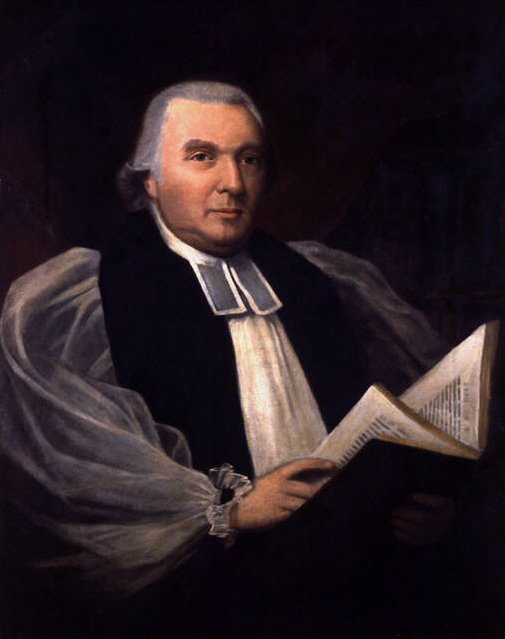
The first idea came from William White. He suggested we ordain a priest, but that idea was quickly rebuked. It would have broken the lines of apostolic succession. The next idea was to send a priest to England and have him consecrated. This was approved, and Samuel Seabury set sail. He was a loyalist, so they believed he would have a better chance of being consecrated. Still, when he arrived, no one would consecrate him because to do so for America, the consecration required that the vow of allegiance to the king be omitted, which required an act of parliament to accomplish.
As you would imagine, the Anglican Church was not very popular around the time of the American Revolutionary War. Many Anglican priests fled the communities where they were threatened, and the patriots killed others for their refusal to renounce the king. However, following the war, the Anglicans looked for a way to move forward in America—the problem was bishops. It takes a bishop to ordain clergy and three bishops to consecrate a new bishop. America didn’t even have one, so the church in Connecticut began looking for ways to resolve the problem.
As an alternative, John Adams, the ambassador of the US to England, made arrangements with the Lutheran Church of Denmark to consecrate Seabury. Thanks be to God that didn’t happen. Can you imagine me a Lutheran?! (That’s a joke.) After thirteen months of trying, Seabury petitioned the council in Connecticut for permission to try for the consecration in Scotland. The Scottish Episcopal Church had broken from the Church of England in 1725. Connecticut and the Scottish agreed, and on November 14, 1785, Samuel Seabury was consecrated as the first bishop of the Episcopal Church in America.
Later, we would have two more bishops, William White and Samuel Provost, consecrated in England in 1792. These three came together and consecrated Thomas John Clagget, the first bishop of Maryland and the first fully American bishop, and in the process, united the Scottish and English lines of episcopal succession.
For Seabury, the first time he appeared in church, he was fully vested in rochet, chimere, academic hood, and miter. Someone commented: “He appears in a black satin gown; white satin sleeves, white belly band, with a scarlet knapsack on his back, and something resembling a pyramid on his head.” A congregational minister noted: “His appearance is singular… It is said he must either be greater than other men or else he is crazy.”
The American church asked for laborers of the harvest in the form of a bishop, and they received Samuel Seabury. From him, we are here. The first Bishop of Oklahoma was Francis Key Brooke, the 165th American Bishop. Our Bishop Poulson is the 1,131st Bishop of the American Church.
There are many ways of understanding the role of bishops, but for me, St. Cyprian of Carthage put it best, “‘The Church is in the bishop and the bishop in the Church.’ Put another way, there is no Church where there is no bishop.’” (Michael Azkoul) The bishops are a connection to the past and to Christ through the laying on of hands and the handing down of the traditions and legacy of our church; therefore, we celebrate Samuel Seabury for bringing the episcopacy to America and to us that we might worship the Lord in fullness and unity.





 Candle in a Cave