
Have you heard of the up and coming rock-n-roll star Larry Underwood? His rising single is Baby, Can You Dig Your Man.
“Bay-yay-yaby you can tell me if anyone can,
Baby, can you dig your man?
He’s a righteous man,
Tell me baby, can you dig your man?”
It gets stuck in your head once you’ve heard the tune, but it is also a fictional song from my favorite novel, The Stand, by—you guessed it!—Stephen King.
No spoilers here, but I can tell you that at the beginning of the book, Captain Trips, a souped-up version of the flu, kills about 98% of the world’s population. Larry and a woman named Rita Blackmoor are in New York City, and they decide it’s best to get out of the city, which has essentially become a morgue. Very uplifting story, I can tell you. Circumstances lead them to the Lincoln Tunnel, which will take them to New Jersey.
For an even more pleasant scene, the Lincoln Tunnel is a parking lot. So many had the same idea of escaping the city, but the tunnel got jammed, and people simply died in their cars, with no one to clean up the aftermath. Even so, Larry and Rita must get through. They set out. Their only source of light was Larry’s Bic lighter. Note to self: if it is the end of the world, don’t forget your flashlight.
“It was much blacker inside than [Larry] had imagined it would be. At first, the opening behind him cast dim white light ahead and he could see yet more cars, jammed in bumper to bumper (it must have been bad, dying in here, he thought, as claustrophobia wrapped its stealthy banana fingers lovingly around his head and began to first caress and then to squeeze his temples, it must have been really bad, it must have been… horrible).” Larry enters the tunnel, and we are told that as he “negotiated the first slow, banked curve, bearing gently to the right, the light grew dimmer until all he could see were muted flashes of chrome. After that the light simply ceased to exist at all.”
Further on, “The solid darkness provided the perfect theater screen on which the mind could play out its fantasies,” of all that was going on around him. However, they push on. Stumbling in darkness over all sorts of terrors—you really should read this one—then, after struggling for what seemed hours, “Rita stopped short. ‘What’s the matter?’ Larry asked. ‘Is there something in the way?’ ‘No. I can see, Larry! It’s the end of the tunnel!’ He blinked and realized that he could see, too. The glow was dim, and it had come so gradually that he hadn’t been aware of it until Rita had spoken. He could make out a faint shine on the tiles, and the pale blur of Rita’s face closer by.” They had made it through the blackness and the terror. Larry is so excited that he reports, “New Jersey never smelled so good.”
Every year, on the Sunday before Ash Wednesday, our Gospel reading is the account of the Transfiguration. Back in the day, when I really didn’t know what I was doing as a priest (I still don’t, but I’m much better at faking it… please don’t tell the Bishop), but before, I thought of this day as the Feast of the Transfiguration. However, one year in early August, I realized we were celebrating it again. We don’t do that. August 6th is the fixed day for the feast, so I got to wondering why we read about it today. The answer is two-part. The first part is because of what lies behind us—the events in the life of Jesus that are considered at the Epiphany and the season after, which today is the last.
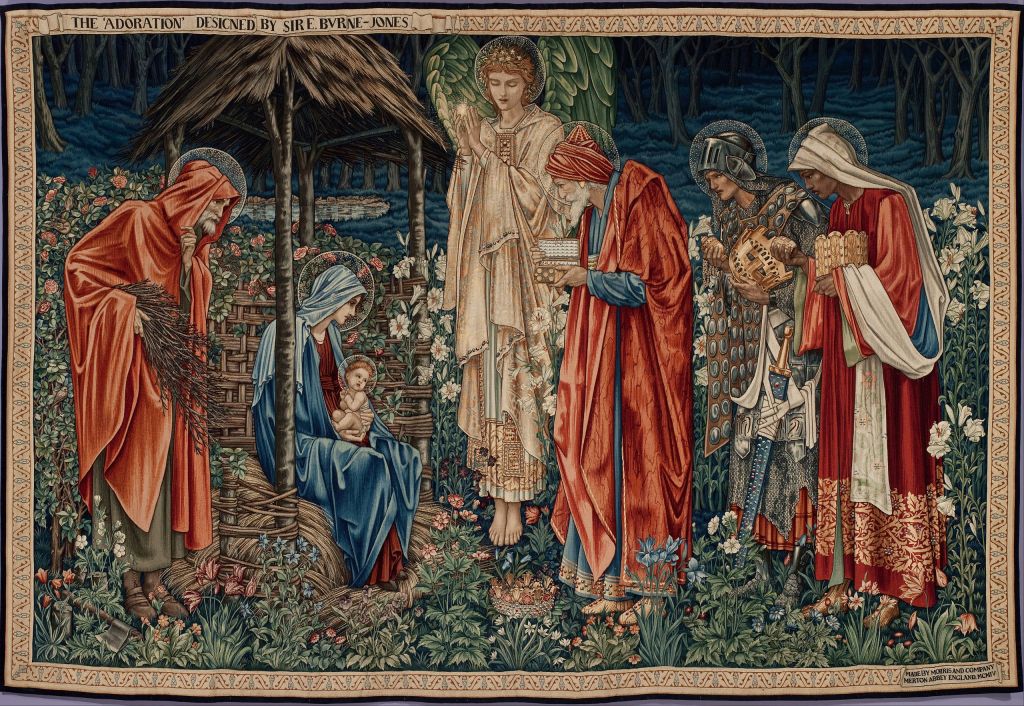
The Epiphany, January 6th, is the revelation of Jesus to the Gentiles through the visitation of the wise men. In the season after the Epiphany, we continue to encounter the person of Jesus and who He is.
There is Jesus’ presentation and later teaching in the Temple when He was a young boy. This is followed by the Baptism of Jesus, when the Spirit descends, and God speaks, “This is my Son, whom I love; with Him I am well pleased.” Later comes the temptation in the wilderness and the first miracle at the wedding in Cana. We also have the Confession of Peter, “You are the Christ, the Son of the Living God.” All of these are revelations—revealings of who Jesus is. So the Transfiguration is another revealing moment, perhaps the most dramatic, for it shows Jesus in all his glory. Origen, writing in the third century, said, “He was transfigured before them. It is not that He then became what He was not before; rather, He showed to His disciples what He was, opening their eyes and giving sight to the blind.”
Up to that moment, the Jesus the disciples knew was walking around as though wearing camouflage. His true nature was hidden. At the Transfiguration, He took off the camouflage and revealed his true self. It was the greatest and most exact of the epiphanies, and it was what all the other epiphanies were leading up to. Like the disciples, we can now see Him transfigured, which helps us understand the second reason the Transfiguration occurs now. Luke’s Gospel helps us begin our understanding.
Very soon after the Transfiguration, Luke tells us, “The days drew near for [Jesus] to be taken up, he set his face to go to Jerusalem” (Luke 9.51). Following the Transfiguration, Jesus began His final journey to Jerusalem and the cross.
The Transfiguration, placed at this point in Jesus’s life and ministry, was intended to encourage the disciples, for the days ahead were about to turn very dark. St. John Chrysostom tells us that Jesus “brings them to the mountain and shows them His glory, that when they should see Him crucified, they might not be troubled.” In the Transfiguration, Jesus was saying to the disciples, “This is who I truly am,” but in order to accomplish the work the Father has set before me, I must first pass through the darkness, this tunnel where there is no light. Only then will I again be able to attain the glory I once had. What you disciples are about to witness will be scary, surrounded by death, but remember this moment. Remember this light and be encouraged.
For us today, liturgically, the Transfiguration, assigned to this Sunday, offers reassurance of Jesus’ ultimate victory over death. After all, we are about to walk that dark tunnel with him. We will see so many turn against him, betray Him, and abuse Him. We will watch as He is arrested, flogged, and crucified. We will witness His death and His being placed in the tomb. We know how the story ends, but if we didn’t, how awful all this would be. We would be like those first disciples, huddled in the upper room, afraid of everything and everyone. However, with the knowledge of the Transfiguration, we may be in the bowels of that dark tunnel, but we will have the residual glow of that moment on the mountain, which will give us hope. That is Jesus’ true nature, and no amount of darkness will overcome Him. We have hope; yet the liturgy of the church year points to something even greater. It is pointing to our very lives.
You see, the Transfiguration is not just revealing who Jesus is. It is also revealing who we are to become. St. Paul tells us, “We all, with unveiled face, beholding the glory of the Lord, are being transformed into the same image from one degree of glory to another” (2 Corinthians 3:18). The Church Fathers have understood this to mean that “Jesus was made man, that we might be made god.” Not the all-powerful divinity, like Jesus, but transformed into the Image of God. Yet, this is only possible if we are willing to walk through the same dark tunnel that Jesus walked before us. Jesus said, “If anyone would come after me, let him deny himself and take up his cross and follow me. For whoever would save his life will lose it, but whoever loses his life for my sake will find it” (Matthew 16:24-25). We take up our cross that we might be crucified with Christ, so that we might travel where He has led the way.
Larry Underwood had his Bic lighter to help guide him through the Lincoln Tunnel. What will we have? Answer: “The true light, which gives light to everyone” (John 1:9). We will have Jesus and the light He revealed to us at the Transfiguration. It is that light which will guide us and encourage us.
Think of it this way: the Transfiguration took place on Mount Tabor. The crucifixion took place at Golgotha, a hill outside Jerusalem. Connecting these two places is not a path of light but a tunnel of darkness. As with our friend Larry, that is a fearful place. It is a place of death, yet to reach the other side, we must pass through it. As we go, with the hope of the light of the Transfiguration, we pray, “Even though I walk through the valley of the shadow of death, I will fear no evil, for you are with me (Psalm 23:4).”
As we stand on the threshold of another Lent, another reminder of the path we all must eventually travel, look to the Transfigured Lord and see the glory of your future. I promise you, it is even better than New Jersey.
Let us pray: Loving Jesus, You were transfigured on the Mountain, showing Your Disciples as much of Your glory as they could hold. Let Your eternal light shine also upon us sinners, through the prayers of the Mother of God, O Giver of Light, glory to You. Amen.
 Candle in a Cave