Sermon: Mary Magdalene

Giovanni Battista Pittoni – The Penitent Magdalene

Throughout history, there have been some epic searches. Some have searched for the Garden of Eden, and others for the Fountain of Youth. Later, there would be a great quest for the Holy Grail (thankfully, Dan Brown uncovered that one for us). Then there was the Titanic (James Cameron sank it and found it). And, of course, Jimmy Hoffa, who everyone thought was buried under the Giants Stadium in New Jersey, but Hoffa was a no-show following the demolition. Amelia Earhart and the Devil’s Triangle—those two might be connected—Atlantis and Cleopatra’s tomb are all things we’ve searched for and continue to do so.

In our personal lives, we also search. We search for happiness, love, security, and much more. That actually probably depends on the day or even the hour, but we do search. Perhaps the greatest search in our lives is the search for meaning. Physician Viktor Frankl, author of Man’s Search for Meaning, writes: “Man’s search for meaning is the primary motivation in his life and not a ‘secondary rationalization’ of instinctual drives [those being security, food, etc]. The meaning is unique and specific in that it must and can be fulfilled by him alone, only then does it achieve a significance which will satisfy his own will to meaning.” He is postulating that there is a unique meaning to each person’s life, so your meaning of life may not be fulfilling to someone else.

Frankl continues, “It is a peculiarity of man that he can only live by looking to the future—sub specie aeternitatis. And this is his salvation during the most difficult moments of his existence, although he sometimes has to force their mind to the task.” (Source) He points to those who survived the concentration camps in Nazi Germany. Many of the survivors found some meaning in their lives, no matter how small, and that meaning gave them the strength and will to live for something and ultimately survive.

What is the connection between all of this and Mary Magdalene, whom we celebrate today?

Mary Magdalene stood weeping outside the tomb. One of the two angels said to her,“‘Woman, why are you weeping?’ She said to them, ‘They have taken away my Lord, and I do not know where they have laid him.’ When she had said this, she turned around and saw Jesus standing there, but she did not know that it was Jesus. Jesus said to her, ‘Woman, why are you weeping? Whom are you looking for?’”

“Whom are you looking for?” What are you searching for? Mary was searching for meaning and purpose in her life that would bring fulfillment. She believed she had found it in the person of Jesus, but then she saw Him so violently stretched out on the cross, and then she saw Him breathe His last. Her meaning in life had died. Then He called her name, and she saw the Resurrected Lord, at which point, her life took on even greater meaning, for she went and proclaimed to the disciples, “I have seen the Lord.”

The Lord has given us all meaning and purpose in our lives. He has seen fit to allow us to search for and find those things and people that bring us happiness. I believe it brings Him great joy to see us realizing our goals and fulfilling our purposes; however, these meanings and purposes, outside of the Resurrected Jesus, are dead. They are vain searches designed to satisfy our egos, and so, even when fulfilled, they leave us unsatisfied. St. Augustine was correct when, in the first paragraph of his Confessions, he wrote, “To praise you is the desire of man… You stir man to take pleasure in praising you, because you have made us for yourself, and our heart is restless until it rests in you.”

Jesus said, “Seek first the kingdom of God and his righteousness, and all these things will be added to you.” (Matthew 6:33) Search first for Jesus, our Resurrected Lord, and, like Mary Magdalene, in finding Him, you will find fulfillment in Him, and in all your life’s endeavors. 

Sermon: Easter 2 RCL C – “Resurrection”


I know I’ve shared this story at a funeral, but I don’t believe I’ve ever shared it with you. 

A man was once sentenced to solitary confinement in a pitch-black prison cell. To relieve his boredom and keep his sanity, he threw a marble against the walls—day in, day out, bang, bang, bang. The marble would bounce off the wall onto the floor and then roll around the room until the man could locate it and repeat the procedure.

One day, he decided to do something different—he would throw the marble up and try to catch it as it came down. Of course, in the pitch black, he missed the catch quite often, so he would listen as the marble hit the floor and bounced around. Feeling around in the general direction of the sound, he would locate it and try again. The longer this went on, the more proficient he became, and the more proficient he became, the higher he would throw the marble. However, when he made his highest throw ever, he did not catch it, and neither was there any sound. The marble simply did not come back down. He became more and more disturbed. What had happened to his precious marble? How could it disappear into thin air like that?! He spent the rest of his life wondering what had happened to his marble, and it eventually drove him to madness, and he died. 

We all have things we wonder about and questions that we seek answers to. Sometimes, we have questions about life: Why does so-and-so not love me? How come all my luck is bad? What did I do to deserve this?

At other times, we question the world around us: Why is the sky blue or the grass green? How was the universe formed? How does Santa get into houses without chimneys? (Just seeing if you were paying attention.)

We also have questions about our faith. Does God hear my prayers? Do I matter to God? Or even, is there a God?

For life’s questions, through our faith, we learn to understand and take each day as it comes. For the questions about the world around us, we explore and study. And for the questions about our faith, we pray and study scripture. However, when it comes to these questions of faith, we also tend to try to make a few deals with God. Why do the hard work if there’s a shortcut?

I’ve never been a Janis Joplin fan in the tiniest little bit, but I remember a song of hers that we would laugh and sing as kids, if only the first verse.

Oh Lord, won’t you buy me a Mercedes-Benz?
My friends all drive Porsches, I must make amends

That’s about all we knew as kids, but it is the third verse that gets to the theological heart of the matter.

Oh, Lord, won’t you buy me a night on the town?
I’m counting on you Lord, please don’t let me down
Prove that you love me and buy the next round

And there it is. “Prove that you love me.” Prove to me that You hear my prayers. Prove to me that I matter to You. Prove to me that You are there.

The first stanza of the poem, Doubt, by Norman Shirk

Let me meet you on the mountain, Lord, just once.
You wouldn’t have to burn a whole bush,
Just a few smoking branches,
And I would surely be your Moses

In the end, it all comes down to the same statement: “Unless I see the mark of the nails in his hands, and put my finger in the mark of the nails and my hand in his side, I will not believe.” 

It is easy to criticize poor ol’ Thomas, but there’s a bit of him—maybe a little or maybe a lot—there’s a bit of Thomas in us all.

Like Thomas, in order to increase our faith, we ask the Lord to meet us halfway. However, He already has. The Lord Jesus met us halfway between heaven and hell. He met us on that hill outside of Jerusalem. He met us outside the empty tomb, and He continues to meet us every day exactly where we are. He also meets us at that altar in the Sacrament of His body and blood.

But you say, “Yes, yes, Father John. That’s real nice, but today, I want to be Thomas. I want to see Him, hear Him, and touch Him. I need the burning bush. I need the missing piece of the puzzle. I need to find the stupid marble that fella pitched up into the air and never came back down. Give me these things, and I will.”

A line from a movie I watched inspired the title of my blog—Candle in a Cave. In the movie, an older priest tells a younger one, “We are all blind men in a cave looking for a candle that was lit 2,000 years ago.” 

In some sense, this is true because I can’t show you a burning bush or guide your hands and allow you to touch the wounds of Christ. Sorry, I can’t do it. If I could, we would have folks flocking to this church by the millions to see it. Why? Because they want God to prove Himself to them, to give them a sign. Like Job, they ask God to explain Himself. 

But remember, the Lord was patient with Job for a while, but after much questioning, the Lord answered, “Who is this that darkens my counsel with words without knowledge?” “Where were you when I laid the earth’s foundation? Tell me, if you understand. Who marked off its dimensions? Surely you know! Who stretched a measuring line across it? Who created the sky, the animals? Were you there when I breathed life into the dust and created you?” 

Like Job, and even during Jesus’ time on earth, we desire signs and wonders, miracles. Scripture states that at one point during Jesus’ ministry, some Pharisees and teachers of the law questioned him: “Teacher, we want to see a miraculous sign from you.” Jesus answered, “A wicked and adulterous generation asks for a miraculous sign! But none will be given it except the sign of the prophet Jonah. For as Jonah was three days and three nights in the belly of a huge fish, so the Son of Man will be three days and three nights in the heart of the earth.”

You see, the problem is not with God; it is with us. The Lord has already given us a sign. After three days and three nights in the heart of the earth, He rose! How? Truly, the Lord only knows. As the Psalmist says, “Such knowledge is too wonderful for me, too lofty for me to attain.” But Jesus rose from the grave. How much more proof does a person need? Just because there were no witnesses to the resurrection, does it mean it did not occur? No. Remember what Billy Graham said, “Can you see God? You haven’t seen him? I’ve never seen the wind. I see the effects of the wind, but I’ve never seen the wind. There’s a mystery to it.”

No one witnessed the resurrection of Jesus, but from that day forward, we have all been witnesses to, and have experienced for ourselves, the effects of the resurrection—this new life in Christ Jesus—and it didn’t involve getting a Mercedes-Benz. Therefore, “Do not doubt but believe.” 

Remember our prisoner and his marble? When the guards later entered the cell to remove his body, a glint of light caught one of the guards’ eyes. He looked up toward the ceiling to see the most astonishing sight—a marble caught in a spider’s web. “Of all the crazy things,” he thought. “How on earth did the spider manage to get a marble up there?” He spent the rest of his life wondering.

There are many mysteries in our lives with God, things we can wonder about and seek answers to throughout our lives. However, the question of the resurrection is not one of them, for the proof is all around us.

Let us pray: Praised be the God and Father of our Lord Jesus Christ, He who in His great mercy gave us new birth, a birth unto hope which draws its life from the resurrection of Jesus Christ from the dead; a birth to an imperishable inheritance, incapable of fading or defilement, which is kept in heaven for you who are guarded with God’s power through faith; a birth to a salvation which stands ready to be revealed in the last days. Amen.

Sermon: 2025 Easter Sunday

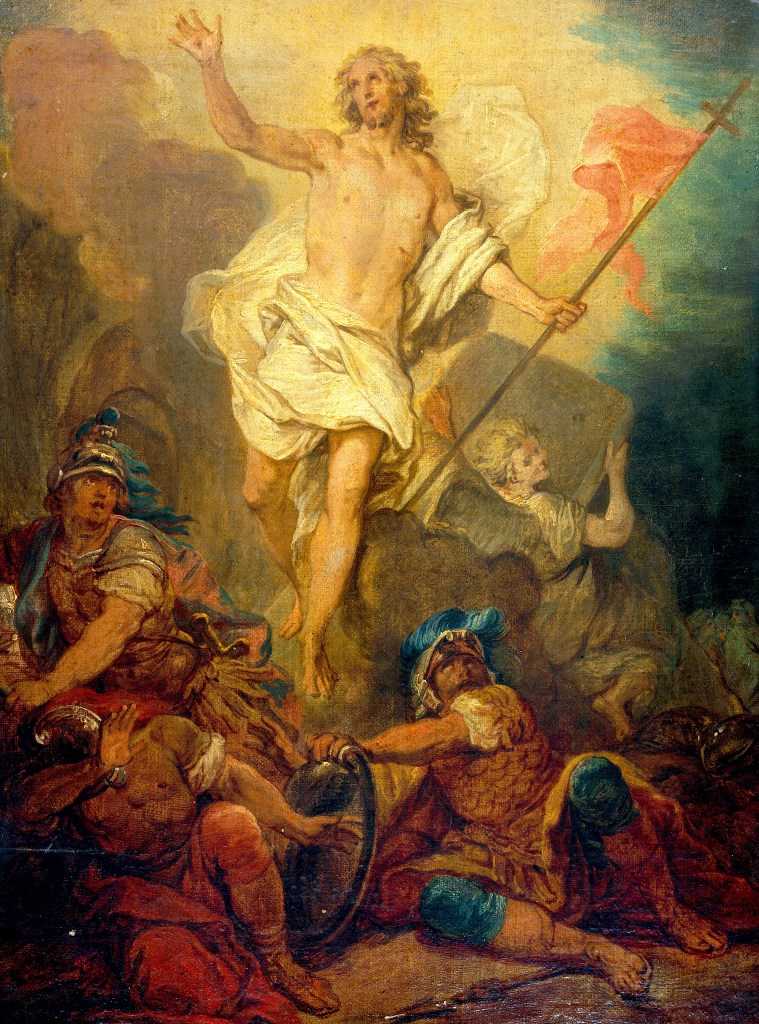
Nicolas Bertin (1668-1736). La Résurrection du Christ

Sam died. His will provided $50,000 for an elaborate funeral.

As the last attendees left, Sam’s wife, Rose, turned to her oldest friend, Sadie, and said, “Well, I’m sure Sam would be pleased.”

“I’m sure you’re right,” replied Sadie, who leaned in close and lowered her voice to a whisper. “Tell me, how much did it really cost?”

“All of it,” said Rose. “$50,000.”

“No!” Sadie exclaimed. “I mean, it was very nice, but really… $50,000?”

Rose nodded. “The funeral was $6,500. I donated $500 to the church for the services, and the reception, food, and drinks were another $500. The rest went for the memorial stone.”

Sadie computed quickly. “$42,500 for a memorial stone?! Wow, how big is it?”

“Five and a half carats,” Rose said, waggling her fingers.

Today is a good day to laugh at death and the devil, for both have been conquered once and for all.

During this past Season of Lent, we’ve been meditating on passages from The Dolorous Passion of our Lord Jesus Christ—a series of visions given to blessed Catherine Emmerich. It was initially published in 1833 and is also the primary source of the movie The Passion of the Christ by Mel Gibson.

The visions provide a brutal account of the events throughout Holy Week, and we’ve looked at some of the more difficult passages, so today, I thought it only fair that I share a portion of the joyous conclusion. When studying these, it is important to keep in mind that they are visions; therefore, they are not biblical—there is no account of the resurrection in scripture. That said, perhaps they may spark our imaginations and offer some insight into that great event. 

Chapter 63: The Resurrection of Our Lord.

“I beheld the soul of our Lord between two angels, who were in the attire of warriors: it was bright, luminous, and resplendent as the sun at midday; his soul penetrated the rock, touched the sacred body, passed into it, and the two were instantaneously united and became as one.  I then saw the limbs move and the body of our Lord, being reunited to his soul and to his divinity, rise and shake off the winding sheet: the whole of the cave was illuminated and lightsome.

“At the same moment, I saw a frightful monster burst from the earth underneath the sepulcher.  It had the tail of a serpent, and it raised its dragon head proudly as if eager to attack Jesus; and had likewise a human head. But our Lord held in his hand a white staff, to which was appended a large banner; and he placed his foot on the head of the dragon, and struck its tail three times with his staff, after which the monster disappeared….

“I then saw the glorified body of our Lord rise up, and it passed through the hard rock as easily as if the latter had been formed of some [soft] substance. The earth shook, and an angel in the garb of a warrior descended from Heaven with the speed of lightning, entered the tomb, lifted the stone, placed it on the right side, and seated himself upon it. At this tremendous sight, the soldiers fell to the ground and remained there, apparently lifeless.”

Can you see the angel of the Lord suddenly appearing before those soldiers, a mischievous grin on his face, asking, “How you doin’?” I somehow suspect that after those boys woke up, they probably had to go home and change their shorts.

Honestly, I don’t know how it all happened, but I do know this: Jesus rose from the dead. Say, “Amen.” We learn from the various Gospel accounts that the women and some of the disciples went to the tomb and found it empty. All that remained were the grave clothes. Some encounter angels, and Mary actually encounters the Risen Lord. Can you imagine what they were all thinking? 

For me, I think at first I would have been like them—afraid, shocked, wondering what those evil men had done with my Lord’s body. Perhaps after a while, pieces would come into focus, only to blow away like wisps of fog. 

The quote from N.T. Wright, which Diane shared with us on Good Friday, holds true not only for John’s Gospel but also for all the Gospel accounts and events of those days. He said, “I don’t know that any of us will ever be able to hold all this in our minds at any one time.  John allows the images to build up, one upon another, upon another, until we’re overwhelmed by them. . . . The only way forward is to allow all the different ideas and levels, the clashes of meaning and misunderstanding, to echo around until they produce prayer, awe, silence, and love.” (John for Everyone, Part Two, p.104)

The same must have been true for the Disciples on that first Easter Sunday. Like us, they had all this information—the prophecies from Isaiah and Ezekiel about the coming Messiah, the salvation of the Gentiles, and the Psalmist’s words regarding the piercing of the Messiah’s hands and feet. They also had the sayings of Jesus: “The Son of Man must be killed.” “Destroy this temple, and in three days, I will raise it up.” “This is my body… my blood.” All this information and so much more before Jesus’ death, yet none of it coalesced until after the Resurrection. However, they kept watching and were patient. They remained focused on God, and then, like a rose blooming, it all came together.

St. Paul said to the Colossians, and it is also true for us, “the mystery hidden for ages and generations” has now been “revealed to his saints. To them”—to you!—“God chose to make known how great among the Gentiles are the riches of the glory of this mystery, which is Christ in you, the hope of glory.” (Colossians 1:25b-27)

It would be like stepping out of that tomb on the first Easter morning. While inside, objects are shrouded in shadows and darkness. Your mind races. What happened here? Then you step out into the clear light of the new day and realize this is all God’s doing, and it is all about God’s love for you. Everything, from the first day when God created the Heavens and the Earth, to Jesus’ first breath in the manger on that first Christmas some 2,000 years ago, to the sunrise of that first Easter Sunday, to this very day, everything has been and is about God’s love for you and His desire to draw you to Himself. 

Laugh at death. Step out of the darkness and the shadows of your self-created tomb and walk in the light and life of Christ Jesus. Rise with Him into life eternal.

Alleluia. Christ is risen.

The Lord is risen indeed. Alleluia.

Sermon: Holy Saturday


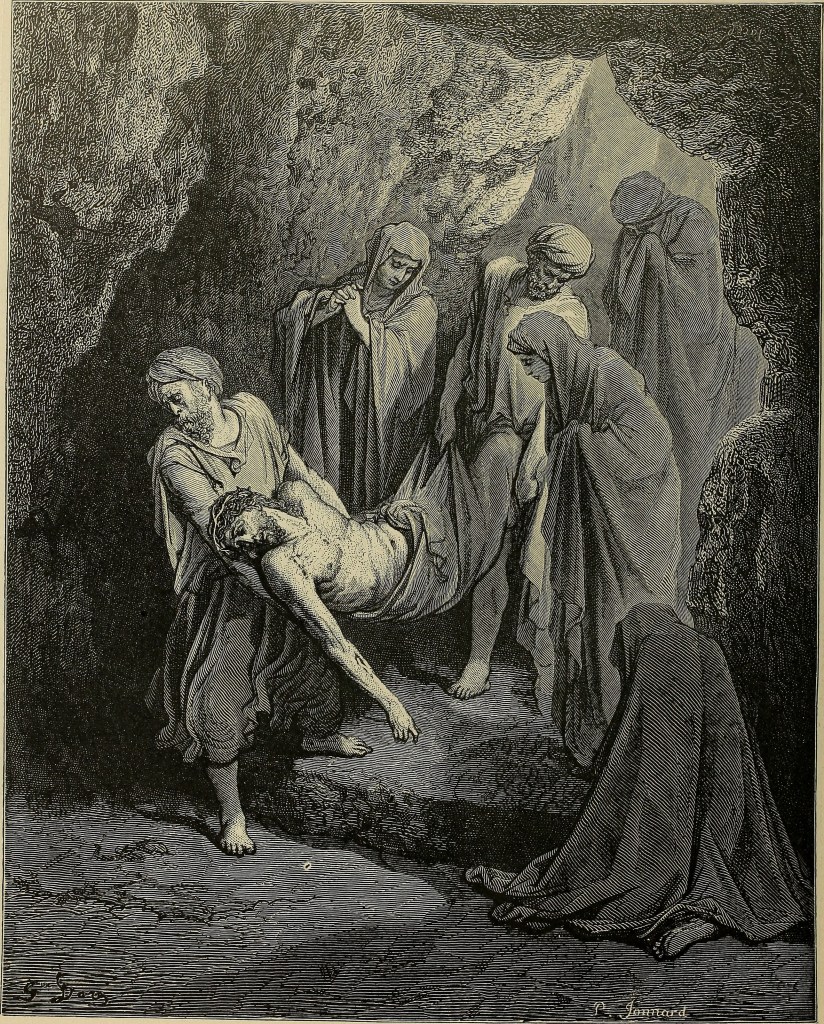
We’ve come this far with Anne Catherine Emmerich, so we might as well continue. Chapter 52 of The Dolorous Passion: The Body of Our Lord Placed in the Sepulchre.

The men placed the sacred body on a species of leathern hand-barrow, which they covered with a brown-coloured cloth, and to which they fastened two long stakes. This forcibly reminded me of the Ark of the Covenant. Nicodemus and Joseph bore on their shoulders the front shafts, while Abenadar and John supported those behind. After them came the Blessed Virgin, Mary of Heli, her eldest sister, Magdalen and Mary of Cleophas, and then the group of women who had been sitting at some distance —Veronica, Johanna Chusa, Mary the mother of Mark, Salome the wife of Zebedee, Mary Salome, Salome of Jerusalem, Susanna, and Anne the niece of St. Joseph. Cassius and the soldiers closed the procession. The other women, such as Marone of Naïm, Dina the Samaritaness, and Mara the Suphanitess, were at Bethania, with Martha and Lazarus. Two soldiers, bearing torches in their hands, walked on first, that there might be some light in the grotto of the sepulchre; and the procession continued to advance in this order for about seven minutes, the holy men and women singing psalms in sweet but melancholy tones. I saw James the Greater, the brother of John, standing upon a hill the other side of the valley, to look at them as they passed, and he returned immediately afterwards, to tell the other disciples what he had seen.

The procession stopped at the entrance of Joseph’s garden, which was opened by the removal of some stakes, afterwards used as levers to roll the stone to the door of the sepulchre. When opposite the rock, they placed the Sacred Body on a long board covered with a sheet. The grotto, which had been newly excavated, had been lately cleaned by the servants of Nicodemus, so that the interior was neat and pleasing to the eye. The holy women sat down in front of the grotto, while the four men carried in the body of our Lord, partially tilled the hollow couch destined for its reception with aromatic spices, and spread  over them a cloth, upon which they reverently deposited the sacred body. After having once more given expression to their love by tears and fond embraces, they left the grotto. Then the Blessed Virgin entered, seated herself close to the head of her dear Son, and bent over his body with many tears. When she left the grotto, Magdalen hastily and eagerly came forward, and flung on the body some flowers and branches which she had gathered in the garden. Then she clasped her hands together, and with sobs kissed the feet of Jesus; but the men having informed her that they must close the sepulchre, she returned to the other women. They covered the sacred body with the extremities of the sheet on which it was lying, placed on the top of all the brown coverlet, and closed the folding-doors, which were made of a bronze-coloured metal, and had on their front two sticks, one straight down and the other across, so as to form a perfect cross.

The large stone with which they intended to close the sepulchre, and which was still lying in front of the grotto, was in shape very like a chest* or tomb; its length was such that a man might have laid himself down upon it, and it was so heavy that it was only by means of levers that the men could roll it before the door of the sepulchre. The entrance of the grotto was closed by a gate made of branches twined together. Everything that was done within the grotto had to be accomplished by torchlight, for daylight never penetrated there.

Sermon: Easter Sunday 2024


Doc Pierre decided that he wanted to get into the ranching business, so he went out and purchased himself a bunch of cows and put them out on the pasture. He also knew he would need a bull, so he called up one of his hands, Ol’ Boudreaux, and gave him the plan. 

“Boudreaux,” he says, “I’m going out to find the bull. Once I’ve purchased one, you hook the trailer to that pick ‘em up truck of yours and come fetch it.”

“How will I know?” Bou asks.

Doc Pierre says, “I’ll send a telegram,” and it was all set.

Doc Pierre goes out searching for the bull with $5,000 in his pocket. He finds one for exactly $5,000. Hoping to lower the price, he asks the rancher if that is the best offer. “Well, I suppose I could let it go for $4,999.” Doc Pierre thinks it’s a good deal and takes him up on it. Then, he heads to Western Union to send the telegram to Boudreaux, but it is there that he learns it’ll cost him $1 per word, and all he’s got left is a $1. He thinks on it a moment, then writes out a one-word message to Boudreaux.

The telegraph operator looks at it questioningly, then back up to Doc Pierre. Doc Pierre nods in understanding and explains, “Boudreaux don’t read so good, so he’ll have to sound it out first. He’ll get the message.” The telegraph operator said OK and sent the one-word telegram: “Comfortable.”

About an hour later, Boudreaux showed up with the pick ‘em up truck and trailer.

Doc Pierre sent, “Comfortable,” and Boudreaux had to sound it out, “Come.. for… da… bull.”

Have you heard of response latency? It is defined as “The interval of time elapsing between a stimulus and a response.” (Source) You may not have heard of it, but you may have just experienced it. I told you what I hoped was a good joke, and hopefully, you laughed! However, there was a short period of time between the punch line and you getting the joke and laughing. The time between is the response latency. It is the time when you have all the necessary information, but not quite yet understanding. It is the time leading up to a moment of clarity or an “Aha!” moment or epiphany. Response latency.

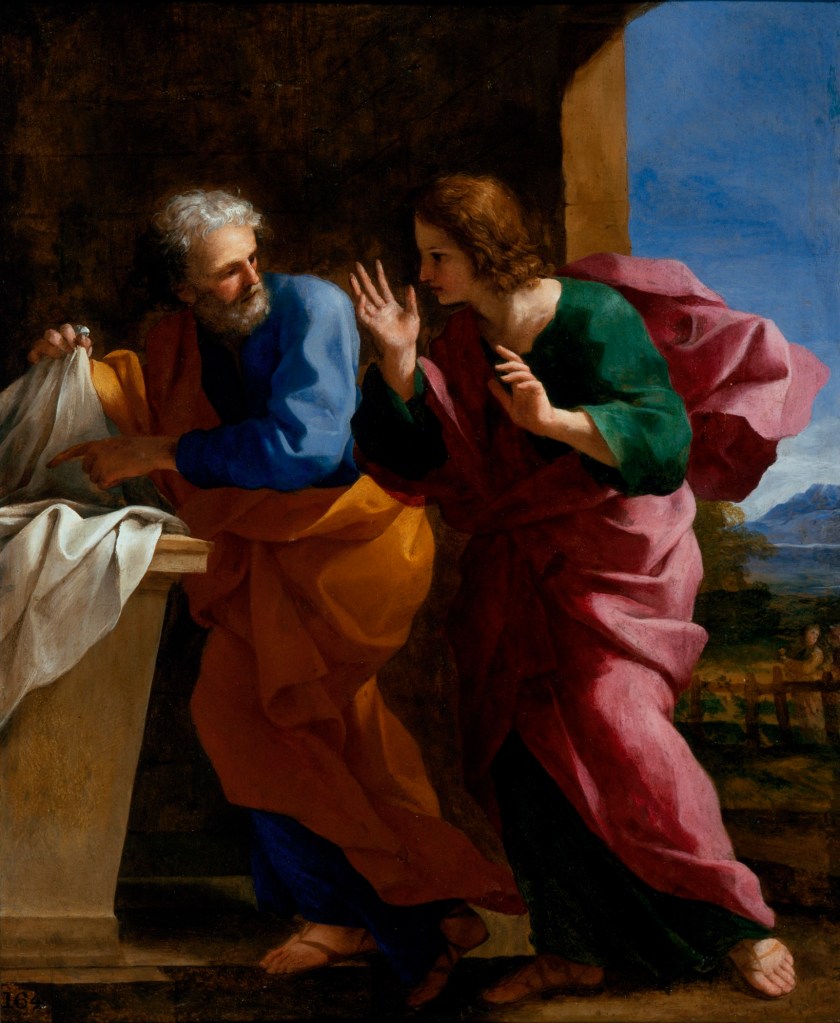
Our Gospel reading this morning tells us that Mary Magdalene went to the tomb of Jesus, found the stone rolled away, and ran back and told Peter and John. Hearing this, the two disciples take off. John outruns Peter and arrives first. John stands just outside the tomb, but Peter—never really one for restraint—goes barging in. After gaining his courage, John follows. There, they discover the linen shroud that had covered Jesus’ body and the veil that had been over his face, but the body of Jesus is not there. 

The image on the front of your bulletin depicts the scene. The painting St. John and St. Peter at Christ’s Tomb (c.1640) is by the Italian artist Giovanni Francesco Romanelli. Peter, on the left, is pointing at the shroud and seems to be staring off, trying to understand, but for John,  the response latency is ending. The pieces are falling into place. It is like he is holding up his hands to tell Peter to be quiet so that he can think. The reading tells us that the disciple whom Jesus loved, John, “saw and believed.” Romanelli captured that moment.

The reading then tells us that the two returned home, but Mary, who must have followed behind the footrace, remained. She leaned into the tomb and saw and spoke to the angels, then turning, she saw the gardener, not knowing it was Jesus. 

Now, this is an interpretation on my part, but the gardener was there all along, watching. Maybe he was out of sight, or maybe, in all the excitement and rushing about, all three saw him but more or less dismissed him. Either way, I believe the gardener, Jesus, was there watching this entire scene unfold. And I believe Jesus anxiously anticipated the end of John’s response latency when all the pieces came together. When they did, Jesus smiled and said to Himself, “That’s my boy.” Working behind John’s understanding is God’s grace.

St. John later tells us, “We love because he first loved us” (1 John 4:19), and St. Paul tells us, “For by grace you have been saved through faith. And this is not your own doing; it is the gift of God” (Ephesians 2:8). Believing in Jesus is a grace—a gift from God. Jesus anxiously anticipated all the pieces falling together for John to believe, but the reason this could happen for John was because God first loved John—God’s grace was given to John so that he might believe.

Today, we are the ones standing in the tomb. We are the ones seeing the shroud and other linen. Like John, we have all the teachings of the Prophets and all the words and deeds of Jesus at our disposal. In addition, we have the teachings of the Apostles, the Saints, and the Church. We have all the information. Question: have they fallen into place for you, or are you still in that time of response latency? If yes, if they’ve fallen into place, then have a passion for souls and pray that others may receive the light of the Gospel. If not, then pray for God’s grace, so that He might give you understanding.

“Early on the first day of the week, while it was still dark,” and before Mary Magdalene arrived at the tomb, Jesus rose from the dead—He is “the firstborn from the dead.” (Colossians 1:18) He did this out of His great love for us and accomplished it so that you and I might also be given eternal life with Him. 

This is your first day of the week. The empty tomb is before you. Pray that all the pieces, all the information falls into place and that God’s grace pours out upon you that you might believe and live.

In 1917, the Virgin Mary appeared six times to three young children near Fatima, Portugal. On the second appearance, she gave them a prayer that she asked to be added to the end of each decade of the Rosary. Whether you pray the Rosary or not, it is a prayer worth learning. It is known as the Fatima Prayer.

Let us pray: “Oh, my Jesus, forgive us our sins. Save us from the fires of Hell and lead all souls to Heaven, especially those in most need of Thy mercy. Amen.”

Sermon: Easter Sunday – “Fools”

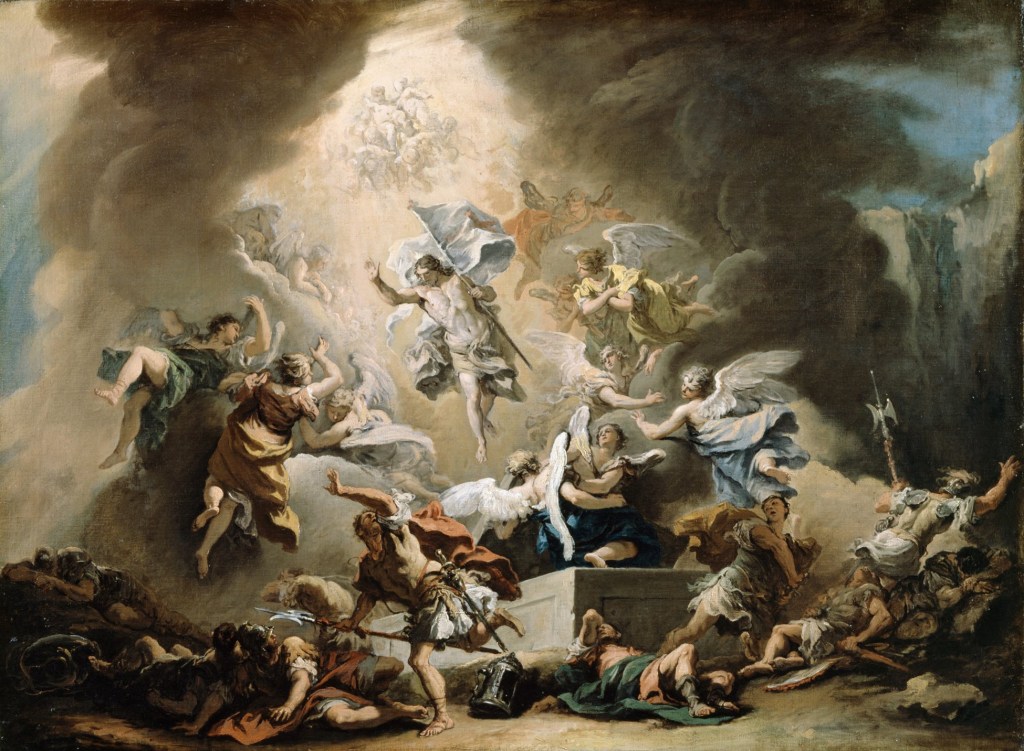
The Resurrection by Sebastiano Ricci

An atheist professor was teaching a college class and told the students that he would prove there was no God. He said, “God, if you are real, then I want you to knock me off this platform. I’ll give you 15 minutes!”

Ten minutes passed, and he kept taunting God, saying, “Here I am, God, I’m still waiting.” 

He got down to the last couple of minutes when a 320-pound lineman on the football team happened to walk by the door and heard what the professor was saying. The football player walked into the classroom and, at the last minute, hit the professor with a haymaker, sending him flying off the platform.

When the professor woke up, he stood and, still shaken, said, “Where did you come from, and why did you do that?”

The 320-pound lineman replied, “God was busy; He sent me!”

When you begin to talk to people about what Jesus said, most will believe it. The good solid teachings. They make people want to be better individuals. They teach us how to live. All that talk about “Loving your neighbor” gets people’s motor running.

When you talk about some of the things Jesus did, like flipping over the tables in the Temple or picking and eating grain on the Sabbath, folks are pretty much OK with these as well. Even his trial, death, and crucifixion are believed to be historical facts because most believe in a historical Jesus, and crucifixion was how the Romans dealt with criminals and troublemakers. But when you talk about the miracles Jesus performed, folks start to get a little skeptical. 

Giving sight to the blind, healing the lame, feeding the 5000 (that’s a maybe because they can logically figure out how that might have been done. They assume more food was available than was recorded in the Scriptures), walking on water, and casting out demons (this one gets a double negative because you’ve first got to believe in demons.) When you begin to talk about miracles, people start to shake their heads. They say, “Those things just aren’t possible.”

When you bring up Jesus raising the dead, you run into a brick wall. Lazarus, the little girl, and probably others we’re not told about. It’s like St. John wrote at the end of his Gospel, “Now there are also many other things that Jesus did. Were every one of them to be written, I suppose that the world itself could not contain the books that would be written.” (John 21:25) Ask around about raising the dead and you will be told, “Not going there.” And the one that is an absolute hard-stop show-stopper is Jesus being raised from the dead on the third day. You talk about that, and for many, you’ve entered the land of make-believe and fairy tales. To believe in the resurrection makes you a fool.

Can I tell you something that you may already know? I am a fool. I believe, and I would like for you to believe and to be a fool, also. The trouble is I cannot prove any of it to you. Even if I could get a 320-pound lineman to come in, hit you with his best haymaker, and say, “God was busy, so he sent me!” You would still say, “I’m no fool.” Although, perhaps, you would not say it to the 320-pound lineman.

The First Sunday after Easter is always the incident concerning doubting Thomas. You remember the one: “Unless I see in his hands the mark of the nails, and place my finger into the mark of the nails, and place my hand into his side, I will never believe.” (John 20:25) I know why it’s placed on the first Sunday after Easter but I also think it would be very appropriate for Easter Sunday because there are so many who fall into the same category as Thomas. When it comes to the resurrection, their first name becomes, Doubting. So how do we overcome our doubts?

An incident is recorded in Mark’s Gospel: a man comes to Jesus begging that his son be healed. The man says, “If you can do anything, have compassion on us and help us.” And Jesus said to him, “‘If you can’!—Who do you think you’re talkin’ to with all that “if” business—All things are possible for one who believes.” Immediately the father of the child cried out and said, “I believe; help my unbelief!” 

“I believe; help my unbelief!” Is a prayer. It is a prayer from one who desires to believe but needs God’s grace in order to believe more fully. You see, believing in God, Jesus, the Holy Spirit, and all they have accomplished, including the resurrection, is not a matter of your reasoning, or your faith, or your understanding. Believing these things is a grace from God. As St. Paul said in his letter to the Ephesians, “For by grace you have been saved through faith. And this is not your own doing; it is the gift of God, not a result of works, so that no one may boast.” (Ephesians 2:8-9) By grace, you have been saved. By God’s grace, we are able to believe, so pray with the man, “I believe; give me Your grace, and help my unbelief.” 

Pray for God’s grace and become a fool with me when and so many others. That belief, that faith, comes with some exceptional benefits—not just for when you’re dead and gone but for today. Benefits like peace of body, soul, and mind, joy even in difficult situations, healing—not always the body—but always of the soul and spirit, a love that can be felt and expressed to others, and so much more… and even though you may think me more a fool for saying it, it also comes with eternal life. Life with God and all of God’s children.

Saint Paul says, “Let no one deceive himself. If anyone among you thinks that he is wise in this age, let him become a fool that he may become wise. For the wisdom of this world is folly with God.” (1 Corinthians 3:18-19) And again, speaking of the Apostles and therefore speaking of us, he says it plainly, “We are fools for Christ’s sake” (1 Corinthians 4:10a) becoming spectacles “to the world, to angels, and to men.” (1 Corinthians 4:9b) 

Pray that you may become a fool for Christ. Pray that you may receive God’s grace and believe.

Let us pray: 

Christ is Risen: The world below lies desolate.
Christ is Risen: The spirits of evil are fallen.
Christ is Risen: The angels of God are rejoicing.
Christ is Risen: The tombs of the dead are empty.
Christ is Risen indeed from the dead,
the first of the sleepers,
Glory and power are his forever and ever.

Amen.

Sermon: Easter Sunday – “Listen”

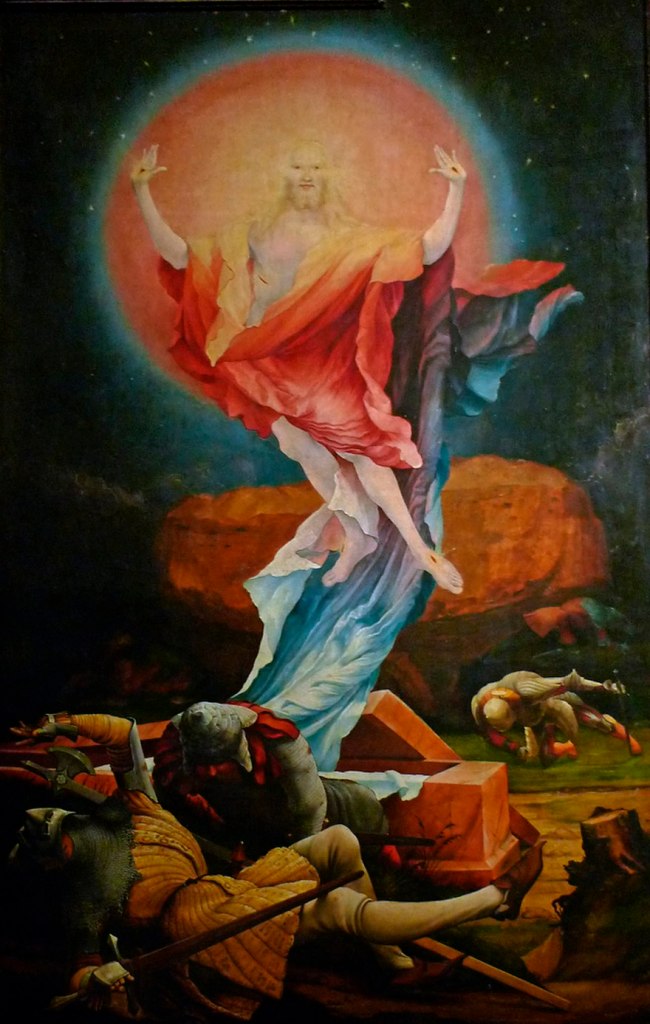
The Isenheim Altarpiece (1512–1516) by Matthias Grünewald (c. 1470 – 1528)

Mark Twain wrote, “No sinner is ever saved after the first twenty minutes of a sermon.”  Today we’re here to put that theory to the test.  No.  Not really.  If I hit the twenty-minute mark, you can tell me to shut up and sit down, but this is the Super Bowl and the World Series and the Stanley cup and the Master’s Golf Tournament of sermons all rolled into one.  It’s the one I’m supposed to knock out at the park and wow everybody with.  No pressure.  None whatsoever.  

In fretting over that, I’ve also thought about all the pessimism and skepticism in the world today and wondered how a few words of mine could make a difference. What can I say to you that will change anything?  Not just that, but in order to be heard above the clamor of everything else, I’m going to need something to grab your attention.  What could it be?  

Well, if I just wanted to get a lot of attention, then I could stand up here and tell you that as a priest and as a church we really don’t believe that Jesus rose from the dead.  That would get some attention.  That would even get my bishop’s attention!  The Facebook post would go off the charts and I’d probably even get a few “love letters” from people threatening to send me to meet Jesus.  Yes.  I could say that Jesus never rose from the dead and everyone would be up in arms, but if I say, “Jesus rose from the dead,” no one really gets excited.  There are no angry posts on Facebook, the Bishop is not called, we can all go back home to our lives, and nothing and no one is actually changed.  So the question is this: what would it take for this message—the Gospel of Jesus Christ, the love of God, and the resurrection to eternal life—what would it take for this message to actually change your life?  Today’s Gospel reading helps us in the right direction.  

Mary Magdalene went to the tomb. The stone was rolled away, so she runs and tells Peter and John who then get into a foot race to the tomb (John wins).  They look inside and see that the tomb is empty and the cloth that Jesus had been wrapped in was set to one side.  They saw all this, but they didn’t know what it meant, so what did they do?  Our Gospel reading tells us, “Then the disciples returned to their homes.”  They were probably confused more so than they ever had been. They were probably wondering who stole the body.  They were also wondering how they could continue after the death of Jesus and wondering where do we go now?  He’s dead.  He’s gone.  We’re here and everybody either hates us or thinks we’re freaks.  The best thing we can do is just to go home.  Go back to what we’re doing before we even knew the tomb was empty or even before we ever met him.  For the most part that’s you and I.  We hear this message, we know it intellectually, we read it every year.  I would wager that most everyone is very well aware of this basic Christian message: “Christ has died.  Christ has risen.  Christ will come again.”  It’s a very simple proclamation but so many hear it and then they just go back home.  The message hasn’t changed their lives, but then we have the second part of our Gospel reading today.

Mary Magdalene has experienced the exact same thing as the disciples.  She had witnessed the miracles and the teachings.  She had been there for the trial, the crucifixion, the death, and the burial, but the one difference between the disciples and Mary is that on that morning, Mary heard Jesus call her name.  She had a very real and personal encounter with the Risen Lord.  And now everyone says, “Oh, Father John, you’re just preaching like an evangelical minister this morning!  Going to tell me I need a personal relationship with Jesus Christ.  Yes, you do.  It’s true.  But if that’s all I tell you then you’re just gonna go back home, not changed, so what is it you need to hear in order to believe this message of the Gospel so that you don’t just go back home unchanged? 

If I was one of those really great passionate charismatic orators I might be able to tell you a story, give you an example, share my testimony about how God has changed my life or the life of so many others.  I might even for a minute or for a day or season convince you to follow Jesus, but after doing this for almost twenty years I know that there isn’t anything I can preach that will ultimately turn a person’s heart.  That was true even for Jesus.  Judas heard every one of Jesus’ sermons and those sermons didn’t do him a lick of good.  So what we do here on days like today is provide opportunities for souls to encounter God in hope that those souls won’t simply go home, but will instead stop and listen for God to speak their name just as he did with Mary.

When you decided to come to church this morning this is not what you were expecting to hear. You were probably expecting to hear Jesus Christ is risen today.  Hallelujah.  You would hear it then maybe go out to brunch, an Easter egg hunt, take a nap, but in the end, you would just go home.  Would your life be changed?  Would you stop everything to follow Jesus?  I don’t know.  But today, I don’t believe I can convince you, so instead of trying, I’m going to ask you to do something.  I know, the preacher asking us to do something probably wants us to give money.  Give Jesus $100 today and make a downpayment on that heavenly mansion.  No.  It’s nothing like that.  Instead, I’m just asking that you go home and listen.  Close yourself off in your room and sit quietly by yourself and say, “Speak Lord, for your servant is listening.”  And then, listen.  Listen for the voice of God.  At first, you’ll probably think you’re crazy, but then somewhere in that silence, you will hear God speak your name and you will know that on the third day Jesus Christ rose from the dead and that all who call on his name will be saved to eternal life.  You will know and you will be changed eternally.

Let us pray:
For Your mercies’ sake, O Lord our God,
tell us what You are to us.
Say to our soul: “I am your salvation.”
So speak that we may hear, O Lord;
our hearts are listening;
open our hearts that we may hear You,
and say to our soul: “I am your salvation.”
After hearing this word,
may we come in haste to take hold of you.
Amen.

Sermon: Great Vigil of Easter – “This is the Night”

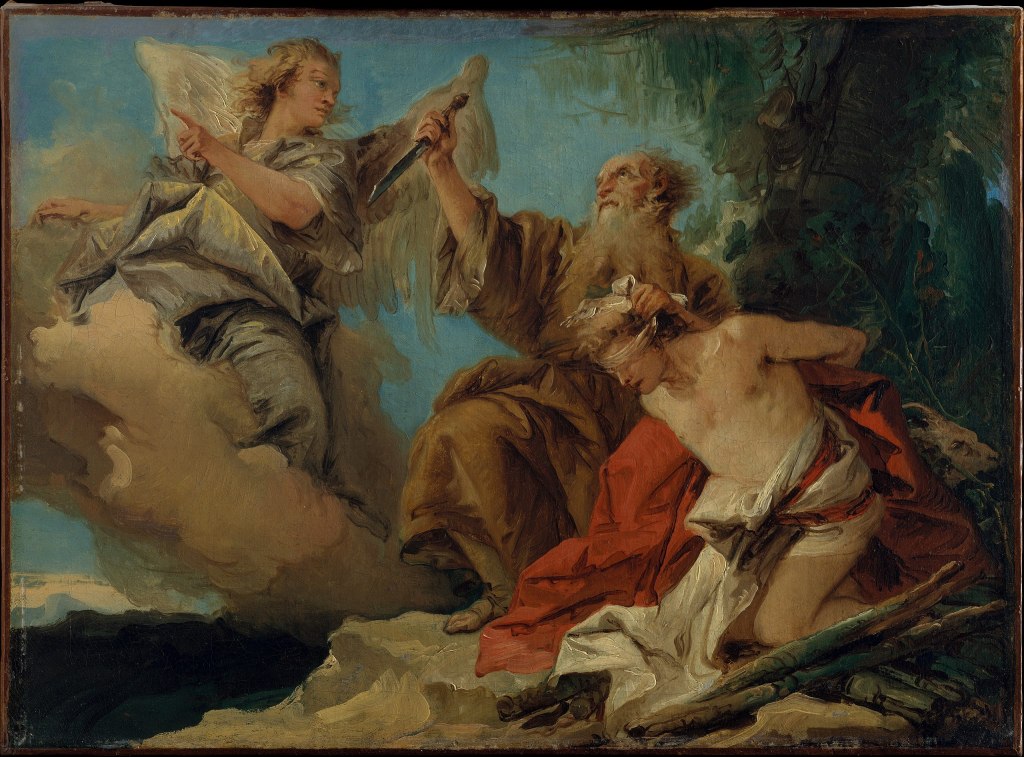
The Sacrifice of Isaac (mid-1750s) by Giovanni Domenico Tiepolo (1727 – 1804)

In her book, When God is Silent, author and Episcopal priest, Barbara Brown Taylor speaks to clergy about preaching.  At one point she addresses how we should go about preaching on some of the more difficult passages, such as the one we read: the sacrifice of Isaac.  Barbara says, that the Bible is full “of such raw and powerful stories.  Maybe we should preach more of them and where they are obscure, troubling, or incomplete, perhaps we should leave them that way.  Who are we, after all, to defend God?… The discord—like the silence—is God’s problem, not ours.  When we try to solve it, we are no longer being courteous.” (p.115-116)

When it comes to her advice and that passage of scripture of Abraham and Isaac, very few have taken Barbara’s advice.  They launch into long explanations of how this is only a myth and not an actual event or attempt to break down Abraham’s thought process or the psychology of Isaac or anything else so as to avoid or distract us from what the story tells us.  I’m guilty of all of the above because when taken at face value, all that remains is God telling Abraham, “Take your son, your only son Isaac, whom you love, and go to the land of Moriah, and offer him there as a burnt offering on one of the mountains that I shall show you.”  Abraham did not argue or weep or bargain.  He was obedient.  In the end, because of his obedience, Isaac was saved.  In his letter to the Hebrews, Paul summarizes what took place and how it was viewed, “By faith Abraham, when he was tested, offered up Isaac, and he who had received the promises was in the act of offering up his only son.”

We can finagle, whitewash, and analyze the incident all we want to make it easier to swallow, but the Scripture itself is clear: God tested Abraham by asking him to deliver his son up as a burnt offering so that God could determine whether or not Abraham was faithful.  

I do not believe that there is a parent in the room who would even consider it.  In fact, I believe that every single one of us—parent or not—would fail that test.  We would unapologetically tell God, likely in some rather colorful language, “No!  What you ask is impossible.”  If that were the end of it, we would all be lost, but Jesus refuses to lose us.  

Jesus says, “What is impossible with man is possible with God.”  

Jesus says, “Father, if you are willing, remove this cup from me. Nevertheless, not my will, but yours, be done.”  

Jesus says, “Father, into your hands I commit my spirit!”  

Jesus says, “It is finished.”

“This is the night, when Christ broke the bonds of death and hell, and rose victorious from the grave.” 

In order to prove our faith, we will never be called upon to sacrifice anyone or anything, for this is the night that the sacrifice that was made once and for all restores us to God. 

Alleluia.  Christ is Risen.

The Lord is risen indeed.  Alleluia.

Article: 365 Days of Easter

treeBorn a Jew, Billy Crystal may not have the best insights into the Christian faith, then again, he may have it pretty well worked out. With regards to Easter, in his book Still Foolin’ ‘Em: Where I’ve Been, Where I’m Going, and Where the Hell Are My Keys, he writes, “Two thousand years ago Jesus is crucified, three days later he walks out of a cave and they celebrate with chocolate bunnies and marshmallow Peeps and beautifully decorated eggs. I guess these were things Jesus loved as a child.” Leading up to Easter, a quick glance around the stores will only confirm his conclusion, but perhaps there is a bit more to it.

When we think of Easter, we often consider it to be that one glorious Sunday of celebrating the Lord’s resurrection. Yet for many, Easter is a season – Eastertide – lasting 50 days. If they had been around, Jesus very well may have enjoyed a chocolate bunny and Peeps, but what he “loved” as a child and as an adult, were the people of God. What did he hope to accomplish through this love? Redemption and adoption. “When the fullness of time had come, God sent his Son, born of a woman, born under the law, in order to redeem those who were under the law, so that we might receive adoption as children” (Galatians 4:4-5). No. Easter is not simply about sugary confections. Easter is the time we celebrate the resurrection of Our Lord, the conquering of death, and the receiving of our full inheritance as sons and daughters of God. So is this great gift something we should only celebrate for day? For only the fifty days of Easter? What would our lives look like, what would the church be like, how would our world change if we lived into the resurrection not just for one day or 50 days, but 51 days? 150 days? 250? What would happen if we lived into the resurrection of Our Lord 365 days a year?

Jesus declares, “I am resurrection” (John 11:25). This is not an event held in suspension to be celebrated for a few hours on a specified day. Instead, it is an event that should permeate everyday and every aspect of our lives. Yet, like so many opportunities in our lives, daily living the resurrected life requires choice and intentionality. Daily living the resurrected life requires us to follow in the footsteps of Jesus without hesitating or questioning where He might be leading. It requires us to boldly say with Mary, “Behold the maidservant of the Lord! Let it be to me according to your word” (Luke 1:38). Finally, daily living the resurrected life requires us to love. In Abba’s Child: The Cry of the Heart for Intimate Belonging, Brennan Manning states, “For me the most radical demand of Christian faith lies in summoning the courage to say yes to the present risenness of Jesus Christ.” What is the “radical demand of the Christian faith”: “You shall love the Lord your God with all your heart, and with all your soul, and with all your strength, and with all your mind; and your neighbor as yourself” (Luke 10:27). That command is not for the faint of heart! It takes great courage to truly love, because to truly love means to risk everything.

Make the decision. Be bold. Say, “Yes,” to the risenness of Jesus. Not just for a few hours or a day, a week or even a year, but every day. Every day, live the resurrected life God has blessed you with.