
Perhaps you’ve seen the letter to Jesus from Jordan Management Consultants.
It appears Jesus used these consultants to help identify potential leaders among his followers. The letter states that JMC has conducted extensive research on the candidates and then offers its recommendations:
“Simon Peter is emotionally unstable and prone to fits of temper. Andrew has absolutely no leadership qualities. The two brothers, James and John, the sons of Zebedee, place personal interests above loyalty to the company. Thomas demonstrates a questioning attitude that would tend to undermine morale.
“We feel it is our duty to inform you that Matthew has been blacklisted by the Greater Jerusalem Better Business Bureau. James, the son of Alphaeus, and Thaddaeus definitely have radical leanings and both registered high scores on the manic-depressive scale.
“One of the candidates, however, shows great potential. He is a man of ability and resourcefulness, meets people well, has a keen business mind, and has contacts in high places. He is highly motivated, ambitious, and responsible. We recommend Judas Iscariot as your controller and right-hand man.”
Did you ever notice how easy it is to pull a snippet from a person’s life and, from then on, judge and label them according to that snippet? We hear the stories of many of the characters in the Bible and do the same thing.
In the Old Testament, Abraham lied, David was an adulterer, Moses argued with God, and Jonah was flat-out disobedient. Those are only a few. Those in the New Testament aren’t any better. The apostles questioned Jesus’ methods. They argued amongst themselves. They wanted to call down fire from heaven and destroy cities (I actually kind of like that one). They abandoned Christ in his time of need. They denied him, and so on.
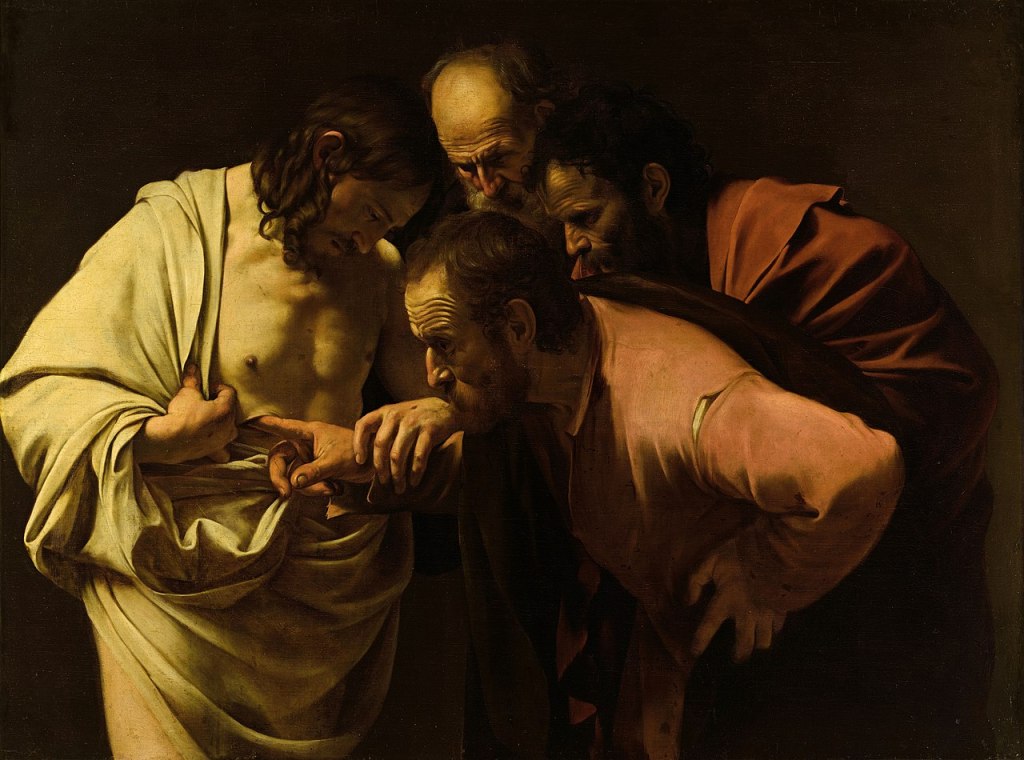
And then there is poor old Thomas. It is easy to understand why grade schoolers think his last name was Thomas and his first name was “Doubting.” Doubting Thomas. To tell you the truth, I think he gets a bad wrap, so today I would like to try to remedy that a bit.
Thomas is mentioned in all four gospels and the Acts of the Apostles, but in John’s gospel, he receives the most attention.
In John’s gospel, he is first mentioned as Jesus plans to return to Judea, where he would later raise Lazarus from the dead. The disciples are concerned because it was in Judea that the Jews had tried to stone Jesus just a short time earlier. Despite their concerns, Jesus says, “Let us go to Lazarus.”
I love the quote and have probably shared it with you before, but have you seen The Lord of the Rings? Great films. Gimli is a main character and a dwarf. A huge battle is about to take place, with slim chances of victory, so there is an argument over what to do. Stand and fight, or flee and possibly fight another day. Gimli settles the argument when he says, “Certainty of death, small chance of success- what are we waiting for?”
When Jesus said, “Let us go to Lazarus,” even though there was the possibility of death and everyone else wanted to stay put, Thomas said, “Let us also go, that we may die with him.”
Note to the wise: if you can find a friend like this, don’t let them go. In this situation, Thomas demonstrates bravery, loyalty, and dedication. While the rest were “doubting,” Thomas was prepared to lay down his life for the Lord.
In a later event, Jesus cryptically explained to the disciples that he would be killed and go to the Father. He went on to tell them that they knew the way to where he was going, yet Thomas said, “Lord, we don’t know where you are going, so how can we know the way?” Jesus then explained that he is “the way and the truth and the Life.”
No one else understood either, but Thomas demonstrated simple honesty by not pretending to understand what Jesus was trying to tell them.
Brave, loyal, dedicated, honest, and now, from today’s text, doubting.
When Jesus first appeared to the disciples, ten were there who saw and believed. Thomas was not.
Some have suggested that Thomas’ greatest mistake was not his doubting but his absence. After the death of Jesus, instead of remaining in the Christian community, he is postulated to have withdrawn and sought loneliness. By isolating himself from the community of faith, he failed to witness Christ’s appearance.
Whatever the case, Thomas doubts. The Lord appears again, and Thomas is present. At this appearance, Thomas redeems himself from his initial doubt. After laying eyes on, and possibly even touching, the Risen Lord, he makes a confession of faith regarding Jesus. This confession is greater than what all the rest have said to this point. Thomas declares, “My Lord and my God.”
From a distance, it is easy to criticize Thomas, but his doubt seems to have stemmed from a need for facts. Once he was certain, Thomas committed himself fully to Jesus, declaring him Lord and God.
Brave, Loyal, Dedicated, Honest, Doubting, Fully Committed. That’s a better first name than “doubting.”
The beginning of the Acts of the Apostles records Jesus’ last appearance to the apostles, and his final words to them were, “You will be my witnesses in Jerusalem, and in all Judea and Samaria, and to the ends of the earth.” It is clear from the rest of Acts that several of the apostles did as Jesus commanded; however, we don’t hear about them all, and Thomas is one for whom scripture is silent.
There is, however, what is known as the New Testament Apocrypha. It is not considered scripture or even true, but this collection includes a book titled “The Acts of Thomas.” According to this book, regarding being “witnesses to the end of the earth,” we learn that the apostles divided the earth and went out into the world to spread the Gospel message, as Jesus had commanded. Thomas, as legend has it, was assigned to the area we know as India.
When he arrived in India, he was enslaved, but it came to the attention of Gustafor, an Indian king, that Thomas was a carpenter. Learning this, Gustafor commanded Thomas to build him a palace. The king gave Thomas a considerable sum to buy materials and pay the workers; however, every time the king gave him money, Thomas gave it all to the poor. The king grew suspicious and sent for Thomas, asking, “Have you built my palace?” Thomas answered, “Yes.” The king asked when he could go and see the palace, and Thomas replied, “You cannot see it now, but when you depart this life, then you will see it.” Through his good works, Thomas was building a palace in heaven for the king. At first, the king was furious, and Thomas was nearly put to death. Yet through this situation, Thomas won the Indian king to Christ. Legend has it that this is how Christianity came to India.
True or false? It’s hard to say, but here’s a fact: To this day, Syrian Christians in India call themselves the Mar-Thoma Church, or “Father Thomas” Church, and are in communion with The Episcopal Church.
What can we gain from this apostle with the unfortunate first name? One theologian wrote, “What this church needs is what every church needs: a man who knows God at more than second-hand knowledge.”
When Jesus first appeared, Thomas wasn’t willing to take the other apostles’ word for it. He didn’t want second-hand knowledge. He wanted proof for himself. He wanted to see, hear, and lay his hands on the risen Lord.
That is what we should all want. Jesus says to Thomas, “Have you believed because you have seen me? Blessed are those who have not seen and yet have come to believe.” It is true. Faith is believing in the things we cannot see, but bouncing along in unsubstantiated faith is foolish, for when the trials come, that kind of faith can abandon us.
Therefore, we must also lay hold of the Risen Lord, and we can do so through prayer, study of Holy Scripture, meditation, our own experiences of Jesus, and the witness of others. It is then that the roots of our faith will be grounded in the Rock who is our Lord and our God. When trials blow through our lives, they may knock us around a bit, but we will not be uprooted. Like Thomas, we will learn never to doubt the one who saves us.
Let us pray: St. Thomas, you surrendered your doubts and placed your faith completely in the Resurrected Lord. Teach us to surrender ourselves fully to God’s will, trusting in His providence and love. May we let go of our fears and uncertainties, knowing that God is always with us. Pray for us, St. Thomas, that we may surrender our hearts to the Lord and find true peace in Him. Amen.
 Candle in a Cave