Sermon: Easter 2 RCL C – “Resurrection”


I know I’ve shared this story at a funeral, but I don’t believe I’ve ever shared it with you. 

A man was once sentenced to solitary confinement in a pitch-black prison cell. To relieve his boredom and keep his sanity, he threw a marble against the walls—day in, day out, bang, bang, bang. The marble would bounce off the wall onto the floor and then roll around the room until the man could locate it and repeat the procedure.

One day, he decided to do something different—he would throw the marble up and try to catch it as it came down. Of course, in the pitch black, he missed the catch quite often, so he would listen as the marble hit the floor and bounced around. Feeling around in the general direction of the sound, he would locate it and try again. The longer this went on, the more proficient he became, and the more proficient he became, the higher he would throw the marble. However, when he made his highest throw ever, he did not catch it, and neither was there any sound. The marble simply did not come back down. He became more and more disturbed. What had happened to his precious marble? How could it disappear into thin air like that?! He spent the rest of his life wondering what had happened to his marble, and it eventually drove him to madness, and he died. 

We all have things we wonder about and questions that we seek answers to. Sometimes, we have questions about life: Why does so-and-so not love me? How come all my luck is bad? What did I do to deserve this?

At other times, we question the world around us: Why is the sky blue or the grass green? How was the universe formed? How does Santa get into houses without chimneys? (Just seeing if you were paying attention.)

We also have questions about our faith. Does God hear my prayers? Do I matter to God? Or even, is there a God?

For life’s questions, through our faith, we learn to understand and take each day as it comes. For the questions about the world around us, we explore and study. And for the questions about our faith, we pray and study scripture. However, when it comes to these questions of faith, we also tend to try to make a few deals with God. Why do the hard work if there’s a shortcut?

I’ve never been a Janis Joplin fan in the tiniest little bit, but I remember a song of hers that we would laugh and sing as kids, if only the first verse.

Oh Lord, won’t you buy me a Mercedes-Benz?
My friends all drive Porsches, I must make amends

That’s about all we knew as kids, but it is the third verse that gets to the theological heart of the matter.

Oh, Lord, won’t you buy me a night on the town?
I’m counting on you Lord, please don’t let me down
Prove that you love me and buy the next round

And there it is. “Prove that you love me.” Prove to me that You hear my prayers. Prove to me that I matter to You. Prove to me that You are there.

The first stanza of the poem, Doubt, by Norman Shirk

Let me meet you on the mountain, Lord, just once.
You wouldn’t have to burn a whole bush,
Just a few smoking branches,
And I would surely be your Moses

In the end, it all comes down to the same statement: “Unless I see the mark of the nails in his hands, and put my finger in the mark of the nails and my hand in his side, I will not believe.” 

It is easy to criticize poor ol’ Thomas, but there’s a bit of him—maybe a little or maybe a lot—there’s a bit of Thomas in us all.

Like Thomas, in order to increase our faith, we ask the Lord to meet us halfway. However, He already has. The Lord Jesus met us halfway between heaven and hell. He met us on that hill outside of Jerusalem. He met us outside the empty tomb, and He continues to meet us every day exactly where we are. He also meets us at that altar in the Sacrament of His body and blood.

But you say, “Yes, yes, Father John. That’s real nice, but today, I want to be Thomas. I want to see Him, hear Him, and touch Him. I need the burning bush. I need the missing piece of the puzzle. I need to find the stupid marble that fella pitched up into the air and never came back down. Give me these things, and I will.”

A line from a movie I watched inspired the title of my blog—Candle in a Cave. In the movie, an older priest tells a younger one, “We are all blind men in a cave looking for a candle that was lit 2,000 years ago.” 

In some sense, this is true because I can’t show you a burning bush or guide your hands and allow you to touch the wounds of Christ. Sorry, I can’t do it. If I could, we would have folks flocking to this church by the millions to see it. Why? Because they want God to prove Himself to them, to give them a sign. Like Job, they ask God to explain Himself. 

But remember, the Lord was patient with Job for a while, but after much questioning, the Lord answered, “Who is this that darkens my counsel with words without knowledge?” “Where were you when I laid the earth’s foundation? Tell me, if you understand. Who marked off its dimensions? Surely you know! Who stretched a measuring line across it? Who created the sky, the animals? Were you there when I breathed life into the dust and created you?” 

Like Job, and even during Jesus’ time on earth, we desire signs and wonders, miracles. Scripture states that at one point during Jesus’ ministry, some Pharisees and teachers of the law questioned him: “Teacher, we want to see a miraculous sign from you.” Jesus answered, “A wicked and adulterous generation asks for a miraculous sign! But none will be given it except the sign of the prophet Jonah. For as Jonah was three days and three nights in the belly of a huge fish, so the Son of Man will be three days and three nights in the heart of the earth.”

You see, the problem is not with God; it is with us. The Lord has already given us a sign. After three days and three nights in the heart of the earth, He rose! How? Truly, the Lord only knows. As the Psalmist says, “Such knowledge is too wonderful for me, too lofty for me to attain.” But Jesus rose from the grave. How much more proof does a person need? Just because there were no witnesses to the resurrection, does it mean it did not occur? No. Remember what Billy Graham said, “Can you see God? You haven’t seen him? I’ve never seen the wind. I see the effects of the wind, but I’ve never seen the wind. There’s a mystery to it.”

No one witnessed the resurrection of Jesus, but from that day forward, we have all been witnesses to, and have experienced for ourselves, the effects of the resurrection—this new life in Christ Jesus—and it didn’t involve getting a Mercedes-Benz. Therefore, “Do not doubt but believe.” 

Remember our prisoner and his marble? When the guards later entered the cell to remove his body, a glint of light caught one of the guards’ eyes. He looked up toward the ceiling to see the most astonishing sight—a marble caught in a spider’s web. “Of all the crazy things,” he thought. “How on earth did the spider manage to get a marble up there?” He spent the rest of his life wondering.

There are many mysteries in our lives with God, things we can wonder about and seek answers to throughout our lives. However, the question of the resurrection is not one of them, for the proof is all around us.

Let us pray: Praised be the God and Father of our Lord Jesus Christ, He who in His great mercy gave us new birth, a birth unto hope which draws its life from the resurrection of Jesus Christ from the dead; a birth to an imperishable inheritance, incapable of fading or defilement, which is kept in heaven for you who are guarded with God’s power through faith; a birth to a salvation which stands ready to be revealed in the last days. Amen.
Sermon: Easter 2 RCL A – “Frustration”

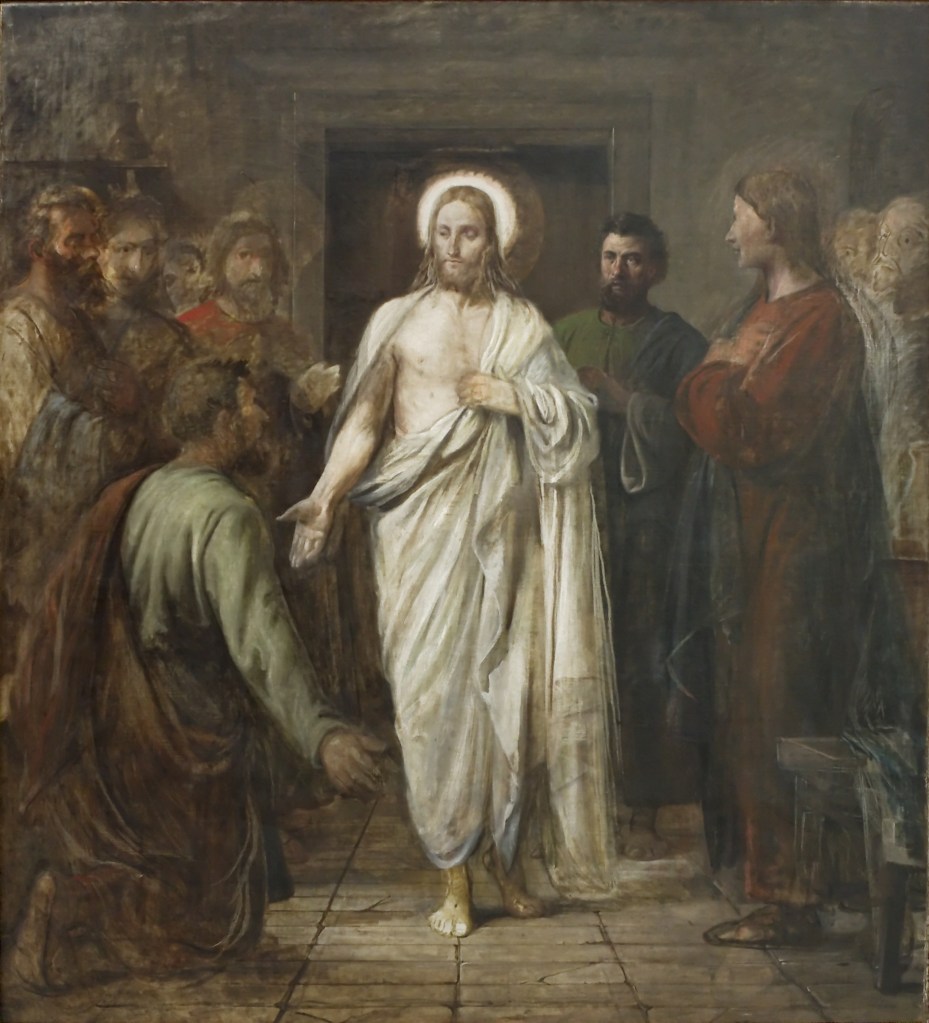
Doubting Thomas
by Wilhelm Marstrand

Boudreaux had been hearing about chainsaws for years, and how easy they were to use, so he finally decided to get one for himself. When he got to the hardware store, the clerk assured him these new saws could cut down five big oak trees in an hour. That was enough for Bou, so he purchased one and headed to the woods for some stovewood. Twenty-four hours later, he returned to the store. He was mad and frustrated. “It took me all day to cut down one tree,” he said. “I’d a done better with my axe.” 

Puzzled, the store owner stepped outside with the saw, gave the cord a swift pull, and fired up the steel-toothed beast. Its deafening roar sent Boudreaux stumbling backward. 

With his fingers in his ears, Boudreaux shouted, “What’s that noise?”

I told you a while back that when it comes to movies, I’m a bit like a kid—not only in the kind of movies I like but in the number of times I can watch the same one repeatedly. I find that I’ll do this when I want to relax. I know the movie, the story, and probably even most of the lines, so I can enjoy it without having to really think about it. One of those I watched last week, with all that was going on during Holy Week, was the Hunger Games series. 

There is a simple scene, but it reminded me of something. Katniss is using a flashlight as a cat toy. Move the light around, and the cat will chase it but never be able to catch it. You’ve probably all seen the same idea with those laser beam cat toys. A cat will climb the wall trying to get at the fast-moving red dot. The Queen—the eight-pound feline monarch that rules my house—has had her time with that red dot, but at some point, like Katniss in the movie, I began to wonder if it was actually any fun for the animal. Sure, it is entertaining for us, but how frustrating is it to chase after something and never be able or allowed to catch it? After a session with The Queen, I noticed she would wander the house for a good hour, meowing and unable to settle down. I realized that watching her scramble around chasing it was fun for me, but I didn’t think it was fun for her, so I put it on the shelf.

The Cambridge Dictionary defines frustration as “the feeling of being annoyed or less confident because you cannot achieve what you want, or something that makes you feel like this.” And we’ve all known this feeling. In one way or another, we’ve all chased the red dot and exhausted ourselves in our attempt to catch it, yet every time, it eludes us. From jobs to relationships to any number of goals, no matter the attempts or effort applied, they seem unattainable. This frustration then leads to anger, anxiety, shame, and even guilt. Not only is this true with life in general, but it is also true in our life with God.

Prayers that seem to be unanswered. Circumstances that can’t be resolved. Unrelenting illness. We seem unable to follow the commands in our lives, failing, and sinning time and time again, chasing the red dot of our faith, yet unable to ever catch it. Unable to get it right or know that God even hears us. If you’ve ever felt that way, you are not alone. Consider these words of King David in Psalm 13:

How long, O Lord? Will you forget me forever?
    How long will you hide your face from me?

How long must I take counsel in my soul
    and have sorrow in my heart all the day?
How long shall my enemy be exalted over me?

Consider and answer me, O Lord my God;
    light up my eyes, lest I sleep the sleep of death,

lest my enemy say, “I have prevailed over him,”
    lest my foes rejoice because I am shaken.

Why have you not heard me? Have you forgotten me? I am sick. I am tired. There are those things and people that have come against me. Am I just supposed to give up and die? So much has gone wrong. Frustration. Anger. Anxiety. Shame. Guilt. And all those feelings of frustration lead us to say, “Unless I see the mark of the nails in his hands, and put my finger in the mark of the nails and my hand in his side, I will not believe.” 

When we become frustrated with our lives, our lives with God, and even frustrated with God, we can doubt. Does God have a plan for my life? Does God care about me? Does God see that I’m hurting? Well, I’ve got some news for God, unless I see hard proof, then… I just don’t know. 

David was frustrated. He cried out, “How long, O Lord?” But at the end of Psalm 13, it is as though David took a deep breath and set aside his frustrations and doubt, for he concluded,

But I have trusted in your steadfast love;
    my heart shall rejoice in your salvation.

I will sing to the Lord,
    because he has dealt bountifully with me.

No longer is he speaking doubt and hurt. His words have become those of assurance, confidence, and determination. His words have become those of faith.

From what I read, Bear Bryant was one of the best college football coaches and had the track record to back it up. John McKay, another great coach, tells the following: “We were out shooting ducks, and finally, after about three hours, here comes one lonely duck. The Bear fires. And that duck is still flying today. But Bear watched the duck flap away, looked at me, and said, ‘John, you are witnessing a genuine miracle. There flies a dead duck!’” 

Bear Bryant’s faith in his shooting skills may have been a bit overinflated, but our faith in God can never be. 

I do not have a cure for frustrations; they will come, but see and know that the Lord our God is very near to those He loves, working out His good purposes.

Speaking through the Prophet Isaiah, the Lord says, 

But now thus says the Lord,
he who created you, O Jacob,
    he who formed you, O Israel:
“Fear not, for I have redeemed you;
    I have called you by name, you are mine.

When you pass through the waters, I will be with you;
    and through the rivers, they shall not overwhelm you;
when you walk through fire you shall not be burned,
    and the flame shall not consume you.

For I am the Lord your God,
    the Holy One of Israel, your Savior.

First, ask God if what you are attempting to do is His will or if you’re just chasing some random red dot. If you discern that it is God’s will, then trust that He will see it through. “Do not doubt but believe,” and say with Thomas, “My Lord and my God!”

Let us pray: Lord, if what we seek is according to Your will, then let it come to pass and let success attend the outcome. But if not, Dear Lord, let it not come to pass. Do not leave us to our own devices, for You know how unwise we can be. Keep us safe under Your protection with faith in Your word, and in Your own gentle way, guide and rule us as You know best. Amen.

Sermon: Easter Sunday – “Fools”

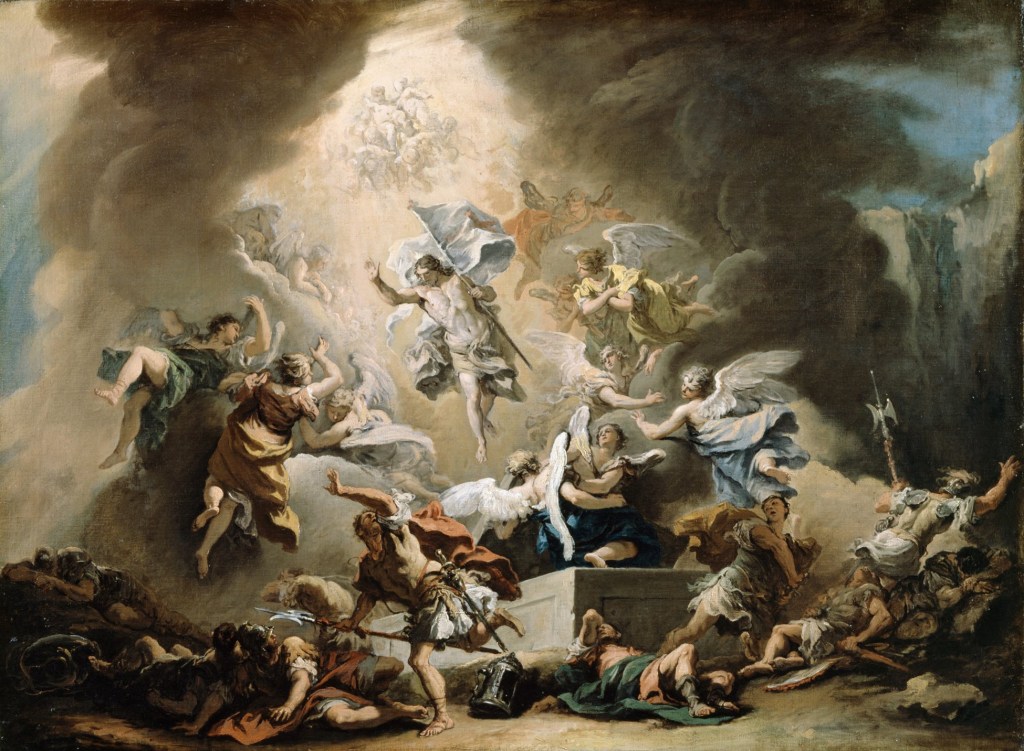
The Resurrection by Sebastiano Ricci

An atheist professor was teaching a college class and told the students that he would prove there was no God. He said, “God, if you are real, then I want you to knock me off this platform. I’ll give you 15 minutes!”

Ten minutes passed, and he kept taunting God, saying, “Here I am, God, I’m still waiting.” 

He got down to the last couple of minutes when a 320-pound lineman on the football team happened to walk by the door and heard what the professor was saying. The football player walked into the classroom and, at the last minute, hit the professor with a haymaker, sending him flying off the platform.

When the professor woke up, he stood and, still shaken, said, “Where did you come from, and why did you do that?”

The 320-pound lineman replied, “God was busy; He sent me!”

When you begin to talk to people about what Jesus said, most will believe it. The good solid teachings. They make people want to be better individuals. They teach us how to live. All that talk about “Loving your neighbor” gets people’s motor running.

When you talk about some of the things Jesus did, like flipping over the tables in the Temple or picking and eating grain on the Sabbath, folks are pretty much OK with these as well. Even his trial, death, and crucifixion are believed to be historical facts because most believe in a historical Jesus, and crucifixion was how the Romans dealt with criminals and troublemakers. But when you talk about the miracles Jesus performed, folks start to get a little skeptical. 

Giving sight to the blind, healing the lame, feeding the 5000 (that’s a maybe because they can logically figure out how that might have been done. They assume more food was available than was recorded in the Scriptures), walking on water, and casting out demons (this one gets a double negative because you’ve first got to believe in demons.) When you begin to talk about miracles, people start to shake their heads. They say, “Those things just aren’t possible.”

When you bring up Jesus raising the dead, you run into a brick wall. Lazarus, the little girl, and probably others we’re not told about. It’s like St. John wrote at the end of his Gospel, “Now there are also many other things that Jesus did. Were every one of them to be written, I suppose that the world itself could not contain the books that would be written.” (John 21:25) Ask around about raising the dead and you will be told, “Not going there.” And the one that is an absolute hard-stop show-stopper is Jesus being raised from the dead on the third day. You talk about that, and for many, you’ve entered the land of make-believe and fairy tales. To believe in the resurrection makes you a fool.

Can I tell you something that you may already know? I am a fool. I believe, and I would like for you to believe and to be a fool, also. The trouble is I cannot prove any of it to you. Even if I could get a 320-pound lineman to come in, hit you with his best haymaker, and say, “God was busy, so he sent me!” You would still say, “I’m no fool.” Although, perhaps, you would not say it to the 320-pound lineman.

The First Sunday after Easter is always the incident concerning doubting Thomas. You remember the one: “Unless I see in his hands the mark of the nails, and place my finger into the mark of the nails, and place my hand into his side, I will never believe.” (John 20:25) I know why it’s placed on the first Sunday after Easter but I also think it would be very appropriate for Easter Sunday because there are so many who fall into the same category as Thomas. When it comes to the resurrection, their first name becomes, Doubting. So how do we overcome our doubts?

An incident is recorded in Mark’s Gospel: a man comes to Jesus begging that his son be healed. The man says, “If you can do anything, have compassion on us and help us.” And Jesus said to him, “‘If you can’!—Who do you think you’re talkin’ to with all that “if” business—All things are possible for one who believes.” Immediately the father of the child cried out and said, “I believe; help my unbelief!” 

“I believe; help my unbelief!” Is a prayer. It is a prayer from one who desires to believe but needs God’s grace in order to believe more fully. You see, believing in God, Jesus, the Holy Spirit, and all they have accomplished, including the resurrection, is not a matter of your reasoning, or your faith, or your understanding. Believing these things is a grace from God. As St. Paul said in his letter to the Ephesians, “For by grace you have been saved through faith. And this is not your own doing; it is the gift of God, not a result of works, so that no one may boast.” (Ephesians 2:8-9) By grace, you have been saved. By God’s grace, we are able to believe, so pray with the man, “I believe; give me Your grace, and help my unbelief.” 

Pray for God’s grace and become a fool with me when and so many others. That belief, that faith, comes with some exceptional benefits—not just for when you’re dead and gone but for today. Benefits like peace of body, soul, and mind, joy even in difficult situations, healing—not always the body—but always of the soul and spirit, a love that can be felt and expressed to others, and so much more… and even though you may think me more a fool for saying it, it also comes with eternal life. Life with God and all of God’s children.

Saint Paul says, “Let no one deceive himself. If anyone among you thinks that he is wise in this age, let him become a fool that he may become wise. For the wisdom of this world is folly with God.” (1 Corinthians 3:18-19) And again, speaking of the Apostles and therefore speaking of us, he says it plainly, “We are fools for Christ’s sake” (1 Corinthians 4:10a) becoming spectacles “to the world, to angels, and to men.” (1 Corinthians 4:9b) 

Pray that you may become a fool for Christ. Pray that you may receive God’s grace and believe.

Let us pray: 

Christ is Risen: The world below lies desolate.
Christ is Risen: The spirits of evil are fallen.
Christ is Risen: The angels of God are rejoicing.
Christ is Risen: The tombs of the dead are empty.
Christ is Risen indeed from the dead,
the first of the sleepers,
Glory and power are his forever and ever.

Amen.