
After five years of therapy, a psychiatrist told his patient, “We don’t often use the word cured, but I’m pleased to tell you that I believe you’re completely cured.”
To his surprise, the woman looked deeply disappointed.
He said, “What’s wrong? I thought you’d be thrilled.”
She said, “Doctor, look at it from my point of view. Five years ago I was Joan of Arc. Now I’m nobody.”
Expectations are funny things. They don’t just affect how we feel about what happens. They also shape how we interpret it.
Some expectations are fanciful: when I was about eight, I wanted a pair of leather pants because I expected to grow up and be a cowboy, and of course I couldn’t be a cowboy without them. Other expectations are more reasonable: you purchase a plane ticket from point A to point B, and you can pretty much expect to land at about the correct time at point B.
Today in our reading from Exodus, we hear of a reasonable expectation followed by disappointment.
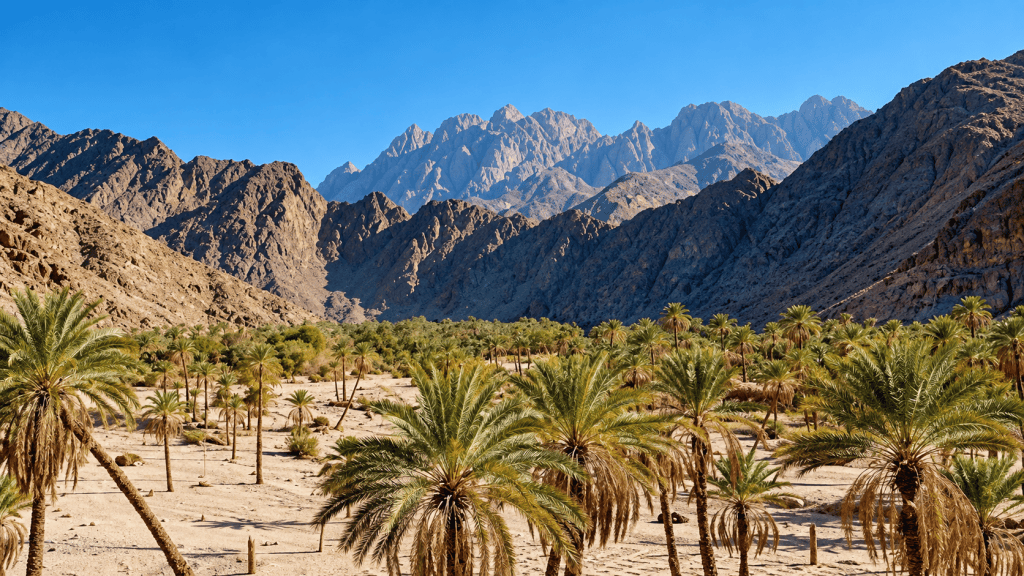
The Israelites are a desert people; they know you can never travel too far from a water source. So, to get somewhere, you don’t necessarily travel in a straight line. Instead, you travel from one oasis to the next. This is what the Israelites did because it was smart if you wanted to live, and because God told them to: “The whole congregation of the Israelites journeyed by stages, as the Lord commanded.” By doing this, they came to Rephidim. The picture on the front of your bulletin shows the traditional site. It is an oasis. Why did they go there? The text is not explicit, but it is safe to say they had a reasonable expectation that there would be water.
Being in the desert without water is death, so the people quarreled with Moses: “Why did you bring us out of Egypt, to kill us and our children and livestock with thirst?” Then they asked a hard question: “Is the Lord among us or not?”
We read the words of the Psalmist:
Hear my teaching, O my people;
incline your ears to the words of my mouth.
He worked marvels in the sight of their forefathers,
in the land of Egypt, in the field of Zoan.
He split open the sea and let them pass through;
he made the waters stand up like walls.
He led them with a cloud by day,
and all the night through with a glow of fire.
The people at Rephidim who asked, “Is the Lord among us or not,” are the same people who have experienced these praiseworthy deeds and witnessed the power of the Lord. Yet about 45 days later, when their expectations were not immediately met, they quarreled over whether God was with them.
Despite their complaints against God, the miracle came, and water flowed from the rock at Horeb. The miracle is remembered, but so is the complaining. Moses called the place Rephidim Massah and Meribah, meaning testing and quarreling. Years later, the Psalmist will instruct the people,
Today, if you hear his voice,
do not harden your hearts, as at Meribah,
as on the day at Massah in the wilderness,
when your fathers put me to the test
and put me to the proof, though they had seen my work.
(Psalm 95:8-9)
Sitting here in our nice air-conditioned church, it is easy to be critical of the Israelites: “You had firsthand knowledge of all God can do, and now you’re complaining. What’s a little water when you’ve lived through the ten plagues of Egypt and seen the sea parted?” However, I suspect there is a place in each of our lives that was once Rephidim but has become a place of Massah and Meribah—a place where we grumble because, even though we’ve done all God asked in the way He asked, there is no water.
You’ve gone to church, you’ve confessed your sins, you’ve prayed, you’ve knocked because you believe Jesus’ words, and you’ve been faithful; therefore, you have a reasonable expectation that God will act in a certain way. Yet there is no water. The prayer isn’t answered, the relationship cracks, the sickness persists… there is no water.
Like the Israelites, whether spiritually or physically, you need water to live. There is a possibility the Lord will provide a rock at Horeb—water—but there is also the possibility that Riphidim remains a barren and dry place, a place of Massah and Meribah—testing and quarreling. And in that place you may ask, “Is God with me or not?”
As a deer pants for flowing streams,
so pants my soul for you, O God.
My soul thirsts for God,
for the living God.
When shall I come and appear before God?
My tears have been my food
day and night,
while they say to me all the day long,
“Where is your God?”
(Psalm 42:1-3)
In your thirst, what are you to do?
Today, Jesus tells us the parable of the father with the vineyard and two sons: “A man had two sons; he went to the first and said, ‘Son, go and work in the vineyard today.’ He answered, ‘I will not’; but later he changed his mind and went. The father went to the second and said the same; and he answered, ‘I go, sir’; but he did not go.”
Now, imagine you are that first son. You’ve been going to work in that vineyard day after hot, sweaty day, but on this day you’ve had enough. Your father asks you, and without giving any reason, you say no. Notice, the father does not offer you an increase in your allowance or any other reward, but neither does he beg or threaten. The father simply asks. You say no, but after a time you have a change of heart—nothing has changed; there is still no water—nothing has changed except you. Why did you go into the vineyard to work?
I would suggest two possible reasons. First, there is obedience. You have been asked by your father, one who is in authority over you, to carry out a task. You can obey or not. So, you may have had a change of heart because you recognize the father’s authority. However, in this case, I think obedience is a very distant second to the main reason behind your change of heart.
The main reason is the relationship between the father and the son. The son knows that the father has always cared for him, provided for his needs, and been faithful in all things. The son knows that his father loves him. Therefore, in response to the father’s love, the son goes and works in the vineyard. Nothing has changed; there is still no water, but because of the father’s loving faithfulness, you know he has his reasons. It may not look like what you wanted. It may not be what you think you need. Yet God is with you. He has always been with you and loved you.
You are faithful. To the best of your ability, you do what our heavenly Father asks, so you have a reasonable expectation that when you ask for water—peace, healing, renewal, consolation, answers—God will provide. Yet when you get to Rephidim, it is a wasteland. It hurts and is disappointing, but that doesn’t mean God is absent. We remember the Father’s loving kindness and trust that he is with us.
You say, “That’s all well and good, Father John, but I’m dying of thirst out here.”
You say with David,
O God, you are my God; earnestly I seek you;
my soul thirsts for you;
my flesh faints for you,
as in a dry and weary land where there is no water.
(Psalm 63:1)
Yet when we say these things, the Lord replies as he did to the Prophet Isaiah:
When the poor and needy seek water,
and there is none,
and their tongue is parched with thirst,
I the Lord will answer them;
I the God of Israel will not forsake them.
I will open rivers on the bare heights,
and fountains in the midst of the valleys.
I will make the wilderness a pool of water,
and the dry land springs of water.
(Isaiah 41:17-18)
“Yes, yes, yes,” you say. “God will do those things, but when? I’m thirsty now.”
I know.
And I wish I could tell you where your rock of Horeb is. I wish I could tell you when the water will come, but I can’t. Still, there are things I can do. I can sit with you in Rephidim. When you cannot remember what God has done, I can remember it for you. When you cannot pray, I can pray for you. When you ask, “Is the Lord among us or not?” I will stay with you as we wait. You see, that is what the Church does. We don’t pretend there is water when there isn’t. We don’t tell thirsty people they simply haven’t prayed hard enough. We don’t explain away the wilderness. Instead, we sit together, just as we are doing today. And perhaps that is how we know the Lord is among us. Because we can reach out and touch Him in the person next to us.
Let us pray: O Lord our God, grant us to trust in your overshadowing wings. Protect us beneath them and bear us up. You will carry us as little children; even to our grey-headed age, you will carry us still. When you are our strong security, that is strength indeed. Amen.

