
Sermon: Christmas Day RCL A


The first words of the Bible are “In the beginning God created the heavens and the earth,” and then, in very poetic language, the account of creation follows: light and darkness, the sun, moon, and stars, earth, land and sea, plants, animals, and finally humankind. This is God’s creation.

The Gospel of John begins with a similar phrase: “In the beginning…” However, it is not the creation account that follows, but what was before even that — “In the beginning was the Word.” Then comes another poetic passage about who the Word is and what he does.

But why do we hear these verses today? It becomes clear when we read, “And the Word became flesh and dwelt among us.” These words point to the child in the manger. They reveal who this newborn child truly is—a human child, but not only that. His origins go back further and deeper than ours. We are people begotten of men, but Jesus is “God from God, Light from Light,” as the Nicene Creed states. He is God’s own Son, who has become man, taken on flesh, our mortal humanity, and become one of us.

God became man; this is what we say about the Christ Child in the manger. That is the focus of today’s Gospel. When God became man, He brought with Him the divine light that shines in the darkness—a light that brightens every shadow and dark corner as brightly as the noonday sun.

Why? Because He knows that we often wander in darkness—darkness of sin, death, sickness, war, and much more. We can become lost in a harsh world we don’t understand. We seek answers even when we don’t know the questions. That is why the Word became flesh, why God became man. So He could shine His divine light into the darkness of this world and our hearts, so that we might know joy and so that we all might find our way home to Him.

History records for us an interesting footnote. It was during the dark winter of 1864 at Petersburg, Virginia, where Robert E. Lee’s Confederate army faced the Union divisions led by General Ulysses S. Grant. The war, now three and a half years old, had transitioned from glorious charges to the muddy realities of trench warfare. Late one evening, Major General George Pickett, one of Lee’s generals, received news that his wife had given birth to a healthy baby boy. Throughout the line, Southerners lit large bonfires to celebrate the event. These fires did not go unnoticed in the Northern camps, prompting a cautious Grant to send a reconnaissance patrol to investigate. The scouts returned with news that Pickett had a son, and that the fires were celebratory. Interestingly, Grant and Pickett had been classmates at West Point and knew each other well. To mark the occasion, Grant also ordered bonfires to be built. 

What a strange night it was. Fires blazed on both sides of the lines for miles. No gunshots, no shouts, no fighting. Just light celebrating the birth of a child. But that didn’t last long. Soon, the fires died out, and darkness took over again—both of the night and of the war. 

The good news of Christmas is that in the midst of great darkness, there came a light, and the darkness was not able to overcome the light. It was not just a temporary flicker; it was an eternal flame. We need to remember that. There are times, in both world events and our personal lives, when we feel the light of the world will be snuffed out. But the Christmas story affirms that no matter what happens, the light still shines.

The theologian Robert Alden wrote, “There is not enough darkness in all the world to put out the light of even one small candle.” That being true, then the divine light born in a manger in Bethlehem is more than adequate to dispel the darkness of this world eternally.

Sermon: Christmas 1 RCL C – “Being Light”


A young girl once consulted with her priest. “I cannot stick it out any longer. I am the only Christian in the factory where I work. I get nothing but taunts and sneers. It is more than I can stand. I am going to resign.”

“Will you tell me,” asked the priest, “where lights are placed?”

“What has that to do with it?” the young Christian asked him rather bluntly.

“Never mind,” the priest replied. “Answer my question: Where are lights placed?”

“I suppose in dark places,” she replied.

Speaking of Jesus, John wrote in the Prologue of his Gospel, “What has come into being in him was life, and the life was the light of all people. The light shines in the darkness, and the darkness did not overcome it…. The true light, which enlightens everyone, was coming into the world.”

It speaks of Jesus, but it also speaks of the illuminating light of Jesus. A light that seeks out others and enlightens them in the ways of God. Jesus says toward the beginning of the Sermon on the Mount: “You are the light of the world. A city set on a hill cannot be hidden. Nor do people light a lamp and put it under a basket, but on a stand, and it gives light to all in the house. In the same way, let your light shine before others, so that they may see your good works and give glory to your Father who is in heaven.”

Jesus is the light, but he has shared His light with us so that we might also become beacons of hope and love in the darkness.

What does such light look like? 

Desmond Tutu was born in 1931, and he died on December 26, 2021. He was also one of ours—a South African Anglican bishop and theologian known for his work against apartheid and for human rights.

In 1940, Desmond’s mother worked as a cook in a hospital for women. The story tells that Desmond—he was nine years old at the time—and his mother were walking down the street, and a white man in a dark suit was walking toward them. The rules of apartheid dictated that Desmond and his mother step into the gutter, bow their heads, and allow the white man to pass. However, before they had the opportunity to do so, the white man stepped off the street first and, as they passed, tipped his hat to Desmond’s mother. After a time, Desmond asked his mother why the white man would do that, to which his mother replied, “He is a man of God.” The white man was Trevor Huddleston, Bishop in the Anglican Church.

Bishop Huddleston not only could have but should have ignored them; instead, he ignored the societal expectations and norms and honored the Image of God that was within them. He became a light in a dark world.

Tutu said much later, “I couldn’t believe my eyes, a White man who greeted a Black working-class woman.”  This one event was a great deal of the inspiration for Desmond becoming an Anglican priest.

What does it look like to be the light in the darkness? It is not necessarily something big and grand. Sometimes, it is nothing more than a tip of the hat, but that tip of the hat can speak volumes of the work of God.

Later, Bishop Tutu would say, “So often when people hear about the suffering in our world, they feel guilty, but rarely does guilt actually motivate action like empathy or compassion. Guilt paralyzes and causes us to deny and avoid what makes us feel guilty. The goal is to replace our guilt with generosity. We all have a natural desire to help and to care, and we simply need to allow ourselves to give from our love without self-reproach. We each must do what we can. This is all that God asks of us.” 

How will you be the light? You don’t have to look far, and you don’t have to come up with some grand scheme. All that is required is that you be faithful to God’s calling to love one another as He has loved us.

Let us pray (a prayer from Blessed John Henry Cardinal Newman that we can each make our own):  Dear Jesus, help me to spread Your fragrance everywhere I go. Flood my soul with Your spirit and life. Penetrate and possess my whole being so utterly that my life may only be a radiance of Yours. Shine through me, and be so in me that every soul I come in contact with may feel Your presence in my soul. Let them look up and see no longer me but only Jesus! Stay with me, and then I shall begin to shine as You shine, so to shine as to be a light to others; the light, O Jesus, will be all from You; none of it will be mine; it will be you, shining on others through me. Amen.

Sermon: Wednesday in Holy Week

Photo by David Werbrouck on Unsplash

The deadline for completing the construction of a skyscraper was near, so the crews worked around the clock. The night crew was hard at work on the twenty-first floor when unknown to the others, one of the welders went over the edge. 

Dropping everything, he flung his hands into the pitch-black and grabbed an edge. Hanging there, he yelled, screamed, and prayed that someone would come, but because of all the other construction noise, no one heard, and his grip began to slip. 

He let out a scream and fell… three feet, and landed on the scaffolding that was below him. Scaffolding he had not been able to see in the dark. 

There is a physical darkness, but we also know that there is a spiritual darkness, and it is this spiritual darkness Paul tells us we do battle against it. “Our struggle is not against enemies of blood and flesh, but against the rulers, against the authorities, against the cosmic powers of this present darkness, against the spiritual forces of evil in the heavenly places.” (Ephesians 6:12)  Therefore, Jesus tells us, “The light (He is the way, the truth, and the light)… the light is with you for a little longer.  Walk while you have the light, so that the darkness may not overtake you.  If you walk in the darkness, you do not know where you are going.  While you have the light, believe in the light, so that you may become children of light.” (John 12:35-36a)  And it is through Jesus, as Paul teaches us again, that we “are all children of light and children of the day.” (1 Thessalonians 5:5a)

Our Gospel tells us, “When Jesus had dipped the piece of bread, he gave it to Judas son of Simon Iscariot.  After he received the piece of bread, Satan entered into him.  Jesus said to him, ‘Do quickly what you are going to do.’” (John 13:26b-27) Then, “after receiving the piece of bread, Judas immediately went out.  And it was night.” (John 13:30)  As he turned from Jesus and left, Judas entered the darkness, both physically and spiritually.

Later that evening, “Judas brought a detachment of soldiers together with police from the chief priests and the Pharisees, and they came there with lanterns and torches and weapons.” (John 18:3) “They came there with lanterns and torches”—they came there in the dark and carried out the works of darkness, the works of the “spiritual forces of evil.”

For Judas, there was a threshold, both literally and spiritually, that he crossed when he went out. He intentionally stepped out of the light of the room where Jesus and the others were gathered—the Light of Christ—and, in a similar manner, he intentionally stepped into the spiritual darkness and was lost.

For Judas and for us, the threshold between the light and the dark is the place of testing. It is the place of free will, where we choose light or dark. The biggest mistake we can make is to think there can be a compromise.  “I won’t go so far into the night that I can’t see the threshold leading back into the light.”  That’s like a woman saying she’s only a little bit pregnant.  There is not a little bit of darkness. We either walk in the dark or we walk in the light. Therefore, walk in the light and believe in the light so that you may remain children of light.  This is God’s plan for us; through the guidance and strength of his Holy Spirit, we can be obedient.

Sermon: Palm Sunday RCL C – “Darkness”

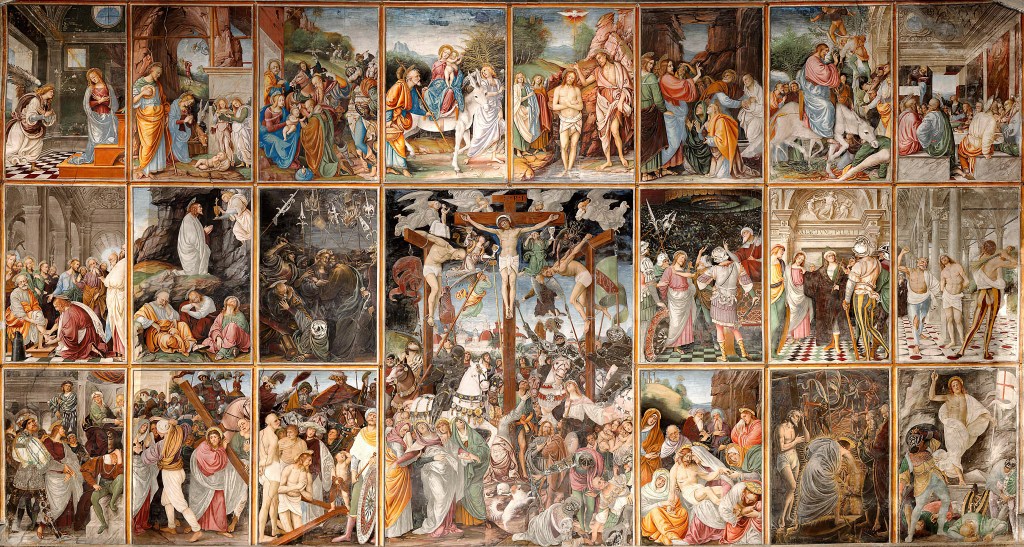
Gaudenzio Ferrari (1475–1546), Stories of The Life and Passion of Christ (1513),
Church of Santa Maria delle Grazie, Varallo Sesia (VC), Italy.

The Gospels are not time-stamped so it is somewhat difficult to calculate the length of Jesus’ public ministry, but given the clues and festivals mentioned, it is estimated to have been three to three and a half years.  With that understanding, we can say that the forty days Jesus spent in the wilderness and the temptation he experienced there took place about three years prior to the events we are reading today.

At the end of those forty days we are told, “When the devil had ended every temptation, he departed from him until an opportune time.”  Following this, Scripture tells us, “Jesus returned in the power of the Spirit to Galilee, and a report about him went out through all the surrounding country. And he taught in their synagogues, being glorified by all.”  The public ministry begins.

Throughout that ministry, we know that there were many encounters with religious leaders, demons that he exorcised, teachings, feedings, miracles, and more.  For three years Jesus poured out his life for the sake of the mission, fighting every battle that came along, so when he arrived in the Garden of Gethsemane on the night before he was crucified—knowing full well what was about to happen—not only was he exhausted, he was also highly stressed.  He sweated drops of blood.  Hematidrosis.  An exceptionally rare medical condition brought on by stress and anxiety that causes a person to sweat blood.  Because of its rarity, the doctors aren’t entirely certain as to what brings it on, but it is postulated that it is related to the fight and/or flight response: “Father, if you are willing, remove this cup from me; yet, not my will but yours be done.”  And then they came to arrest him, Jesus said, “Have you come out with swords and clubs as if I were a bandit? When I was with you day after day in the temple, you did not lay hands on me. But this is your hour, and the power of darkness!”

“But this is your hour, and the power of darkness!”  The word ‘power’ (exousia) in that sentence can be translated in several different ways: power, right, liberty, strength, jurisdiction, authority.

Following the forty days, the devil left Jesus “until an opportune time”.  That opportune time arrived on the night of Jesus’ arrest when he was experiencing the greatest anxiety.  That hour and the hours to come were handed over to the power of darkness… to the jurisdiction / authority of darkness.  This handing over to the darkness was not because Jesus had been defeated, instead, it occurred so that Jesus might be glorified.  The darkness believed it had finally conquered God, but in being given authority for a short while, it was defeated.

What you and I experience of the darkness of this life is nothing more than the death throes of death itself.

“In the beginning was the Word, and the Word was with God, and the Word was God.  He was in the beginning with God.  All things were made through him, and without him was not any thing made that was made.  In him was life, and the life was the light of men.  The light shines in the darkness, and the darkness has not overcome it.”

As we walk with Jesus during this Holy Week, darkness may seem to have conquered, but do not be afraid, it is only the hour before sunrise.

Sermon: Christmas Eve RCL C

Photo by Akira Hojo on Unsplash

Boudreaux and Thibideaux somehow managed to get a job working in the same office, and on one particular Friday, Boudreaux showed up to work and found Thibideaux hanging upside down from the ceiling.

“What are you doing?” Boudreaux asked.

“Shh,” Thibideaux said, “I’m a light bulb. I’m acting crazy to get a few extra days off, as squirrel season opens this weekend.”

A minute later the boss walked by and asked Thibideaux what he was doing.

“I’m a light bulb!” Tibs exclaimed.

“You’re going crazy,” said the boss. “Take a few days off, and come back when you are less stressed.”

With that, Tibs jumped down and started walking out. Boudreaux started following him whereupon the boss asked where he thought he was going.

Without missing a beat, Bou says, “I can’t work in the dark.”

Boudreaux knows how to work the angles.

I am definitely a night person, but I still need the light in order to work, but we know that John in his prologue was speaking of different kind of light and a different kind of darkness when he wrote, “The light shines in the darkness, and the darkness did not overcome it.” Lord Byron, in his poem, Darkness, does a fine job of describing the kind of darkness that John refers to. He writes:

I had a dream, which was not all a dream.
The bright sun was extinguish’d, and the stars
Did wander darkling in the eternal space,
Rayless, and pathless, and the icy earth
Swung blind and blackening in the moonless air;
Morn came and went—and came, and brought no day,
And men forgot their passions in the dread
Of this their desolation; and all hearts
Were chill’d into a selfish prayer for light.

In Byron’s world of darkness there was nothing but despair and the people began to die off. They all finally came together and built a great fire, but they all died when, in its light, they saw what they had become. And a Merry Christmas to you too.

I don’t know the circumstances behind Byron writing that peom, but I believe it does a fine job of describing the world that Jesus was born into. For the people of God, the world held a great spiritual darkness. There hadn’t been a prophet from God for over four hundred years, the oppression of the Roman legions was steadily on the increase, and the religious leaders were no help, so all that God had promised seemed to be vanishing before their eyes.

The people of of God were horrified at what they had become and there seemed nothing that they could do about it, but our God who is faithful and true had not abandoned his people.

On a cold winter’s night, God tore open the heavens over the region of Judea, above the City of David, which is called Bethlehem, and a star appeared. That star received its light from the God who created it, but was then wrapped in swaddling cloths and lying in a manger. And the child not only gave light to the star, but to all flesh. God had become flesh and dwelt among us.

As we declare in the Nicene Creed: For us and for our salvation he came down from heaven, by the power of the Holy Spirit he became incarnate from the Virgin Mary and was made man.

The birth of Jesus, the Incarnation of God, was what this dark world had been waiting and praying for. Yet, the mistake we all can make is to limit the incarnation of our Lord to its historical context. We say that it was something that happened 2,000 some odd years ago, and in doing so we fail to understand its power in this present dark world and in our own lives

The light that first shone in the world on that first Christmas still shines as brightly today as it did back then. It still has the power to dispel the darkness and to bring about our redemption, the forgiveness of sins.

St. Paul confirms this: “For God, who said, ‘Let light shine out of darkness,’ has shone in our hearts to give the light of the knowledge of the glory of God in the face of Jesus Christ.” This Light, who is our very life—body, soul, and spirit—has rescued us from the dominion of darkness and given us access to the very Kingdom of God. And to all who receive this Light, who believe in his name, Jesus gives the power to become children of God, but understanding this still leaves us with one very important question: Why? Why has God rescued us? Why has he forgiven us? Why has he given us power to become His children?

Why did God become man? Holy scripture has one answer to this question: love. “In this the love of God was made manifest among us, that God sent his only Son into the world, so that we might live through him.  In this is love, not that we have loved God but that he loved us and sent his Son to be the atonement for our sins.”

God became man because of his love for you, so then the question is: do you believe that you are loved by God? We can talk theology and philosophy and so on, but that’s what it all comes down to: do you know and believe that you are loved by God? My friend Brennan Manning says, “I am now utterly convinced that on Judgment day the Lord Jesus will ask one question and only one question, ‘Did you believe that I loved you? That I desired you? That I waited for you day after day?’” Brennan believes the answer for most of us will be, “No.” We don’t believe God loves us or even could. Why? Because, as Brennan says, “We make God in our own image and he winds up being as fussy, and rude, and narrow minded, judgmental and legalistic, and unloving and unforgiving as we are!” And a God like that could never love us, but those are human traits, not God traits, because as St. John tells us, “God is love.” Because of this love, Brennan believes that Jesus comes along side each one of us and says, “I have a word for you. I know your life story. I know every skeleton in your closest, I know every moment of sin and shame, dishonesty and degraded love that darkens your past. Right now, I know your shallow faith, your feeble prayer life, your inconsistent discipleship. And my word for you is this. I dare you to trust that I love you, just as you are! Not as you should be. Because none of us are as we should be.” I dare you to trust that I love you….

On a cold winter’s night in the region of Judea and in the City of David, which is called Bethlehem, God tore open the heavens and the Virgin gave birth to the light of the world, God’s one and only son. Mary wrapped the child in swaddling clothes and laid him in a manger. This and all that followed… was for us, for our salvation, and because of his great love. Receive the gift. Receive the Light. Dare to believe you are loved by God.

Let us pray:
Father in Heaven,
You made us Your children
and called us to walk in the Light of Christ.
Free us from darkness
and keep us in the Light of Your Truth.
The Light of Jesus has scattered
the darkness of hatred and sin.
Called to that Light,
we ask for Your guidance.
Form our lives in Your Truth,
our hearts in Your Love.
Through the Holy Eucharist,
give us the power of Your Grace
that we may walk in the Light of Jesus
and serve Him faithfully.
Amen