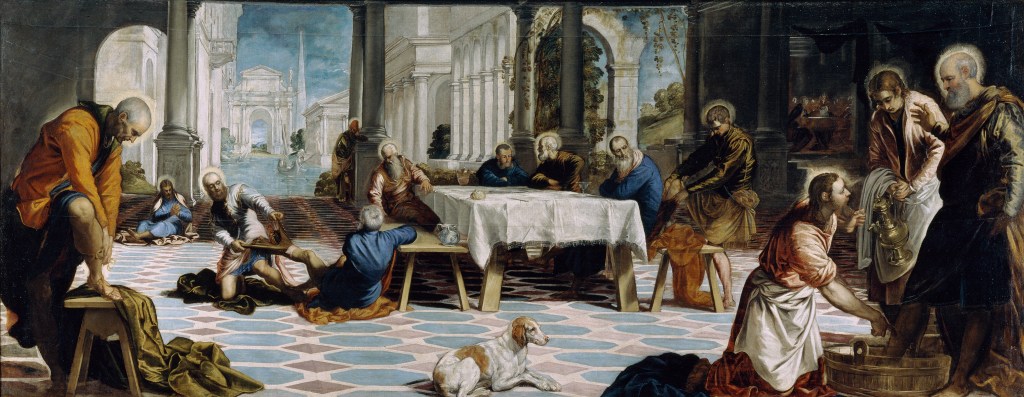
“Jesus, in the vestibule, told John to take a basin, and James a pitcher filled with water, with which they followed him into the room, where the chief steward had placed another empty basin.
“Jesus, on returning to his disciples in so humble a manner, addressed them a few words of reproach on the subject of the dispute which had arisen between them, and said among other things, that he himself was their servant, and that they were to sit down, for him to wash their feet. They sat down, therefore, in the same order as they had sat at table. Jesus went from one to the other, poured water from the basin which John carried on the feet of each, and then, taking the end of the towel wherewith he was girded, wiped them. Most loving and tender was the manner of our Lord while thus humbling himself at the feet of his Apostles.”
And then there was Peter. “‘You will never wash my feet.’ Jesus answered, ‘Unless I wash you, you have no share with me.’ Simon Peter said to him, ‘Lord, not my feet only but also my hands and my head!’”
It is easy to pick on Peter, but would we have acted any differently? Jesus is kneeling before you and says He’s about to wash your feet. What do you do? Yeah. Me too. “Lord, this is so far below You, and I am so unworthy of such an honor.” Yet, as with Peter, this act of washing the disciples’ feet points to something beyond itself.
Jesus says, “Unless I wash you, you have no share with me.” The term “share” can also be interpreted as “heritage” or “inheritance.” In the context of the Old Testament, the Lord speaks to Moses about the Israelites’ inheritance, which is the Land of Canaan, also known as the Promised Land. The Lord declares, “This is the land that shall fall to you for an inheritance, the land of Canaan as defined by its borders.” (Numbers 34:2) In the New Testament, we learn that Jesus will say to the righteous, “Come, you who are blessed by my Father, inherit the kingdom prepared for you from the foundation of the world.” (Matthew 25:34) Unless Jesus washes Peter’s feet, Peter will have no part in the New Promised Land, the very Kingdom of God.
However, remember what Jesus said before he washed their feet. He said, “You do not know now what I am doing, but later you will understand.” This indicates that foot washing is not only about humbly serving one another. It is also pointing to something greater than itself, and the Disciples would not understand until after the Resurrection. St. Paul says it plainly in his letter to the Philippians—“Being found in human form, [Jesus] humbled himself by becoming obedient to the point of death, even death on a cross.” (Philippians 2:8)
The washing of the Disciples’ feet is pointing to the cleansing of sin from their souls, but not just theirs “only but also for the sins of the whole world.” We, like Peter and everyone else who desires the Kingdom of God, must submit to the humility of Jesus and allow Him to wash our feet—allow Him to wash our souls, for “no one comes to the Father except through” Him, and these great acts He performed in the Upper Room and on the hill outside Jerusalem, upon the Cross.
Tonight, I invite you to come forward so that I can learn more about the humility of our Savior by washing your feet. However, remember that these acts serve as an example established by Jesus. Therefore, we are not only witnesses to them but also called to practice them. As Jesus tells us, “Very truly, I tell you, servants are not greater than their master, nor are messengers greater than the one who sent them. If you know these things, you are blessed if you do them.”
On the first Sunday of Lent, I shared that the movie The Passion of the Christ was heavily inspired by the text we’ve been meditating on for the past three weeks—The Dolorous Passion of Our Lord Jesus Christ by Anne Catherine Emmerich. One of the scenes in the movie, which is not found in Scripture, originates from Chapter 39.
I apologize in advance for reading too much to you today.
In the movie, the cross lies on the ground while Jesus is nailed to it. A hole has been dug at the base of the cross to allow it to stand upright. Now, with ropes tied to it, the soldiers are lifting the cross so that it will settle into the hole. When the cross is finally vertical, it drops violently a few feet into the prepared hole.
In chapter 39, Catherine speaks of this sudden violent dropping, the sound of it, and the result.
The cross was “raised up in the midst of the vast concourse of persons who were assembled all around…. The air resounded with acclamations and derisive cries when they beheld it towering on high, and after vibrating for a moment in the air, fall with a heavy crash into the hole cut for it in the rock. … When the solemn sound of the fall of the cross into the hole prepared for it in the rock was heard, a dead silence ensued, every heart was filled with an undefinable feeling of awe—a feeling never before experienced, and for which no one could account, even to himself; all the inmates of hell shook with terror, and vented their rage by endeavouring to stimulate the enemies of Jesus to still greater fury and brutality; the souls in Limbo were filled with joy and hope, for the sound was to them a harbinger of happiness, the prelude to the appearance of their Deliverer. Thus was the blessed cross of our Lord planted for the first time on the earth; and well might it be compared to the tree of life in Paradise, for the wounds of Jesus were as sacred fountains, from which flowed four rivers destined both to purify the world from the curse of sin, and to give it fertility, so as to produce fruit unto salvation.
The eminence on which the cross was planted was about two feet higher than the surrounding parts; the feet of Jesus were sufficiently near the ground for his friends to be able to reach to kiss them.”
In the New Testament, the Simon we are most familiar with is Simon Peter; however, there is another Simon, Simon the Pharisee, who we hear about in Luke’s Gospel.
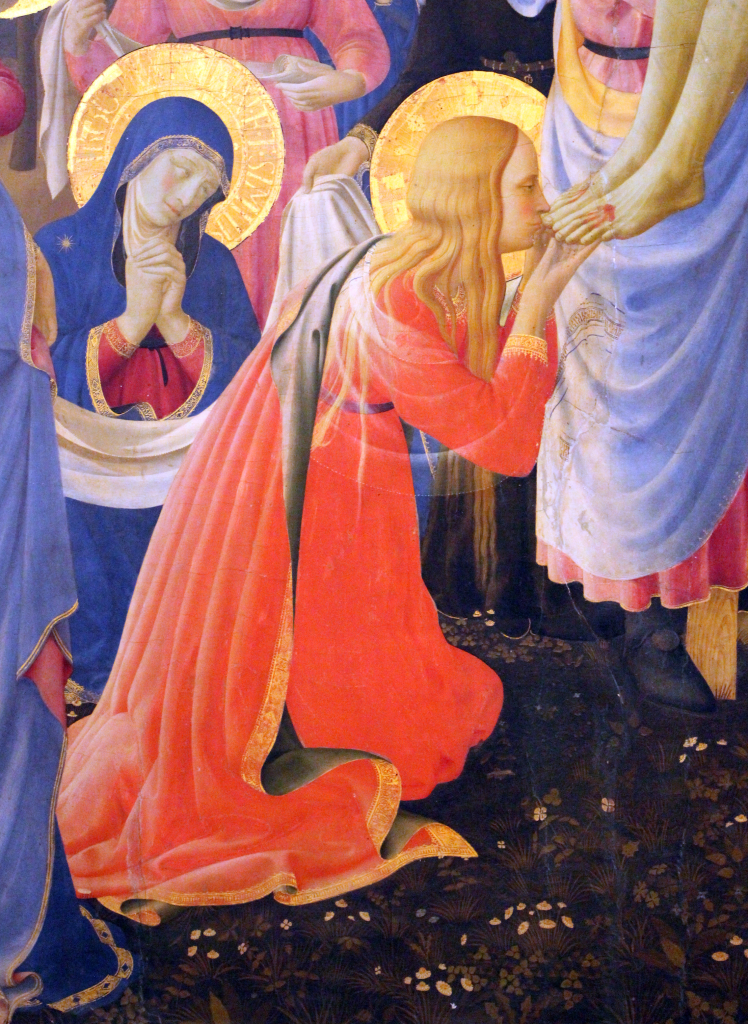
Simon invites Jesus to dinner. While there, “A woman in that town, who lived a sinful life, learned that Jesus was eating at the Pharisee’s house, so she came there with an alabaster jar of perfume. As she stood behind him at his feet, weeping, she began to wet his feet with her tears. Then she wiped them with her hair, kissed them, and poured perfume on them.”
Simon, aware of this woman’s reputation, believes that if Jesus truly is who he claims to be, He would recognize that this woman is wicked. Understanding Simon’s thoughts, Jesus then told a parable.
“Two people owed money to a certain moneylender. One owed him five hundred denarii, and the other fifty. Neither of them had the money to pay him back, so he forgave the debts of both. Now which of them will love him more?”
Simon replied, “I suppose the one who had the bigger debt forgiven.”
Simon receives the gold star. Jesus then says, “Do you see this woman? I came into your house. You did not give me any water for my feet, but she wet my feet with her tears and wiped them with her hair. You did not give me a kiss, but this woman, from the time I entered, has not stopped kissing my feet. You did not put oil on my head, but she has poured perfume on my feet. Therefore, I tell you, her many sins have been forgiven—as her great love has shown. But whoever has been forgiven little loves little.”
To the woman, Jesus says, “Your sins are forgiven…. Your faith has saved you; go in peace.” (Luke 7:36-50)
Gathered around Jesus as He hung upon His Cross were soldiers, religious leaders, gawkers, and followers. However, Catherine tells us that others were present—demons who cheered on those committing these evil acts and souls in Limbo, witnessing the coming of their salvation. Heaven, Hell, and all of creation witnessed the King upon the Cross, which we can break down into their respective categories. However, in the end, there are really only two categories, and Jesus identified them earlier in His ministry. He stated, “Whoever is not with me is against me, and whoever does not gather with me scatters.” (Matthew 12:30)
Gathered around the Cross were those who were either with Jesus or against Him. Present were those whose sins were forgiven and those who stood condemned. There is no gray area. Those who were forgiven, out of the deepest gratitude and adoration, came forward and, like the woman in Simon’s house, kissed the feet of Jesus. Like the Prodigal Son, they were the ones who knew they had been lost but also understood that they had been found, forgiven, and would be received into the Kingdom of God as sons and daughters.
What is particularly interesting is the fact that in the past 2,000 years, nothing has changed. There is our crucified Savior upon His Cross, and gathered around Him are Heaven, Hell, and all Creation. As before, we can categorize them into their respective groups—white/black, Republican/Democrat, male/female, rich/poor, Asian/European, etc., etc., etc. However, as before, there are only two categories—those who are with Jesus or those who are against Him. Sons and daughters of God Most High or condemned. Some will time and time again nail Jesus’ feet to the cross, while others will, out of the deepest sense of gratitude and adoration, come forward and kiss His bloodied feet. There are those who will hear Jesus say, “I never knew you; depart from me” (Matthew 7:21), and there are those who will hear Jesus say, “Your sins are forgiven…. Your faith has saved you” (Luke 7:50).
Have faith. Within your soul, come and kneel before the Cross of Jesus, and kiss the nail-pierced feet. He is the only One who can forgive and save, and He endured all of this for you. He is waiting for you.
Let us pray… Lord Jesus Christ, author of our salvation and most gracious Dispenser of pardon, and most patient in tolerating man’s wickedness, I bless and thank you for the great pain, the many stripes, and the bloody wounds inflicted on your tender and noble body. From the soles of your feet to the crown of your head there was no area without its injury or lesion.
O precious wounds, supreme signs of incomparable love, abounding with divine sweetness, it is from you that the sinner learns abiding trust.. otherwise his guilty conscience would cause him to despair. In these wounds we find the medicine for life, abundant grace, full forgiveness, unstinting mercy, and the gateway to promised glory. Whatever defilement I incur or whatever sins of the flesh I commit, it is in these fountains that I wash myself clean, and am purified, and again made new.
Lord Jesus Christ, fountain of holiness and sweetness, I bless and thank you for your abundant love… Instill in my flesh a fear of you, lest I yield to carnal appetites; pierce my hands, lest I yield to sloth; transfix my feet that I may remain firm and courageously endure toil and sorrows. May your nails enter my heart’s center and there inflict a saving wound, as a consequence of which and because of my overwhelming contrition, may I shed tears and be lost in love of you. Fill me with wonder and increase my devotion, until nothing will be more pleasant or dearer to my heart than Christ Jesus and him crucified. Amen.
From The Dolorous Passion of Our Lord Jesus Christ by Anne Catherine Emmerich, Chapter Thirty-Eight: “The Nailing of Jesus to the Cross.”
“The executioners did not allow Jesus to rest long, but bade him rise and place himself on the cross that they might nail him to it. Then seizing his right arm they dragged it to the hole prepared for the nail, and having tied it tightly down with a cord, one of them knelt upon his sacred chest, a second held his hand flat, and a third taking a long thick nail, pressed it on the open palm of that adorable hand, which had ever been open to bestow blessings and favors on the ungrateful Jews, and with a great iron hammer….”
You know how that is going to end.
In the beginning, after God created, Adam and Eve were free to live in the Garden, with only one stipulation—God said, “You may surely eat of every tree of the garden, but of the tree of the knowledge of good and evil you shall not eat, for in the day that you eat of it, you shall surely die.” (Genesis 2:16-17) Did they listen? No, they reached out their hand, took, and ate the fruit. What was the first thing they realized afterward? They were naked. Break out the fig leaves. They believed that by eating, by reaching out, and taking what they wanted, even though it was contrary to God’s command, all things would be revealed to them. Instead, they and their sin were the ones revealed, and they became ashamed before God. Ever since, we’ve gone to great lengths to hide our nakedness, both physically (the worldwide fashion industry is worth $1.8 trillion) and spiritually.
At the other end of Holy Scripture, in the Book of Revelation, we get our clothes—not ones we’ve made, but those gifted by God. Clothes that make known our faith in Jesus. John writes, “I looked, and behold, a great multitude that no one could number, from every nation, from all tribes and peoples and languages, standing before the throne and before the Lamb, clothed in white robes.” (Revelation 7:9) When he asks who these people are, he is told, “These are the ones coming out of the great tribulation. They have washed their robes and made them white in the blood of the Lamb.” (Revelation 7:14) It is only through Jesus that we are properly clothed, enabling us to stand before God. How did Jesus accomplish this great work?
As Jesus walked, a man with leprosy approached Him and fell down before Him. The leper said, “‘Lord, if you will, you can make me clean.’ And Jesus stretched out his hand and touched him, saying, ‘I will; be clean.’ And immediately his leprosy was cleansed.” (Matthew 8:2-3)
While in Sidon, the people brought a man who was deaf and had a speech impediment and begged Jesus to help him. “Taking him aside from the crowd privately, [Jesus] put his fingers into his ears [He touched him], and after spitting touched his tongue. And looking up to heaven, he sighed and said to him, ‘Ephphatha,’ that is, ‘Be opened.’ And his ears were opened, his tongue was released, and he spoke plainly.” (Mark 7:33-35)
One day, while Jesus was teaching, the ruler of the synagogue came and pleaded with him to save his daughter, who was near death. Jesus agreed, but by the time they arrived, the daughter was already dead. Jesus told them not to worry; the girl was only sleeping. The people laughed at Him. “Jesus put them all outside and took the child’s father and mother and those who were with him and went in where the child was. Taking her by the hand, he said to her, ‘Talitha cumi,’ which means, ‘Little girl, I say to you, arise.’ And immediately the girl got up and began walking.” (Mark 5:40-42)
Jesus and the disciples had fed the 5,000. Afterward, Jesus sent the disciples back across the lake in a boat while He went up a mountain to pray. A great storm began to blow. Jesus came to them, walking on the water, and impetuous Peter said, ‘Lord, if that is really you, tell me to come to you.’ Jesus replied, ‘Well, come on.’ Peter got out of the boat and also walked on the water, but “when he saw the wind, he was afraid, and beginning to sink, he cried out, ‘Lord, save me.’ Jesus immediately reached out his hand and took hold of him, saying to him, ‘O you of little faith, why did you doubt?’” (Matthew 14:30-31)
Jesus stretched out His hand, touched the leper, and healed him. Jesus stretched out His hand, touched the deaf/mute, and restored his hearing and speech. Jesus stretched out His hand, touched the dead little girl, and gave her life. Jesus stretched out His hand, grabbed hold of Peter, and saved him.
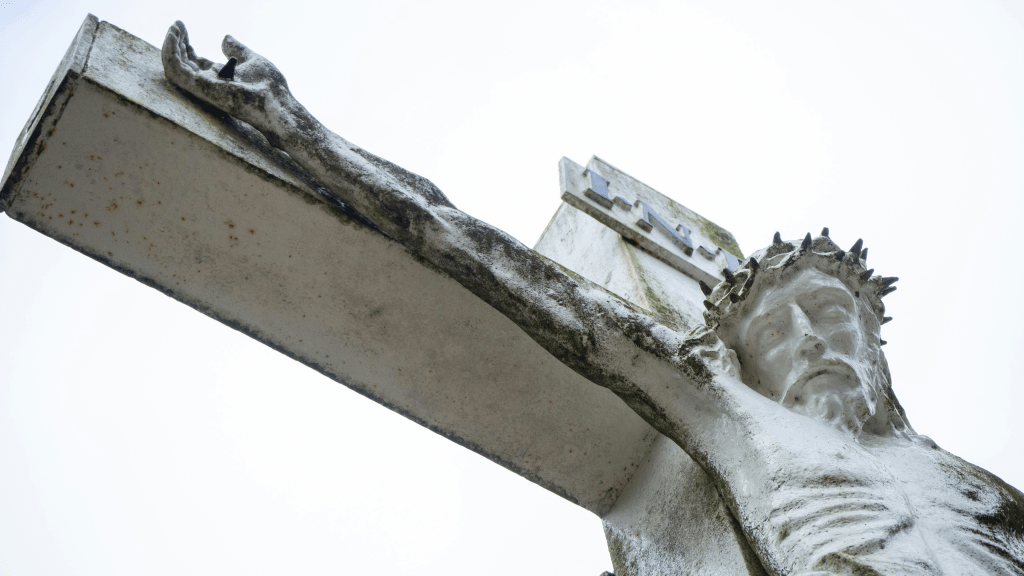
Jesus saved us all and made it possible for us to clothe our spiritual nakedness with white robes, making us worthy to stand before His Father by stretching out His hand one last time. When He did, they drove a spike through it. However, what the devil and all the others who opposed the will of God failed to understand was that the result this one last time would be exactly the same as it had always been. He stretched out His hand on the hard wood of the cross, and He healed, He restored, He gave life, and He pulled us from the grasp of the enemy. With the blood He shed, He washed our robes, and He washed our souls.
Too often, we follow the example of Adam and Eve—reaching out our hands and grabbing whatever we desire, regardless of God’s commands. Instead, we should follow the example of Jesus—reaching out to heal, restore, and show others how they might be raised to eternal life. Like the friends of the deaf/mute, we are to bring others to Jesus so that He might touch them.
When you see the outstretched hands of Jesus nailed to the cross, meditate on what those most sacred hands accomplished, and then commit yourself to continuing that work. Jesus said, “Truly, truly, I say to you, whoever believes in me will also do the works that I do; and greater works than these will he do, because I am going to the Father.” (John 14:12) May we stop always grabbing at the things we want and instead stretch out our hands to continue the healing, restoring, life-giving work of Jesus.
Let us pray… Lord Jesus Christ, most gracious Creator of man and Restorer of his wounded nature… I praise and glorify you for your ever-consuming love for our salvation, for your being so violently stretched out on the hard wood of the Cross, waiting there to receive you…. I praise you for the pungent piercing of your hands….
You allowed your hands to be transfixed by evil men, and in this way your sacred hands, while nailed to the Cross, paid back the heavy debt incurred by Adam, who had extended his deadly hands to the forbidden tree. By your precious blood you wiped away that long-standing debt.
O faithful servant of Jesus, raise your eyes upward, and with a sad heart and grieving face, look upon your God and Redeemer hanging between the lofty arms of the Cross… He stretches out his most loving arms to you; he shows you his open wounds; he bends his head to kiss you; he is prepared to receive you in his favor and without any hesitation to forgive your every sin… Far be it for us to glory in anything but the Cross of our Lord Jesus Christ.
O good and gentle Jesus, beloved Son of God, in following your Father’s will you deigned to take unto yourself the substance of our flesh … and to offer it on the altar of the Cross for the world’s salvation. Have mercy on me, your servant, who now asks your forgiveness and grace. Relying on your goodness and the infinite merits of your Passion, pardon all my sins committed against you, whether recent or old, knowingly or unknowingly. Your merits far exceed mankind’s wickedness and your abounding atonement is much greater than all my iniquity, no matter how frequently committed. Knowing this, I come before you under the protection of the Cross and hope for still greater mercy. From the depths of my heart I ask and seek the remedy that will bring me to salvation. Amen. (On the Passion of Christ: According to the Four Evangelists, p.74-78)

 Candle in a Cave