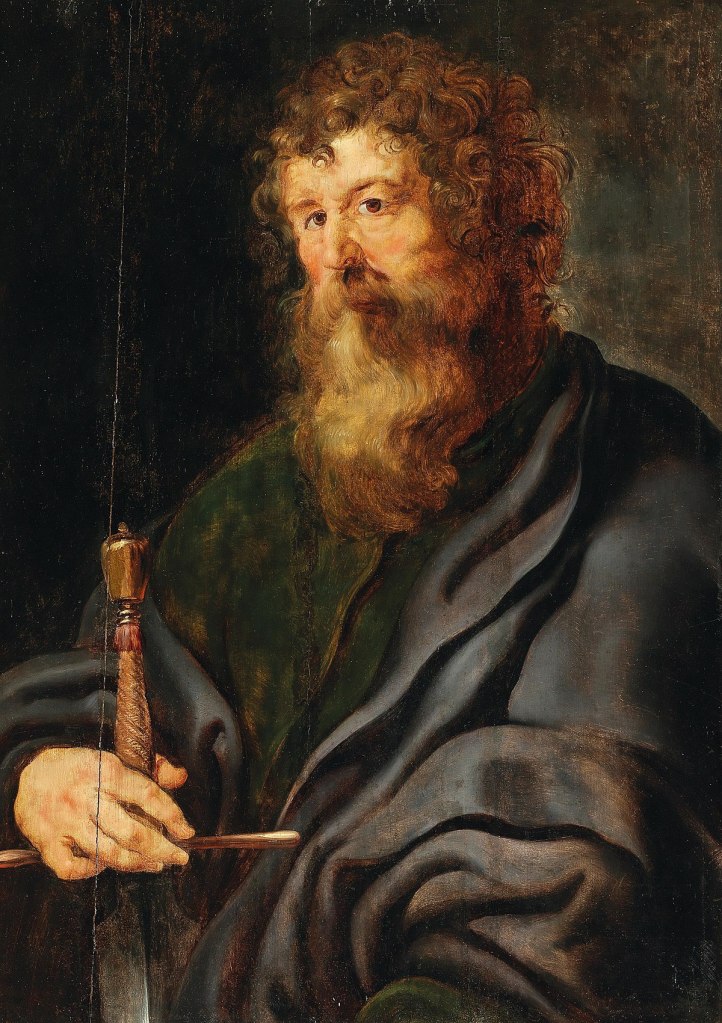
Sermon: Conversion of St. Paul (A Passion for Souls)


The sixth chapter of the Book of the Prophet Isaiah begins: “In the year that King Uzziah died, I saw the Lord sitting on a throne, high and lofty; and the hem of his robe filled the temple.”  He goes on to describe the angels in attendance who were singing:

“Holy, holy, holy is the Lord of hosts;
the whole earth is full of his glory.”

However, because he had seen the Lord (no one can see the Lord and live), he cried out: “Woe is me! I am lost, for I am a man of unclean lips, and I live among a people of unclean lips; yet my eyes have seen the King, the Lord of hosts!”  Then he reports, “One of the seraphs flew to me, holding a live coal that had been taken from the altar with a pair of tongs.  The seraph touched my mouth with it and said: ‘Now that this has touched your lips, your guilt has departed and your sin is blotted out.’  Then I heard the voice of the Lord saying, ‘Whom shall I send, and who will go for us?’ And I said, ‘Here am I; send me!’  And he said, ‘Go….’”  And Isaiah went to the Israelites as the Lord commanded him.

Although Paul’s encounter with the Lord was different, it was also very similar.  The great light and glory of the Lord appeared around him, and he fell to the ground in fear.  However, unlike the message that Isaiah was given, Paul was told to go to the Gentiles and proclaim the Good News “to  open their eyes so that they may turn from darkness to light and from the power of Satan to God, so that they may receive forgiveness of sins and a place among those who are sanctified by faith in me.”  In a very real way, the Lord said to Paul the same words as he spoke to Isaiah: “Whom shall I send, and who will go for us?” And Isaiah said, and Paul said, and so many others have said, “Here am I; send me!”

From the beginning, God has been calling all people back into relationship and making that relationship possible and eternal through Jesus, the only begotten Son.  This is a message that you have all heard and responded to.  The Lord called, and you responded, but there is more, for Jesus also said to us, “You will receive power when the Holy Spirit has come upon you; and you will be my witnesses in Jerusalem, in all Judea and Samaria, and to the ends of the earth.”  Jesus is asking… he is asking us, “Whom shall I send, and who will go for us?”  For various reasons, that can be a scary question to answer because we do not know where it will lead or who it will lead us to.  And to my knowledge, there is really only one way to overcome the reasons and the fears: to have a passion for souls.  Without any judgment, to look at them, to love them, and to desire eternal life for them.  This passion for souls is constantly seeking ways to reveal God to those who are lost, broken, or unaware of his great love for them.  It is a passion that must burn brightly and, therefore, must always be tended and nourished with the Word of God, prayer, and the blessed sacrament of the Eucharist.  Build up this passion for souls within yourself, and when the Lord asks, “Whom shall I send, and who will go for us?”  Say with Isaiah and Paul, “Here am I, send me!”

Sermon: The Conversion of St. Paul

The Conversion of Saint Paul by Luca Giordano

I had been working on a house, rewiring some outlets.  The outlets were on the first floor, but the breaker box was down in the basement.  For whatever reason, I could not get this one outlet to work from a switch on the wall, so I would make an adjustment, run downstairs, flip the breaker, run back upstairs, test the switch, and then when it still wouldn’t work, go through it all again.

I don’t know about you, but in the middle of these frustrating projects, I’ll get some less-than-brilliant idea and try something new.  In this case, my less than brilliant idea: “I’m tired of going up and down the dang stairs.  I can make these adjustments without flipping the breaker.”  I was unsuccessful and quickly learned what it felt like to be hit with a cattle prod.

The cattle prod comes in many different forms.  There is the electrical node on the end of a stick used to get cattle to move along, and the bark collar is working off that same principle—a rather unkind way of trying to teach a dog not to bark at everything.  And then there is the ultimate cattle prod known as the police taser, which attempts to teach hardheaded individuals to stop what they are doing.  These devices, especially the cattle prod, are descendants of the ox goad.

The ox goad is a long stick with a sharp metal point on one end.  The farmer, behind a plow, would hold the point of the goad around the oxen’s ankles and use it to guide the animal: a tap on the left, go left.  A tap on the right, go right.  However, the ox—particularly the younger ones—were not accustomed to being harnessed and could become a bit stubborn, so a little prod with that sharp stick was a way to “goad” them and encourage them along.  Not only that, but if the ox got out of hand and started kicking, they would prick themselves. 

In our reading from Acts, Paul, speaking to King Agrippa, says, “I was traveling to Damascus with the authority and commission of the chief priests, when at midday along the road, your Excellency, I saw a light from heaven, brighter than the sun, shining around me and my companions.  When we had all fallen to the ground, I heard a voice saying to me in the Hebrew language, ‘Saul, Saul, why are you persecuting me? It hurts you to kick against the goads.’”  In other words, Jesus was saying to him, “Saul, Saul, why are you fighting against my church and me when you know in your heart that I am the Messiah?  It hurts you to kick against the goads—it hurts you to continue to be stubborn and to doubt what you know is true.”  Paul knew in his heart what the truth was, but he remained stubborn.

What is the root of such stubbornness, of failing to be obedient?  Pride.  And, like Paul, we can fall into the same error.  We pray, “My will be done,” and not, “Thy will be done,” and we kick against the goads.  We grab the live wire, even though we know better.

A wonderful saying from St. Josemaría Escrivá: “If obedience does not give you peace, it is because you are proud.” (The Way #620)

If we do not feel peace about our words or actions, if we feel the sharp prick of the goad in our spirit, then perhaps we need to consider whether or not we are being prideful, seeking our own will and our own ways instead of God’s; and then remember that the goading is not God’s way of punishing. His ways are teaching and loving, so that we may stay on the path of righteousness.