

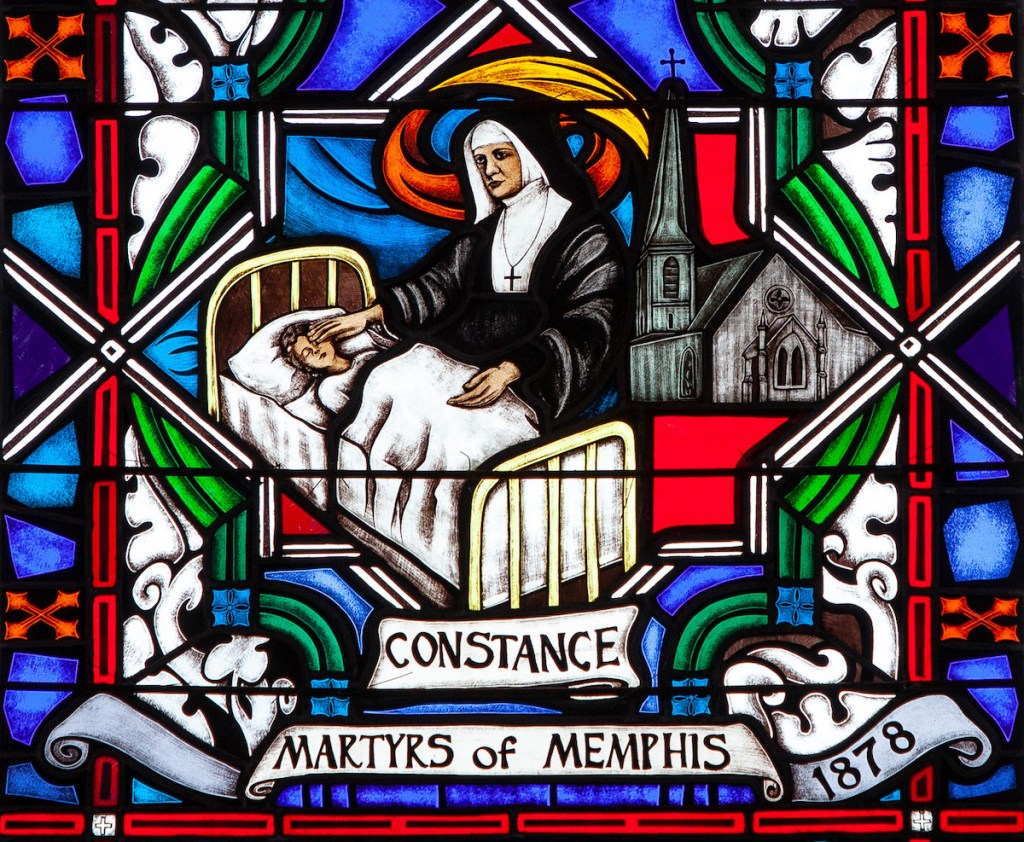
In 1873, the sisters of the Community of St. Mary in Peekskill, New York, were invited by the Bishop of Tennessee to establish a school for girls in Memphis. I couldn’t determine the exact reason; however, I suspect it had something to do with the Yankees’ arrival in the South shortly after the Civil War. Still, it is implied that the sisters’ presence was not appreciated. Undeterred, the sisters continued their work, but as soon as the school opened, the first of two Yellow Fever epidemics broke out. While most of the city was fleeing, the sisters remained and cared for the sick. A member of the community wrote about Constance:
“Sister Constance went out first to the sick. Before she reached the house to which she was going, she was met by a young girl weeping and in great distress. She said her sister was just taken with the fever, that they could get no doctor, and did not know what they ought to do for her. My Sister went immediately to the sick child, did for her all that could be done, and ministered to her wants daily till her recovery. My Sister always loved to speak of this little Louise as her first patient.”
During that first epidemic, 5,000 people became ill and 2,000 died.
Afterward, the school opened, and during four smooth years, Constance and another sister went back to New York for a retreat. However, they were gone only two weeks before news arrived that a second epidemic had started. They quickly returned to Memphis and once again began caring for the sick.
Over 5,000 died during this second wave of Yellow Fever, including Constance and most of her companions, known as the Martyrs of Memphis. Speaking of Constance’s death, one biographer wrote, “Few know what a wonderful life it was that ended, for this world, when Sister Constance died. It was one long and entire consecration to Christ and the Church; and the strength with which she met the fearful trials of those last days, directing, sustaining, and cheering her devoted companions, and working day and night to spare others, was a supernatural strength. She was but thirty-three years old when called away; a woman of exquisite grace, tenderness, and loveliness of character, very highly educated, and one who might have adorned the most brilliant social circle. All that she had she gave without reserve to her Lord, asking only Himself in return as her own.”
Constance’s final words, “Hosanna. Hosanna.”
Father Morgan Dix wrote: “Before the memorable year 1878, many spoke against these faithful and devoted women; but after that year, the tongue of calumny was silent, while men looked on with beating hearts and eyes dim with tears.”
Jesus said, “Very truly, I tell you, unless a grain of wheat falls into the earth and dies, it remains just a single grain; but if it dies, it bears much fruit. Those who love their life lose it, and those who hate their life in this world will keep it for eternal life. Whoever serves me must follow me, and where I am, there will my servant be also. Whoever serves me, the Father will honor.”
Constance and her companions were those who first died to self and, like single grains of wheat, fell to the ground, grew, and produced much fruit. They then sacrificed their lives again, just as their Savior did, by serving others.
The final petition of our collect (prayer) for Constance asks the Lord to “Inspire in us a like love and commitment to those in need, following the example of our Savior Jesus Christ.” We pray that God’s Church will be inspired by these Martyrs of Memphis and many others who give of themselves and produce such abundant good fruit.
 Candle in a Cave