
For this Season of Easter, the opening sentence of any Eucharistic service has been “Alleluia. Christ is Risen.” Following Pentecost, we’ll return to “Blessed be God: Father, Son, and Holy Spirit.” However, what follows, no matter the season of the church year, is always the same: “Almighty God, to you all hearts are open, all desires known, and from you no secrets are hid: Cleanse the thoughts of our hearts by the inspiration of the Holy Spirit, that we may perfectly love you, and worthily magnify your holy Name; through Christ our Lord.” It is known as the Collect for Purity.
It began as one of the many private prayers for clergy to be said before the Mass, yet it was deemed too meaningful to be locked away in the sacristy and was eventually introduced into the public prayers of corporate worship.
What does that have to do with today? We are celebrating Blessed Alcuin of Tours, born in the year 730, who preserved and incorporated that prayer into our worship. Just because we worship with the 1979 Book of Common Prayer does not mean it is an entirely modern invention. Over the centuries, many like Alcuin have contributed to that wonderful little red book that automatically falls open to page 355.
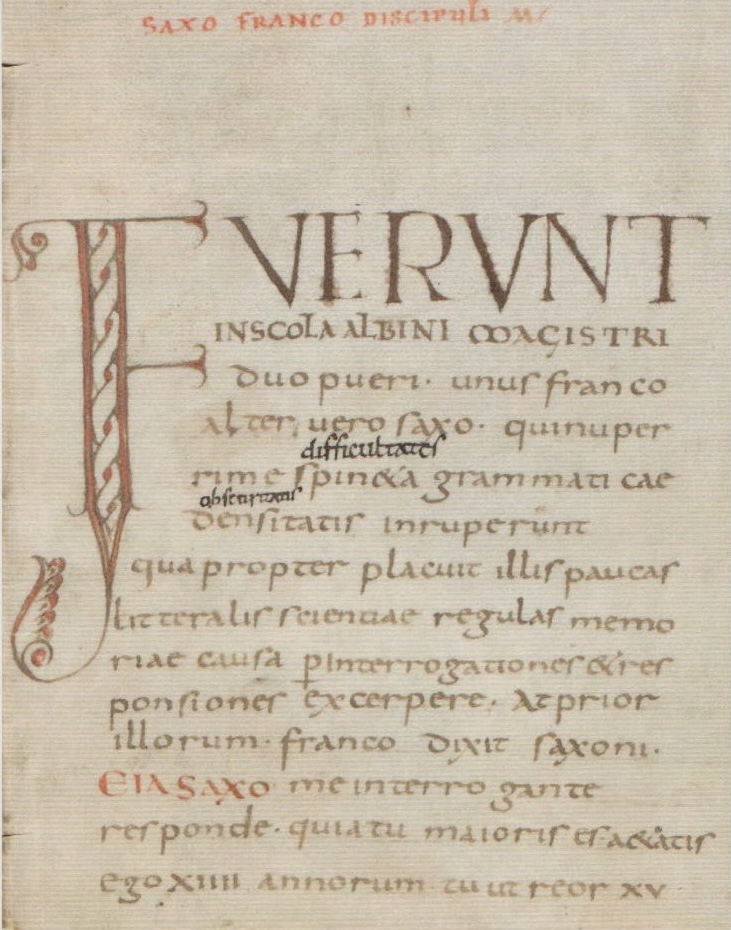
Alcuin was one of the great scholars. At the time, he was considered “The most learned man anywhere to be found.” Fr. John Julian says that “Alcuin’s work was seldom highly original, but his own commitment was rather to the protection, compilation, and promulgation of the words of others.” Through these efforts, he “was chiefly responsible for the preservation of the classical heritage of western civilization.” And if that weren’t enough, he is also credited with giving the world the punctus interrogativus. Is that true? Did he really? What could that possibly be? Why, the question mark.
Jesus said, “Every scribe who has been trained for the kingdom of heaven is like the master of a household who brings out of his treasure what is new and what is old.” There is a theological interpretation of this passage, as well as a practical one, and it is the practical one that we understand to apply to Alcuin. The “scribe,” according to Sirach, is one who “will seek out the wisdom of all the ancients.” Think of it in terms of the George Santayana quote, “Those who cannot remember the past are condemned to repeat it.” Alcuin not only sought out the wisdom of the ancients but, as Jesus taught, believed that the teachings of our fathers were worth preserving, not only for their historical value but for our collective benefit.
He died in the year 804, and a portion of his epitaph reads, “Dust, worms, and ashes now… Alcuin my name, wisdom I always loved, Pray, reader, for my soul.”
When we think of the lives of the Saints, we often think of the apostles, martyrs, or evangelists. So, in the midst of them all, did you ever imagine coming across a librarian? Alcuin’s life says to us, “It’s not about the specific gift that God has graced you with. It’s about how you employ that gift.”
God has graced each of us with gifts. Don’t squander them or leave them unused. Like Alcuin of Tours, practice them to your greatest ability in the work of God’s Kingdom.

