Day nine of Japan started with a nine-hour nap. That was absolutely brilliant. Afterward, I got up and started moving. I had a nice breakfast downstairs, and then it was time for church.
I had the option of attending an English language service, but I chose a Japanese one instead. I wanted the experience of it. The rhythm of the service is the same and they provided me a bulletin in English so that I could follow along with the lessons. It worked out just fine. It was beautiful. I wish I knew what the priest was saying because he was very excited about it. Regardless, his enthusiasm was catching, and I felt like I had definitely heard a good sermon.
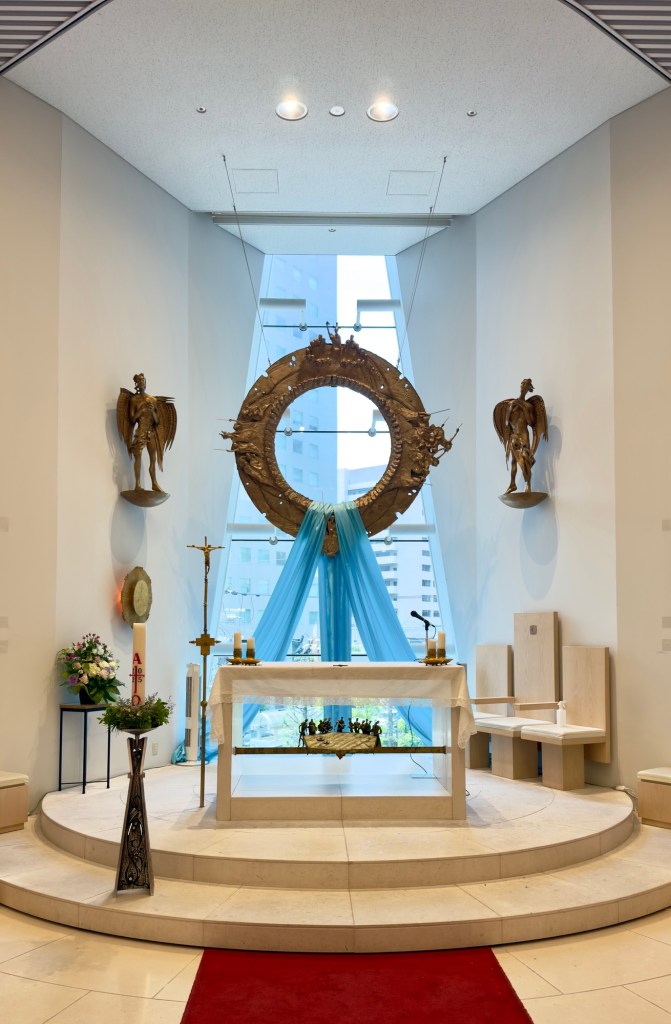
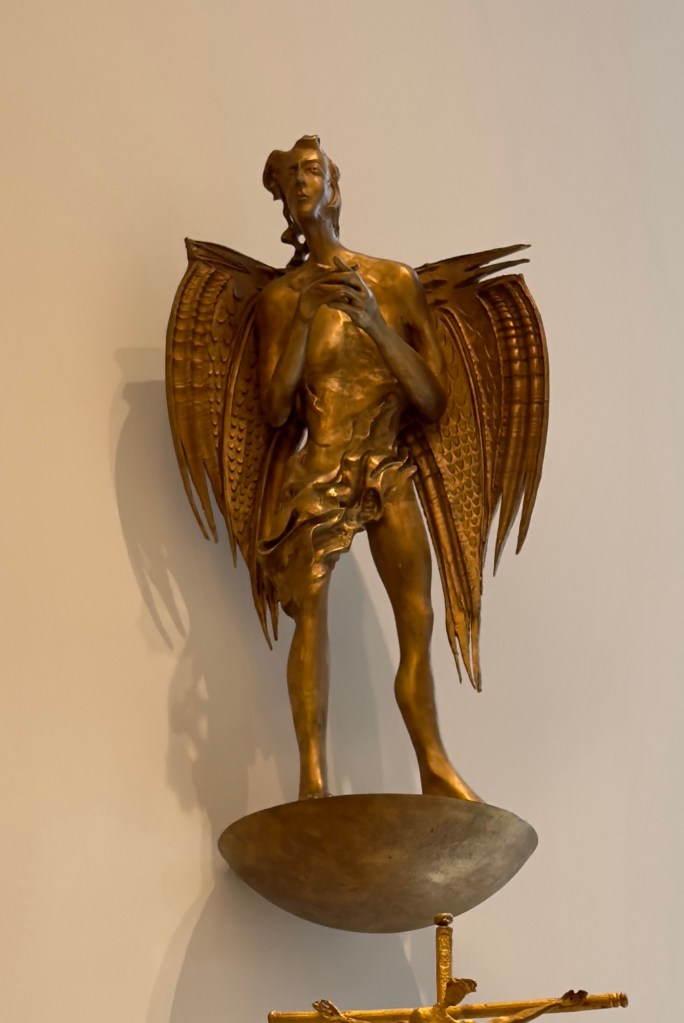
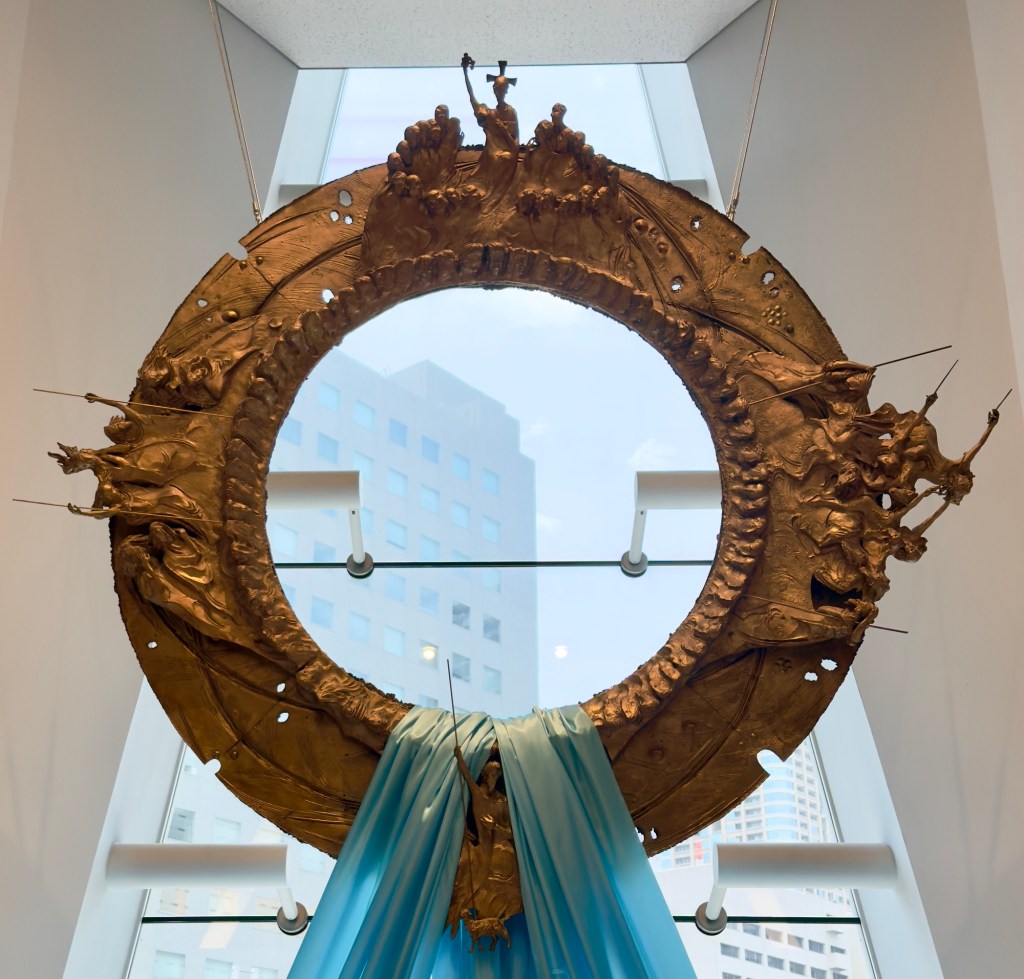
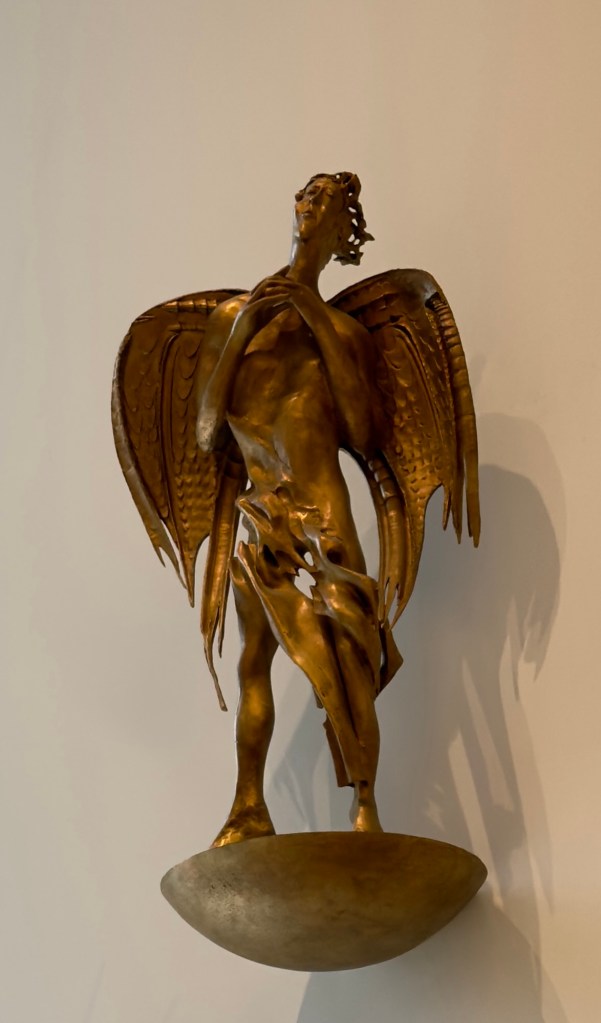
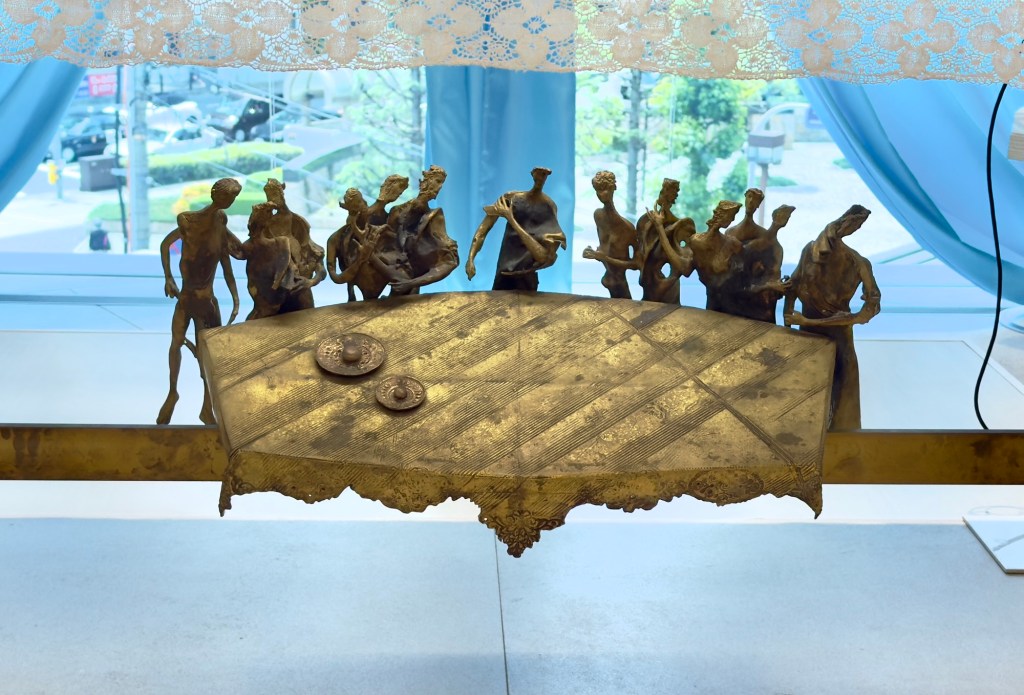
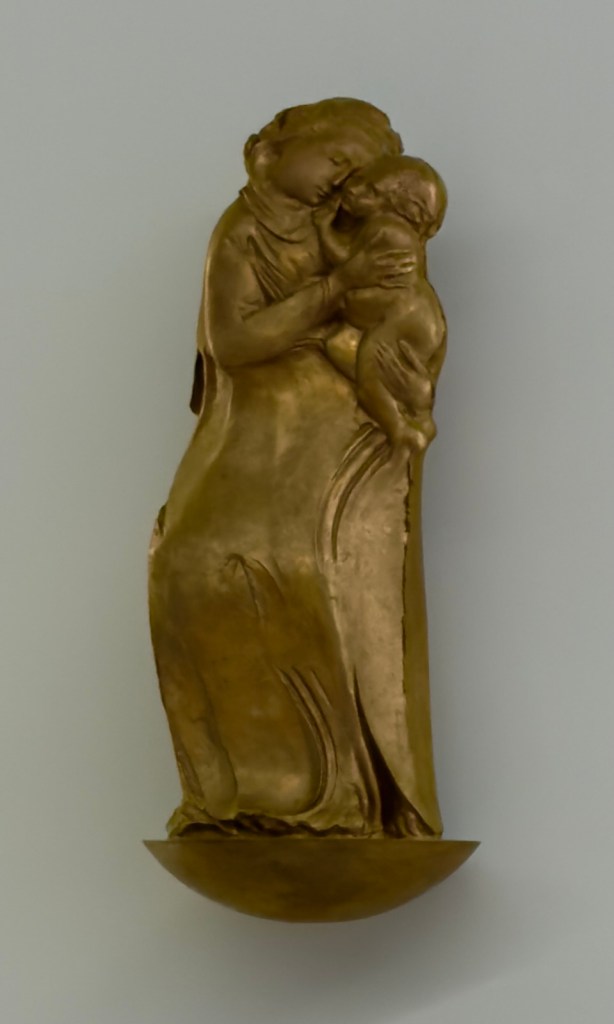
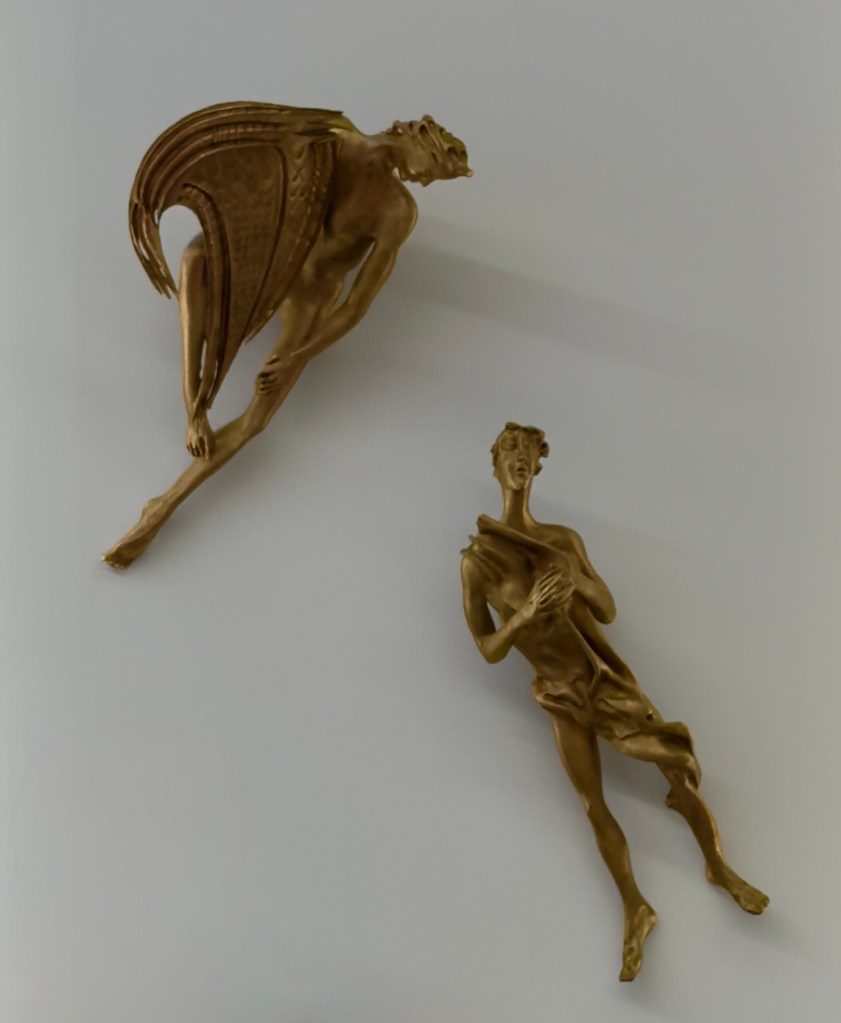
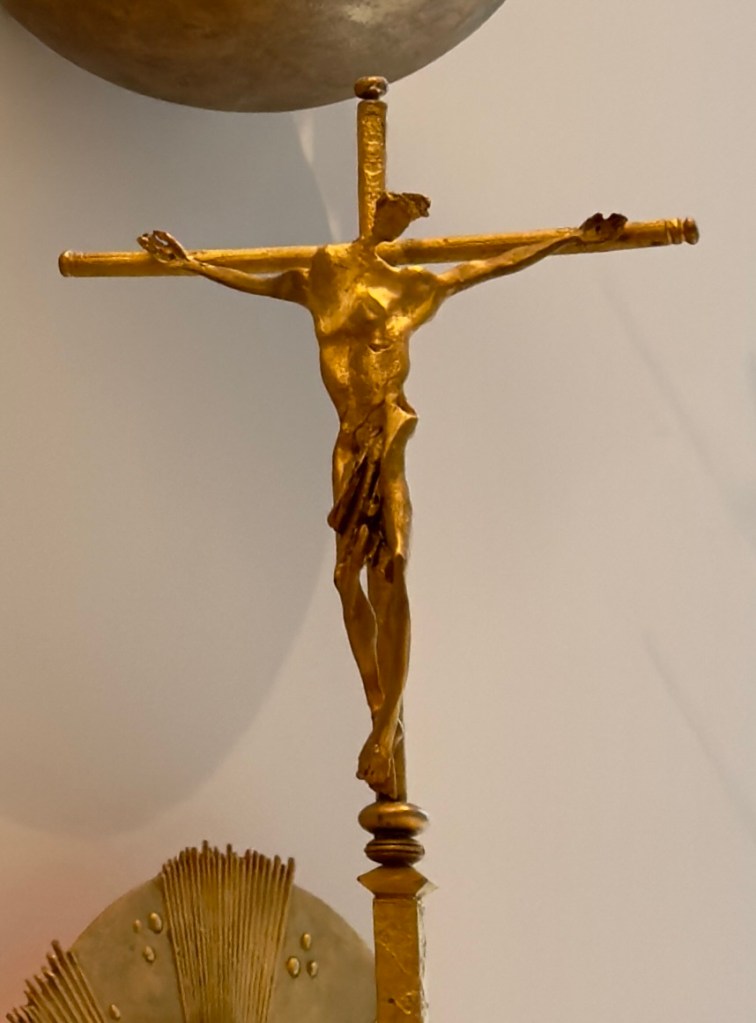
The works in the church were produced by Cecco Bonaotte, and the design of the church was done by his son, Pier Paolo Maria Bonanotte.
This church was planned by 5 churches in umeda area, Osaka. It is a four-story complex facility, produces an impressive space with the fusion of tradition and modernity. In other stories of the building, there are the satellite campus of Sophia University, the bookstore of Sanpaolo, which deals with the books of Catholic and so on.
Utilizing the natural light, the pure white church marvelously brings out the grace and lightness of the bronze sculpture by Bonanotte.
Beneath the altar / Last Supper
Processional Cross
The sanctuary was quite full (I was the only non-Japanese), and the congregation was very welcoming. If you find yourself in Osaka, I can highly recommend Holy Family to you.
Oh… I don’t know what kind of wafers they used for Mass, but they were “different.” I may have to try and find them for St. Matthew’s. Definitely not your standard styrofoam.
After all that work, It was time for an early afternoon snack. I went to my local favorite—Minori. Enid does not need another Mexican restaurant. It needs an Açai Bowl restaurant!
Peanut butter with honey, almonds, blue berries, strawberries, banana, peach, coconut, granola, açai. Yum!
After a brief rest, I headed back out. While wandering the city, I bumped into something and can’t seem to get it off my arm. Very strange. Maybe it’ll wash off tomorrow.
Being Sunday night and all, I thought the city would be quieter. That was not the case. I suppose they are getting in every minute of the weekend before back to work.
And, if you stand in this one spot for long enough, the camera comes on and your up on the big screen. Yes. I’m a dork, and stood there and took a picture of me taking a picture of myself.
That is all for today, my Japan virtual companions. Tomorrow is my last day here, and I have only one item remaining on my Japan itenerary. Am I ready to come home? I suppose I probably am. I miss you all and I miss The Queen. So, for now, I’ll leave you with this thought…
You all know that I make wine, and many of you know that my wine is good. My wine is so good that even former Baptists like it. Given that, I don’t mind telling you a couple of short wine jokes.
It’s funny how eight glasses of water a day seems impossible, but eight glasses of wine is a sign of a good meal.
I’ve trained my dog to bring me a glass of red wine. It’s a Bordeaux collie.
I was having wine with my wife when she said, ‘I love you so much, you know. I don’t know how I could ever live without you.’ I said, ‘Is that you or the wine talking?’ She said, ‘It’s me talking to the wine.’
One of the funniest water-into-wine skits I’ve seen has Jesus and the disciples going to a fancy restaurant. The waitress comes up to the table and asks them what they’d like to drink, at which point they all start to giggle. Jesus elbows Peter to get him to stop, then says to the waitress, “We’ll just have water.” And then they all fall out.
In John’s Gospel, Jesus performs many “signs” and turning the water into wine at the wedding in Cana is the first. In looking at it more deeply, we can see that this one event defines Jesus’ mission and purpose—transforming the lesser into something greater—the fulfillment of its higher purpose.
This week, during our Wednesday night study of the Pivotal Players of the Church, we learned about the life and teachings of the Venerable Fulton Sheen, and this idea of the lesser being transformed into the greater came up. It was summarized in the video, so I went looking for Sheen’s actual words, and I found them. Sheen writes, “The sunshine, the carbons, and the rain could never share the life of the plant unless they died to their lower existence and were assumed or taken up into plant life. Plants could never share the sensitive and locomotive power of animals, unless they died to their lower existence and were taken up by the animal. None of the things in lower creation could live in man, and share his arts, his sciences, his thinking and his loves unless they ceased to be what they were, submitting to the death of knife and fire.” (These are the Sacraments, 1962)
If the sunlight, elements, and rain are to fulfill their higher purpose, they must give themselves up and be absorbed into the vine and the grapes. If the grapes want to ascend into and fulfill their higher purpose, they must be picked and crushed. If the wine wants to achieve its higher purpose, it must be consumed by a person.
So that the lesser can become greater, the lesser must die to itself and become a part of something else. So, then, how can we become greater and fulfill our higher purpose? St. Paul tells us, “I have been crucified with Christ. It is no longer I who live, but Christ who lives in me. And the life I now live in the flesh I live by faith in the Son of God, who loved me and gave himself for me.” (Galatians 2:20) I have been crucified with Christ—I have died to myself—and have become a part of Christ Jesus.
We fulfill our higher purpose not by living our best life but by giving up our life, participating in Jesus’s life, and serving His purposes. How do we do this?
These days, it’s a hard thing to “sell.” We have so many other options of things to do and see—books, movies, internet, sports, hobbies etc., etc., etc. All of these are our attempts to find true fulfillment in our lives. However, to fulfill our higher purpose, we must die to self and participate in the life of Christ. We do this by being filled with God’s Holy Spirit and then—and this is the hard sell—participating in the life and ministry of the Church, for the Church is Christ’s Mystical Body.
In his book, The Mystical Body of Christ, Fulton Sheen says, “What now is this new Body which Christ assumed after He had ascended into His glory, to which He sent His heavenly Spirit, and through which He continues to exercise His office as Teacher, King, and Priest? If I said it was the Church, I would not be believed. I will therefore let St. Paul say it clearly and unmistakably: ‘Who now rejoice in my sufferings for you, and fill up those things that are wanting of the sufferings of Christ, in my flesh, for His Body, which is the Church.’ (Col 1:24)” (p.37) Paul rejoices in his suffering for he knows it is serving God’s purposes and Christ’s Body—the Church. To achieve his higher purpose, Paul knows that he must be caught up in the Body of Christ, the Church.
Remember when John was baptizing on the banks of the Jordan River? Following Jesus’ baptism, Jesus’ “popularity” began to eclipse John’s. Some came to John and asked him what he thought about this, to which John responded that he had told them all along that he was not the Christ, and there was another coming. His conclusion, “He must increase, but I must decrease.” (John 3:30) To fulfill our purpose, those words must become ours. “Jesus must increase, but I must decrease.” The Mystical Body of Christ—His Church—must, through our participation, increase, and for this to happen, we must decrease.
Today is our Annual Meeting. There’ll be good food, vestry elections, reports given, budget shared, all sorts of fun stuff. However, the meeting is ultimately about us and how we, as the Body of Christ in this place, are dying to self and fulfilling our purpose in God’s Kingdom on Earth. God will not force us. We are quite free to choose. Jesus turned water into wine, and the water had no say in the matter, but we do. Jesus could say He chooses to transform us into the very best, and we could respond, “Ya know… thanks, but I’m happy being water.” However, if we say, “We will die to self and decrease, so that You may increase in us,” we will become something extraordinary.
I believe we have already begun that transformational process—you’re already a pretty tasty Bourdeaux Collie—but there is always more “dying” that must occur. Therefore, as individuals, we must ask, “How might I decrease so that Christ Jesus can increase in me?” and, as the Body of Christ, we must ask the same.
We generally begin the Annual Meeting in the Parish Hall, but today, I would like to start it now so that our first action together is receiving the Body and Blood of our Savior in the Eucharist. This will nourish our spirits and help us continue on the path to achieving God’s higher purpose for our lives and His Church.
Let us pray: Almighty and everliving God, source of all wisdom and understanding, be present with those who take counsel in this Annual Meeting of St. Matthew’s for the renewal and mission of your Mystical Body, the Church. Teach us in all things to seek first your honor and glory. Guide us to perceive what is right, and grant us both the courage to pursue it and the grace to accomplish it; through Jesus Christ our Lord. Amen.
The human body is a fantastic creation, yet most of us don’t give it a second thought until something breaks. It’s a bit like what Jerry Seinfeld said, “The human body is like a condominium. The thing that keeps you from really enjoying it is the maintenance.” Outside of the maintenance, when we do think of it, we are primarily concerned with the outward appearance. Am I fit? How’s my hair? Do I have blemishes? “Honey, does this dress make me look fat?” That sort of thing. However, as interesting as all that can be, what goes on below the surface of the flesh is mindblowing—a few examples.
Did you know that when you listen to music, your heartbeat changes and attempts to mimic the beat? It is why soothing jazz slows you down, and that old-time rock-n-roll gets your blood moving.
The fastest-moving muscle in your body is the one that controls the contractions in your eye, helping you to focus. It does its job in 1/100th of a second.
Every second, you produce 25 million new cells.
If you live to 70, your heart will beat about 2.5 billion times; it is the only muscle that never gets tired.
The one fact that seems beyond belief is the circulatory system. A newborn’s circulatory system—all the arteries and veins—if stretched end to end, is 60,000 miles long. When you are an adult, it reaches 100,000 miles.
All this and more is happening, but when we look at another person, we see none of it.
If you’ve seen any of my travel pictures, you probably picked up on the fact that I haunt churches. The churches are the number one places to see when I visit a new city. I don’t know much about architecture or art, but I love the feel of them—how you can sit quietly and be surrounded by the centuries of prayers, sense the individuals who walked through and learn of the great history that took place in and around those walls. And most of all, to simply be there. Inside, you experience the awe and reverence that spills from your soul as the church’s grandness speaks of the greatness of God.
When I’m visiting one, I never think about everything that is going on behind the scenes. I don’t think about the choirmaster toiling away in a back office seeking the perfect hymn to fit with the upcoming services or the organist, who spends hours practicing so that the music is perfect. I don’t think about the individuals who polish the floors or pay the bills. When I see an ornate pulpit, I don’t necessarily think of the priest—I say to myself, “Man, I sure would like to preach from there.” It never crosses my mind that they may have a new refrigerator that makes a weird banging sound, but they can’t get anyone out to look at it, so they must call repeatedly. I can’t imagine someone there spending a couple of hours researching how to get the oxidation off the big red doors so that they aren’t the big pink doors. I don’t think about any of those things and so many other details. I am allowed to experience the greatness of God and His majesty and to worship when I am there. Why? Because I may not be thinking about or doing all those things, but someone is.
The pictures of the pyramids are on the front of your bulletin. I was looking at something and came across the one on the right. The pyramids are in the distance, with the city at the forefront. I wondered where that was. As it turns out, it is the exact same location as the picture on the left. That image on the left is how I always thought of the pyramids—isolated from the world, surrounded by the beautiful sands of the desert, the clear blue sky, and the remarkable symmetry of the structures, but it is only the angle from which you are looking. I had no idea. If we were there, facing the pyramids from the angle of the picture on the left, that is what we would see. If we turn 180°, the city is right there in all its chaos!
Walking into this church, I have the benefit of being able to see it from many angles. This—looking out at you—is my favorite view. It is like seeing the pyramids in all their glory—beautiful sand, blue sky, perfectly ordered—but if I change the angle and “look behind me,” it can be wild. Everything that had to take place and get done so that we could be here at this very moment, experiencing God together. However, what is even more fascinating is all that occurred in the past so that we could be here in the first place.
There’s a great film, Lucy, with… hubba hubba, you guessed it… Scarlett Johansson. In one scene, she sits in an office chair in Times Square in New York. Then, she swipes her hand and begins a rapid rewind of time. She stops the rewind; it is still Times Square, but it is being built. She swipes again; the city is gone, and she is seated in front of several Native Americans. Again, she swipes and continues to go further and further back. Through the process, she sees all that had to take place for her to be in that present moment. What if we could do the same with St. Matthew’s? What would we see? Not just what took place in the past week for us to be here but what took place over the centuries for us to be here. We would see the Bishops and the clergy and the people and would see the Land Run. Further back, we would see the establishment of the Anglican Church in the New World, and further and further until we see Jesus standing in front of a tax collector, saying to him, “Follow me.”
During all that 2,000-year history, you will discover many great women and men who made it possible for us to be here today. They are the ones we celebrate on this All Saints Day, but as I was thinking about them, I thought again about sitting in Scarlett’s chair and not swiping back, but instead swiping forward—into the future. If we did, what would we see in this place?
James Lloyd Breck is one of the saints of our Church. He was a great missionary and, in 1842, founded Nashotah House, the seminary I attended. He died in 1897, and on a gray autumn day in October, the people gathered at Nashotah House to lay him to rest. In attendance were Bishop Daniel Sylvester Tuttle, the first missionary Bishop of Montana, and Bishop Francis Key Brooke, the first Missionary Bishop of Oklahoma. Bishop Tuttle spoke at the graveside.
“There was a Grecian race in which the runners were charged to care not for themselves, nor indeed for each other, but for the torch they bore. As one and another, wearied and overcome, fell by the way, he held aloft his torch, handing it to a comrade who seized it quickly and sped on. So, with the torch borne by the Christian man. It has a triple flame: God’s truth, Christ’s love, men’s good. We are to hold it up and pass it on. One or another of us is soon to fall in the hard-trodden, dusty path. But never mind us, it is dust to dust, though it may be sacred dust that falls, and God will take care of it. Do not mind us; seize the torch, we pray you, and push on to the blessed goal.”
Those who went before us, all the Saints and that Great Cloud of Witnesses, carried that torch, and when they fell, someone else picked it up. And so, it is now our turn. We must pick up the torch with its triple flame, “God’s truth, Christ’s love, men’s good,” and carry it into the future so that when we fall back into dust, there will be someone new to pick it up and carry on.
It is a gift to be able to gather in this place, to be concerned with nothing other than the worship of the One True God, and to have fellowship with one another. It is a gift, but we must all turn and understand what makes this gift possible.
Like the saints that have gone before us, we have the responsibility to pick up that torch with its triple flame and carry it so that when the next generation picks it up, it is burning all the brighter.
How are we able to carry it? We carry it through our service to one another and the church—our attendance and participation in corporate worship, volunteering, helping in the various ministries, going out into the community and proclaiming the Gospel through word and deed, and financially supporting the Church as we are able.
We celebrate All Saints Day to honor those who have gone before us and to remind ourselves of who we are to become.
So, if you sit in Scarlett’s chair and fast forward into St. Matthew’s future, what do you want to see? When you see a vision of that future, ask yourself, “How can I help create that?” Then, in faithfulness and obedience, commit yourself to God, pick up that torch, and carry on.
Let us pray: Almighty ever-living God, by whose gift we venerate in one celebration the merits of all the Saints, bestow on us, we pray, through the prayers of so many intercessors, an abundance of the reconciliation with you for which we earnestly long. Through our Lord Jesus Christ, your Son, who lives and reigns with you in the unity of the Holy Spirit, God, for ever and ever. Amen
The first Holy Communion of the Church of England was held in 1607 in Jamestown, Virginia. It was a slow start, but the church began to take hold and was quite successful; however, because of its ties to England, that changed following America’s independence. According to Powell Mills Dawley in Our Christian Heritage, “the American Revolution left the Anglican parishes shattered, stripped of most of their financial support, weakened by the flight of many clergy and thousands of members, with a number of buildings destroyed and property lost.”
Not only did the citizens of the new United States abandon the church, but in a very real sense, the Church of England did as well. The primary issue was that we had no American Bishops. As you know, a Bishop is required to Confirm, ordain clergy, and it takes three Bishops to consecrate a new Bishop. Therefore, if a person wanted to be ordained a priest, they had to make the long and perilous trip to England.
To remedy the situation, a few devoted men took up the cause. Among them were Samuel Seabury, Samuel Provoost, the person we celebrate today, William White, and James Madison – all four of which made the journey to England to be consecrated. Then, having enough American Bishops, Thomas Clagget was consecrated Bishop in New York, and the Church in America could function separately from the Church of England. In 1789 – the first General Convention – under these men’s leadership, specifically William White, the American Episcopal Church was fully organized.
William White served as our first and fourth presiding Bishop in 1789 and from 1795 to 1836. In addition, he served for 57 years as the rector of St. Peter and Christ Church in Philadelphia. He died in 1836.
A lengthy obituary devoted to Bishop White appeared in the National Gazette and Literary Register. In part, it described his character, “…[T]he duties of the several important relations in which he stood to society were performed with undeviating correctness and suavity; he possessed the rare merit of winning the respect and love of an entire community to which he was an ornament and a blessing. His piety was deep and unfeigned; his walking humble yet dignified; his acquirements profound; in his mind the welfare of the Christian church was always the prominent consideration…He was one of those examples of steady virtue sent upon earth by Divine Providence, as if to prove how near the great pattern of perfection it is permitted to approach.”
In our Gospel reading today, Jesus asked St. Peter, “Simon, son of John, do you love me more than these?” He said to him, “Yes, Lord; you know that I love you.” Jesus said to him, “Feed my lambs.” This was the restoration of St. Peter after he denied Jesus three times the night before Jesus was crucified. It is also a command given to all who would be followers of Jesus – “Feed my sheep.” In those three words, God calls us all, lay and ordained, to care for those we encounter. To care for them in both their physical and spiritual needs. For us in the Episcopal Church, William White is an exemplary role model for us to emulate. When you consider what it means to be true and faithful to the Church, you need only consider him to find the “great pattern of perfection” that leads to becoming a faithful servant to God and His One Holy Catholic and Apostolic Church.
The words of the Exsultet, “This is the night, when…”
This is the night when the Church attempts to read all of Holy Scripture in one sitting.
This is the night when the choir and organist threaten to go on strike if I add one more piece of music.
This is the night when the parish administrator double-dog dares me to make one more change to the bulletin.
This is the night when the congregation asks, “Are we there yet?”
This is the night, the eve of our salvation when we enter into the darkness of the tomb and create a spark that becomes a flame that sets the whole world ablaze with the Light of Christ.
This is the night when we baptize Nolan, and Crawford receives his first communion.
From the song, December, 1963, by Frankie Valli and the Four Seasons, “O, what a night!”
Of all the liturgies throughout the church year, this is the highest and most grand. It is the culmination of all the other days and festivals, from the Incarnation to the Transfiguration to Good Friday to Easter. On this night, we remember all that God has done for His people, we give thanks for what He has done for us, and we celebrate the bringing into the Kingdom those new members who receive the cleansing that comes through Baptism and the participation of others in Christ’s body by becoming one with Jesus through receiving the Holy Sacrament. O, what a night.
Tonight is a reminder that we are not alone in this world. It is a reminder that the Church Triumphant—those who have gone before us—and the Chruch Militant—we today—are bound together in love through baptism into Christ’s death and resurrection. That through Jesus’ giving of Himself, we truly become one with Him and each other.
I will not be long-winded tonight because everything you see and hear is a sermon. So, I’ll encourage you to be one in Christ Jesus. So many things seek to divide us, but the bonds of love are stronger than any of these, and the only way those bonds can be severed is if we intentionally cut them ourselves.
You are Christ’s one holy catholic and apostolic Church. Let us receive Nolan into our family through her baptism and then participate with Crawford in his first communion. O, what a night.
“The candidate for Holy Baptism will now be presented.” BCP p.301.
Clotile talked ol’ Boudreaux into taking her to New Your City because there was a Broadway show she really wanted to go and see, primarily because Pierre, the lead dancer, was a fella from Louisiana. Well, they fly up to Yankee Central and go to the show.
Soon after the show starts, Pierra walks onto the stage and starts doing the most beautiful, energetic, and exciting dancing that either of them has ever seen. His dances include some elegant ballet and some modern dance. At one point, he incorporates some contemporary dancing like the moonwalk, break dancing, and even some energetic acrobatic dancing. Suddenly, Clotile turns to Boudreaux and, pointing to Pierre on the stage, says, “I didn’t tell you this before, but I know this man from my ‘previous life.’ In fact, he proposed to me nearly 20 years ago, but I quickly rejected him as he just wasn’t my type.”
Boudreaux nodded understandingly and said, “Well, it looks to me like he’s still celebrating!” I’m guessing ol’ Bordeaux was also wishing he had been rejected.
This past week, I came across a short news story about an archeological site in southeastern France. As they went through the dig, they came across a piece of tile flooring, maybe two feet by one foot. There wasn’t anything extraordinary about it—no hieroglyphs or mosaics—but right in the middle was a toddler’s footprint. You can imagine Dad working hard to make the tiles, and while his back is turned, his child walks across the freshly poured tile. It reminded me of a few of the tiles at the Blessed Stanley Rother Shrine. When those were made, they were placed in the sun to dry, and a happy dog had walked across some. I may have mentioned it to you before, but after the guide pointed it out, it was easy to spend more time looking for paw prints than it was looking at the cathedral.
As I was thinking about this, I was reminded of my trip to Portugal and my time in some of the ancient cathedrals and monasteries. During the tour of the Monastery of Batalha—construction began in 1386—our tour guide pointed out various symbols carved into each stone. Each symbol was simple but unique. These are known as “banker’s marks” and are the “signature” of the stone mason who cut the stone so that when the stone arrived at the construction site, the mason could receive payment for his work. Like those paw prints in the tiles at the Rother Shrine, once you knew banker’s marks were there, you looked for them.
With those hand-cut stones, not only were the great cathedrals built, but so were castles, sea walls, and other buildings, public and private. What is so surprising and difficult to understand is that those cathedrals and other structures that were constructed centuries upon centuries ago are still standing. Yet, we’ve got buildings that were built fifty years ago that are completely falling apart. Why? There are several reasons, but part of the answer lies in the concrete used to hold those stones together.
The concrete we use today has a life span of fifty to one hundred years, but the concrete used to build the Mayan temples—temples that are over 1,000 years old and still standing—is still in place and not going anywhere. A recent article stated, “Even in harbors, where seawater has been battering structures for ages, you’ll find concrete ‘basically the way it was when it was poured 2,000 years ago.’” (Source) That being the case, scientists are now studying the makeup and chemistry of the concrete used 1,000s years ago to see if it can be recreated.
Put all that together, if you want to build something that is still standing in a millennium, you’ll need the right material, but you’ll also need a good plan and a solid foundation. In his book Walden, Henry David Thoreau wrote, “If you have built castles in the air, your work need not be lost; that is where they should be. Now put the foundations under them.” (Chapter 18) Once you have these things, good material, and a solid foundation, you lay the first stone—the cornerstone. The cornerstone “is the first stone that is set in the construction of the foundation and all other stones are set in reference to this stone. This stone determines the position of the entire structure.” (Source)
Jesus has made his triumphal entry into Jerusalem, cleansed the temple of the money changers, and been in arguments with the religious leaders. They are not happy with Him. The feeling is mutual. In response to their actions, Jesus said, “Listen to another parable.” He then tells the parable of the wicked tenants.
A man has a vineyard. After everything is in place for its safekeeping, the owner hires some tenants to care for it. Those tenants get to keep a portion of what they grow, but they also owe the owner a significant amount—more than they would get to keep. In the parable, when the owner sends his slaves to collect what is due, the tenants beat, stone, and murder them. The owner then sends his son, thinking the tenants would deal rightly with him, but the tenants say, “This is the heir; come, let us kill him and get his inheritance.” We kill him, and we get everything.
After telling the parable, Jesus asked the religious leaders, “‘When the owner of the vineyard comes, what will he do to those tenants?’ They said to him, ‘He will put those wretches to a miserable death, and lease the vineyard to other tenants who will give him the produce at the harvest time.’” By answering such, the religious leaders have condemned themselves, for in the parable, the vineyard’s owner represents God the Father, the vineyard represents the people of God, the owner’s slaves are the prophets, the son is Jesus, and the tenants are the very same religious leaders Jesus was arguing with.
Jesus was saying to religious leaders that God the Father placed His people into your care, but you didn’t do a good job of it, so God the Father sent his prophets to correct you and show you your errors. And it wasn’t just one prophet, but many, the last being John the Baptist. Yet, in every case, you failed to listen, so Jesus said, the Father has sent Me, His Son, and… well, we all know what you’re planning for me, “Therefore I tell you, the kingdom of God will be taken away from you and given to a people that produces the fruits of the kingdom.”
In the midst of saying all this, Jesus made the comment regarding the cornerstone, which is the explanation as to how they had gotten it all wrong:
“‘The stone that the builders rejected has become the cornerstone; this was the Lord’s doing, and it is amazing in our eyes’?”
The cornerstone “is the first stone that is set in the construction of the foundation and all other stones are set in reference to this stone. This stone determines the position of the entire structure,” but you religious leaders rejected it. You built something, yes, but what you built will not last. It was flawed from the very beginning; therefore, it will be given to others who will rebuild. Not only will these others use quality materials, but they will also use the cornerstone; they will use God—Jesus—as their point of reference for all they do.
What was rebuilt is the Church. St. Paul teaches us in his letter to the Ephesians, “So then you are no longer strangers and aliens, but you are citizens with the saints and also members of the household of God, built upon the foundation of the apostles and prophets, with Christ Jesus himself as the cornerstone. In him the whole structure is joined together and grows into a holy temple in the Lord; in whom you also are built together spiritually into a dwelling-place for God.” (Ephesians 2:19-22)
In this dwelling place of God, you, each of you can be considered a stone, cut by the master stone mason, and on you, he has carved his banker’s mark, “For you were bought with a price.” (1 Corinthians 6:20a) The price being the Blood of Christ. And it is the Holy Spirit of God binding us together (cf. Ephesians 4:3) into this dwelling place of God, His one holy catholic and apostolic Church. Not a building of stone and mortar but one of flesh and blood. Not a building that will crumble and fall after a few years, but one that will last for all eternity.
Today, I ask you to remember that as a part of God’s Church, you are a part of something much larger than yourself. You are a part of something that expands across the earth and time. And not only does it grow outward, but also upward to join with those that have gone before us, those who will come after us, and with the very Throne Room of God. Because we are a part of it, it is far from perfect, but it is the Place where God has chosen to make Himself known, and you, each of you, are His ambassadors.
Let us pray: Everliving God, Whose will it is that all should come to You through Your Son Jesus Christ: Inspire our witness to Him, that all may know the power of His forgiveness and the hope of His resurrection; Who lives and reigns with You and the Holy Spirit, one God, now and for ever. Amen.
I did not make my evening post yesterday, but this being a vacation and all… yeah.
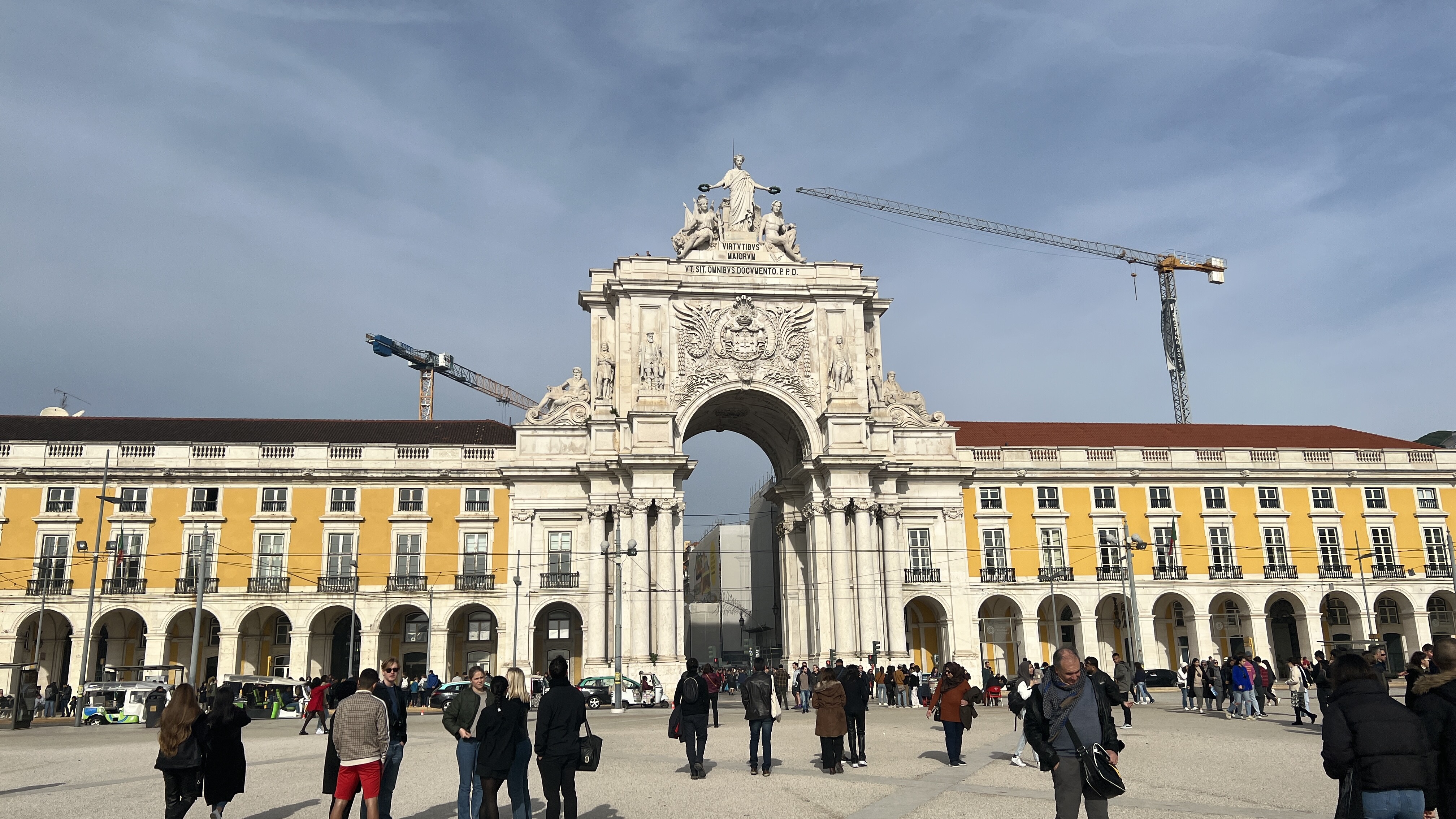
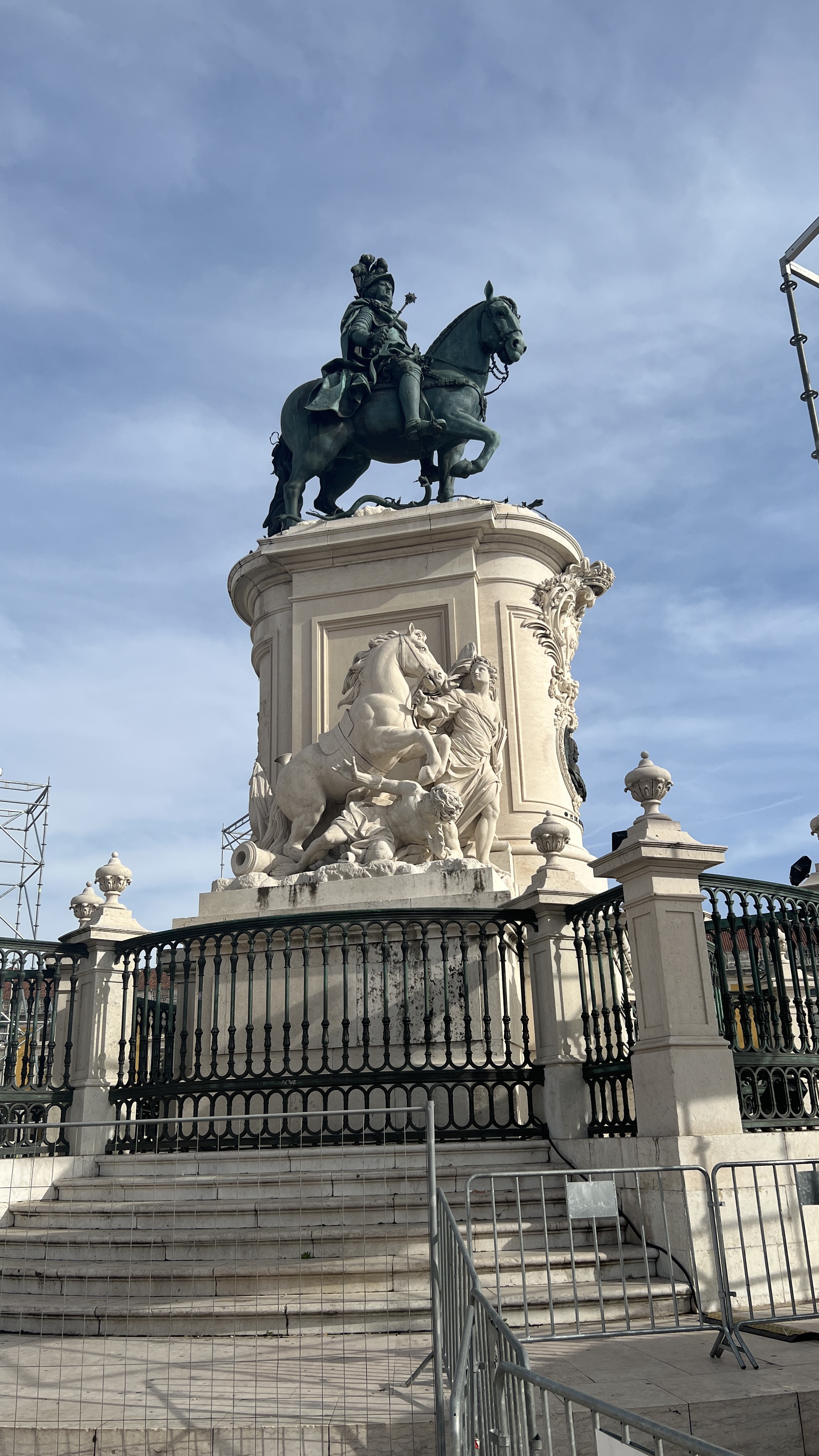
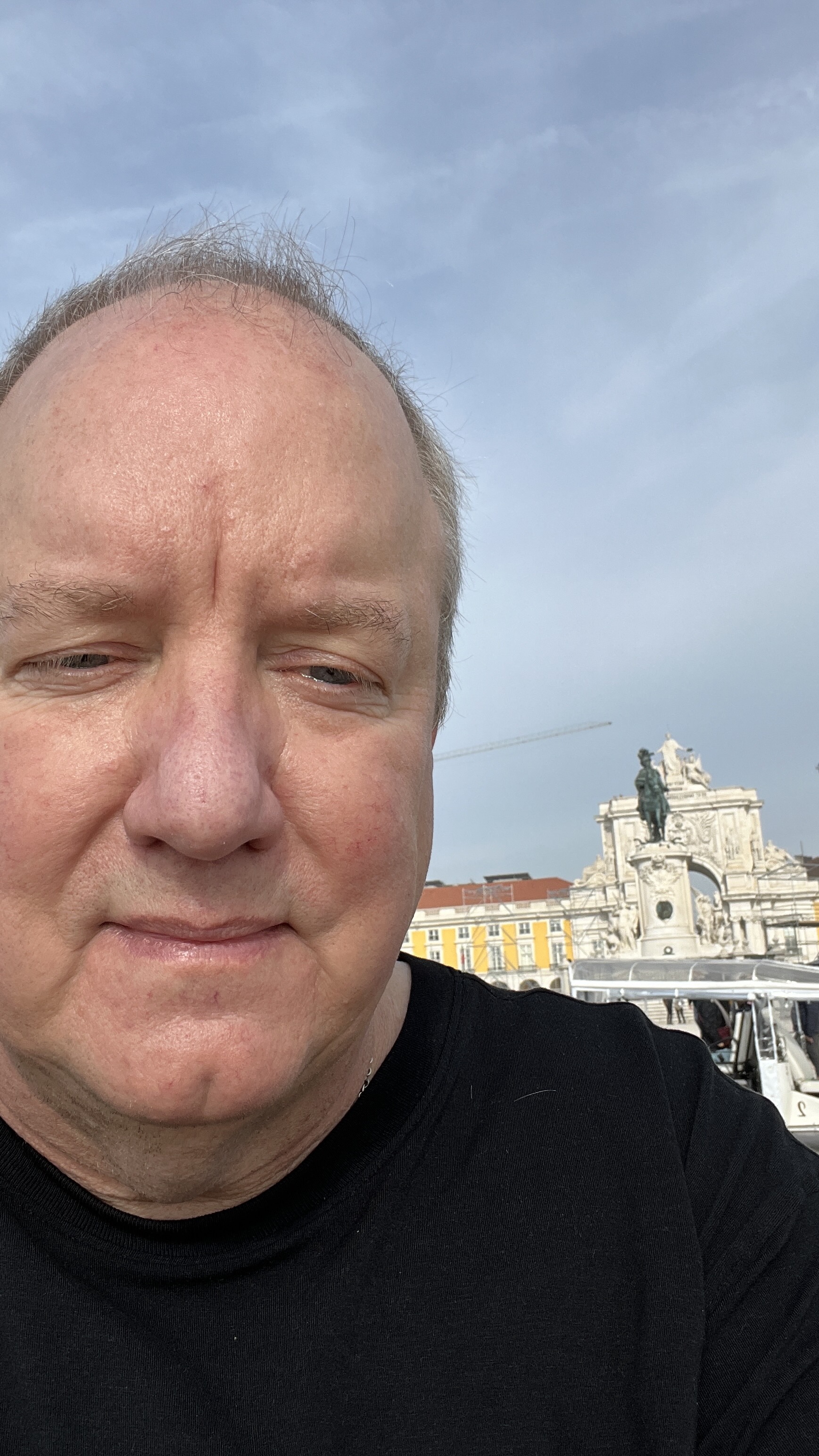
Day two was remarkable. I was able to get out and begin to discover the city and the food. When I left the apartment, I was on a mission that brought me here…
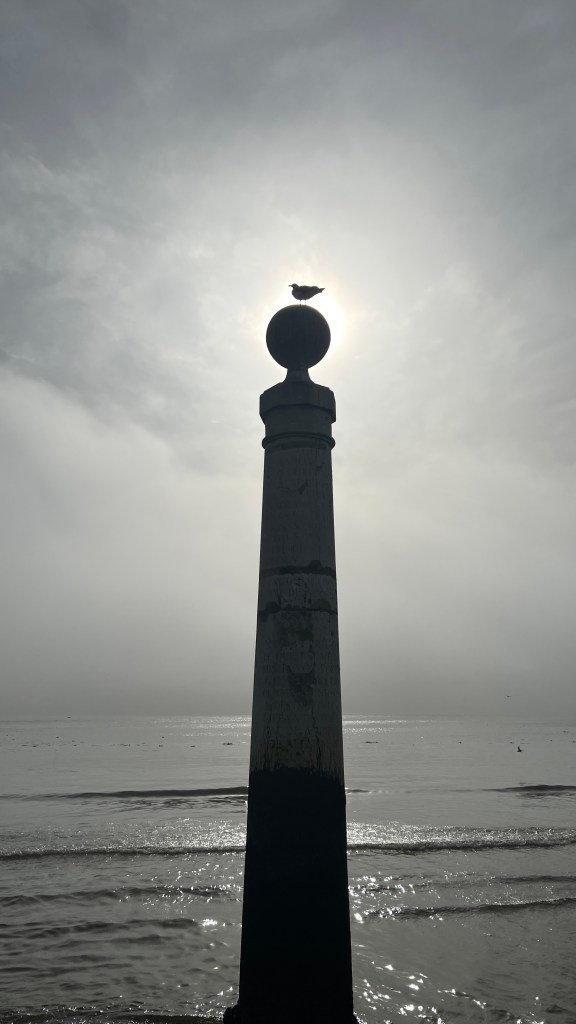
The Arco da Rua Augusta located on the banks of the Tagus River. The far shore was enshrouded in fog, so you get the artistic shot of the day.
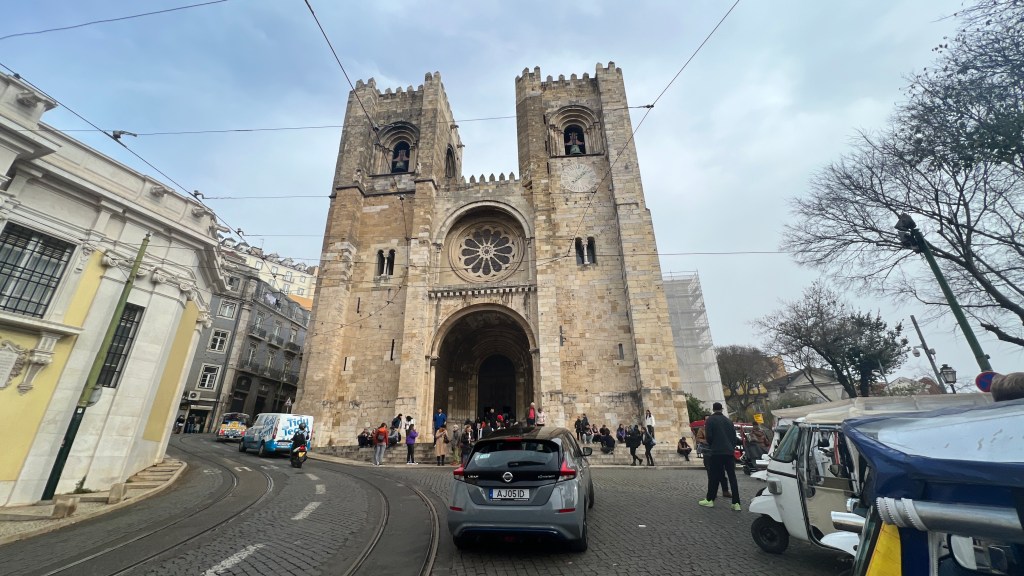
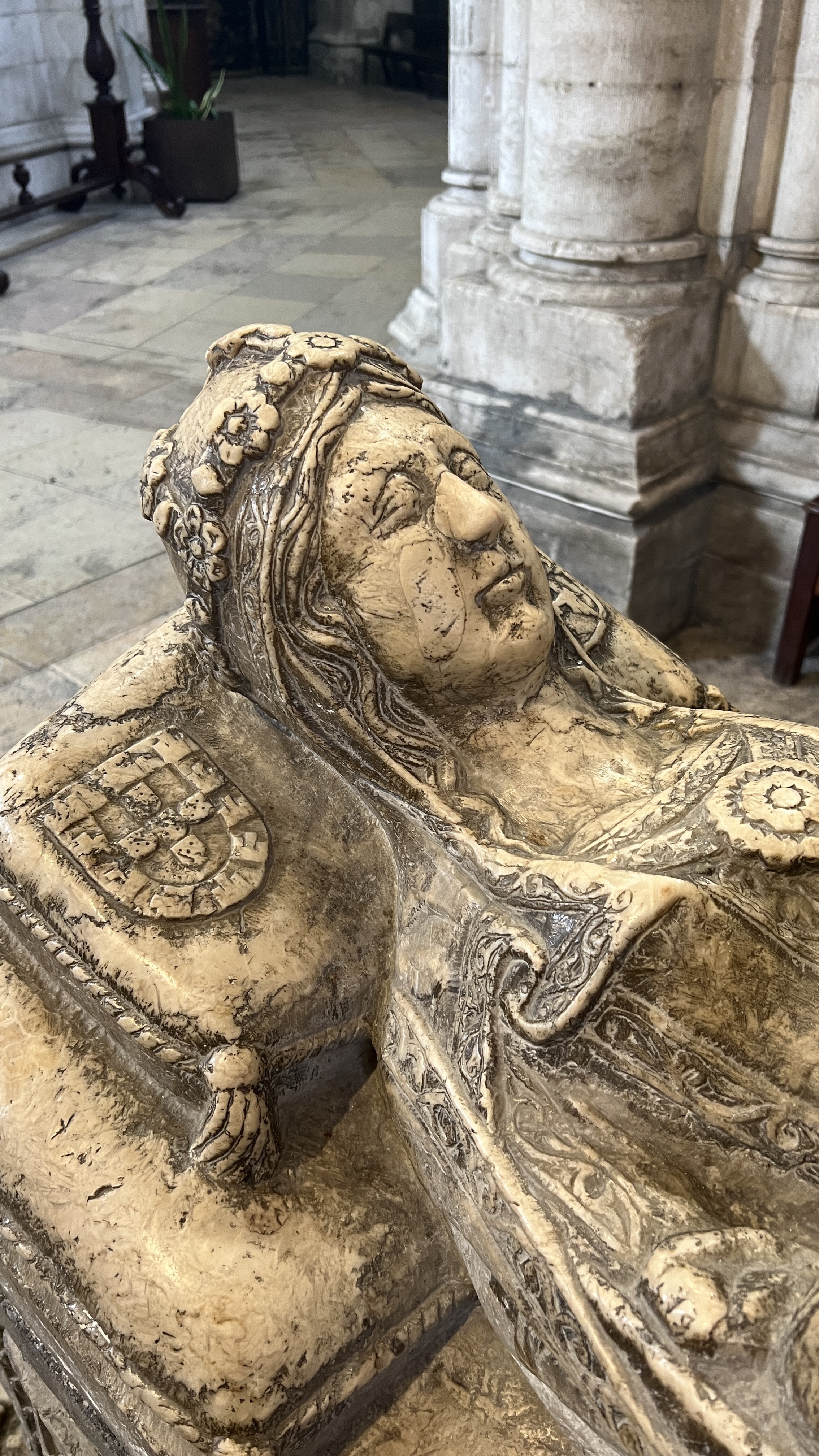
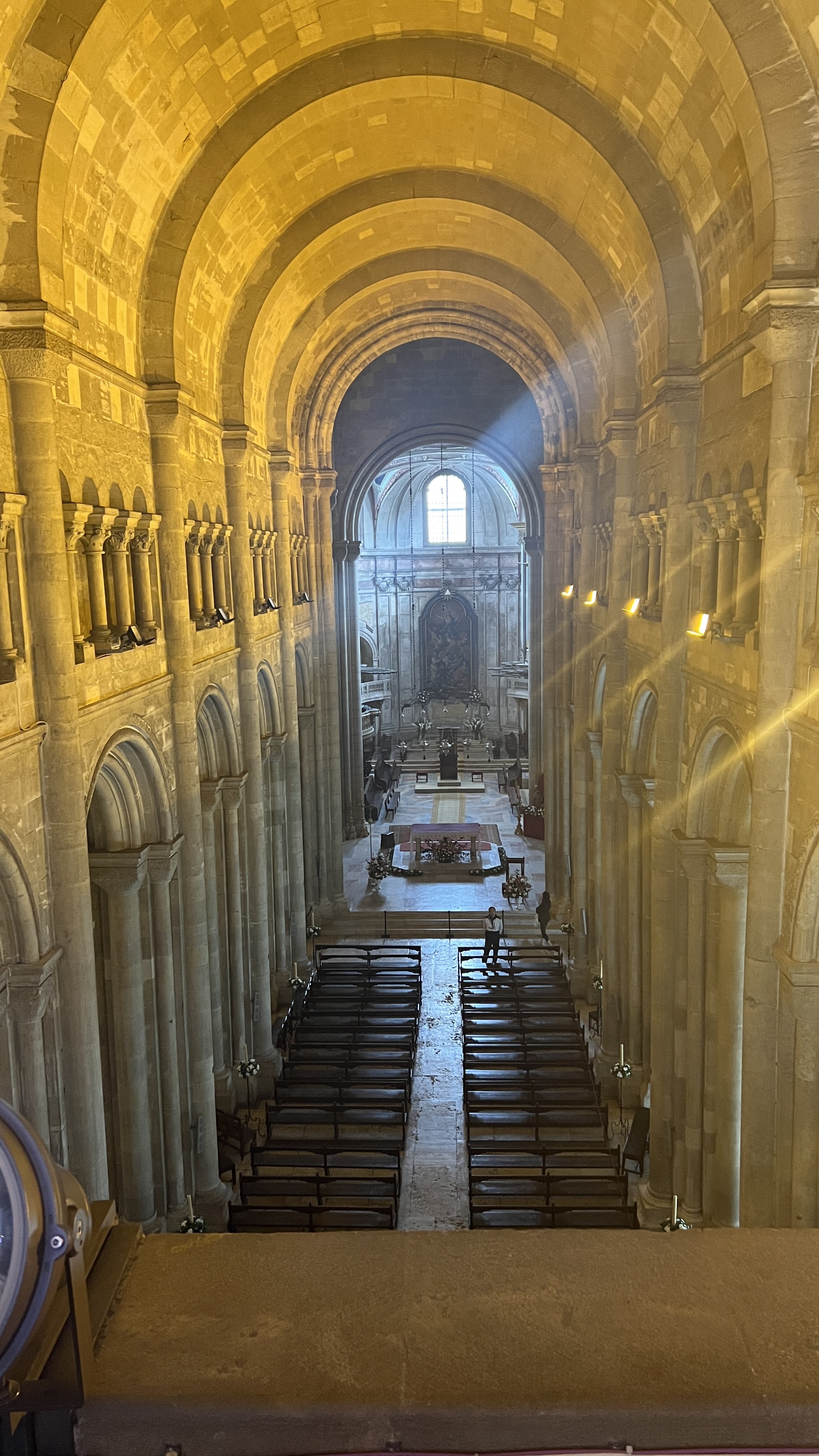
From here, I followed the river banks and then turned into the city toward Se Cathedral of Lisbon, which—from the outside—resembles more of a castle than a church.
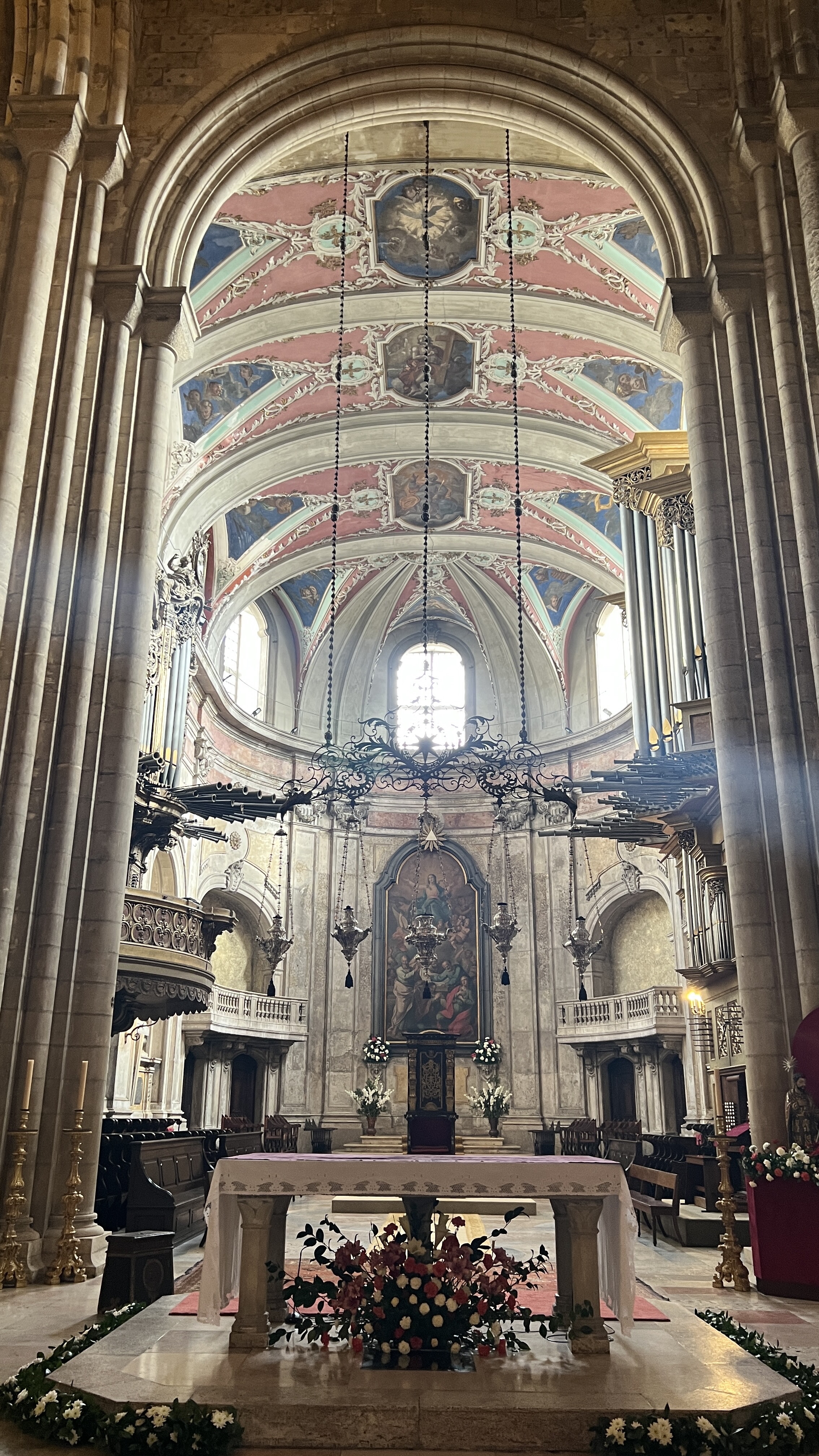
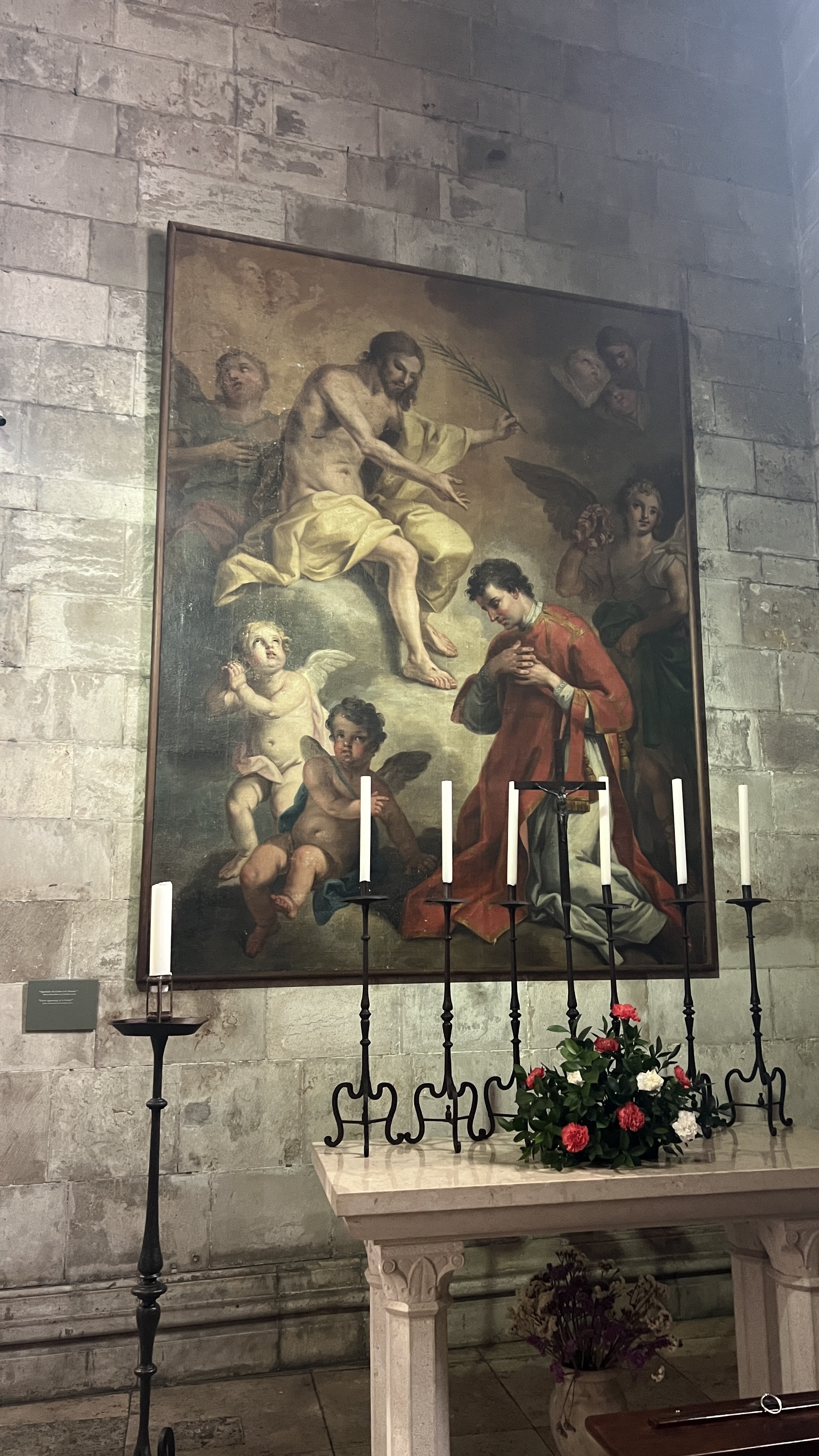
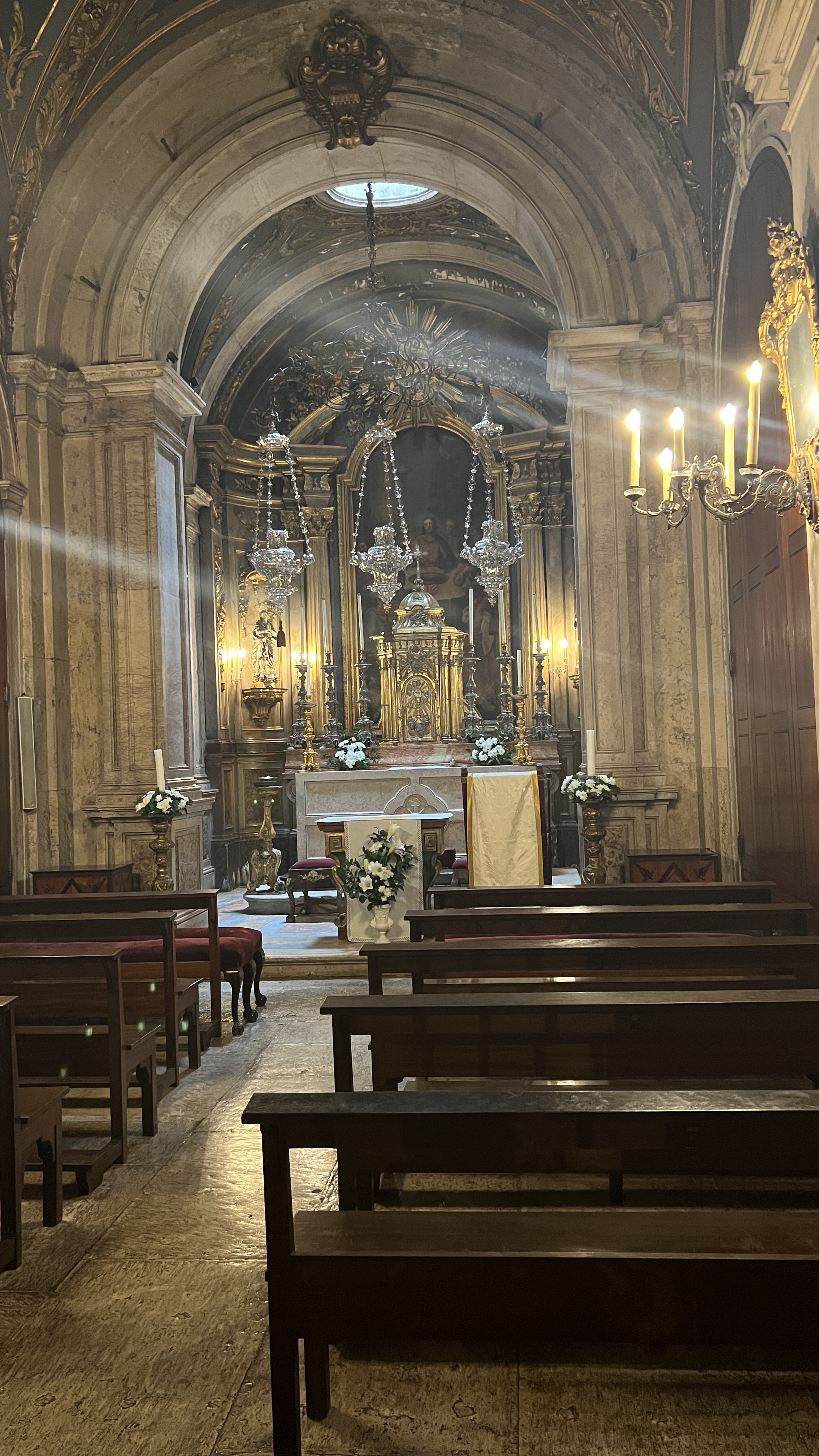
Over the years—it was built in the 12th century!!—it has suffered damage from several earthquakes, but each time, the people of Lisbon work to restore its beauty. So far, the churches in Lisbon are far more austere than those of Florence and Rome. In their architecture and appointments, they indicate strength. They are definitely places the crusaders would have felt at home. Inside is quite the same, with many side chapels adorned and beautiful statues. I plan to attend church here on Sunday.
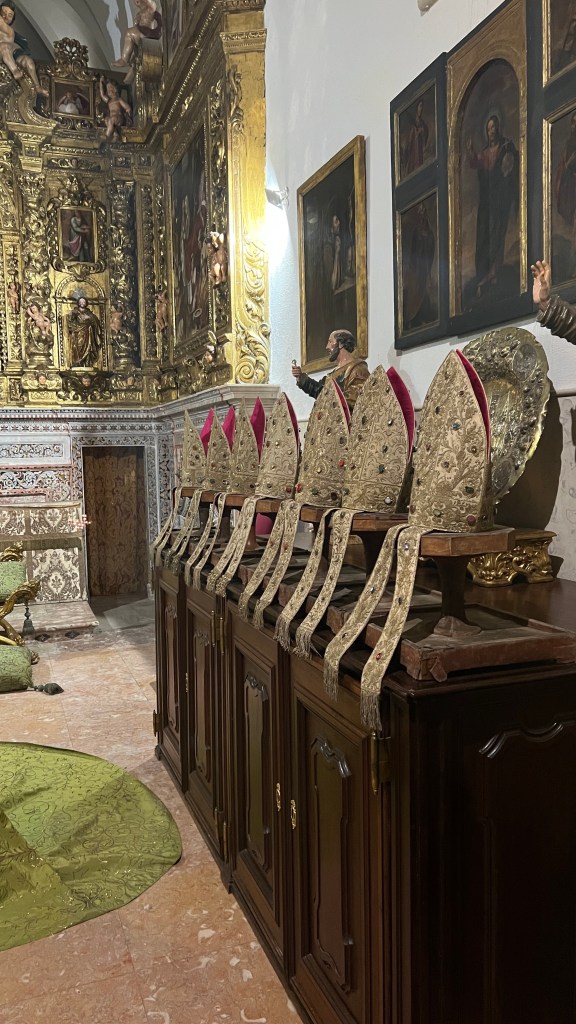
Dear Altar Guild – Wondering if you could hook a brother up (just don’t tell the Bishop!) This is the dressing chamber of the Patriarch.
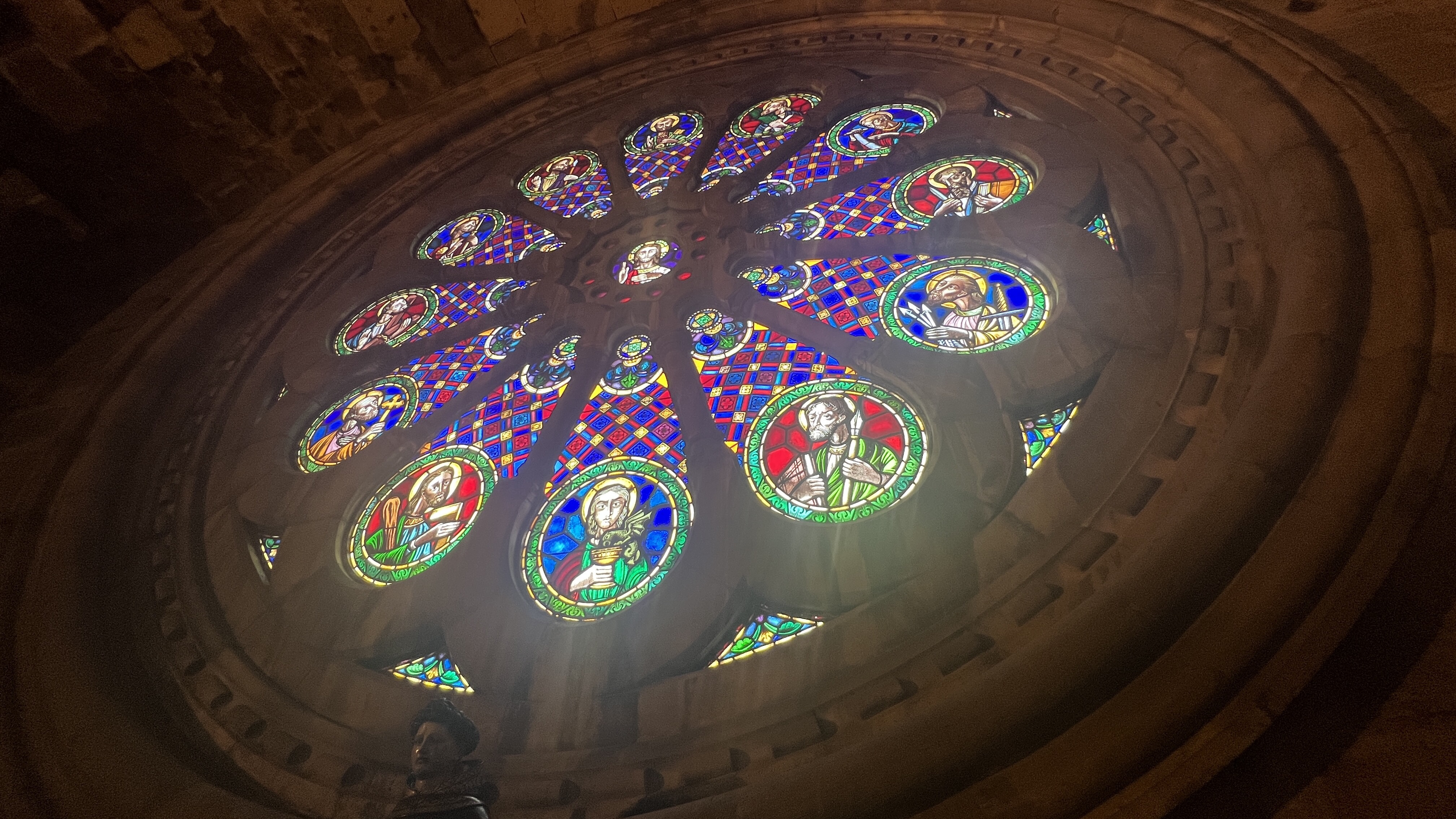
Finally, the view from outside on the ledge below the rose window.
The tour of the cathedral is said to take 40 minutes… well, after spending two and a half hours poking around every corner, I was hungry. I wandered the streets near the cathedral and found Restaurante Ruca, which instead of being filled with tourists, was filled with locals. Began with a creamy seafood soup, followed by baked cod, new potatoes, and cabbage. I had the meal with sparkling water, a nice glass of port wine, and finished with an expresso.
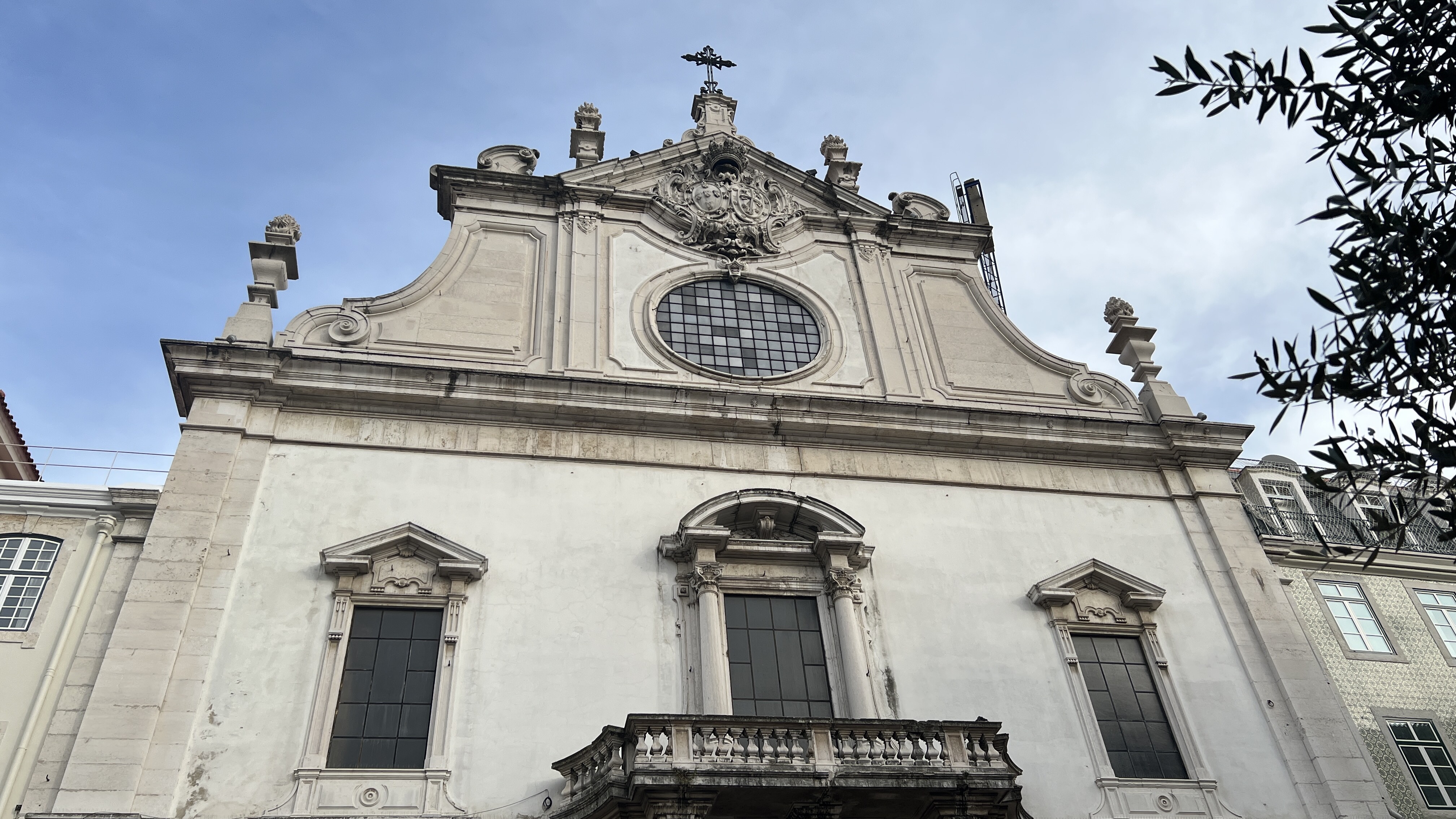
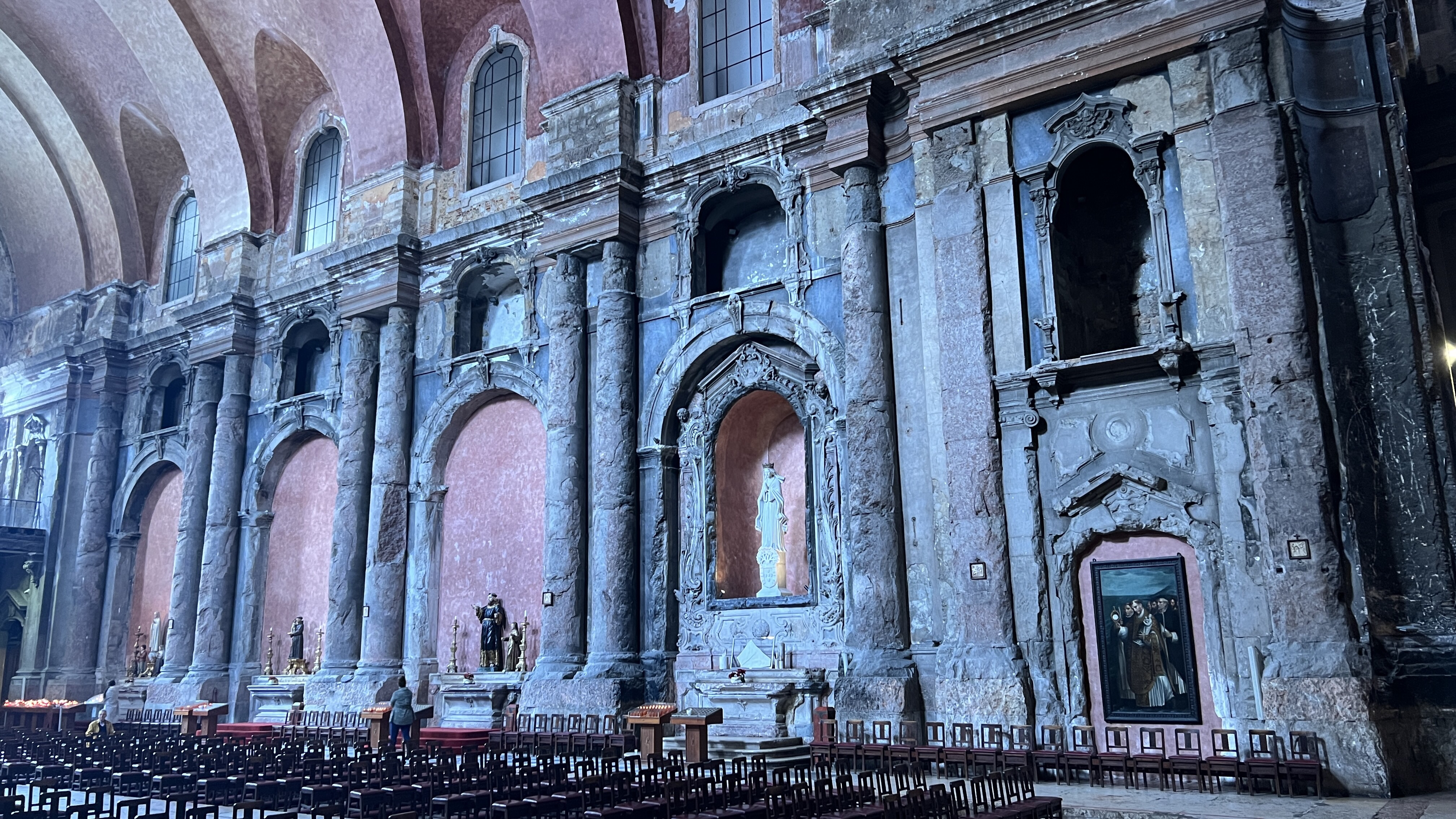
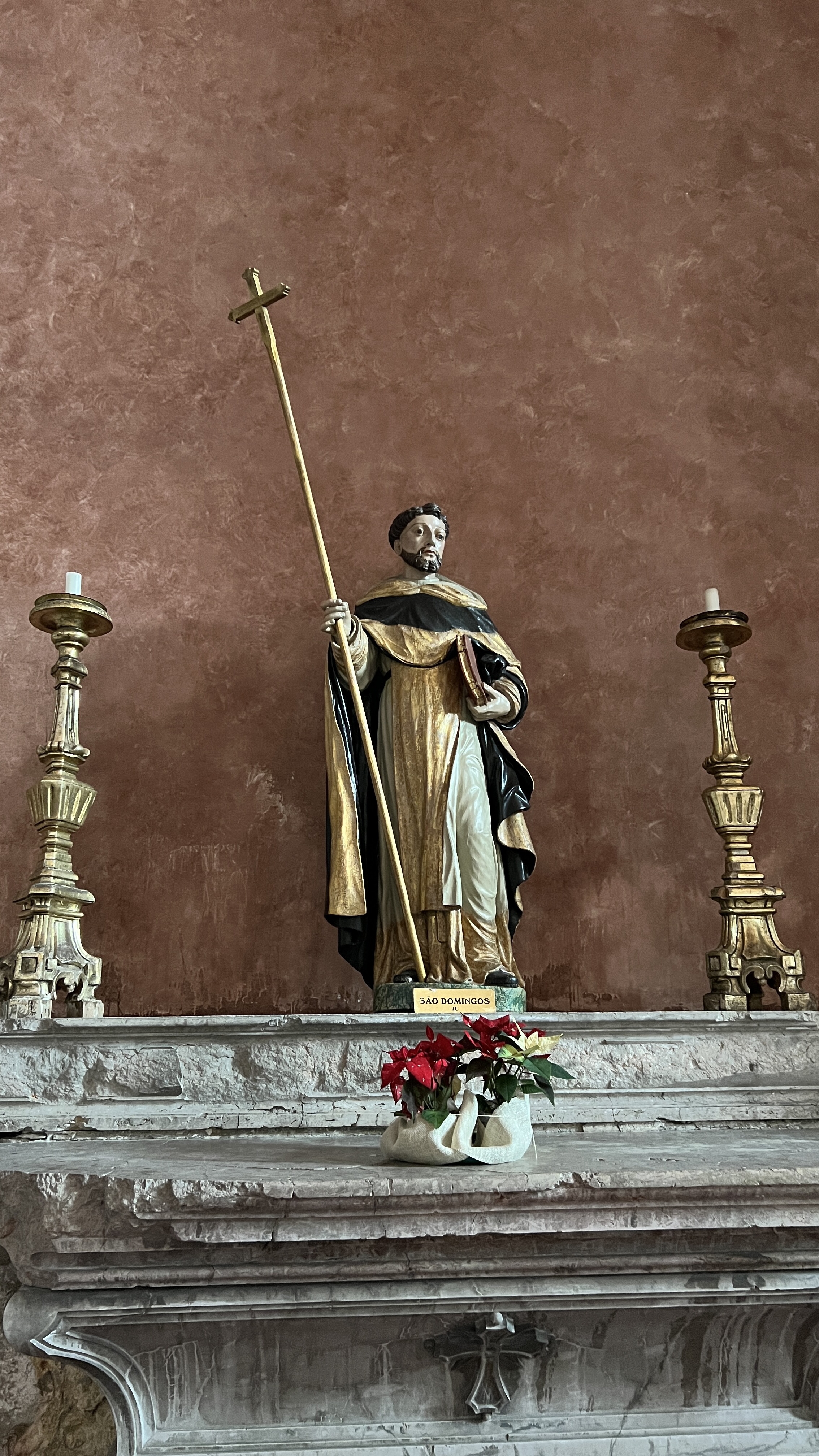
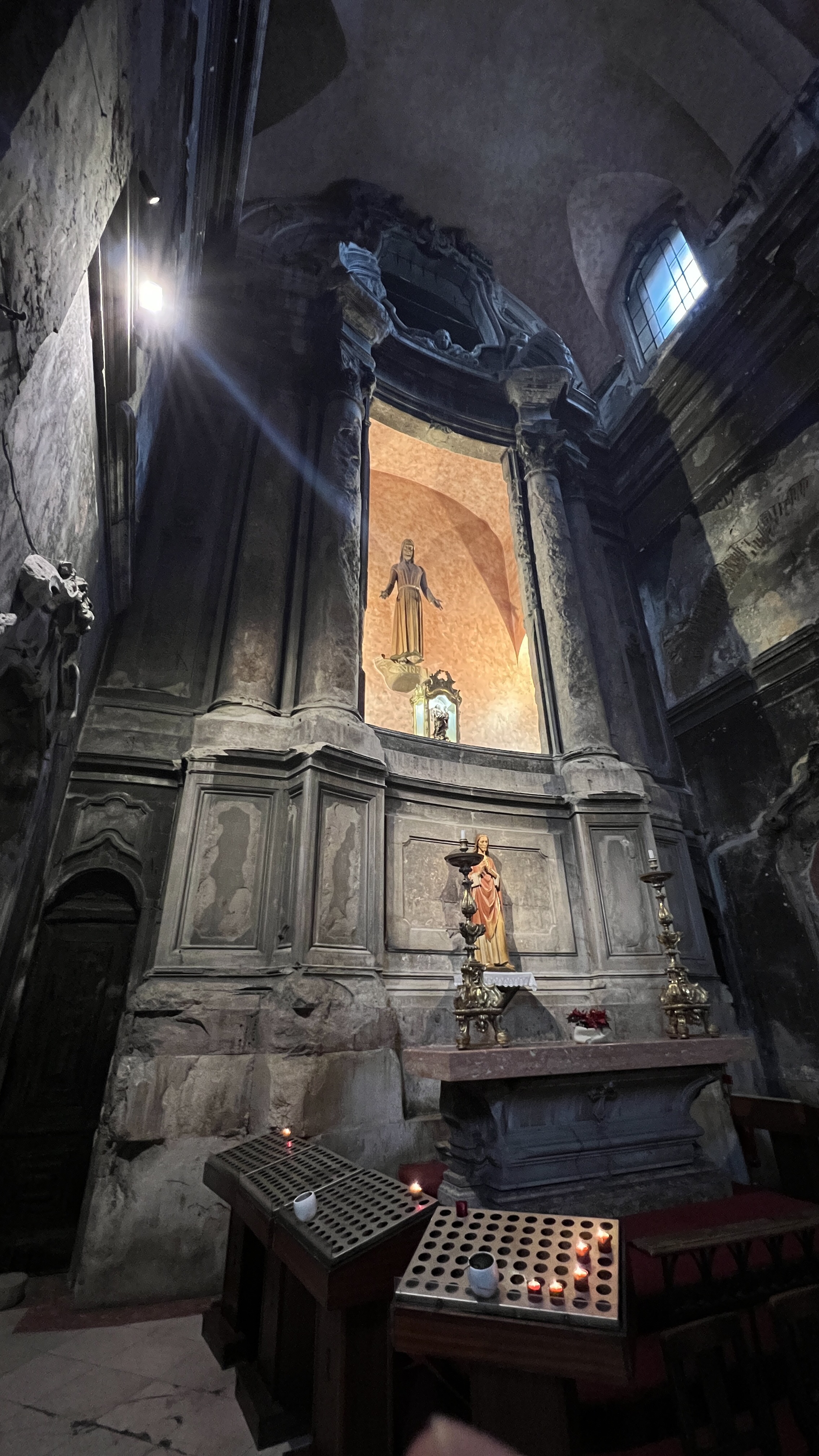
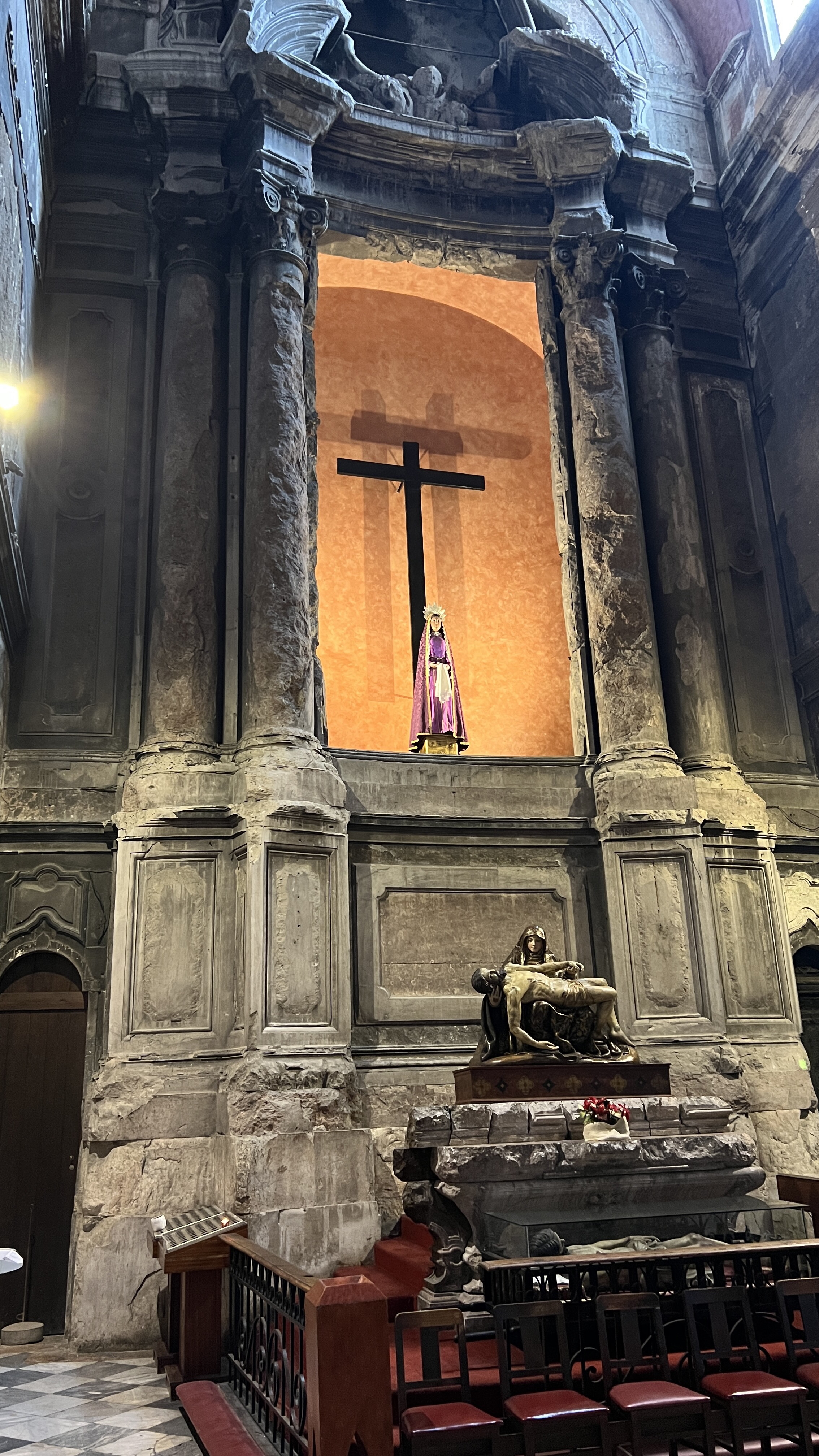
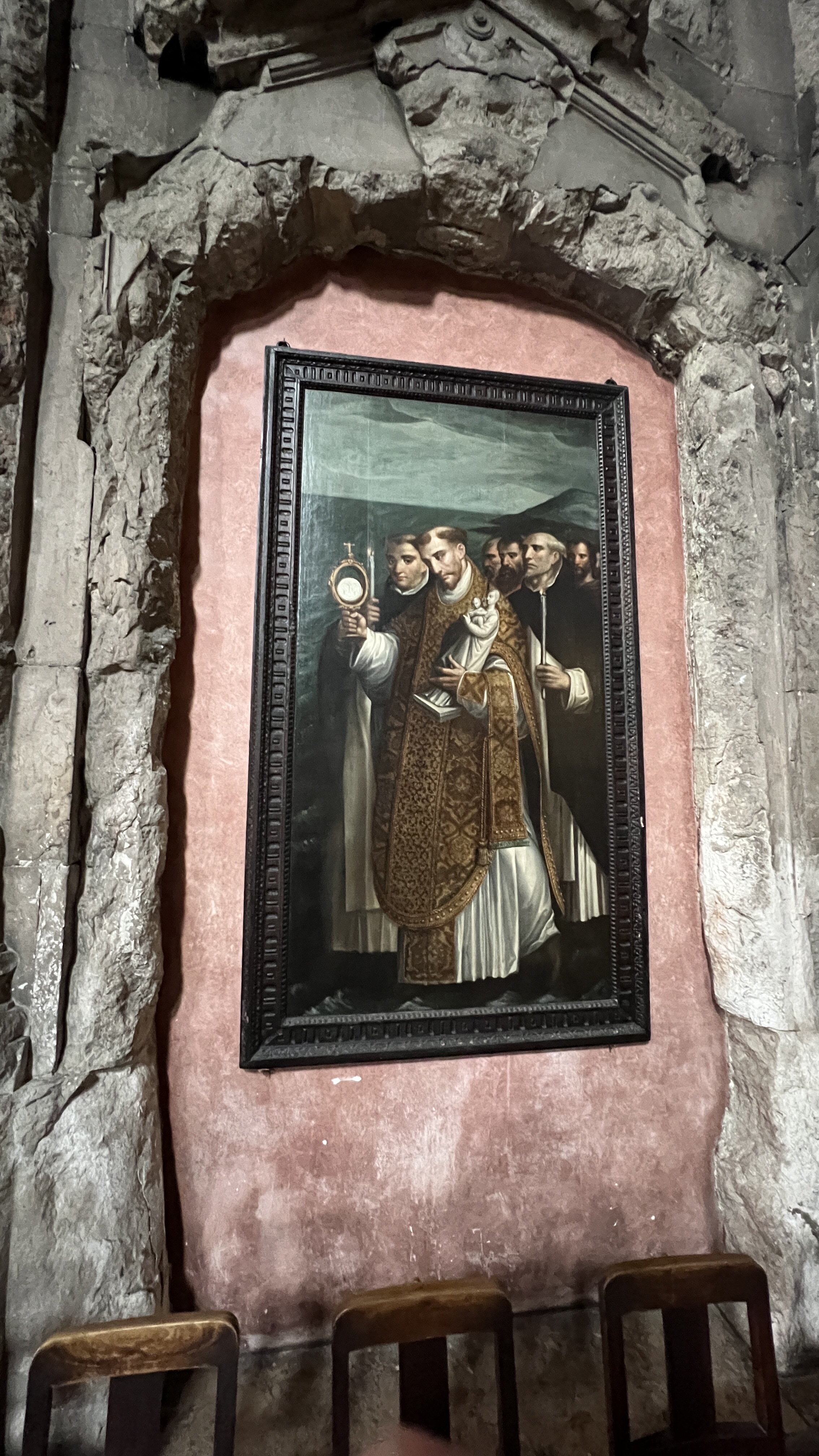
After lunch, it was time for another church: Igreja Sao Domingos, Church of St. Dominic. Work on the church began in 1241 and was completed in 1748. It is a church of great history and great tragedy. Between various earthquakes and a massive fire in 1959, it is a miracle that it is still standing. It is beautiful, just the same.
I was a few “Hail Marys” away from finishing my Rosary when I had a coughing spell and had to leave. It is distant, but you can still smell the smoke from the fire, and there is still evidence of those flames. Touch the door, and your hand will come away black.
From here, I made my way back to the apartment and had plans for a light supper and then back out to experience the lights, but then I met a Sikh. In this case, Sandeep (I believe I have his name correct) is the Sikh I met at the Deep Ink Zone Tattoo only a few steps from my apartment. I asked if I could set up an appointment and was told, “How about tonight?” For eight hours, my Sikh friend never lost focus. It was 4 a.m. when I finished up, so I will be out seeing the lights tonight.
This story contains a disclaimer: I am not talking about our church. This is not about our church. This story you are about to hear in no way reflects our church. Does everyone understand the disclaimer? Good.
A new Pastor in a small Oklahoma town spent the first four days making personal visits to each member, inviting them to come to his first services.
The following Sunday, the church was all but empty. Accordingly, the Pastor placed a notice in the local newspapers, stating that it was everyone’s duty to give it a decent Christian burial because the church was dead. The funeral would be held the following Sunday afternoon, the notice said.
Morbidly curious, a large crowd turned out for the “funeral.” In front of the pulpit, they saw a closed coffin smothered in flowers. After the Pastor delivered the eulogy, he opened the coffin and invited his congregation to come forward and pay their final respects to their dead church.
Filled with curiosity about what would represent the corpse of a “dead church,” all the people eagerly lined up to look in the coffin. Each “mourner” peeped into the coffin and quickly turned away with a guilty, sheepish look.
In the coffin, tilted at the correct angle, was a large mirror.
No. That is not our church; however, over time, it can be the story of any church. By looking back into history, we can see how.
It’s been a while, but we’ve talked about how in 538 b.c. the Persian king, Cyrus, freed the Israelites and allowed them to return to Jerusalem. Once home, the Israelites began to rebuild the city that had been destroyed, starting with the walls. That project took almost one hundred and fifty years because of politics and infighting, but when Ezra and Nehemiah arrived on the scene, progress was made. In the year 385 b.c., the Prophet Nehemiah says, “The wall was finished on the twenty-fifth day of the month Elul, in fifty-two days. And when all our enemies heard of it, all the nations around us were afraid and fell greatly in their own esteem, for they perceived that this work had been accomplished with the help of our God.” (Nehemiah 6:15-16)
Following its completion, the people were all brought together, and the Book of the Law of Moses was read to them. The people now had a wall to guard their city and, in the Law, a wall to guard their souls.
The walls we build are meant to protect us from the elements, those who wish us harm, the wild beasts, and such. They provide security, yet sometimes the walls we build become so high that we become isolated, not seeing the world around us and not really caring about it either. The Israelites finished the wall around their city, but the religious leaders never stopped building the wall around their souls. It got higher and higher, and in the process, it no longer provided security for the soul; it became a prison for the heart, creating a heart that no longer cared, no longer had compassion, and no longer loved. It created a heart so rigid that it would become angry if a woman who had been sick and bent over for eighteen years was restored to health on the wrong day.
Scipio of Rome is considered one of the greatest generals of the Roman Empire. He did not put up with much nonsense. Writing of him in City of God, St. Augustine said, “He did not consider that republic flourishing whose walls stand, but whose morals are in ruins. But the seductions of evil-minded devils had more influence with you than the precautions of prudent men.” It is good to have strong fine walls to protect a city, but if the people living inside them are not good, then walls or not, the place itself is not good. That was the result the religious leaders had accomplished, and Jesus was angry with them, not because they were keeping the Sabbath holy, but because they had stopped caring, stopped loving, and not just on the Sabbath but the other six days as well. The spiritual wall that was given to protect the soul had become a prison for the heart, so everything that God had accomplished in the time of Ezra and Nehemiah was still standing but in ruins.
In calling out the religious leaders, Jesus was having a funeral for a dead church. He was holding up a mirror and showing them what they had become.
The words of Isaiah that we read this morning speak very clearly about what was happening but also point the way out of the prison they had created:
If you remove the yoke from among you, the pointing of the finger, the speaking of evil, if you offer your food to the hungry and satisfy the needs of the afflicted, then your light shall rise in the darkness and your gloom be like the noonday.
It is not about the walls around this building that matter. It is the wall around our souls. Should we have one around the soul? Yes. Absolutely. As we said last week, we must care for our souls, but to avoid becoming a dying or dead church, we can’t turn it into a prison. We guard our souls so that we can go outside these walls and care for the souls of others. How do we do this?
I enjoy the short films you can find on YouTube. They are five to twenty minutes in length. A few weeks back, I came across one that had been nominated for an Oscar: Feeling Through. It is about a young homeless man’s encounter with an older man who is both blind and deaf. Imagine trying to communicate with someone who is both blind and deaf. Not easy. The two meet when the younger man reads the sign that the other is holding: “I am blind and deaf. Tap me if you can help.” Tap me. Touch me so that I know you are there.
How do we care for the souls of those outside the walls? We touch them so that they know we are here. We help ease their burdens, both physically and spiritually, we bring reconciliation and not strife, we feed bodies as well as souls, and we care for and love the oppressed and afflicted. If we do these things, then it will be as Isaiah said: “The Lord will guide you continually, and satisfy your needs in parched places, and make your bones strong; and you shall be like a watered garden, like a spring of water, whose waters never fail. Your ancient ruins shall be rebuilt; you shall raise up the foundations of many generations; you shall be called the repairer of the breach, the restorer of streets to live in.”
Or, as Jesus said, “If anyone thirsts, let him come to me and drink. Whoever believes in me, as the Scripture has said, ‘Out of his heart will flow rivers of living water.’” If we touch those outside of these walls, then we will become stronger, and we will continue to provide rivers of living water to all who are thirsty.
There is a story about a tourist visiting Italy who came upon a construction site. “What are you doing?” he asked three stonemasons.
“I’m cutting the stone,” answered the first.
“I’m cutting stone for 1,000 lire a day,” the second said.
But the third answered, “I’m helping to build a cathedral!”
With the enthusiasm and joy of that third stonemason, let’s care for our souls but also build a church that is the source of living water so that the souls of many are touched and cared for.
Let us pray: Come, all who are thirsty says Jesus, our Lord, come, all who are weak, taste the living water that I shall give. Dip your hands in the stream, refresh body and soul, drink from it, depend on it, for this water will never run dry. Come, all who are thirsty says Jesus, our Lord. Amen.
This is probably something you’ve seen, but I don’t believe I’ve shared it with you. It is the comedian Robin William’s list of the top 10 reasons to be an Episcopalian:
10. No snake handling.
9. You can believe in dinosaurs.
8. Male and female God created them; male and female we ordain them.
7. You don’t have to check your brains at the door.
6. Pew aerobics.
5. Church year is color-coded.
4. Free wine on Sunday.
3. All of the pageantry – none of the guilt.
2. You don’t have to know how to swim to get baptized.
And the Number One reason to be an Episcopalian:
1. No matter what you believe, there’s bound to be at least one other Episcopalian who agrees with you.
That is a list that most Episcopalians could agree on. It is a humorous way of looking at how we see ourselves. Not only is it essential to have fun with such things, but it is also important to take a more serious look, and we, in the Episcopal Church, received the results of one of these more serious looks in Jesus in America, a study, commissioned by the church, that came out in March. Its goal: to learn how people understood Jesus and the church. What did we learn?
When we as a Christian people look at ourselves, we believe we’re doing a pretty good job representing the faith: in the 50%+ percentiles, we see ourselves as giving, compassionate, loving, and respectful. Those are good qualities. However, those who are not religious have a different view of Christians. In the 50%+ percentiles in this group, Christians are seen as hypocritical, judgmental, and self-righteous. Not such good qualities. We look just fine to ourselves, but not to others.
It would seem that many have a bad taste in their mouths regarding Christianity and Christians, and that bad taste is getting worse. I read a bumper sticker that said, “I’ve got nothing against God. It’s his fan club that I can’t stand.” Not necessarily original. You have all probably heard the Gandhi quote from several years ago, “I like your Christ, I do not like your Christians. Your Christians are so unlike your Christ.” However, the Christian “image” seems to be deteriorating even more, but it’s no wonder when we spend so much time condemning what we dislike instead of proclaiming Who it is we love.
Please don’t misunderstand; I am in no way lumping you all in this category. You are not guilty of this type of behavior. Still, in the eyes of many today, you are guilty: guilt by association because we all live under the banner of Christianity regardless of denominational lines, ideologies, theologies, etc.
For some, to overcome, the appropriate response is to separate and attempt to isolate themselves and shout in their loudest voices, “We are different! We are better! We have the answer!” But this does not resolve anything. In all likelihood, it only compounds the original problem because Christians begin fighting with other Christians, and the rest of the world sits back and laughs at the hypocrisy. At the other end of responses are those who simply walk away, disillusioned and frustrated with their experience with Christianity, because they had believed it was something different. They thought it held meaning for their lives and answers to life’s questions, but they discovered it was no different—if not worse—than the secular world. In between those two extremes is just a great deal of apathy.
Is there a way out? Absolutely. And we begin to see that way when we answer the question that was put to Jesus: “Who is my neighbor?”
Our Gospel reading today is probably one of the more familiar: the parable of the Good Samaritan. Jesus tells the story after a rabbi asks what he must do to inherit eternal life. Jesus’ answer is simple, “Love the Lord your God with all your heart, mind, strength, and soul and love your neighbor as yourself.” However, the rabbi was more interested in one-upping Jesus than actually seeking wisdom, so he added a follow-up question, “And who is my neighbor?” In response, Jesus tells the parable.
A man, presumably Jewish, was attacked on the road and left for dead. A priest comes by but does not stop to help. Another of the religious leaders comes by, but he does not stop to help either. It is the Samaritan that comes across the dying man, and it is he that helps. To fully understand the parable, we must understand two critical details of the story, 1) the relationship between Jews and Samaritans and 2) the perspective that the parable is being told from.
First, Jews and Samaritans: we’ve covered this before, but the best way to understand that relationship is to look at the state of Jewish / Arab relations today. There may not have been open warfare between Jew and Samaritans, but the animosity between the two groups is similar to Jews and Arabs. They don’t get along.
Second, generally, we understand this parable from the perspective of the Samaritan. Would we be like the one that helps the injured man, a person who is often regarded as an enemy? Would we see this enemy as our neighbor? However, Bishop N. T. Wright, the former Bishop of Durham, tells us that we’ve got it the wrong way around. (For the record, we are to look at parables from all perspectives. That’s how we learn from them.) Wright says the proper perspective is viewing the parable from that of the injured Jewish man. Will he decide who his neighbor is? Wright puts it this way, “Can you—that is, the injured Jewish man—Can you recognize the hated Samaritan as your neighbor? If you can’t, you might be left for dead.” See how the story turns? It is no longer about you being this big-hearted person saying, “Look at me. See me helping this poor slob. Aren’t I a good neighbor?” No. It is about that “poor slob” deciding whether or not you’re a good neighbor.
Imagine lying on the side of the road, beaten and bloody, half dead. Several people, maybe even your priest, see you but can’t be bothered with stopping—too busy or whatever—and then, the one person you detest, despise, loathe more than anyone else comes by and instead of pointing at you and laughing and declaring, “I see you’ve finally gotten what you deserve!” Instead, this person stops and begins to offer you help. What do you do? Because you detest, despise and loathe them, will you tell them to go away and leave you to die? Or, are you going to think to yourself, “Perhaps this isn’t such a bad fella after all? Perhaps this person is my real neighbor?”
The world around us has a very poor view of Christianity. We are not going to change the world’s opinion. Still, we, St. Matthew’s Episcopal Church, may be able to change our community’s view of Christianity by showing them that we are willing to set aside race, creed, politics, and financial status, all of it for one straightforward reason: we want to serve, which is to love. In the process, the community might decide that we are not such bad neighbors after all.
Will our community—the wounded and the injured—will they know we are their neighbor if we shout out what we like or don’t like? Whom we agree with, or whom we disagree with? By our staunch view on this topic or that? No. They’ll know what we think and maybe, rightly or wrongly, what we believe, but they will not know us as their neighbors.
Thomas Merton writes, “Corrupt forms of love wait for the neighbor to ‘become a worthy object of love’ before actually loving him. This is not the way of Christ. Since Christ Himself loved us when we were by no means worthy to love and still loves us with all our unworthiness, our job is to love others without stopping to inquire whether or not they are worthy. That is not our business, and in fact, it is nobody’s business. What we are asked to do is to love; and this love itself will render both ourselves and our neighbor worthy if anything can.” (Disputed Questions, p.125) If we shout out at the world who they must be and what they must believe before we will love them as neighbors, then we’ve honestly forgotten how it is that Jesus loves us.
We can change our community’s view of Christianity not by just seeing them as our neighbors but also by loving them in such a way that they see us—see us!—as their neighbor. That is the church we are called to become.
Let us pray: Heavenly Father, look upon our community of faith which is the Church of your Son, Jesus Christ. Help us to witness to his love by loving all our fellow creatures without exception. Under the leadership of our Bishop keep us faithful to Christ’s mission of calling all men and women to your service so that there may be “one fold and one shepherd.” We ask this through Christ, our Lord. Amen.


















 Candle in a Cave