

In 1946, the first car phone service was launched. It was big, clunky, and expensive. In 1964, Ma Bell rolled out a newer generation. It wasn’t until 1973 that the first truly mobile phone call was made. Martin Cooper of Motorola called Joel Engel, his rival at Bell Labs, to say, “Joel, I’m calling you from a cell phone… a real handheld portable cell phone.” Yet, it wasn’t until October 13, 1983, that the first mobile phone network went online. The phone was the Motorola DynaTAC 8000X. It weighed 2.5 pounds, took ten hours to charge, and provided 30 minutes of talk time.
Today, 348 million people live in the United States, and it is reported that 331 million of us have a cellphone, which we use to watch countless millions of cat videos every day. I suppose none of us really knows all that those little devices can do, but one interesting feature comes to us from Uncle Sam—Wireless Emergency Alerts, or WEA.
Once or twice, we’ve had it alert during a service. It gives the government the power to send a message to every cellphone in a selected geographic location. It’ll override the silent features and everything else with a loud, blaring horn. I’m sure you know it. With this feature, the US government can send a message to every cellphone in the country (unless it is turned off), and, on average, almost all 331 million cellphones will receive it within two minutes. Why am I thinking on this?
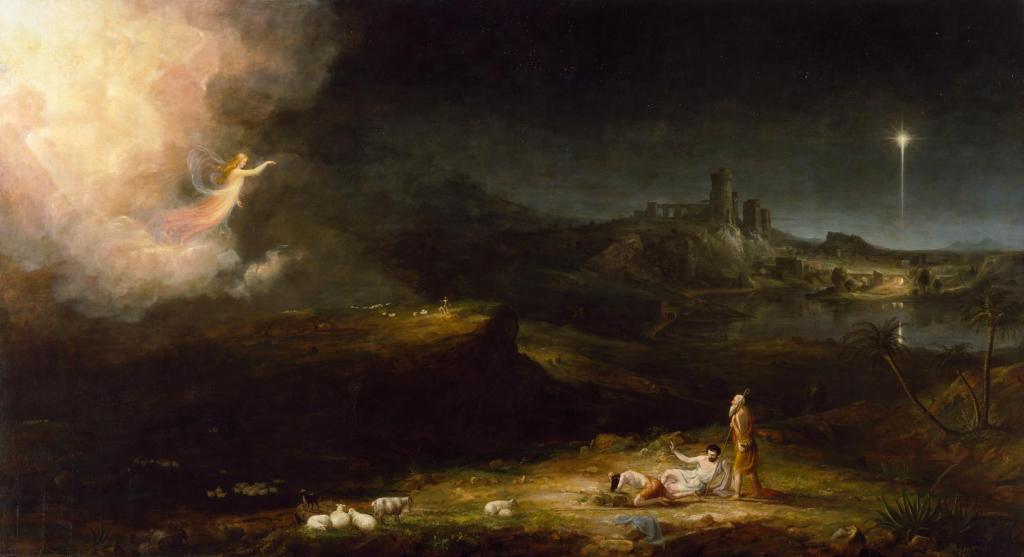
In Holy Scripture, the image of the shepherd represents faithful leadership. The Psalmist says, “The Lord is my Shepherd, I shall not want.” Jesus says, “I am the Good Shepherd, my sheep know the sound of my voice.” However, the image of the shepherd in Holy Scripture is dramatically different from how the shepherd was perceived in society.
They were viewed as thieves, uneducated outsiders with little to no synagogue attendance, and were considered equal in depravity to dice-throwers, pigeon-racers, and tax collectors. They were ritually unclean because of their work with animals, and their testimony should never be trusted. Scripture speaks highly of them, but for the most part, they were seen as some of the lowest of the low. So, why, of all people, would the angels first announce the birth of the Messiah to shepherds, and why were they chosen as the first visitors to this newborn King?
It may not have been as efficient as the system we have today, but in Rome, there was one who could have quickly spread the message across the known world—Caesar Augustus.
Caesar Augustus is widely considered the greatest ruler of the Roman Empire. He came to power in 27 BC and ruled for forty years. Under his reign, there was the Pax Romana—the Peace of Rome, a period of almost two centuries of relative peace under Roman rule, and it was at its height under Caesar Augustus.
During his reign, the Romans had 250,000 miles of roads, 62,000 of which were paved to support the rapid deployment of military troops and trade. Sure, you had slavery, high taxation, and suppression, but what a small price to pay for Caesar and his cronies to live in comfort.
Caesar considered himself the son of God and the savior of the people, but let’s say he, instead of those dirty shepherds, heard the angel’s message, went to the manger, saw, and believed. Jesus could have been swept out of that dump and given a royal palace, servants, and everything He would ever want or need. The whole crucifixion business could have been dispensed with. How?
Caesar, using his own version of the Wireless Emergency Alert system, could have used those 250,000 miles of roads and the messengers, who were constantly running to and fro, to spread the word of this new King while keeping Jesus safely cloistered away. Within two months of Jesus’s birth and Caesar’s visit to the manger, the message would have been broadcast to the entire empire. Not as fast as we could today, but a heck of a lot faster and more efficient than a couple of untrustworthy shepherds with no means of communicating to the rest of the world.
The words of Judas Iscariot in the rock opera Jesus Christ Superstar,
“Why’d you choose such a backward time in such a strange land?
If you’d come today you could have reached a whole nation.
Israel in 4 BC had no mass communication.”
Not only could Caesar have communicated the message more quickly, but he could have commanded and put into law that Jesus was the true Son of God, that there would be no other gods but the Father, and that anyone stupid enough to disagree could be put to death. How great is that?
Here, we’ve been trudging along for 2,000 years to make Jesus known and loved, but if the angels had gone to Caesar Augustus, the world would have become Christian almost overnight and would have remained so until 476 AD, when the Roman Empire fell. That’s when whoever rose to power would have ushered in a new god, required everyone to worship it, and put to death those who disagreed. And the world would have fallen into step with little to no resistance. Why?
God chose shepherds when he came into the world because Jesus would not be managed by politicians and used to further agendas. That type of system is always doomed to failure. Instead, Jesus came so that hearts would be changed. This does not happen with commands and dictates. It doesn’t happen with power and threats. It happens when the humble and meek, the lowly and despised—the shepherds—hear the angels’ message and submit themselves, body and soul, to the One who calls them into His presence and reveals Himself to them.
In a sermon preached in the early fifth century, St. Augustine said,
“Shepherds were watching their flocks by night.
Shepherds—simple men, humble men, poor men—were watching, and the angel of the Lord stood by them.
Not to kings, not to scribes, not to the wise of this world was the birth of Christ announced, but to shepherds.
Why shepherds?
Because they were humble; because they were vigilant; because they were keeping watch.
Pride does not keep watch; humility does.”
Jesus had no desire to conquer worldly empires. He came to conquer sin and death, so that those who believe in Him and call on His Name might receive forgiveness of sins and eternal life. This could never be accomplished by the dictates of Caesar. St. Leo the Great said, “Truth sought not the halls of kings, but the hearts of the humble.” Starting with shepherds has taken longer, but through those very humble beginnings, the world has never been the same.
This evening, we are the shepherds gathered in this place. We came not by compulsion or command, but because we too have had our hearts changed, made new. Somewhere within our souls, the angels spoke, saying to us as they did to the shepherds, “Do not be afraid; for see—I am bringing you good news of great joy for all the people: to you is born this day in the city of David a Savior, who is the Messiah, the Lord.” We have heard those words, and like the shepherds, we visit the manger, kneel before our infant King, and believe. In his sermon, St. Augustine went on to say,
Let us imitate the shepherds.
Let us keep watch over what has been entrusted to us.
Let us guard Christ in our hearts.
Let us proclaim Him by our lives.
Our God and King has drawn near, come, let us adore Him.
Let us pray (also from St. Augustine): Let the just rejoice, for their justifier is born. Let the sick and infirm rejoice, for their Savior is born. Let the captives rejoice, for their Redeemer is born. Let slaves rejoice, for their Master is born. Let free men rejoice, for their Liberator is born. Let all Christians rejoice, for Jesus Christ is born. Amen.
 Candle in a Cave