
Sermon: Lent I RCL A – “Forgiveness, Pt. 1 – Where to Begin?”

forgive-tumblr

The Beatitudes.  Blessed are the poor, those who mourn, the meek, those who hunger for righteousness, the merciful, the pure in heart, peacemakers, and the persecuted.  Have you ever read those and thought to yourself, “I am so going to hell!”  There are days when I think that my ticket is already stamped.  This notion  of going to hell is only confirmed when I consider the seven deadly sins.

Pride.  How could I possibly be prideful when I’m the humblest person I know?  Greed?  Yeah.  Here’s a good one, lust.  You know what I think of when I think of being lustful?  Roy Orbison.  No.  Not Roy himself, but that song of his, “There she was just walking down the street, singing do wah diddy diddy dum diddy do.  She looked good, she looked fine, and I nearly lost my mind”  What is wrong with me?  Sloth?  Wrath?  Gluttony?  Please!  Just look at me.  I couldn’t come close to measuring up to a single one of the Beatitudes, but give me the seven deadly sins and I’m batting 1,000.  I am most certainly going to hell and my only consolation is that I can look around the congregation and know that I’ll at least have several friends with me!

In our Gospel today Jesus was able to overcome all the temptations that the Devil threw at him – worldly pleasures, fame, power, everything – but if you were to set a double beef cheeseburger, large fries and an ice cold Coca-Cola down in front of me, I’m fairly certain that I would commit at least half of the seven deadly sins.  If you set that same double beef cheeseburger, large fries, and ice cold Coca-Cola down in front of somebody else, I would probably break the other half.

I know it is Lent and we aren’t suppose to be having any fun in Church, but I’m sure you see the point as it would apply to a wide range of sinful activity that’s a bit more serious than a double cheeseburger.

St. Peter implores us, “Dear friends, I urge you, as foreigners and exiles, to abstain from sinful desires, which wage war against your soul.  Live such good lives among the pagans that, though they accuse you of doing wrong, they may see your good deeds and glorify God on the day he visits us.”  As a Christian people, that is the goal, but so often we end up in the same boat as St. Paul, “I do not understand what I do.  For what I want to do I do not do, but what I hate I do.”

Pride is at the top of the list of the seven deadly sins, because it takes a great deal of humility to admit that we have sinned.  Think how difficult it is to go to confession, how much humility it takes to confess your sins to another –  many can’t even make themselves practice this sacrament, but if we do humble ourselves, we can recognize that we have sinned, that we have damaged our relationship with God.

But the committing of the sin is not the saddest part?  We can discuss the fact that we have sinned.  We can identify times in our lives that we committed horrible acts.  We can identify times in our lives when someone committed horrible acts against us.  We will gladly beat ourselves up time and time again for something we did wrong even if it was years ago.  I can stand up here, point you out, and say, “You are a sinner.”  With the exception of the very proud, most, in humility will hang their head in agreement and defeat.

During the Ash Wednesday service we recited the 51st Psalm and we can agree with the words David wrote, “For I know my transgressions, and my sin is ever before me.  Against you only have I sinned and done what is evil in your sight.  Indeed, I have been wicked from my birth, a sinner from my mother’s womb.”

But you know what?  That’s not the sad part.  The sad part is that in the next sentence after I have said you are a sinner – in the very next sentence – I can tell you that you are forgiven – you are forgiven – and the sad part is… you won’t believe me.

Jesus said, “Take heart, son; your sins are forgiven.”  Again “Jesus said, ‘Your sins are forgiven.’” And again, “This is my blood of the covenant, which is poured out for many for the forgiveness of sins.”  Peter declares, “Repent and be baptized, every one of you, in the name of Jesus Christ for the forgiveness of your sins.”  St. Paul writes, “Blessed are those whose transgressions are forgiven, whose sins are covered.”  St. John confirms, “I am writing to you, dear children, because your sins have been forgiven on account of Jesus’ name.”  All that and many still won’t believe those words, “You are forgiven.”

Not only that, but believing that we are forgiven is almost as difficult as it is for us to forgive others.  That whole bit about “forgive, that you may be forgiven.”  “Forgive us our trespasses as we forgive others.”  Yeah, there are days when I definitely don’t want to pray that!  Do you really always forgive others?

Forgiveness, in every form, is key to the teachings of Holy Scripture.  We know that it is a large part of our Christian identity, but what does it really mean?  I should probably spend Lent beating you over the head with your sins, but most of us don’t need any help with that.  So I’ve decided that during this Holy Lent we are going to look at the various aspects of this rather illusive topic.

To begin with, you have an assignment for this week: think about forgiveness.  No.  Not about who you should forgive or anything like that, but consider your ideas about forgiveness.  What do you think Jesus means when he says we should forgive?  How can we forgive ourselves?  Next week we will begin with many of the myths out there about what true Christian forgiveness is all about and see if what we believe is right or wrong.

In the meantime, consider these words Mahatma Gandhi: “The weak can never forgive.  Forgiveness is the attribute of the strong.”
 

Sermon: Matthew 5:21-37

telemachus1

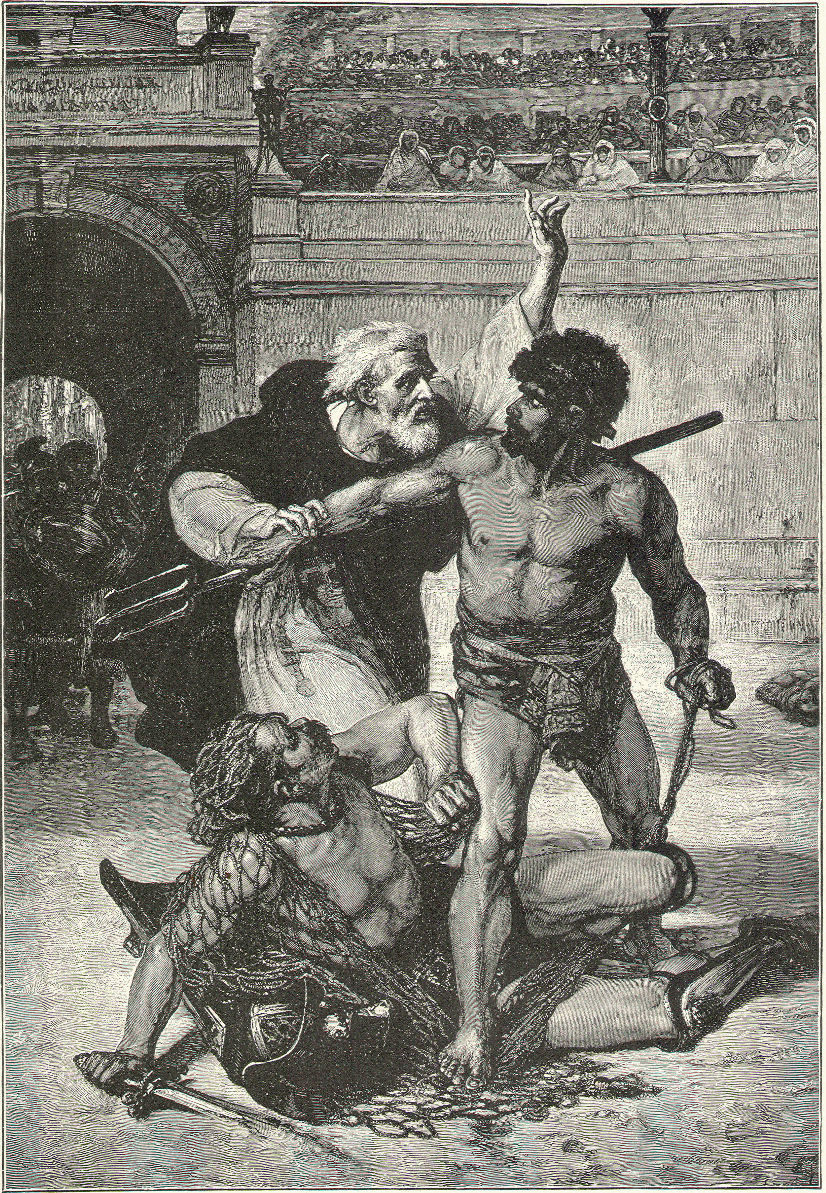
Foxes’ Book of Martyrs tells us the story of Telemachus, a Christian monk who, in 391 AD, went on a pilgrimage to Rome. While there he noticed crowds flocking to the Coliseum to see gladiators do battle. He followed them in, only to witness a sight that repulsed him.

Emperor Honorius was celebrating his triumph over the Goths. Gladiators armed with spears and swords reenacted the battle.  After their reenactment the bodies of the dead were dragged from the arena and its bloodied surface covered with a fresh layer of sand.

In came a new series of gladiators. Some were armed with swords and spears, others with nets. The crowd watched with excitement as they sought to outdo each other. When a gladiator was wounded, his opponent would loom over him, waiting for the crowds verdict on whether to slay him or let him live. So great was the bloodlust that at times wealthier spectators would climb down to get a better view of the execution.

Telemachus watched with horror as people died, battles raged and the crowds cheered. Prompted into action this bald headed, robed figure found his way onto the arena floor. He ran toward two gladiators locked in battle, grabbed one of them and pulled him away. He exhorted the two gladiators to abandon their murderous sport. He appealed to the crowd to not break God’s law by murdering.

The response was anything but favorable. Angry voices drowned out Telemachus’, demanding that the spectacle continue. The gladiators prepared to do battle again, but Telemachus stood between them, holding them apart, urging them to reconsider. Driven by the anger of the crowd and their rage at Telemachus’ interference, the gladiators cut Telemachus to the ground, as the crowd threw missiles at him. Telemachus was killed.

Legend holds that when the crowd saw the little monk lying dead in a pool of blood, they fell silent and then began leaving the stadium, one by one.  Because of Telemachus’ death, three days later, the Emperor by decree ended the Games.

In this brief history we can see the work of a saint, but what struck me today was the crowd.  Most, I would hope, were opposed to the violence of war and murder.  However, having entered into the arena they were swept up in the event.  They cheered on the violence and encouraged the murder of the innocent monk.  They voluntarily subjected themselves to witness these horrors, they engaged a temptation, and in the process became complicit in then sin.

In our Gospel reading today, Jesus makes several statements where he ups the standard, “You have heard that it was said to those of ancient times, `You shall not murder’… But I say to you that if you are angry with a brother or sister, you will be liable to judgment.”  He speaks in a similar manner with regard to adultery, lust, swearing and more.  Like the crowd in the arena, these are offenses that we voluntarily subject ourselves to.  We walk into them knowing full well what we are doing.  Someone might anger us, but they don’t cause that anger to swell into a rage.  I may see a pretty girl walking down the street, but she is not the cause of lust rising up in me.  However, like those in the crowd, when we engage with a temptation instead of immediately walking away, then we may fall into sin.

St. Josemaria Escriva put it this way, “Do not enter into dialogue with temptation.  Allow me to repeat: have the courage to run away and the moral strength not to dally with your weakness or wonder how far you can go.  Break off, with no concession!”

When temptations arise in your life, do not entertain them.  Do not consider the “what ifs.”  Immediately set the temptation aside, not giving it the slightest edge.  In this way we can all live holier lives.

Choosing Barabbas

GiveUsBarabbas

Now the chief priests and the elders persuaded the crowds to ask for Barabbas and to have Jesus killed.  The governor again said to them, “Which of the two do you want me to release for you?” And they said, “Barabbas.” – Matthew 27:20-21

There they are, side by side.  I can have either and the choice is mine.  Sure, I know good from evil (Genesis 3:22).  I know the “right” choice, but today I think I will choose Barabbas.  That’s who everyone else keeps shouting for.  Even the preacher said it!

“Barabbas!”

Why does that feel so wrong?  Why does it feel as though a piece of my soul just died?   Who is this man?

“Barabbas.”

This can’t be right.  I don’t even know this Barabbas.  What did this Jesus do?  Someone said that if he didn’t die that they would kill us all.  Don’t they know, we’re already dead.

“….”

“Father, forgive them; for they do not know what they are doing.” – Luke 23:34

Each day is a choice between Jesus and Barabbas.  Today you chose Barabbas.  There is tomorrow.

Never despair. Lazarus was dead and decaying: “iam foetet, quatriduanus set enim“–“by now he will smell; this is the fourth day,” Martha told Jesus.

If you hear the inspiration of God and follow it–“Lazare, vein foras!“–“Lazarus, come forth!”–you will return to life.

St. Josemaria Escriva – The Way #719 

Sermon: Presentation of Our Lord RCL A – “Killing Hornets”

images-18

In nature there are some epic battles that take place every day.  One such battle goes on between the Japanese honeybee and the Giant Japanese Hornet.  The Japanese Hornet is five times larger than the bee and is the world’s strongest predatory hornet.

When a Giant Japanese Hornet finds a honeybee nest it will kill a few honeybees and take them back to its nest to feed on it’s larvae. But then it returns, this time marking the honeybee hive with a scent. The scent attracts other hornets, and when two or three have arrived they begin to slaughter the honeybees at an extraordinary rate.  One such event records that 30,000 honeybees were killed by just 30 hornets in about three hours.

But the honeybees have developed a defense, and a defense that puzzled scientists for quite some time. You see, the honeybees can kill the hornets, but not in the way you might think – they don’t sting them to death. Instead, they do the opposite of what might be expected. They begin by doing all they can to annoy the hornet trying to mark its scent on their nest. Over 100 worker honeybees gather near the entrance to the nest, and then, when the hornet comes near, they lift and shake their abdomens in a peculiar dance. And the hornet finds this really aggravating. The bees then dive into their nest, and the steamed up hornet follows, intent to do some damage!

Unbeknown to the hornet 1000 worker bees are waiting for him just inside the entrance. When he gets close enough, around 500 of the honeybees jump on him, enclosing him in a ball of honeybees about the size of a clenched fist. They gather as close as they can to the hornet and start vibrating their muscles.  What happens? The vibrations cause the temperature to rise and rise and rise. In ten minutes or so the temperature’s up to 117 degrees.  Guess what temperature is too hot for a hornet to survive – 113 degrees; whereas the honeybees can function up to 120 degrees.  When the temperature of the ball of vibrating honeybees goes above 113 degrees the hornet dies and the honeybees survive.

r920817_9560133

That is a rather remarkable act of God’s creation, and it is a rather profound lesson for the church.  We as individual members of a church can go it alone, doing things our own way and in all likelihood, not only will we fail as individuals, but we may also fail corporately.  St. Josemaria Escriva put it a bit more bluntly, “Convince yourself, my child, that lack of unity within the Church is death.” (The Forge, #631)  However, if we choose to work as a body – recognizing that we are in fact “in this thing together” – then, although there may be difficult times, we will manage to overcome.  Please note, I’m not eluding to a Giant Japanese Hornet buzzing around at our front door.  I’m not referring to some observed problem existing within the church, but it is good for us all to remember that we are called to stand together in the mission of Christ’s one, holy, catholic, and apostolic Church.

Consider the words of the Psalmist today:

For one day in your courts 

     is better than a thousand in my own room,

and to stand at the threshold of the house of my God 

     than to dwell in the tents of the wicked.

“… to stand at the threshold of the house” – that passage can take several meanings: it can mean to be the doorman, or one of the masses just hoping to get a peek inside, or even a beggar, but each implies the same message, “I would rather be a nobody in the house of God, than a somebody outside of it.”  For us: “I would rather be a small and insignificant part of the Body of Christ, than not to be a part at all.”  And not only are we all a part of the Body of Christ, we need one another.

Paul teaches us in his first letter to the Corinthians, “just as the body is one and has many members, and all the members of the body, though many, are one body, so it is with Christ.  For in the one Spirit we were all baptized into one body—Jews or Greeks, slaves or free—and we were all made to drink of one Spirit.  Indeed, the body does not consist of one member but of many.”  He goes on to say, “If all were a single member, where would the body be?  As it is, there are many members, yet one body.  The eye cannot say to the hand, ‘I have no need of you,’ nor again the head to the feet, ‘I have no need of you.’”  We are the Body and we need one another.  To say, “I have no need of you,” to separate yourself from the body, from the church, is in a very real way excommunication, not as in an action that has been imposed on you, but as an action you have imposed on yourself.  In the end, not only does the individual suffer, but the body suffers as well.  We are the body of Christ, the church, and he is the head of the body.  “Christ is the head of the church, the body of which he is the Savior,” says Paul to the Ephesians; and the loss of any of its members brings harm to the church.

I’ll remind you again of those wonderful words of the Archbishop of Canterbury, Michael Ramsey, “The Church is not the society of those labeled virtuous.  It is the mixed community of sinners called to be saints.”  The church is anything but perfect; but it is far better within its embrace than it is outside.  Outside, the hornets can take us one by one, but together, within the spiritual walls of this place, we can defend one another and conquer our greatest enemies.

Today, following the Confession of Sin we will offer the Sacrament of Unction – of healing.  If you need healing in body, mind or soul, then I invite you to come forward to receive an anointing and the laying on of hands.  I also invite you to come forward to receive the same for the healing of any infirmity within the church, so that we might not only bring healing to our individual bodies, but to this Body of Christ as well.

Entering the Walls

Brick Wall

There was once when it actually worked…

On the seventh day, they got up at daybreak and marched around the city seven times in the same manner, except that on that day they circled the city seven times.  The seventh time around, when the priests sounded the trumpet blast, Joshua commanded the army, “Shout! For the Lord has given you the city! … When the trumpets sounded, the army shouted, and at the sound of the trumpet, when the men gave a loud shout, the wall collapsed; so everyone charged straight in, and they took the city. (Joshua 6:16-17, 20)

The God of the Old Testament is the God of the New Testament, but it is in His revealing in the New Testament that we find another way:

When Jesus entered Jerusalem… – Matthew 12:10

Jesus entered a house… – Mark 3:20

Jesus entered Jericho and was passing through. – Luke 19:1

I came from the Father and entered the world… – John 16:28

What I find curious is that we, as a Christian people, often try the way of the Israelites rather than the way of Jesus.  We wrongly believe that we can stand outside the wall, shout at the tops of our lungs, and the walls of the city will come tumbling down.

“You are sinning by _____!  (Book Chapter : verse – verse)”

“God said, ‘_____.’  (Book Chapter : verse)”  [Swing baseball bat.]

Yes, Jesus gave them a tongue lashing, flipped over some tables, and ran off a few opportunist, but mostly Jesus “entered.”  The world.  The city.  The house.  The Temple.  LIVES.  Jesus entered lives.  He sat down and ate a meal, had a conversation, touched, healed…  He revealed the Father – not by yelling and beating them with a baseball bat of Holy Scripture – but by entering in and revealing the Father that was within Himself. (John 14:9)  Instead of standing outside and yelling at the city walls, enter in and reveal Christ to it’s inhabitants.  It won’t mean that you are consorting with the enemy, compromising the faith, soiling your unblemished soul, apostatizing, etc.; it will mean that you are following Jesus and entering in.