Sermon: Proper 25 RCL B – “Questions”


The poet Robert Frost is reported to have said, “A jury consists of twelve persons chosen to decide who has the better lawyer.” With that in mind, I’ll let you judge if these lawyers won their case.

Q: “Now, Mrs. Johnson, how was your first marriage terminated?”
A: “By death.”
Q: “And by whose death was it terminated?”

Q: “Have you ever thought of committing involuntary manslaughter?”

Q: “Any suggestions as to what prevented this from being a murder trial instead of an attempted murder trial?”
A: “The victim lived.”

Q: What was the first thing your husband said to you when he woke up that morning?
A: He said, “Where am I, Cathy?”
Q: And why did that upset you?
A: My name is Susan.

Q: “Was it you or your younger brother who was killed in the war?”

Q: “Do you recall the time that you examined the body?”
A: “The autopsy started around 8:30 p.m..”
Q: “And Mr. Dennington was dead at the time?”
A: “No, he was sitting on the table wondering why I was doing an autopsy.”

When it comes to asking questions, preschoolers take the prize. They average 300-390 questions per day. By the time children are nine, that number drops to about 140. As adults, I suppose we think we know all the answers because we only ask 25-30 questions per day. 

Answers to some questions range from one word—yes/no—to entire volumes dedicated to a single answer. Other questions range from rhetorical to simple inquiries. For example, “Does Father John have a point?” Answer: Yes!

If you combine the texts of the New Testament, you’ll discover that Jesus asked a total of 307 questions. Today, he asked Bartimaeus, “What do you want me to do for you?” At other times, His questions become more difficult. “What are you looking for?” (John 1:38) “Why do you notice the splinter in your neighbor’s eye yet fail to see the wooden beam in your own eye?” (Matt 7:2) “Why are you terrified?” (Matt 8:26) “Why do you harbor evil thoughts?” (Matt 9:4) “Could you not watch for me one brief hour?” (Matt 26:40) “What are you thinking in your hearts?” (Luke 5:22) “What are you discussing as you walk along?” (Luke 24:17) Each of those is asked in a particular context, but even alone, in the context of our faith, they are good questions and not always so easy to answer.

On the other side, Jesus was asked 183 questions. Care to guess how many He answered? Three. You should think about that the next time someone seems to have all the answers.

Jesus asks us questions, and we ask Jesus questions, but I suspect that most of our questions fall in the category of requests for favors or healing. However, at the root of all we are asking, perhaps even subconsciously, is a more important question, and it is the same question we heard a few weeks ago in our Gospel reading—“Good Teacher, what must I do to inherit eternal life?” Even our craziest requests come back to this. “Jesus, will you help me pick the right numbers to win the lottery?” That sounds materialistic on the surface, but below the surface, it is a request for stability, fulfillment, the meeting of needs, and so on, all of which will be given on the last day—eternal life with God.

Jesus said, “Truly, truly, I say to you, whoever hears my word and believes him who sent me has eternal life. He does not come into judgment, but has passed from death to life.” Jesus also said, “All authority in heaven and on earth has been given to me. Go therefore and make disciples of all nations, baptizing them in the name of the Father and of the Son and of the Holy Spirit, teaching them to observe all that I have commanded you.”

So, we have a question that is being asked by believers and unbelievers,  “What must I do to inherit eternal life?” Fortunately, we have the answer: faith in the Son of God, Jesus. And we have a command: “Go and share this Good News. 

The Church has many secondary missions, but this going and proclaiming the Good News—that is, proclaiming the cross, the death and resurrection of Jesus, repentance, the forgiveness of sins, and eternal life, all of which can be summed up in those few words, “For God so loved the world”—this going and proclaiming the Good News far outweighs all the secondary missions/ministries combined, but… and there it is… we can preach by words all day long, yet, unless we also proclaim the Good News through those secondary missions/ministries, through our actions, then the message goes largely unheard.

You know the Scripture: “What good is it, my brothers and sisters, if someone says he has faith but does not have works? Can that faith save him? If a brother or sister is poorly clothed and lacking in daily food, and one of you says to them, ‘Go in peace, be warmed and filled,’ without giving them the things needed for the body, what good is that? So also faith by itself, if it does not have works, is dead.” (James 2:14-17)

Bottom line: we, the Church, must proclaim the Good News of Jesus Christ by word and deed. We can all agree on this, but there is a catch. To those who receive what we are offering, there is no charge. There is no cost for the message we share, and we do not charge for the works we perform; however, for us—the Church—the act of proclaiming by word and deed is not free.

I have joked with you about the two ways I can make you most uncomfortable. The first is for me to be silent. Silence makes us crazy. It shouldn’t, but it does. The second way I can make you uncomfortable and perhaps even have you tune me out is to talk about money and giving. Over the course of the last ten years, I’ve spoken to you many times about the need for silence in our lives, but I can count on one hand the number of times I’ve talked to you about money and giving. You have always been so generous with your gifts and pledges to the Church, and we are a financially healthy church, so I’ve never seen the need. Today, you are still as generous as always, and we are still a financially healthy church. That hasn’t changed. However, the needs of the world around us have, and they are greater than ever, and every indication is that it will only get worse. And it is to this world that we must proclaim through word and deed.

Not everyone has the gifts to proclaim by word, and many times, those who can proclaim by their deeds and actions are out working to provide for their own needs and the needs of their families. However, the Church is uniquely positioned to do both, but not without your financial assistance. 

Our Presiding Bishop (for one more week), Michael Curry, is fond of saying we are the Episcopal Branch of the Jesus Movement. So, St. Matthew’s is the Episcopal Branch of the Jesus Movement in Enid, Oklahoma. Through our individual actions, we can do much, but through our collective actions, we have made and are making a considerable difference in our community. We feed people experiencing poverty, pay for student meals at the local schools, put books in the hands of children through our partnership with the Enid Public Library and the Dolly Parton Imagination Library, help build soccer complexes and tennis facilities that provide healthy activities for the youth of our community, and so much more. In addition, this year, we’re hoping to add the 5% Mission Tithe back into the budget so that our reach and proclamation of the Good News of Jesus Christ can be even greater. I don’t get really excited about asking you to help us pay the electric bill, but the ability to fulfill so many opportunities, to help so many individuals and organizations, and to proclaim the Good News in creative ways gets me going. However… we need your giving to help do these things. 

Speaking through the Prophet Malachi, the Lord says, “Bring the full tithe into the storehouse, that there may be food in my house. And thereby put me to the test, says the Lord of hosts, if I will not open the windows of heaven for you and pour down for you a blessing until there is no more need.”

I am not preaching prosperity Gospel here; that is heresy, but the Lord says, “Test me on this. Bring your tithe into the church and watch what happens.” 

Yes. This is the beginning of our annual pledge drive. Yes. You are going to hear more about giving, pledging, and tithing. Yes. You can tune it all out, but… don’t. Giving our time, talents, and treasures is as much a spiritual discipline as praying and worshipping. So, I ask you to read through the information that will be provided over the next week, then, next week, prayerfully consider and make your 2025 pledge. Together, in our community and maybe even further, we will proclaim the Good News and answer the question, “What must I do to inherit eternal life?”

Let us pray: Gracious Father, the owner of all things, we pause in reverence, acknowledging that everything we possess ultimately belongs to you. We open our hearts to the profound reality that we are only temporary stewards of your eternal treasures. Help us to embrace the responsibility and privilege of managing your blessings with diligence and integrity. Amen.

Sermon: Thérèse of Lisieux


I have some excellent yard maintenance skills. Except for a few shrubs, if it is green and grows in my yard… hit it with Roundup. It’s not that I don’t enjoy having flowers; I do, but I don’t want to waste money on plants that are going to die because I know that I’m not going to take care of them. I just really don’t enjoy working in the yard. However, back when the cousin lived in Enid, the yard had all kinds of flowers, and if I planted something, she would take care of it.

Of the few flowers I planted, the one I cherished the most was my John Paul II memorial rose. It was a glorious luminescent white when it bloomed. When that happened, a hundred different types of flowers could be blooming all around it, but that rose would be the only one I noticed.  

Have you heard of the Saint we celebrate today, Thérèse of Lisieux, also known as the Little Flower of Jesus? Most say yes. She is often considered one of the greatest modern Saints, having died on October 1, 1897. We read her autobiography, Story of a Soul, for one of our Saints Book Club selections. She is a very “popular” saint. Do you know anything about Verissimus, Maxima, and Julia, or have you even heard of them? No? They are also Saints who share the same feast day as Thérèse—October 1st. All three were martyred in Lisbon, Portugal, under Emperor Diocletian’s persecution in 305 A.D. 

When we consider them all together, Thérèse of Lisieux is the St. John Paul II memorial rose, while Verissimus, Maxima, and Julia are seen as little Lantanas or Impatiens. 

Thérèse looked at things differently. She writes, “Jesus set before me the book of nature. I understand how all the flowers God has created are beautiful, how the splendor of the rose and the whiteness of the lily do not take away the perfume of the violet or the delightful simplicity of the daisy. I understand that if all flowers wanted to be roses, nature would lose her springtime beauty, and the fields would no longer be decked out with little wildflowers. So it is in the world of souls, Jesus’ garden. He has created smaller ones, and those must be content to be daisies or violets destined to give joy to God’s glances when He looks down at His feet. Perfection consists in doing His will, in being what He wills us to be.”

There are “big” Saints, and there are “little” Saints, but in the eyes of God, they are all Saints. All—whether we recognize their names or not—have submitted to the will of God and fulfilled His purposes; therefore, they reveal His glory in the world. So, if those are the Saints living their eternal lives in Jesus’ garden, where are we? Are we getting hit with the Roundup, or are we also in that garden? Are we those whom God looks lovingly upon as He passes by? You may not always believe it, but you are in that garden. You are one in whom Christ delights.

In our reading from Colossians, Paul said to us, “Set your minds on things that are above, not on things that are on earth, for you have died, and your life is hidden with Christ in God. When Christ who is your life is revealed, then you also will be revealed with him in glory.” (Colossians 3:4)

We may not always believe that we are worthy of being placed in Jesus’ garden with the likes of Thérèse, Verissimus, Maxima, and Julia, and, in our own right, we are not. However, by setting our hearts and minds on Jesus, as all the Saint have done, it is Jesus and His glory that will be revealed in us—that will bloom in us and make us worthy “to share in the inheritance of the saints in light.” (Colossians 1:12) 

Sermon: Proper 20 RCL B – “Corruption”


Part of the time I was in college, I worked at a kennel. During the week, we would be about half full, but on the weekend, the place was usually booked up—200+ dogs, 20 cats, and the occasional bird, snake, lizard, or other family pet. It could be interesting and loud (part of the reason I say, “Huh,” so much.) 

There’s quite a bit to do when caring for so many animals, but there are also times when not much happening—even the dogs like an afternoon nap. However, the owner of the place was not big on employees just sitting about, so he was always good at finding something for us to do. On one occasion, he decided that a two-story house on the property needed to be painted, and the job fell on me. I can paint, so no problem, but before I could get at it, I had to remove the thick vines that had grown and covered one entire side of the house. 

I worked the lower levels with no problem, then hauled out the ladder and started on the upper level. It was in the middle of summer in Texas, and it was hot, dirty work, so I had peeled off my shirt, so I’m about fifteen feet up, wearing a pair of shorts and sneakers. This is when I yank on one particular vine, which erupts in a horde of yellow jackets. In my humble opinion, the yellow jacket is not one of God’s creations. It is of the devil, for sure. 

I make it about three feet down the ladder before I get stung.

That little yellow cuss got me on top of the head, so I reached up to swat it—and this is where the real satanic powers of the yellow jacket kick in; unlike a honey bee, a yellow jacket can sting you as many times as it likes. So, when I swat it off my head, it stings me on the hand. When it stings me on the hand, I slap it to my chest, hoping to be rid of it, and, yes, it stung me on the chest. I’ve no idea how I managed not to fall the remaining twelve feet off the ladder. 

I’ve had kidney stones, but I’m pretty sure those three stings were more painful. The pain is absolutely excruciating and all-encompassing. As many of you know, when a yellow jacket stings, you don’t just feel it at the site of the sting; your entire body is jolted, as with an intense electrical shock that courses all the way through. 

St. Augustine (he died in the year 430) had a young friend and student, Alypius. Alypius had gone to Rome to study and attempted to keep himself from falling into traps on the seedier side of the great city, so he stayed away from many of the events, including the battles of the gladiators in the Colosseum. However, one day, his friends dragged him there. Alypius said to them, “You may drag me there bodily, but do you imagine that you can make me watch the show and give my mind to it?”

As if to prove they could, they hauled him in. The entire time, Alypius kept his eyes tightly closed, never peaking. However, a battle took place, and at one point, a great cry arose from the onlookers. It was too much. Augustine reports, “So Alypius opened his eyes, and his soul was stabbed with a wound more deadly than any which the gladiator, whom he was so anxious to see, had received in his body. He fell, and fell more pitifully than the man whose fall had drawn that roar of excitement from the crowd. The din had pierced his ears and forced him to open his eyes, laying his soul open to receive the wound which struck it down.

“When he saw the blood, it was as though he had drunk a deep draught of savage passion. Instead of turning away, he fixed his eyes upon the scene and drank in all its frenzy, unaware of what he was doing. He reveled in the wickedness of the fighting and was drunk with the fascination of bloodshed. He was no longer the man who had come to the arena, but simply one of the crowd which he had joined, a fit companion for the friends who had brought him.” (Confessions, VI.8)

The yellow jacket sting is all-encompassing, but after a short time, the pain subsides. When, like Alypius, we open ourselves, our eyes, and our bodies to sin, that “sting” is also all-encompassing, but the effects do not subside. Not only that, but the “sting” of sin infects and corrupts the body and the soul. Like Alypius, once infected, we want more. We get caught up in the madness that is so satisfying for a moment but will eventually kill us if we do not repent.

Matthew, Chapter Five is the beginning of the Sermon on the Mount. It starts with the Beatitudes—blessed are the meek, blessed are the merciful, blessed are the peacemakers—and then continues with a litany of teachings on anger, lust, retaliation, and enemies. While speaking on lust, Jesus says something quite startling, “If your right eye causes you to sin, tear it out and throw it away. For it is better that you lose one of your members than that your whole body be thrown into hell. And if your right hand causes you to sin, cut it off and throw it away. For it is better that you lose one of your members than that your whole body go into hell.” (Matthew 5:29-30)

Now, we know that Jesus does not intend for us to pluck out an eye or cut off our hands. These are deliberate exaggerations, but they are exaggerations that describe how ruthlessly we are to deal with our sins. No dabbling. Sinning a little bit is like being a little bit pregnant. No negotiations. I’ve shared it with you before: if you dance with the devil, the devil doesn’t change. The devil changes you. Be rid of it. Why? Because once you open your eyes to evil, once you touch that which should not be touched, once you begin to sin, it is all-encompassing.

You may have noticed that all this month, our New Testament lesson has been from the Epistle of James. He frequently speaks of this idea of the beginning of sin leading to all-encompassing sin.

In chapter two, James, speaking of the Mosaic Law, says, “You do well if you really fulfill the royal law according to the scripture, ‘You shall love your neighbor as yourself. But if you show partiality, you commit sin and are convicted by the law as transgressors. For whoever keeps the whole law but fails in one point has become accountable for all of it.” (James 2:8-10) It starts small, showing partiality, but it leads to a complete abandonment of all the Law.

Further on, he writes, “How great a forest is set ablaze by a small fire! And the tongue is a fire. The tongue is placed among our members as a world of iniquity; it stains the whole body, sets on fire the cycle of nature, and is itself set on fire by hell.” (James 3:5b-6) How many relationships, be they between individuals, families, friends, and even nations, have been utterly ruined by the tongue? By hurtful words? James is saying, don’t let it start. Don’t give that sin a single spark; it may bring everything down.

We heard today, “Those conflicts and disputes among you, where do they come from? Do they not come from your cravings that are at war within you? You want something and do not have it; so you commit murder. And you covet something and cannot obtain it; so you engage in disputes and conflicts.” (James 4)1-2a) Look at the wars in the world. What brings them on? Peoples or governments wanting what belongs to another. Whether it be land or oil or bragging rights. The same can happen to us if we seek to take what others have.

What is the solution? How can we work to avoid the “sting” of sin and the all-encompassing pain that begins with a single stick but consumes body and soul? Jesus’ exaggeration of plucking out an eye or cutting off a hand is defined for us in the words we heard from James this morning: “Submit yourselves therefore to God. Resist the devil, and he will flee from you. Draw near to God, and he will draw near to you.” (James 4:7-8)

Jesus said, “The light has come into the world, and people loved the darkness rather than the light because their works were evil. For everyone who does wicked things hates the light and does not come to the light, lest his works should be exposed. But whoever does what is true comes to the light, so that it may be clearly seen that his works have been carried out in God.” (John 3:19-21)

We work at overcoming sin by resisting the works of darkness and the devil. Therefore, come into the Light and draw near to God, and the Light of God will draw near to you and embrace you. 

“‘O death, where is your victory?
    O death, where is your sting?’

The sting of death is sin, and the power of sin is the law. But thanks be to God, who gives us the victory through our Lord Jesus Christ.” (1 Corinthians 15:55-57) Amen.

Let us pray: Holy Michael, the Archangel, defend us in battle. Be our safeguard against the wickedness and snares of the devil. May God rebuke him, we humbly pray; and do you, O Prince of the heavenly host, by the power of God, cast into hell Satan and all the evil spirits who wander through the world seeking the ruin of souls. Amen.

Sermon: Proper 14 RCL B – “Miracles”

Photo by Shubhendu Mohanty on Unsplash

A guy is cycling through the country when he spots a sign that reads, “Talking Horse for Sale.” Intrigued, he goes to the stable to check it out. Not expecting much, he walks up to the horse and asks. “So, what have you done with your life?”

“I’ve led a full life,” the horse miraculously answers in a deep voice. “I was born in The Andes, where I herded for an entire village. Years later, I joined the mounted police force in New York and helped keep the city clean. And now, I spend my days giving free rides to underprivileged kids here in the country.”

The guy is flabbergasted. He turns to the horse’s owner and says, “This horse is a bonafide miracle! Why on earth would you want to get rid of such an incredible animal?”

The owner says, “Because he’s a liar! He never did any of that!”

“There are only two ways to live your life. One is as though nothing is a miracle. The other is as though everything is a miracle.” Albert Einstein

Are you a believer in miracles? Let’s find out. Take your red Book of Common Prayer and turn to page 461. What does it say at the bottom, next to the page number? “Ministration to the Sick.” Turn the page. Page 462. What does it say next to the page number? “At Time of Death.” Page 467. “At Time of Death.” And turn the page one more time. Page 468. What does it say? “Burial I.” If you believe in miracles, don’t you think at least one page between pages 467 and 468 is missing? One that says next to the page number, “Raising the Dead.” I’ve probably told you that before, probably about the same time I told you about the time there was a devastating drought in a farming community, so the town entire town gathered in a field to pray for rain, but only one little girl showed up with an umbrella. 

Perhaps the biggest problem is that we believe in miracles but don’t really believe they happen. We doubt. So, today, I’m going to ask you to set aside any doubt you might have for just a short time and believe that miracles do happen, in particular,  as they pertain to the Holy Eucharist, the bread and the wine, the Body and the Blood—the Blessed Sacrament. 

Garabandal is a small village in northern Spain and the site of a Marian apparition to four children. One of the girls, Conchita, was told by an angel that on July 18, 1962, he would give her communion from Heaven. There is a very grainy film of the event, but many witnesses. Conchita was kneeling, with her tongue out to receive as she would from a priest. Nothing was on her tongue. Then, the next moment, a host—the bread—appeared. She held it on her tongue for several minutes so that all could see. Miracle or sleight of hand—or tongue? You can pull that one up on the internet and see the film.

There are three very well-documented occurrences—and many other similar events—where the host (the bread) was found to be bleeding. According to the reports, these were medically examined, and it was shown that not only was it blood on the host, but that the host, in two of those cases, was cardiac tissue from the heart’s interior. In each case, the blood, some of which had not coagulated, even after an extended period of time, was found to be AB+. Just for fun, would you like to take a guess as to the blood type found on the Shroud of Turin? 

Some might just mark all this up as an ecclesiastical conspiracy theory, but remember, we’re setting aside our doubt for a short period and believing miracles really do occur. 

Last week, we discussed the various understandings of what happens with the bread and wine during the Eucharist. There was memorialism, consubstantiation, and transubstantiation. With memorialism, we said that the bread and wine remain bread and wine—nothing happens. In consubstantiation, the bread and wine truly become the Body and the Blood, but they maintain the outward appearance of bread and wine. And with transubstantiation, the bread and wine truly become the Body and Blood, and, regardless of appearance, are flesh and blood. 

You’ll also recall that when the bread and wine have been consecrated, they can be reserved in the Tabernacle. Our Tabernacle is the small cabinet under the red lamp. And some—myself included—believe it contains the Real Presence of Jesus. It is why we bow whenever we come before it.

In October 1995, St. John Paul II visited Baltimore. At one point during the visit, the Pope made a quick schedule change (I suppose being the Pope allows you to do that sort of thing.) Father Arthur Byrne wrote a brief article for the Garabandal Journal.

“On the evening of the last day of his October 1995 visit to the United States, John Paul II was scheduled to greet the seminarians at Saint Mary’s Seminary in Baltimore. It had been a very full day that began with a Mass at Oriole Park in Camden Yards, a parade through downtown streets, a visit to the Basilica of the Assumption, the first cathedral in the country, lunch at a local soup kitchen run by Catholic Charities; a prayer service at the Cathedral of Mary Our Queen in North Baltimore; and finally a quick stop at Saint Mary’s Seminary.

The schedule was tight, so the plan was simply to greet the seminarians while they stood outside on the steps. But the Pope made his way through their ranks and into the building. His plan was to first make a visit to the Blessed Sacrament [reserved in the Tabernacle in the chapel].

When his wishes were made known, security flew into action. They swept the building paying close attention to the chapel where the Pope would be praying. For this purpose, highly trained dogs were used to detect any person who might be present.

The dogs are trained to locate survivors in collapsed buildings after earthquakes and other disasters. These highly intelligent and eager dogs quickly went through the halls, offices, and classrooms and were then sent to the chapel. They went up and down the aisle, past the pews, and finally into the side chapel where the Blessed Sacrament is reserved.

Upon reaching the Tabernacle, the dogs sniffed, whined, pointed, and refused to leave, their attention riveted on the Tabernacle until called by their handlers. They were convinced that they discovered someone there.”

Did those dogs sense the Real Presence of Jesus in the Tabernacle, or had they gotten their wires crossed? You can pull up the pictures of the event on the internet. The internet doesn’t lie, after all.

Now, set aside your doubts for just a few more minutes. Jesus said, “I am the living bread that came down from heaven. Whoever eats of this bread will live forever; and the bread that I will give for the life of the world is my flesh.” 

“The bread that I will give for the life of the world is my flesh.” Setting your doubts aside… what if He meant it? What if each Sunday we come into this place where we worship and pray and then, right up there on the altar, witness a bonafide miracle? A miracle that at its very heart is our God saying to us, “I desire to become a part of you. A part of you spiritually, yes, but more importantly, a part of you physically, that we may be one.”  

What if the words we speak during the Eucharistic Prayer aren’t just part of some ritual but are, in fact, Heaven—Jesus—breaking into this world?  What if, when you come forward to receive communion, God is truly present—truly there, giving Himself to you? What if, when you receive Him in the Eucharist, He truly, physically becomes a part of you? Finally, if all those “what ifs” are true, then what are the implications for your life? 

Eight days following the resurrection, Jesus appeared to his disciples in the upper room, and “Thomas was with them. Although the doors were locked, Jesus came and stood among them and said, “Peace be with you.” Then he said to Thomas, “Put your finger here, and see my hands; and put out your hand, and place it in my side. Do not disbelieve—do not doubt—but believe.” I say to you, like Thomas when you put out your hands, you will touch Jesus. Do not disbelieve but believe.

Let us pray: Lord Jesus Christ, Son of the living God, Who, by the will of the Father, with the cooperation of the Holy Spirit, have by Your death given life to the world, deliver us by this Your Most Sacred Body and Blood from all our sins and from every evil. Make us always cling to Your commandments, and never permit us to be separated from You. Who with the same God the Father and the Holy Spirit, live and reign, world without end. Amen.

Sermon: Proper 12 RCL B – “The Boat”

Photo by Mickey O’neil on Unsplash

The report states that on Lake Isabella, in California, a couple were new to sailing. I’ve done a little sailing in the past and know that it requires a bit of instruction before you get out there on your own; however, with only a few hours, the couple purchased themselves a brand new 22-foot sailboat, invited friends, and headed out. Nothing went right. No matter how hard they tried, they couldn’t get the boat going. It was very sluggish in almost every maneuver, no matter how much wind was blowing or power they applied through the inboard motor. After about an hour of trying to make it go, they put into a nearby marina, thinking someone there could tell them what was wrong. A thorough topside check revealed everything was in perfect working condition. So, one of the marina guys jumped in the water to check underneath to see if perhaps the keel was not properly deployed or damaged. He came up choking on water, he was laughing so hard. Under the boat, still strapped securely in place, was the boat trailer! There was no problem with the boat. It was all operator error.

This is reportedly an urban legend, but a fella in Oregon says it really happened. The only difference, he didn’t have to get in the water. He could see the trailer’s license plate sticking up.

My friend St. Josemaría Escrivá wrote, “I never talk politics. I do not approve of committed Christians in the world forming a political-religious movement. That would be madness, even if it were motivated by a desire to spread the spirit of Christ in all the activities of men.” (Christ is Passing By, #153)

I happen to agree with that 100%. After almost a decade of preaching in this church, you may have noticed that I don’t fly anyone’s flag. If we were to fly a flag in this sanctuary, the only thing it would say is “Sinners in the hands of a Loving God,” because once you strip away all the rest, that is all that remains. As the Church and a Christian people, that is what we should be most concerned about. So today, I’m not planning on breaking my rule, but I would like to address how we engage in that realm of politics and what I believe the role of Christianity and the Church should be. If you all walk away unhappy with what I say, then I’ll feel like I did my job.

It begins by understanding truth. Is there such a thing as an ultimate truth? Yes. I’m sure some of you cross your fingers at specific points, but we speak what we believe as the ultimate truth when we confess our faith in the Creeds—“We believe in one God, the Father, the Almighty….” However, for many, the ultimate truth does not end there. We have what we believe are ultimate truths about everything from the abhorrent abomination of mint chocolate ice cream to questions of sexuality, end-of-life issues (euthanasia, assisted suicide, aging), immigration and refugees, the war in Ukraine, Israel, or Africa, etc.

The point is that we have the truth of our Creed, and then we have these other truths, which are often opinions or personal truths. This then leads to a great deal of the current strife we experience—if it is true for me, whether you agree with it or not, then it must unequivocally be true for you. If you disagree with me, which in many cases is the opinion or personal truth of the majority, you are a terrible person. When you say, “I’m going to remain silent,” well, then you are an evil person. This is also where Christianity comes in because Christians love this—someone will haul out the quote from Dietrich Bonhoeffer (even though he never said it): “Silence in the face of evil is itself evil: God will not hold us guiltless. Not to speak is to speak. Not to act is to act.” Therefore, if I speak an opinion or personal truth and you either a) disagree or b) do not stand up in support of my personal truth, then you’re going to hell. I say abortion is evil. You say that not supporting women’s rights is evil. Some choose to remain silent, so we both say they are evil. Ultimately, by calling someone evil, we are saying that God is on our side and we are the righteous. It is this arrogance that leads to heresies like the one we see on the rise today—Christian nationalism.

One of the great contemporary Anglican theologians, N.T. Wright states, “Christian nationalism is impoverished as it seeks a kingdom without a cross. It pursues a victory without mercy. It acclaims God’s love of power rather than the power of God’s love.” He then references our Gospel reading for today when he writes, “We must remember that Jesus refused those who wanted to ‘make him king’ by force just as much as he refused to become king by calling upon ‘twelve legions of angels.’ Jesus needs no army, arms, or armoured cavalry to bring about the kingdom of God. As such, we should resist Christian nationalism as giving a Christian facade to nakedly political, ethnocentric and impious ventures.”

Someone or some group begins to believe that they know the absolute truth, so they demand that this truth be not only believed by everyone but legislated and imposed on everyone. To make their case even more potent, they break the Second Commandment by taking the Lord’s Name in vain, claiming God is on their side. 

In the end, if we continue on this course, we will successfully destroy the nation and, worse, the Church. It is the hard lesson the German Lutherans learned as the Nazis began to rise to power—Christianity and government do not go together. It is why Jesus fled when they tried to make Him king. As the state is on the rise, it will make certain concessions to the Church to gain support; however, once the state has full power, it will expect the Church to make concessions to it, ultimately bringing the Church to a point where it will either compromise the Faith or be persecuted by the state they helped to build. You may be thinking, “Father John, you’ve been reading too many dystopian novels.” Maybe, but that’s not where this line of thought originates. It is coming from history. When the Church gets into bed with the state, it is always the Church that ends up getting short-sheeted.

Enough of that. What’s the point? If this is a problem, then what is the solution? 

The short version of a popular quote, generally attributed to G.K Chesterton, “We are all in the same boat.” The long version of that quote is, “We are all in the same boat in a stormy sea, and we owe each other a terrible loyalty.” However, today, it is popular to say, “We are all in the same storm but not the same boat.” It is then explained that some are in a little dingy without a paddle, others are on super yachts, and others ride around in aircraft carriers. At first, this appears to be a valid point, but it is also a lie. We are all in the same boat, but we’ve forgotten what Chesterton said, “We owe each other a terrible loyalty.” There is nothing wrong with the boat we are in, but someone forgot to detach the trailer. Our boat is good, but operator error is wreaking havoc, and we are the operator.

Whether in the Church or society, it is true (not opinion!), “The eye cannot say to the hand, ‘I don’t need you!’ And the head cannot say to the feet, ‘I don’t need you!’” (1 Corinthians 12:21) Our boat is fine, but so many seem to be under the impression that they’re the only ones in it. 

The storm on the rough waters has always been interpreted as life, and the boat has always represented the Church and our faith. The fantastic thing about that boat is that it has always accommodated and made room for everyone, including those who aren’t even Christian. Why? Because this boat is not of our making. It is of God’s making, and there is not a single person—not one—that our God desires to perish. Every person we allow in is a way of allowing Jesus in. You might not like them, you may disagree with everything they say, you may not want anything to do with them, but let them in the boat. Let Jesus in the boat. They are a child of God and you owe them a terrible loyalty. 

When the disciples saw Jesus walking on the water, they were terrified. Jesus said to them, “It is I; do not be afraid.” Some who walk up to the boat may be so different from us that we become afraid, but Jesus says the same thing to us, “Do not be afraid. Let them on the boat and we will all get safely to the other side.”

Let us pray: Lord Jesus, Son of God, our brother and our savior, we give you glory. Protect your Church and make us one. Send your Spirit to guide us and to lead us back to unity and love. Lord Jesus, we praise your holy name forever. Amen.

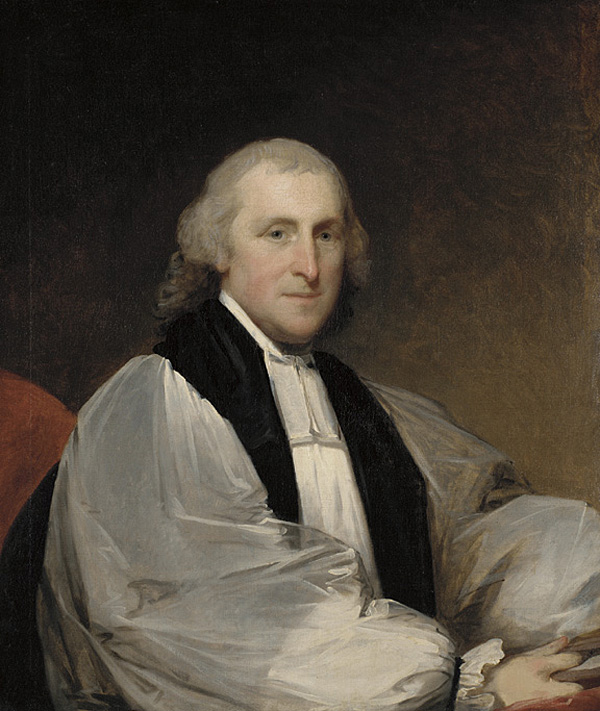
Sermon: William White


The first Holy Communion of the Church of England was held in 1607 in Jamestown, Virginia.  It was a slow start, but the church began to take hold and was quite successful; however, because of its ties to England, that changed following America’s independence.  According to Powell Mills Dawley in Our Christian Heritage, “the American Revolution left the Anglican parishes shattered, stripped of most of their financial support, weakened by the flight of many clergy and thousands of members, with a number of buildings destroyed and property lost.”

Not only did the citizens of the new United States abandon the church, but in a very real sense, the Church of England did as well.  The primary issue was that we had no American Bishops.  As you know, a Bishop is required to Confirm, ordain clergy, and it takes three Bishops to consecrate a new Bishop.  Therefore, if a person wanted to be ordained a priest, they had to make the long and perilous trip to England.

To remedy the situation, a few devoted men took up the cause.  Among them were Samuel Seabury, Samuel Provoost, the person we celebrate today, William White, and James Madison – all four of which made the journey to England to be consecrated.  Then, having enough American Bishops, Thomas Clagget was consecrated Bishop in New York, and the Church in America could function separately from the Church of England.  In 1789 – the first General Convention – under these men’s leadership, specifically William White, the American Episcopal Church was fully organized. 

William White served as our first and fourth presiding Bishop in 1789 and from 1795 to 1836.  In addition, he served for 57 years as the rector of St. Peter and Christ Church in Philadelphia.  He died in 1836.

A lengthy obituary devoted to Bishop White appeared in the National Gazette and Literary Register.  In part, it described his character, “…[T]he duties of the several important relations in which he stood to society were performed with undeviating correctness and suavity; he possessed the rare merit of winning the respect and love of an entire community to which he was an ornament and a blessing. His piety was deep and unfeigned; his walking humble yet dignified; his acquirements profound; in his mind the welfare of the Christian church was always the prominent consideration…He was one of those examples of steady virtue sent upon earth by Divine Providence, as if to prove how near the great pattern of perfection it is permitted to approach.”

In our Gospel reading today, Jesus asked St. Peter, “Simon, son of John, do you love me more than these?” He said to him, “Yes, Lord; you know that I love you.” Jesus said to him, “Feed my lambs.”  This was the restoration of St. Peter after he denied Jesus three times the night before Jesus was crucified.  It is also a command given to all who would be followers of Jesus – “Feed my sheep.”  In those three words, God calls us all, lay and ordained, to care for those we encounter.  To care for them in both their physical and spiritual needs.  For us in the Episcopal Church, William White is an exemplary role model for us to emulate.  When you consider what it means to be true and faithful to the Church, you need only consider him to find the “great pattern of perfection” that leads to becoming a faithful servant to God and His One Holy Catholic and Apostolic Church. 

Sermon: Great Vigil

Photo by zhang kaiyv on Unsplash

The words of the Exsultet, “This is the night, when…”

This is the night when the Church attempts to read all of Holy Scripture in one sitting.

This is the night when the choir and organist threaten to go on strike if I add one more piece of music.

This is the night when the parish administrator double-dog dares me to make one more change to the bulletin.

This is the night when the congregation asks, “Are we there yet?”

This is the night, the eve of our salvation when we enter into the darkness of the tomb and create a spark that becomes a flame that sets the whole world ablaze with the Light of Christ.  

This is the night when we baptize Nolan, and Crawford receives his first communion.

From the song, December, 1963, by Frankie Valli and the Four Seasons, “O, what a night!”

Of all the liturgies throughout the church year, this is the highest and most grand. It is the culmination of all the other days and festivals, from the Incarnation to the Transfiguration to Good Friday to Easter. On this night, we remember all that God has done for His people, we give thanks for what He has done for us, and we celebrate the bringing into the Kingdom those new members who receive the cleansing that comes through Baptism and the participation of others in Christ’s body by becoming one with Jesus through receiving the Holy Sacrament. O, what a night.

Tonight is a reminder that we are not alone in this world. It is a reminder that the Church Triumphant—those who have gone before us—and the Chruch Militant—we today—are bound together in love through baptism into Christ’s death and resurrection. That through Jesus’ giving of Himself, we truly become one with Him and each other.

I will not be long-winded tonight because everything you see and hear is a sermon. So, I’ll encourage you to be one in Christ Jesus. So many things seek to divide us, but the bonds of love are stronger than any of these, and the only way those bonds can be severed is if we intentionally cut them ourselves. 

You are Christ’s one holy catholic and apostolic Church. Let us receive Nolan into our family through her baptism and then participate with Crawford in his first communion. O, what a night.

“The candidate for Holy Baptism will now be presented.” BCP p.301.

Sermon: Lent 4 RCL B – “Into the Light”

Photo by Matthew Henry on Unsplash

Ol’ Boudreaux had been out carousing all night, so he decided it might be best to go to confession before going home to Clotile. It had been many years since his last confession, so he was a bit surprised when he stepped into the confessional. On one wall was a fully stocked bar with Guinness on tap. A dazzling array of the finest cigars and chocolates was on the other wall. Boudreaux here’s the priest come in on the other side and says, “Father, forgive me, for it’s been a very long time since I’ve been to confession, but I must admit that the confessional box is much more inviting than it used to be.”

The priest responds, “Get out! You’re on my side.”

The Israelites had been set free from their bondage in Egypt, and they passed through the parted waters of the Red Sea, but through their sin, they ended up wandering around for forty years. At one point, they came to Mount Hor, about forty miles south of the Dead Sea. As it was difficult in the land, they again complained against the Lord, so the Lord sent the serpents to punish them. Many died from being bitten by the poisonous snakes. When the people came to their senses, they confessed to Moses—“We have sinned by speaking against the Lord and against you; pray to the Lord to take away the serpents from us.” The Lord heard their cries for mercy, so He said to Moses, “‘Make a poisonous serpent, and set it on a pole; and everyone who is bitten shall look at it and live.’” So Moses made a serpent of bronze, and put it upon a pole; and whenever a serpent bit someone, that person would look at the serpent of bronze and live.” They named the bronze snake Nehushtan, and later in Israel’s history, they’ll turn it into a god and worship it, but that’s for another day. In today’s lesson, the people sinned, and death entered in the form of the serpents. When the people confessed their sins, the Lord provided a way for them to live—look upon the serpent that has been raised up, and you will live.

In our Gospel reading this morning, Jesus said, “Just as Moses lifted up the serpent in the wilderness, so must the Son of Man be lifted up, that whoever believes in him may have eternal life.”

In the time of Moses, the people sinned, and death came upon them. So they confessed their sin, and if they looked up at the bronze snake, they would live.

Today, we know that “all have sinned and fall short of the glory of God” (Romans 3:23) and that “the wages of sin is death.” (Romans 6:23) However, we also know that “If we confess our sins, [God] is faithful and just to forgive us our sins and to cleanse us from all unrighteousness.” (1 John 1:9) In confessing and repenting, we are not looking up at a bronze snake, but within our souls, we are looking up to our crucified Lord, and by doing so, by believing in the sacrifice He made on our behalf, we have eternal life.

Within the teachings of the Old Testament and the New, we know that there is sin and death, as well as forgiveness and life. However, between those two paths lies confession. 

There is the general/private confession we make almost every time we gather, and there is auricular confession. Auricular relates to the ear, meaning to be heard, so it is our confession to a priest.

Is the general/private confession just as good as auricular confession? Yes, in that forgiveness of sin is assured. No, in that sometimes, you need to confront and speak a sin—you need to make it real—not for God’s sake, but for yours, so that, as we say in The Exhortation, “you may receive the benefit of absolution, and spiritual counsel and advice; to the removal of scruple and doubt, the assurance of pardon, and the strengthening of your faith.” And there’s one more reason to speak your sins to another that the Prayer Book will not mention—it is humbling, and there are times when we need to be humbled. It is not a pleasant experience, far from it, but it is a cleansing one. 

Think of what Jesus said, “All who do evil hate the light and do not come to the light, so that their deeds may not be exposed. But those who do what is true come to the light, so that it may be clearly seen that their deeds have been done in God.” The confession of sin is the hauling out into the light those things we would prefer to keep hidden. It is the recognition that as much as we would like to think otherwise, we are not always good little boys and girls. In my heart, I can speak to God about my unrighteousness, and God says, “Yeah, I know.” However, when I speak to the image of Christ in another person, when I make my sin real, then I also genuinely know of my fallenness. No longer can I deceive myself into thinking that I’ve confessed when I come before another. In Life Together, Dietrich Bonhoeffer writes, “Our brother breaks the circle of self-deception. A man who confesses his sins in the presence of a brother knows that he is no longer alone with himself; he experiences the presence of God in the reality of the other person.” (p. 116) When we confess, we come into the light with all that is dark within us and allow God’s Light to reveal and cleanse us of that darkness.

I know that we always have fun when the topic of confession comes up, but I do believe in its ability to heal, so, all fun aside, I want you to know about it. Do I expect there to be a line on Wednesday for those of you seeking to make confession? Nope. But I do ask you to consider it, and if nothing else, the next time you make a general confession, don’t just say the words. Instead, bring the burden of your sins before God, and seek to make amendment of life, not just with words, but in actions as well. And then—and this is the other half and perhaps the more difficult aspect of confession—receive the absolution. Know in your soul, without hesitation or doubt, that you have been forgiven. You don’t have to carry the weight of your sins. As St. John tells us, “If we walk in the light, as he is in the light, we have fellowship with one another, and the blood of Jesus his Son cleanses us from all sin.” (1 John 1:7) Jesus was lifted up on the cross that you might receive forgiveness of sin. Receive that forgiveness and know that you have been made acceptable to God. From the Book of the Prophet Isaiah,

“Come now, let us reason together, says the Lord:
though your sins are like scarlet,
    they shall be as white as snow;
though they are red like crimson,
    they shall become like wool.”

(Isaiah 1:18)

Today, I’ll close with a portion of Psalm 32,

Blessed is the one whose transgression is forgiven,
whose sin is covered.
Blessed is the man against whom the Lord counts no iniquity, and in
whose spirit there is no deceit.
For when I kept silent, my bones wasted away
through my groaning all day long.
For day and night your hand was heavy upon me;
my strength was dried up as by the heat of summer.
I acknowledged my sin to you,
and I did not cover my iniquity;
I said, “I will confess my transgressions to the Lord,”
and you forgave the iniquity of my sin. (Psalm 32:1-5)

The Word of the Lord.

Thanks be to God.

Sermon: Proper 11 RCL A – “Pulling Weeds”


Mark it up as an urban legend or an actual event; whatever the case may be, the myth persists: on June 26, 1963, President John F. Kennedy, while visiting West Berlin, gave one of the finest speeches of the Cold War. He said, “Two thousand years ago, the proudest boast was civis romanus sum [I am a Roman citizen]. Today, in the world of freedom, the proudest boast is ‘Ich bin ein Berliner! [I am a Berliner]. All free men, wherever they may live, are citizens of Berlin, and therefore, as a free man, I take pride in the words ‘Ich bin ein Berliner!’” 

According to the legend, Kennedy was supposed to say, “Ich bin Berliner!” Not “Ich bin ein Berliner!” In the first, Kennedy is, in fact, saying, “I am a Berliner.” In the second, he proudly proclaims, “I am a jelly doughnut!”

I mention this in recognition that we all make mistakes, and hope you will show me compassion for the one I made during last week’s sermon. 

For whatever reason, I got it in my pointy little head that the Parable of the Sower—seeds that fell on rocky ground, the road, etc.—was the only time we benefitted from Jesus’ explanations of the parables. If you were just listening to the Gospel, you would have heard I was mistaken. Please accept this as my apology for that misinformation… I am a jelly doughnut. Moving on.

There is a good bit of speculation on what heaven will actually be like and quite a bit more speculation on who actually gets in, but I was wondering, would you allow me to choose for you?

When we were younger, I suppose we all had to endure that humiliating ritual of choosing sides, especially when it came to sporting events during recess or P.E. The teacher always chose the captains of the teams, and it seemed that the captain was always Mr. Jock and he always had his jockettes that he would choose first. When the good picking was over, you knew he and his buddies were no longer choosing who they wanted on their team. Instead, they were deciding who they would rather be stuck with. If it were up to them, they would likely not choose the losers but force them to sit on the sideline, which they did anyways because there was no way on God’s green earth they intended to jeopardize the balance of world power which hung on the outcome of this particular bout of dodge ball.

Now, perhaps you wouldn’t mind me picking or not picking you for a dodgeball game, but again I ask you, would you allow me to choose whether or not you get to go to heaven? If you are smart, you will answer that question with a resounding “NO!” I am so desperately in need of God’s grace myself that I don’t want anyone or anything getting between me and it; however, what I find so curious, is that we don’t want someone to choose for us, but we are more than willing to choose for others.

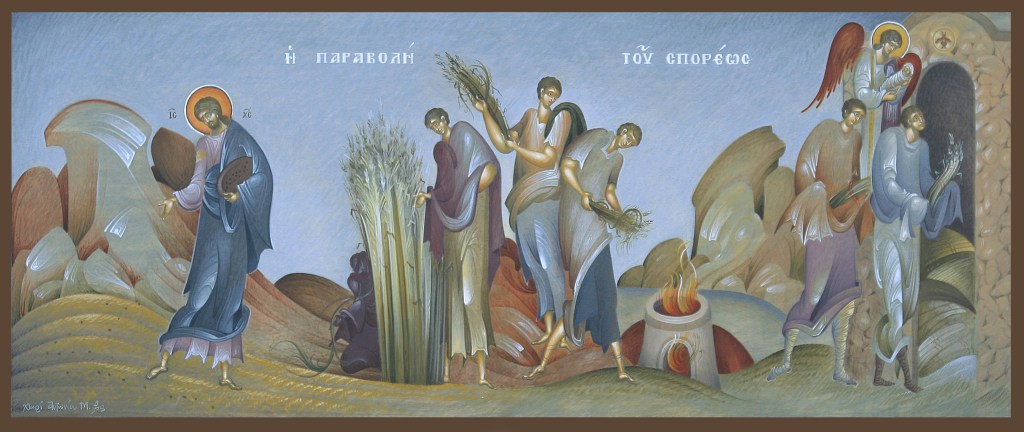
In our parable today, Jesus tells us that he is the sower of the seed and that the seeds represent the righteous—the children of God. The weeds sown with the good seed are the unrighteous—the children of the father of lies. And on God’s appointed day, He will send his angels to clear the field of weeds and throw them into the fire.

When we get a bit too big for our britches, we mistakenly believe that we are either God or an angel, that we have the knowledge, the right, and by golly, the responsibility to go into that field and pull some weeds because we know who they are. If God is too busy taking care of other business, we will happily step in. Sometimes we step in for what we consider to be noble reasons, “That person is a heretic! Burn them at the stake!” While at other times, our reasons aren’t quite so noble.

You won’t like this story—Stephen Covey, the author of The 7 Habits of Highly Effective People and other books, tells of the time on a lovely quiet Sunday afternoon when he was taking the subway through New York City. There were a few other passengers in the car with him, but not many, and all were enjoying the peace of the day. However, at the next stop, a man and his two sons burst onto the train, and the boys created all sorts of havoc. They ran absolutely wild up and down the car, screaming, shouting, wrestling—destroying the peace of that Sunday afternoon. I guess Covey thought the father of these two terrorists was a weed that needed pulling, so after a particularly noisy moment, he turned to the father and said, “Sir, perhaps you could restore order here by telling your children to come back and sit down.”

Have you ever been in that place? So confident that you were right and the other person wrong? That you could look at someone with all confidence and judge them? Of course, you have. We all have. We believe we have God’s infinite knowledge and wisdom to make these sorts of snap decisions, but how often are we wrong?

After Covey told this weed to get the terrorist under control, the weed said, “I know I should do something. We just came from the hospital. Their mother died an hour ago. I just don’t know what to do.” Covey had not snatched out some weed worthy of the fires of hell. Instead, he had only further bruised a broken heart that was in desperate need of the love of God.

Consider the fact that Jesus knew all along that Judas Iscariot was going to betray him. He knew that Judas was a weed among the wheat, but Jesus never threw him out. Instead, Jesus washed Judas’ feet, just as he had washed Peter’s, James’, John’s, and all the rest. Judas betrayed Jesus unto death, yet Jesus never condemned him and allowed Judas to participate in the Lord’s Supper. Question: how many have we renounced for far more trivial offenses by comparison?

In the parable, Jesus tells us we are neither God nor angels. Because we are not God, then we are not the judge. Because we are not angels, we are not the ones called to go into the fields and pull the weeds. We are, however, the grain of wheat, and if our work is not to judge or reap, then what is it? Jesus says, “Very truly I tell you, unless a kernel of wheat falls to the ground and dies, it remains only a single seed. But if it dies, it produces many seeds.”

What is our work? Jesus said, “This is to my Father’s glory, that you bear much fruit, showing yourselves to be my disciples.” Jesus says, “You did not choose me, but I chose you and appointed you so that you might go and bear fruit—fruit that will last.” One of the desert fathers said, “If a man settles in a certain place and does not bring forth the fruit of that place, the place itself casts him out, as one who has not borne its fruit.” For me, this brings to mind a rather unpleasant thought: if we are not producing good fruit, could it be that we are the weeds? We won’t entertain that one.

St. Josemaría Escrivá writes, “The Lord’s field is fertile and the seed he sows of good quality. Therefore when weeds appear in this world of ours, never doubt that they spring up because of a lack of correspondence on the part of men, Christians especially, who have fallen asleep and have left the field open to the enemy—Don’t complain, for there’s no point; examine your behaviour, instead.” If the weeds are truly growing amongst the wheat, we must consider that the fault might be ours and that we may be acting like a weed when we should be working on producing good fruit.

Only God chooses who goes to heaven, and thanks be to God for that! But we do have a role to play, and that is to produce good fruit. The person you’ve discounted, cast off, considered a weed in this world that must be yanked out, might just need someone—and not just any someone—but you. They just might need you to help them produce the fruit in their own life; therefore, be brave, have patience, and persevere in loving them, bringing glory to Our Father in Heaven.

St. Francis stated this best in a prayer. Let us pray: “Lord, make me an instrument of Your peace. Where there is hatred, let me sow love; where there is injury, pardon; where there is doubt, faith; where there is despair, hope; where there is darkness, light; where there is sadness, joy. O, Divine Master, grant that I may not so much seek to be consoled as to console; to be understood as to understand; to be loved as to love; for it is in giving that we receive; it is in pardoning that we are pardoned; it is in dying that we are born again to eternal life. Amen.”