Can you prove to me that there is a God? Sounds easy enough, but when it comes down to it… not so much. However, several have tried, and in the eyes of many, including the Church, have succeeded, one of which is our Saint for today, Thomas Aquinas.
Thomas was born in 1225 in Italy. His teachings and writings can only be compared to those of St. Augustine of Hippo when considering their effect on Christian thought (think of them as the Einstein’s of Christianity). It was during Thomas’ life that the writings of the great philosopher Aristotle were ‘rediscovered,’ and it was Thomas Aquinas who took these writings of Aristotle and integrated them into Christian thought, which means that a new way of understanding God was brought into Christian thinking and that understanding was through the use of reason. How so? Think of the polarized views of today.
On one side, we have science. Science is essentially all reason. A bit like math: one plus one equals two. That same reason has led some in the scientific fields or understanding to deny the existence of God; for example, the creation of the universe came about through the Big Bang; therefore, all that business in Genesis is just a fairy tale, and God doesn’t exist. The other side is Sola Scriptura, which declares that the Bible is all that is needed to prove the existence of God. Aquinas would say, “Not so fast,” to both groups.
In his greatest work, Summa Theologica, Aquinas puts forward five logical arguments (reasons) for the existence of God, the first of which is the argument of motion. He begins by simply saying things move. We can all agree on that. From there, he says, for things to move, something had to make them move. Think of a ball on a pool table: if that ball is going to move, something has to move it, whether it is the cue stick or gravity or even a ghosty; something made it move, but what made that something move? You can chase that as far back as you want. Still, for Aquinas, you eventually have to admit that there was something entirely different that made the very first thing move: the ‘first mover,’ something that was the initiator of all other movement, so why not call that ‘first mover’ God? That doesn’t reveal the God of Christianity, but it establishes some ‘higher power,’ as some refer to it today. So, when it comes to creation and someone arguing the Big Bang started it all, Aquinas would ask, “Who made it go bang?” To those who say Sola Scriptura, Aquinas would say, “God gave you a brain. Use it.” The one thing the argument of reason cannot answer is how we go from ‘higher power’ to the God of Christianity. For Aquinas, that takes one more step: revelation.
Revelation goes back to our study of St. Paul’s Epistle to the Romans, where we understood that our belief in God is a grace given to us by God. Because of this grace, this revelation, even though we cannot prove that the ‘higher power’ is the God of Christianity, we can have faith and believe. This same grace, faith, revelation helps us discern the Holy Trinity, the Incarnation, and ultimately the ability to declare that Jesus is Lord, for as Jesus said to Simon Peter when Peter declared Jesus as Lord, “Blessed are you, Simon Bar-Jonah! For flesh and blood has not revealed this to you, but my Father who is in heaven.” “Flesh and blood,” that is ‘reason’ did not reveal this to you, but the “Father,” that is ‘revelation’ did.
Confused? It’s OK if you are. Most of us are. The important thing to note is that there have been and are really great thinkers of the Christian faith, like Thomas Aquinas, and through their work, we can learn that things like reason and science and faith are not incompatible opposites but work together in providing a more clear understanding of God as revealed in the person of Jesus Christ.
You all know that I make wine, and many of you know that my wine is good. My wine is so good that even former Baptists like it. Given that, I don’t mind telling you a couple of short wine jokes.
It’s funny how eight glasses of water a day seems impossible, but eight glasses of wine is a sign of a good meal.
I’ve trained my dog to bring me a glass of red wine. It’s a Bordeaux collie.
I was having wine with my wife when she said, ‘I love you so much, you know. I don’t know how I could ever live without you.’ I said, ‘Is that you or the wine talking?’ She said, ‘It’s me talking to the wine.’
One of the funniest water-into-wine skits I’ve seen has Jesus and the disciples going to a fancy restaurant. The waitress comes up to the table and asks them what they’d like to drink, at which point they all start to giggle. Jesus elbows Peter to get him to stop, then says to the waitress, “We’ll just have water.” And then they all fall out.
In John’s Gospel, Jesus performs many “signs” and turning the water into wine at the wedding in Cana is the first. In looking at it more deeply, we can see that this one event defines Jesus’ mission and purpose—transforming the lesser into something greater—the fulfillment of its higher purpose.
This week, during our Wednesday night study of the Pivotal Players of the Church, we learned about the life and teachings of the Venerable Fulton Sheen, and this idea of the lesser being transformed into the greater came up. It was summarized in the video, so I went looking for Sheen’s actual words, and I found them. Sheen writes, “The sunshine, the carbons, and the rain could never share the life of the plant unless they died to their lower existence and were assumed or taken up into plant life. Plants could never share the sensitive and locomotive power of animals, unless they died to their lower existence and were taken up by the animal. None of the things in lower creation could live in man, and share his arts, his sciences, his thinking and his loves unless they ceased to be what they were, submitting to the death of knife and fire.” (These are the Sacraments, 1962)
If the sunlight, elements, and rain are to fulfill their higher purpose, they must give themselves up and be absorbed into the vine and the grapes. If the grapes want to ascend into and fulfill their higher purpose, they must be picked and crushed. If the wine wants to achieve its higher purpose, it must be consumed by a person.
So that the lesser can become greater, the lesser must die to itself and become a part of something else. So, then, how can we become greater and fulfill our higher purpose? St. Paul tells us, “I have been crucified with Christ. It is no longer I who live, but Christ who lives in me. And the life I now live in the flesh I live by faith in the Son of God, who loved me and gave himself for me.” (Galatians 2:20) I have been crucified with Christ—I have died to myself—and have become a part of Christ Jesus.
We fulfill our higher purpose not by living our best life but by giving up our life, participating in Jesus’s life, and serving His purposes. How do we do this?
These days, it’s a hard thing to “sell.” We have so many other options of things to do and see—books, movies, internet, sports, hobbies etc., etc., etc. All of these are our attempts to find true fulfillment in our lives. However, to fulfill our higher purpose, we must die to self and participate in the life of Christ. We do this by being filled with God’s Holy Spirit and then—and this is the hard sell—participating in the life and ministry of the Church, for the Church is Christ’s Mystical Body.
In his book, The Mystical Body of Christ, Fulton Sheen says, “What now is this new Body which Christ assumed after He had ascended into His glory, to which He sent His heavenly Spirit, and through which He continues to exercise His office as Teacher, King, and Priest? If I said it was the Church, I would not be believed. I will therefore let St. Paul say it clearly and unmistakably: ‘Who now rejoice in my sufferings for you, and fill up those things that are wanting of the sufferings of Christ, in my flesh, for His Body, which is the Church.’ (Col 1:24)” (p.37) Paul rejoices in his suffering for he knows it is serving God’s purposes and Christ’s Body—the Church. To achieve his higher purpose, Paul knows that he must be caught up in the Body of Christ, the Church.
Remember when John was baptizing on the banks of the Jordan River? Following Jesus’ baptism, Jesus’ “popularity” began to eclipse John’s. Some came to John and asked him what he thought about this, to which John responded that he had told them all along that he was not the Christ, and there was another coming. His conclusion, “He must increase, but I must decrease.” (John 3:30) To fulfill our purpose, those words must become ours. “Jesus must increase, but I must decrease.” The Mystical Body of Christ—His Church—must, through our participation, increase, and for this to happen, we must decrease.
Today is our Annual Meeting. There’ll be good food, vestry elections, reports given, budget shared, all sorts of fun stuff. However, the meeting is ultimately about us and how we, as the Body of Christ in this place, are dying to self and fulfilling our purpose in God’s Kingdom on Earth. God will not force us. We are quite free to choose. Jesus turned water into wine, and the water had no say in the matter, but we do. Jesus could say He chooses to transform us into the very best, and we could respond, “Ya know… thanks, but I’m happy being water.” However, if we say, “We will die to self and decrease, so that You may increase in us,” we will become something extraordinary.
I believe we have already begun that transformational process—you’re already a pretty tasty Bourdeaux Collie—but there is always more “dying” that must occur. Therefore, as individuals, we must ask, “How might I decrease so that Christ Jesus can increase in me?” and, as the Body of Christ, we must ask the same.
We generally begin the Annual Meeting in the Parish Hall, but today, I would like to start it now so that our first action together is receiving the Body and Blood of our Savior in the Eucharist. This will nourish our spirits and help us continue on the path to achieving God’s higher purpose for our lives and His Church.
Let us pray: Almighty and everliving God, source of all wisdom and understanding, be present with those who take counsel in this Annual Meeting of St. Matthew’s for the renewal and mission of your Mystical Body, the Church. Teach us in all things to seek first your honor and glory. Guide us to perceive what is right, and grant us both the courage to pursue it and the grace to accomplish it; through Jesus Christ our Lord. Amen.
West of the Denver suburbs is the community of Indian Hills, home of the Indian Hills Community Center. The Center had a sign out front, but in 2012, they asked a volunteer, Vincent, if he could build them a larger one.
The sign had the typical information you would expect from a sign until April Fools Day, which is when Vincent decided to have a bit of fun. I suppose the first message wouldn’t mean anything to those outside Indian Hills, but that community found it hysterical—“Indian Hills annexed by Morrison slow down.”
After that first message, the sign took on a life of its own, being changed regularly, and the punny messages became a town favorite. “Of course, I’m an organ donor. Who wouldn’t want a piece of this?!” “I’ll take the high road; you take the psycho path.” “Past, present, and future walked into a bar. It was tense.” “It’s easy to get back on your feet. Just miss two car payments. “My relationship with whiskey is on the rocks.” And my Stephen King favorite, “If clowns attack, go for the juggler.” The sign now has a Facebook page and many followers.
Signs are everywhere. Some are more complicated than others, but many have been used so much that we no longer need words to tell us what they mean. They have become simple symbols. You see a red octagon, and you know it means stop (unless, of course, you live in Enid, then it is a suggestion to stop). You see a cigarette with a red circle around it and a red slash, the prohibition symbol; you know it means no smoking. And, if you were to replace the cigarette with a penguin, you would know that you can’t take your pet penguin along.
Just as there are many signs around us, there are just as many symbols. The more complicated symbols are those that point to something beyond themselves. Take, for example, the American flag.
In some respects, the American flag is a simple symbol—it represents the United States. Easy enough, but when you ask people what that flag means, it takes on greater meaning—patriotism, honor, freedom, and so on. However, if you were to ask someone outside of the United States what the American flag represents, you would likely get a very different answer—opportunity, wealth, hope—but not all those who see it would have such positive responses. Others would see the American Flag as a symbol of oppression, imperialism, greed, the Great Satan, and more.
The American flag is, therefore, a simple symbol, but it is also very complex and nuanced. It points to something beyond itself—an idea.
Within our life with God and in Holy Scriptures, there is another kind of symbol—the prophetic or religious symbol. We can find many examples in both the Old and New Testaments.
In the Book of Jeremiah, there was a time when the Lord was angry with the people for their disobedience. To demonstrate how angry He was, God told Jeremiah to get a clay pot and go before the leaders and inhabitants of Jerusalem. Jeremiah is then to say, “Hear the word of the Lord… I am bringing such disaster upon this place.” Then Jeremiah is to take the clay pot and throw it to the ground. The Lord, speaking through Jeremiah, says, “Thus says the Lord of hosts: So will I break this people and this city, as one breaks a potter’s vessel, so that it can never be mended.”
The clay pot was used as a religious symbol. It is a symbol that points beyond itself, but it is a religious symbol because a) it points to an action of God that b) will affect the people and change them in some way.
From there, the religious symbol can become even more—a sacrament. Water is one such symbol.
Sometimes, water is just water, but throughout Scripture, water can be so much more. In the beginning, the Spirit of God hovered above the waters. With Noah, the earth was again covered by water, destroying almost all God had created. The people, being led by Moses, were saved through the waters of the Red Sea when the waters were parted, and all passed through safely, but then those same waters crashed down on the Egyptian army, killing both horse and rider. The waters are home to the great sea monster, the leviathan.
All together, this tells us that the waters are not necessarily a safe place. In fact, the water became a religious symbol of chaos and death. Then, along came Jesus, who stood before John the Baptist and was baptized by him. Jesus was pressed into the water, the chaos and death, and then pulled back up. Jesus did not need to be baptized, but He gave the water and these actions to us as a religious symbol, a sacrament. Together, they signify to us that at our baptism, we go into the waters, we go into chaos and death, but we come back up, washed, cleaned, restored, and once again made holy in the eyes of God. As St. Paul tells us, “Do you not know that all of us who have been baptized into Christ Jesus were baptized into his death? We were buried therefore with him by baptism into death, in order that, just as Christ was raised from the dead by the glory of the Father, we too might walk in newness of life.”
Water, a symbol that became a religious symbol, which, through Jesus, became a Sacrament. It is partly how we gained our definition of a Sacrament in the Catechism—“The sacraments are outward and visible signs of inward and spiritual grace, given by Christ as sure and certain means by which we receive that grace.”
Our Gospel reading from John begins with the words, “In the beginning was the Word, and the Word was with God, and the Word was God. He was in the beginning with God.” In that statement, the Word is more than a person; yet, it is also speaking, in part, of the person of Jesus, so we can say, “In the beginning was Jesus, and Jesus was with God, and Jesus was God. Jesus was in the beginning with God.”
Jesus confirms this later in John’s Gospel. One of the Disciples, Philip, says to Jesus, “Lord, show us the Father, and it is enough for us.” Jesus answers him, “Have I been with you so long, and you still do not know me, Philip? Whoever has seen me has seen the Father.”
In the beginning, Jesus was with God, and Jesus was God. Jesus says to Philip, ‘If you see Me, you see God the Father.” Jesus is not just a religious symbol of the Father. Jesus is the Sacrament—the outward and visible sign—of God the Father. Jesus’ nature shows us the very nature of God. For example, one aspect of God’s nature is love. Jesus said, “Just as I have loved you, you also are to love one another.” Jesus’ love for us is an outward and visible sign of God the Father’s love for us, for “God is love.”
Jesus is the Sacrament of God.
If it ended there, we could all go home, but there is one more step. Remember, a religious symbol is pointing to an action of God that will affect the people and change them in some way. Therefore, John told us, “To all who received [Jesus], who believed in his name, he gave power to become children of God, who were born, not of blood or of the will of the flesh or of the will of man, but of God.”
If you receive the Sacrament of God, Jesus, He gives you the power to become like Him—a child of God. In other words, if you receive Jesus, you become a Sacrament of Jesus—an outward and visible sign of God’s inward and spiritual grace.
On a night like tonight, we are surrounded by symbols. The star which beckons us. The angels that call us. The shepherds who seek Him. Mary, who said “Yes” to Him, and Joseph, who is obedient and faithful. However, perhaps the symbol that most represents this night is the manger, where Jesus is to be born. Like all other religious symbols, the manger is a symbol pointing to something more, and in this case, and on this night, it is pointing to you.
Within each of us is a manger. It can remain commonplace, storing all parts of an ordinary life. Or we can clear it out and make a place for the Christ Child to be born. A place where the Sacrament of God—Jesus—can be born in us and affect such change in our lives. The transformation of the commonplace into a holy and extraordinary place. A place where not only is Christ Jesus born but also where we are reborn as children of God—ourselves becoming sacraments—Sacraments of Jesus.
On this night, allow Christ Jesus to be born within the manger of your entire being and become a Sacrament—an outward and visible sign to all those around you of God’s great love for His Children.
Let us pray: Almighty God, you have given your only-begotten Son to take our nature upon him, and to be born of a pure virgin: Grant that we, who have been born again and made your children by adoption and grace, may daily be renewed by your Holy Spirit; through our Lord Jesus Christ, to whom with you and the same Spirit be honor and glory, now and for ever. Amen.
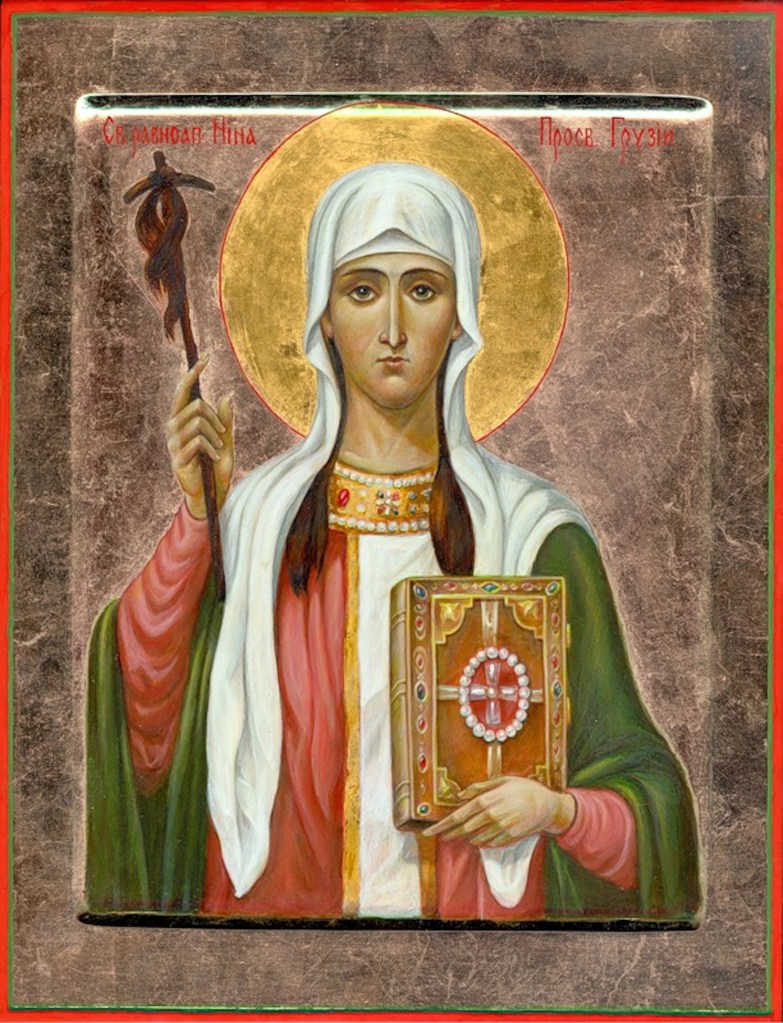
Legend has it that a Jewish Rabbi named Elias was in Jerusalem when Jesus was crucified. Following the crucifixion, he found the soldier who had won Jesus’ robe through the casting of dice and bought it from him. He then returned to his own country in Georgia, where he took the robe. Later, the robe would find its home in the crypt at the Orthodox Cathedral in Mtskheta. It is brought out on October 1st every year and celebrated as the Robe of Christ.
Around the year 300, a young girl, Nino, was born in Cappadocia, Turkey. When she was twelve, her family moved to Jerusalem, where Nino would eventually become an orphan. She was taken in by an older Christian woman who told her the stories of Christ, including the history of the Robe. Hearing this, Nino desired to be found worthy to travel to Georgia to venerate the relic, so she began to pray to the Theotokos, the Mother of God.
Her prayer was answered, and the Virgin Mary spoke to her, “Go to the country that was assigned to me by lot and preach the Gospel of our Lord Jesus Christ. He will send down His grace upon you, and I will be your protector.”
Nino did not believe she could carry out such a task. “How can I, a fragile woman, perform such a momentous task, and how can I believe that this vision is real?” In her vision, she was given a cross made out of grapevine, and the Theotokos said to her, “Receive this cross as a shield against visible and invisible enemies!” When she woke up, the cross was in her hands. She relayed the words of Mary to the Patriarch of the church, her uncle, who prayed. “O Lord, God of Eternity, I beseech Thee on behalf of my orphaned niece: Grant that, according to Thy will, she may go to preach and proclaim Thy Holy Resurrection. O Christ God, be Thou to her a guide, a refuge, and a spiritual father. And as Thou didst enlighten the Apostles and all those who feared Thy name, do Thou also enlighten her with the wisdom to proclaim Thy glad tidings.” (Source)
A series of events eventually led Nino to the people of Georgia, where she converted the Queen and King, solidifying the Christian faith in that country.
The Church that was initially established by the preaching of the Apostle Andrew and later built up by Nino still exists today, and the people of the Russian Orthodox Church and others still revere Nino.
Naaman came to Elisha to be healed of his leprosy, so Elisha instructed him to go and bathe in the river. Naaman thought that to be too simple of a task. He wanted to earn his cleansing, but his servant said, “Father, if the prophet had commanded you to do something difficult, would you not have done it? How much more, when all he said to you was, ‘Wash, and be clean’?”
To do God’s will, some are called to go and preach the Gospel, while others are called to simply wash and be clean. When God calls a person to the fulfillment of His will, it is not about whether or not the task is simple or challenging. Instead, it is about our obedience in submitting and following through.
Whatever God is calling you to, be obedient. When you are uncertain or even unmotivated, obedience will see you through.
A violinist noticed that his playing had a hypnotic effect on his audience. They sat motionless as though they were in a trance. He found he had the same impact on his friends’ pets. Dogs and cats would sit spellbound while he played. Wondering if he could cast the same spell over wild beasts, he went to a jungle clearing in Africa, took out his violin, and began to play. A lion, an elephant, and a gorilla charged into the clearing stopped to listen, and sat mesmerized by the music. Soon, the clearing was filled with every kind of ferocious animal, each one listening intently. Suddenly, another lion charged out of the jungle pounced on the violinist, and killed him instantly.
The first lion, bewildered, asked, “Why did you do that?”
The second lion cupped his paw behind his ear. “What?”
If you ask the experts, they will tell you that a digital recording produces better sound quality than a vinyl record. If you ask me, I’ll tell you vinyl produces better quality. Why? For whatever reason, I can hear it better, and for someone who does not hear so well, that is reason enough to spend a few more dollars on the music I genuinely enjoy.
When you look at a record, you can see it has grooves/lines that the needle settles into. However, when you put a vinyl record under a microscope, it looks like a mountain range: ridges, valleys, bumps, wiggles, and all. When you play a CD, it is reading a digital code made up of ones and zeroes. When you play a vinyl record, the needle (stylus for all you aficionados) reads all those ridges, valleys, bumps, and wiggles, converting them into electrical signals that are then played through the speakers. If all goes well… beautiful music, but you have to take care of records.
A scratch on a CD may or may not damage the sound quality, but even minor scratches on a vinyl record will produce a popping sound. Why? You’ve added a new element to the ridges and valleys, and the needle reads it. It may pop, but if the scratch is bad enough, the needle may jump out of the groove and skip part of the song.
Today, our Gospel reading begins with a list of who’s who. Luke, by providing all these details, isn’t dropping names. Instead, he is setting the timeframe for those who would read his Gospel. So, with the info provided, we know it is about 29/30 AD. (FYI: many believe that AD means “after death,” referring to the death of Jesus. However, it is an abbreviation for Anno Domini, meaning “the year of our Lord.”) What is Luke setting the timeframe for? The ministry of John the Baptist.
John, we are told, went about the region surrounding the Jordan River “proclaiming a baptism of repentance for the forgiveness of sins.” Luke then states, “as it is written in the book of the words of the prophet Isaiah.” In other words, Luke tells us that John’s ministry is a fulfillment of prophecy.
“The voice of one crying out in the wilderness:
‘Prepare the way of the Lord, make his paths straight.’”
That is Isaiah 4:3, but who is speaking those words? To learn this, we have to read the first two verses of Isaiah 40.
“Comfort, comfort my people, says your God.
Speak tenderly to Jerusalem, and cry to her that her warfare is ended, that her iniquity is pardoned, that she has received from the Lord’s hand double for all her sins.”
“Comfort, comfort my people, says your God.” Isaiah records the words, but it is as though he is sitting in the room with God, for it is God Himself speaking. God is calling for the comfort of His people. Why?
You’ll remember from last week, we discussed the Babylonian Captivity—when the Israelites were taken slaves in Babylon following the sacking of Jerusalem. God is speaking comfort because that captivity is nearing its end. The people will soon be set free and allowed to return home, and it is God who will lead them. A few verses on, the Lord says,
“He will tend his flock like a shepherd; he will gather the lambs in his arms; he will carry them in his bosom, and gently lead those that are with young.”
(Isaiah 40:11)
So, putting that all together, the Lord says that He will lead his people out of captivity and that the way ahead shall be made ready and made easy. As though calling on His Holy Angels, the Lord says to them,
“Prepare the way of the Lord, make his paths straight. Every valley shall be filled, and every mountain and hill shall be made low, and the crooked shall be made straight, and the rough ways made smooth.”
So, if Isaiah was talking about the release of captivity from Babylon, why then was Luke applying this passage to the ministry of John? Answer: the people are still being held captive. However, this time, it is not by some foreign adversary (although the Romans occupy the land); instead, they are being held captive by their sins.
John came “proclaiming a baptism of repentance for the forgiveness of sins.” The call to “Prepare the way of the Lord” is not about preparing smoother roads. It is about preparing the soul.
You were created in the Image of God, an image that is perfection. An image that was never meant to decay or even know death. People will say that “death is natural.” No, it is not. It is the most unnatural thing we do. We were created for life eternal, but through sin, death entered in—the Image of God that is within us became distorted.
Our bodies and souls were created to play the most beautiful music. Music that was in perfect harmony with our Creator. Yet, through the sin of Adam and Eve, we received our first “scratch.” Over time, and through our disobedience, we became even more damaged so that the music we now play contains discord—pops, skips, and missing pieces; therefore, John’s proclamation for repentance is still valid. Luke’s call to fill in the valleys and smooth the rough ways is a way of saying we need to repair the scratches so that we may again play beautiful music. How do we do this?
Isaiah told those in captivity that God would lead them. Remember his words: “He will tend his flock like a shepherd.” God will also lead us. God, the Good Shepherd—Jesus—will lead us. It is He who leads us out of the captivity of our sins and restores the Image of God within us. In the next chapter of Luke, we hear Jesus also quote Isaiah.
“The Spirit of the Lord is upon me, because he has anointed me to proclaim good news to the poor. He has sent me to proclaim liberty to the captives and recovering of sight to the blind, to set at liberty those who are oppressed,
to proclaim the year of the Lord’s favor.
And he rolled up the scroll and gave it back to the attendant and sat down. And the eyes of all in the synagogue were fixed on him. And he began to say to them, ‘Today this Scripture has been fulfilled in your hearing.’” (Luke 4:18-21)
Jesus will restore the image of God within, but just as we must protect and care for a vinyl record, we must also protect and care for our souls. This is not because Jesus will get tired and just quit repairing the scratches. Through grace, He never will, but to sin is to willingly place ourselves back into the captivity we were set free from. St. Paul also asked this same question.
“What shall we say, then? Shall we go on sinning so that grace may increase? By no means! We are those who have died to sin; how can we live in it any longer?” A few verses on, he says, “Sin shall no longer be your master, because you are not under the law, but under grace… Thanks be to God that, though you used to be slaves to sin, you have come to obey from your heart the pattern of teaching that has now claimed your allegiance. You have been set free from sin and have become slaves to righteousness.” (Romans 6:1-2, 14, 17-18)
We are not those who willingly submit ourselves to captivity and the slavery of sin. Sin shall not be our master and defile the beautiful song of our souls. Instead, we submit ourselves to God and allow His ways to rule in our lives so that the song of our souls may once again be in harmony with the Lover of our souls.
St. James tells us, “Submit yourselves, then, to God. Resist the devil, and he will flee from you. Come near to God and he will come near to you…. Humble yourselves before the Lord, and he will lift you up.” (James 4:7, 10)
Submit yourself to God so that the Image of God within you may be restored.
Let us pray: Merciful God, who sent your messengers the prophets to preach repentance and prepare the way for our salvation: Give us grace to heed their warnings and forsake our sins, that we may greet with joy the coming of Jesus Christ our Redeemer; who lives and reigns with you and the Holy Spirit, one God, now and for ever. Amen.
Text: Sailing amid the tumult of the cares of life, I founder with the ship of sin and am cast to the soul-destroying beast; yet like Jonah I cry to Thee, O Christ; Lead me up from the deadly abyss!
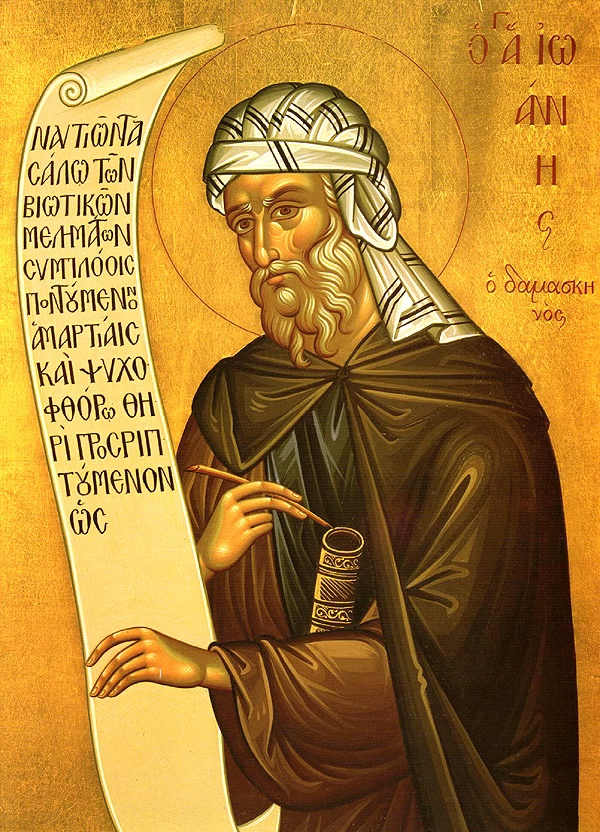
The second of the top ten: “You shall not make for yourself an idol of any kind, or an image of anything in the heavens above, on the earth beneath, or in the waters below. You shall not bow down to them or worship them; for I, the LORD your God, am a jealous God, visiting the iniquity of the fathers on their children to the third and fourth generations of those who hate Me.” (Exodus 20:4-5) For the Jew and the Muslim, there remains a rigorous prohibition against images of any kind that would depict God. Still, within Christianity, the interpretation of this passage has a gray area: the use of icons.
Legend has it that St. Luke the Evangelist ‘wrote’ the first icon, but from there, the history of these windows into heaven becomes foggy. Whatever the case, in the 8th century, the iconoclast pushed for the removal of all images, but there were some who pushed back. Sounds like a little church fight, but this one issue resulted in over 100,000 individuals being killed or injured in the battles that ensued. Eventually, those in favor of icons would win the day.
Pope John Paul II, in 1999, wrote his “Letter to Artists,” stating, “The decisive argument to which the bishops appealed in order to settle the controversy was the mystery of the Incarnation.”
The bishop who made the greatest case that John Paul refers to is our saint for the day: St. John of Damascus or St. John Damascene. He writes, “I do not worship matter, I worship the God of matter, who became matter for my sake (speaking of the Incarnation of Jesus) and deigned to inhabit matter (his body), who worked out my salvation through matter (the cross). I will not cease from honoring that matter (icons) which works for my salvation. I venerate it (the icon), though not as God.”
How might we pray with or venerate a window into heaven? Consider our icon of Julian of Norwich in this chapel named after her. Julian writes: “And in this he showed me a little thing, the quantity of a hazel nut, lying in the palm of my hand, as it seemed. And it was as round as any ball. I looked upon it with the eye of my understanding, and thought, ‘What may this be?’ And it was answered generally thus, ‘It is all that is made.’ I marveled how it might last, for I thought it might suddenly have fallen to nothing for littleness. And I was answered in my understanding: It lasts and ever shall, for God loves it. And so have all things their beginning by the love of God. In this little thing I saw three properties. The first is that God made it. The second that God loves it. And the third, that God keeps it.”
Now consider this: in her vision/showing, Julian understood that what she held, the size of a hazel nut, was all of creation: earth, planets, sun, stars, galaxies, universe… everything. And she was also a part of it. And God showed this to her, lying in the palm of her hand. For us, praying with the icon, we can visualize our smallness, but then again… how great is our God that he can hold it all, and how comforting to know that he loves it.
Imagine that you were one of the peasants living in the 8th century with no understanding of theology. You would never have read or heard the words of the Bible in a language you could understand. But what if someone told you that this little hazelnut is all of creation, and this is how God holds and loves you? John of Damascus understood this: these windows point us all to a deeper understanding of God and his love for us.
I’ve no idea how I’ve ended up in the world of old radio programs—last week, it was Orson Welle’s broadcast of War of the Worlds—and this week, I’ve found another one. It began on July 31, 1930, as the Detective Story Hour radio program. Each episode starts with the narrator stating, “Who knows what evil lurks in the hearts of men? The Shadow knows!” Each episode concludes, “As you sow evil, so shall you reap evil! Crime does not pay…The Shadow knows!”
Later episodes reveal that Kent Allard is The Shadow but goes by many different aliases. His best-known alias is Lamont Cranston, a bit of a Batman/Bruce Wayne character. Living in New York, he is a vigilante with a vast network of assistants and informants and a trusty .45 Colt pistol that aids him in fighting crime. Through these, he can gain the information he needs to defeat the criminals. He is also where we get the phrase, “Only the Shadow knows.” (I actually had no idea what that meant until I started reading about it this week. It was just one of those things you said.)
In the end, The Shadow learned and knew what others did not.
In our Saints Book Club this past week, we discussed Saint Catherine of Siena: Mystic of Fire—Preacher of Freedom. I think we all walked away, wanting to know more about her. Although uneducated and not learning to read or write until a later age, she was one who advised paupers and Popes. Very remarkable. In her writing, she also speaks of a shadow. Like the radio character, her shadow also learns and knows what others do not, but instead of it being about others, her shadow knows about herself.
Catherine says, “Never leave the knowledge of yourself!” (p.41) What she is saying is that we need to know the shadow, our inner selves intimately, so that we can begin, in the words of St. Paul, to “work out [our] own salvation with fear and trembling, for it is God who works in [us], both to will and to work for his good pleasure.” (Philippians 2:12-13)
How does it work? Someone can tell me, “You’re so kind and loving.” I can believe that and go on my merry way, but if I look at the shadow within, I know that is not really true. As David says in the Psalms,
“For I know my transgressions, and my sin is ever before me.” (Psalm 51:3)
Understanding your shadow means knowing yourself and rooting out even the slightest transgressions. This helps us temper the praise of others, which can build our ego to unmanageable levels and also keeps us from believing the lies we tell ourselves. It also keeps us humble and compassionate, for by recognizing our faults and weaknesses, we begin to understand the struggles that others are facing in their own lives. However, knowing your shadow comes with a warning.
When you discover the shadow within, those ugly bits about yourself, you start to believe what it says about you. Catherine writes, “[W]hen notions come into the heart that say, ‘What you are doing is neither pleasing nor acceptable to God; you are in a state of damnation.’ And little by little, after these notions have caused discouragement, they infiltrate the soul and point out a way disguised as humility, saying, ‘You can see that because of your sins you aren’t worthy of many graces and gifts’—and so the person stays away from communion and from other spiritual gifts and practices. This is the devil’s trick, the darkness he causes.” (p.60)
We can come to believe we are all that and a bag of chips based on what others say about us, but by understanding our shadow and the sinfulness within, we can also come to believe the devil, who tells us we are completely lost and outside of God’s redeeming work. Through self-condemnation, we become discouraged and may eventually walk away from God entirely, believing we will never be good enough. That is a lie of the devil, but what is the solution? The solution is recognizing that the shadow only distorts the image within you. The shadow is not who you truly are. To see the true you, you must look in what Catherine calls “the Gentle Mirror of God.”
“In the gentle mirror of God,” Catherine writes, the believer when at prayer “sees her own dignity: that through no merit of hers but by his creation she is the image of God.” (p.47)
The image of God within can reveal itself in a multitude of ways—how we give, how we serve, how we sacrifice ourselves—but for Catherine, all of these can be summed up in one word: fire.
Today, in our first lesson, Daniel relates a vision.
As I watched, thrones were set in place, and an Ancient One took his throne, his clothing was white as snow, and the hair of his head like pure wool; his throne was fiery flames, and its wheels were burning fire. A stream of fire issued and flowed out from his presence. (Daniel 7:9-10a)
Catherine is very much aware of the shadow within herself, but as she looks in the gentle mirror of God, she begins to understand the nature of God and, in so doing, understands her own nature, which is the image of God within her. Speaking to God, who she refers to as boundless Love, she says, “In your nature, eternal Godhead, I shall come to know my nature. And what is my nature, boundless Love? It is fire, because you are nothing but a fire of love.” (p.47) St. John says, “God is love, and whoever abides in love abides in God, and God abides in him.” (1 John 4:16b) God is love, and for Catherine, this love is revealed as fire. A fire that reveals the defects of the shadow and a fire that, through its love, restores us to the true Image of God.
She writes, “For just as you can better see the blemish on your face when you look at yourself in the mirror, so the soul who in true self-knowledge rises up with desire to look at herself in the gentle mirror of God… sees all the more clearly her own defects because of the purity she sees in him.” (p.47)
This is not an easy process. It can be painful at times because recognizing the defects of your own shadow is recognizing the not-so-nice bits about yourself. However, it is also “sweet” because by identifying the defects of the shadow, you can begin to do something about them.
Today is Christ the King Sunday. The day we celebrate the Kingship of our Lord. Liturgically, this is the last Sunday of the Church year. Next Sunday we begin the Season of Advent, which will lead up to the birth of the Christ Child. Much like the Season of Lent, the Season of Advent is a time of preparation. In Advent, we prepare our hearts, minds, and souls to receive the great gift of our salvation given to us through the birth of Jesus. One of the ways that we can prepare is by doing as Catherine encourages—knowing the shadow within as revealed by the fire we see in the gentle mirror of God.
You can stop there, but there are times when it must be spoken to release a thing’s power. Catherine says, “When [evil] thoughts or strong temptations regarding some specific thing (no matter how ugly) come into your heart, never keep them inside, but reveal them to the father of your soul…. We mustn’t be afraid, but must reveal our every infirmity to the doctor of our soul.” (p.92) Don’t shoot the messenger, but she is talking about confession. There are times when, in order to release the power of sin, the sin must be spoken, and the Church provides the Sacrament of Reconciliation/Confession for this specific purpose.
The Book of Common Prayer teaches us, “[I]f, in your preparation, you need help and counsel, then go and open your grief to a discreet and understanding priest, and confess your sins, that you may receive the benefit of absolution, and spiritual counsel and advice; to the removal of scruple and doubt, the assurance of pardon, and the strengthening of your faith.” (BCP 317) No. Confession is not the Church’s way of learning about all the ugliness of your shadow. Instead, it is the Church’s way of helping the fire of God’s love within you burn away sin so that you might be set free. It is as simple as that.
“Only the Shadow knows.” The shadow within you knows your inner self. Get to know it, then get to work on it. Allow the fire of God… allow Jesus to set you free, which is true freedom. For as Jesus teaches, “If the Son sets you free, you will be free indeed.” (John 8:36)
Let us pray: (Prayer 12: My Nature Is Fire)
In your nature, eternal Godhead, I shall come to know my nature. And what is my nature, boundless love? It is fire, because you are nothing but a fire of love. And you have given humankind a share in this nature, for by the fire of love you created us. And so with all other people and every created thing; you made them out of love. O ungrateful people! What nature has your God given you? His very own nature! Are you not ashamed to cut yourself off from such a noble thing through the guilt of deadly sin? O eternal Trinity, my sweet love! You, light, give us light. You, wisdom, give us wisdom. You, supreme strength, strengthen us. Today, eternal God, let our cloud be dissipated so that we may perfectly know and follow your Truth in truth, with a free and simple heart. God, come to our assistance! Lord, make haste to help us!
The English historian Robert Blake in 1982 wrote about one of the English monarchs: he “was a tyrannical monster. His rule echoed Caligula’s and prefigured that of Hitler or Stalin. Parliament was his collective accomplice: it blotted out his debts, it carried acts of attainder which deprived his enemies or imagined enemies of land, title and life without even the form of trial, it altered the succession, it allowed the king to bequeath the Crown by will, it gave his proclamations the force of statutory law.”
This monarch’s official title was a bit on the wordy side, “By the Grace of God, King of England, France and Ireland, Defender of the Faith and of the Church of England and also of Ireland in Earth, under Jesus Christ, Supreme Head.” We know him as Henry VIII. I suppose it is good to be king, but when we consider the monarchs of that era, Blake’s description appears fitting for most of them. Therefore, it seems a bit odd to celebrate the life of one, but Elizabeth, Princess of Hungary, was a bit different.
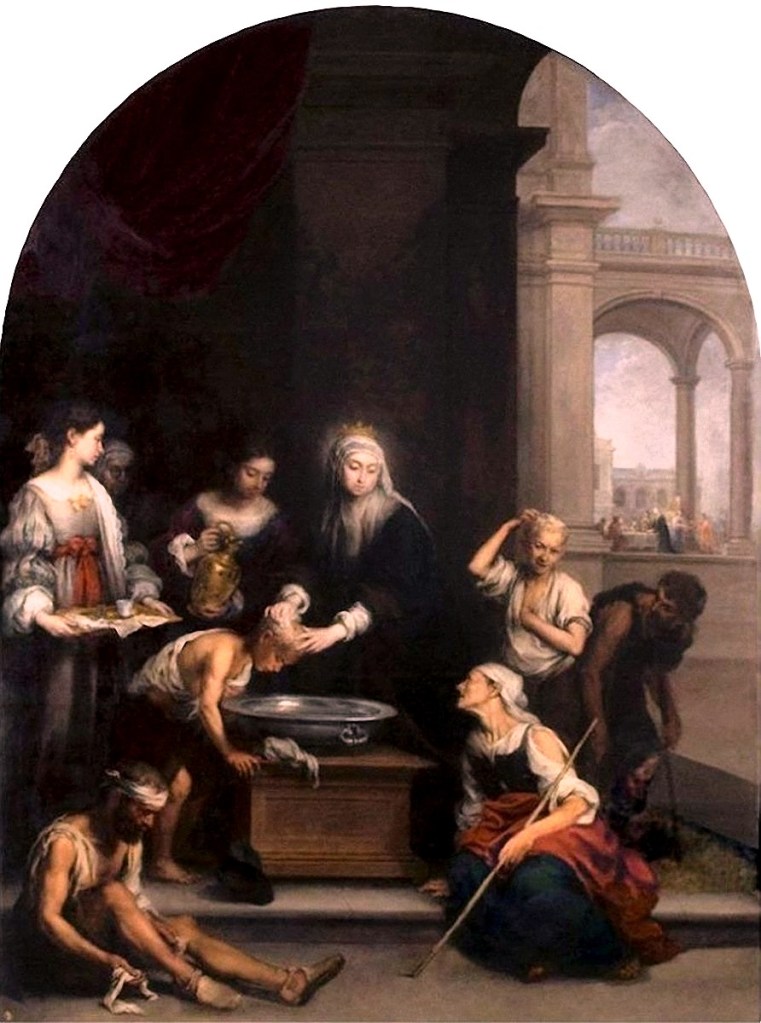
Following the death of her husband, the court compelled her to leave her home and take on a life of near poverty because of her extravagant lifestyle. What were those extravagances? Giving to the poor. Building hospitals. Feeding the hungry—she even opened the royal granaries during a famine in the land. She is reported to have said, “How could I bear a crown of gold when the Lord bears a crown of thorns? And bears it for me!”
She wrote, “Today, there is an inescapable duty to make ourselves the neighbor of every individual, without exception, and to take positive steps to help a neighbor whom we encounter, whether that neighbor be an elderly person, abandoned by everyone, a foreign worker who suffers the injustice of being despised, a refugee, an illegitimate child wrongly suffering for a sin of which the child is innocent, or a starving human being who awakens our conscience by calling to mind the words of Christ: ‘As long as you did it for one of these, the least of my brethren, you did it for me’”
Jesus said, “Sell your possessions, and give alms. Make purses for yourselves that do not wear out, an unfailing treasure in heaven, where no thief comes near and no moth destroys.”
That verse has inspired so many individuals to do such great things. Like Elizabeth, those “great things” did not involve building vast empires or great wealth. They had nothing to do with making a name for themselves or gaining fame. Instead, those “great things” had to do with setting themselves aside, seeing Jesus, and seeking to serve Him in others with their entire being. How far does that go? Elizabeth died from exhaustion in serving the sick and needy.
I’m not going to ask you to do the same, but just as we are called to tithe 10% of our income to the work of God, what do you think the world would be like if we also tithed 10% of our lives to the work of God? What “great things” could we do as a Christian people? I can assure you that we would be a force to be reckoned with in turning back the pain and suffering of this world.
Here’s a challenge for you: An hour has 60 minutes. Ten percent of 60 is 6… 6 minutes. How could you change the lives of those around you if you gave 6 minutes of every hour to God? I dare you to try it.
“Ladies and gentlemen, this is the most terrifying thing I have ever witnessed . . . Wait a minute! Someone’s crawling out of the hollow top. Someone or . . . something. I can see peering out of that black hole two luminous disks . . are they eyes? It might be a face. It might be . . . Good heavens, something’s wriggling out of the shadow like a gray snake. Now it’s another one, and another. They look like tentacles to me. There, I can see the thing’s body. It’s large, large as a bear and it glistens like wet leather. But that face, it . . . Ladies and gentlemen, it’s indescribable. I can hardly force myself to keep looking at it. The eyes are black and gleam like a serpent. The mouth is V-shaped with saliva dripping from its rimless lips that seem to quiver and pulsate.”
It may not have actually happened, but at the time, hundreds of listeners believed it was. The broadcast of War of the Worlds, written by Orson Welles. Welles said, “I had conceived the idea of doing a radio broadcast in such a manner that a crisis would actually seem to be happening, and would be broadcast in such a dramatized form as to appear to be a real event taking place at that time, rather than a mere radio play.” It worked. Before the broadcast was complete, there were police in the studio lobby demanding that Welles stop the play and announce that it was all a radio drama. There were reported riots, suicides, and mayhem. Did the author and radio cast intend for such results? No.
From an article in the Smithsonian, “No one involved with War of the Worlds expected to deceive any listeners, because they all found the story too silly and improbable to ever be taken seriously.” (Source)
Now, listen to these words given to us by John.
“Now the seven angels who had the seven trumpets prepared to blow them.
“The first angel blew his trumpet, and there followed hail and fire, mixed with blood, and these were thrown upon the earth. And a third of the earth was burned up, and a third of the trees were burned up, and all green grass was burned up.
“The second angel blew his trumpet, and something like a great mountain, burning with fire, was thrown into the sea, and a third of the sea became blood. A third of the living creatures in the sea died, and a third of the ships were destroyed.
“The third angel blew his trumpet, and a great star fell from heaven, blazing like a torch, and it fell on a third of the rivers and on the springs of water. The name of the star is Wormwood. A third of the waters became wormwood, and many people died from the water, because it had been made bitter.” (Revelation 8:6-11)
You are all still here? That’s from Holy Scripture. I thought that would have the same effect as the War of the Worlds broadcast. Why haven’t you run for the hills? Could it be that we also find these writings “too silly and improbable to ever be taken seriously”? A zombie apocalypse is far more likely. Right?
The same indifference can be said for the passage from Mark’s Gospel that we read. The Disciples wanted to know when the end would come—those last great days. Jesus said, “Many will come in my name and say, ‘I am he!’ and they will lead many astray. When you hear of wars and rumors of wars, do not be alarmed; this must take place, but the end is still to come. For nation will rise against nation, and kingdom against kingdom; there will be earthquakes in various places; there will be famines. This is but the beginning of the birthpangs.” (Mark 13:5-8) Today, there are wars and earthquakes and famines, but we’ve always had these things—from the very beginning. This is nothing new, so there’s no reason to get excited about it. It’s just another day in the neighborhood. Right?
Many have spent a lifetime trying to sort out when the end will come. They pull out the Book of Revelation, Daniel, and the Prophets. They do math, counting days and years. They assign names to individuals and events they believe are associated with the end and place them on timelines to plot the future. It is an interesting exercise, but each and every person who has taken on such a challenge has failed. Why? Jesus said, “Concerning that day and hour no one knows, not even the angels of heaven, nor the Son, but the Father only.” (Matthew 24:36) And, the bottom line, we’re really just not too concerned. We won’t say it’s silly because it is from Holy Scripture, but we’re OK with the description of it being too “improbable to ever be taken seriously.”
Fine. Let’s take this End—with a capital “E”—and set it aside for a few minutes, and talk about another end, specifically, your end.
We may not be too concerned about the end of the world, but how many of you have a five-year plan? Something that deals with goals, financial status, job, health, weight loss, etc. You’ve got your plan all laid out nicely. Question: as it relates to your end, in your five-year planning, did you include the care for the widows and orphans in your midst? How does your plan account for feeding the hungry? Clothing of the naked? Sharing the Gospel message with others? You may know the financial yield of your IRA down to the penny on the day of your retirement, but how have you planned to extend your hand in love to those around you so that on your last day, you hear those words, “Well done good and faithful servant?”
You say, “Well, Fr. John, I don’t have a five-year plan, much less an IRA, so this doesn’t apply to me.” And I say, “Not so fast.” Do you have plans for your next day off? Got it worked out what you might be doing, or just happily thinking about a day away from the boss? Have you wondered if you might have enough left over to take the kids to a movie? I hope you do. Truly! I hope you are joyfully looking forward to living your life, but have you said your prayers this past week? Have you stopped long enough to listen for the voice of God? (And just in case you’re hedging on your answer, this morning in church doesn’t count!) I’m not asking if you spent an hour each day in deep meditation, but did you stop long enough each day to pray even the Lord’s Prayer? “Thank you, Fr. John; I now feel sufficiently guilty.”
I’m not saying you shouldn’t plan; you must be responsible, and I’m not trying to make you feel guilty either; live your life and enjoy it to its fullest. In addition, I’m not saying that the end of days is not something to consider and be aware of. Still, Jesus and John in the Book of Revelation or any other apocalyptic messages were not necessarily given to us so that we would sit around and be harassed by the future. The main point behind those writings is not to have us focus on “The End” or the future, but instead, to focus on our end. How is it we are living today?
It’s not, have you identified the Great Babylon in John’s Revelation, but have you identified your place in God’s plan?
It’s not, have you discovered the person of the anti-Christ, but have you discovered the person of Jesus Christ?
It’s not whether you can afford to retire early but whether you love God each and every day.
The focus is not solely on the end of the world, your five-year plan, or your weekend plans. It is about your relationship with God today, and it’s about encountering, serving, blessing, and being blessed by Jesus here and now.
Yes, we must be responsible in our daily lives, and we must plan for the future, but an unhealthy preoccupation with the End of Days, the future, and all the “What ifs?” can lead us astray from the opportunities of today.
The end of days, the end of the year, the end of the week, the end of this sermon—yes, these are things to be considered, but they should never lead you astray or distract you from what God is doing in this very moment and how you should be making plans for and considering your own end.
I’m honestly not trying to depress you or make you feel guilty. However, the War of the Worlds may have been “too silly and improbable to ever be taken seriously,” but your end is not. In all you do, ask, “How am I storing up treasure in Heaven,” so that on your last day, Jesus says to you, “Well done, good and faithful servant… Enter into the joy of your master.” (Matthew 25:23)
Let us pray:
Lord, for tomorrow and its needs, We do not pray; Keep us, our God, from stain of sin Just for today.
Let us both diligently work, And duly pray. Let us be kind in word and deed, Just for today.
Let us be slow to do our will, Prompt to obey; Help us to sacrifice ourselves Just for today.
And if today our tide of life Should ebb away, Give us thy Sacraments divine, Sweet Lord today.
So for to-morrow and its needs We do not pray, But keep us, guide us, love us, Lord, Just for to-day.
Amen.
(This prayer is from the St. Augustine Prayer Book)





 Candle in a Cave