Pip: There is a cave, and there is a candle — and this week, someone lit it by asking who gets to decide which plants are weeds.
Mara: That question runs straight through the posts Fr. John published recently — a sermon that moves from a Charlie Brown comic strip to a Persian king to the parable of the wheat and the weeds. Let's start with the field.
Sermon: Proper 11 RCL A — Identifying Weeds
Pip: The sermon opens with a very relatable Lucy moment — she tells Charlie Brown his problem is simply that he is himself — and uses it to name something the sermon treats as a persistent human instinct: the confidence that we can correctly identify who the troublemakers are.
Mara: The sermon sets up that instinct and then runs it straight into Isaiah, where the Lord designates a deliverer for Israel. Here is the passage: "I have stirred him up in righteousness, and I will make all his ways level; he shall build my city and set my exiles free, not for price or reward, says the Lord of hosts."
Pip: And the deliverer in question is not David, not Gideon, not Jesus — it is Cyrus, a pagan king who worshipped idols and had never heard of the God of Israel. Which means the people hearing Isaiah's announcement would have looked at their liberator and seen exactly the wrong kind of person.
Mara: That is precisely the tension the sermon develops. Cyrus conquered Babylon, freed the Israelites, and funded the rebuilding of Jerusalem — all without sharing their faith. The sermon then moves to the gospel parable, where a farmer's field fills with Darnel, a poisonous grass nearly indistinguishable from wheat until the grain head forms.
Pip: By the time you can tell the difference, the roots are so tangled that pulling the weed destroys the wheat. So the farmer says: wait. Which is, frankly, a harder instruction than it sounds when you have already mentally drafted your weed-pulling list.
Mara: Augustine is quoted directly on this: "How many sheep are outside, how many wolves within! And how many sheep are inside, how many wolves without! How many are blaspheming Christ who will yet believe in Him!"
Mara: The sermon holds up Paul as the case in point — present at Stephen's stoning, feared by the early church, and yet the future Apostle to the Gentiles. The people who saw a wolf were not lying; they were simply wrong.
Pip: So the sermon's practical instruction lands in Romans 12 — repay no evil for evil, feed your enemy if he is hungry — because the alternative is letting someone else's sin generate yours.
Mara: And the sermon closes with a sharp reversal: those who crucified Jesus believed they were doing exactly the right kind of weed removal. The job of identifying and pulling, the sermon argues, belongs to the angels at the end of the age — not to us.
Pip: What stays with me is Cyrus — the idea that the person you would most confidently label a weed might be the one God has already called by name.
Mara: That tension between what we see and what God sees seems like territory worth returning to. More to come from Candle in a Cave.
Pip: Candle in a Cave — where the sermon opens with a statistical case against chocolate mint ice cream, and somehow that is exactly the right move.
Mara: Fr. John's recent writing takes the Parable of the Sower as its anchor — what it means to have good soil in your heart, and what quietly erodes it. Let's start with the sermon itself.
Sermon: Tending the Soil of the Heart
Mara: The Parable of the Sower is usually read as a sorting mechanism — which type of person are you? But this sermon pushes past that framing and asks a harder question: even if the seed landed in good soil, what happens to that soil over time?
Pip: The setup is a statistics lesson. Before getting to Jesus, the sermon walks through a set of perfectly true, perfectly misleading correlations — nearly everyone who dies from cancer has eaten chocolate mint ice cream — to make a point about how easily we bend evidence to say what we want, including scripture. Then comes the turn: "However, today Jesus said, 'Not so fast,' and, in a rare instance, told us what he meant."
Mara: That's the hinge. Because Jesus actually interprets the parable himself, there's less room to spin it. The soil is the heart. The birds are the devil snatching the Word before it takes root. Rocky ground is shallow faith that withers. Thorns are the overwhelming noise of the world choking off what grew.
Pip: And then comes the move that makes this more than a conversion story. The sermon turns directly to people who already believe — the ones who think the parable isn't about them.
Mara: Right, because the soil doesn't stay fixed. The sermon uses a Montana farming image to explain it: rocks don't sink in soil, they rise. You pick them out in spring, and if you don't, they're back. The sermon puts it plainly — "if you do nothing to tend the soil, over time the rocks will work their way to the surface, and the once-fertile soil becomes rocky."
Pip: The washing machine flood, the "Insufficient Funds" stamp on the mortgage — those aren't hypotheticals, they're the actual mechanism. The bird doesn't wait for crisis; it works with whatever's already loose.
Mara: St. Paul and St. Josemaria Escriva both get quoted here. Escriva's image is striking — the world, the devil, and the flesh as adventurers trading you "the poor bauble of pleasure" for "the pure gold and the pearls, the diamonds and the rubies, drenched in the living and redeeming blood of your God."
Pip: That is not a subtle metaphor.
Mara: It isn't. And the sermon lands on a practical response: pray, cooperate with grace, and stop shooting yourself in the foot while asking God why your foot hurts. Paul's line from Philippians frames it — "work out your own salvation with fear and trembling" — meaning tend the gift, don't just receive it and walk away.
Pip: Soil maintenance as spiritual discipline. Which, given how the sermon started, is a long way from chocolate mint ice cream — but the logic held the whole way through.
Mara: The through-line is vigilance — not anxious striving, but the steady, daily work of keeping the ground clear.
Pip: Guard the soil. Tend it. And maybe don't let the mail lady open your letters first.
As most of you are aware, Chocolate Mint Ice Cream is an abomination unto the Lord. For those who disagree, I’ve come across some really interesting statistics that prove this point and why it should be banned forthwith. Nearly all sick people have eaten Chocolate Mint Ice Cream at least once in their lives. An estimated 99.9% of people who die from cancer and heart disease have eaten Chocolate Mint Ice Cream. 99.9% of people involved in car crashes ate Chocolate Mint Ice Cream. 93.1% of juvenile delinquents come from homes where Chocolate Mint Ice Cream has been served. Among people born in 1839 who later ate Chocolate Mint Ice Cream, there has been a 100% mortality rate. Given the interpretation of these facts, I rest my case.
One of my first jobs out of college was as a Statistical Analyst. I was terrible at math, but once someone gave me the right number, I could make it say and do whatever you would like. The example above is not among my better works. One of the difficulties with Holy Scripture is that we can do the same thing with it. Depending on who you ask, you’ll get all sorts of interpretations of even a single verse. However, today Jesus said, “Not so fast,” and, in a rare instance, told us what he meant.
The soil represents the heart. The birds snatching the seed away represent the devil, who snatches the Good News from the heart of one who hears it before they have the opportunity to grow and flourish. The seed that fell on rocky ground represents one who hears the word of God and believes at first, but has no depth and therefore withers and dies, producing no fruit. The seed that fell among the thorns is like one who hears the word of God, but everything going on around them is so overwhelming that they are choked off. Finally, there is the seed that fell on good ground. It grows. It flourishes. It produces. The Word of God grows within the good soil, within the heart of the believer.
If we are ones in whom the seed has been planted in good soil, then we may wonder what this parable has to do with us. It seems to be only about those who have not yet come to faith. But we know that scripture is multivalent, that is, it has many levels, so not only does this parable speak to those who have not yet come to faith, but it also speaks to the believer. Why? Because at this moment, your heart may be good and producing good fruit, but what about when you leave here? The heart is as temperamental and erratic as the Queen, my crazy cat.
Example: You leave here today and, in your heart, feel the presence of God. You feel at peace, and my goodness, what an amazing sermon that was! It’s all good! Then you head home. When you get home, you discover that the water line on the washing machine has decided to blow out, and when you open the front door, you find everything in the house floating in about four inches of water. In that instant, that bird, the enemy of God’s people, snatches the good fruit, the good work that has happened, right out of your heart.
Or, come Monday morning, having just finished your prayer, you know in your heart that God really heard you. Soon afterward, the dog starts barking, and, given the time of day, you know it’s the mail lady. You go out and greet her with a smile; she hands you a few letters, returning the smile, and says, “Oh. I wonder what the bank wants?” You open it, and stamped in bold red ink across the mortgage payment are the words “Insufficient Funds.” It’s only the 11th of the month. What am I going to do? The worries of the world, like that thorn bush growing in the field, just choked the joy of God right out of your soul.
The soil of the heart is temperamental and erratic; however, it doesn’t always change as quickly as all that. At other times, it changes more slowly, like the seasons of the year.
I’m not sure if it is the case in Oklahoma, but in western Montana, if you do any digging, you will soon discover the ground is full of rocks. Anyone who cuts hay or gardens knows that one of the first chores in spring is to go out into those fields and “pick rocks.” If you are uninitiated, it may seem that someone has played a dirty trick on you by throwing rocks onto your land, but what has happened is that the rocks have worked their way to the surface.
It is counterintuitive. The rocks should sink because they are heavier than dirt. Yet the soil settles downward, so the rocks rise to the surface. Those who like to garden know that you regularly have to clear the ground of the rocks that have worked their way up, or you’ll end up with a field full of rocks and busted equipment.
The soil of our hearts works in a similar way. The seed, that is, the Word of God, is planted. When it finds good soil, it will grow and produce good fruit. However, if you do nothing to tend the soil, over time the rocks will work their way to the surface, and the once-fertile soil becomes rocky. It has no depth and can no longer support life. The same is true of weeds and thorn bushes. If you don’t tend the soil regularly, weeds and thorns begin to encroach on the good soil and can eventually choke it off, leaving it unfit for growing anything.
St. Paul wrote, “To set the mind on the flesh is death, but to set the mind on the Spirit is life and peace.” St. Josemaria Escriva put it this way, “The world, the devil, and the flesh are a band of adventurers who take advantage of the weakness of that savage you have within you. In exchange for the poor bauble of pleasure [that is the world] which is worth nothing, they want you to hand over to them the pure gold and the pearls, the diamonds and the rubies, drenched in the living and redeeming blood of your God—the price and the treasure of your eternity.”
The world, the devil, and the flesh want to destroy the good soil of your heart, whether when the seed is first planted or over time. The enemies of God seek to bring death to places where God has sown life. As Peter says, “Be sober-minded; be watchful. Your adversary the devil prowls around like a roaring lion, seeking someone to devour.” (1 Peter 5:8) So how do we defend ourselves?
The answer begins and ends with God. We pray, “Lead us not into temptation, but deliver us from evil.” We are asking for God’s protection over our lives and, more importantly, over our hearts. God is faithful to His promises. The question is whether we will cooperate with His grace. Yes, there are random things, like broken water lines, that we can’t control and that work against us, but for the most part, we can handle them. It stinks, but call a plumber. The bigger problem is us. We tend to worry when we should pray. We tend to get angry when we should let something go. We tend to treat our relationship with God on an as-needed basis rather than seeking to maintain and strengthen it daily.
We defend ourselves against the world, the devil, and the flesh by asking the Lord our God to continue in that love and care. But as we do, we can’t be shooting ourselves in the foot and then ask God why it happened. We can’t say, “Oh, Lord! I’ve got this big hole in my foot. Yes, I pointed the gun and pulled the trigger, but Lord, why did you let that happen?” Free will is a beautiful thing, but it comes with responsibility and consequences.
St. Paul wrote in his letter to the Philippians: “Work out your own salvation with fear and trembling” (Philippians 2:12b). Salvation is from God, unearned and freely given. And notice, Paul doesn’t say, “Work for your salvation…” He says, “Work out your salvation…” We are not working to earn God’s free gift. So Paul is saying, work out this gift, hold on to it, and nurture it with deep reverence and holy seriousness. God has done and will continue to do His part, but if you want to produce good fruit and not have it stolen, withered, or choked off, you must engage and be vigilant in tending the good soil of your heart.
Our Father has planted a seed in the good soil of your heart. Guard that soil. Tend it. Water it. Keep it clear of predators and of anything that does not belong. Then produce fruit worthy of God’s glory.
Let us pray: Lord, if what we seek be according to our will, then let it come to pass and let success attend the outcome. But if not, Dear Lord, let it not come to pass. Do not leave us to our own devices, for you know how unwise we can be. Keep us safe under your protection, Lord our God, and in your own gentle way, guide us and rule us as you know best. Amen.
Pip: If you've ever wondered what pesto, the Cold War, and the Book of Isaiah have in common, Fr. John has done the research, and the answer is more coherent than it has any right to be.
Mara: This episode follows a single sermon that moves from the origins of a national motto to the harder question underneath it — the difference between believing in God and actually trusting God. Let's start with that journey from Virgil's kitchen to the gates of Jerusalem.
Sermon: Trusting God or Just Saying So
Pip: The sermon opens with a question about national identity, but it's really asking something more uncomfortable — whether "In God We Trust" is a conviction or just text printed on currency.
Mara: The setup begins in an unexpected place. Virgil, writing a pesto recipe around 50 BC, produced the phrase that became America's first de facto motto. As the sermon puts it: "out of many, a single color — color est e pluribus unus — and if we shorten that and add proper grammar, we have the phrase e pluribus unum, which the founding fathers added to the Great Seal of the United States in 1782."
Pip: So the founding motto was essentially a salad metaphor. And it held for over 170 years until the Cold War made atheism the enemy and "In God We Trust" became the official counter-move in 1956.
Mara: That shift sets up the sermon's real question. The motto changed, but the sermon asks whether the trust behind it changed with it. And the answer comes through Hezekiah, king of Judah around 700 BC.
Pip: Hezekiah is a useful case study because he's not a villain. He kept the religious observances, ran the temple, did the visible things — and yet Isaiah records God saying, essentially, I've had enough of your burnt offerings.
Mara: The problem was that Hezekiah believed in God but didn't trust him. When Assyria threatened, he sought an alliance with Egypt instead. The sermon quotes Isaiah directly: "Woe to those who go down to Egypt for help and rely on horses, who trust in chariots because they are many — but do not look to the Holy One of Israel or consult the Lord."
Pip: It took the Assyrian army standing outside Jerusalem's gates before Hezekiah actually prayed. Which is a very human timeline for getting serious about trust.
Mara: And the sermon draws that line straight to the gospel. Jesus's invitation to "take my yoke" gets read not as shared labor with a partner, but as a replacement — setting down the yoke of sin, self, and fear, and picking up the yoke of discipleship instead.
Pip: The question the sermon lands on is precise: not "do you believe?" — the congregation already answered that by showing up — but "do you trust him enough to remove all those yokes and put on his?"
Mara: It closes with Thomas Merton's prayer, which holds the tension honestly: "I have no idea where I am going. I do not see the road ahead of me." Trust, the sermon argues, doesn't require certainty. It requires the desire to follow, and Merton's prayer suggests that desire itself is already a form of faithfulness.
Pip: In God We Trust — lip service or a way of life. That's the question left sitting in the pew.
Mara: The thread running through all of this is the gap between profession and practice — saying the words and living the weight of them.
Pip: Belief is the easy part, apparently. Trust is where it gets costly. We'll see what Candle in a Cave brings next time.
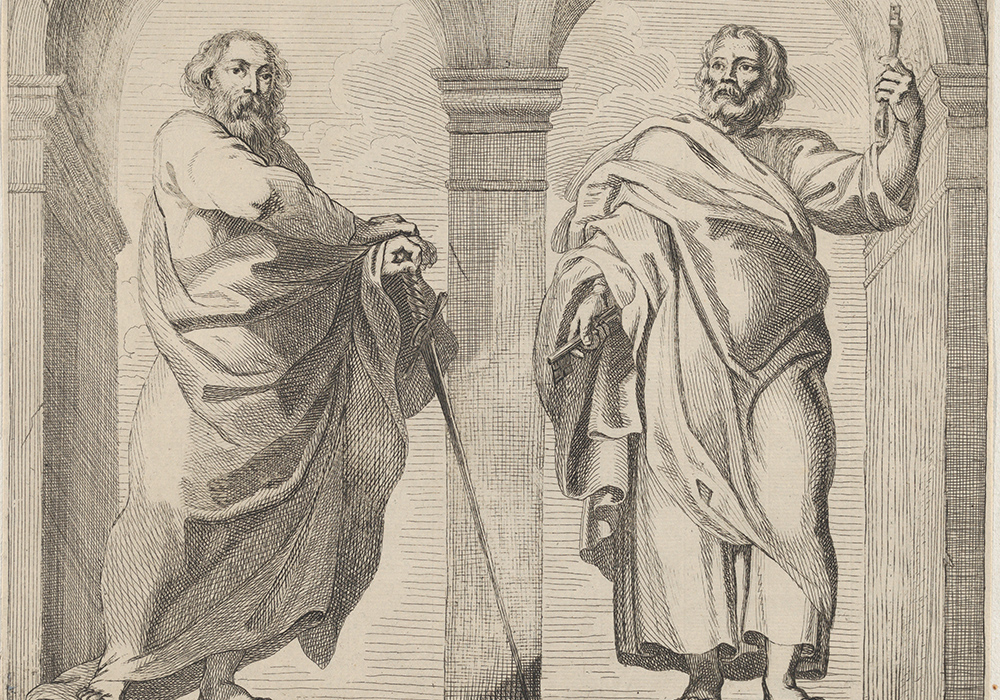
“Saints Peter and Paul in a vestibule,” etching by Rombout Eynhoudts after Peter Paul Rubens, circa 1630-80 (Metropolitan Museum of Art)
After his resurrection, Jesus appeared to his disciples on several occasions. Toward the end of Luke’s Gospel, we hear of the disciples on the road to Emmaus:
That same day, two of them were going to a village called Emmaus, about seven miles from Jerusalem. They were talking with each other about everything that had happened. As they talked and discussed these things, Jesus himself came up and walked along with them, but they were kept from recognizing him. He asked them, “What are you discussing together as you walk along?”
Later, in the Acts of the Apostles, we read that Jesus appeared to Paul as he was on the road to Damascus:
“Saul, Saul, why do you persecute me?”
“Who are you, Lord?” Saul asked.
“I am Jesus, whom you are persecuting,” he replied. “Now get up and go into the city, and you will be told what you must do.”
The men traveling with Saul stood there speechless; they heard the sound but did not see anyone. Saul got up from the ground, but he could see nothing when he opened his eyes.
The Gospels record several instances when Jesus appeared to Peter. Today we read of his restoration. There is also a legend of Jesus appearing to Peter many years later.
Peter eventually made his way to Rome, and after a time, one of the persecutions of the Christian church began. The legend picks up:
His friends, so runs the story, had entreated the Apostle to save his life by leaving the city. Peter finally consented, but on the condition that he should go away alone. But when he wished to pass the city gate, he saw Christ meeting him. Falling down in adoration, he said to Him, ‘Lord, whither goest Thou?’ And Christ replied, ‘I am coming to Rome to be again crucified.’ And Peter said to Him, ‘Lord, wilt Thou again be crucified?’ And the Lord said to him, ‘Even so, I will again be crucified.’ Peter said to Him, ‘Lord, I will return and will follow Thee.’ And with these words, the Lord ascended into Heaven.
The encounter on the road out of Rome gave Peter the courage to return to Rome and face his death, which Jesus also spoke of in our Gospel: “When you grow old, you will stretch out your hands, and someone else will fasten a belt around you and take you where you do not wish to go.” You will stretch out your hands—you will be crucified.
Today, I have a question for you. Three different encounters and three different roads. Jesus asked, “What are you discussing together as you walk along?” Jesus asked, “Saul, Saul, why do you persecute me?” Jesus said, “I am coming to Rome to be again crucified.”
Now imagine, if you will: you are walking down an old dirt road in Oklahoma. It is pleasantly warm, the sun is beginning to set, and you are at peace, simply enjoying your time, when you encounter Jesus. You say a little prayer: “Speak, Lord, for your servant is listening.”
Pip: There's a Peanuts cartoon that opens a sermon, and somehow it leads directly to eternal life — which is either a bold homiletical move or proof that Lucy van Pelt has always been theologically underrated.
Mara: This episode covers one sermon from Fr. John, working through what it means to be part of a body where every gift counts — not just the ones delivered from a pulpit.
Pip: Let's start with the sermon itself, and the question of who actually does the work of the church.
Empowered for the Mission — Every Gift Counts
Mara: The sermon is built around a deceptively simple question: if not everyone is called to preach or heal or cast out demons, what exactly is everyone else doing in the mission of God?
Pip: The answer comes from the tail end of Matthew 10, Jesus wrapping up his instructions to the twelve before sending them out. The setup is that hardship is guaranteed — and so is help from unexpected quarters.
Mara: The sermon lands the key line directly from that passage: "Whoever receives you, receives me, and whoever receives me, receives the Father." The argument is that welcoming and supporting those who carry the mission makes you a participant in it.
Pip: Which is a genuinely generous theological claim — you don't have to be the one casting out demons to get credit for the demon-casting.
Mara: Two Old Testament figures anchor that claim. Elijah and the widow of Zarephath: she shares her last flour and oil, and the jar never empties. Later, her son dies and Elijah raises him. Elisha and the Shunammite woman: she feeds him whenever he passes through, and Elisha promises her a son she had stopped hoping for.
Pip: Both women receive what the sermon calls the prophet's reward — not because they prophesied, but because they made the prophet's work possible.
Mara: Paul's letter to the Corinthians supplies the structural argument: "There are varieties of gifts, but the same Spirit; and there are varieties of service, but the same Lord; and there are varieties of activities, but it is the same God who empowers them all in everyone. To each is given the manifestation of the Spirit for the common good."
Mara: The upshot is that no single gift runs the whole operation. The apostles need the widow's flour. The prophet needs the Shunammite's hospitality. The body needs every member.
Pip: And the sermon loops back to Lucy at this point — those five fingers, individually nothing, curled together into something formidable. It is, against all odds, the correct analogy.
Mara: Archbishop Michael Ramsey gets the closing description of what that body looks like across centuries: "Human lives united to Jesus, receiving his presence, and showing his goodness, his love, his sacrifice, his humility and his compassion. Living stones."
Pip: The sermon closes by naming the stakes beyond the prophet's reward — Christ's reward, forgiveness and resurrection, the food that does not perish. The call is direct: find where your gift fits, and get to work.
Mara: The harvest line from Luke lands as the final push: "The harvest is plentiful, but the laborers are few." Every laborer counts, regardless of what kind of laboring they do.
Pip: One sermon, but the argument keeps widening — from twelve apostles to a widow's jar to every person sitting in a pew wondering if they have anything to offer.
Mara: The answer the sermon gives is yes, unambiguously. The body needs what you have. More on that territory next time.
In a Peanuts cartoon, Lucy demands that Linus change the TV channel and then threatens him with her fist if he doesn’t. “What makes you think you can walk right in here and take over?” asks Linus. “These five fingers,” says Lucy. “Individually, they are nothing, but when I curl them together like this into a single unit, they form a weapon that is terrible to behold.” “What channel do you want?” asks Linus. Turning away, he looks at his fingers and says, “Why can’t you guys get organized like that?”
My initial reaction to today’s Gospel reading was to shake my head at the liturgical committee that chose it. There is no time, context, audience, or anything provided in the reading to help us understand. So let’s begin by setting the scene, which is a little easier if you were here last week, because this week’s reading is part of that same conversation.
The audience Jesus is speaking to is the twelve apostles, and he is giving them instructions because He is about to send them out.
At the beginning of the chapter, Matthew 10, where our reading is located, we are told, “Jesus called to him his twelve apostles and gave them authority over unclean spirits, to cast them out, and to heal every disease and every affliction” (Matthew 10:1). Jesus gives them instruction on their travels and what to expect: “Behold, I am sending you out as sheep in the midst of wolves, so be wise as serpents and innocent as doves” (Matthew 10:16), and also tells them to “have no fear” (Matthew 10:26) for they are of great worth to their Father in heaven.
Then comes our lesson from last week. Jesus tells them that the message they carry will not bring peace but division, saying, “I have not come to bring peace, but a sword” (Matthew 10:34b).
Today’s Gospel is the conclusion of the apostles’ marching orders, and it can be seen as encouragement, because Jesus tells them that as they go and experience the hardships along the way, there will be people who never preach a sermon, never cast out a demon, never heal the sick, yet by welcoming, encouraging, and supporting Christ’s servants they become participants in the very mission of God. “Whoever receives you, receives me, and whoever receives me, receives the Father.” Good. In other words, when someone receives you as my disciple, it will be like in times past when someone received and helped a prophet carry out their work. Elijah and Elisha provide two very good examples of this.
During the reign of King Ahab, he did evil in the eyes of the Lord, so the Lord brought a drought upon the land, as Elijah had proclaimed. Afterward, the Lord sent Elijah to Zarephath. There, Elijah encountered a widow and asked her for a little something to eat and a drink of water. She responded that she had only a little flour in a jar, enough to make one small cake for her and her son to eat, after which they would die because of their poverty and the drought. Yet Elijah said, “Do not fear… The jar of flour shall not be spent, and the jug of oil shall not be empty, until the day that the Lord sends rain upon the earth” (1 Kings 17:14), and it was done according to the word of Elijah. While the world around her suffered from the drought and went hungry, the widow and her son received the prophet’s reward and had plenty.
Later, the widow’s son died because of illness, yet because of her support and kindness to Elijah, the Lord raised the child from the dead through Elijah’s prayer.
Then there was Elisha, who frequently passed through the town of Shunem. A wealthy woman lived there, and each time Elisha passed through, she would feed and care for him. Elisha asked what could be done to repay her kindness. She would not say, but Gehazi, Elisha’s servant, told him that the woman was childless, even though she and her husband desired one. Hearing this, Elisha promised her the reward of a prophet: “At this season, about this time next year, you shall embrace a son.” (2 Kings 4:16) She was too afraid to believe it, but the following year she had a son.
When Jesus speaks to the disciples about the prophets’ reward and the righteous person’s reward, he says, “You will encounter hardships in following me and doing the Father’s will, but there will be those who help you. Because of their help, they too will receive a reward.”
Why? Not everyone can be called to be a prophet or a apostle, but all can assist the prophet or apostle in other ways.
Saint Paul tells us, “Now there are varieties of gifts, but the same Spirit; and there are varieties of service, but the same Lord; and there are varieties of activities, but it is the same God who empowers them all in everyone. To each is given the manifestation of the Spirit for the common good.” (1 Corinthians 12:4-7) And remember how, a little later, he asked a series of questions, “Are all apostles? Are all prophets? Are all teachers? Do all work miracles?” (1 Corinthians 12:29), and so on. The answer is no. Not all are this or that, but each one has been empowered with gifts “for the common good.” That’s exactly the point Lucy was making, “These five fingers… Individually, they are nothing, but when I curl them together like this into a single unit…” This same principle applies to Elijah and Elisha, the apostles, and on down through history to us gathered here today. Is this true?
Do you know how many people I’ve asked from this congregation to come up here and preach? Do you know how many times, when I ask that question, the person looks at me as though I didn’t have the sense God gave a turnip? Yet that same person may have taken on another ministry in the church or an act of hospitality. Something I had no clue how to do.
Paul again says, “For just as the body is one and has many members, and all the members of the body, though many, are one body, so it is with Christ. For in one Spirit we were all baptized into one body—Jews or Greeks, slaves or free—and all were made to drink of one Spirit.” (1 Corinthians 12:12-13) He is, of course, speaking of the church. When Jesus spoke of those who would receive a prophet’s reward or a righteous person’s reward, he was also speaking of the church, all of its members. This reward from God is not limited to the front person, the one in the dog collar and fancy robes. The reward is for the entire body of Christ, with each member exercising the gifts they have been empowered with.
A few weeks back, we spoke of our baptism and our entrance into the body of Christ. We then spoke of what it means to be loyal to God, not simply a passive relationship but one that is active in thought, word, and deed. Today, we understand that this active faith, as sons and daughters of God, is lived out in the Church, using the gifts we have been blessed with, both individually and corporately.
In The Canterbury Pilgrim, Archbishop of Canterbury Michael Ramsey speaks of the church as a building, which he then describes as a symbol of the Church formed by those who become the Body of Christ. Of this Body, Archbishop Ramsey captures exactly what Paul said, “Through the centuries this other Church—the Body of Christ—has stood: human lives united to Jesus, receiving his presence, and showing his goodness, his love, his sacrifice, his humility and his compassion. Living stones – what a mingling of metaphors! It tells of firm, solid, unmovable loyalty, and of persons alive in joy, in freedom, in creativity, in influence. This is the Church that Jesus Christ founded, the Church of which he said that the gates of death would never prevail against it.” (Glory Descending, Eerdmans, p.129)
This is the Church and the great work that takes place within these walls and within the Body of Christ. However, for our participation in it, there’s not just the prophet’s reward or the righteous person’s reward. Jesus says, “This is the will of my Father, that everyone who looks on the Son and believes in him should have eternal life, and I will raise him up on the last day.” (John 6:40) Therefore, Jesus says, “Do not work for the food that perishes, but for the food that endures to eternal life, which the Son of Man will give to you.” (John 6:27) For us, there is more than the prophet’s or righteous person’s reward, there is Christ’s reward, the food that does not perish—the forgiveness of sins and eternal life on the last day.
In your life with God and your life in the Church, use the gifts you have been empowered with and work for Christ’s reward. No gift is too small. No gift is unnecessary. And by combining them, we become the church God desires us to be. Ask yourself, where can I put my gifts to work in the Body of Christ, and then get busy. You are needed, for “The harvest is plentiful, but the laborers are few,” (Luke 10:2), and we may not all be apostles or prophets, but we are all laborers in this great Kingdom of our God.
Let us pray: Everliving God, whose will it is that all should come to you through your son Jesus Christ: Inspire our witness to him, that all may know the power of his forgiveness and the hope of his resurrection; who lives and reigns with you and the Holy Spirit, one God, now and forever. Amen
Pip: There's a sermon out there that opens with Henry Ford, pivots through a Ridley Scott film, and lands at a baptismal font — and somehow the logic holds the whole way through.
Mara: That's Fr. John's recent work at Candle in a Cave — a sermon on what baptism actually does to a person, and why the answer is more than symbolic.
Pip: Let's start with the knights of Jerusalem and what they have to do with a sacrament.
What Baptism Actually Does
Mara: The sermon opens with a question that sounds almost dismissive — does water make someone a child of God any more than a sword makes someone a knight?
Pip: And the film Kingdom of Heaven is doing real theological work here. Balian of Ibelin knights common farmers and blacksmiths before a siege, and the bishop asks whether the ceremony changes anything. Balian's answer is one word.
Mara: The sermon quotes it directly: "Does making a man a knight make him a better fighter?" — and Balian looks the bishop square in the eye and says, "Yes."
Pip: That yes carries weight because medieval knighthood wasn't ceremonial decoration. It conferred land, status, religious standing, and — crucially — a new interior sense of self.
Mara: Exactly the point. The sermon draws the parallel plainly: baptism isn't merely about water, just as knighthood isn't merely about a sword. Both are about, in the sermon's own words, "a new allegiance, a new identity, and a new life."
Pip: The Ford story at the opening earns its place here — a machinist returns stolen tools the morning after his baptism. Something actually shifted.
Mara: The sermon lists what that shift includes: forgiveness of sins, participation in Christ's death and resurrection, renunciation of evil, and entry into the community of faith. Then it names the seal — chrismation with oil blessed by the bishop, and the words spoken at the sign of the cross.
Pip: "You are sealed by the Holy Spirit in Baptism and marked as Christ's own for ever." That's the line that closes the ceremony, and the sermon treats it as the thing that makes the rest of it stick.
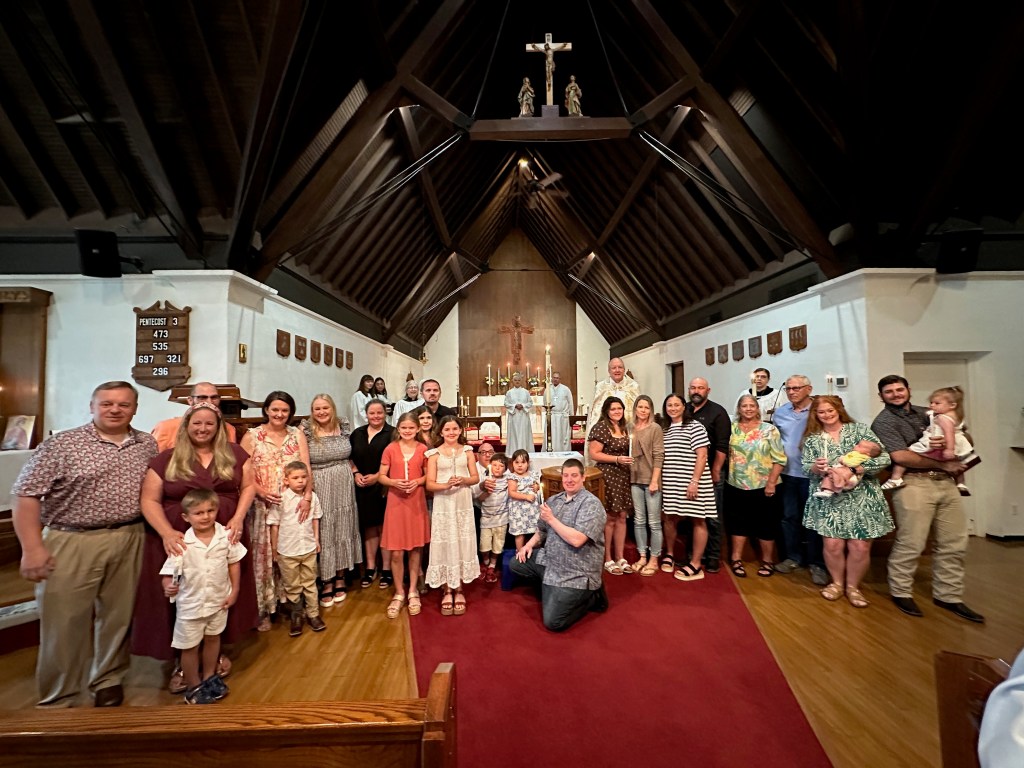
Mara: Nine baptisms on the day this sermon was preached. The closing line echoes Ford: dam up the Cimarron and baptize everyone.
Pip: A bishop, a machinist, and Balian of Ibelin walk into a font — and the sermon makes the case that all three are asking the same question.
Mara: What holds this together is a single claim — that identity conferred by ritual is real identity, not performance.
Pip: Which means the next time someone asks what water does, the answer is still yes.
According to Christian ministry lore, a machinist at the Ford Motor Company found religion and was baptized. Before his conversion, the man had frequently stolen parts and tools from the Ford factory.
Moved by his newfound faith, the employee returned all the stolen goods to his boss the very next morning, explained his baptism, and asked for forgiveness. Dumbfounded by this unprecedented response, the manager sent a telegram to Henry Ford (who was traveling in Europe at the time) asking how to handle the situation. Ford reportedly wired back his enthusiastic approval with the now-famous reply: “Dam up the Detroit River, and baptize the entire city!”
When I get home on Thursday nights—my Friday—my brain is only up for a glass of wine and a movie. Since most new movies disappoint, I’ll usually rewatch an old favorite. A couple of Thursdays ago, I settled in with Kingdom of Heaven, best described as historical fiction about the defense and fall of Jerusalem to Saladin in 1187.
This movie centers on Balian of Ibelin. In the movie, his personal life is entirely fictional; however, his role in the defense of Jerusalem is quite accurate, down to a powerful scene as the final battle approaches.
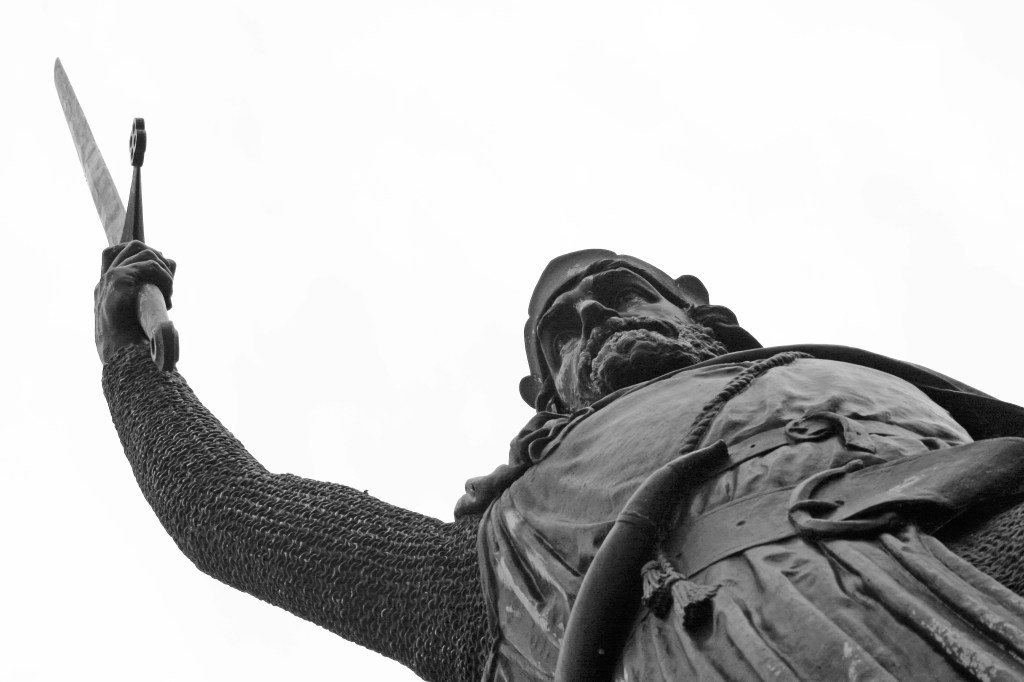
The problem: too few knights remain to defend the city. Most have died or fled. The Patriarch of Jerusalem points this out to Balian. Accepting his words, Balian gives a rousing speech and commands, “Every man-at-arms or capable of bearing them, kneel.” All comply. Approaching a young man, Balian recites his father’s words: “Be without fear in the face of your enemies. Be brave and upright, that God may love thee. Speak the truth even if it leads to your death. Safeguard the helpless. That is your oath.” To the young man’s surprise, Balian slaps him and says, “And that’s so you remember it.” Balian then steps back, addressing the assembly, and says, “Rise, a knight.”
The bishop, who has witnessed all this, is not impressed and says to Balian, “Does making a man a knight make him a better fighter?” Balian looks the bishop square in the eye and says, “Yes.”
That actually happened, but for us today, we might be inclined to think like the bishop—putting lipstick on a pig doesn’t make a pig a beauty queen. However, that’s us today. Back then, being made a knight made you something new.
Being made a knight gave you land and privileges. It offered chances for advancement, political influence, and access to goods and services a commoner would never have. It meant entry into the aristocracy and more. But perhaps more importantly, a shift took place within. You actually became someone. People looked up to you; they called you “Sir.” Your sense of self-worth increased dramatically.
There was also a religious aspect, especially in Jerusalem. There, you became a true defender of the faith. For many, you were a Christian hero. The Pope essentially stated that serving as a knight in Jerusalem counted toward all penances you owed.
When the bishop asked, “Does making a man a knight make him a better fighter?” Balian’s “Yes” carried all this weight, and those who took the knee believed it. No longer were they blacksmiths, farmers, peasants, or even slaves. They were now great defenders of the faith, and for those who truly believed, it would have meant a great deal and, in fact, made them knights and better fighters.
And if you have figured out by now that I’m not talking about the knights of Jerusalem but about those to be baptized into the Christian faith, give yourself a gold star.
Today, we have ____ who will be baptized into Christ’s one holy catholic and apostolic Church. Yet some might ask, “Does water make someone a child of God any more than a sword makes someone a knight?” The answer: Yes! Because neither baptism nor knighthood is merely about water or swords. Both are about a new allegiance, a new identity, and a new life.
Behind that, yes, lie forgiveness of sins, participation in Christ’s death and resurrection, the renunciation of Satan and evil forces of this world, the desire to fight sin and injustice, and true loyalty to Christ Jesus as Lord and Savior. Baptism also opens participation in the community of faith in thought, word, and deed, the call to commend the faith that is in you, and more. Through baptism, you become a citizen of the Kingdom of God and take on all the benefits and duties of a child of God, as has been practiced throughout the Church’s history.
Finally, I won’t be slapping anyone to make them remember it, but we will chrismate all those baptized with the oil blessed and set aside by the bishop. As the sign of the cross is made on the forehead, the words are spoken: “You are sealed by the Holy Spirit in Baptism and marked as Christ’s own for ever.” This sealing in the Holy Spirit helps us remember all that has been done for us and all that we have vowed to do ourselves.
Given all this sacrament of baptism accomplishes in a person, I say, “Dam up the Cimarron and let’s baptize everyone.” Or, according to the Book of Common Prayer on page 301, “The candidates for Holy Baptism will now be presented.”