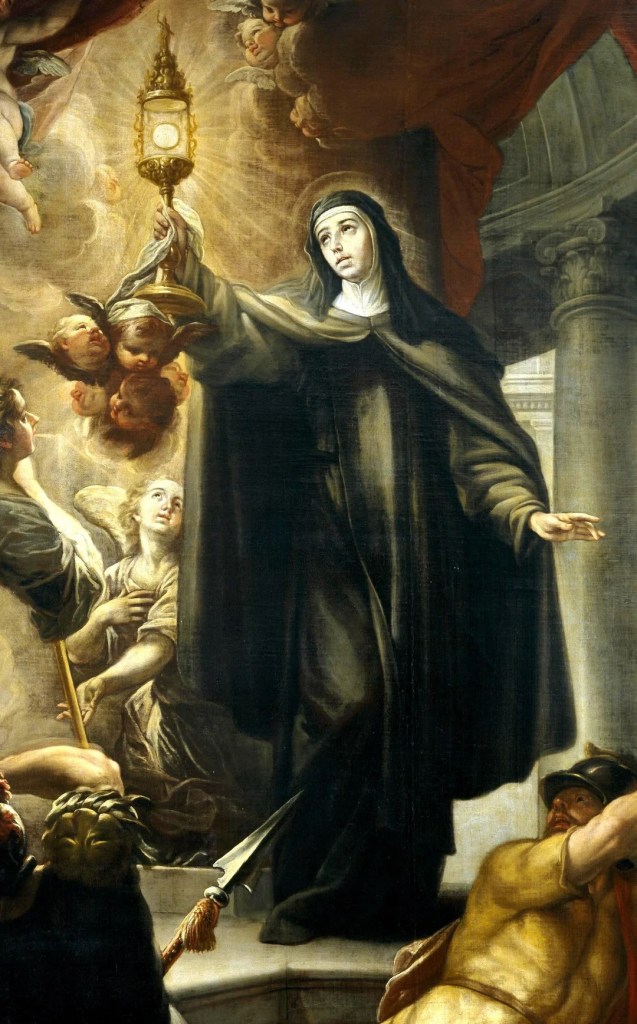
Sermon: Clare of Assisi

St. Clare of Assisi: We know very little about her childhood beyond being born into a wealthy family. However, at age eighteen, she had the opportunity to hear St. Francis of Assisi preach and decided to leave everything behind.

Sneaking away from her family, who would have prevented her, she went to Francis and expressed her desire to follow in the way of his teachings. She exchanged her fine clothes for a dress of rough fabric. She cut her long, beautiful hair and replaced it with a veil. At one point, her family tried to pull her back, but she ultimately prevailed, and later her sister Agnes and her mother, when widowed, joined her in the convent.

How did she live? She was barefoot all year, spoke only when necessary, prayed for hours daily, had no source of income, so begged for alms, ate no meat, fasted on bread and water, and slept on a hard floor. Eventually, the Bishop and Francis ordered her to sleep on a mattress for health reasons. You might think such a life would be so unappealing that no one would follow in her footsteps, but that was not the case. When she died, “there were forty-seven convents in Spain alone, with many others in Italy, Bohemia, and France. And not long after Clare’s death, four convents of Poor Clares—as they became known—were founded in England.”

She was considered so pure and righteous in faith that bishops, cardinals, and even Popes sought her advice. Pope Innocent IV, who heard her last confession. Following that confession, he said, “I would to God I had so little need of absolution myself.”

On August 11, 1253, the day she died, she was heard to say, “Go forth in peace, for you have followed the good road. Go without fear, for he who created you has sanctified you, has always protected you, and loves you as a mother. Blessed are you, O God, for having created me.”

Could such a movement continue today? Currently, there are 20,000 Poor Clares spread across the world, living cloistered lives dedicated to prayer—praying for the needs of the church and the world.

In a letter to Agnes, the daughter of the King of Bohemia, who also became a Poor Clare, Clare wrote,

When You have loved [Him], You shall be chaste;
when You have touched [Him], You shall become pure;
when You have accepted [Him], You shall be a virgin.
Whose power is stronger,
Whose generosity is more abundant,
Whose appearance more beautiful,
Whose love more tender,
Whose courtesy more gracious.
In Whose embrace You are already caught up;
Who has adorned Your breast with precious stones
And has placed priceless pearls in Your ears
and has surrounded You with sparkling gems
as though blossoms of springtime
and placed on Your head a golden crown
as a sign [to all] of Your holiness.

There is no doubt that St. Clare of Assisi has received the golden crown from the One she loved above all others—Jesus.
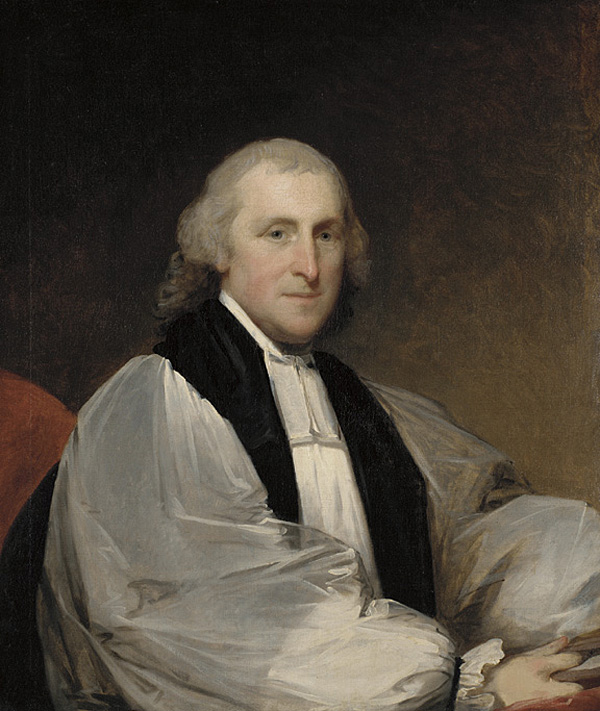
Sermon: William White


The first Holy Communion of the Church of England was held in 1607 in Jamestown, Virginia.  It was a slow start, but the church began to take hold and was quite successful; however, because of its ties to England, that changed following America’s independence.  According to Powell Mills Dawley in Our Christian Heritage, “the American Revolution left the Anglican parishes shattered, stripped of most of their financial support, weakened by the flight of many clergy and thousands of members, with a number of buildings destroyed and property lost.”

Not only did the citizens of the new United States abandon the church, but in a very real sense, the Church of England did as well.  The primary issue was that we had no American Bishops.  As you know, a Bishop is required to Confirm, ordain clergy, and it takes three Bishops to consecrate a new Bishop.  Therefore, if a person wanted to be ordained a priest, they had to make the long and perilous trip to England.

To remedy the situation, a few devoted men took up the cause.  Among them were Samuel Seabury, Samuel Provoost, the person we celebrate today, William White, and James Madison – all four of which made the journey to England to be consecrated.  Then, having enough American Bishops, Thomas Clagget was consecrated Bishop in New York, and the Church in America could function separately from the Church of England.  In 1789 – the first General Convention – under these men’s leadership, specifically William White, the American Episcopal Church was fully organized. 

William White served as our first and fourth presiding Bishop in 1789 and from 1795 to 1836.  In addition, he served for 57 years as the rector of St. Peter and Christ Church in Philadelphia.  He died in 1836.

A lengthy obituary devoted to Bishop White appeared in the National Gazette and Literary Register.  In part, it described his character, “…[T]he duties of the several important relations in which he stood to society were performed with undeviating correctness and suavity; he possessed the rare merit of winning the respect and love of an entire community to which he was an ornament and a blessing. His piety was deep and unfeigned; his walking humble yet dignified; his acquirements profound; in his mind the welfare of the Christian church was always the prominent consideration…He was one of those examples of steady virtue sent upon earth by Divine Providence, as if to prove how near the great pattern of perfection it is permitted to approach.”

In our Gospel reading today, Jesus asked St. Peter, “Simon, son of John, do you love me more than these?” He said to him, “Yes, Lord; you know that I love you.” Jesus said to him, “Feed my lambs.”  This was the restoration of St. Peter after he denied Jesus three times the night before Jesus was crucified.  It is also a command given to all who would be followers of Jesus – “Feed my sheep.”  In those three words, God calls us all, lay and ordained, to care for those we encounter.  To care for them in both their physical and spiritual needs.  For us in the Episcopal Church, William White is an exemplary role model for us to emulate.  When you consider what it means to be true and faithful to the Church, you need only consider him to find the “great pattern of perfection” that leads to becoming a faithful servant to God and His One Holy Catholic and Apostolic Church.