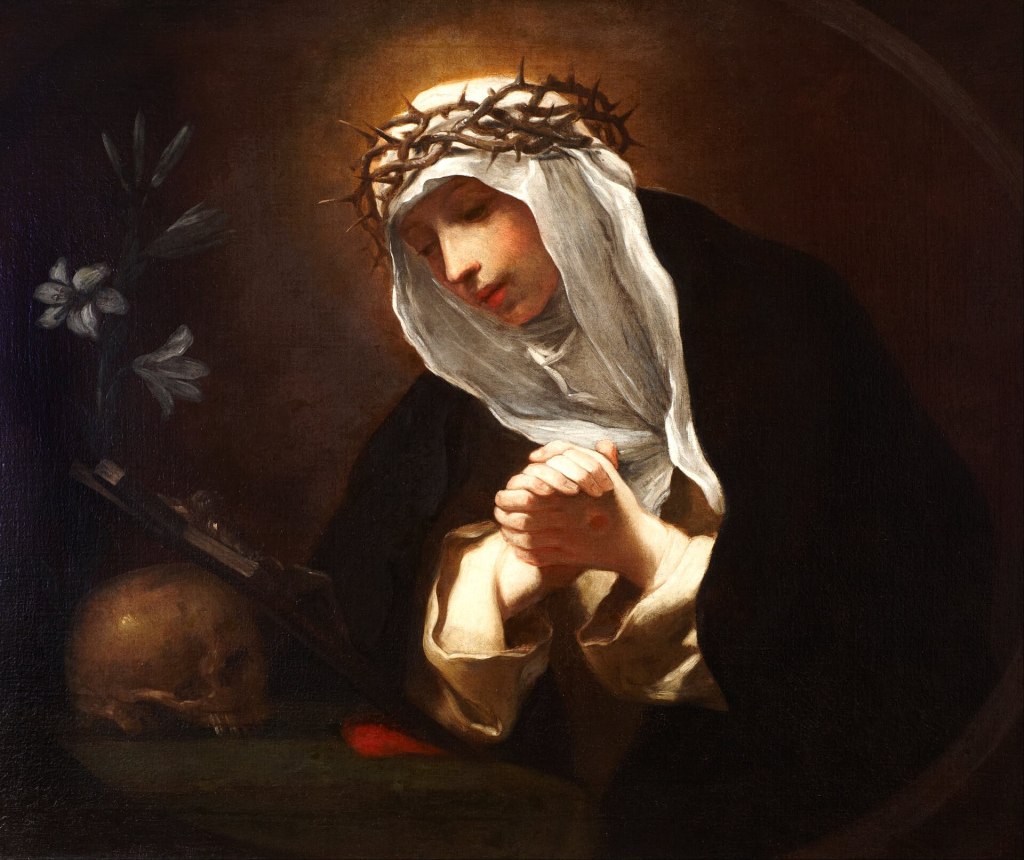
Saint Catherine of Siena by Franceschini Baldassare, 17th century
Catherine of Siena was born in 1347, the twenty-fourth of her parents’ twenty-five children. At the age of seven, she vowed her life to Christ. At the age of fifteen, she cut her hair in defiance of her parents, who were pressing her to marry. At the age of eighteen, she joined the Dominicans. At the age of twenty-one, she had a mystical experience in which she became spiritually espoused to Christ. Those events alone are enough, but through her work, particularly her writings, she became a force in her community and beyond, even with Popes.
In her letters and her Dialogue, perhaps the greatest of her writings, she recounts a soul’s journey through the mystical experience of God. There is much to discuss in her writings, so I’ll focus on one idea: she writes a prayer to Christ, speaking to Him about His great love for God’s people and asking what could drive the Creator of all to pursue His creation so recklessly.
“O priceless Love! You showed your flamed desire when you ran like a blind and drunk man to the opprobrium [the disgrace] of the cross. A blind man can’t see, and neither can a drunk man when he is fast drunk. And thus he [Christ], almost like someone dead, blind and drunk, lost himself for our salvation.” Continuing this theme of drunkenness in her Dialogue, she says, “O mad lover! Why then are you so mad? Because you have fallen in love with what you have made! You are pleased and delighted over her within yourself, as if you were drunk for her salvation. She runs away from you, and you go looking for her. She strays, and you draw closer to her. You clothed yourself in our humanity, and nearer than that you could not have come.”
Continuing elsewhere, she writes, “O unutterable love, even though you saw all the evils that all your creatures would commit against your infinite goodness, you acted as if you did not see and set your eye only on the beauty of your creature, with whom you fell in love, like one drunk and crazy with love. And in love you drew us out of yourself, giving us being.”
I am certain that we’ve all been in love before, or at least thought we were, and in that state, I feel certain we’ve all done some pretty stupid things. I’m also fairly certain that most have overindulged in some intoxicating beverage and done some rather stupid things then as well. If you have had the fortune (or misfortune) of being both in love and intoxicated, the level of stupidity can reach even higher levels. That is how Catherine says that Jesus loves us, as though He were drunk and in stupid love with us. That may sound crazy and, to some, irreverent if not blasphemous, but how would you describe a love that lays down his life for you? Logic can’t explain it. Duty doesn’t come close. I suppose we could just say He was crazy, but if we have faith, if we believe that it is the Father’s desire that all should be saved even if we are wicked, then we must at least consider that Catherine was onto something: a love that appears to be a drunken insanity, but which is in fact pure and true.
You don’t have to agree with Catherine’s images of God’s love for us, but take some time to reflect on that love. Jesus was not intoxicated by wine, but how would you describe and explain His actions? You might just discover that a crazy, drunken lover is the best you can do.
I’ve no idea how I’ve ended up in the world of old radio programs—last week, it was Orson Welle’s broadcast of War of the Worlds—and this week, I’ve found another one. It began on July 31, 1930, as the Detective Story Hour radio program. Each episode starts with the narrator stating, “Who knows what evil lurks in the hearts of men? The Shadow knows!” Each episode concludes, “As you sow evil, so shall you reap evil! Crime does not pay…The Shadow knows!”
Later episodes reveal that Kent Allard is The Shadow but goes by many different aliases. His best-known alias is Lamont Cranston, a bit of a Batman/Bruce Wayne character. Living in New York, he is a vigilante with a vast network of assistants and informants and a trusty .45 Colt pistol that aids him in fighting crime. Through these, he can gain the information he needs to defeat the criminals. He is also where we get the phrase, “Only the Shadow knows.” (I actually had no idea what that meant until I started reading about it this week. It was just one of those things you said.)
In the end, The Shadow learned and knew what others did not.
In our Saints Book Club this past week, we discussed Saint Catherine of Siena: Mystic of Fire—Preacher of Freedom. I think we all walked away, wanting to know more about her. Although uneducated and not learning to read or write until a later age, she was one who advised paupers and Popes. Very remarkable. In her writing, she also speaks of a shadow. Like the radio character, her shadow also learns and knows what others do not, but instead of it being about others, her shadow knows about herself.
Catherine says, “Never leave the knowledge of yourself!” (p.41) What she is saying is that we need to know the shadow, our inner selves intimately, so that we can begin, in the words of St. Paul, to “work out [our] own salvation with fear and trembling, for it is God who works in [us], both to will and to work for his good pleasure.” (Philippians 2:12-13)
How does it work? Someone can tell me, “You’re so kind and loving.” I can believe that and go on my merry way, but if I look at the shadow within, I know that is not really true. As David says in the Psalms,
“For I know my transgressions, and my sin is ever before me.” (Psalm 51:3)
Understanding your shadow means knowing yourself and rooting out even the slightest transgressions. This helps us temper the praise of others, which can build our ego to unmanageable levels and also keeps us from believing the lies we tell ourselves. It also keeps us humble and compassionate, for by recognizing our faults and weaknesses, we begin to understand the struggles that others are facing in their own lives. However, knowing your shadow comes with a warning.
When you discover the shadow within, those ugly bits about yourself, you start to believe what it says about you. Catherine writes, “[W]hen notions come into the heart that say, ‘What you are doing is neither pleasing nor acceptable to God; you are in a state of damnation.’ And little by little, after these notions have caused discouragement, they infiltrate the soul and point out a way disguised as humility, saying, ‘You can see that because of your sins you aren’t worthy of many graces and gifts’—and so the person stays away from communion and from other spiritual gifts and practices. This is the devil’s trick, the darkness he causes.” (p.60)
We can come to believe we are all that and a bag of chips based on what others say about us, but by understanding our shadow and the sinfulness within, we can also come to believe the devil, who tells us we are completely lost and outside of God’s redeeming work. Through self-condemnation, we become discouraged and may eventually walk away from God entirely, believing we will never be good enough. That is a lie of the devil, but what is the solution? The solution is recognizing that the shadow only distorts the image within you. The shadow is not who you truly are. To see the true you, you must look in what Catherine calls “the Gentle Mirror of God.”
“In the gentle mirror of God,” Catherine writes, the believer when at prayer “sees her own dignity: that through no merit of hers but by his creation she is the image of God.” (p.47)
The image of God within can reveal itself in a multitude of ways—how we give, how we serve, how we sacrifice ourselves—but for Catherine, all of these can be summed up in one word: fire.
Today, in our first lesson, Daniel relates a vision.
As I watched, thrones were set in place, and an Ancient One took his throne, his clothing was white as snow, and the hair of his head like pure wool; his throne was fiery flames, and its wheels were burning fire. A stream of fire issued and flowed out from his presence. (Daniel 7:9-10a)
Catherine is very much aware of the shadow within herself, but as she looks in the gentle mirror of God, she begins to understand the nature of God and, in so doing, understands her own nature, which is the image of God within her. Speaking to God, who she refers to as boundless Love, she says, “In your nature, eternal Godhead, I shall come to know my nature. And what is my nature, boundless Love? It is fire, because you are nothing but a fire of love.” (p.47) St. John says, “God is love, and whoever abides in love abides in God, and God abides in him.” (1 John 4:16b) God is love, and for Catherine, this love is revealed as fire. A fire that reveals the defects of the shadow and a fire that, through its love, restores us to the true Image of God.
She writes, “For just as you can better see the blemish on your face when you look at yourself in the mirror, so the soul who in true self-knowledge rises up with desire to look at herself in the gentle mirror of God… sees all the more clearly her own defects because of the purity she sees in him.” (p.47)
This is not an easy process. It can be painful at times because recognizing the defects of your own shadow is recognizing the not-so-nice bits about yourself. However, it is also “sweet” because by identifying the defects of the shadow, you can begin to do something about them.
Today is Christ the King Sunday. The day we celebrate the Kingship of our Lord. Liturgically, this is the last Sunday of the Church year. Next Sunday we begin the Season of Advent, which will lead up to the birth of the Christ Child. Much like the Season of Lent, the Season of Advent is a time of preparation. In Advent, we prepare our hearts, minds, and souls to receive the great gift of our salvation given to us through the birth of Jesus. One of the ways that we can prepare is by doing as Catherine encourages—knowing the shadow within as revealed by the fire we see in the gentle mirror of God.
You can stop there, but there are times when it must be spoken to release a thing’s power. Catherine says, “When [evil] thoughts or strong temptations regarding some specific thing (no matter how ugly) come into your heart, never keep them inside, but reveal them to the father of your soul…. We mustn’t be afraid, but must reveal our every infirmity to the doctor of our soul.” (p.92) Don’t shoot the messenger, but she is talking about confession. There are times when, in order to release the power of sin, the sin must be spoken, and the Church provides the Sacrament of Reconciliation/Confession for this specific purpose.
The Book of Common Prayer teaches us, “[I]f, in your preparation, you need help and counsel, then go and open your grief to a discreet and understanding priest, and confess your sins, that you may receive the benefit of absolution, and spiritual counsel and advice; to the removal of scruple and doubt, the assurance of pardon, and the strengthening of your faith.” (BCP 317) No. Confession is not the Church’s way of learning about all the ugliness of your shadow. Instead, it is the Church’s way of helping the fire of God’s love within you burn away sin so that you might be set free. It is as simple as that.
“Only the Shadow knows.” The shadow within you knows your inner self. Get to know it, then get to work on it. Allow the fire of God… allow Jesus to set you free, which is true freedom. For as Jesus teaches, “If the Son sets you free, you will be free indeed.” (John 8:36)
Let us pray: (Prayer 12: My Nature Is Fire)
In your nature, eternal Godhead, I shall come to know my nature. And what is my nature, boundless love? It is fire, because you are nothing but a fire of love. And you have given humankind a share in this nature, for by the fire of love you created us. And so with all other people and every created thing; you made them out of love. O ungrateful people! What nature has your God given you? His very own nature! Are you not ashamed to cut yourself off from such a noble thing through the guilt of deadly sin? O eternal Trinity, my sweet love! You, light, give us light. You, wisdom, give us wisdom. You, supreme strength, strengthen us. Today, eternal God, let our cloud be dissipated so that we may perfectly know and follow your Truth in truth, with a free and simple heart. God, come to our assistance! Lord, make haste to help us!