Pip: A three-year-old invoking the name of Jesus to score twenty-three boxes of chocolate chip cookies — honestly, that is the most theologically efficient prayer in recorded history.
Mara: That story opens a sermon by Fr. John, and it turns out to be the perfect door into something much larger: what prayer actually does when God already has a plan.
Pip: Right — and that tension between providence and petition is exactly where this episode lives. Let's get into it.
Providence, Prayer, and a Busted Hip
Mara: The central question here is one that anyone who has prayed and waited and heard nothing will recognize: if God has a wise, loving plan already in motion, what is the point of asking?
Pip: The sermon lands its answer through Jacob — a man who wrestled God at the Jabbok River and refused to let go. Here is the line that frames everything: "Jacob prayed, 'Bless me,' and the Lord replied, 'What you are asking is good, but it is too small.'"
Mara: That reframe is the hinge of the whole argument. Jacob got his blessing — but it arrived as a dislocated hip, a new name, and a lineage that eventually produced Jesus of Nazareth. The prayer was answered; it just expanded far beyond what Jacob could have conceived.
Pip: So the sermon is not really arguing that God ignores us. It is arguing that our requests are structurally too small for what God is doing.
Mara: Exactly, and three reasons for prayer follow from that. The first two are fairly direct: Jesus commands it, and prayer enlarges the soul to receive more of God — the sermon uses the image of a teaspoon versus a five-gallon bucket both dipped in the ocean. Neither empties the ocean; one simply holds more.
Pip: The third reason is the one with some weight to it.
Mara: It is. The sermon draws on Paul's letter to the Corinthians: "We are God's fellow workers. You are God's field, God's building." The claim is that prayer is not just petition — it is participation. God wants us asking so we can be woven into the work itself.
Pip: Which reframes the unanswered prayer entirely. You are not being ignored; you are being incorporated.
Mara: And when we do not know what to ask for, Paul's words from Romans carry the load: "The Spirit himself intercedes for us with groanings too deep for words." Our feeble attempts, the sermon says, are taken and perfected.
Pip: Twenty-three boxes of cookies, or a busted hip — either way, you are not praying into a void.
Mara: The through-line is that providence and prayer are not in competition — prayer is how we become part of the story rather than just recipients of it.
Pip: Jacob limped away from that riverbank with everything he asked for and more than he bargained for. That seems about right. More next time.
A story is told about a 3-year-old boy who went to the grocery store with his mother. Before they entered the store, she told him, “Now you’re not going to get any chocolate chip cookies, so don’t even ask.” She put him in the cart, and he sat in the little child’s seat while she wheeled down the aisles. He was doing just fine until they came to the cookie section. He saw the chocolate chip cookies, stood up in the seat, and said, “Mom, can I have some chocolate chip cookies?” She said, “I told you not even to ask. You’re not going to get any at all.” So he sat back down. They continued down the aisles, but in their search for certain items, they ended up back in the cookie aisle. “Mom, can I please have some chocolate chip cookies?” She said, “I told you that you can’t have any. Now sit down and be quiet.” Finally, they were approaching the checkout lane. The little boy sensed that this might be his last chance. So just before they got to the line, he stood up on the seat of the cart and shouted in his loudest voice, “In the name of Jesus, may I have some chocolate chip cookies?” And everybody round about just laughed. Some even applauded. Due to the generosity of the other shoppers, the little boy and his mother left with twenty-three boxes of chocolate chip cookies.
Ever wondered what your life would be like if God answered your prayers exactly as you prayed them? There have been times when I wish He would: “Lord, please let me win the lottery so I can prove to you that it won’t spoil me.” But there have also been so many other prayers that would have ended miserably if they had been answered. However, I suppose it is a moot point, because it seems to me that God doesn’t answer too many of our prayers, and when He does, it certainly isn’t in the way we asked. Consider Jacob, whom we read about this morning.
Jacob wronged his brother Esau. Not only did Jacob purchase Esau’s birthright with a cup of stew, but he also tricked his father and stole Esau’s blessing. In his anger, Esau said, “The days of mourning for my father are near; then I will kill my brother Jacob.” (Genesis 27:42) To resolve the issue, Jacob ran away. He was gone for twenty years, and today we read about his return home with his two wives and all his possessions.
They camped on the Jabbok River, and that night, when he was alone, Jacob spoke with and wrestled with a heavenly being. Whether it was an angel or God, we do not learn here, but the Prophet Hosea wrote, “He struggled with the angel and overcame him; he wept and begged for his favor.” (Hosea 12:4a)
The Church, looking at the event in light of Hosea’s statement, has long understood Jacob’s wrestling with God as an image of persevering prayer, for Jacob struggled with God and would not let him go until he received God’s blessing. However, what should be noted is that Jacob did receive the blessing, but not before God gave him a busted hip and a new name—Israel. Jacob had his prayer answered, but not in the way he asked for. Jacob prayed for something very specific and personal, and God answered the prayer, but not just for Jacob. God answered Jacob’s prayer for everyone, us included. How?
The Lord blessed Jacob/Israel and also gave him twelve sons, one of whom was Judah. Several generations later in Israel’s lineage, there was a king, David. Many more generations and years later, there was a man named Joseph, whom another angel of the Lord spoke to: “Joseph son of David, do not be afraid to take Mary home as your wife, because what is conceived in her is from the Holy Spirit. She will give birth to a son, and you are to give him the name Jesus, because he will save his people from their sins.” (Matthew 1:20b-21)
Jacob prayed, “Bless me,” and the Lord replied, “What you are asking is good, but it is too small. I will bless you, but it’s not going to look like anything you could have ever imagined. Oh, and I’m also going to give you a busted hip so that you remember it.”
Last week we talked about God’s providence; we concluded that we do not believe things come about by luck or chance, nor do we believe the ways of the world have been set on a path of fate from which nothing deviates.
We are a people who believe in God’s providence, defined as God’s wise, loving, and continual governance of all creation, by which He sustains the universe and directs history toward His good purposes while respecting our free will. God takes the good, the bad, and the ugly and uses them for His purposes.
During this past week, I’ve continued to reflect on that, and I’ve been wondering how our prayers work within God’s providence. My question was, if God has this big, beautiful plan worked out in His providence, then what good are my prayers? Why pray?
The easy answer is that Jesus tells us we should pray, and He sets the example for us. But in addition, prayer enlarges our souls so that we might be able to receive more of God.
Imagine you have a teaspoon and a five-gallon bucket. You take them both to the beach and fill them in the ocean. Neither the teaspoon nor the five-gallon bucket diminishes the ocean; however, the five-gallon bucket can receive more. Now, think of God as the ocean. Through our connection and immersion in God, and even through our desires, our souls are enlarged, and we are able to receive more.
We pray because we are told we should, and we pray because it allows us to receive more of God. Those two reasons are fairly straightforward; however, the third reason is more complicated but also more exciting.
When we pray, we are most often looking for a particular result. “Lord, I need ____.” Even when prayed rightly, we focus on the outcome, but what if our prayer were more about communion with God than the result? What if God is saying, “I want you to pray, I want you to pray so that you can receive more of me, but I also want you to pray so that you can be a part of this great work”? This is what St. Paul means when he writes, “We are God’s fellow workers. You are God’s field, God’s building.” (1 Corinthians 3:9) God says, “I want you to pray, asking for anything, and like with Jacob who wanted to be blessed, I’m going to take your prayer, your work, and incorporate it into something greater than you could ever ask for or imagine.”
Do our prayers matter? Are they answered? Yes. It’s just that we don’t know how to pray properly. St. Paul teaches us, “The Spirit helps us in our weakness. For we do not know what to pray for as we ought, but the Spirit himself intercedes for us with groanings too deep for words. And he who searches hearts knows what is the mind of the Spirit, because the Spirit intercedes for the saints according to the will of God.” (Romans 8:26-27) Our prayers matter, but we don’t know how to pray properly, so the Lord, in His loving care, takes our feeble attempts and perfects them. What does that look like?
I pray to win the lottery, and God says, “No, but through your prayers and your work in My kingdom, I will store up treasures for you in heaven, where neither moth nor rust destroys and where thieves do not break in and steal” (Matthew 6:20b). You pray for healing, and God says, “Yes, but too small; I’ll take your prayer and weave it into Providence. I won’t just heal you and fix you up for a few more years, but I’ll prepare you for the resurrection and eternal life, and even more, I’ll give eternal life to all those who believe in me.” We pray, “Lord, relieve me of my suffering,” and God says, “I can do that, but My greater purpose is to teach you about My Son.” We say, “But Lord, it hurts.” And just when we begin to think He’s not going to answer, we discover that He is sitting with us in that deep darkness, speaking comfort, perhaps not to our physical bodies but to our souls.
We offer up our prayers; they matter, and God hears. God says, “I will take your prayer and perfect it. Along the way, you may get twenty-three boxes of chocolate chip cookies, or, like Jacob, you may get a busted hip or worse. Also like Jacob, you may see your prayer answered today, or tomorrow, or in fifty years, or never, but you and I will be in communion with one another. You and I will be working together, and in the end, you and I will be together, for that too is part of My providence and is, in fact, the ultimate goal.”
The Psalmist writes,
The Lord frustrates the designs of the nations, he defeats the plans of the peoples. His own designs shall stand for ever, the plans of his heart from age to age.
They are happy, whose God is the Lord, the people he has chosen as his own. From the heavens the Lord looks forth, he sees all the children of men.
From the place where he dwells he gazes on all the dwellers on the earth, he who shapes the hearts of them all and considers all their deeds.
(Psalm 33:10-15)
Let us pray (a prayer of St. Ignatius): Take, Lord, receive all our liberties, our memories, our understandings, our whole will, all that we have and all that we possess. You gave it all to us, Lord; we give it all back to you. Do with it as you will, according to your good pleasure. Give us your love and your grace; for with this we have all that we need. Amen.
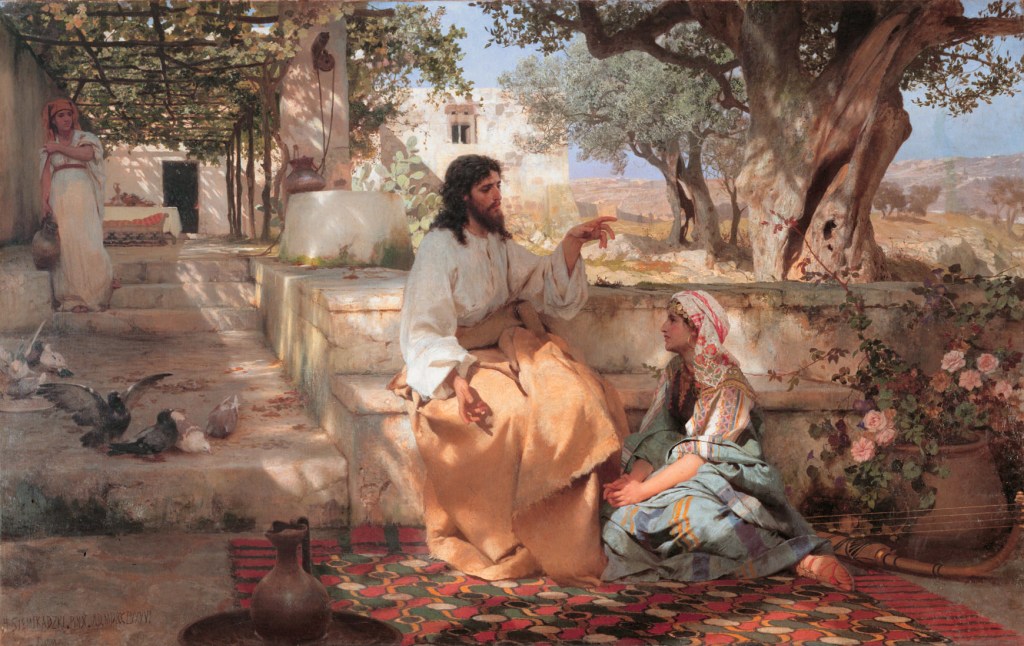
Christ in the house of Martha and Mary, by Henryk Siemiradzki, 1886
An archaeologist once hired some tribesmen to lead him to an archaeological site deep in the mountains. After they had been moving for some time, the tribesmen stopped and insisted they would go no further. The archaeologist grew impatient, then angry. But no matter how much he cajoled, the tribesmen would not go any further. Then, all of a sudden, the tribesmen changed their attitude. They picked up the gear and set off once more. When the bewildered archaeologist asked why they had stopped and refused to move for so long, the tribesmen answered, “We had been moving too fast and had to wait for our souls to catch up.”
Thomas Merton, in his book No Man is an Island, wrote, “We cannot be happy if we expect to live all the time at the highest peak of intensity. Happiness is not a matter of intensity but of balance and order and rhythm and harmony.
“Music is pleasing not only because of the sound but because of the silence that is in it: without the alternation of sound and silence there would be no rhythm. If we strive to be happy by filling all the silences of life with sound, productive by turning all life’s leisure into work, and real by turning all our being into doing, we will only succeed in producing a hell on earth.” (No Man is an Island, 134)
I believe this is part of the message of Mary and Martha. We are always Martha. We are always running here and there, making lists of where we need to run here and there next, and planning the list of the next here and there. Yet, in the midst of here and there, we must find the space between the notes, the silence, and rest at the feet of Jesus as Mary did.
Even the great Saints of God must find times of silence to stop and allow their souls to catch up. You and I are no different. We must find a balance – and it is different for each of us – that allows us to carry on with the mission of Christ’s church and our state of life, while at the same time receiving the grace and renewal that come from God.
This time of silence or rest, when assigned to a day, is known as the Sabbath. In his book The Sabbath, Abraham Joshua Heschel writes, “In defense of the Sabbath, Philo, the spokesman of the Greek-speaking Jews of Alexandria, says: this day we are commanded to abstain from all work, not because the law inculcates slackness. … Its object is rather to give man relaxation from continuous and unending toil and by refreshing their bodies with a regularly calculated system of remissions to send them out renewed to their old activities. For a breathing spell enables not merely ordinary people but athletes also to collect their strength with a stronger force behind them to undertake promptly and patiently each of the tasks set before them.” (The Sabbath, 13)
That is the Sabbath as a day, but it can also be understood as a time during the day set aside for the renewal of the soul, which the soul also needs. Again, from Thomas Merton and the analogy of music, “If we have no silence, God is not heard in our music. If we have no rest, God does not bless our work. If we twist our lives out of shape in order to fill every corner of them with action and experience, God will silently withdraw from our hearts and leave us empty.”
“Let us, therefore, learn to pass from one imperfect activity to another without worrying too much about what we are missing.” (No Man is an Island, 134)
Regardless of how busy you think you are or how busy you actually are, we must all find balance and make time to be Mary and sit at the feet of Jesus.
Pip: Eleven shells hit a fuel tank. None of them exploded. One contained a handwritten note in Czech. Fr. John is asking what you call that — and the answer is not luck.
Mara: This episode follows a sermon on providence — the claim that God's governance holds even when evil is the instrument. Let's start with that question: luck, fate, or something else entirely.
Sermon: Providence, Luck, and the Shells That Didn't Explode
Mara: The sermon opens with a World War Two bombing run — eleven shells lodged in a fuel tank, none detonating, one carrying a handwritten note from Czech prisoners of war. The frame is a question: what do you call a result like that?
Pip: The note inside that shell is the hinge of the whole argument. The translation, when Intelligence finally found someone to read it, was this: "This is all we can do for you now."
Mara: And the point is that neither luck nor fate can hold that story. Luck is pure chance — spin the wheel. Fate is predetermined and immovable. Either way, there is no room for free will and no need for God.
Pip: Providence is the alternative — defined in the sermon as "God's wise, loving, and continual governance of all creation, by which He sustains the universe and directs history toward His good purposes while respecting our free will." That is a precise claim, not a vague comfort.
Mara: The precision matters because the sermon extends it to evil, not just good outcomes. The Czech prisoners were in a Nazi labor camp. That was not a good thing. But the sermon argues God used that evil to preserve the crew — and that this pattern runs through all of history, including the crucifixion.
Pip: Peter's line from Acts 2:23 lands hard here: Christ was "delivered up according to the definite plan and foreknowledge of God" — and still killed by lawless hands. Providence and human evil, occupying the same sentence.
Mara: The sermon draws the practical consequence plainly: if God redeemed the greatest evil ever committed, then no evil in your life is beyond his power to redeem. The question becomes how you respond when evil arrives — and the sermon offers exactly two options.
Pip: Option one gets its own parable — the Devil's Supply Store, where discouragement and doubt are kept off the shelves because they are too valuable to sell. Hopelessness, the sermon says, is the weapon that causes a soul to do nothing, which is far more deadly than anger or lust.
Mara: Option two is Paul's confidence in Romans 8: that nothing — "neither death, nor life, nor angels, nor rulers, nor things present, nor things to come" — can separate us from the love of God. Providence is the ground that makes that confidence possible, not naive optimism.
Pip: Saint Padre Pio gets the closing word before the prayer: "God is our Father, so what have you to fear while you are the child of such a Father, through whose providence not even a single hair will fall from your head?" Lean on that and see what it holds.
Mara: The thread running through all of this is that the frame you bring to events — luck, fate, or providence — changes what you do when things go wrong.
Pip: Right. And the note in the shell is still there whether you read it that way or not. More to come from Candle in a Cave.
Elmer Bendiner, in his book, The Fall of Fortresses, describes a bombing run over the German city of Kassel: Our B-17 was barraged by flak from Nazi anti-aircraft guns. That was not unusual, but on this particular occasion our gas tanks were hit. Later, as I reflected on the miracle of a twenty-millimeter shell piercing the fuel tank without touching off an explosion, our pilot, Bohn Fawkes, told me it was not quite that simple.
On the morning following the raid, Bohn had gone down to ask our crew chief for that shell as a souvenir of unbelievable luck. The crew chief told Bohn that not just one shell but eleven had been found in the gas tanks—eleven unexploded shells where only one was sufficient to blast us out of the sky. It was as if the sea had been parted for us. Even after thirty-five years, so awesome an event leaves me shaken, especially after I heard the rest of the story from Bohn.
He was told that the shells had been sent to the armorers to be defused. The armorers told him that Intelligence had picked them up. They could not say why at the time, but Bohn eventually sought out the answer.
Apparently, when the armorers opened each of those shells, they found no explosive charge. They were clean as a whistle and just as harmless. Empty? Not all of them.
One contained a carefully rolled piece of paper. On it was a scrawl in Czech. The Intelligence people scoured our base for a man who could read Czech. Eventually, they found one to decipher the note. It set us marveling. Translated, the note read: “This is all we can do for you now.”
An almost unbelievable story. So how would you categorize the result? Was the B-17 crew lucky? Was it fate? Or was it something more?
Luck refers to events or outcomes that happen by chance rather than through our own planning or effort. Chance is the key element. Spin the wheel and see what happens. Fate, on the other hand, can be defined as a predetermined course of events, unwavering and unalterable. No matter what anyone says or does, good or bad, will have any effect on the outcome. Yet when it comes to luck and fate, where is God? Luck says chance and fate says predetermined. With either, there is no room for free will and there is no need for God.
Yet we know that there is a God who Rules over all things. Saint Paul teaches us in the letter to the Colossians, in Jesus “all things were created, in heaven and on earth, visible and invisible, whether thrones or dominions or rulers or authorities—all things were created through him and for him. And he is before all things, and in him all things hold together.” (Colossians 1:16-17) Therefore, we do not believe that things come about by luck or chance, nor do we believe that the ways of the world have been set on the path of fate from which nothing deviates. Instead, we believe in God’s providence, defined as God’s wise, loving, and continual governance of all creation, by which He sustains the universe and directs history toward His good purposes while respecting our free will. It is God’s providence that allowed Saint Paul to write in his letter to the Romans, which we read today: “We know that all things work together for good for those who love God, who are called according to his purpose.”
I think that sometimes, when we read those verses, we believe they refer only to good occurrences, but that is not the case. They also include evil, for God uses both to serve his purposes.
Consider the fellows whose plane was shot up with those non-explosive shells. Miraculous. Incredible. They went on to live another day, and that is good. However, consider those Czech POWs in a Nazi work camp. Was that a good thing? Do you think they were thrilled with the idea? No. It was evil, yet God used that evil to bring about good and to serve his purposes.
The greatest example we have of God using evil to bring about good is Jesus. On the Day of Pentecost, Peter said to the Israelites, “This Jesus, delivered up according to the definite plan and foreknowledge of God, you crucified and killed by the hands of lawless men.” (Acts 2:23) And the why, behind the good that came from this evil, Peter explains in his first epistle, “For Christ also suffered once for sins, the righteous for the unrighteous, that he might bring us to God.” (1 Peter 3:18b) If God could take the greatest evil ever committed—the crucifixion of His own Son—and use it for the salvation of the world, then there is no evil in your life that is beyond His power to redeem.
All of this points to the fact that much is going on in the world around us that we do not see or even catch a hint of. We see only our small world, but in all of it, nothing good or evil will disrupt God’s providence—His loving care of his children.
This teaches us something about our lives, although it is not an easy lesson or one that is easily practiced—both the good and the evil of our lives are used by God. God did not create the evil—hear that—God is not responsible for the evil in our lives, but He takes it and uses it for His purposes to accomplish His will and our salvation.
And the fact is, both good and evil will come. It is inevitable. So, how do we respond? When it is good, we dance. The more important question is how we respond to God’s providence when the evil comes knocking, because it most certainly will.
There are variations and nuances to the answers, but there seem to be only two options. Option one can be explained with a story. It goes by several different names, so I’ll call it The Devil’s Supply Store.
The legend explains that the devil used to sell his items and artifacts to potential buyers and demons. He would sell them items such as the scent of lust, a collar of greed, and blades that inflicted wounds of anger, along with other weapons that shot pride deep into the hearts of unsuspecting souls. With these weapons and more, demons were able to spread darkness across the world even more effectively.
One day, a potential buyer, another demon, arrived. As he perused the devil’s wares, he saw in the back corner something that caught his eye. On a plain pedestal sat two unmarked items, an old wooden mallet and a very boring-looking wooden spike. He inquired about them, and the devil quickly said they were not for sale. The Demon, even more curious, asked why. “Explain,” he said. The devil said, “They are discouragement and doubt. Together, they become hopelessness. They are my most powerful weapons. When none of my other items work, I employ these two, and they get the job done every time.” “How so?” said the demon, who would know very much more.
The devil sighed, leaned in, and said, “Nothing paralyzes the soul more than discouragement and doubt. While my other items may cause the soul to act out, such as anger or lust, hopelessness, discouragement, and doubt cause a soul to do nothing, which is much more deadly. They are no respecter of persons. They drain their victims of courage and faith, blurring and blocking out their visions and dreams with anxiety and fear. When the soul succumbs to hopelessness, it becomes an empty shell, a sack with only enough energy to feel sorry for itself.”
Option one, when evil comes knocking, is to fall into despair and hopelessness. You can lose your faith and curse God, or—option two—you can understand that when Paul says, “We know that all things work together for good for those who love God,” he really does mean all things. Whether good or evil, all things are under God’s providence. This understanding gives Paul the confidence to go on and say, “I am convinced that neither death, nor life, nor angels, nor rulers, nor things present, nor things to come, nor powers, nor height, nor depth, nor anything else in all creation, will be able to separate us from the love of God in Christ Jesus our Lord.”
Saint Padre Pio wrote, “God is our Father, so what have you to fear while you are the child of such a Father, through whose providence not even a single hair will fall from your head?”
Your life is not a matter of luck or fate. It is a fulfillment of God’s providence—God working out His will for your life and the lives of others, and for your salvation. That is what it is really all about. God sees all the good and all the evil and, in His love, uses it so that you might be with Him eternally.
“Be on your guard; stand firm in the faith; be courageous; be strong. Do everything in love.” (1 Corinthians 16:13 NIV) Stand secure in God’s providence.
Let us pray: Eternal God! Whose eyes are over all Thy works, especially intent on Thy servants: vouchsafe to turn away from us whatever is hurtful, and grant us whatever is advantageous, that through Thy favor, and under the benign influence of Thy special Providence, we may securely pass through the dangers and difficulties of this life, and happily arrive at the eternal joys of the next. Through Jesus Christ Our Lord. Amen.
Pip: There is a cave, and there is a candle — and this week, someone lit it by asking who gets to decide which plants are weeds.
Mara: That question runs straight through the posts Fr. John published recently — a sermon that moves from a Charlie Brown comic strip to a Persian king to the parable of the wheat and the weeds. Let's start with the field.
Sermon: Proper 11 RCL A — Identifying Weeds
Pip: The sermon opens with a very relatable Lucy moment — she tells Charlie Brown his problem is simply that he is himself — and uses it to name something the sermon treats as a persistent human instinct: the confidence that we can correctly identify who the troublemakers are.
Mara: The sermon sets up that instinct and then runs it straight into Isaiah, where the Lord designates a deliverer for Israel. Here is the passage: "I have stirred him up in righteousness, and I will make all his ways level; he shall build my city and set my exiles free, not for price or reward, says the Lord of hosts."
Pip: And the deliverer in question is not David, not Gideon, not Jesus — it is Cyrus, a pagan king who worshipped idols and had never heard of the God of Israel. Which means the people hearing Isaiah's announcement would have looked at their liberator and seen exactly the wrong kind of person.
Mara: That is precisely the tension the sermon develops. Cyrus conquered Babylon, freed the Israelites, and funded the rebuilding of Jerusalem — all without sharing their faith. The sermon then moves to the gospel parable, where a farmer's field fills with Darnel, a poisonous grass nearly indistinguishable from wheat until the grain head forms.
Pip: By the time you can tell the difference, the roots are so tangled that pulling the weed destroys the wheat. So the farmer says: wait. Which is, frankly, a harder instruction than it sounds when you have already mentally drafted your weed-pulling list.
Mara: Augustine is quoted directly on this: "How many sheep are outside, how many wolves within! And how many sheep are inside, how many wolves without! How many are blaspheming Christ who will yet believe in Him!"
Mara: The sermon holds up Paul as the case in point — present at Stephen's stoning, feared by the early church, and yet the future Apostle to the Gentiles. The people who saw a wolf were not lying; they were simply wrong.
Pip: So the sermon's practical instruction lands in Romans 12 — repay no evil for evil, feed your enemy if he is hungry — because the alternative is letting someone else's sin generate yours.
Mara: And the sermon closes with a sharp reversal: those who crucified Jesus believed they were doing exactly the right kind of weed removal. The job of identifying and pulling, the sermon argues, belongs to the angels at the end of the age — not to us.
Pip: What stays with me is Cyrus — the idea that the person you would most confidently label a weed might be the one God has already called by name.
Mara: That tension between what we see and what God sees seems like territory worth returning to. More to come from Candle in a Cave.
Charlie Brown rests his head in his hands while leaning against the wall. He looks miserable when his friend Lucy approaches. “Discouraged again, eh, Charlie Brown?” Charlie Brown does not even answer. “You know what your trouble is?” Lucy asks. Without waiting for a response, she announces, “The trouble with you is that you are you!” Charlie Brown says, “Well, what in the world can I do about that?” Lucy replies, “I don’t pretend to be able to give advice. I merely point out the trouble!”
Lucy demonstrates a human failing that has truly plagued us from the beginning. According to our assessment, ___ is the trouble. After this determination has been made and solidified in our minds, we decide that something must be done about ___. However, this is not how the Lord would have us operate.
The Lord, speaking through the Prophet Isaiah, describes a great leader. He says,
Thus says the Lord to his anointed… whose right hand I have grasped, to subdue nations before him and to loose the belts of kings, to open doors before him that gates may not be closed. (Isaiah 45:1)
Of this anointed one, the Lord declares:
I have stirred him up in righteousness, and I will make all his ways level; he shall build my city and set my exiles free, not for price or reward,” says the Lord of hosts. (Isaiah 45:13)
One clue to the person’s identity is the title “anointed.” That word can also be translated as “messiah.” From this, you might think the Lord is speaking of one of the great Israelite heroes: David, Gideon, or Esther. Or perhaps we might think the Lord is talking about Jesus, but as it turns out, the Lord is actually speaking of a pagan king, a worshiper of idols, and a believer in false gods.
For roughly 70 years, the Israelites had been in exile in Babylon after being conquered. However, as with all empires, the next one is already on deck, waiting for its turn to dominate the world scene. Enter Persia, and the anointed one whom God was praising: Cyrus.
Cyrus conquered the Israelites’ enemy, the Babylonians, and then set the Israelites free. Free to return home and rebuild Jerusalem and the temple. Free to worship the one true God. Cyrus did these things and much more for the Israelites, even though he himself was not a believer.
The Israelites would have looked at Cyrus and been appalled by the kind of person he was. When Isaiah told them who their messiah would be, they were. Even so, the Lord looked at Cyrus and said,
I will give you the treasures of darkness and the hoards in secret places, that you may know that it is I, the Lord, the God of Israel, who call you by your name. (Isaiah 45:3)
Today in our gospel, Jesus tells the parable of the wheat and the weeds. A farmer sends out his servants to scatter wheat seeds. However, at night, when no one is watching, an enemy comes in and scatters weed seeds. Everyone believes all is well until the plants begin to mature. It is then that the weeds are discovered.
There is widespread agreement that the weed in question was Darnel, a poisonous grass. I am no farmer, but apparently, the wheat plant and the Darnel weed are nearly identical when young. It is not until the wheat begins to form its head of grain that the problem is identified. Yet by this time, the wheat and the Darnel have been growing side by side long enough that their root systems are intertwined. If you pull up the Darnel, the wheat will come with it. Therefore, the farmer tells his servants to wait until the harvest before doing anything about the problem.
Jesus uses this parable to describe the world around us, and the church fathers have gone one step further, saying it also describes the church—the righteous and the unrighteous growing together side by side. The rub is that, like the farmer’s servants, we are unable to tell the difference between wheat and weed, the righteous and the unrighteous, the evil. Like Lucy, we are remarkably confident in our ability to diagnose everyone who is a problem. However, I suspect that Jesus is rarely pleased with our diagnoses.
Many Israelites, if they had heard Jesus’ parable, could have easily looked at Cyrus and said, “That man is a weed. He needs to be pulled up and cast into the fire.” Yet God looked at Cyrus and said, “You are my anointed.”
Saint Augustine wrote, “How many sheep are outside, how many wolves within! And how many sheep are inside, how many wolves without!… How many are blaspheming Christ who will yet believe in Him!… In like manner, how many are praising within who will yet blaspheme.” (Tractate 45.12)
We see this problem throughout scripture. Think of Saint Paul. He began as one of the church’s greatest persecutors. He was present when St. Stephen was stoned to death and approved of it. Even after his conversion, the young church looked at him with great fear. They saw him as a weed or a wolf. Yet God looked at Paul and saw the Apostle to the Gentiles.
You and I lack the knowledge and ability to know who is righteous and who is not. As for pulling weeds, that particular job is above our pay grade. Jesus said, “Just as the weeds are collected and burned up with fire, so will it be at the end of the age. The Son of Man will send his angels, and they will collect out of his kingdom all causes of sin and all evildoers, and they will throw them into the furnace of fire.” There will come a day when the wheat and the weeds will be separated. There will come a day of judgment, but that judgment and the casting of the weeds into the fire will not be accomplished by us. It will be accomplished by God’s holy angels.
Now, please don’t think I’m saying those who do wrong shouldn’t be punished or locked up. I’m not saying that at all. I am saying that we can’t truly know a person or their final outcome. Therefore, we must allow the wheat and the weeds to grow side by side until the Lord sends His workers to bring in the crop.
So what are we to do when we believe the evil, the enemy, is near? We must recall and practice what Paul teaches: “Repay no one evil for evil, but give thought to do what is honorable in the sight of all. If possible, so far as it depends on you, live peaceably with all. Beloved, never avenge yourselves, but leave it to the wrath of God, for it is written, ‘Vengeance is mine, I will repay, says the Lord.’ To the contrary, ‘if your enemy is hungry, feed him; if he is thirsty, give him something to drink; for by so doing you will heap burning coals on his head.’ Do not be overcome by evil, but overcome evil with good.” (Romans 12:17-21) When you see evil, a person you believe to be a weed, do not allow their sin to cause you to sin. The enemy of us all has won if you do.
Can this be frustrating? Absolutely. Don’t we all want to go out and yank a few weeds? I’d wager each of you just imagined someone you’d go after first. Yet Jesus is calling us to walk a different way, the way He walked. Why? For there were many who looked at Him and saw a weed that needed pulling, even though He was here for their salvation. Yet they condemned Him and nailed Him to a cross. Did they believe they were doing evil? No. They thought they were clearing God’s field of just one more weed. Instead… they crucified the Lord of the harvest.
Our job is not to go around trying to identify weeds, and most certainly not to pull those we believe we have identified. Our job is to go where Jesus has led the way, to take up our cross and follow Him so that we may also bring glory to our Father in Heaven.
Let us pray: Lord, enlighten our understanding, Strengthen our will, Purify our hearts, and make us holy. Help us to repent of our past sins And to resist temptation in the future. Help us to rise above our human weaknesses And to grow stronger as a Christian. Amen.
Pip: Candle in a Cave — where the sermon opens with a statistical case against chocolate mint ice cream, and somehow that is exactly the right move.
Mara: Fr. John's recent writing takes the Parable of the Sower as its anchor — what it means to have good soil in your heart, and what quietly erodes it. Let's start with the sermon itself.
Sermon: Tending the Soil of the Heart
Mara: The Parable of the Sower is usually read as a sorting mechanism — which type of person are you? But this sermon pushes past that framing and asks a harder question: even if the seed landed in good soil, what happens to that soil over time?
Pip: The setup is a statistics lesson. Before getting to Jesus, the sermon walks through a set of perfectly true, perfectly misleading correlations — nearly everyone who dies from cancer has eaten chocolate mint ice cream — to make a point about how easily we bend evidence to say what we want, including scripture. Then comes the turn: "However, today Jesus said, 'Not so fast,' and, in a rare instance, told us what he meant."
Mara: That's the hinge. Because Jesus actually interprets the parable himself, there's less room to spin it. The soil is the heart. The birds are the devil snatching the Word before it takes root. Rocky ground is shallow faith that withers. Thorns are the overwhelming noise of the world choking off what grew.
Pip: And then comes the move that makes this more than a conversion story. The sermon turns directly to people who already believe — the ones who think the parable isn't about them.
Mara: Right, because the soil doesn't stay fixed. The sermon uses a Montana farming image to explain it: rocks don't sink in soil, they rise. You pick them out in spring, and if you don't, they're back. The sermon puts it plainly — "if you do nothing to tend the soil, over time the rocks will work their way to the surface, and the once-fertile soil becomes rocky."
Pip: The washing machine flood, the "Insufficient Funds" stamp on the mortgage — those aren't hypotheticals, they're the actual mechanism. The bird doesn't wait for crisis; it works with whatever's already loose.
Mara: St. Paul and St. Josemaria Escriva both get quoted here. Escriva's image is striking — the world, the devil, and the flesh as adventurers trading you "the poor bauble of pleasure" for "the pure gold and the pearls, the diamonds and the rubies, drenched in the living and redeeming blood of your God."
Pip: That is not a subtle metaphor.
Mara: It isn't. And the sermon lands on a practical response: pray, cooperate with grace, and stop shooting yourself in the foot while asking God why your foot hurts. Paul's line from Philippians frames it — "work out your own salvation with fear and trembling" — meaning tend the gift, don't just receive it and walk away.
Pip: Soil maintenance as spiritual discipline. Which, given how the sermon started, is a long way from chocolate mint ice cream — but the logic held the whole way through.
Mara: The through-line is vigilance — not anxious striving, but the steady, daily work of keeping the ground clear.
Pip: Guard the soil. Tend it. And maybe don't let the mail lady open your letters first.
As most of you are aware, Chocolate Mint Ice Cream is an abomination unto the Lord. For those who disagree, I’ve come across some really interesting statistics that prove this point and why it should be banned forthwith. Nearly all sick people have eaten Chocolate Mint Ice Cream at least once in their lives. An estimated 99.9% of people who die from cancer and heart disease have eaten Chocolate Mint Ice Cream. 99.9% of people involved in car crashes ate Chocolate Mint Ice Cream. 93.1% of juvenile delinquents come from homes where Chocolate Mint Ice Cream has been served. Among people born in 1839 who later ate Chocolate Mint Ice Cream, there has been a 100% mortality rate. Given the interpretation of these facts, I rest my case.
One of my first jobs out of college was as a Statistical Analyst. I was terrible at math, but once someone gave me the right number, I could make it say and do whatever you would like. The example above is not among my better works. One of the difficulties with Holy Scripture is that we can do the same thing with it. Depending on who you ask, you’ll get all sorts of interpretations of even a single verse. However, today Jesus said, “Not so fast,” and, in a rare instance, told us what he meant.
The soil represents the heart. The birds snatching the seed away represent the devil, who snatches the Good News from the heart of one who hears it before they have the opportunity to grow and flourish. The seed that fell on rocky ground represents one who hears the word of God and believes at first, but has no depth and therefore withers and dies, producing no fruit. The seed that fell among the thorns is like one who hears the word of God, but everything going on around them is so overwhelming that they are choked off. Finally, there is the seed that fell on good ground. It grows. It flourishes. It produces. The Word of God grows within the good soil, within the heart of the believer.
If we are ones in whom the seed has been planted in good soil, then we may wonder what this parable has to do with us. It seems to be only about those who have not yet come to faith. But we know that scripture is multivalent, that is, it has many levels, so not only does this parable speak to those who have not yet come to faith, but it also speaks to the believer. Why? Because at this moment, your heart may be good and producing good fruit, but what about when you leave here? The heart is as temperamental and erratic as the Queen, my crazy cat.
Example: You leave here today and, in your heart, feel the presence of God. You feel at peace, and my goodness, what an amazing sermon that was! It’s all good! Then you head home. When you get home, you discover that the water line on the washing machine has decided to blow out, and when you open the front door, you find everything in the house floating in about four inches of water. In that instant, that bird, the enemy of God’s people, snatches the good fruit, the good work that has happened, right out of your heart.
Or, come Monday morning, having just finished your prayer, you know in your heart that God really heard you. Soon afterward, the dog starts barking, and, given the time of day, you know it’s the mail lady. You go out and greet her with a smile; she hands you a few letters, returning the smile, and says, “Oh. I wonder what the bank wants?” You open it, and stamped in bold red ink across the mortgage payment are the words “Insufficient Funds.” It’s only the 11th of the month. What am I going to do? The worries of the world, like that thorn bush growing in the field, just choked the joy of God right out of your soul.
The soil of the heart is temperamental and erratic; however, it doesn’t always change as quickly as all that. At other times, it changes more slowly, like the seasons of the year.
I’m not sure if it is the case in Oklahoma, but in western Montana, if you do any digging, you will soon discover the ground is full of rocks. Anyone who cuts hay or gardens knows that one of the first chores in spring is to go out into those fields and “pick rocks.” If you are uninitiated, it may seem that someone has played a dirty trick on you by throwing rocks onto your land, but what has happened is that the rocks have worked their way to the surface.
It is counterintuitive. The rocks should sink because they are heavier than dirt. Yet the soil settles downward, so the rocks rise to the surface. Those who like to garden know that you regularly have to clear the ground of the rocks that have worked their way up, or you’ll end up with a field full of rocks and busted equipment.
The soil of our hearts works in a similar way. The seed, that is, the Word of God, is planted. When it finds good soil, it will grow and produce good fruit. However, if you do nothing to tend the soil, over time the rocks will work their way to the surface, and the once-fertile soil becomes rocky. It has no depth and can no longer support life. The same is true of weeds and thorn bushes. If you don’t tend the soil regularly, weeds and thorns begin to encroach on the good soil and can eventually choke it off, leaving it unfit for growing anything.
St. Paul wrote, “To set the mind on the flesh is death, but to set the mind on the Spirit is life and peace.” St. Josemaria Escriva put it this way, “The world, the devil, and the flesh are a band of adventurers who take advantage of the weakness of that savage you have within you. In exchange for the poor bauble of pleasure [that is the world] which is worth nothing, they want you to hand over to them the pure gold and the pearls, the diamonds and the rubies, drenched in the living and redeeming blood of your God—the price and the treasure of your eternity.”
The world, the devil, and the flesh want to destroy the good soil of your heart, whether when the seed is first planted or over time. The enemies of God seek to bring death to places where God has sown life. As Peter says, “Be sober-minded; be watchful. Your adversary the devil prowls around like a roaring lion, seeking someone to devour.” (1 Peter 5:8) So how do we defend ourselves?
The answer begins and ends with God. We pray, “Lead us not into temptation, but deliver us from evil.” We are asking for God’s protection over our lives and, more importantly, over our hearts. God is faithful to His promises. The question is whether we will cooperate with His grace. Yes, there are random things, like broken water lines, that we can’t control and that work against us, but for the most part, we can handle them. It stinks, but call a plumber. The bigger problem is us. We tend to worry when we should pray. We tend to get angry when we should let something go. We tend to treat our relationship with God on an as-needed basis rather than seeking to maintain and strengthen it daily.
We defend ourselves against the world, the devil, and the flesh by asking the Lord our God to continue in that love and care. But as we do, we can’t be shooting ourselves in the foot and then ask God why it happened. We can’t say, “Oh, Lord! I’ve got this big hole in my foot. Yes, I pointed the gun and pulled the trigger, but Lord, why did you let that happen?” Free will is a beautiful thing, but it comes with responsibility and consequences.
St. Paul wrote in his letter to the Philippians: “Work out your own salvation with fear and trembling” (Philippians 2:12b). Salvation is from God, unearned and freely given. And notice, Paul doesn’t say, “Work for your salvation…” He says, “Work out your salvation…” We are not working to earn God’s free gift. So Paul is saying, work out this gift, hold on to it, and nurture it with deep reverence and holy seriousness. God has done and will continue to do His part, but if you want to produce good fruit and not have it stolen, withered, or choked off, you must engage and be vigilant in tending the good soil of your heart.
Our Father has planted a seed in the good soil of your heart. Guard that soil. Tend it. Water it. Keep it clear of predators and of anything that does not belong. Then produce fruit worthy of God’s glory.
Let us pray: Lord, if what we seek be according to our will, then let it come to pass and let success attend the outcome. But if not, Dear Lord, let it not come to pass. Do not leave us to our own devices, for you know how unwise we can be. Keep us safe under your protection, Lord our God, and in your own gentle way, guide us and rule us as you know best. Amen.