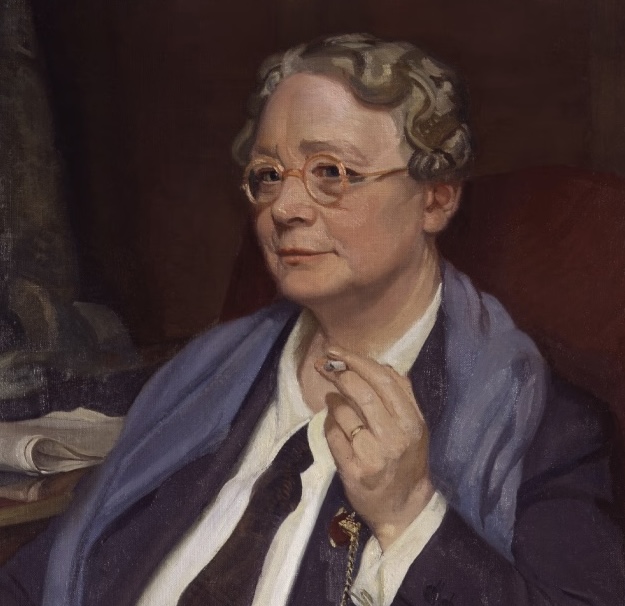
Dorothy Sayers is not one of those capital “S” saints, but she is on the Episcopal/Anglican Church calendar for her contributions to writing.
Her father was an Anglican priest, so she knew the church arena well, and she had a talent for conveying the Christian message in ways that made it more understandable for the general public. One of these writings was the radio play The Man Born to be King.
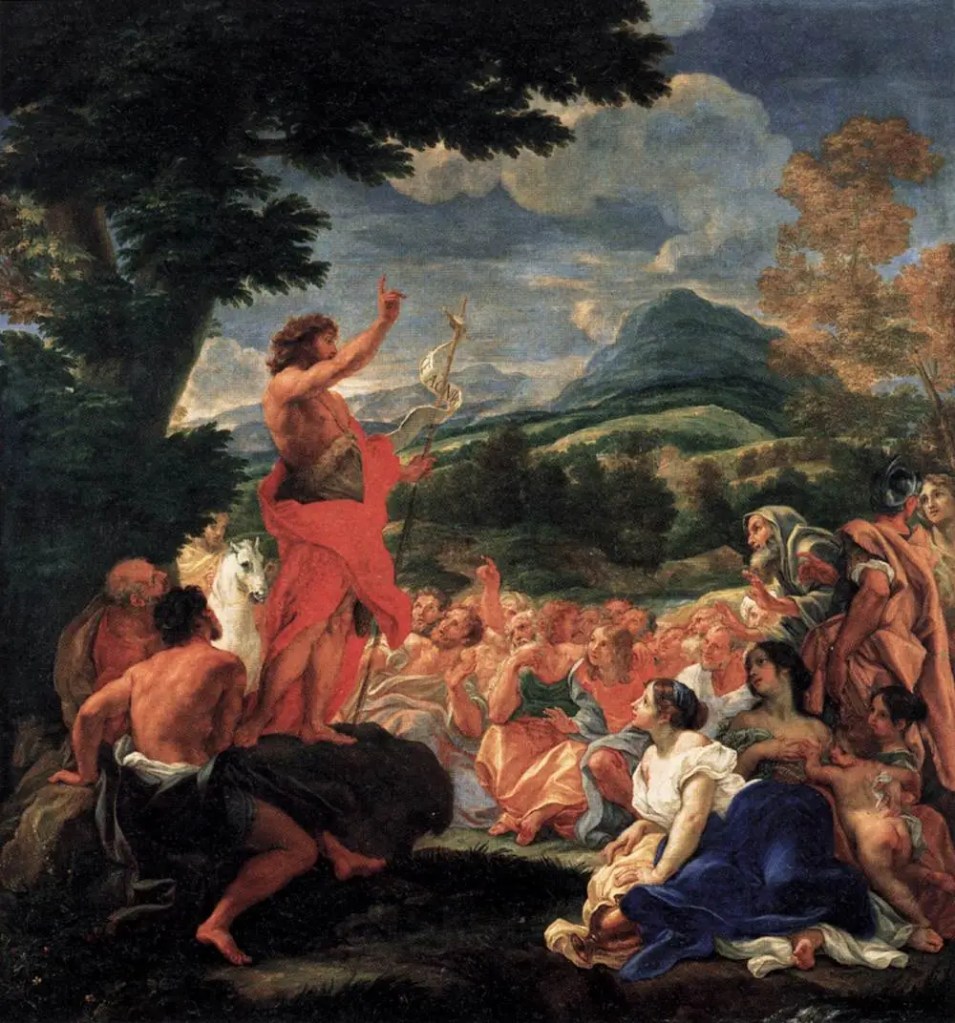
In one scene, she has a family driving out to see this new prophet in the land, John Baptist. There’s quite a bit of interaction from the crowd, but I’ll mostly share with you the words of John.
JOHN BAPTIST: Men and women of Israel! Once more, once more I call you to repent. And quickly. For God’s Kingdom is coming as the Prophets foretold. Not in some distant future. Not a year or a week hence. Not tomorrow. But now… Are you ready for it? You know very well you are not. For years, you have been saying, “Some day, some day the tide will turn. Someday, someday Messiah will come, and all will be well with Israel.” But your hour is upon you-Messiah is at your very gate—and what will he find when he comes? I see a worldly priesthood, a worldly ruler, a worldly people—a nation of shopkeepers and petty bureaucrats, their hearts fixed on cash and credit, and deaf and blind to righteousness. Sackcloth and ashes! Sackcloth and ashes! The Kingdom is at hand, and you are not prepared. Now, now repent of your sins and the sins of the whole nation. Now let God wash away your guilt in the clear waters of Jordan. Wash and be clean, that you may be fit for the task that is laid upon you, for the great and terrible day of the Lord is at hand.
The Religous leaders show up.
JOHN BAPTIST: Some of you, I see, are Pharisees. Religious men, keepers of the Law, patterns of respectable piety, what are you doing here? (with sudden violence) Hypocrites, humbugs, brood of vipers! Who warned you to flee from the vengeance to come?
CROWD (indignant murmurs): “Well, I never.. insolence. Upon my word,” etc. (mingled with) “That’s right! Give it to ‘em hot… confounded lot of prigs.”
JOHN BAPTIST: Yes, I know what you will say: “We need no repentance. We keep the Law. We are the privileged children of Abraham. God will look after us, whatever happens.” Don’t flatter yourselves. God doesn’t depend on you. He can find His children everywhere. He could raise them out of these desert stones, which are no harder than your hearts. You too will be lost if you don’t repent and do better. Messiah is coming like a woodman with his axe, and all the rotten trees, all the barren trees, will be cut down at the roots and thrown into the fire. All of them.
When the crowd asks what they must do to be saved, JOHN BAPTIST says,
Be generous. Do more than the Law demands. You, there, with the good coat—you don’t need a cloak as well. Give it to the naked beggar beside you. And you with the picnic basket, how about sharing it with some of these poor children! (his voice rising harshly again) Renounce the world—weep, wail, and beat your breasts—and await the Kingdom in fear and trembling.
When the religious leader asked who he was, JOHN BAPTIST says,
JOHN BAPTIST: I am the herald of God’s Kingdom. I baptise, but only with the water of repentance. There is a far greater man coming soon. I shan’t be worthy so much as to tie his shoe-laces. He will baptise you with spirit and with fire.
CROWD: Where is he? Show us the Messiah! Show us the Christ!
JOHN BAPTIST: Christ will come among you like a man thrashing corn. He will gather the grain and burn the chaff. There will be a great purging of Israel… Make ready to meet him. Draw near, confess your sins, and be baptised in Jordan. (Source)
When it first aired, the atheist got all bent out of shape because the BBC was promoting Christianity on the radio, and the conservative Christians got all bent out of shape because she hadn’t used the traditional King James Bible version. However, the general public loved it, with students being let out of school early to catch the latest installment. And, for added credibility, if needed, C.S. Lewis told Sayers that every year, he used the print version of the play for his Lenten Devotional. That’s good enough for me.
When it comes to daily devotional books that you might read as part of a spiritual practice, we most often think of ones that are uplifting and joyful. Something to give a good start to the day. I’ve come across several that I quit pretty quickly, but some I get very involved with. Few are specific for priests, but there are a couple, and one that I discovered several months back is TheDignity and Duties of the Priest, by St. Alphonsus Liguori.
In the first few pages, I thought it would be inspiring and uplifting. There was a quote by St. John Chrysostom that was setting the tone—“Priests should be so holy that all may look to them as models of sanctity; because God has placed them on earth that they may live like angels, and be luminaries and teachers of virtue to all others.” I read that and began to feel good about my calling, but then it took a turn. A couple of pages later—“In a word, [the priest] that is not holy is unworthy to approach the altar, because by the stains that he brings with him, he contaminates the sanctuary of God. Let him not approach the altar, because he has a blemish, and he must not defile my sanctuary.” On the next page, a quote from Saint Augustine further illumines this: “To the Lord is more pleasing the barking of dogs than the prayer of such priests.”
It was such a wonderful book—and I mean that—but there were mornings when I would look at it and say, “You’ll get your turn. Give me a minute.” Then I would read and get smacked again—“At present, says the holy church, I am not persecuted by the pagans, for the tyrants have ceased, nor by the heretics, because there are no new heresies; but I am persecuted by the [priest], who by his scandals robs me of many souls.” For such a priest, Liguori tells us, “The end shall be, first, abandonment of God, and then the fire of hell.”
I kept reading—it actually changed my understanding of the priesthood—but I kept wanting him to throw me a bone. Give me some sign of hope, because there were times I felt convinced I had no chance of heaven.
Now imagine you are Jewish and living during the time leading up to the birth of Jesus. You attend synagogue every Sabbath. You understand the teachings of the Torah and sincerely want to follow them, but you find that every turn, you stumble over one aspect of the Law or another. The only way to enter God’s Kingdom is if you are without sin, but no sooner have you made the appropriate sacrifices at the Temple for the forgiveness of sins, you fall into another pit. You want to be holy, but there seems to be no hope.
Now, imagine you’re living in the small city of Nazareth. One night, after a long, hard day, you’re making your way home. As you walk, you recall all the times you’ve failed God, and you understand the consequences of those failures. Yet, until you can return to the Temple again to make the necessary sacrifices, your salvation remains in question. In your fear and frustration, you stop along the way and lean against a wall just to have a moment of quiet. Then, you see a strange light begin to shine out of the window of the house you’re leaning against. Just as you’re about to move on, you hear the sweetest voice begin to speak, and it stops you in your tracks. You have no choice but to listen.
“Greetings, O favored one, the Lord is with you!” There’s a brief pause, then you hear, “Do not be afraid, Mary, for you have found favor with God. And behold, you will conceive in your womb and bear a son, and you shall call his name Jesus. He will be great and will be called the Son of the Most High. And the Lord God will give to him the throne of his father David, and he will reign over the house of Jacob forever, and of his kingdom there will be no end.”
Another pause, then you hear a young woman’s voice, “How will this be, since I am a virgin?”
The response comes immediately: “The Holy Spirit will come upon you, and the power of the Most High will overshadow you; therefore, the child to be born will be called holy—the Son of God. And behold, your relative Elizabeth in her old age has also conceived a son, and this is the sixth month with her who was called barren. For nothing will be impossible with God.”
Imagine you’re listening outside the window as all this happens. You realize that it is an angel of the Lord speaking to the girl. What he offers is not only salvation for the girl, but for the whole world—yourself included. The angel is offering the hope you are so desperately seeking. You know that through the Son of God, whom the angel is speaking about, you will receive forgiveness of sin, you will be given the freedom to serve and worship God without fear, and that you will be set free from the sting of death. In that moment, you understand all of this, but you also realize that everything depends on one thing—the young woman’s response.
St. Bernard of Clairvaux wrote in a sermon about that moment—a moment when all of creation held its breath, waiting for Mary to speak: “You have heard, O Virgin, that you will conceive and bear a son; you have heard that it will not be by man but by the Holy Spirit. The angel awaits an answer; it is time for him to return to God who sent him. We too are waiting, O Lady, for your word of compassion; the sentence of condemnation weighs heavily upon us…. Tearful Adam with his sorrowing family begs this of you, O loving Virgin, in their exile from Paradise. Abraham begs it, David begs it. All the other holy patriarchs, your ancestors, ask it of you, as they dwell in the country of the shadow of death. This is what the whole earth waits for.”—Mary, what is your answer? On one side is condemnation and death, and on the other is the forgiveness of sins and life eternal.
As I read Liguori’s book, I kept asking, “Is there any hope?” And for you, standing outside the window, listening to the angel’s words, you’ve asked the same question: “Is there any hope?” Yes, there is. The greatest of all hope. Why? Because “Mary said: Behold the handmaid of the Lord; be it done to me according to thy word.” Mary said yes, and Hope Incarnate, the very Word of God, the Son of God, Christ Jesus the Lord, was conceived in the Virgin’s womb.
There is often confusion about why the Blessed Virgin Mary is held in such high esteem, but the answer lies in those few words of hers, for all of salvation—ours, the world’s, all of creation—hinged on her response.
That great Archbishop of Canterbury from the 11th century, St. Anselm, said, “To Mary God gave his only-begotten Son, whom he loved as himself. Through Mary, God made himself a Son, not different but the same, by nature Son of God and Son of Mary. The whole universe was created by God, and God was born of Mary. God created all things, and Mary gave birth to God. The God who made all things gave himself form through Mary, and thus he made his own creation. He who could create all things from nothing would not remake his ruined creation without Mary.”
If I could accomplish one thing today, it would be to increase your devotion to the Blessed Virgin Mary. Our salvation is through Christ Jesus alone—no one comes to the Father except through Him—however, it was through Mary and her yes that Christ took on our flesh and, through that same flesh, was able to give us hope. As I’ve told you before, this hope we possess is not mere wishful thinking. Our hope in Christ Jesus is an unshakable knowledge and expectation of what the Father has promised all along. What is that promise? We read it in the:
“He has shown the strength of his arm, he has scattered the proud in their conceit.
He has cast down the mighty from their thrones, and has lifted up the lowly.
He has filled the hungry with good things, and the rich he has sent away empty.
He has come to the help of his servant Israel, for he has remembered his promise of mercy,
The promise he made to our fathers, to Abraham and his children for ever.”
The Father has promised that we will be with Him in His Kingdom, where there will be no end, and it all started with Mary’s “Yes.”
Mary’s life is devoted to guiding us to her Son, our Savior, Jesus Christ. Offer your devotion to her. Respect her as Queen and mother, and through her intercessions, you will be drawn deeper into your relationship with the One True God.
Let us pray: Hail, holy Queen, Mother of mercy, hail, our life, our sweetness and our hope. To thee do we cry, poor banished children of Eve: to thee do we send up our sighs, mourning and weeping in this vale of tears. Turn then, most gracious Advocate, thine eyes of mercy toward us, and after this our exile, show unto us the blessed fruit of thy womb, Jesus, O merciful, O loving, O sweet Virgin Mary! Amen.
Pray for us, O Holy Mother of God, that we may be made worthy of the promises of Christ.
The Feast of the Immaculate Conception of Mary was on Monday, the Feast of Our Lady of Loreto is today, and the Feast of Our Lady of Guadalupe is this coming Friday. We can’t cover them all, so I’ll share with you a report by Don Antonio Valeriano, a Native American author of the sixteenth century.
At daybreak one Saturday morning in 1531, on the very first days of the month of December, an Indian named Juan Diego was going from the village where he lived to Tlatelolco in order to take part in divine worship and listen to God’s commandments. When he came near the hill called Tepeyac, dawn had already come, and Juan Diego heard someone calling him from the very top of the hill: “Juanito, Juan Dieguito.”
He went up the hill and caught sight of a lady of unearthly grandeur whose clothing was as radiant as the sun. She said to him in words both gentle and courteous: “Juanito, the humblest of my children, know and understand that I am the ever virgin Mary, Mother of the true God through whom all things live. It is my ardent desire that a church be erected here so that in it I can show and bestow my love, compassion, help, and protection to all who inhabit this land and to those others who love me, that they might call upon and confide in me. Go to the Bishop of Mexico to make known to him what I greatly desire. Go and put all your efforts into this.”
When Juan Diego arrived in the presence of the Bishop, Fray Juan de Zumarraga, a Franciscan, the latter did not seem to believe Juan Diego and answered: “Come another time, and I will listen at leisure.”
Juan Diego returned to the hilltop where the Heavenly Lady was waiting, and he said to her: “My Lady, my maiden, I presented your message to the Bishop, but it seemed that he did not think it was the truth. For this reason I beg you to entrust your message to someone more illustrious who might convey it in order that they may believe it, for I am only an insignificant man.”
She answered him: “Humblest of my sons, I ask that tomorrow you again go to see the Bishop and tell him that I, the ever virgin holy Mary, Mother of God, am the one who personally sent you.”
The Bishop again did not believe and asked for a sign.
On Monday Juan Diego did not return. His uncle, Juan Bernardino, became very ill, and at night asked Juan to go to Tlatelolco at daybreak to call a priest to hear his confession.
Juan Diego set out on Tuesday, but he went around the hill and passed on the other side, toward the east, so as to arrive quickly in Mexico City and to avoid being detained by the Heavenly Lady. But she came out to meet him on that side of the hill and said to him: “Listen and understand, my humblest son. There is nothing to frighten and distress you. Do not let your heart be troubled, and let nothing upset you. Is it not I, your Mother, who is here? Are you not under my protection? Are you not, fortunately, in my care? Do not let your uncle’s illness distress you. It is certain that he has already been cured. Go up to the hilltop, my son, where you will find flowers of various kinds. Cut them, and bring them into my presence.”
When Juan Diego reached the peak, he was astonished that so many Castilian roses had burst forth at a time when the frost was severe. He carried the roses in the folds of his tilma (mantle) to the Heavenly Lady. She said to him: “My son, this is the proof and the sign which you will bring to the Bishop so that he will see my will in it. You are my ambassador, very worthy of trust.”
Juan Diego set out on his way, now content and sure of succeeding. On arriving in the Bishop’s presence, he told him: “My lord, I did what you asked. The Heavenly Lady complied with your request and fulfilled it. She sent me to the hilltop to cut some Castilian roses and told me to bring them to you in person. And this I am doing, so that you can see in them the sign you seek in order to carry out her will. Here they are; receive them.”
He immediately opened up his white mantle, and as all the different Castilian roses scattered to the ground, there was drawn on the cloak and suddenly appeared the precious image of the ever virgin Mary, Mother of God, in the same manner as it is today and is kept in her shrine of Tepeyac.
The whole city was stirred and came to see and admire her venerable image… they called her by the name that she herself had used: “the ever virgin holy Mary of Guadalupe.”
The American Film Institute has several “Top 100” lists: 100 best movies, 100 best musicals, 100 best heroes and villains, and so on. They also have the “100 top movie quotes.” Way down in the 80s, we have lines like, “Yo, Adrian,” and “My Precious.” Moving up into the 40s, there is “Shane. Shane. Come back,” and “Stella! Hey, Stella!” Then breaking into the top ten, there are “Go ahead, make my day,” and “I’m gonna make him an offer he can’t refuse.” Number one on the list, you’ve got to love Rhett Butler—“Frankly, my dear, I don’t give a….” However, the one I’m thinking of today comes in at number ten, spoken by Travis Bickle, played by Robert De Niro, in Taxi Driver. The line: “You talkin’ to me? You talkin’ to me!?” (Source)
In our Gospel reading, when John the Baptist confronts the Pharisees and Sadducees, I can picture them glancing at each other, then at John, and in their best Robert De Niro impression, asking, “You talkin’ to me?!” And then John firing back with number forty-four on the AFI list, “I see dead people.” Okay. Enough of that.
As we know, John’s criticism didn’t stop with the religious leaders. He was an equal-opportunity rebuker, and later, he would criticize Herod for marrying his brother’s sister, which landed him in jail and eventually led to his beheading. Yet for the prophets, including John the Baptist, they were almost always upsetting someone and finding themselves in danger.
In the Acts of the Apostles, the first deacon was Stephen. He said to the religious leaders, “You stiff-necked people, uncircumcised in heart and ears, you always resist the Holy Spirit. As your fathers did, so do you. Which of the prophets did your fathers not persecute? And they killed those who announced beforehand the coming of the Righteous One.” (Acts 7:51-52) They then proceeded to stone him to death.
Despite the dangers of the job, the prophet’s role is to stir up the people and point out their errors, hoping they will return to God. In fact, they are responsible for the souls of the people before God. Speaking to Ezekiel, the Lord said, “So you, son of man, I have made a watchman for the house of Israel. Whenever you hear a word from my mouth, you shall give them warning from me. If I say to the wicked, O wicked one, you shall surely die, and you do not speak to warn the wicked to turn from his way, that wicked person shall die in his iniquity, but his blood I will require at your hand. But if you warn the wicked to turn from his way, and he does not turn from his way, that person shall die in his iniquity, but you will have delivered your soul.” (Ezekiel 33:7-9)
Prophet: a dangerous job before the people and before God, yet God calls those He chooses. The Prophet Jeremiah said, “The Lord put out his hand and touched my mouth. And the Lord said to me, ‘Behold, I have put my words in your mouth. See, I have set you this day over nations and over kingdoms, to pluck up and to break down, to destroy and to overthrow, to build and to plant.’” (Jeremiah 1:9-10)
The Lord chooses and sends His prophets to speak His words, not their own. Knowing this, you might think they—dare I say, “We”?—would respond accordingly, but it was said, “The Lord, the God of their fathers, sent persistently to them by his messengers, because he had compassion on his people and on his dwelling place. But they kept mocking the messengers of God, despising his words, and scoffing at his prophets, until the wrath of the Lord rose against his people, until there was no remedy.” (2 Chronicles 36:15-16)
The same was true with John the Baptist. The people heard what was said, but they did not respond according to the will of God. Instead, they became angry with these messengers and persecuted them, often putting them to death. Thank goodness we are not like them. We accept criticism and correction very well. When someone offers Godly corrections to us, we don’t get angry. No, sir. We might get even, but we don’t get angry! Right?
Let me ask you this: you hear John the Baptist crying out, “Repent, for the kingdom of heaven has come near.” How do you respond? The human thing to do is to look at everyone around you and say, “Darn tooting! Y’all need to repent! Get right with the Lord!” The whole time, thinking John the Baptist couldn’t possibly be talking to you. Or what about this: Christian groups love to quote this one from 2nd Chronicles: “If my people who are called by my name humble themselves, and pray and seek my face and turn from their wicked ways, then I will hear from heaven and will forgive their sin and heal their land.” (2 Chronicles 7:15) What’s the first thing to go through your head? “If those left-wingers or the fascist right (I too am an equal opportunity rebuker) would just learn to pray and follow Jesus, then this whole thing could be sorted out overnight!” Can I get an “Amen”? Why do we think this way? Isn’t it obvious? This call to turn from wicked ways is about them, and has nothing to do with me!
However, the prophet confronts us and says, “Oh, yes, it is. It is all about you. You are the one who needs to get right with God.” Like everyone else, we don’t much like hearing it, but we must be willing to listen to the words of John the Baptist—“Repent, for the kingdom of heaven has come near.”—and allow those words to be spoken to us personally and as the Church. We must let God correct us so we are not the ones provoking His wrath. Through this process of correction, we are allowing him to perfect us. As the Lord told the church in Laodicea, “Those whom I love, I reprove and discipline, so be zealous and repent.” (Revelation 3:19)
How can we let the prophets’ words speak to us and correct us? There is a powerful phrase from Martin Luther: “The Cross tests everything.”
If we test our thoughts, actions, and deeds the same way the Pharisees and Sadducees evaluated theirs, we respond like they did—“You talking to me?” However, if we test those same thoughts, actions, and deeds by the Cross, we may discover a different outcome. It might not be what we want to hear, but it will be God’s truth.
I wonder, if we are willing and brave enough to look closely, which part of ourselves, our lives, our being would we hesitate to put to the test of the Cross? I suspect there are aspects of all our lives that are much safer tucked away in their own personal niches, their own special places of worship within our souls, even illuminated with one of those little votive candles—areas that are far too cherished by the Great “I” to be put to such a test. Yet, if we did, if we nailed those silly notions to that most sacred tree, the Cross, well, they would likely scream out in protest and blasphemy, just like the wicked thief did who was crucified with Jesus. But in the end, we would be set free from those things that bind us.
The prophets deliver messages to a world that is broken, but their messages are also for us. Jesus says, “He who has ears, let him hear.” (Matthew 13:9) I pray that if you hear in your soul John the Baptist calling you to repentance, don’t be like those who become proud and angry. Instead, submit to the call of repentance and accept the forgiveness of sins; for as St. John tells us, “If we confess our sins, [God] is faithful and just to forgive us our sins and to cleanse us from all unrighteousness.” (1 John 1:9)
Let us pray:
O God, You raised up St. John the Baptist to prepare a perfect person for Christ. We call upon St. John’s intercession to properly prepare us with a true sense of repentance to receive Your grace and salvation. Make us faithful to Truth and justice, as You did Your servant, John the Baptist, herald of Your Son’s birth and death. Lord, may You increase Your life within us. Amen.
I came across a poem that I thought Mary Alice would like, but also one that feels as though she lived it. It is often attributed to St. Augustine, but it is much more contemporary than that. It was written in the early 20th century by German musician and teacher Georg Goetsch. The title: I Praise the Dance.
I praise the dance, for it frees people from the heaviness of matter and binds the solitary to community. I praise the dance, which demands everything: health and a clear spirit, a poised soul and a shining body. The dance transforms the soul into a dwelling of light.
O human, learn to dance, for otherwise the angels in heaven will not know what to do with you.
The dance is wholly from the beginning. It is the movement of creation itself, the becoming of all things, their passing and their re-becoming. The dance turns the deepest, holiest things into visible and living form.
Dance, because the whole of creation dances: the sun, the stars, the earth— they all move in rhythm and harmony. So too should you move in rhythm with God.
The author told us,
O human, learn to dance, for otherwise the angels in heaven will not know what to do with you.
I can assure you, you do not want to see me dance. It’s not pretty, but I do understand the deeper meaning of the author’s message.
He is telling us that in this life, we are meant to find joy. We should learn not only to experience God through prayer and study but also to encounter Him in the people we meet. We are called to seek out ways in this lifetime to love, show compassion, practice our faith, and give of ourselves. Living this way allows those around us to experience glimpses of heaven—the eternal life to come. From what I’ve learned, Mary Alice was just such a person. She was one who learned how to dance in her soul and showed others how to do the same.
You might think that someone who has lived such a life would face no troubles, but we know that’s not true. I recall the time St. Teresa of Avila was crossing a stream in winter. She lost her footing and fell into the icy water, then complained to the Lord about all her suffering. Jesus said to her, “Don’t complain, my daughter, this is how I treat My friends.” To which Teresa responded, “If this is how you treat your friends, it’s no wonder you have so few!”
Mary Alice, also a friend of Jesus, had every reason to complain just as St. Teresa did, but like St. Teresa, Mary Alice did not lose her faith. She heard those words of Jesus we read in our Gospel and lived them—“Do not let your hearts be troubled. Believe in God, believe also in me.” Despite her suffering, she held onto her belief, her faith in Jesus, so that on this day, we can confidently say that she is dancing with the angels in God’s Eternal Kingdom.
Those of us gathered here today are saddened by our loss, but we can also rejoice in knowing that Mary Alice, through the power of the resurrection, is now truly home. We can also rejoice in the knowledge that a place has been prepared for us, and on the day of the Lord’s choosing, he will gather us to Himself, where we will all be reunited in the very presence of His glory. As the Psalmist declares, “This is the Lord’s doing, and it is marvelous in our eyes.”
Before 2011, beer was considered a soft drink in Russia.
It is impossible to hum while holding your nose. (As you will all be curious about that one, and not hear the sermon until you try, go ahead.)
A group of cats can be called a clowder, or a cluster, or a glaring, or a nuisance, or a pounce, or a clutter.
More than half of the world’s population is under 30 years old.
The plastic tip on the end of a shoelace is called an “aglet”.
The Caesar salad was created in Tijuana, Mexico, by an Italian immigrant named Caesar Cardini.
It’s always good to be teachable and to learn new things. I never even thought about holding my nose while trying to hum until I read that (and tried). I would like to say that as I prepare sermons and teachings, I already know and understand it all, but each week I learn something new or gain a deeper understanding. This week was no different, even though it was something I already knew, I saw it with more clarity and fullness.
Today is the last Sunday of the Church Year: Christ the King Sunday—the day we celebrate the Kingship of our Savior, Jesus. When I reflect on this and the Kingdom of God, I’ve always viewed it as a Kingdom outside of myself. A Kingdom that I can walk through and work in. A Kingdom that I, if it is God’s will, can help move forward. But this week, I heard Jesus’ words in a different way. Which words were those? “The kingdom of God is not coming in ways that can be observed, nor will they say, ‘Look, here it is!’ or ‘There!’ for behold, the kingdom of God is within you.”
For me, Christ is the King I come before, kneel before, and desire to serve to the best of my abilities. I try to do His bidding as a faithful servant in His Kingdom, which is around me. However, what happens when I say, “Not only do I live and work in the Kingdom of God, but the Kingdom of God lives and works within me?” I understand God’s Holy Spirit working in me, just as I understand accepting Jesus into my heart, but what does it mean to have God’s Kingdom working within me?
What prompted me to meditate on this were the words in the notebook On Prayer by Origen of Alexandria, a second-century priest. He writes, “The kingdom of God, in the words of our Lord and Savior, does not come for all to see… Thus it is clear that he who prays for the coming of God’s kingdom prays rightly to have it within himself, that there it may grow and bear fruit and become perfect…. The Father is present in the perfect soul, and with him Christ reigns, according to the words: We shall come to him and make our home with him.” And a little further, Origen says, “There should be in us a kind of spiritual paradise where God may walk and be our sole ruler with his Christ. In us the Lord will sit at the right hand of that spiritual power which we wish to receive. And he will sit there until all his enemies who are within us become his footstool, and every principality [and power] in us is cast out.”
Listen to these words:
“God is the King of all the earth!” (Psalm 47:7)
“The Lord reigns; let the peoples tremble!” (Psalm 99:1)
“Who would not fear you, O King of the nations?” (Jeremiah 10:7)
“King of kings and Lord of lords.” (Revelation 19:16)
“The LORD is king forever and ever.” (Psalm 10:16)
What if we said that Jesus is Lord, Jesus is King, out there, but also in here? What if we understood that this King of all the earth can and will conquer His enemies in this world, but can also conquer the enemies within our souls? What would happen if you let the King of kings and Lord of lords reign within you to rule not only over your external life but also over your internal one? St. Paul tells us that “our God is a consuming fire.” (Hebrews 12:29) What if we allowed that consuming fire to burn within? Allowed is the right word because, so often, we hold God in check.
Do you remember the story of Charlemagne, the Holy Roman Emperor? He wanted to conquer the world for Christianity and insisted that all his soldiers be baptized. They did. All but one hand was submerged, and in that hand they held a sword. It was a statement that declared there bodies belonged to God, but that hand and that sword belonged to Charlemagne. When we say we want the consuming fire of the King of kings to reign within us, like those soldiers, we sometimes tuck away a few things in a fireproof room, because we’re willing to let God rule most of our lives but keep a few exceptions. Those few exceptions are the problem. Those few exceptions are what prevent us from fully submitting to the Kingship of Christ, which then causes a ripple effect, impacting not only the Kingdom of God within us but also the Kingdom of God in this world.
All I know about her is that her name is Amy and she is on the internet. (I promise this is not some weird story about me falling in love with the operating system on my computer.) Amy is someone who posts content online, and I’ve seen two of her posts. Anyway, she tells the story of going to the grocery store. At the checkout, standing in line in front of her is a man in his 70s. As they wait, one of the cashiers approaches and says, “Sorry, this line is closed, you’ll have to go to that one.” Amy does so, but the older man looks a bit confused, so he continues to stand there. After a minute, the cashier returns to him and repeats herself, and he understands. He moves toward the line she is in, but since she’s shifted, four more people are now behind her. Amy steps forward.
“You were in line in front of me,” she says. “You can go ahead of me.”
“Are you sure?” he asks. “Are you sure I was in front of you?” Amy assures him that he was, and he says, “Thank you for your honesty. It doesn’t happen very often anymore, and I really appreciate you being honest.” She tells him it’s no problem, but he continues, “It is such an odd world that we live in now, and I don’t know what to think of it anymore.”
She says, “Yeah, it is an odd ball world. I agree with you. It’s odd. Things are not going well for society right now.”
He responds, “Sometimes I’m happy that my life is almost over so that I don’t have to live in this world anymore.”
Amy later asked herself, “What if letting someone get in front of you in the line at the grocery store is a massive gesture of kindness? We have to do better as a society.”
If letting someone in front of us in line at the grocery store is the greatest act of kindness we can perform, then there’s not only something wrong with society, but also something deeply wrong with us. If someone is happy that they are nearing the end of their life because of how they are treated in the world, then the One who said, “Love one another as I have loved you,” is not the King of our lives. What is the solution?
Today in our Gospel reading, we heard about Jesus’ crucifixion. After those standing around and one of the others who had been crucified with Him finished taunting Him, the good thief said, “Jesus, remember me when you come into your kingdom.” He had no hope of reaching Heaven for himself, but he at least wanted to be remembered. However, Jesus said to him, “Truly I tell you, today you will be with me in Paradise.”
In this context, we see paradise as something to come; however, what did Origen say? “There should be in us a kind of spiritual paradise where God may walk and be our sole ruler with his Christ.” We are to create within ourselves a paradise where the King of Heaven and the “King of all the earth” can be the King within so that He might rule every aspect of our lives, and that, my friends, is a scary thing. St. Paul said in his letter to the Hebrews, “It is a fearful thing to fall into the hands of the living God.” (Hebrews 10:31) It is a fearful thing to fall into God’s hands to be ruled, but I will guarantee you this: it will be a far more fearful thing to fall into His hands to be judged.
Within, many choose to establish their own kingdom and sit on a throne they’ve created for themselves so they might rule over their own lives. However, a wise person will realize that within they can create a paradise for the very Kingdom of God, and within that Kingdom, there can be a throne where the King of Glory is permitted to take His rightful seat. Your soul and this world need the Kingdom of God.
Allow yourself to be consumed by the fire of God so that He may reign in your life as the Righteous King.
Let us pray: May the light of Christ, the King of all, shine brighter in our hearts, that with all the saints in light, we may shine forth as lights in the world. Amen.
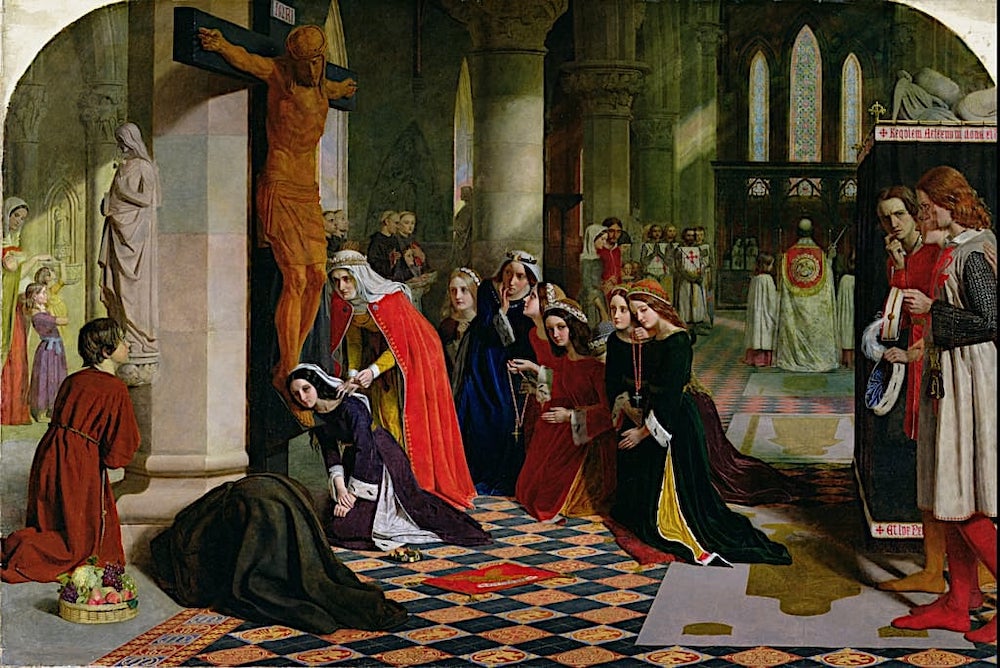
An Incident in the Life of St. Elizabeth of Hungary (The Renunciation of Queen Elizabeth of Hungary), by James Collinson (1825-1881). Elizabeth is kneeling with her face against the feet of Jesus. You can see the crown she set aside on the floor next to her.
Elizabeth of Hungary was born into nobility in 1207 AD. However, from a very young age, she saw it as her duty to care for the poor. She would sneak food from the castle’s kitchen to the poor at the gates and tend to their other needs as best she could. She was married young, but even then, continued to give as much as she had, saying, “How could I bear a crown of gold when the Lord bears a crown of thorns? And bears it for me!”
At 20, her husband died, and her in-laws turned her out, not caring for the fact that she was giving everything away. She wrote, “Today, there is an inescapable duty to make ourselves the neighbor of every individual, without exception, and to take positive steps to help a neighbor whom we encounter, whether that neighbor be an elderly person abandoned by everyone, a foreign worker who suffers the injustice of being despised, a refugee, an illegitimate child wrongly suffering for a sin of which the child is innocent, or a starving human being who awakens our conscience by calling to mind the words of Christ: ‘As long as you did it for one of these, the least of my brethren, you did it for me’”
She was later reinstated to some extent, but she never stopped her work for the poor and those in need.
Conrad of Marburg, Elizabeth’s spiritual director, wrote, “She was a lifelong friend of the poor and gave herself entirely to relieving the hungry. She ordered that one of her castles should be converted into a hospital in which she gathered many of the weak and feeble. She generously gave alms to all who were in need, not only in that place but in all the territories of her husband’s empire. She spent all her own revenue from her husband’s four principalities, and finally, she sold her luxurious possessions and rich clothes for the sake of the poor.
“Twice a day, in the morning and in the evening, Elizabeth went to visit the sick. She personally cared for those who were particularly repulsive; to some she gave food, to others clothing; some she carried on her own shoulders, and performed many other kindly services. Her husband, of happy memory, gladly approved of these charitable works. Finally, when her husband died, she sought the highest perfection; filled with tears, she implored me to let her beg for alms from door to door.
“On Good Friday of that year, when the altars had been stripped, she laid her hands on the altar in a chapel in her own town, where she had established the Friars Minor, and before witnesses she voluntarily renounced all worldly display and everything that our Savior in the gospel advises us to abandon. Even then she saw that she could still be distracted by the cares and worldly glory which had surrounded her while her husband was alive. Against my will she followed me to Marburg. Here in the town she built a hospice where she gathered together the weak and the feeble. There she attended the most wretched and contemptible at her own table.
“Apart from those active good works, I declare before God that I have seldom seen a more contemplative woman. When she was coming from private prayer, some religious men and women often saw her face shining marvelously and light coming from her eyes like the rays of the sun.
“Before her death I heard her confession. When I asked what should be done about her goods and possessions, she replied that anything which seemed to be hers belonged to the poor. She asked me to distribute everything except one worn out dress in which she wished to be buried. When all this had been decided, she received the body of our Lord. Afterward, until vespers, she spoke often of the holiest things she had heard in sermons. Then, she devoutly commended to God all who were sitting near her, and as if falling into a gentle sleep, she died.” She was twenty-four.
Elizabeth had the Spirit of God working in her in a way I don’t fully understand, but I believe it’s one we should all try to imitate as best as we can, whether we fully grasp it or not.
A priest waited in line to get his car filled with gas just before a long holiday weekend. The attendant worked quickly, but there were many cars ahead of him at the service station. Finally, the attendant motioned him toward a vacant pump. “Father,” said the young man, “sorry about the delay. It seems as if everyone waits until the last minute to get ready for a long trip.”
The priest chuckled, “I know what you mean. It’s the same in my business.”
Don’t you just love waiting in a good, long line? I know I do. Have you ever gone up to the checkout lines in the grocery store and checked each line to see which shopper has the fewest items, just to avoid waiting those extra few minutes? Usually, just as I’ve figured it all out, someone else steps in, and I end up behind the person with two baskets. Oh, yes, I love to wait.
Our first lesson this morning from Malachi was from chapter 4:1-2. However, by stopping at verse 2, I feel like we get a bit shortchanged. I want to share with you through verse 6, which is the end of the chapter, because these are the very last words of the Old Testament.
“For behold, the day is coming, burning like an oven, when all the arrogant and all evildoers will be stubble. The day that is coming shall set them ablaze, says the Lord of hosts, so that it will leave them neither root nor branch. But for you who fear my name, the sun of righteousness shall rise with healing in its wings. You shall go out leaping like calves from the stall. And you shall tread down the wicked, for they will be ashes under the soles of your feet, on the day when I act, says the Lord of hosts.
“Remember the law of my servant Moses, the statutes and rules that I commanded him at Horeb for all Israel.
“Behold, I will send you Elijah the prophet before the great and awesome day of the Lord comes. And he will turn the hearts of fathers to their children and the hearts of children to their fathers, lest I come and strike the land with a decree of utter destruction.”
Following these words, there is a 400-year period of silence until the birth of Christ. For thousands of years before these verses were written, people waited for the coming of the savior, the Messiah. Now they are told they will wait some more, and so they do. Finally, after that 400-year wait, “The angel Gabriel was sent from God to a city of Galilee named Nazareth, to a virgin betrothed to a man whose name was Joseph, of the house of David. And the virgin’s name was Mary.” And the child was given the name Jesus.
Jesus teaches, gives hope, heals, and raises the dead. He tells us, “The kingdom of God is in the midst of you.” (Luke 17:21b) However, after only three years of ministry, he begins saying things like “The time will come” and “When I come again.” He speaks of trials and endurance, and in doing so, it starts to sound like the kingdom of God on earth is not yet here.
If I were a believer back then, my response to these statements would have been, “What are you saying, Jesus? You mean we have to wait some more?” And Jesus would say, “Haven’t you been listening? Of course, you will have to wait for the Kingdom of God to come to its fullness.” After we get over our disappointment, we must then ask, “How do we, as followers of Jesus, wait?” As has been proven over the last 2,000 years, it is not easy.
Pastor and author Warren Wiersbe observes, “The ability to calm your soul and wait before God is one of the most difficult things in the Christian life. Our old nature is restless…the world around us is frantically in a hurry. But a restless heart usually leads to a reckless life.”
Oftentimes, we get in a hurry, and then we become reckless, even in our faith. God isn’t acting quickly enough for us, so we tend to strike out on our own. Think about the Israelites after the Exodus from Egypt.
They have arrived at Mount Horeb, and Moses has gone up to meet with the Lord, but this meeting lasts longer than the people expected. At this point, “When the people saw that Moses delayed to come down from the mountain, the people gathered themselves together to Aaron and said to him, “Up, make us gods who shall go before us. As for this Moses, the man who brought us up out of the land of Egypt, we do not know what has become of him.’” So Aaron told the people to bring all their gold jewelry, and he made a golden calf from it. When the people saw it, they said, “These are your gods, O Israel, who brought you up out of the land of Egypt!”
They grew tired of waiting for the one true God, so they created a god for themselves. They made sacrifices to it, worshipped it, then held a feast, got drunk, and danced the hoochie coochie before it. They committed all kinds of wickedness. This serves as a warning for us today: if we become weary of waiting on God, lower our guard, and start following other gods, we risk falling into the same sinful behaviors.
As Christian people, acknowledging upfront that what Wiersbe said—waiting on God is “one of the most difficult things in the Christian life”—then how can we wait without falling into sin? The list is longer, but there seem to be three main components.
Henri Nouwen describes the first in his book Sabbatical Journeys by sharing the story of two friends who were trapeze artists—the Flying Roudellas.
They told him that there exists a special relationship between the flyer and the catcher. As they swing through the air, the flyer is the one who lets go, and the catcher is the one who catches. As the flyer swings high above the crowd on the trapeze, the moment comes when he must let go. He arcs out into the air. His job is to remain as still as possible and wait for the strong hands of the catcher to catch him.
One of them told Nouwen, “The flyer must never try to catch the catcher.” The flyer must wait in absolute trust. The catcher will catch him, so he must wait.
While waiting on the Lord, we must have patient trust. We must wait and trust that the Lord will do exactly as He has promised, but it will be in His own time. We are not to go grabbing at other things, but hold fast to the promise.
The second requirement is confident humility. We must trust that God can do what He promises and be humble enough to recognize that we cannot do it without Him. This kind of confident humility brings a peaceful sense of holiness into our lives, knowing that the chaos around us is not from God. Remember when the disciples were out on the sea and a great storm arose? They were terrified and thought they would die. Chaos was all around them. Where was Jesus? He was asleep in the bow of the boat. When the disciples woke Him and cried out, He rebuked the storm. Jesus spoke into the chaos, and peace was restored.
Confident humility affirms that God can speak into any chaos in our lives at any moment and bring peace.
Finally, while waiting on the Lord, we must learn to recognize God’s voice. In our Gospel lesson, Jesus said some will say, “I am he,” and others will say, “The time is near.” To such claims, Jesus instructed them to “not go after them.” Don’t follow every half-baked idea, and lead a reckless life. Instead, we must listen for His voice, the voice of the Good Shepherd. Jesus says, “My sheep hear my voice, and I know them, and they follow me. I give them eternal life, and they will never perish, and no one will snatch them out of my hand.” (John 10:27-28) Yet, if we do not take the time to learn and hear that voice through study and prayer, then we risk being led astray. We must practice listening to His voice so that when He does speak, we can know with certainty that it is Him.
Patient trust, confident humility, and knowing the voice of God—this is not all that is required to properly wait on God, but they are solid building blocks. The Prophet Isaiah writes,
“My way is hidden from the Lord, and my right is disregarded by my God”? Have you not known? Have you not heard? The Lord is the everlasting God, the Creator of the ends of the earth. He does not faint or grow weary; his understanding is unsearchable. He gives power to the faint, and to him who has no might he increases strength. Even youths shall faint and be weary, and young men shall fall exhausted; but they who wait for the Lord shall renew their strength; they shall mount up with wings like eagles; they shall run and not be weary; they shall walk and not faint.” (Isaiah 40:27-31)
Patient trust, confident humility, and knowing the voice of God. Let us renew our own strength and wait patiently on the Lord, so that when the day comes, we too may soar on wings like eagles.
Let us pray (from St. Thomas Aquinas): Grant us, O Lord our God, minds to know you, hearts to seek you, wisdom to find you, conduct pleasing to you, faithful perseverance in waiting for you, and a hope of finally embracing you. Amen.
Years ago, a young pastor found the roads blocked one Sunday morning and was forced to skate on the river to get to church, which he did. When he arrived, the elders of the church were horrified that their preacher had skated on the Lord’s day. After the service, they held a meeting where the pastor explained that it was either skate to church or not go at all. Finally, one elder asked, “Did you enjoy it?” When the preacher answered, “No,” the board decided it was all right!
The album, The Stranger, by Billy Joel was released in 1977. I must have been in junior high at the time, but I did have a copy and probably wore it out. I could probably still sing along to all of the songs (not that you would want me to).
One of the songs I remember is Only the Good Die Young. At the time, I had no idea what it was all about, but I eventually sorted it out. And even more so when I was introduced to John Keating, the English professor that Robin Williams played in the Dead Poets Society. He told students, all young men, that “Language was invented for one reason, boys – to woo women – and, in that endeavor, laziness will not do.” The song Only the Good Die Young was just such an attempt.
“You got a nice white dress and a party on your confirmation You got a brand new soul Mmm, and a cross of gold But, Virginia, they didn’t give you quite enough information You didn’t count on me When you were counting on your rosary
“And they say there’s a heaven for those who will wait Some say it’s better, but I say it ain’t I’d rather laugh with the sinners than cry with the saints The sinners are much more fun You know that only the good die young”
“The sinners are much more fun;” therefore, all fun must be declared sinful and stamped out at all costs. How do we stamp out fun? We make laws. How do we force people to follow the laws? We threaten them with all sorts of punishments. And, finally, who is best suited to write and enforce these laws? The Church! Can I get an “Amen”? Actually, religious leaders of every make and model, even before Jesus, have been doing this. During Jesus’ time, and with Judaism, there were two major parties of religious leaders and several minor ones.
The minor groups included the Essenes, Zealots, and Scribes, each with their own agenda. The two main parties we hear most about are the Pharisees and the Sadducees. Who were they?
Between the two groups, the Pharisees were more popular with the people and the common man. Although they were associated with the Temple through their faith, they were not the priests serving there. Instead, they focused on the Mosaic Law found in the Torah and other Old Testament writings. They would interpret the Law further and then interpret their interpretations, all aimed at leading to personal righteousness before God. The problem, and what Jesus criticized most, was that they got so far down in the weeds with their interpretation and application of the Law that they forgot about the souls of the people.
In His criticism of the Pharisees, Jesus said, “They tie up heavy burdens, hard to bear, and lay them on people’s shoulders, but they themselves are not willing to move them with their finger. They do all their deeds to be seen by others.” (Matthew 23:4-5) And again He says of them, “You are like whitewashed tombs, which outwardly appear beautiful, but within are full of dead people’s bones and all uncleanness.” (Matthew 23:27)
They did, however, believe in the resurrection, but it was earned through works, not by faith. Favor was granted through obedience. To gain eternal life, one had to follow the Law to the letter. The Lord, speaking through the Prophet Daniel, said, “Many of those who sleep in the dust of the earth shall awake, some to everlasting life, and some to shame and everlasting contempt.” (Daniel 12:2) The side of the bed you woke up on depended on whether or not you kept the Law. Nonetheless, this led to their understanding of the resurrection, which was one of the differences between the Pharisees and the Sadducees.
The Sadducees were the priests who controlled everything related to the Temple and the sacrificial system. They strictly followed the Mosaic Law, but their understanding was limited to the Law as written in the Torah—the first five books of the Old Testament. They did not recognize the authority of the other books—the Writings and the Prophets.
The Sadducees were the elites of society and in close relationship with the Romans. If your main concern is Temple worship, then you focus on keeping the peace and the status quo so that sacrifices can continue. They also prioritized their Jewish identity. As we read today, they did not believe in the resurrection. Instead, they believed that when you die, well, you’re dead—nothing more.
With such a belief, you might ask, “What’s the point?” Why go through all these rituals, follow the Law, make sacrifices, and maintain the Temple if, in the end… poof? The answer goes back to their identity. They did what they did for honor, for the nation of Israel, and for future generations. Perhaps the heretical teachings of the prosperity gospel today are the best way to understand the Sadducees—if you follow God and do what He tells you, then you get the big house on the hill. So, the best you can hope for after you die is to be remembered and leave a nice inheritance. Why didn’t they believe in the resurrection? Remember, they only followed what was written in the first five books of the Bible, the Torah, and they did not believe the Torah taught resurrection, so for them, it did not exist.
After the Temple was destroyed in 70 A.D., the Sadducees disappeared because, without the Temple, the sacrificial system could not continue, and there was no need for priests. So, the “brand” of Judaism that continues, even today descended from the Pharisees, with their emphasis on adhering to the Law and its interpretation.
Today in our Gospel reading, Jesus encounters some Sadducees who propose a question which is the equivalent of “If Peter Piper Picked a Peck of Pickle Peppers.” On other occasions, Jesus will have similar encounters with the scribes and Pharisees. In almost all of these encounters, the religious leaders come to Jesus in an attempt to trip Him up over the Law. If they succeed, they can use their influence and power to denounce Him. But in each case, He turns it around on them and eventually silences them, at which point they resort to lying. At the trial the night before He was crucified, “The chief priests and the whole council were seeking false testimony against Jesus that they might put him to death, but they found none, though many false witnesses came forward.” (Matthew 26:59-60)
Through Christ and His sacrifice on the Cross, we are no longer under the Mosaic Law, but under grace. St. Paul states this clearly in his letter to the Romans: “You are not under law but under grace,” (Romans 6:15), but he quickly adds that sin still exists. How? We are no longer governed by the Mosaic Law, but we are under the law of the Spirit. Paul writes, “We are released from the [Mosaic] law, having died to that which held us captive, so that we serve in the new way of the Spirit and not in the old way of the written code.” (Romans 7:6) And what is the heart of this law of the Spirit? Paul tells us, “For the whole law is fulfilled in one word: “You shall love your neighbor as yourself,” (Romans 5:14) which includes the love of God because you cannot love your neighbor if you do not first love God.
Our society is quick to impose specific laws on itself and others, whether to maintain order or uphold moral standards. Some individuals ignore these laws altogether and live a lawless life—that’s a different topic. However, most follow these laws, and for the most part, they do so out of fear of punishment, a similar approach to that of the Sadducees and Pharisees. Follow the law to receive a reward. Break the law and face punishment. But the law of the Spirit is beyond any codified system. Why? Because it concerns the heart. It is about love.
We do what God asks of us not because it’s written in a book, but because it’s written on our hearts. We follow His commands not out of fear of being thumped on the head, but because we love Him and want to please Him. We don’t need a law telling us to feed the hungry; we do it because we love our neighbor. We don’t need a law that says, “Don’t drive drunk,” because we should love those who travel with us and those around us enough that we take responsibility for their safety and ours through our actions.
Are you following the law of the Spirit, or are you breaking it? Answer the question: Am I loving my neighbor?
As followers of Jesus, the things we do or don’t do should not be motivated by fear of punishment or reward. Instead, they should be guided by the answer to that one question. Additionally, I would add, err on the side of grace. You can love too little, but you can never love too much.
Let us pray: Breathe into me, Holy Spirit, that my thoughts may all be holy. Move in me, Holy Spirit, that my work, too, may be holy. Attract my heart, Holy Spirit, that I may love only what is holy. Strengthen me, Holy Spirit, that I may defend all that is holy. Protect me, Holy Spirit, that I may always be holy. Amen.





 Candle in a Cave