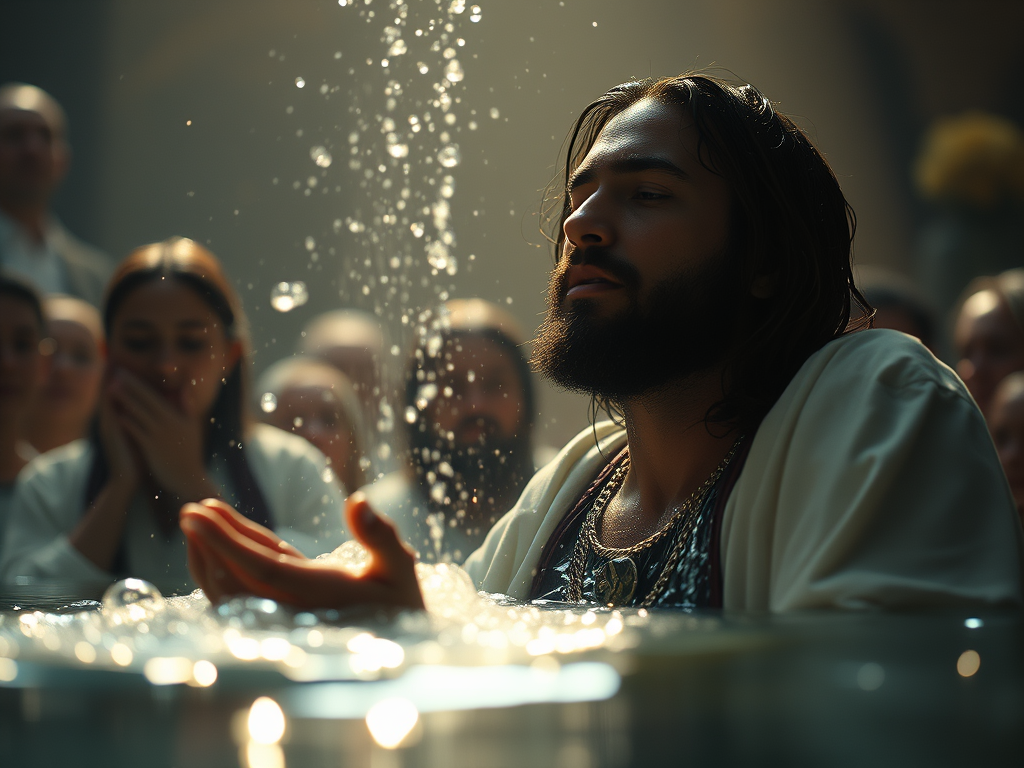
Sermon: The Baptism of Our Lord RCL C – “Suffering”


A jet traveling from New York to California was experiencing a severe thunderstorm. As the passengers were being bounced around by the turbulence, a woman turned to the priest sitting next to her and, with a nervous laugh, asked, “Father, you’re a man of God. Can’t you do something about this storm?”

The priest replied, “Sorry, I’m in sales, not management.”

Baptism has been popping up these past several weeks. Sometimes, I plan several sermons around a particular theme or topic, but this was not one of them. Yet, here we are again—The Baptism of Our Lord.

As we understand, we have been baptized into the death and resurrection of Jesus and given new life in Him. It is an assurance of God’s love for us, but do you ever think God has a funny way of showing His love for you? If you did feel that way, you wouldn’t be the first.

Teresa of Avila was traveling in bad weather. When she attempted to cross a stream, her carriage suddenly stuck in the mud, and she fell into the water. She complained to Jesus, and He said, “That’s how I treat my friends. ” Teresa replied, “No wonder you have so few friends.”

It would seem that if we were joined with God in our baptism, then everything should be coming up roses. For many, this is their way of thinking, and when things go south, they begin to wonder. Does God love me? Has He forgotten me? Is He angry and punishing me? Or maybe God just likes to mess with us.

The movie Bruce Almighty with Jim Carrey? Very funny and surprisingly accurate. When Bruce experiences a series of unfortunate events, they bring suffering into his life. When he’s had enough, he gets mad at God and says, “God is a mean kid sitting on an anthill with a magnifying glass, and I’m the ant. He could fix my life in five minutes if he wanted to, but he’d rather burn off my feelers and watch me squirm!”

When we think of God’s love and our union with Him through baptism, and things go wrong, we begin to feel that it’s just not right. These kinds of nasty things should not be happening to me. I’m on the team. But thinking in such a way shows that we haven’t been paying attention.

We read that when Jesus was baptized “and was praying, the heaven was opened, and the Holy Spirit descended upon him in bodily form like a dove. And a voice came from heaven, ‘You are my Son, the Beloved; with you I am well pleased.’” Such a declaration from the Father could lead you to believe that nothing would ever come against Jesus, but…

“You are my Son, the Beloved; with you I am well pleased.”

The “men who were holding Jesus in custody were mocking him as they beat him.” (Luke 22:63)

“You are my Son, the Beloved; with you I am well pleased.”

The crowd “kept shouting, ‘Crucify, crucify him!’” (Luke 23:21)

“You are my Son, the Beloved; with you I am well pleased.”

The soldiers “flogged [Jesus]. And the soldiers twisted together a crown of thorns and put it on his head and arrayed him in a purple robe. They came up to him, saying, ‘Hail, King of the Jews!’ and struck him with their hands.” (John 19:1-3)

“You are my Son, the Beloved; with you I am well pleased.”

“They crucified him (Luke 23:33)… mocked him (Luke 23:36)… he breathed his last. (Luke 23:46)”

“You are my Son, the Beloved; with you I am well pleased.” You are God’s sons and daughters. You are His beloved. With you, He is well pleased. However, from what we know of Jesus’ last day, it is not always easy to be a child of God. Although we have passed through the waters of baptism and participated in the death and resurrection of Jesus, the raging of the seas still pound against us. We have been redeemed, but all creation is still groaning and waiting. 

Archbishop Michael Ramsey writes, “The old world continues with its contradictions and its sufferings, but by the Cross and resurrection these very contradictions and sufferings can be transformed into things fruitful and creative wherein, by faith in the Crucified, the power of God may be found. There is no escaping from the facts of this world. Rather does membership within the world-to-come enable Christians to see the facts of this world with the light of the Cross and resurrection upon them, and to know that their own tasks are but the working out of a victory that Christ has already won.” (Glory: the Spiritual Theology of Michael Ramsey, p.25)

Our faith in God’s will is not a fatalistic acceptance but a faithful one—faith in the Father’s love. Faith when you pray, “Thy will be done,” for this is baptism. We are baptized into the death and resurrection of Jesus, but that death we are baptized into is an internal death of the old self—the person of sin that resided in us all. Therefore, our souls experience this new and resurrected life in Christ, but our bodies, like Jesus’, must continue to endure the crushing waves of the world and the suffering that comes with it.

How’s that old song go?

“I beg your pardon
I never promised you a rose garden
Along with the sunshine
There’s gotta be a little rain sometime.”
(Rose Garden by Lynn Anderson)

In this life, Jesus never promised us a rose garden. St. Peter confirms this. “Beloved, do not be surprised at the fiery trial when it comes upon you to test you, as though something strange were happening to you. But rejoice insofar as you share Christ’s sufferings, that you may also rejoice and be glad when his glory is revealed.” (1 Peter 4:12-13) 

Suffering is going to happen, so what are we, as a Christian people, to do when trials and suffering arrive at our doorstep? Peter answers that one for us as well. “Let those who suffer according to God’s will entrust their souls to a faithful Creator while doing good. (1 Peter 4:19)

Jesus said in the Sermon on the Mount, “You have heard that it was said, ‘You shall love your neighbor and hate your enemy.’ But I say to you, Love your enemies and pray for those who persecute you, so that you may be sons of your Father who is in heaven.” (Matthew 5:43-45a) In other words, pray to your Father in Heaven and say, “Thy will be done,” then have faith that God’s will is being accomplished regardless of the suffering that is pouring out. You may not feel all that great about it. His will might just be painful at times. In many cases, you will not understand it or know why, but have faith and “pray for your enemies.” That is, continue doing good, for this is also your Father’s will.

The Father says, “You are my child, my beloved; with you I am well pleased.” “The sufferings of this present time are not worth comparing with the glory that is to be revealed to us. For I am certain,” St. Paul tells us, “that neither death nor life, nor angels nor rulers, nor things present nor things to come, nor powers, nor height nor depth, nor anything else in all creation, will be able to separate us from the love of God in Christ Jesus our Lord.” (Romans 8:18, 38-39)

You are God’s child. He loves you, and regardless of your circumstances (that is a management decision), He is pleased with you. Therefore, stand in faith and perseverance, knowing His will is being fulfilled in your life.

Let us pray (a prayer of St. John Paul II):
O God, You are our Creator. You are
good and Your mercy knows no bounds.
To You arises the praise of every creature.
O God, You have given us an inner law
by which we must live. To do Your will
is our task. To follow Your ways is to
know peace of heart. To You we offer
our homage. Guide us on all the paths we travel
upon this earth. Free us from all the evil
tendencies which lead our hearts away
from Your will. Never allow us to stray
from You. Amen

Sermon: Great Vigil

Photo by zhang kaiyv on Unsplash

The words of the Exsultet, “This is the night, when…”

This is the night when the Church attempts to read all of Holy Scripture in one sitting.

This is the night when the choir and organist threaten to go on strike if I add one more piece of music.

This is the night when the parish administrator double-dog dares me to make one more change to the bulletin.

This is the night when the congregation asks, “Are we there yet?”

This is the night, the eve of our salvation when we enter into the darkness of the tomb and create a spark that becomes a flame that sets the whole world ablaze with the Light of Christ.  

This is the night when we baptize Nolan, and Crawford receives his first communion.

From the song, December, 1963, by Frankie Valli and the Four Seasons, “O, what a night!”

Of all the liturgies throughout the church year, this is the highest and most grand. It is the culmination of all the other days and festivals, from the Incarnation to the Transfiguration to Good Friday to Easter. On this night, we remember all that God has done for His people, we give thanks for what He has done for us, and we celebrate the bringing into the Kingdom those new members who receive the cleansing that comes through Baptism and the participation of others in Christ’s body by becoming one with Jesus through receiving the Holy Sacrament. O, what a night.

Tonight is a reminder that we are not alone in this world. It is a reminder that the Church Triumphant—those who have gone before us—and the Chruch Militant—we today—are bound together in love through baptism into Christ’s death and resurrection. That through Jesus’ giving of Himself, we truly become one with Him and each other.

I will not be long-winded tonight because everything you see and hear is a sermon. So, I’ll encourage you to be one in Christ Jesus. So many things seek to divide us, but the bonds of love are stronger than any of these, and the only way those bonds can be severed is if we intentionally cut them ourselves. 

You are Christ’s one holy catholic and apostolic Church. Let us receive Nolan into our family through her baptism and then participate with Crawford in his first communion. O, what a night.

“The candidate for Holy Baptism will now be presented.” BCP p.301.

Sermon: Baptism of Our Lord RCL B – “Rewriting the Script”

Photo by NON on Unsplash

One morning, Clotile woke up, looked at herself in the mirror, and rushed off to her doctor.

Breathless and panicked, she said, “Dr. Pierre, take a look at me. When I woke up this morning, I looked at myself in the mirror and saw my hair all wiry and frazzled up, my skin was all wrinkled and pasty, my eyes were blood-shot and bugging out, and I had this corpse-like look on my face! What’s wrong with me, Doctor?”

Dr. Pierre looks her over for a few minutes, then calmly says, “Well, Clotile, I can tell you one thing… there’s nothing wrong with your eyesight.”

This past Wednesday, we celebrated the Feast of the Holy Name. A celebration of the name that God the Father gave His Son—Jesus. It is, without a doubt, the most powerful name throughout time because regardless of where and when it is spoken, it can generate powerful negative and positive emotions.

As I was preparing that sermon, I guess this one was percolating in the background because I want to come back to this idea of names, but today, instead of the names we are given at birth, I’m thinking about the names we give ourselves. For example, I can look in the mirror and think, “Now there’s one sexy beast.” Not really. Most of the time, the name I use when looking in the mirror is not so kind. And there are times when I look past the image I see in the mirror to my inner self, and the names can be even more cruel and hateful. I don’t imagine I’m the only one, so why is that? Why is it that we can be unkind to ourselves?

A few months back, we did a class by Lysa Terkeurst—Forgiving What You Can’t Forget. Most found it beneficial. I’m not sure if this is one of the major points she was trying to get across in the teachings, but one thing that has stuck with me has to do with the stories we tell ourselves. The stories of our lives with all the various players, the emotions (whether real or perceived), the joy or the pain experienced, and so on. We have these stories, and we tell them to ourselves.

If, in that story, we are the one that is hurt or done wrong, then every time we tell that story to ourselves, we re-enter it, and in those negative stories, all the hurt, pain, and anger resurfaces. We experience it all over again. That’s not a good thing because it does not allow us to heal. We remain in this rut, and over time, our lives are lived out of that rut, never experiencing joy or forgiveness.

In the telling of these stories, we give ourselves names. With the good stories, the names can be joyful: rock star, sexy beast, strong, faithful, obedient, happy. But in those other stories, the negative ones are where we employ the cruel and hateful names. And, because the negative in our lives has far more significant influence over us than the positive, we come to believe those negative names we call ourselves are who we truly are. If someone calls you “stupid” enough times, you come to believe you are stupid. From a spiritual perspective, call yourself unholy, unloveable by God, unworthy, and damned enough times, and guess what? You start to believe that as well.

To get ourselves out of the rut of the story and to begin to have a better view of ourselves, Lysa suggests that we rewrite the script of that story. For example, if there is a story in your life where someone hurt you, or you were the one doing the hurting, you can tell yourself that story repeatedly, each time experiencing the same pain, anger, and resentment you’ve always felt. The rut continues to hold you on the path, but what if you rewrote the script? What if you said, “I’m no longer going to be angry or hurt.” What if you said, “Instead of feeling angry or hurt at someone else or myself, I will rewrite the script. When I begin to tell myself that story again, instead of becoming angry at them or myself, I will choose to forgive. Instead of raging in my mind and continuing down that path, I’m going to forgive the person who hurt me, or I’m going to forgive myself and accept the forgiveness that comes from God.” It doesn’t fix it overnight; it is a process that requires patience, but over time, you begin to tell a story of forgiveness, not anger and resentment.

This same principle applies to the names we call ourselves. We must begin to rewrite that script as well, but what do we replace them with?

“In those days Jesus came from Nazareth of Galilee and was baptized by John in the Jordan. And just as he was coming up out of the water, he saw the heavens torn apart and the Spirit descending like a dove on him. And a voice came from heaven, ‘You are my Son, the Beloved; with you I am well pleased.’”

In the Catechism at the back of the Book of Common Prayer, the question is, “What is Holy Baptism?” The answer is, “Holy Baptism is the sacrament by which God adopts us as his children and makes us members of Christ’s Body, the Church, and inheritors of the kingdom of God.” (p.858)

Jesus was God’s son, so he did not need to be baptized and adopted; however, Jesus’ baptism demonstrates how we can be adopted and become sons and daughters of God. Jesus is showing us the way to the Father.

At His baptism, Jesus heard the words of the Father, “You are my Son, the Beloved; with you I am well pleased.” Henri Nouwen writes, “These words revealed the true identity of Jesus as the beloved. Jesus truly heard that voice, and all of his thoughts, words, and actions came forth from his deep knowledge that he was infinitely loved by God. Jesus lived his life from that inner place of love.” (Source, January 2)

How is it that Jesus could submit Himself to the horrors of the cross? He understood that, regardless of all that would come against Him, all that was said about Him, and all that was done to Him, He was the Beloved Son of God. In the face of it all, He could say, “I am the Beloved.” And in knowing that, He could trust the Father to see Him through.

How do we move away from the hateful and cruel names we call ourselves? Through your baptism, you have become God’s daughters, God’s sons. Of this, Nouwen writes, “I know now that the words spoken to Jesus when he was baptized are words spoken also to me and to all who are brothers and sisters of Jesus. My tendencies toward self-rejection and self-deprecation”—my tendencies to look in the mirror and speak cruel and hateful words—“make it hard to hear these words truly and let them descend into the center of my heart. But once I have received these words fully”—I am also the beloved—“I am set free from my compulsion to prove myself to the world and can live in it without belonging to it. Once I have accepted the truth that I am God’s beloved child, unconditionally loved, I can be sent into the world to speak and to act as Jesus did.” (Ibid.)

You can look in the mirror and speak words of hate, but how can you hate what God loves so dearly? Rewrite the script. You are not the person in the stories that you tell yourself. You are the beloved of God. Rewrite the script. Imagine for a moment what your life could be if you lived into that knowledge, that place of love. Imagine what it would be like to look in that mirror and say, “I am the beloved of God.” And not only say it but believe it.

In our first lesson from Genesis, we heard how God separated the light from the darkness. “Let there be light.” The author then tells us, “And there was evening and there was morning, the first day.”

Look into the mirror of your soul and say to it, “I am the beloved of God.” Believe it, and let this be the day God separates the light from the dark within you. Let this be your first day.

Let us pray:
Father in Heaven,
You made us Your children
and called us to walk in the Light of Christ.
Free us from darkness
and keep us in the Light of Your Truth.
The Light of Jesus has scattered
the darkness of hatred and sin.
Called to that Light,
we ask for Your guidance.
Form our lives in Your Truth,
our hearts in Your Love.
Amen.

Sermon: The Baptism of Our Lord

Fra Angelico’s Baptism of Christ

Today is a feria, a word that means weekday and, liturgically speaking, a day when no saint is celebrated, so the readings for the day are the readings we had this past Sunday: The Baptism of Our Lord.

Much of what God continues to do today was prefigured in what he did early on. For the baptism of our Lord, we can begin, “In the beginning, God created the heavens and the earth,” but it becomes more apparent if we move a little further along in history to the great flood, to when God became grieved because of our sinfulness. “The Lord said, ‘I will blot out man whom I have created from the face of the land, man and animals and creeping things and birds of the heavens, for I am sorry that I have made them.’ But Noah found favor in the eyes of the Lord.”

Noah built the Ark and was saved from the rising waters that covered the entire face of the earth. When the rain stopped, Noah sent forth a raven that found no place to rest, then a dove that also returned. Seven days later, he sent forth another “dove out of the ark. And the dove came back to him in the evening, and behold, in her mouth was a freshly plucked olive leaf.” The waters raged, yet Noah and all with him on the Ark were saved. When God’s wrath was complete, a dove was sent forth and brought back the olive leaf, a sign of peace.

We read today, “When Jesus had been baptized, just as he came up from the water, suddenly the heavens were opened to him, and he saw the Spirit of God descending like a dove and alighting on him.” There are the waters and the dove, but what of the olive leaf, the sign of peace? St. Paul tells us, “For in [Jesus] all the fullness of God was pleased to dwell, and through him to reconcile to himself all things, whether on earth or in heaven, making peace by the blood of his cross.” (Colossians 1:19-20) The olive leaf becomes the cross, the sign of peace established between God and us.

The events of Noah prefigured what God would accomplish through his Son and what continues to happen with us. In our baptism, through water and the Holy Spirit, we are baptized into the death—the cross—and resurrection of Jesus.

St. John Chrysostom writes in his commentary, “The dove is a gentle and pure creature. Since then, the Spirit, too, is ‘a Spirit of gentleness,’ he appears in the form of a dove, reminding us of Noah, to whom, when once a common disaster [the flood] had overtaken the whole world and humanity was in danger of perishing, the dove appeared as a sign of deliverance from the tempest, and bearing an olive branch, published the good tidings of a serene presence over the whole world. All these things were given as a type of things to come. . . . In this case, the dove also appeared, not bearing an olive branch, but pointing to our Deliverer from all evils, bringing hope filled with grace. For this dove does not simply lead one family out of an ark, but the whole world toward heaven at her appearing. And instead of a branch of peace from an olive tree, she conveys the possibility of adoption for all the world’s offspring in common.”

“She conveys adoption of all the world’s offspring,” making us the very children of God. God has been working out our salvation since the day of the fall in the Garden of Eden, and it all hinged upon the Cross, the means and sign of peace between our God and us. 

Sermon: The Baptism of Our Lord RCLC

Baptism of Christ by Pietro Perugino

Boudreaux wanted to go parachuting, so he signed up for a class.

During one of the first classes, the instructor tells them, “One thing you need to know, is that it’s important to start preparing for your landing at around 300 feet.”

Boudreaux asked, “How do you know when you’re at 300 feet?”

“A good question,” replied the instructor. “At 300 feet you can recognize the faces of people on the ground.”

Boudreaux thought about this for a while before asking, “What happens if I don’t recognize anyone?”

Facial recognition has been the dream of many technology companies and is now used by police departments to identify criminals and mobile phone companies to unlock phones. Needless to say, there are many benefits to being able to properly identify an individual via a computer, but there are also many opportunities to exploit the technology. Whether good or bad, the computers are getting better at it. As for people recognizing other people, we do fairly well. We will recognize a person’s face even if we can’t remember their name, so how is it the brain does this? For the answer, we have to go to the scientist and I found an article in the Smithsonian that helped.

Turns out, when we are remembering a person’s face, we are not remembering the entire face, but really only key points. The scientist who was interviewed said, “as far as your neurons [your brain] are concerned, a face is a sum of separate parts, as opposed to a single structure.” (Source)

This might very well explain why, when I have spoken to people who are wearing a mask for health reasons, I end up talking to complete strangers. Only seeing half their face does not allow my brain to properly analyze those key points. It has, however, made for some rather interesting conversations.

I got to thinking about this and thought, “Wouldn’t it be a great idea if there was a key marker in our faces that would identify us as Christians.” That would make it easy for us to recognize one another so we would know when we are with the “right people”. For example, maybe when we are baptized there is some subtle change in our appearance, some marker that declares to everyone: Christian, but then my cynical mind kicked in and said, “Think of all the money you could make by coming up with a product that could hide that marker, so that when we felt like being ‘not so Christian’, we could cover it up.” And the only reason my cynical mind thought of that was because I would likely be the first one in line to buy it! As Hamlet says in the William Shakespeare play, “God has given you one face, and you make yourself another.” Still, there must be a way. How can we identify each other as Christian?

Jesus actually provides us an answer to this question: “A new commandment I give to you, that you love one another: just as I have loved you, you also are to love one another.  By this all people will know that you are my disciples, if you have love for one another.” (John 1:34-35) That sounds so simple, but we are all aware of how truly difficult it is, because love is far more than words.

In The Four Loves, C.S. Lewis writes, “To love at all is to be vulnerable. Love anything and your heart will be wrung and possibly broken. If you want to make sure of keeping it intact you must give it to no one, not even an animal. Wrap it carefully round with hobbies and little luxuries; avoid all entanglements. Lock it up safe in the casket or coffin of your selfishness. But in that casket, safe, dark, motionless, airless, it will change. It will not be broken; it will become unbreakable, impenetrable, irredeemable. To love is to be vulnerable.” And that is just one aspect of what love is, because love also involves acceptance and sacrifice, giving and receiving, repenting and forgiving, and so much more. To be identified as a Christian is to love in such a way, which as we know, means to love as Jesus loved. It would be nice, if at our baptism, we were suddenly imbued with the capacity to love in such a way, but that is clearly not the case. However, at our baptism, we are given a road map. Would you take out your Book of Common Prayer and turn to page 292.

Please see below for The Renewal of Baptismal Vows.

You are all familiar with this. It is the Baptismal Covenant and most of you have renewed your vows in the past. And as this is the day we celebrate the Baptism of Our Lord, we are given yet another opportunity to renew them.

That first question (“Do you reaffirm your renunciation of evil and renew your commitment to Jesus Christ?”) is the equivalent of our more protestant friends asking us if we are “saved”. The next three questions concern what we believe and the combined answers make up one of the oldest confessions of the Christian faith: the Apostles’ Creed. There are 1,000s of pages written further explaining what it is we are saying in those few words, but these statements are truly sufficient. The road map on how we are to love as Jesus loved is provided in the next five questions. Like the Creed, each of these can be expanded on, but once we fully understand what it is we are saying, we learn that these questions are all inclusive of the Christian life: fellowship, Communion, worship, prayer, study, service, repentance, forgiveness, loving, justice… all are included here. Yet, we also know that it is not all about what we say. It is also about what we do, for as the Apostle James said, “What good is it, my brothers, if someone says he has faith but does not have works? Can that faith save him?  If a brother or sister is poorly clothed and lacking in daily food, and one of you says to them, ‘Go in peace, be warmed and filled,’ without giving them the things needed for the body, what good is that? So also faith by itself, if it does not have works, is dead.” (James 2:14-17) We will be identified as Christians by our love, but that love must be accompanied by actions that reflect it.

In the renewal of our baptismal vows, we state in Who and what we believe, then we respond as to how we live and act as we are called. What does that look like? I’ll never be a Mother Teresa, but…

Shane Claiborne is an activist and author and had the opportunity to work alongside Mother Teresa. In his book, The Irresistible Revolution, he says that he is often asked what she was like. He writes, “Sometimes it’s like they wonder if she glowed in the dark or had a halo. She was short, wrinkled, and precious, maybe even a little ornery, like a beautiful, wise old granny. But there is one thing I will never forget – her feet. Her feet were deformed. Each morning in Mass I would stare at them. I wondered if she had contracted leprosy. But I wasn’t going to ask, of course, ‘Hey Mother, what’s wrong with your feet?’ One day a sister said to us, ‘Have you noticed her feet’. We nodded, curious. She said, ‘Her feet are deformed because we get just enough donated shoes for everyone, and Mother does not want anyone to get stuck with the worst pair, so she digs through and finds them. And years of doing that have deformed her feet.’” Claiborne wrote, “Years of loving her neighbour as herself deformed her feet.”

We are not all being asked to wear shoes that deform our feet so that others may be more comfortable, but we are all being asked to love in such radical ways as to have the unmistakeable and identifiable mark of Jesus upon our lives. So I give you this to consider: when someone looks at you and your life, will they be able to identify you as a disciple of Jesus?

Let us pray: God, our Father, You redeemed us and made us Your children in Christ. Through Him You have saved us from death and given us Your Divine life of grace. By becoming more like Jesus on earth, may we come to share His glory in Heaven. Give us the peace of Your kingdom, which this world does not give. By Your loving care protect the good You have given each of us. Open our eyes to the wonders of Your Love that we may serve You with a willing heart. Amen.

The Renewal of Baptismal Vows

Do you reaffirm your renunciation of evil and renew your commitment to Jesus Christ?
I do.

Do you believe in God the Father?
I believe in God, the Father almighty, creator of heaven and earth.

Do you believe in Jesus Christ, the Son of God?
I believe in Jesus Christ, his only Son, our Lord.
He was conceived by the power of the Holy Spirit
and born of the Virgin Mary.
He suffered under Pontius Pilate,
was crucified, died, and was buried.
He descended to the dead.
On the third day he rose again.
He ascended into heaven,
and is seated at the right hand of the Father.
He will come again to judge the living and the dead.

Do you believe in God the Holy Spirit?
I believe in the Holy Spirit,
the holy catholic Church,
the communion of saints,
the forgiveness of sins,
the resurrection of the body,
and the life everlasting.

Will you continue in the apostles’ teaching and fellowship, in the breaking of bread, and in the prayers?
I will, with God’s help.

Will you persevere in resisting evil, and, whenever you fall into sin, repent and return to the Lord?
I will, with God’s help.

Will you proclaim by word and example the Good News of God in Christ?
I will, with God’s help.

Will you seek and serve Christ in all persons, loving your neighbor as yourself?
I will, with God’s help.

Will you strive for justice and peace among all people, and respect the dignity of every human being?
I will, with God’s help.

The Celebrant concludes the Renewal of Vows as follows

May Almighty God, the Father of our Lord Jesus Christ, who has given us a new birth by water and the Holy Spirit, and bestowed upon us the forgiveness of sins, keep us in eternal life by his grace, in Christ Jesus our Lord. Amen.