And did those feet in ancient time Walk upon England’s mountains green? And was the holy Lamb of God On England’s pleasant pastures seen? And did the Countenance Divine Shine forth upon our clouded hills?
The hymn Jerusalem, taken from a poem by William Blake, alludes to a legend that tells how Joseph of Arimathea, a tin merchant and uncle of Jesus, once brought the boy Jesus to England on a trading journey, and suggests that Jesus once walked the shores of England.
The Legend of Glastonbury goes on to describe how, after the death of Jesus, Joseph and some of the other disciples came to England. It is said that upon arrival, Joseph planted his staff, which miraculously flowered and reportedly still does so each Christmas. A sprig is taken to Buckingham Palace every year as a reminder of the miracle. The church established under Joseph of Arimathea in Glastonbury is said to be the first church in England.
That may have been the beginning of the English Church, but its early history was quite rocky, and it wasn’t until the late 6th century that it began to experience more consistent growth.
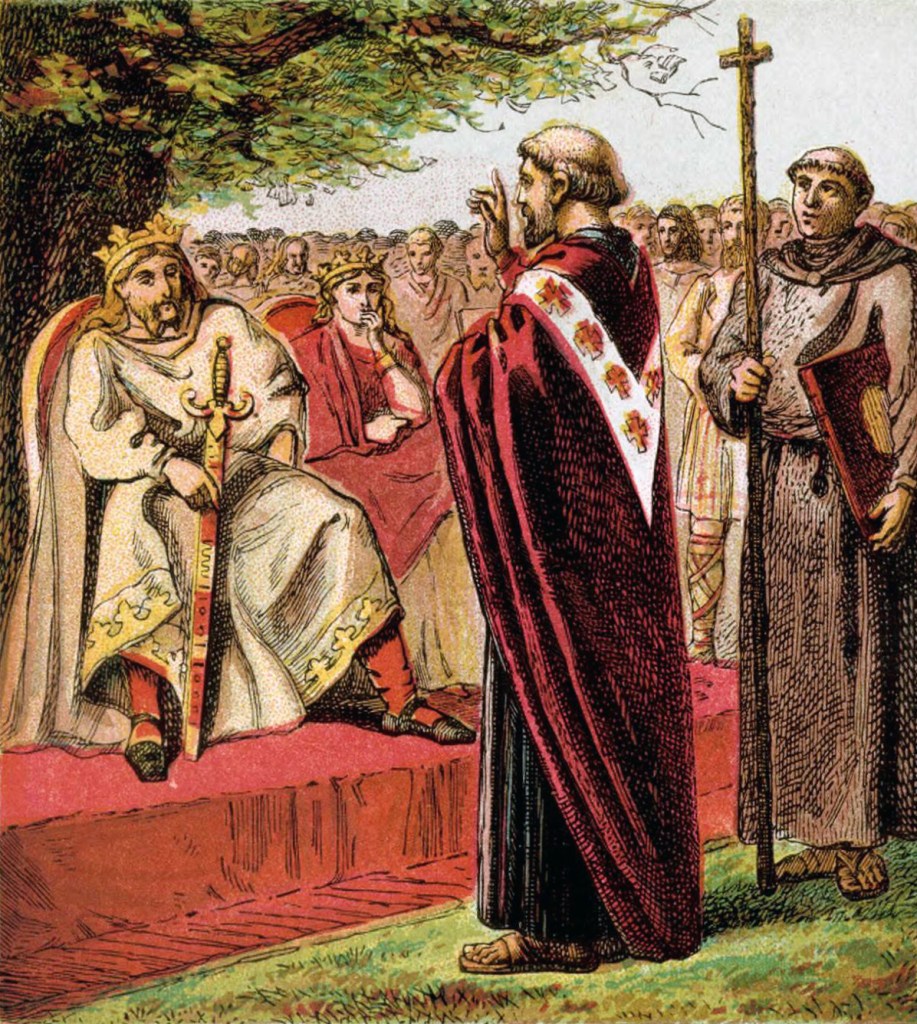
In the year 596, Pope St. Gregory the Great sent Augustine, the near-sighted prior of an abbey, along with 30 other monks to England to convert the English to Christianity. This small band of monks landed on the Isle of Thanet, located at the southeast corner of England, in the year 597.
The territory was ruled by Ethelbert, king of Kent, who was wary of these Christians, but because his wife was a Christian, he allowed the monks to stay. Eventually, Ethelbert would convert to Christianity, which encouraged his citizens to do the same. On a single day shortly after Ethelbert’s conversion and baptism, some 10,000 English were baptized in the River Swale by Augustine and his fellow monks. Not bad for a day’s work!
Augustine was consecrated as the first Archbishop of Canterbury and is known as the “Apostle to the English.” Archbishop Sarah Mullally, whom we pray for each week, is the 106th Archbishop of Canterbury.
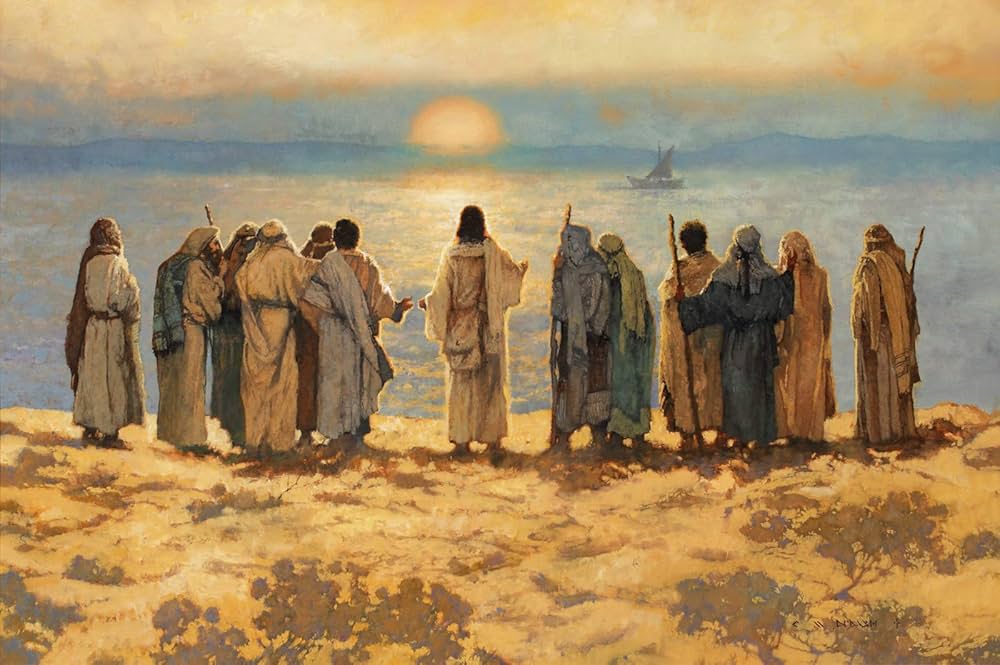
In our Gospel reading today, Jesus saw Simon Peter and the others fishing. He said to them, “Throw your nets out into the deep water for a catch.” Simon Peter’s response was, “Look, we’re fishermen. We know what we’re doing, and we’ve been out here all night trying. They aren’t biting, but just to satisfy you…” “They caught so many fish that their nets were beginning to break. So they signaled their partners in the other boat to come and help them. And they came and filled both boats, so that they began to sink.”
That event seems to be very accurate in describing the early history of the English Church. Casting and casting – 600 years of casting – then finally bringing in the catch when Augustine and his monks arrived. One of the many lessons in studying the life of Augustine and this era of English church history is persistence in faith. Recognizing that the goal is worth reaching, no matter the setbacks and hardships. This is true in the greater scheme of things and in our own lives.
A new priest came to town. On the first Sunday, he preached one of the best sermons folks had ever heard. Everyone was excited, believing things were looking up for their church. They all complimented him on his wonderful, inspiring words. The following Sunday, the new priest preached the exact same sermon, to the letter. Folks looked a bit bewildered, but since it was so good, they all thought it was worth hearing a second time, just not two Sundays in a row. However, since he was new, no one said anything other than that they enjoyed the sermon. The third Sunday, once again, the priest preached the exact same sermon. The Sr. Warden didn’t think they could take a fourth Sunday, so after everyone had exited the church, he had a word with the priest. “Father,” he said, “that’s a good sermon you preached.” “Thank you,” he replied. “However,” continued the Senior Warden, “you have preached the same sermon three times now. We’ve all heard it and were wondering when you were going to go on to a different subject.” “Sir,” he responded, “when you all start acting like you’ve heard it, I’ll preach something else.”
In the opening words of our Gospel lesson, Jesus said something curious: “If you love me, you will keep my commandments.” Earlier, He said, “Do not think that I have come to abolish the Law or the Prophets; I have not come to abolish them but to fulfill them. For truly, I say to you, until heaven and earth pass away, not an iota, not a dot, will pass from the Law until all is accomplished” (Matthew 5:17-18). What is curious is that we are also taught that we are no longer under the law or its commandments. St. Paul, in his letter to the Romans, said, “While we were living in the flesh, our sinful passions, aroused by the law, were at work in our members to bear fruit for death. But now we are released from the law, having died to that which held us captive” (Romans 7:5-6a).
So, what’s it going to be, law or no law? The answer, of course, is both, and the reason this sermon may sound like a repeat of so many others I’ve given is that the only way the answer can be both is if the solution is love. Therefore, I can stop preaching on love if we all start acting as if we’ve heard it. The problem is, one quick glance around the world today tells me I’ve got to continue preaching on the topic. So, with that, how is the answer “both”? How can we be under the law and not under the law? Jesus provides the answer when He was questioned by a lawyer who asked Him, “Teacher, which is the great commandment in the Law?” Jesus’ answer, I hope you all know by heart: “You shall love the Lord your God with all your heart and with all your soul and with all your mind. This is the great and first commandment. And a second is like it: You shall love your neighbor as yourself. On these two commandments depend all the Law and the Prophets” (Matthew 22:36-40).
We understand this to mean that behind the law lies a single guiding principle: love. Love is also the defining mark of a Christian. Jesus said, “A new commandment I give to you, that you love one another: just as I have loved you, you also are to love one another. By this all people will know that you are my disciples, if you have love for one another” (John 13:34-35). You know this as well. Together, these point back to the first line of our Gospel, “If you love me, if you are My disciples, then you will keep this summary of the law, which is to love God and to love one another.”
Here endeth the sermon. Go and love God and your neighbor. Amen? You should be so lucky. It would be that easy if we actually knew what it means to love like this, to love as Jesus loves us. But our idea of love often comes from a cherub named Cupid and a greeting card company with estimated revenues of about $5 billion, neither of which teaches us to love as Jesus loves. Let’s see if we can begin to sort it out. We’ll start by looking at a law: #10 of the top ten—“Thou shall not covet.”
To covet has two sides. The first is a lack of gratitude. When we covet, we are not satisfied or thankful for what we have. There is a constant need for more and more. Second, to covet is to become jealous of another for what they have and to want it for ourselves. To covet a thing or person is to desire it, and—whether we would define it as such—the things we desire are the things we love. Yet this love is disordered, because in it there is no love of God or of neighbor. In that disordered love, we become angry, anxious, and restless. Our souls are in turmoil over a desire, a love that cannot be fulfilled. Therefore, St. Augustine was correct when he wrote, “Our hearts are restless until they rest in God.”
To love instead of covet is to be thankful for the blessings and things God has provided us with, and to give thanks for the blessings others have. In your eyes, it may not seem fair that so-and-so has such-and-such, but that is not your concern. If they have sinned in order to gain what they have, that is between them and God. Don’t allow their sin to cause you to sin. If God, out of His goodness, has chosen to bless them, then be happy for them. You, you are to follow the commandment and love.
If that makes sense, then we understand that we don’t love as we should because our love is disordered. Our desire is elsewhere rather than on God, and this is sin in its most basic form. This disordered love has been with us since the very first day, when Adam and Eve desired a piece of forbidden fruit more than they loved God. It is also this disordered love that Jesus came to heal. The Lord said through the Prophet Ezekiel, “I will give you a new heart, and a new spirit I will put within you. And I will remove the heart of stone from your flesh and give you a heart of flesh. And I will put my Spirit within you, and cause you to walk in my statutes and be careful to obey my rules” (Ezekiel 36:26-27). The healing that Jesus brings to our souls fulfills this great work. In doing so, Jesus gives us freedom from the law, because we are no longer trying and failing to obey a set of statutes. Instead, we are living a transformed life. No longer will we say, “I can’t do ____ or I’ll go to hell.” Instead, we say, “I want, I desire to do or not do this, because I love God and I love my neighbor.”
In John’s first epistle (John is the great preacher of love), he writes, “Beloved, let us love one another, for love is from God, and whoever loves has been born of God and knows God” (1 John 4:7). Preaching on this and the verses that followed, St. Augustine said some radical things: “Love, and do what you will: whether you hold your peace, through love hold your peace; whether you cry out, through love cry out; whether you correct, through love correct; whether you spare, through love do you spare: let the root of love be within, of this root can nothing spring but what is good” (Homily 7.8 on the First Epistle of John). “Love, and do what you will.” That sounds very permissive. “I loves you, baby, and I can do whatever I want.” No. That is not what Augustine is saying. He is saying, “If—and that is a mighty big ‘if’—if my love is rightly ordered, if I truly love God, and if I truly love my neighbor as Jesus has loved me, then I am free from the law, because in my heart I will desire to do the right thing—I will fulfill both the law and the commandments of Jesus.” No longer will I have to do something. I’ll want to do it out of my love of God and neighbor.
I will have to preach a variation of this sermon time and time again. Why? Because we’ve been trying since day one to get it right, and only One, only Jesus, has succeeded. However, in Him and through Him, we are learning. And with the help of the Holy Spirit, whom Jesus has sent, we will continue to do so.
Are you loving as Jesus loves? No? If you work on only one thing in your life, work on that. By doing so, you can’t help but walk closer with God.
Let us pray: Grant, almighty God, that we may celebrate with heartfelt devotion these days of joy, which we keep in honor of the risen Lord, and that what we relive in remembrance we may always hold to in what we do. Through our Lord Jesus Christ, your Son, who lives and reigns with you in the unity of the Holy Spirit, God, for ever and ever. Amen.
We have discussed before that not all saints are born as the holiest of holy people, and many start out as quite sinful individuals. One such Saint is Augustine of Hippo. He is the patron saint of beer brewers because of his past habits before his conversion. Yet, he is now considered one of the preeminent Doctors of the Church, and it would be hard to find anyone who has influenced Christianity more than him outside of the Holy Scriptures. So, how did he go from a bad boy to a saint? There were many factors, but if you asked Augustine, he would probably say, “Momma.” We know her as Monica. However, Monica was not always a saint either.
She grew up in a Christian home, but not all the virtues seemed to be present in her life, and one area of concern ultimately led her to a deeper faith. She was responsible for going into the cellar to get the wine for family meals. As a child, she didn’t partake, but one day out of curiosity, she took a sip. Later, that sip became a cup, and eventually, she drank as much as she could. She was eventually found out by a servant who called her a “wine-bibber,” meaning a drunk. The comment made Monica so ashamed that she never drank liquor again, but she must have passed that taste onto her son Augustine.
At first, she would raise a fuss with him and scold him, but he simply ignored her pleas. However, with the help of a priest, she realized that this approach would only breed frustration and create a rift between her and Augustine. So, the priest suggested she try a different approach, which involved intercessory prayer, fasting, and vigils for her son. Later, she had a dream in which she was weeping over her son’s downfall, when suddenly an angel appeared and said, “But your son is with you.” When she told Augustine about the dream, he laughed and told his mother that they could be together if she would give up her Christianity. She replied, “The angel did not say that I was with you, but that you were with me.” That gave her the hope she needed, and she continued to pray. It took several years, but eventually Augustine converted and became one of the greats.
There is an incident in Mark’s Gospel where a young boy is said to have a demon that throws him down and harms him. The boy’s father brought him to Jesus’ disciples and asked them to heal his son. They tried, but were unsuccessful, so the man brought his son to Jesus, who was able to heal him. Later, in private, the disciples asked Jesus, “Why could we not cast it out?” He answered, “This kind can come out only through prayer and fasting.”
It would be wonderful if every time we offered intercessory prayers for healing, the person was healed immediately—and that can happen!—but more often, healing (which can take many forms: physical, spiritual, emotional) takes time. That was a lesson that both the disciples and Monica had to learn, and it is one we also need to be taught. In faith, we must believe that—regardless of the perceived outcome or lack of result—God is working, hearing the prayers of his people, and fulfilling those prayers according to his purposes.
Monica did not become a saint because she performed great deeds or died violently as a martyr. Monica became a Saint because she prayed and she believed in God’s promises. That is a practice we can all follow.