
Things to say to someone you truly dislike:
“I don’t hate you, I’m just not necessarily excited about your existence.”
“I’m not saying I hate you, what I’m saying is that you are literally the Monday of my life.”
“To me, you are like a cloud. When you disappear, it’s a beautiful day.”
“I don’t hate you, but I’d buy you a toaster oven for your bathtub.”
“I’m not saying I hate you, but I would unplug your life support to charge my phone.”
The state of the world these days has stirred up the same level of hatred (and I would say, dysfunction) in many people, so please do not shout anyone’s name—let’s keep things civil here—but I want you to think about the one person you dislike the most. Imagine them like the Grinch as he was looking at the names in the phone book of the citizens of Whooville, saying, “Hate, hate, hate, double hate, LOATHE entirely.” They pretty much just make you angry when you think about them. You would definitely like to give them a piece of your mind. Got it? Now, turn that feeling inward, where you become the target of that intense hatred.
That may seem very unhealthy for many, but for some, it’s how they feel about themselves. If you hate them, try stepping inside their heads for a few minutes, and you’ll realize they hate themselves even more than you ever imagined.
Experts tell us that there are several reasons why someone might not like or even hate themselves. One reason is the illusory truth effect, also known as the illusion of truth effect. A current example of this is what has come to be known as “fake news.”
Believe it or not, fake news exists. Oy! The trick with fake news is to repeat something enough times, whether it’s true or not, and people will start to believe it. The same idea applies to individuals. If you tell a child enough times that they are stupid, even if they have an IQ off the charts, the child is likely to come to believe they are, in fact, stupid. Tell them or treat them as if they are unloved, and they’ll begin to think that way too. We start to believe what others say about us, whether it’s true or not. What does this have to do with today and our Patron Saint, Matthew? I always imagined Matthew sitting alone at a table while people came up to pay their taxes when they were due. But I was wrong.
As we know, during Jesus’ time, the Romans occupied the Holy Land; therefore, they claimed the right to tax the people. To collect the taxes, the Roman senate appointed wealthy citizens to oversee specific areas of collection. These Roman citizens would then hire managers for those areas, who in turn would hire local individuals fluent in the local language to collect the taxes. These local tax collectors were called publicani.
The rules these tax collectors worked under appears to have been, “Tax everything.” And they were inventive. There were taxes “on axles, wheels, pack animals, pedestrians, roads, highways; on admission to markets; on carriers, bridges, ships, and quays; on crossing rivers, on dams, on licenses—in short, on such a variety of objects that even the research of modern scholars has not been able to identify them all.” Additionally, everyone from the Roman government to the publicani wanted a little piece of the action, so the publicani cheated their own people and charged extra.
Matthew, known in one translation as “The Lord of the Passage,” was in Capernaum, a prime location for collecting taxes. He would have been able to tax people traveling on the roads around the Sea of Galilee, including farmers, fishermen, and those arriving by boat. As a result, he would have been loathed entirely by both Jews and Gentiles. One source states that he would not have even been allowed to enter the Temple, and highly religious Jews would be considered unclean if they so much as touched him.
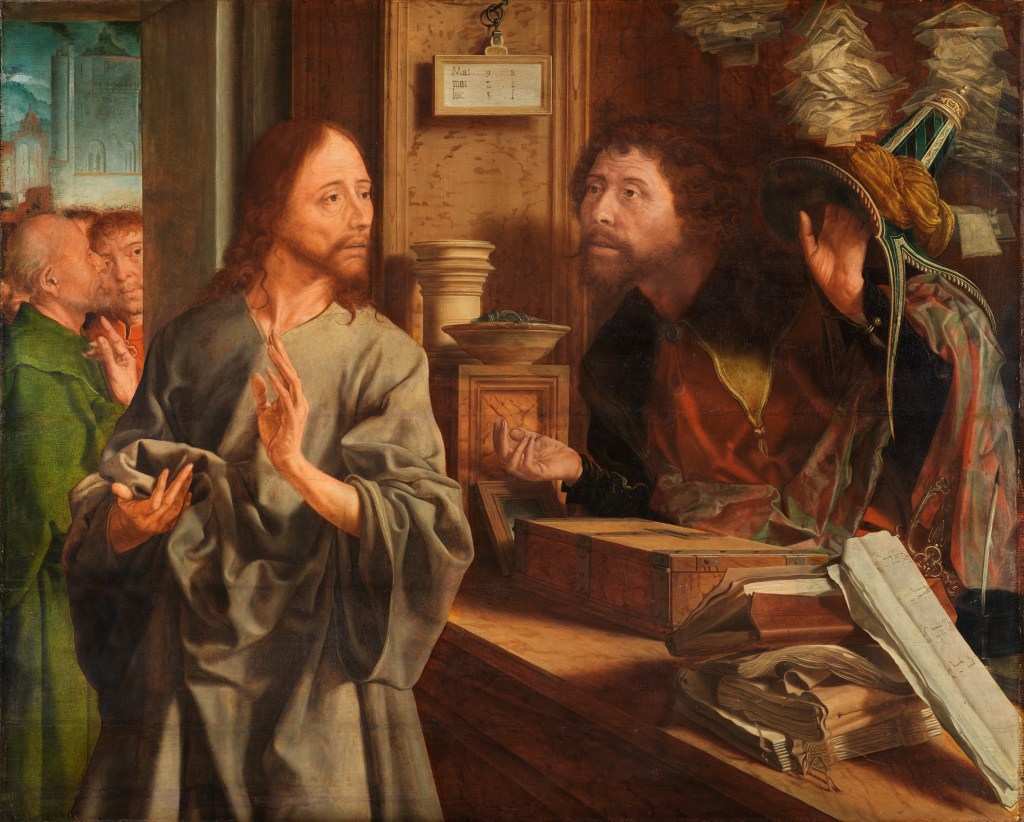
The building he worked in—think toll booth—was a busy place, with Roman guards and soldiers hanging about (seeing to it that everyone paid and no one tried to rob the place) and a line of folks waiting to pay. The mood: hostile and downcast, and there sits Matthew, not caring what you think about paying taxes or what you think about him. Yell, cry, cuss—whatever you please—you’re going to pay, and he doesn’t care. At the end of the day, he’s going home with a fat wallet. Yet, “As Jesus was walking along, he saw a man called Matthew sitting at the tax booth; and he said to him, ‘Follow me.’ And he got up and followed him.”
Without hesitation, Matthew walked away from it all—the job, the money, everything. He walked away from it all to follow a wandering Rabbi. What would make him do it? On that, the Gospel—even Matthew’s own Gospel—is silent, but I can’t help but wonder.
Some folks can be yelled at and cussed all day long without it affecting them one little bit. Like water off a duck’s back. But for most, it may not impact them much initially, yet over time, it begins to wear on them. Just ask anyone who has ever been in an abusive relationship—they start to believe every word—an illusion of truth effect. So I had to wonder, even with the job and the money, do you think it’s possible that Matthew came to hate himself as much as the people hated him? It wasn’t some pity party, but I wonder if, over time, he started to believe he had no real value, no true friends, no real life. Did he come to believe that he was nothing more than the names people called him?
Perhaps he wasn’t a Biblical whiz kid, but he remembers a few things from his youth, like the words of Psalm 22.
I am a worm and not a man,
scorned by everyone, despised by the people.
All who see me mock me;
they hurl insults, shaking their heads. (Psalm 22:6-7)
And, day after day, as he sat there collecting taxes and enduring all the abuse the people dished out, do you think he might have hoped for something better? A life where he could be accepted and valued? A life where he could be loved?
Again, the Gospel is silent, but I have to wonder: when Jesus walked by, did he catch Matthew’s eyes? And in Jesus’ eyes, did Matthew see it all—everything he truly wanted: acceptance and value? And in those two words, “Follow me,” did Matthew hear Love calling out to him?
The Blessed Virgin Mary. In Luke’s Gospel, we learn that when Mary discovered she was with child, she went to visit her cousin Elizabeth. When she entered Elizabeth’s house, Mary greeted her. Scripture says, “When Elizabeth heard Mary’s greeting, the child leaped in her womb. And Elizabeth was filled with the Holy Spirit and exclaimed with a loud cry, ‘Blessed are you among women, and blessed is the fruit of your womb. And why has this happened to me, that the mother of my Lord comes to me? For as soon as I heard the sound of your greeting, the child in my womb leaped for joy.’” Elizabeth’s unborn son, John the Baptist, heard Mary’s greeting and knew that Jesus was near, so he responded with joy by leaping in the womb. I wonder if, in a similar way, when Matthew heard the voice of Jesus, “Follow me,” did his soul leap for joy within him?
Former Presiding Bishop Michael Curry said, “When you look at Jesus, you see one who is loving, one who is liberating, and one who is life-giving.” Matthew was loved by God, he was liberated from those things that bound him, and he was given new life in Jesus.
I came across a quote this past week attributed to Kahlil Gibran, the Lebanese-American writer and philosopher. After a bit of research, I found that he did not actually say it, but the quote remains quite meaningful—”God said ‘Love Your Enemy,’ and I obeyed him and loved myself.”
Matthew saw, heard, and I believe his soul leapt within him when Jesus called out to him. Matthew no longer hated the enemy; he no longer hated himself but learned to love himself because he finally understood what it meant to be loved. In doing these things and in allowing himself to be loved by Jesus, he became a Saint of God.
That is also true when you see Jesus, and it is true when you hear him. If you will look up into the face of Jesus, listen to his voice, and follow Him, He will do the same for you. And not only will he make you a saint, but He will make you a child of God Most High.
Let us pray: O Glorious St. Matthew, in your Gospel you portray Jesus as the longed-for Messiah who fulfilled the Prophets of the Old Covenant and as the new Lawgiver who founded a Church of the New Covenant. Obtain for us the grace to see Jesus living in his Church and to follow his teachings in our lives on earth so that we may live forever with him in heaven. Amen.

 Candle in a Cave