Sermon: All Saints Day – “be a Saint”


In the first Freshman English class of the semester, the teacher stated, “Let us establish some examples about opposites. Timothy, what is the opposite of joy?”

“Sadness,” said the student.

“Fine.

And the opposite of depression, Rachel?”

“Elation,” she replied with a smile.

“Very good.

And you, Johnny, what is the opposite of woe?”

“I believe that would be ‘giddy up’”

Scripturally speaking, the opposite of “woe” is “blessed,” and we heard those beautiful words, “Blessed are you,” but as beautiful as those words are, today is our celebration of All Saints, so instead of focusing on the words, we focus on those who heard the words and followed the one who spoke them. We focus on the ones who were blessed.

There are approximately 8.1 billion people living today out of the roughly 117 billion people who have ever been born. Of those 117 billion, only about 10,000 are recognized by the church as capital “S” saints: St. Mary, St. Matthew, St. Julian, and others. That’s roughly one Saint for every 11,700,000 people born. So, the question for you today is: what are the chances of you becoming a saint?

For me, I go along with what Brennan Manning said in The Ragamuffin Gospel: “When I get honest, I admit I am a bundle of paradoxes. I believe and I doubt, I hope and get discouraged, I love and I hate, I feel bad about feeling good, I feel guilty about not feeling guilty. I am trusting and suspicious. I am honest and I still play games. Aristotle said I am a rational animal; I say I am an angel with an incredible capacity for beer.” I prefer Scotch, but you get the point. I consider the odds 1/11,700,000 and think it could happen, but if we’re being honest… honesty is overrated. My one consolation is that I know I have a much better shot at it than you lot.

Perhaps, instead of asking “Who will become a Saint?” we should ask, “Who should strive to become a Saint?” It might seem a bit bold to us, but many of the great saints intentionally described themselves as working to become saints, and some went as far as to predict that they would. St. Joseph Cafasso writes, “I would be the happiest of men if I could become a saint soon and a big one.” Blessed Mary Fortunata Viti says, “I am fortunate to be given this opportunity to become a saint. I want to become a saint,” and St. Margaret of Cortona says, “A time will come when you will call me a saint, and you will go on a pilgrimage to my tomb with the staff and wallet of a pilgrim.” This might seem to negate the whole idea of humility we see in the saints, but instead it points to the fact that they took seriously Christ’s command to “be perfect as your heavenly Father is perfect,” and, in doing so, they are blessed.

Thomas Merton, in his autobiography The Seven Storey Mountain, describes a notable conversation he had with his friend Robert Lax. Apparently, they were arguing as they walked when Robert suddenly stopped and, turning to Merton, asked, “What do you want to be, anyway?” Merton had a few poor answers in his mind but finally said, “I don’t know; I guess what I want is to be a good Catholic.” Robert responded, “What do you mean you want to be a good Catholic? What you should say… what you should say is that you want to be a saint.” “How do you expect me to become a saint?” Robert replied. “By wanting to.” Merton said, “I can’t be a saint.” 

Remembering the mood of this conversation, years later, Merton wrote, “My mind darkened with a confusion of realities and unrealities: the knowledge of my own sins, and the false humility which makes men say that they cannot do the things that they must do, cannot reach the level that they must reach: the cowardice that says: ‘I am satisfied to save my soul, to keep out of mortal sin,’ but which means, by those words: ‘I do not want to give up my sins and my attachments.’” In their conversation, his friend Robert continued, “All that is necessary to be a saint is to want to be one. Don’t you believe that God will make you what He created you to be, if you will consent to let Him do it? All you have to do is desire it.” The next day, looking for a way out, Merton told another friend, “[Robert] is going around saying that all a man needs to be a saint is to want to be one.” His friend’s response, “Of course.” Of course! All you have to do to become a saint is to want to be one.

God’s love pulls us out of the places of sin where He finds us. He pulls us out because He wants more for us, and in pulling us out of those places, he calls us into another place—one where we can strive to become that one person in 11,700,000. And before you say, “I can’t,” consider the words of Thomas Merton when he said he couldn’t. You see, when we say we can’t, it’s because we become painfully aware of our sins. We are confronted with aspects of our lives that we’re often unwilling to change in order to be more saint-like. Remember St. Augustine’s words, “Lord, make me chaste—but not yet!”

Become a saint! I can’t. Why? Because of pride, gluttony, and anger? Then learn humility, moderation, and forgiveness. If you did those things, would you then be a saint? Probably not, but you might be a step closer. 

Consider a monk who lived on Mount Athos with Elder Paisos. The monk drank excessively, smoked two packs of cigarettes a day, and cursed like a sailor. One day, after the monk’s death, a few pilgrims approached Elder Paisos, who spoke of the monk so affectionately and regarded him as a saint afterward. The pilgrims were distraught; they discussed all the issues the monk had in his life and scolded Elder Paisos for failing to notice those faults. Elder Paisos understood their concerns but then told them that the monk had cut his twenty glasses of wine down to three and reduced his smoking from two packs to just one cigarette a day. Elder Paisos was certain that God saw a fighter, while the world saw a sinner.

Is this an easy task? Of course not—there are many reasons, but one of the main challenges is the need to turn our critical eye toward ourselves. This battle isn’t fought out there but within us, because “For our struggle is not against flesh and blood, but against the rulers, against the authorities, against the powers of this dark world and against the spiritual forces of evil in the heavenly realms.” Becoming a saint is difficult because many of the battles are unseen. They occur in a place where our greatest weapon is our faith. At times that faith may not seem like much; however, behind that faith stands the One True God who loves us. St. Paul reminds us, “Since then we have a great high priest who has passed through the heavens, Jesus, the Son of God, let us hold fast our confession. For we do not have a high priest who is unable to sympathize with our weaknesses, but one who in every respect has been tempted as we are, yet without sin. Let us then with confidence draw near to the throne of grace, that we may receive mercy and find grace to help in time of need.” (Ephesians 4:14-16)

You may never attain sainthood in this life, and you might never receive the title “Saint,” with a capital “S,” but that shouldn’t stop you from consistently and faithfully striving for it. St. John Vianney wrote, “We must never lose sight of the fact that we are either Saints or outcasts, that we must love for Heaven or for Hell; there is no middle path in this.” Don’t be satisfied with merely escaping to heaven “as one escaping through the flames”; instead, put up a good fight and strive to hear those words, “Well done, good and faithful servant!” Strive to become one among 11,700,000. Strive to be blessed.

Let us pray: (This prayer is called The Anima Christi, The Soul of Christ.)

Soul of Christ, sanctify me;
Body of Christ, save me;
Blood of Christ, inebriate me;
Water from the side of Christ, wash me;
Passion of Christ, strengthen me;
O good Jesus hear me;
Within your wounds hide me;
separated from you, let me never be;
From the evil one protect me;
At the hour of my death, call me;
And close to you bid me; That with your saints,
I may be praising you forever and ever. Amen.


Sermon: All Saints Sunday RCL B – “Be a Saint”


The human body is a fantastic creation, yet most of us don’t give it a second thought until something breaks. It’s a bit like what Jerry Seinfeld said, “The human body is like a condominium. The thing that keeps you from really enjoying it is the maintenance.” Outside of the maintenance, when we do think of it, we are primarily concerned with the outward appearance. Am I fit? How’s my hair? Do I have blemishes? “Honey, does this dress make me look fat?” That sort of thing. However, as interesting as all that can be, what goes on below the surface of the flesh is mindblowing—a few examples.

Did you know that when you listen to music, your heartbeat changes and attempts to mimic the beat? It is why soothing jazz slows you down, and that old-time rock-n-roll gets your blood moving.

The fastest-moving muscle in your body is the one that controls the contractions in your eye, helping you to focus. It does its job in 1/100th of a second.

Every second, you produce 25 million new cells. 

If you live to 70, your heart will beat about 2.5 billion times; it is the only muscle that never gets tired. 

The one fact that seems beyond belief is the circulatory system. A newborn’s circulatory system—all the arteries and veins—if stretched end to end, is 60,000 miles long. When you are an adult, it reaches 100,000 miles.

All this and more is happening, but when we look at another person, we see none of it. 

If you’ve seen any of my travel pictures, you probably picked up on the fact that I haunt churches. The churches are the number one places to see when I visit a new city. I don’t know much about architecture or art, but I love the feel of them—how you can sit quietly and be surrounded by the centuries of prayers, sense the individuals who walked through and learn of the great history that took place in and around those walls. And most of all, to simply be there. Inside, you experience the awe and reverence that spills from your soul as the church’s grandness speaks of the greatness of God.

When I’m visiting one, I never think about everything that is going on behind the scenes. I don’t think about the choirmaster toiling away in a back office seeking the perfect hymn to fit with the upcoming services or the organist, who spends hours practicing so that the music is perfect. I don’t think about the individuals who polish the floors or pay the bills. When I see an ornate pulpit, I don’t necessarily think of the priest—I say to myself, “Man, I sure would like to preach from there.” It never crosses my mind that they may have a new refrigerator that makes a weird banging sound, but they can’t get anyone out to look at it, so they must call repeatedly. I can’t imagine someone there spending a couple of hours researching how to get the oxidation off the big red doors so that they aren’t the big pink doors. I don’t think about any of those things and so many other details. I am allowed to experience the greatness of God and His majesty and to worship when I am there. Why? Because I may not be thinking about or doing all those things, but someone is. 

The pictures of the pyramids are on the front of your bulletin. I was looking at something and came across the one on the right. The pyramids are in the distance, with the city at the forefront. I wondered where that was. As it turns out, it is the exact same location as the picture on the left. That image on the left is how I always thought of the pyramids—isolated from the world, surrounded by the beautiful sands of the desert, the clear blue sky, and the remarkable symmetry of the structures, but it is only the angle from which you are looking. I had no idea. If we were there, facing the pyramids from the angle of the picture on the left, that is what we would see. If we turn 180°, the city is right there in all its chaos! 

Walking into this church, I have the benefit of being able to see it from many angles.  This—looking out at you—is my favorite view. It is like seeing the pyramids in all their glory—beautiful sand, blue sky, perfectly ordered—but if I change the angle and “look behind me,” it can be wild. Everything that had to take place and get done so that we could be here at this very moment, experiencing God together. However, what is even more fascinating is all that occurred in the past so that we could be here in the first place.

There’s a great film, Lucy, with… hubba hubba, you guessed it… Scarlett Johansson. In one scene, she sits in an office chair in Times Square in New York. Then, she swipes her hand and begins a rapid rewind of time. She stops the rewind; it is still Times Square, but it is being built. She swipes again; the city is gone, and she is seated in front of several Native Americans. Again, she swipes and continues to go further and further back. Through the process, she sees all that had to take place for her to be in that present moment. What if we could do the same with St. Matthew’s? What would we see? Not just what took place in the past week for us to be here but what took place over the centuries for us to be here. We would see the Bishops and the clergy and the people and would see the Land Run. Further back, we would see the establishment of the Anglican Church in the New World, and further and further until we see Jesus standing in front of a tax collector, saying to him, “Follow me.”

During all that 2,000-year history, you will discover many great women and men who made it possible for us to be here today. They are the ones we celebrate on this All Saints Day, but as I was thinking about them, I thought again about sitting in Scarlett’s chair and not swiping back, but instead swiping forward—into the future. If we did, what would we see in this place? 

James Lloyd Breck is one of the saints of our Church. He was a great missionary and, in 1842, founded Nashotah House, the seminary I attended.  He died in 1897, and on a gray autumn day in October, the people gathered at Nashotah House to lay him to rest. In attendance were Bishop Daniel Sylvester Tuttle, the first missionary Bishop of Montana, and Bishop Francis Key Brooke, the first Missionary Bishop of Oklahoma. Bishop Tuttle spoke at the graveside.

“There was a Grecian race in which the runners were charged to care not for themselves, nor indeed for each other, but for the torch they bore. As one and another, wearied and overcome, fell by the way, he held aloft his torch, handing it to a comrade who seized it quickly and sped on. So, with the torch borne by the Christian man. It has a triple flame: God’s truth, Christ’s love, men’s good. We are to hold it up and pass it on. One or another of us is soon to fall in the hard-trodden, dusty path. But never mind us, it is dust to dust, though it may be sacred dust that falls, and God will take care of it. Do not mind us; seize the torch, we pray you, and push on to the blessed goal.”

Those who went before us, all the Saints and that Great Cloud of Witnesses, carried that torch, and when they fell, someone else picked it up. And so, it is now our turn. We must pick up the torch with its triple flame, “God’s truth, Christ’s love, men’s good,” and carry it into the future so that when we fall back into dust, there will be someone new to pick it up and carry on.

It is a gift to be able to gather in this place, to be concerned with nothing other than the worship of the One True God, and to have fellowship with one another. It is a gift, but we must all turn and understand what makes this gift possible. 

Like the saints that have gone before us, we have the responsibility to pick up that torch with its triple flame and carry it so that when the next generation picks it up, it is burning all the brighter. 

How are we able to carry it? We carry it through our service to one another and the church—our attendance and participation in corporate worship, volunteering, helping in the various ministries, going out into the community and proclaiming the Gospel through word and deed, and financially supporting the Church as we are able.

We celebrate All Saints Day to honor those who have gone before us and to remind ourselves of who we are to become. 

So, if you sit in Scarlett’s chair and fast forward into St. Matthew’s future, what do you want to see? When you see a vision of that future, ask yourself, “How can I help create that?” Then, in faithfulness and obedience, commit yourself to God, pick up that torch, and carry on.

Let us pray: Almighty ever-living God, by whose gift we venerate in one celebration the merits of all the Saints, bestow on us, we pray, through the prayers of so many intercessors, an abundance of the reconciliation with you for which we earnestly long. Through our Lord Jesus Christ, your Son, who lives and reigns with you in the unity of the Holy Spirit, God, for ever and ever. Amen

Sermon: All Saints Day


“In politics, stupidity is not a handicap.” ― Napoleon Bonaparte

“Corrupt politicians make the other ten percent look bad.” ― Henry Kissinger

“The trouble with practical jokes is that very often they get elected.” ― Will Rogers

“When they call the roll in the Senate, the Senators do not know whether to answer ‘Present’ or ‘Not Guilty’.” ― Theodore Roosevelt

“Politicians and diapers must be changed often, and for the same reason.” ― Mark Twain

’Tis the season, but what does politics have to do with All Saints Day? The Saints, throughout the history of the Church, have stood up against those who call themselves rulers/politicians, whether they be kings or queens, presidents or emperors. In many cases, it cost the Saint their life, but they still stood firm.

Shortly before he was put to death for denying Henry VIII, Thomas More said, “I die the King’s good servant but God’s first.” As he stood firm during the Spanish Civil War, Josemaria Escriva told those with him, “Remain faithful. As for the rest, what does it matter?” Standing up to another English king, Thomas Becket said, “The more I loved the king, the more I opposed his injustice until his brow fell lowering upon me.” Joan of Arc stood before tyrants and declared, “To sacrifice what you are and to live without belief, that is a fate more terrible than dying.”

Rulers and elected officials have always pandered to the Church, seeking favor, endorsement, and—more importantly—votes. And, to its detriment, the Church has frequently allowed itself to be drawn in. Yet, the Saints teach us another way. The Saints teach us God’s way. A way that is contrary to that of the world.

Eugene Peterson writes quite a bit for clergy. I don’t remember if I’ve shared this piece with you before. It is from his book The Contemplative Pastor.

He begins one chapter by saying, “As a pastor, I don’t like being viewed as nice but insignificant. I bristle when a high-energy executive leaves the place of worship with the comment, ‘This was wonderful, Pastor, but now we have to get back to the real world, don’t we?’”

He says that when he hears this, he wants to assert his importance, but “Then,” he says, “I remember that I am a subversive. My long-term effectiveness depends on my not being recognized for who I really am. If he—high-energy executive—realized that I actually believe the American way of life is doomed to destruction, and that another kingdom is right now being formed in secret to take its place, he wouldn’t be at all pleased. If he knew what I was really doing and the difference it was making, he would fire me.

“Yes, I believe that. I believe that the kingdoms of this world, American and Venezuelan and Chinese, will become the kingdom of our God and Christ, and I believe this new kingdom is already among us.”

Yes, politics and All Saints Day go very nicely together because the Saints were revolutionaries. In their times, they believed, lived, and died for what Peterson’s subversive pastor declares. And it is why you and I should not get all riled up about what happens next Tuesday or next year or whenever. Yes, it is important, and yes, we should vote, but in doing so, we also know that the outcome—whether we like it or not—is according to the will of God and will serve His purposes, not for some earthly kingdom, but for God’s Kingdom.

Regardless of the outcome, we, the Church, the new saints of God, will do what we’ve been doing for the last 2,000 years—stand up against those who oppress God’s people and care for those in need. We will continue going about the work of our One True King, and no earthly weapon or politician will prosper against Him. 

We, the people, have nothing to fear. However, those who seek authority over us should take heed, for our God says, 

Therefore, you kings, be wise;
    be warned, you rulers of the earth.

Serve the Lord with fear
    and celebrate his rule with trembling.

Kiss his son, or he will be angry
    and your way will lead to your destruction,

for his wrath can flare up in a moment.
    Blessed are all who take refuge in him.

We are the children of the King, and He loves us. Be faithful and fear not. Stand with the Saints and be true.

Sermon: All Saints Day RCL A – “Orthodoxy & Orthopraxy”

Photo by Nicolas Hoizey on Unsplash

One day, eight-year-old Melissa tells her mother, “Mommy, I’ve been thinking about us humans, and I’m a bit puzzled. How did we first appear on Earth?”

“That’s a very good question, darling,” her mother replies. “God made Adam and Eve, and they had children, and then their children had children, and as a result, mankind began.”

Later that day, Melissa asks her father the same question. “Daddy, how did we humans first appear on Earth?”

“That’s an intelligent question, Melissa,” he replies. “Millions of years ago, there were monkeys from which, gradually, the human race evolved.”

Melissa is confused by this answer and goes back to her mother. “Mommy,” she asks, “how come you told me the human race was created by God, yet Daddy said they developed from monkeys?”

“Well darling,” replies her mother, smiling, “the answer is simple. I told you about my side of the family, and your father told you about his.”

In some circles, the answer to the question of where we came from is still debated—and it is certainly not one I’m diving into today—but I think both sides (I could be wrong) could agree on the role DNA plays in our individual makeup. 

It was in 1953 that James Watson and Francis Crick published a one-page article, “A Structure for Deoxyribose Nucleic Acid,” in the scientific weekly journal Nature. That article is the core of our understanding of DNA because it was there that the double-helix structure of DNA was reported.

If you jump back to your science classes in school, you may remember a bit about DNA. I had to do a bit of research. The article that I could understand stated, “DNA is made of two linked strands that wind around each other to resemble a twisted ladder—a shape known as a double helix…. [and] the two strands are connected by chemical bonds between the bases.” The DNA “makes each of us who we are.” The color of our eyes and skin to, our intellectual capacity, and how well we can see are all based on our DNA. Even more impressive is that “the DNA from any two people is 99.9% identical, with that shared blueprint guiding our development and forming a common thread across the world. The differing 0.1% contains variations that influence our uniqueness.” (Source) Two linked strands of sugars and phosphates make us who we are. Those two linked strands are also the root cause of birth defects and disease and are ultimately responsible for killing us (should we not die of some outside agent.) 

In the early stages of development, if the DNA does not come together as it should, we end up with varying degrees and types of birth defects. Should a particular strand of DNA be coded wrong and begin to develop uncontrollably, tumors form. And, over time, as more minor errors enter the process, we age and die.

Why the lesson in genetics this morning? There are two aspects, two strands of our faith: orthodoxy and orthopraxy. 

Orthodoxy is correct belief. As a Christian, what is it we believe? Every week, we state it: “We believe in one God, the Father, the Almighty… We believe in Jesus Christ… We believe in the Holy Spirit.” Orthodoxy is the adherence to these statements. It is why, when we make or renew our Baptismal Covenant, the celebrant asks, “Do you believe in God the Father,” and so on. Orthodoxy deals with things of grace and matters of faith. If there were only orthodoxy right belief, many of us would probably be in good shape, but there is also the other strand, orthopraxy. 

Orthopraxy is correct action, dealing with ethics, morality, and behavior. Where the Creeds give us the best understanding of orthodoxy, the Law, the Ten Commandments, provides the best example of orthopraxy. Right action: Thou shall not commit murder. If you don’t kill, amongst other things, then your actions are correct.

Like the double helix of DNA, orthodoxy and orthopraxy are two strands that cannot function without the other—although there have been some who have tried. In the time of Jesus, the Pharisees relied entirely on orthopraxy. Jesus condemned them for this as the ones who looked good on the outside but who were unchanged on the inside. During the 4th and 5th centuries, St. Augustine of Hippo dealt with the other side as he confronted the heresy of Manichaeism. They believed that the outside world or our sins could not taint us. Both views were errors. Orthodoxy and orthopraxy must work in union with one another. Like the double helix, the two strands must be brought together, and this was accomplished through Jesus. He summed it up for us last week, “‘You shall love the Lord your God with all your heart, and with all your soul, and with all your mind.’ This is the greatest and first commandment. And a second is like it: ‘You shall love your neighbor as yourself.’”

With regard to our faith, right believing and right acting are expressed and practiced through our love of God and our love of one another. Wouldn’t it be nice if that were the end of it? Unfortunately, we like to complicate things because instead of living according to what Jesus said, we’ve taken it upon ourselves to establish orthodoxy and orthopraxy according to our standards. Of course, we know better than God. 

Jesus said to love, but we say, “Before we can love, we must decide what we do and do not believe and how we should and should not act.” Once that is decided, we say, “I can love you if you believe the way I believe. I can love my neighbor as long as they act according to what I decide is right behavior.” In doing this, we introduce errors into this genetic “spiritual” code and bring about dis-ease, defect, and even death. By introducing errors, we’ve created an entirely new set of problems.

Taken to one extreme, orthopraxy can become fundamentalism and fanaticism—“Believe as we say, do as we say, or go to hell.” Taken to another extreme, orthodoxy can become apostasy, where everything is A-OK, and there is no right and wrong—“Believe what you like. What’s most important is that you feel good and are happy.” Combine the two and take them in a particular direction, and you’ll end up with the prosperity gospel—“Believe right, act right, and God will give you a million bucks!” The problem is that instead of allowing God to establish right belief and right action, we take it upon ourselves.

I say, My way is the right way, and all others are wrong. Jesus says, “Blessed are the peacemakers. Blessed are the merciful.” I say I can do whatever I want when I want. Jesus says, “Blessed are the pure in heart. Blessed are those who hunger and thirst for righteousness.” I say ___, and Jesus says, “Blessed are the meek,” the humble. I say I want, Jesus says, “Blessed are the poor in spirit.” 

This is All Saints’ Sunday. The day that we celebrate the great Saints that have gone before us. The Saints did not become Saints because they did all things correctly. They did not become Saints because they believed all things correctly. They became Saints because they did not play God. They became Saints because, first and foremost, they sought after God and not their own understanding. Not “I.”  

The author of Proverbs writes,
“Trust in the Lord with all your heart,
and do not lean on your own understanding. 
In all your ways acknowledge him,
and he will make straight your paths.
Be not wise in your own eyes;
fear the Lord, and turn away from evil.
It will be healing to your flesh
and refreshment to your bones.”
(Proverbs 3:5-8)

St. Francis de Sales said, “Sanctity does not consist in being odd, but it does consist in being rare.” It is a rare soul that can look beyond their understandings, prejudices, wants, beliefs… beyond “I.” It is a rare soul that can get out of the way and allow God to be God. However, when we do, we begin to catch glimpses of God’s understanding of the world around us, truths that are beyond narrowed vision, and a love that knows no limits. Refusing is quite the opposite of God’s calling on our lives.

Let us pray (this is a prayer I also shared during our Wednesday Mass): Dear Jesus, in the Sacrament of the Altar, be forever thanked and praised. Love, worthy of all celestial and terrestrial love! Who, out of infinite love for me, ungrateful sinner, didst assume our human nature, didst shed Thy most Precious Blood in the cruel scourging, and didst expire on a shameful Cross for our eternal welfare! Now illumined with lively faith, with the outpouring of my whole soul and the fervor of my heart, I humbly beseech Thee, through the infinite merits of Thy painful sufferings, give me strength and courage to destroy every evil passion which sways my heart, to bless Thee by the exact fulfillment of my duties, supremely to hate all sin, and thus to become a Saint. Amen.

Sermon: All Saints Day

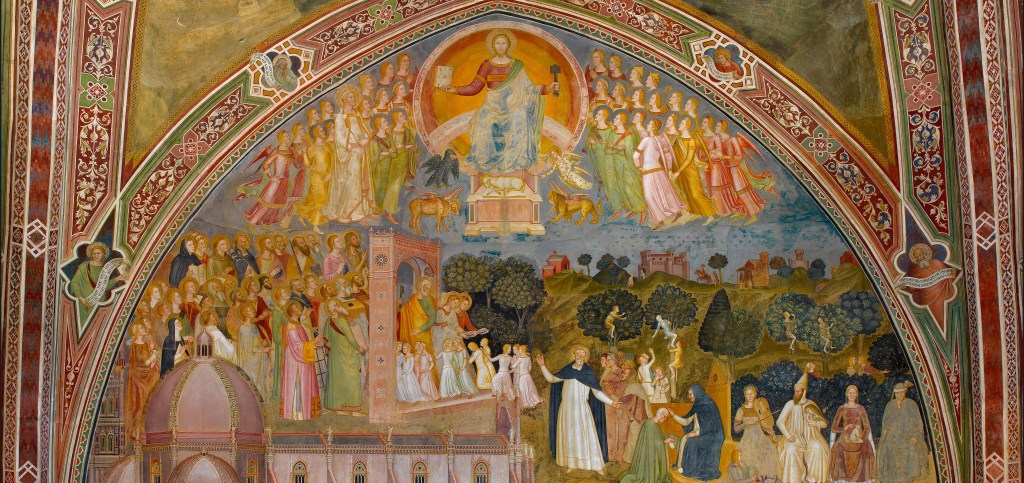
The Way of Salvation fresco by Andrea di Bonaiuto da Firenze

The Book Ecclesiasticus is from the Apocrypha, and the 44th chapter begins,

Let us now sing the praises of famous men,
our ancestors in their generations.
The Lord apportioned to them great glory,
his majesty from the beginning.

So, on this All Saints Day, let us.

About the year 115 a.d. there lived a man we know as Ignatius of Antioch. Except for a brief history, all we know of him comes to us through legend and seven letters he wrote. Concerning the legend, do you remember the story of the little boy that Jesus picked up? Having brought the child into the midst of the disciples, Jesus said, “Whoever receives one such child in my name receives me, and whoever receives me, receives not me but him who sent me.” (Mark 9:37) Well, the legend of Ignatius tells us that he was this child. Legend/history tells us that Ignatius would go on to become Bishop in Antioch. During one of the many persecutions, he was captured and taken to Rome for trial. He would be tried and executed for treason. However, during the journey between Antioch and Rome, his guards treated him somewhat civilly and were sympathetic to the elderly man, so they allowed him to write letters to the believers back home. Seven of those letters survive to this day, and through them, some of the foundational stones of the Christian Church were laid, especially as they relate to Holy Scripture, the Creeds, Bishops, Priests, Deacons, and the liturgy. Ignatius of Antioch is clearly a Saint in the Christian Church. Let us sing the praises of Ignatius.

Let’s change one word of the verse from Ecclesiasticus and say, “Let us now sing the praises of famous women.” The Blessed Virgin Mary is the most famous, but many others exist. During the time of Emperor Septimus Severus in the early third century, it was illegal to convert to Christianity. This likely deterred some, but not all. If the officials became aware, the convert was arrested and given the opportunity to recant. They were then required to make sacrifices to the Roman gods. Only then could they go about their business. If they refused, they were put to death. Felicity and Perpetua were two women who refused to recant their faith even though they had both only recently been baptized and both had just had children. On the day of their execution, they were given one last chance to recant, and when they refused, a wild bull was released into the cage where they were and trampled. Wounded by the animal, they gave each other the kiss of peace and were then put to the sword. Felicity and Perpetua are martyr saints in the Christian Church. Let us sing the praises of Felicity and Perpetua.

We could do this all day and not even hear the tip of the iceberg because the Church recognizes more than 10,000 official Saints. And when we begin to include individuals such as Dietrich Bonhoeffer, the Martyrs of Uganda, C.S. Lewis, and Evelyn Underhill, the list seems endless. However, we are still not done singing praises. Why? There are many more in the making. Today, my question for you is, “How are you becoming a Saint?” For becoming a saint should be the desire of us all. How do you go about it? My friend, St. Josemaría Escrivá wrote, “Do you really want to be a saint? Carry out the little duty of each moment: do what you ought and concentrate on what you are doing.” (The Way, 815)

Follow in the footsteps of the Saints, and in the end, not only will you hear others sing your praises, but you will hear Jesus as well when He says, “Well done, good and faithful servant…. Enter into the joy of your master.” (Matthew 25:21)

Sermon: RCL C – “All Saints Sunday”

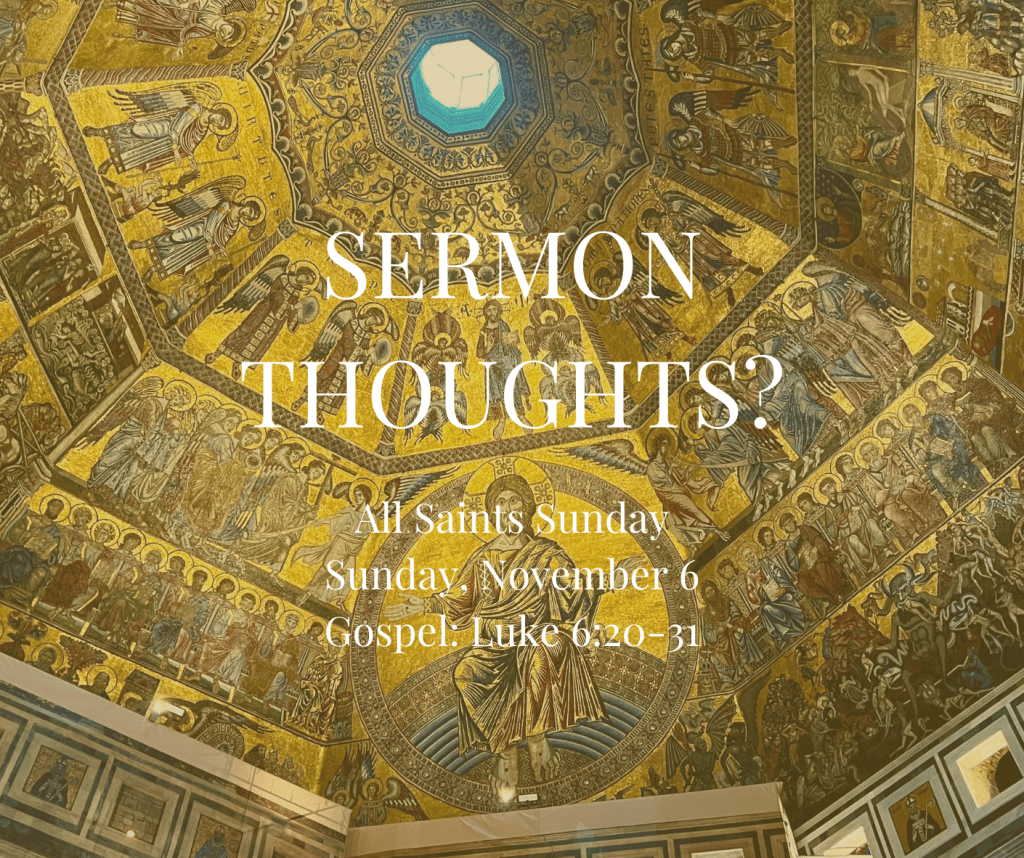
A picture I took while in Florence, Italy, of the ceiling in The Baptistery of St. John at the Duomo

Irish History: Stingy was a miserable, old drunk who liked to play tricks on everyone: family, friends, his mother, and even the Devil himself.  He once invited the Devil to have a drink with him. True to his name, Stingy didn’t want to pay for his drink, so he convinced the Devil to turn himself into a coin he could use to buy their drinks. Once the Devil did so, Stingy decided to keep the money and put it into his pocket next to a silver cross, which prevented the Devil from changing back into his original form. He eventually freed the Devil under the condition that he would not bother him for one year.

As the story goes, Stingy, one day, tricked the Devil into climbing up an apple tree. Once the Devil climbed up the apple tree, Stingy hurriedly placed crosses around the trunk of the tree. The Devil was then unable to get down the tree. Stingy made the Devil promise not to take his soul when he died. Once the devil promised not to take his soul, Stingy removed the crosses and let the Devil down. 

When Stingy finally died many years later, he went to the pearly gates of Heaven and was told by Saint Peter that he was too mean and cruel and had led a miserable and worthless life on earth. He was not allowed to enter heaven. He then went down to Hell and the Devil. The Devil kept his promise and would not allow him to enter Hell. Stingy was scared and had nowhere to go but to wander about forever in the darkness between heaven and hell. He asked the Devil how he could leave as there was no light. The Devil tossed him an ember from the flames of Hell to help him light his way. Stingy placed the ember in a hollowed-out turnip, one of his favorite foods he always carried around whenever he could steal one. From that day onward, Stingy (a.k.a. Stingy Jack) roamed the earth without a resting place, lighting his way as he went with his “Jack O’Lantern.” 

On all Hallow’s eve, which would have been this past Monday, the Irish hollowed out turnips, rutabagas, gourds, potatoes, and beets. They placed a light in them to ward off evil spirits and to keep Stingy Jack away. These were the original Jack O’Lanterns. In the 1800s, Irish immigrants came to America and quickly discovered that Pumpkins were bigger and easier to carve out.

This past week we celebrated All Saints’/Hallows Eve, All Saints’ Day, and All Soul’s Day. In other words, we celebrated all the saints—capital “S” and lowercase “s”—who carried the bright light of the faith. The idea of caring for the soul is—as you know—one that has been ruminating in my mind for several months now. I suppose it comes with the territory, but this past week I wondered if our souls were happy, content, sad, angry, peaceful, or something else. And, of course, the answer depends on the person, but for all of us, we must consider: is our soul in such a condition to allow us into Heaven or, like Stingy Jack, whether will we be denied admittance? 

The Lord has constantly been providing the information we need to remain on the path that leads to Him, yet no matter how hard he tries, we, as his ultimate creation, have a difficult time staying on that path.

The first attempt was the Garden of Eden: “You may surely eat of every tree of the garden, but of the tree of the knowledge of good and evil you shall not eat, for in the day that you eat of it you shall surely die.” One rule: don’t eat the apple. That didn’t work out, so God gave Moses The Law: “Thou shall have none other Gods but me… no graven images… keep the Sabbath Holy… don’t steal or murder or commit adultery.” You know them all. Right?

God provided these laws not to keep us under his thumb but to keep us safe. To protect our souls and to save us from sin, and by golly, we break them at every opportunity. So the condition of our soul comes into question once again. Are we headed to heaven or hell? Yet, out of his great love for us, God makes another way available: Jesus. Romans 10:13—“Everyone who calls on the name of the Lord will be saved.” We hear that and think, “That’s the ticket. Bought and paid for.” We respond, “Amen. I’ll take it!” 

No more of the “Thou shall not” business. Instead, we get “blessed are the poor, the meek, the merciful, the peacemaker, and so on.” We think, “It’s all good!” The beatitudes present the very heart of Jesus; however, the catch is that the beatitudes are not an abolishing of the “Thou shall not’s.” Jesus is not making things easier! He is intensifying the Ten Commandments and taking them to their most radical end. How?

“Thou shall not kill.” Fine. I haven’t killed anyone (yet).. but I haven’t! However, Jesus said, “You have heard that it was said to those of old, ‘You shall not murder; and whoever murders will be liable to judgment.’ But I say to you that everyone who is angry with his brother will be liable to judgment; whoever insults his brother will be liable to the council; and whoever says, ‘You fool!’ will be liable to the hell of fire.” I thought I was golden with not killing, but as it turns out, I’m not even close.

“Thou shall not steal.” You don’t take from others but go back to what we talked about a few weeks back: things done and left undone. There are sins of commission and sins of omission. “Thou shall not steal.” You did not take when you were not supposed to, but “Thou shall not steal” also means, did you give when you were supposed to give? Not stealing is the bare minimum.

How far would we fall short if we began to analyze, “Blessed are the pure in heart for they shall see God” in the same manner? I’ll let you do that alone because I’m not brave enough to do it for myself. Yet, even though I am not courageous enough and seem unable to fulfill the calling God places on my life… the calling is still the truth. It is the one path that Christ calls us to in order to be his disciples. Could we soften it? Make it less difficult?

Lee is the cook and housekeeper for the Trask family in John Steinbeck’s East of Eden. In one scene, Lee is talking to Adam Trask and says, my father said, “There’s more beauty in the truth even if it is dreadful beauty. The storytellers at the city gate twist life so that it looks sweet to the lazy and the stupid and the weak, and this only strengthens their infirmities and teaches nothing, cures nothing, nor does it let the heart soar.” The Beatitudes are the path that Christ Jesus has set for us. They are the truth we must come to grips with so that our hearts and souls may soar. So how do we fulfill them?

Speaking on The Beatitudes in a 2015 sermon, Pope Francis said, “This is the way of holiness, and it is the very way of happiness. It is the way that Jesus traveled. Indeed, He himself is the Way: those who walk with Him and proceed through Him enter into life, into eternal life. Let us ask the Lord for the grace to be simple and humble people, the grace to be able to weep, the grace to be meek, the grace to work for justice and peace, and above all the grace to let ourselves be forgiven by God so as to become instruments of his mercy.

“This is what the Saints did, those who have preceded us to our heavenly home. They accompany us on our earthly pilgrimage, they encourage us to go forward. May their intercession help us to walk on Jesus’ path, and to obtain eternal happiness.” (Source)

The Beatitudes are beauty, but they are Steinbeck’s “dreadful beauty” in that they are the truth and path of our life with God, but the truth and path that we fall so dreadfully short of. However, failure does not mean we quit. As Francis encouraged us, we pray for the grace to follow the path and the grace of forgiveness when we fail. As my friend, St. Josemaría Escrivá, said, “You — be convinced of it — cannot fail. You haven’t failed; you have gained experience. On you go!” Guided by the Saints, get back to the path lit—not by some ember in a gourd, but by the very light of Christ, so… On you go! We have work to do.

Let us pray: Almighty God, you have knit together your elect in one communion and fellowship in the mystical body of your Son Christ our Lord: Give us grace so to follow your blessed saints in all virtuous and godly living, that we may come to those ineffable joys that you have prepared for those who truly love you; through Jesus Christ our Lord, who with you and the Holy Spirit lives and reigns, one God, in glory everlasting. Amen.


Join the conversation on St. Matthew’s Facebook page.

Sermon: All Saints Day

Photo by Gianni Scognamiglio on Unsplash

A doctor was lecturing on the subject of nutrition. He said, “What we put into our stomachs is enough to have killed most of us sitting here, years ago. Red meat is terrible. Soft drinks eat away at your stomach lining. Chinese cooking is loaded with MSG. High-fat diets can be very risky. But there’s one thing that’s more dangerous than all of these, and we’ve all eaten it, or will eat it. Would anyone like to guess what food causes the most grief and suffering for years after eating it?” After a few seconds of silence, a small, hunched 80-year-old man in the front row raised his hand timidly and said: “Wedding cake.”

Today’s service is a combination of Halloween—which was originally known as All Saints Eve—All Saints Day and All Souls Day. Just to make it interesting, we’ve also decided to throw in a wedding. Remember that song from Sesame Street: “One of these things is not like the other….” Well, it may seem like it, but as it turns out, these events are all closely related. Let’s start with the wedding.

Since we are combining the wedding with our Sunday service, we’re doing things just a bit differently, but during the normal wedding liturgy, the bride and groom would stand down here. While here the bride and groom give and receive consent from one another, agreeing to be husband and wife. They also receive the consent and assurances of the congregation that they will be supported in their life together. It is also the time when they hear the reading of the word and a teaching or sermon, expanding on their life together. This first part then, which takes place down here, is about their common life and ours and instruction. Once this portion of the liturgy is completed, the bride and groom take a step up.

It is here that they make their vows to one another. Vows that bind them together as one. Here we also have the giving and the receiving of rings: a symbol of those vows they have taken. A symbol, not only to one another, but to the world. A symbol that states, I have given myself to another and no other. Next, it is here that the couple also receives the blessing of the Church and the pronouncement that they are now husband and wife (but Nick, you don’t get to kiss her yet!), because these vows are followed by a time of prayer for the life together, and then we make the final progression forward to the altar.
At the altar, the bride and groom, now truly husband and wife, through the office of the priest, receive the blessing of God.

There is the work of the people, there is the blessing of the church, and here is the blessing of God. And the entire ceremony is not only a progression of two lives being joined together as one, but of two lives being joined together as one and bound together by Christ Jesus. As husband and wife, they are joined together in a pilgrimage that is designed to draw them ever nearer to God.

How are All Souls Day and All Saints Day so closely related to a wedding: because following the wedding, we celebrate the Holy Eucharist, which is truly the wedding banquet and representative of the wedding banquet to come. Today in our lesson from Revelation, we heard St. John say, “And I saw the holy city, the new Jerusalem, coming down out of heaven from God, prepared as a bride adorned for her husband.” And a few chapters earlier John also used the imagery of the wedding:

“Hallelujah! For the Lord our God the Almighty reigns.
Let us rejoice and exult and give him the glory, for the marriage of the Lamb has come,    and his Bride has made herself ready;
it was granted her to clothe herself with fine linen, bright and pure”—
for the fine linen is the righteous deeds of the saints.

And the angel said to me, “Write this: Blessed are those who are invited to the marriage supper of the Lamb.”

Today, we the Church and all the souls and all the saints are the bride and Christ Jesus is the groom. All the souls and all the saints are the ones who have already washed their robes in the blood of the lamb and have entered into the banquet hall and it is they that we celebrate today for their great works and examples of righteousness that they provide for us. As they await our arrival to the feast, they do not simply mingle about, but are actively engage in prayer and intercession on our behalf. Through this wedding today, we are provided a vision of our future glory in that New Jerusalem, where we, with all the other souls and all the other saints enter the Kingdom that has been prepared for us from the foundation of the world.

As we celebrate all these great events today, it may at first seem that one is not like the other, but as it turns out, the wedding is at the heart of them all.

Let us pray: O God, you have so consecrated the covenant of marriage that in it is represented the spiritual unity between Christ and his Church: send forth therefore your word and your Spirit into our souls, that we might all be conformed into your image and be made holy and righteous in your sight, that we may be found worthy to enter the banquet you have prepared for all those who love you. Amen.