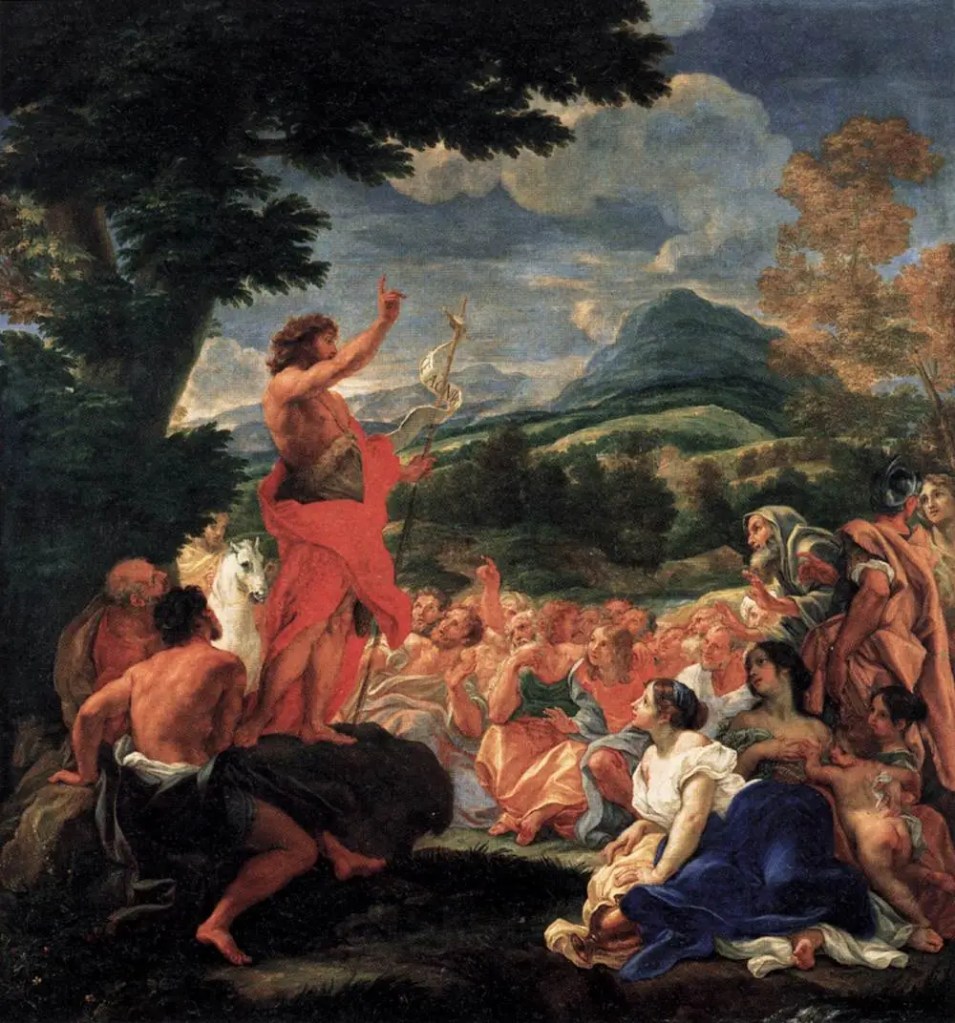
Sermon: Advent 2 RCL A – “Prophet’s Call”


The American Film Institute has several “Top 100” lists: 100 best movies, 100 best musicals, 100 best heroes and villains, and so on. They also have the “100 top movie quotes.” Way down in the 80s, we have lines like, “Yo, Adrian,” and “My Precious.” Moving up into the 40s, there is “Shane. Shane. Come back,” and “Stella! Hey, Stella!” Then breaking into the top ten, there are “Go ahead, make my day,” and “I’m gonna make him an offer he can’t refuse.” Number one on the list, you’ve got to love Rhett Butler—“Frankly, my dear, I don’t give a….” However, the one I’m thinking of today comes in at number ten, spoken by Travis Bickle, played by Robert De Niro, in Taxi Driver. The line: “You talkin’ to me? You talkin’ to me!?” (Source)

In our Gospel reading, when John the Baptist confronts the Pharisees and Sadducees, I can picture them glancing at each other, then at John, and in their best Robert De Niro impression, asking, “You talkin’ to me?!” And then John firing back with number forty-four on the AFI list, “I see dead people.” Okay. Enough of that. 

As we know, John’s criticism didn’t stop with the religious leaders. He was an equal-opportunity rebuker, and later, he would criticize Herod for marrying his brother’s sister, which landed him in jail and eventually led to his beheading. Yet for the prophets, including John the Baptist, they were almost always upsetting someone and finding themselves in danger.

In the Acts of the Apostles, the first deacon was Stephen. He said to the religious leaders, “You stiff-necked people, uncircumcised in heart and ears, you always resist the Holy Spirit. As your fathers did, so do you. Which of the prophets did your fathers not persecute? And they killed those who announced beforehand the coming of the Righteous One.” (Acts 7:51-52) They then proceeded to stone him to death.

Despite the dangers of the job, the prophet’s role is to stir up the people and point out their errors, hoping they will return to God. In fact, they are responsible for the souls of the people before God. Speaking to Ezekiel, the Lord said, “So you, son of man, I have made a watchman for the house of Israel. Whenever you hear a word from my mouth, you shall give them warning from me. If I say to the wicked, O wicked one, you shall surely die, and you do not speak to warn the wicked to turn from his way, that wicked person shall die in his iniquity, but his blood I will require at your hand. But if you warn the wicked to turn from his way, and he does not turn from his way, that person shall die in his iniquity, but you will have delivered your soul.” (Ezekiel 33:7-9)

Prophet: a dangerous job before the people and before God, yet God calls those He chooses. The Prophet Jeremiah said, “The Lord put out his hand and touched my mouth. And the Lord said to me,
‘Behold, I have put my words in your mouth.
See, I have set you this day over nations and over kingdoms,
to pluck up and to break down,
to destroy and to overthrow,
to build and to plant.’”
(Jeremiah 1:9-10)

The Lord chooses and sends His prophets to speak His words, not their own. Knowing this, you might think they—dare I say, “We”?—would respond accordingly, but it was said, “The Lord, the God of their fathers, sent persistently to them by his messengers, because he had compassion on his people and on his dwelling place. But they kept mocking the messengers of God, despising his words, and scoffing at his prophets, until the wrath of the Lord rose against his people, until there was no remedy.” (2 Chronicles 36:15-16)

The same was true with John the Baptist. The people heard what was said, but they did not respond according to the will of God. Instead, they became angry with these messengers and persecuted them, often putting them to death. Thank goodness we are not like them. We accept criticism and correction very well. When someone offers Godly corrections to us, we don’t get angry. No, sir. We might get even, but we don’t get angry! Right?

Let me ask you this: you hear John the Baptist crying out, “Repent, for the kingdom of heaven has come near.” How do you respond? The human thing to do is to look at everyone around you and say, “Darn tooting! Y’all need to repent! Get right with the Lord!” The whole time, thinking John the Baptist couldn’t possibly be talking to you. Or what about this: Christian groups love to quote this one from 2nd Chronicles: “If my people who are called by my name humble themselves, and pray and seek my face and turn from their wicked ways, then I will hear from heaven and will forgive their sin and heal their land.” (2 Chronicles 7:15) What’s the first thing to go through your head? “If those left-wingers or the fascist right (I too am an equal opportunity rebuker) would just learn to pray and follow Jesus, then this whole thing could be sorted out overnight!” Can I get an “Amen”? Why do we think this way? Isn’t it obvious? This call to turn from wicked ways is about them, and has nothing to do with me! 

However, the prophet confronts us and says, “Oh, yes, it is. It is all about you. You are the one who needs to get right with God.” Like everyone else, we don’t much like hearing it, but we must be willing to listen to the words of John the Baptist—“Repent, for the kingdom of heaven has come near.”—and allow those words to be spoken to us personally and as the Church. We must let God correct us so we are not the ones provoking His wrath. Through this process of correction, we are allowing him to perfect us. As the Lord told the church in Laodicea, “Those whom I love, I reprove and discipline, so be zealous and repent.” (Revelation 3:19)

How can we let the prophets’ words speak to us and correct us? There is a powerful phrase from Martin Luther: “The Cross tests everything.”  

If we test our thoughts, actions, and deeds the same way the Pharisees and Sadducees evaluated theirs, we respond like they did—“You talking to me?” However, if we test those same thoughts, actions, and deeds by the Cross, we may discover a different outcome. It might not be what we want to hear, but it will be God’s truth.

I wonder, if we are willing and brave enough to look closely, which part of ourselves, our lives, our being would we hesitate to put to the test of the Cross? I suspect there are aspects of all our lives that are much safer tucked away in their own personal niches, their own special places of worship within our souls, even illuminated with one of those little votive candles—areas that are far too cherished by the Great “I” to be put to such a test. Yet, if we did, if we nailed those silly notions to that most sacred tree, the Cross, well, they would likely scream out in protest and blasphemy, just like the wicked thief did who was crucified with Jesus. But in the end, we would be set free from those things that bind us.

The prophets deliver messages to a world that is broken, but their messages are also for us. Jesus says, “He who has ears, let him hear.” (Matthew 13:9) I pray that if you hear in your soul John the Baptist calling you to repentance, don’t be like those who become proud and angry. Instead, submit to the call of repentance and accept the forgiveness of sins; for as St. John tells us, “If we confess our sins, [God] is faithful and just to forgive us our sins and to cleanse us from all unrighteousness.” (1 John 1:9)

Let us pray: 

O God,
You raised up St. John the Baptist
to prepare a perfect person for Christ.
We call upon St. John’s intercession
to properly prepare us with a true
sense of repentance to receive Your
grace and salvation.
Make us faithful to Truth and justice,
as You did Your servant,
John the Baptist, herald of Your Son’s
birth and death. Lord, may You increase
Your life within us.
Amen.

Sermon: Advent 1 RCL A – “Made New”

Photo by Fuu J on Unsplash

Dietrich Bonhoeffer writes, “If we want to be part of these events, Advent and Christmas, we cannot just sit there like a theatre audience and enjoy all the lovely pictures. Instead, we ourselves will be caught up in this action, this reversal of all things; we must become actors on this stage. For this is a play in which each spectator has a part to play, and we cannot hold back. What will our role be? Worshipful shepherds bending the knee, or kings bringing gifts? What is being enacted when Mary becomes the mother of God, when God enters the world in a lowly manger?”

What is taking place when God–Jesus–enters the world? It was just a few weeks ago that our Gospel lesson was quite similar to today’s, focusing on Jesus’ prophecies about the end of days. The problem with such readings is that we can become so caught up in the “what ifs” and “looking for signs” of the events themselves that we overlook the most important part.

So, if we look behind the curtain of all these events, what is really happening? From Bonhoeffer: “What is being enacted when Mary becomes the mother of God, when God enters the world in a lowly manger?” 

Since this is the first Sunday of Advent, the start of the Church year, it helps us understand because Advent should inspire a deep sense of anticipation — an expectation of something new.

We talk of “wars and rumors of wars,” about one person being taken and another left behind, and about staying awake— yes, we are to do these things: watch, pray, remain alert as we seek Jesus coming again—but there is much more to it than this.

Almost everyone knows at least rumors of the Book of Revelation with all its wormwood, four horsemen of the apocalypse, and bowls of God’s wrath. Most are aware of the Second Coming of Christ. St. John reports, “I saw heaven opened, and behold, a white horse. And He who sat on him was called Faithful and True, and in righteousness He judges and makes war. His eyes were like a flame of fire, and on His head were many crowns.” John continues, “He was clothed with a robe dipped in blood, and His name is called The Word of God. And the armies in heaven followed Him. Out of His mouth goes a sharp sword, that with it He should strike the nations. And He has on His robe and on His thigh a name written: KING OF KINGS AND LORD OF LORDS.”

As Christians, we hear those words and feel like the home team just won the big game at the last second, but what is it all really about? What is the purpose? The Book of Revelation has twenty-two chapters. Most of it focuses on the end of the world—apocalyptic writing. However, at the start of chapter 21, John writes, “Now I saw a new heaven and a new earth, for the first heaven and the first earth had passed away. Also, there was no more sea. Then I, John, saw the holy city, New Jerusalem, coming down out of heaven from God, prepared as a bride adorned for her husband. And I heard a loud voice from heaven saying, ‘Behold, the tabernacle of God is with men, and He will dwell with them, and they shall be His people. God Himself will be with them and be their God. And God will wipe away every tear from their eyes; there shall be no more death, nor sorrow, nor crying. There shall be no more pain, for the former things have passed away.’ Then He who sat on the throne said, ‘Behold, I make all things new. It is done! I am the Alpha and the Omega, the Beginning and the End.’”

God says, I do all these things so that I may make all things new. At that, our excitement that the home team won is slightly diminished. It is like what we were talking about a few weeks ago—waiting! We have to keep waiting for the Lord’s return, but now we also have to keep waiting for things to be made new. 

Well, that’s just great! When the Lord returns, I will start to experience this new life. In the meantime, it’s the same ol’ same ol.’” Thanks for playing. Please try again. St. Paul helps us understand that this “New” is not only in the future but also something we can experience today. Paul writes, “if anyone is in Christ, he is a new creation. The old has passed away; behold, the new has come.” (2 Corinthians 5:17) Yes, the Kingdom of God is a future event, but it is also a present reality.

However, we still can’t get all excited because we look around at the state of the world today and say, “Well, Father John, if this is the new Kingdom of God, then I’ll take what’s behind door number three.” And there is the rub. Today, we only see in a mirror dimly, for although we are made new in Christ Jesus, the world has not yet been made new. Paul says in his letter to the Romans, “For we know that the whole creation has been groaning together in the pains of childbirth until now. And not only the creation, but we ourselves, who have the firstfruits of the Spirit, groan inwardly as we wait eagerly for adoption as sons, the redemption of our bodies.” (Romans 8:22-23) 

Creation suffers, and so do we, but we are a new creation. No longer subject to eternal death, but only a short sleep before the Great Day of the Lord’s return, when all is made new. 

We live in this in-between time—the now and the not yet—so we wait. As frustrating as that may seem, this waiting is what Advent is all about. Bonhoeffer writes, “Celebrating Advent means being able to wait.” However, he goes on to say, “Waiting is an art our impatient age has forgotten. It wants to break open the ripe fruit when it has hardly finished planting the shoot… Whoever does not know the austere blessedness of waiting—that is, of hopefully doing without—will never experience the full blessedness of fulfillment. For the greatest, most profound, tenderest things in the world, we must wait. It happens not in a storm but according to the divine laws of sprouting, growing, and becoming.” Yes. We will watch, pray, and remain alert, and we will also wait.

Yet, in the midst of this waiting and becoming, God offers us glimpses of future blessings through the gifts of one another and the sacraments of the Church. Therefore, today, after Confession and before the Peace, we will offer the laying on of hands and anointing with oil. Through this sacrament of Unction—of healing—I pray you will see and perhaps experience the new life God is offering you, and that it will give you the courage and strength to wait with perseverance for the newness to come.

Let us pray:
God of Love,
Your son, Jesus, is your greatest gift to us.
He is a sign of your love.
Help us walk in that love during the weeks of Advent,
As we wait and prepare for his coming.
We pray in the name of Jesus, our Savior.

Sermon: The Annunciation +1

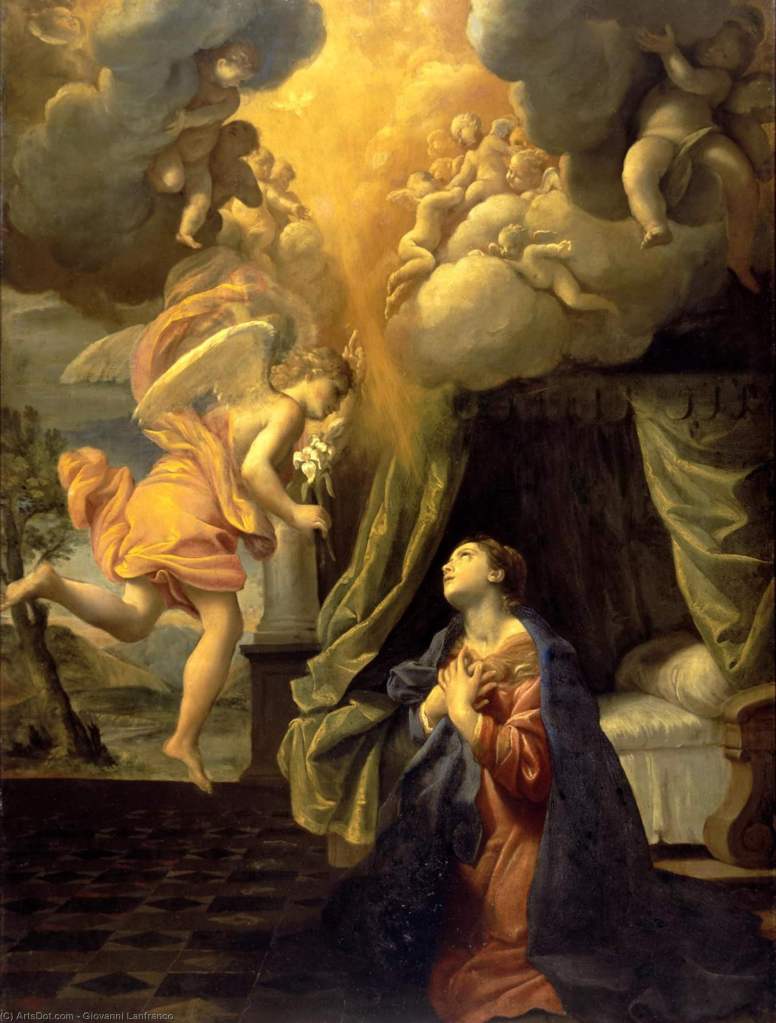
The Annunciation – Giovanni Lanfranco

During the Season of Lent, there are only two significant feast days on our church calendar. One was last Wednesday, the Feast of St. Joseph; the other was yesterday, The Annunciation. Both of these days are fixed, meaning we cannot transfer them from one date to another. St. Joseph’s Day must be celebrated on March 19, and the Annunciation must be celebrated on March 25. Today is March 26, so today we are celebrating the day after the Annunciation when Mary was only a little bit pregnant.

Why must the Annunciation be celebrated on March 26? Math and biology. It is, after all, only 274 days until Christmas—that would be nine months—when we celebrate the birth of Jesus. Therefore, even though we are only days away from Jesus’ death on a cross outside of Jerusalem, we pause to remember the day that the angel of the Lord came to the Blessed Virgin Mary and told her she would conceive in her womb the very Son of God.

The feast of The Annunciation is a pivotal event in God’s plan of salvation for His people.

For centuries, the prophets had been speaking of the coming of a Savior. Perhaps the prophet whose voice we are most familiar with regarding the Savior’s birth is Isaiah.

The people walking in darkness
    have seen a great light;
on those living in the land of deep darkness
    a light has dawned….

For to us a child is born,
    to us a son is given,
    and the government will be on his shoulders.
And he will be called
    Wonderful Counselor, Mighty God,
    Everlasting Father, Prince of Peace.

The world looked for this child, this Savior, because as St. Paul wrote in his letter to the Romans: “The creation was subjected to frustration, not by its own choice, but by the will of the one who subjected it, in hope that the creation itself will be liberated from its bondage to decay and brought into the freedom and glory of the children of God. We know that the whole creation has been groaning as in the pains of childbirth right up to the present time.”

The world is groaning under bondage and decay, but for the child to be born, Jesus can save it. However, all of this depends on the response of a young teenage girl.

The angel tells Mary, “You will conceive in your womb and bear a son, and you will name him Jesus.” He goes on to tell her about her cousin Elizabeth and then waits for Mary’s response. In the moment before Mary spoke, a deacon observed, “It was the moment when all creation held its collective breath.” (Source) St. Bernard of Clairvaux also wrote in his homily for this day, “You have heard, O Virgin, that you will conceive and bear a son; you have heard that it will not be by man but by the Holy Spirit. The angel awaits an answer; it is time for him to return to God who sent him. We too are waiting, O Lady, for your word of compassion.” (Source)

We know her response, but had we been present, we would also have held our breath. Will she say “Yes” or “No?” Will we be saved, or are we condemned forever?

Mary speaks. ”Here am I, the servant of the Lord; let it be with me according to your word.” And all creation wept for joy.

How does that short prayer begin: “Hail Mary, full of grace.
 The Lord is with thee.
 Blessed art thou among women…”

Our Mother Mary is truly blessed. Her “Yes” to God allowed the birth of our salvation.

I wonder, what would your “yes” to God accomplish?

Sermon: Our Lady of Guadalupe


On December 9, 1531, fifty-seven-year-old Juan Diego was walking to Mass. He is a convert to the faith and a widower. As he walks, he begins to hear the most beautiful music. Following the sound, he climbs Tepeyac Hill, located in what is now Mexico City.

When Juan Diego arrives at the top, he sees a beautiful apparition of the Blessed Virgin Mary. She speaks to Juan Diego, calming him, then telling him that she would like a church to be built on that spot for the people of Mexico. It is to be a place where they can come for healing and worship. She instructs him to go to the local bishop and give him this message, adding, “Now go and put forth your best effort.” 

Juan Diego does as he is told, but the bishop is highly skeptical, thinking this peasant is either mad or a trickster. So, he sends him away. 

Juan Diego returns to Tepeyac Hill, where he sees the Virgin again. He tells her what she already knew—he had failed. Mary tells him that he is to go again on the following morning and try again. Juan Diego is obedient, but the result is essentially the same; however, the bishop tells him if the visions are real, he is to bring some sign the following day. Juan Diego agrees, but when he returns home, he finds his uncle, who he lives with, very ill—near death. He cannot return to the bishop but must stay and care for him. 

Two days later, Juan Diego is convinced that his uncle will die, so he goes in search of a priest. Along the way, he again encounters Our Lady. He explains everything that has happened, yet she says, “Am I not your mother? Are you not in the crossing of my arms?” In other words, she says, “Don’t you trust that I will care for you?” He says that he will believe, and she gives him additional instructions.

Juan Diego is to go that moment and again climb Tepeyac Hill. There, he will find flowers that he has never seen before. He is to gather the flowers in his tunic and take them to the bishop as a sign. It is the middle of December when all this is happening, so he doesn’t know how flowers could bloom, but he does as he is told. Arriving, he finds a beautiful field of flowers. Gathering them quickly in his tunic, he rushes to see the bishop.

The bishop is still skeptical, but Juan Diego drops the flowers, thinking they are the sign, but there is much more. On his tunic, in great detail, is the image of the Blessed Virgin. The image is the sign.

While Juan Diego is with the bishop, the Blessed Virgin appears to his uncle, whom he was caring for. The uncle is healed, and the Virgin tells him of Juan Diego’s mission and that she will be called “Santa Maria, de Guadalupe.” 

The bishop believed, and the church was built on Tepeyac Hill, the former site of an Aztec Temple—The Basilica of Our Lady of Guadalupe. Millions have come to faith in Christ Jesus through these events.

The tunic that Juan Diego was wearing was made of cactus fiber. It should have fallen to pieces within thirty years. After more than 500 years, it is miraculously preserved.

What started it all was the message that Our Lady gave to Juan Diego on their first meeting. “Know for certain, least of my sons, that I am the perfect and perpetual Virgin Mary, Mother of the True God through whom everything lives, the Lord of all things near and far, the Master of heaven and earth. It is my earnest wish that a temple be built here to my honor. Here, I will demonstrate, I will exhibit, I will give all my love, my compassion, my help, and my protection to the people. I am your merciful mother, the merciful mother of all of you who live united in this land, and of all mankind, of all those who love me, of those who cry to me, of those who seek me, of those who have confidence in me. Here, I will hear their weeping, their sorrow, and will remedy and alleviate all their multiple sufferings, necessities, and misfortunes.”

God used a simple peasant farmer, Juan Diego, to bring this all about. How might God use you?

Sermon: Advent 2 RCL C – “Song of the Soul”


A violinist noticed that his playing had a hypnotic effect on his audience. They sat motionless as though they were in a trance. He found he had the same impact on his friends’ pets. Dogs and cats would sit spellbound while he played. Wondering if he could cast the same spell over wild beasts, he went to a jungle clearing in Africa, took out his violin, and began to play. A lion, an elephant, and a gorilla charged into the clearing stopped to listen, and sat mesmerized by the music. Soon, the clearing was filled with every kind of ferocious animal, each one listening intently. Suddenly, another lion charged out of the jungle pounced on the violinist, and killed him instantly.

The first lion, bewildered, asked, “Why did you do that?”

The second lion cupped his paw behind his ear. “What?”

If you ask the experts, they will tell you that a digital recording produces better sound quality than a vinyl record. If you ask me, I’ll tell you vinyl produces better quality. Why? For whatever reason, I can hear it better, and for someone who does not hear so well, that is reason enough to spend a few more dollars on the music I genuinely enjoy. 

When you look at a record, you can see it has grooves/lines that the needle settles into. However, when you put a vinyl record under a microscope, it looks like a mountain range: ridges, valleys, bumps, wiggles, and all. When you play a CD, it is reading a digital code made up of ones and zeroes. When you play a vinyl record, the needle (stylus for all you aficionados) reads all those ridges, valleys, bumps, and wiggles, converting them into electrical signals that are then played through the speakers. If all goes well… beautiful music, but you have to take care of records.

A scratch on a CD may or may not damage the sound quality, but even minor scratches on a vinyl record will produce a popping sound. Why? You’ve added a new element to the ridges and valleys, and the needle reads it. It may pop, but if the scratch is bad enough, the needle may jump out of the groove and skip part of the song.

Today, our Gospel reading begins with a list of who’s who. Luke, by providing all these details, isn’t dropping names. Instead, he is setting the timeframe for those who would read his Gospel. So, with the info provided, we know it is about 29/30 AD. (FYI: many believe that AD means “after death,” referring to the death of Jesus. However, it is an abbreviation for Anno Domini, meaning “the year of our Lord.”) What is Luke setting the timeframe for? The ministry of John the Baptist.

John, we are told, went about the region surrounding the Jordan River “proclaiming a baptism of repentance for the forgiveness of sins.” Luke then states, “as it is written in the book of the words of the prophet Isaiah.” In other words, Luke tells us that John’s ministry is a fulfillment of prophecy. 

“The voice of one crying out in the wilderness:

‘Prepare the way of the Lord,
make his paths straight.’”

That is Isaiah 4:3, but who is speaking those words? To learn this, we have to read the first two verses of Isaiah 40.

“Comfort, comfort my people, says your God.

Speak tenderly to Jerusalem,
    and cry to her
that her warfare is ended,
    that her iniquity is pardoned,
that she has received from the Lord’s hand
    double for all her sins.”

“Comfort, comfort my people, says your God.” Isaiah records the words, but it is as though he is sitting in the room with God, for it is God Himself speaking. God is calling for the comfort of His people. Why? 

You’ll remember from last week, we discussed the Babylonian Captivity—when the Israelites were taken slaves in Babylon following the sacking of Jerusalem. God is speaking comfort because that captivity is nearing its end. The people will soon be set free and allowed to return home, and it is God who will lead them. A few verses on, the Lord says,

“He will tend his flock like a shepherd;
    he will gather the lambs in his arms;
he will carry them in his bosom,
    and gently lead those that are with young.”

(Isaiah 40:11)

So, putting that all together, the Lord says that He will lead his people out of captivity and that the way ahead shall be made ready and made easy. As though calling on His Holy Angels, the Lord says to them, 

“Prepare the way of the Lord,
make his paths straight.
Every valley shall be filled,
and every mountain and hill shall be made low,
and the crooked shall be made straight,
and the rough ways made smooth.”

So, if Isaiah was talking about the release of captivity from Babylon, why then was Luke applying this passage to the ministry of John? Answer: the people are still being held captive. However, this time, it is not by some foreign adversary (although the Romans occupy the land); instead, they are being held captive by their sins.

John  came “proclaiming a baptism of repentance for the forgiveness of sins.” The call to “Prepare the way of the Lord” is not about preparing smoother roads. It is about preparing the soul. 

You were created in the Image of God, an image that is perfection. An image that was never meant to decay or even know death. People will say that “death is natural.” No, it is not. It is the most unnatural thing we do. We were created for life eternal, but through sin, death entered in—the Image of God that is within us became distorted.

Our bodies and souls were created to play the most beautiful music. Music that was in perfect harmony with our Creator. Yet, through the sin of Adam and Eve, we received our first “scratch.” Over time, and through our disobedience, we became even more damaged so that the music we now play contains discord—pops, skips, and missing pieces; therefore, John’s proclamation for repentance is still valid. Luke’s call to fill in the valleys and smooth the rough ways is a way of saying we need to repair the scratches so that we may again play beautiful music. How do we do this? 

Isaiah told those in captivity that God would lead them. Remember his words: “He will tend his flock like a shepherd.” God will also lead us. God, the Good Shepherd—Jesus—will lead us. It is He who leads us out of the captivity of our sins and restores the Image of God within us. In the next chapter of Luke, we hear Jesus also quote Isaiah.

“The Spirit of the Lord is upon me,
    because he has anointed me
    to proclaim good news to the poor.
He has sent me to proclaim liberty to the captives
    and recovering of sight to the blind,
    to set at liberty those who are oppressed,

to proclaim the year of the Lord’s favor.

And he rolled up the scroll and gave it back to the attendant and sat down. And the eyes of all in the synagogue were fixed on him. And he began to say to them, ‘Today this Scripture has been fulfilled in your hearing.’” (Luke 4:18-21)

Jesus will restore the image of God within, but just as we must protect and care for a vinyl record, we must also protect and care for our souls. This is not because Jesus will get tired and just quit repairing the scratches. Through grace, He never will, but to sin is to willingly place ourselves back into the captivity we were set free from. St. Paul also asked this same question.

“What shall we say, then? Shall we go on sinning so that grace may increase? By no means! We are those who have died to sin; how can we live in it any longer?” A few verses on, he says, “Sin shall no longer be your master, because you are not under the law, but under grace… Thanks be to God that, though you used to be slaves to sin, you have come to obey from your heart the pattern of teaching that has now claimed your allegiance. You have been set free from sin and have become slaves to righteousness.” (Romans 6:1-2, 14, 17-18) 

We are not those who willingly submit ourselves to captivity and the slavery of sin. Sin shall not be our master and defile the beautiful song of our souls. Instead, we submit ourselves to God and allow His ways to rule in our lives so that the song of our souls may once again be in harmony with the Lover of our souls.

St. James tells us, “Submit yourselves, then, to God. Resist the devil, and he will flee from you. Come near to God and he will come near to you…. Humble yourselves before the Lord, and he will lift you up.” (James 4:7, 10)

Submit yourself to God so that the Image of God within you may be restored.

Let us pray: Merciful God, who sent your messengers the prophets to preach repentance and prepare the way for our salvation: Give us grace to heed their warnings and forsake our sins, that we may greet with joy the coming of Jesus Christ our Redeemer; who lives and reigns with you and the Holy Spirit, one God, now and for ever. Amen.

Sermon: Advent 1 RCL C – “Liminal Space”

Photo by ANTIPOLYGON YOUTUBE on Unsplash

A man approached a little league baseball game one afternoon. He asked a boy in the dugout what the score was. The boy responded, “Eighteen to nothing—we’re behind.”

“Boy,” said the spectator, “I’ll bet you’re discouraged.”

“Why should I be discouraged?” replied the little boy. “We haven’t even gotten up to bat yet!”

In the year 605 BC, Nebuchadnezzar (five points if you can spell it correctly) became King of Babylon, and Babylon was a force to be reckoned with. Through a series of battles, Judah, with Jerusalem as its capital, became a vassal state of Babylon. In other words, as long as Judah did what the Babylonians told them, Judah could pretend it was a sovereign country. 

The Babylonian grip on Judah held for several years, but then Egypt defeated the Babylonians in a significant battle, so everyone began to think that Egypt was the rising power, including the King of Judah. So, he cast off the shackles of Babylon and took up the shackles of the Egyptians. This did not go over well with the Babylonians, who stormed back on the scene and put everyone back in their proper place. In addition, Nebuchadnezzar handpicked the next King of Judah, Zedekiah. 

Zedekiah was a good boy for a while but then became too big for his britches. He rebelled against the Babylonians. At this point, Old Nebuchadnezzar had had enough of this troublesome fly and again laid siege to Jerusalem. Enter the Prophet Jeremiah.

Jeremiah begins to prophesy against Zedekiah. In his first message, Jeremiah says, “Thus the Lord said to me: ‘Make yourself straps and yoke-bars, and put them on your neck.’” (Jeremiah 27:2) Straps and yoke-bars were signs of people being carried off into slavery. Through Jeremiah, the Lord then says, “Now I have given all these lands into the hand of Nebuchadnezzar, the king of Babylon, my servant, and I have given him also the beasts of the field to serve him. All the nations shall serve him and his son and his grandson, until the time of his own land comes.” (Jeremiah 27:6-7a) The Lord is saying that unless Zedekiah and the Israelites repent of their sins, He is going to use Nebuchadnezzar and the Babylonians to punish them. How did it end? Zedekiah “did what was evil in the sight of the Lord his God. He did not humble himself before Jeremiah the prophet, who spoke from the mouth of the Lord.” (2 Chronicles 36:12) Zedekiah did not obey, and Jerusalem was sacked, and the Temple of God, the First Temple, was destroyed. In addition, the Israelites were taken as slaves of the Babylonians. (This is known as the Babylonian Captivity.) 

Fortunately, the Babylonians would not have the last word. Jeremiah will prophesy again. We heard it in our first reading. “The days are surely coming, says the Lord, when I will fulfill the promise I made to the house of Israel and the house of Judah. In those days and at that time I will cause a righteous Branch to spring up for David; and he shall execute justice and righteousness in the land. In those days Judah will be saved and Jerusalem will live in safety.” (Jeremiah 33:14-16a) The Lord is saying to His people, “Don’t be discouraged. We haven’t even gotten up to bat yet!”

I told you once before that when I first really began reading the Bible, I started with the Book of Revelation. I don’t remember exactly why, but I do remember that even to begin to understand parts of what is being said, you more or less have to read the entire Bible. Perhaps because of that first read, I enjoy going back through it, not trying to sort out the end of the world. I find it fascinating. I’ve just about completed another read through it and have been doing so with the help of a commentary by Bishop N.T. Wright. You get passages of incredible beauty and passages that are straight-up Stephen King. That latter bit draws in most readers, but you quickly realize that most of the imagery is beyond our understanding. I am of the opinion that when the things spoken of in Revelation begin to occur, anyone and everyone will be able to say, “So, that’s what it means.”

As we read through it, we discover dragons, falling stars, cups of God’s wrath, and plagues upon humanity. Many believe Christian believers will not endure any suffering during that time. I say, read it again. Perhaps the believers won’t have to endure the plagues, but there is more than enough persecution going on that will affect everyone. It is one catastrophe after another, and they are horrifying. And, in reading the messages and prophecies, many say they are being fulfilled today. Perhaps they are, but keep in mind, since Revelation was written, there have been those who believe what is being spoken occurred in their lifetime.

Without going into the argument for or against, the Gospel reading we have today from Luke is something of a two-paragraph summation of all that John reports in Revelation.

Jesus said, “There will be signs in the sun, the moon, and the stars, and on the earth distress among nations confused by the roaring of the sea and the waves. People will faint from fear and foreboding of what is coming upon the world, for the powers of the heavens will be shaken. Then they will see ‘the Son of Man coming in a cloud’ with power and great glory.” That is all in Revelation; just expanded there.

Jesus says there will be great signs in the heavens and on the earth. People will be terrified. Revelation tells us that they will be under so much duress and fear they will beg for death, but it will not come to them. Then Jesus says, “Now when these things begin to take place, stand up and raise your heads because your redemption is drawing near.” Jesus says, “Stand up. Pay attention. It is our turn to go to bat.”

It is fascinating, yet for many, their response is, “I hear you, Father John, but to be honest, I got my own problems. There may be wars and rumors of wars, but have you been to my house lately? There’s a few wars going on there, too. There may be signs in the heavens, but there’s a sign on a piece of mail I just got, and it reads, ‘Past Due.’ How does all this apply to me today?” 

My time on social media goes in spurts. Sometimes, I’ll scroll too much; other times, I forget it is out there. When I scroll, I have a few favorite pages, one of which has to do with liminal spaces. One article defines liminal spaces.

“Liminal spaces are transitional or transformative spaces that are neither here nor there; they are the in-between places or thresholds we pass through from one area to another.

“These spaces often evoke feelings of eeriness or discomfort because they are not meant for staying, but rather for passing through, such as empty parking lots at night, hallways, stairwells and abandoned malls.” (Source)

Think of it as passing through a doorway from one room to the next. The liminal space is the doorway, the threshold. That is where we are in the unfolding of God’s plan—standing in the doorway. Through His death and resurrection, Jesus has already won the victory, but it is not yet His turn to bat, so we are in the space in between. At times, it is disorienting and uncomfortable. At times, we still experience the pain and anxiety of the room we just left. The next room is our true home, but we are not there yet, which is why Jesus gives us very specific instructions as we stand waiting in the doorway.

“Be on guard so that your hearts are not weighed down with dissipation and drunkenness and the worries of this life, and that day catch you unexpectedly, like a trap. For it will come upon all who live on the face of the whole earth. Be alert at all times, praying that you may have the strength to escape all these things that will take place, and to stand before the Son of Man.”

The Season of Advent, which we begin today, is approximately four weeks long, ending with the celebration of the Birth of Jesus. However, the Spirit of Advent is one that we live every day. It is a Spirit of patience and perseverance, of being alert and watching, of knowing the victory has been won but not yet complete. You and I stand on the threshold of the very Kingdom of God—the new Heaven and Earth. “Stand up and raise your heads, because your redemption is drawing near.”

Let us pray:Almighty God, give us grace to cast away the works of darkness, and put on the armor of light, now in the time of this mortal life in which your Son Jesus Christ came to visit us in great humility; that in the last day, when he shall come again in his glorious majesty to judge both the living and the dead, we may rise to the life immortal; through him who lives and reigns with you and the Holy Spirit, one God, now and for ever. Amen.

Sermon: Advent 3 RCL B – “Your Purpose”

Photo by Ryoji Iwata on Unsplash

On May 25, 1961, President John F. Kennedy made a speech to Congress titled Urgent National Needs. Among other items, he stated, “I believe this nation should commit itself to achieving the goal, before this decade is out, of landing a man on the moon and returning him safely to earth.” He concluded, “In a very real sense, it will not be one man going to the moon… it will be an entire nation. For all of us must work to put him there.” (Source

In her book Resonate, Nancy Duarte picks up a part of the story. “Later in the 1960s, JFK was touring NASA headquarters and stopped to talk to a man with a mop. The president asked him, ‘What do you do?’ The janitor replied, ‘I’m putting the first man on the moon, sir.’ This janitor could have said, ‘I clean floors and empty trash.’ Instead, he saw his role as part of the bigger mission that was to fulfill the vision of the president. As far as he was concerned, he was making history.”

Growing up in Louisiana, I remember even there, we could have these cold and rainy Saturdays. A bit too unpleasant to be out, so my brother and I would set up a card table between our twin beds and put together a puzzle. Maybe 250/300 pieces. Nearing the end, we both wanted to place the last piece, so we took to hiding one (or, at least, I did). All the pieces but that one were in place, then you could snatch it out of your pocket and have the thrill of finishing the puzzle. However, there were other times when neither of us would hide a piece, but there would still be one missing, so we would crawl around on the floor searching and only give up once it was found. Why would we do that?

If it was a 300-piece puzzle of a deer in the woods and the piece missing was the head of the deer, I could understand it, but most of the time, it was some random bit of sky or a part of a tree. A piece that was missing but did not detract from the overall picture. You knew what it was. Yet, we would search, and I’m guessing you would too. It’s not that you can’t tell what the picture is supposed to be. It’s just that it is not complete. You look at the picture, and the only thing you can see is the hole where that missing piece belongs. Perhaps a minor part of the overall image, but without it….

Jesus said, “What do you think? If a man has a hundred sheep, and one of them has gone astray, does he not leave the ninety-nine on the mountains and go in search of the one that went astray? And if he finds it, truly, I say to you, he rejoices over it more than over the ninety-nine that never went astray.” (Matthew 18:12-13) The puzzle is incomplete without the one piece, and the flock is incomplete without the one sheep. Each piece and each sheep fulfill a purpose that completes the whole.

In the time of Jesus, we know that the people were looking for a Messiah, but they were also looking for the coming of a particular prophet. In the last book of the Old Testament, Malachi, and the second to last verse of that book, the Lord says through Malachi, “Behold, I will send you Elijah the prophet before the great and awesome day of the Lord comes.” (Malachi 4:5) The people were looking a Messiah and for Elijah. Why Elijah? In 2 Kings 2, we see that Elijah did not die but was carried away into Heaven by a whirlwind. The people were looking for Elijah, the great prophet, to return the same way he went. This is why, in our Gospel reading today, we read that “the Jews sent priests and Levites from Jerusalem to ask him, ‘Who are you?’ He confessed and did not deny it, but confessed, ‘I am not the Messiah.’ And they asked him, ‘What then? Are you Elijah?’ He said, ‘I am not.’ ‘Are you the prophet?’ He answered, ‘No.’” They were trying to ascertain whether or not John was the fulfillment of Malachi’s prophecy. Although John denies it, not believing that he is the Prophet, Jesus will say of John, “He is Elijah who is to come.” (Matthew 11:14b) 

However, following John’s denial, the priests will say to John, “‘Who are you? Let us have an answer for those who sent us. What do you say about yourself?’ [John] said, ‘I am the voice of one crying out in the wilderness.’”

In the overall picture, John was unsure who he was, but when asked, “Who are you?” He knew his exact purpose and fulfilled that purpose, preparing the way for Jesus.

President Kennedy asked, “‘What do you do?’ The janitor replied, ‘I’m putting the first man on the moon, sir.’” The priests asked John the Baptist, “Who are you?” Put another way, the priests asked John, “What do you do?” And John said, “I am the voice of one crying out in the wilderness.” Question: what do you do? We are each a piece of the puzzle of God’s plan on earth. Without you—even if, like John, you are uncertain as to what part you play, and even if you think you’re a minor detail of the overall image—the picture is incomplete without you. What do you do? You can’t say, “I serve no purpose.” If you have a heartbeat, you serve a purpose, so what do you do?

If you already know or have an idea, then I pray you are fulfilling your purpose. If unsure, go through a discernment process, intentionally seeking out how God would like to use you. Once you discover it, go to work. What we cannot do is ignore our purpose, thinking someone else will do it. Our piece in the puzzle is as specific as John’s and even Jesus’. Therefore, our last words should be the same as Jesus’ last words, “It is finished.” We should be able to confidently speak those words, knowing that we have finished God’s will and His purposes in our lives.

The Lord says,

“Fear not, for I have redeemed you;
    I have called you by name, you are mine.” (Isaiah 43:1b)

You were the lost sheep. God went out and found you. Jesus redeemed you. You belong to God. He has a purpose for you. Discover it, and if you have, put it to use in His Kingdom. The work of His Kingdom and His Church needs you. We are making history, and you are a part of it.

Let us pray: Loving Father, faith in Your Word is the way to wisdom. Help us to think about Your Divine Plan so that we may grow in the truth. Open our eyes to Your deeds, our ears to the sound of Your call, so that our every act may help us share in the life of Jesus. Give us the grace to live the example of the love of Jesus, which we celebrate in the Eucharist and see in the Gospel. Form in us the likeness of Your Son and deepen His Life within us. Amen.

Advent Devotional: Prepare

This devotional was for The Episcopal Church of the Resurrection’s annual Advent Devotional series.


Now the Feast of Unleavened Bread drew near, which is called the Passover. And the chief priests and the scribes were seeking how to put him to death, for they feared the people.

Then Satan entered into Judas called Iscariot, who was of the number of the twelve. He went away and conferred with the chief priests and officers how he might betray him to them. And they were glad, and agreed to give him money. So he consented and sought an opportunity to betray him to them in the absence of a crowd.

Then came the day of Unleavened Bread, on which the Passover lamb had to be sacrificed. So Jesus sent Peter and John, saying, “Go and prepare the Passover for us, that we may eat it.” They said to him, “Where will you have us prepare it?” He said to them, “Behold, when you have entered the city, a man carrying a jar of water will meet you. Follow him into the house that he enters and tell the master of the house, ‘The Teacher says to you, Where is the guest room, where I may eat the Passover with my disciples?’ And he will show you a large upper room furnished; prepare it there.” And they went and found it just as he had told them, and they prepared the Passover.

-Luke 22:1-13 (ESV)


Prepare

The Passover that Jesus asked John and Peter to prepare for is the greatest of festivals during the Jewish year. It is a memorial of the night when the tenth plague swept through Egypt, killing all the firstborn of the Egyptians but “passing over” the Jews. In the process of establishing the festival (Exodus 12), God gave the Jews several laws on how to prepare for and celebrate the festival in the subsequent years. For example, one of these laws prescribed the removal of all leaven from the home. Over the centuries, these laws became more strict and codified, leaving no room for error. Not all are as fastidious as others in adhering to the requirements, yet one author reports, “We have a pious friend in Israel who airs out every book in her home in case there should be any bread crumbs in them.” (Source)

Although not prescribed by Holy Scripture, the Church has established two seasons of preparation: Advent and Lent. In Advent, we prepare to celebrate Jesus’ birth and to prepare for his second coming, and in Lent, we prepare to celebrate Christ’s victory over death. With regard to Advent, Dietrich Bonhoeffer wrote, “There are only two places where the powerful and great in this world lose their courage, tremble in the depths of their souls, and become truly afraid. These are the manger and the cross of Jesus Christ.” (God Is in the Manger: Reflections on Advent and Christmas, p.26) If that be the case—which it should be!—then we should not enter lightly into our encounter with him in the manger, but instead, we should seek out the “old leaven, the leaven of malice and evil” (1 Corinthians 5:8) and prepare our hearts so that we might humbly kneel before our Lord and King.

In 2008, during his general audience, John Paul II said,

The liturgy of Advent, filled with constant allusions to the joyful expectation of the Messiah, helps us to understand the fullness of the value and meaning of the mystery of Christmas. It is not just about commemorating the historical event, which occurred some 2,000 years ago in a little village of Judea. Instead, we must understand that our whole life should be an “advent”, in vigilant expectation of Christ’s final coming. To prepare our hearts to welcome the Lord who, as we say in the Creed, will come one day to judge the living and the dead, we must learn to recognize his presence in the events of daily life. Advent is then a period of intense training that directs us decisively to the One who has already come, who will come and who continuously comes. (Source)

As we “prepare our hearts to welcome the Lord, let us heed the words of St. Paul: “Examine yourselves, to see whether you are in the faith. Test yourselves” ( 2 Corinthians 13:5a), and cleanse yourself of the “old leaven.”

Jesus said to Peter and John, “Go and prepare the Passover for us, that we may eat it.” In like manner, go and prepare yourselves so that “at his coming, [he] may find in us—in you—a mansion prepared for himself; who lives and reigns with you, in the unity of the Holy Spirit, one God, now and for ever. Amen.” (Collect for the Fourth Sunday of Advent)

The Rev. Dr. John Toles

Rector

St. Matthews

Sermon: Advent 1 RCL A – “Separating the Darkness”

Michelangelo is painting the Sistine Chapel’s ceiling when he sees a woman praying the rosary. He decides to take a break and lies back on the scaffolding so the woman can’t see him and says in a loud voice, “I am Jesus Christ. Listen to me, and I will perform miracles.”

The woman is intent on her beads and prayers and does not look up.

Michelangelo figures that she is hard of hearing, so he shouts, “I am Jesus Christ! Listen to me, and I will perform miracles!”

With head bent, the woman continues praying, so Michelangelo shouts, “I AM JESUS CHRIST! LISTEN TO ME!”

The woman yells back, “Would you shut up? I’m talking to your mother.”

As you know, last Sunday, a group of us went down to the city and saw the Sistine Chapel Exhibit. Being together and seeing the images close up was a treat. 

The construction of the Sistine Chapel was completed in 1483 and consecrated by Pope Sixtus IV, but Michelangelo’s work did not begin until 1508. When it started, it took him four years. That is remarkable in itself, but when you consider a few more details, it seems impossible. The chapel is 132 feet long, 44 feet wide, and 68 feet high. With the arch, the ceiling—Michelangelo’s canvas—is over 12,000 square feet. 

Ten years after it was complete, not everyone got it. For example, a visiting bishop wrote, “Among the most important figures is that of an old man, in the middle of the ceiling, who is represented in the act of flying through the air.” That old man flying through the air is supposed to be God.

Finally, due to a mistranslated word, it was long believed that Michelangelo painted the ceiling while lying on his back. As it turns out, he did it standing and even wrote a short poem about how uncomfortable it was.

I’ve already grown a goiter from this torture,
hunched up here like a cat in Lombardy
(or anywhere else where the stagnant water’s poison).
My stomach’s squashed under my chin, my beard’s pointing at heaven,
my brain’s crushed in a casket, my breast twists like a harpy’s.
My brush, above me all the time, dribbles paint so my face makes a fine floor for droppings!
My haunches are grinding into my guts, my poor [back side] strains to work as a counterweight…
my spine’s all knotted from folding over itself.
I’m bent taut as a Syrian bow.

On our way home from the exhibit, Marianne asked us each which was our favorite image. For me, it is the one on the front of your bulletin, inspired by Genesis 1:1-4— “In the beginning, God created the heavens and the earth. “The earth was without form and void, and darkness was over the face of the deep. And the Spirit of God was hovering over the face of the waters. And God said, ‘Let there be light,’ and there was light. And God saw that the light was good. And God separated the light from the darkness.” In the picture, God is looking up and separating the light from the dark. It is as if he were pushing the darkness asides so that the light could be revealed. 

How is this relevant for us today? Because the bringing of light into the darkness is what the Season of Advent is all about. 

[Light first Advent candle]

As we light the first candle, it does not provide much light, but it is only the beginning.

You all know I’m a Stephen King fan and my favorite Stephen King book (I won’t scare you by telling you how many times I’ve read it) is The Stand. The setting is a world where 99.99% of all human beings have died—very uplifting. At one point, two individuals, Larry and Rita, must find their way out of New York City, and they choose to walk through one of the tunnels. There is no electricity, so the tunnel is dark and jammed up with cars, and… let’s just say it is a scary place. They’ve lost their lights (naturally) and are blindly stumbling through the pitch-black tunnel. Rita suddenly stops, and Larry asks her what is wrong.

Rita says, “‘I can see, Larry! It’s the end of the tunnel!’

“[Larry] blinked and realized that he could see, too. The glow was dim and it had come so gradually that he hadn’t been aware of it until Rita had spoken. He could make out a faint shine on the tiles, and the pale blur of Rita’s face closer by. Looking over to the left he could see the dead river of automobiles.”

St. Matthew tells us:

“The people dwelling in darkness
    have seen a great light,
and for those dwelling in the region and shadow of death,
    on them a light has dawned.” (Matthew 4:16)

Like Rita and Larry, the people had been in darkness so long that they may not have even noticed that light was coming into the world. Like the dawn that comes slowly, almost imperceptibly at first, but the light is there. The people only needed to recognize it. And recognizing the light is not always easy, especially when our souls are in a dark place.

For many individuals, the holiday season is not a happy season. They can put on a smile at the office party or be cheery while around others, but inside… they are not so good. Instead of being a time of joy, it is a time of regrets or loneliness. It is a time for missing those we’ve lost: spouses, other family members, and friends. It is also a time when we may experience the loss of ourselves and all the what-ifs. At such times, our souls can begin to feel like Michelangelo’s body as he painted the Sistine Chapel: tortured, hunched, crushed, unbalanced, bent out of shape, and worse. As a result, just as this time of year has greater darkness, a darkness of a spiritual nature can seep into our souls and spirits. Like walking through that tunnel, our souls stumble along, unable to see what is around us. For some in that place, even if the light does begin to shine, like Larry, who had spent so much time in that dark tunnel, they aren’t able to recognize that the light has started to shine. 

We know that Jesus said, “I am the light of the world. Whoever follows me will not walk in darkness, but will have the light of life.” So, when we encounter someone in that spiritually dark place, we can quote that off to them, thinking that should be enough, but the last thing a person in a spiritually dark place needs from you is for you to start preaching to them. No. What they need from you, more than anything is for you to be that candle. Don’t tell them about the light, be the light. You can’t simply “fix” them so, it may be that you can only sit in that dark place with them, but you can be a sign of hope. Your presence will tell them what Rita said to Larry: “I can see, Larry! It’s the end of the tunnel!” 

If you are a person who is in that dark place, then I encourage you to look around you here because I see many candles burning brightly who would share their light with you. You are loved by God and by God’s people. Your soul may be in a dark place, but you do not have to be alone. I read, “Hope is faith holding out its hand in the dark.” You do not have to be alone in the dark. Perform one small act of hope: reach out.

God is still separating the light from the darkness, and he invites us all to participate in this great work. When the work begins, it may be only a dim glow, one small candle’s worth, but it will be there—a sign of hope—and we can know that it is only the beginning of all that Our Father longs to give us.

Let us pray: Father in heaven, our hearts desire the warmth of your love, and our minds search for the light of your Word. Increase our longing for Christ our Savior and give us the strength to grow in love, that the dawn of his coming may find us rejoicing in his presence and welcoming the light of his truth. We ask this in the name of Jesus the Lord. Amen.