
An archaeologist once hired some tribesmen to lead him to an archaeological site deep in the mountains. After they had been moving for some time, the tribesmen stopped and insisted they would go no further. The archaeologist grew impatient, then angry. But no matter how much he cajoled, the tribesmen would not go any further. Then, all of a sudden, the tribesmen changed their attitude. They picked up the gear and set off once more. When the bewildered archaeologist asked why they had stopped and refused to move for so long, the tribesmen answered, “We had been moving too fast and had to wait for our souls to catch up.”
Thomas Merton, in his book No Man is an Island, wrote, “We cannot be happy if we expect to live all the time at the highest peak of intensity. Happiness is not a matter of intensity but of balance and order and rhythm and harmony.
“Music is pleasing not only because of the sound but because of the silence that is in it: without the alternation of sound and silence there would be no rhythm. If we strive to be happy by filling all the silences of life with sound, productive by turning all life’s leisure into work, and real by turning all our being into doing, we will only succeed in producing a hell on earth.” (No Man is an Island, 134)
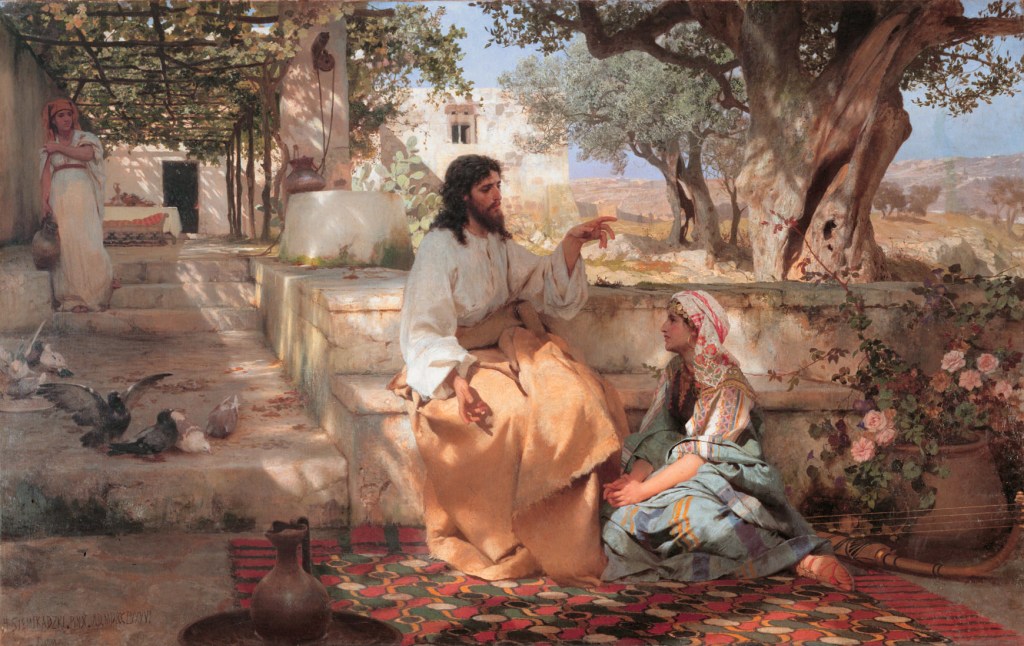
I believe this is part of the message of Mary and Martha. We are always Martha. We are always running here and there, making lists of where we need to run here and there next, and planning the list of the next here and there. Yet, in the midst of here and there, we must find the space between the notes, the silence, and rest at the feet of Jesus as Mary did.
Even the great Saints of God must find times of silence to stop and allow their souls to catch up. You and I are no different. We must find a balance – and it is different for each of us – that allows us to carry on with the mission of Christ’s church and our state of life, while at the same time receiving the grace and renewal that come from God.
This time of silence or rest, when assigned to a day, is known as the Sabbath. In his book The Sabbath, Abraham Joshua Heschel writes, “In defense of the Sabbath, Philo, the spokesman of the Greek-speaking Jews of Alexandria, says: this day we are commanded to abstain from all work, not because the law inculcates slackness. … Its object is rather to give man relaxation from continuous and unending toil and by refreshing their bodies with a regularly calculated system of remissions to send them out renewed to their old activities. For a breathing spell enables not merely ordinary people but athletes also to collect their strength with a stronger force behind them to undertake promptly and patiently each of the tasks set before them.” (The Sabbath, 13)
That is the Sabbath as a day, but it can also be understood as a time during the day set aside for the renewal of the soul, which the soul also needs. Again, from Thomas Merton and the analogy of music, “If we have no silence, God is not heard in our music. If we have no rest, God does not bless our work. If we twist our lives out of shape in order to fill every corner of them with action and experience, God will silently withdraw from our hearts and leave us empty.”
“Let us, therefore, learn to pass from one imperfect activity to another without worrying too much about what we are missing.” (No Man is an Island, 134)
Regardless of how busy you think you are or how busy you actually are, we must all find balance and make time to be Mary and sit at the feet of Jesus.

