Sermon: Lent 3 RCL B – “Minimum Requirement”

25f8174f79bfb813742a07528cf598d7Boudreaux and his brother Pierre were not the most religious folks in town, in fact they really only went to church twice a year so that they could be considered “members in good standing.” As they were leaving the Church, the priest said, “Boudreaux, it sure would be nice to see you and Pierre here more than once a year!” “I know,” replied Boudreaux, “but at least we keep the Ten Commandments.” “Well I suppose that’s a start,” the priest said. “I’m glad to hear that you keep the Commandments.” “Yep,” Boudreaux said proudly, “Pierre keeps six of them and I keep the other four.”

The Ten Commandments are the beginning of the Law handed down to Moses. From there it grows to a total of 613 laws outlined in the Old Testament. Everything from the first of the Ten, “you shall have no other gods,” to laws like Leviticus 11:12, “Anything living in the water that does not have fins and scales is to be regarded as unclean by you,” which means no more lobster, shrimp, crawdads, or Unagi (a tasty little morsel you can find at a sushi bar.) Breaking any of these laws comes with repercussions ranging from death by stoning to having to make a sacrifice.

By the time of Jesus the religious leaders were experts at interpreting the Law and enforcing it on the people to such an extent that it became a form of enslavement. Perhaps this was not their intent, but through their zeal for adherence to the Law, they missed the point and sent the wrong message to the people.

A story tells of a frail old man who went to live with his son, daughter-in-law, and four-year-old grandson. The old man’s hands trembled, his eyesight was blurred, and his step faltered. The family ate together at the table, but the elderly grandfather’s shaky hands and failing sight made eating difficult. Peas rolled off his spoon onto the floor. When he grasped the glass, milk spilled on the tablecloth. The son and daughter-in-law became irritated with the mess. “We must do something about Grandfather,” said the son. “I’ve had enough of his spilled milk, noisy eating, and food on the floor. So the husband and wife set a small table in the corner. There Grandfather ate alone while the rest of the family enjoyed dinner.

Since Grandfather had broken a dish or two, his food was served in a wooden bowl. When the family glanced in Grandfather’s direction, sometimes he had a tear in his eye as he sat alone. Still, the only words the couple had for him were sharp admonitions when he dropped a fork or spilled food. The four-year-old grandson watched all this in silence.

One evening before supper, the father noticed his four-year-old son playing with wood scraps on the floor. He asked the child sweetly, “What are you making?” Just as sweetly, the boy responded, “Oh, I am making a little bowl for you and Mama to eat your food out of when I grow up.” The four-year-old smiled and went back to work.

Mom and Dad taught Jr. all about how to keep the china intact, the tablecloth clean, and how to maintain proper decorum at the supper table, but in the process they taught him nothing of grace, mercy, compassion, or love.

In Matthew’s Gospel Jesus says, “Woe to you, teachers of the law and Pharisees, you hypocrites! You give a tenth of your spices—mint, dill and cumin. But you have neglected the more important matters of the law—justice, mercy and faithfulness. You should have practiced the latter, without neglecting the former.  You blind guides! You strain out a gnat but swallow a camel.” The religious leaders missed the point of the Law and enslaved the people, which brings us to one of the many lessons that can be gleaned from our Gospel lesson.

There was one of those funny cartoons that made the internet rounds a short while back. You’ve heard the question: What would Jesus do? WWJD? The cartoon stated, “The next time someone asks you, ‘What would Jesus do?,’ remind them that freaking out and flipping over tables is a viable option.”

The Temple was the place of sacrifice. For this there were very specific rules on how this was to take place. Only certain money could be tendered and only animals that were considered perfect could be used. Therefore, the religious leaders allowed a marketplace to be established to accommodate all the commerce. Yet they allowed this marketplace to be setup within the Court of the Gentiles – a section within the Temple complex – which was meant to be set aside as a place of prayer for non-Jews.

The religious leaders were following the letter of the Law, not violating a single statute. Proper money was used. Proper animals were used. The sacrifices were made exactly to the specifications of the Law. Yet in their zeal to fulfill the Law, they missed the point. It’s not about the blood of animals. It’s about prayer and a relationship with the One True God.

Long before Jesus, King David understood this. In the 40th Psalm, he wrote:

Sacrifice and offering you do not desire,
but you have given me an open ear.
Burnt offering and sin offering
you have not required.
Then I said, “Here I am;
in the scroll of the book it is written of me.
I delight to do your will, O my God;
your law is within my heart.”

Jesus, through his words and actions demonstrates that it is not through the fulfilling of the Law that we are made righteous. Instead it comes in allowing the Word of God to transform our hearts. What did we say after we read each of the Commandments in the Decalogue? “Lord, have mercy upon us, and incline our hearts to keep this law.” Incline our hearts to keep this law. What does that look like?

The Law says, “You shall not murder.” Yes, it means don’t kill, but written upon our hearts it also means that we should not destroy another person though lies and gossip. It means we shouldn’t neglect those in need, allowing them to suffer. It means we aren’t to tear one another down, but as Paul teaches we are to “encourage one another and build each other up.”

The Law says, “You shall not commit adultery.” In our hearts it means that we are not to see the other person as an object or a means, but to recognize every human being as a child of God, worthy of His love and ours. It means that we love a person, not for what they can do for us, but for who they are in Christ Jesus.

The Law says, “You shall not covet” and in our hearts we need to recognize that there is a point when enough is enough. Written on our hearts that law declares we do not need every new toy advertised on the TV. It asks you to “Consider the lilies, how they grow: they neither toil nor spin; yet I tell you, even Solomon in all his glory was not clothed like one of these.”

Do you see how that works? With Jesus, the Law is the minimum requirement. A starting place, but as the great Anglican poet George Herbert states, “he shoots higher that threatens the moon, than he that aims at a tree.”

What Jesus expects and teaches takes the Law to an entirely different level. Jesus says, “Do not think that I have come to abolish the law or the prophets; I have come not to abolish but to fulfill. … For I tell you, unless your righteousness exceeds that of the scribes and Pharisees, you will never enter the kingdom of heaven.”

When considering the Law or even just the Ten Commandments, don’t say to yourself, “Well, I didn’t kill anybody today, so I must still be right with God.” We must remember that fulfilling the Law as Jesus calls us to is much more difficult than simply not eating shrimp. It involves a transforming of our hearts and a renewing of our minds. Ask the Holy Spirit to be your teacher so that you can more fully understand God’s law as it is written upon your heart.

Sermon: Perpetua and Her Companions

taking-a-stand_t_nv-687x515On the coast of the Mediterranean in northern Africa, a young woman and her companions were put to death because of their faith in Jesus Christ. Their murderers were barbaric and their deaths are too brutal to describe. Sound familiar? Sound like something you may have read in the papers or seen on the news? Unfortunately, the answer is “yes,” but these murders that I’m referring to took place 1,700 years ago. It is the martyrdom of Perpetua and her companions.

At the time, Emperor Septimius Severus ruled and he decreed that all living in the empire should make sacrifices to the divinity of the emperor. This was not something that a Christian could do without denying their faith and Perpetua and her companions were among them.

Following their arrest Perpetua had a dream where she realized that she was not battling the evils of this world, but was instead battling the devil. She wrote, “And I awoke, understanding that I should fight, not with beasts, but with the Devil.”

He father came and pleaded with her to renounce the faith. Her response to him and others was quite simple, but carried the wait of her convictions, “I am a Christian.” I am a Christian. Soon afterward she was thrown in the pit with the wild beasts. She cried out to her companions, “Stand fast in the faith and love one another. And do not let what we suffer be a stumbling block to you.”

I made the mistake of watching one of the videos showing the atrocities that are taking place in the same part of the world where Perpetua and her companions were put to death. It has haunted me ever since. I can assure you I won’t be making that mistake again. However, I wondered ever since then, as I’m sure many others have, how would I respond? Could I have stood alongside Perpetua – or those today – or would I have fallen?

What Jesus said has proven to be true time and time again: “They will hand you over to be tortured and will put you to death, and you will be hated by all nations because of my name. Then many will fall away, and they will betray one another and hate one another.”

Then many will fall away… Could we stand or would we fall?

The answer is, “Yes,” we can stand firm; however, we must be prepared, and the day of preparation is not then, but now. The Apostle Paul wrote in his letter to the Ephesians, “Finally, be strong in the Lord and in his mighty power.  Put on the full armor of God, so that you can take your stand against the devil’s schemes.  For our struggle is not against flesh and blood, but against the rulers, against the authorities, against the powers of this dark world and against the spiritual forces of evil in the heavenly realms.  Therefore put on the full armor of God, so that when the day of evil comes, you may be able to stand your ground, and after you have done everything, to stand.”

Hear that last part again, “…put on the full armor of God, so that when the day of evil comes, you may be able to stand your ground…”

My favorite 14th century monk and one you will hear me speak of quite often, Thomas à Kempis, said, “The present is very precious; these are the days of salvation; now is the acceptable time.”

Could you stand with Perpetua and her companions? Yes you can, but to face that day of trial – that day of evil – you must prepare today. We may never have to face something so horrible, but by being prepared in Christ Jesus, we will have no fear. We will stand with Perpetua and say, “I am a Christian.”

Sermon: Lent 2 RCL B – “Discover”

BB6259-001Athanasius, newly consecrated bishop of Alexandria, was determined to visit all the churches in his see, to make certain the orthodox faith was being proclaimed. On his journey he learned of three, old monks who lived alone on an island. Like the devoted bishop he was, Athanasius set sail to the island to shepherd, even if briefly, this small flock. He was greeted with great warmth and reverence by the monks. “Tell me,” Athanasius said to them after awhile, “how it is that you pray.” “Father, we are not learned men,” the monks replied. “We simply lift our hands to God and say, ‘We are three and you are three: Have mercy upon us.’”

“Ah, dear Fathers, this will never do,” said Athanasius. “I must teach you to pray as the church prays.” And for the next several days – the monks were slow learners – the new bishop taught the old monks the Lord’s Prayer. Satisfied at last that the monks knew how to pray properly, Athanasius set sail for Alexandria. That very night aboard his ship he noticed a glow in the distance, a glow getting brighter and rapidly approaching the ship. He looked and saw the three old monks running toward him on the water. When they reached the ship they simply stood on the water as on dry ground with holy light encompassing them. “Father Athanasius,” they said, “forgive our slowness, but we have forgotten again the words of the prayer you taught us. Please pray with us again.” “No, my fathers,” Athanasius said. “It is you who must pray for me.”

Being right all the time and always knowing what is best for others is quite the burden, but it is a burden that I bear with great humility.

I suppose there are times when we all know what is best for others and we don’t mind telling them. In some cases we may be right, but I suspect that much of the time we fall far short of the mark in the “advice” department.

Athanasius believed that because these three monks did not know the Lord’s Prayer, they couldn’t possibly be praying correctly; therefore, in his great wisdom and innocence proceeded to teach them how to pray “properly” – “Our Father, who art in Heaven…” As it turns out the three monks were ignorant of the Lord’s Prayer, but they were in no way ignorant of the Lord, so much so that they radiated the glory of God, while walking on the water.

So often, what we want others to do is more directly related to what we want, instead of being what they need.

Take Jesus’ temptations in the wilderness. At the third temptation we read, “Again, the devil took him to a very high mountain and showed him all the kingdoms of the world and their splendor. ‘All this I will give you,’ he said, ‘if you will bow down and worship me.’ Jesus said to him, ‘Away from me, Satan! For it is written: “Worship the Lord your God, and serve him only.”’”

That’s a fairly easy one given the two main characters, Jesus and the Devil. The Devil wants Jesus to renounce God’s will and follow his. He wanted Jesus to do what he – the Devil – wanted him to do and not what God had called him to.

A similar situation occurred in our Gospel reading today. Jesus was teaching his disciples about what was to come: the rejection, the suffering, and his eventual death. Peter refused to believe what he was hearing. It tore through him. “This will not be,” and he rebukes Jesus. And Jesus turns and rebukes him, “Get behind me, Satan! For you are setting your mind not on divine things but on human things.” Once again, the Devil wants Jesus to renounce the Father’s will and follow his, and once again Jesus rebukes him.

There is a right and a wrong, good and evil. Believe it or not, we know the difference. After Adam and Eve had eaten of the fruit the Lord said, “The man has now become like one of us, knowing good and evil.” And as Paul teaches in his Letter to the Hebrews, we can train ourselves “to distinguish good from evil.” However, even though we know and can distinguish good from evil, we are not always certain because of sin. Because of our own sin, there will always be this gray area, so when it comes to instructing others and even discerning for ourselves, we must remember that there are two sides that stand in complete contrast of one another. There is what the world wants and what God wants. Darkness and Light. Yet, in the middle – where we reside – there is often confusion. The etymology of the word confusion is to pour-together..

Most folks know that if you pour yellow and blue together you get green, but the confusion that comes from pouring good and evil together is not so simple and that is what the Devil is very good at. Blatant evil – darkness – is easy to spot, but this gray area, this confusion can be quite murky. Harry Truman said it best, “If you can’t convince them, confuse them.” The Devil is a master of this. So how are we to respond? How will we be able to separate the good from evil, the darkness from light, the way of God and the way of the Devil? It is never simple but there is a wonderful story in First Kings about the Prophet Elijah that will assist us in beginning to clear the murkiness.

Elijah is being pursued by those who will not tolerate his words. They seek to kill him, so he flees to the mountains. While there the Lord comes and speaks to him and asked, “What are you doing here, Elijah?” Elijah pours out all his problems. In his voice you can hear the confusion, the anxiety, the lack of peace in his soul. So the Lord tells him, “Go out and stand on the mountain in the presence of the LORD, for the LORD is about to pass by.”

“Then a great and powerful wind tore the mountains apart and shattered the rocks before the LORD, but the LORD was not in the wind. After the wind there was an earthquake, but the LORD was not in the earthquake. After the earthquake came a fire, but the LORD was not in the fire. And after the fire came a gentle whisper. When Elijah heard it, he pulled his cloak over his face and went out and stood at the mouth of the cave.”

Then the Lord asked him the exact same question He had asked him before, “What are you doing here, Elijah?” Surprisingly, Elijah answers him with the exact same word, but this time you can hear the calmness in his voice and the lack of anxiety. You can hear the peace as he speaks with our God. Elijah could not understand the words of God while in the whirlwind or the earthquake or the fire. He couldn’t understand the voice of the Lord while in the confusion. It was only in the peace of that “gentle whisper” that he heard God, and it was then that God spoke very specific instructions to Elijah on how to proceed.

How will we be able to separate the good from evil, the darkness from light, to be able to come out of the confusion of those gray areas? Ultimately, how will we know the direction that will lead us to God?

This is what the Lord says, from Jeremiah 6, “Stand at the crossroads and look; ask for the ancient paths, ask where the good way is, and walk in it, and you will find rest for your souls.”

How will we know? The answer lies in the peace. In the gentle whisper, the still small voice.

You may think, “We have a priest now. Like Athanasius with the three monks, he will tell us what to do.” I hope you won’t be disappointed, but that is not my job. Instead, I pray that we will find that peace, that we will hear that gentle whisper, and that together we will stand at the crossroads and discover the ancient path – the good way – and together will walk in it.

What will we discover on that path? It won’t be the secrets to the universe or a formula for world peace or some narrowly defined agenda or any other grandly conceived scheme. No. Instead, we will discover love, but not the kind of love expressed in a Hallmark card. We will discover the kind of love that hangs upon a cross. A kind of love that unites us one to another and a kind of love that unites us all to our God.

“Teacher, which is the greatest commandment in the Law?

Jesus replied: “‘Love the Lord your God with all your heart and with all your soul and with all your mind.’  This is the first and greatest commandment.  And the second is like it: ‘Love your neighbor as yourself.’  All the Law and the Prophets hang on these two commandments.”

If, together, we discover nothing else along the way, this will be more than enough.

Sermon: Epiphany 3 RCL B – “Encounter”

keep-calm-and-encounter-jesusBoudreaux lived across the bayou from Clarence, who Boudreaux did not like. There was no bridge or other easy way to cross the bayou so the two would argue by yelling across the bayou.

Boudreaux would often yell across the bayou to Clarence, “Clarence, if I had a way to cross dat bayou, I would come beat you up!”

The threats continued for many years.

One day the state built a bridge across the Bayou.

Soon after the bridge was built, Boudreaux’s wife, Clotile, says “Boudreaux, you’ve been talking about going across dat bayou to beat up Clarence all dese years. Now that they have dat bridge, what are you waiting for?”

So Boudreaux decided it was time to go see Clarence, so he started walking down to the bridge.

Just as he was getting ready to cross the bridge, he looks up at the sign on the bridge, reads it, and goes back home.

When Boudreaux gets home, Clotile asks “Mais, Boudreaux, did you go beat up Clarence?” Boudreaux said, “Mais no Clotile, dat sign on dat bridge says ‘Clearance 13 feet 3 inches’. Mais, Clotile, Clarence don’t look dat big from across de bayou!”

There are times when we all look out over the bayou and think that Clarence isn’t all that big. It is a common mistake and folks have been warning us against for years. Thoughts such as, “Don’t judge a book by its cover” and, “Don’t judge another until you walk a mile in their shoes” Unfortunately, it is quite often how we operate. We get these preconceived ideas that we apply to situations and people. You see a man wearing a camel hair coat with a leather belt, who eats locust and wild honey and you think to yourself, “There’s a freak.” Turns out – prophet of the Most High God. See a sharp dressed man walking down the street with a briefcase in one hand and a cell phone in the other and you think, “Successful. Upstanding citizen.” Turns out he’s a mean drunk and last night he beat his wife to within an inch of her life.

It is the same way when folks have an encounter with Christ for the first time. Think of the stoning of Stephen that we read in the Acts of the Apostles. Who was there? “They dragged him out of the city and began to stone him. Meanwhile, the witnesses laid their coats at the feet of a young man named Saul… And Saul approved of their killing him… Saul began to destroy the church. Going from house to house, he dragged off both men and women and put them in prison. Saul was breathing out murderous threats against the Lord’s disciples.”

Saul had an idea about this Jesus: He was a madman, a heretic, a liar, and deceiver. A destroyer of truth. This Jesus deserved the death he received and now his followers deserve nothing less. Cut out the disease and let it die. But then Saul encountered Christ. Not the Christ he had been told about or the Christ that he had conjured up in his mind. He encountered the Risen Lord:

“Saul, Saul, why do you persecute me?”

“Who are you, Lord?” Saul asked.

“I am Jesus, whom you are persecuting”

Saul – that is the great disciple Paul – had an encounter with Christ. The scales that had blinded him from seeing who Jesus truly was fell from his eyes, he believed, he was baptized, and he proclaimed the Word of God. In the end, it cost him his life, but that didn’t bother him. As he said, “I consider my life worth nothing to me; my only aim is to finish the race and complete the task the Lord Jesus has given me—the task of testifying to the good news of God’s grace.”

The Gospel reading from last week and this week are about Christ encounters, first meetings with Jesus. Last week it was Philip and Nathanael. This week it is Simon Peter, Andrew, James, and John. When they met Jesus for the first time, when he said to them, “Follow me,” they already had this idea of who they thought he was. How? From the time they were old enough to understand the Torah – God’s Holy Word – they were taught about the long awaited Messiah. They believed he was going to be a great leader and military genius. Another King David and Moses rolled into one, but on steroids. However, like Paul would later understand and so many others since then, the apostles would grow to know that the Christ is so much more than they had originally believed.

You are fully known by God, but to know God – even a little bit – requires much more from you than simply looking across the bayou and yelling at him. It actually takes walking with Him, and not just talking to Him, but listening to Him as well. To know God requires that you not only break bread with Him, but that you also suffer with Him, die with Him, and rise victorious with Him. Therefore, you too must have a Christ encounter, so that you might be joined to Him and made one with God.

What is so amazing about this Christ encounter is that for it to occur you don’t have to be up on the holy mountain or cloistered away in a nunnery or monastery. Jesus encountered the disciples on the shores of the sea. Paul was encountered on the road to Damascus. Mary Magdalene was encountered in adultery. Matthew was encountered at work as a tax collector. Lazarus was encountered in the grave. St. Josemaria writes, “What amazes you seems quite natural to me: God has sought you out right in the midst of your work. That is how he sought the first, Peter and Andrew, John and James, beside their nets, and Matthew, sitting in the customhouse. And – wonder of wonders – Paul, in his eagerness to destroy the seeds of Christianity.”

Your encounter with Christ is not something that must follow a specific formula, nor will it happen at a specific time or under certain circumstances. Jesus said, “The wind blows wherever it pleases. You hear its sound, but you cannot tell where it comes from or where it is going. So it is with everyone born of the Spirit.” The time and place are determined by God, because it is in that time and in that place that God desires to use you. Yes, some are called out for other service, but most are called to serve God where they are. Paul teaches us, “Brothers and sisters, each person, as responsible to God, should remain in the situation they were in when God called them.” In most instances, we don’t serve God in some yet to be disclosed location, but instead we serve Him right where we are, in the midst of our lives. Writing on the topic of conversion St. Cyril of Jerusalem declares, “You are standing in front of God and in the presence of the hosts of angels. The Holy Spirit is about to impress his seal on each of your souls. You are about to be pressed in the service of the great king,” and in all likelihood that service will not occur in a stone basilica made of marble and gold. Instead, it will occur in the office where you work, the home where you raise your children, the dusty streets and back alleys of your own neighborhood. It will occur in the general messiness of your life, because that is where – through you – others will encounter Christ.

We are made one with Christ where we are, so that we might be used by Christ, where we are. You don’t have to be ordained or travel around the world in order to serve God, because you can serve Him by living your life for Him, right where you are.

St. Jean Eudes was a 17th century French missionary. The following was his prayer for his people, and you may not like it, but let’s pray it anyways. Let us pray: I implore Jesus to annihilate you entirely and to establish Himself perfectly in you; to draw and consume you completely within Himself; to be all in you, that one may no longer see anything but Jesus in your interior or exterior life, in time and eternity; to dwell in you, live and function in you, suffer and die in you, and adore and glorify Himself in you in whatever way He desires. Through the intercessions of the Most Blessed Virgin Mary and in Jesus most Holy Name we pray. Amen.

Sermon: Advent 4 RCL B – “Man on a Necklace”

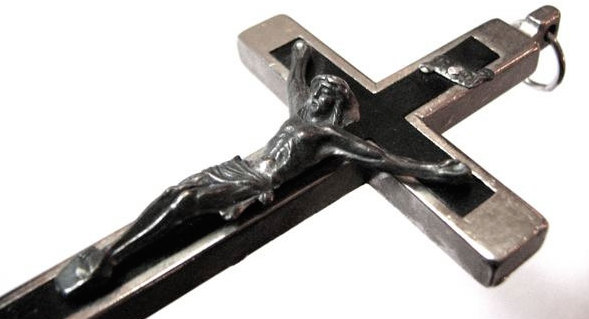
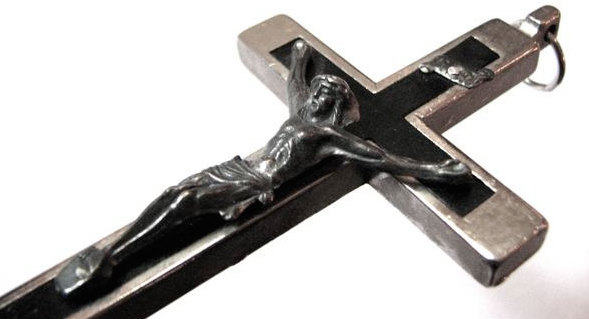
CrucifixA man enters the Confessional box.  He notices on one side a fully equipped bar with Guinness on tap.  On the other wall is a dazzling array of the finest Cuban cigars. Then the priest comes in.  “Father, forgive me, for it’s been a very long time since I’ve been to Confession, but I must first admit that the Confessional box is much more inviting these days.”  The priest replies, “Get out! You’re on my side.”

It is quite interesting being a priest. You see the world from a different angle, because so often folks want you to see their “good side.” It’s not often that when you are all dressed up in a clerical collar that you can meet someone for the first time and come away actually knowing much about them. There are those rare occasions when someone begins talking and it seems they’ve lost the “Off” switch, but for the most part it comes down to respectful pleasantries. You also get various reactions from people as you walk along. There’s always some who give you a hearty, “Hello, Father,” but there are others that avert their eyes. They don’t want to be seen by a priest or they have a certain disdain for clergy to the point that they won’t even recognize you as a person.

Some priests don’t think that it is necessary to walk around looking like a priest, but I do, whether the world accepts it or not. It is a way of constantly reminding folks that there is another way.

Of all the looks you get along the way, the oddest ones come from folks who have never really seen a priest up close. They give you more than the once over and particularly stare at the dog collar. I mention this because I got this certain look while around several youth in their early teens. A girl – maybe fourteen – looked at me and my collar, then noticed the crucifix that I wear. Her eyes lit up a bit as she leaned in for a closer look. “Nice necklace,” she said, “it has a man on it.” “It has a man on it.” Now, it is one thing to not really know much about priest, but this girl – this fourteen year old girl – did not know that this man on my necklace was Jesus. She didn’t know the story or anything about Him. Her friend sitting next to her looked up and said, “Oh, that’s God” and I was thankful for her input, because at the time I was a bit too flummoxed to say anything.

The angel said to her, “Do not be afraid, Mary, for you have found favor with God. And now, you will conceive in your womb and bear a son, and you will name him Jesus. He will be great, and will be called the Son of the Most High, and the Lord God will give to him the throne of his ancestor David. He will reign over the house of Jacob forever, and of his kingdom there will be no end.” His name will be Jesus. He will be great. Son of the Most High. David’s ancestor. He will reign forever. He will be… a man on a necklace.

Dietrich Bonhoeffer wrote, “For those who are great and powerful in this world, there are two places where their courage fails them, which terrify them to the very depths of their souls, and which they dearly avoid, these are the manger and the cross of Jesus Christ.” Yet, there will be no fear of the Lord as long as he remains a man on a necklace. He must move into the world and call people to righteousness, but not only call, He must also be heard. His message must not only proclaim another way, but demonstrate that other way through lives changed, the hungry fed, the lame healed, and the blind given their sight.  This man on a necklace must take on flesh and blood.

The word “incarnation” refers to God, in the person of Jesus, taking on human form. Taking on flesh and blood. For you and I to live an incarnational life means that Jesus is born within us. And this is what must occur if the world is to know Jesus as more than a man on a necklace. We are called to be His body in the world today.

How do we make such a transfiguration in our own lives, going from simply being observers of the world around us to living as incarnational disciples, intentionally putting flesh on God? I like St. Josemaria’s answer, “Don’t fly like a barnyard hen when you can soar like an eagle.” It takes courage, but that courage is within you. As he says again, “Courage! You can! Don’t you see what God’s grace did to that sleepy, cowardly Peter, who had denied him to that fierce, relentless Paul, who had persecuted him?” To go from observer to incarnational disciples requires that we profess the words of the Blessed Virgin Mary. The words that she spoke on the day that the angel of the Lord came and visited her, “Here am I, the servant of the Lord; let it be with me according to your word.” But we must not only profess those words, we must also allow them to breathe life into us, a life filled with the Holy Spirit of God.

The Blessed Virgin Mary was probably about fourteen when she said “Yes” to God – about the same age as the girl who liked my necklace with the man on it – but it was Mary’s “Yes” that changed all of creation. It was her participation in the incarnation of God that gave God flesh and blood in this world. It is your “Yes” to God that continues this great work, that continues God’s incarnation.

I’m not preaching works – what we do for God – over faith, but there must be action behind our words. Brennan Manning writes in The Rabbi’s Heartbeat, “The Christian commitment is not an abstraction. It is a concrete, visible, courageous, and formidable way of being in the world forged by daily choices consistent with inner truth. A commitment that is not visible in humble service, suffering discipleship, and creative love – or as in the language we’ve been using ‘a life that is not living incarnationally’ – is an illusion. Jesus Christ is impatient with illusions, and the world has no interest in abstractions.” As Manning says in this work and also in the Ragamuffin Gospel, “If you want to know what a person really believes, don’t just listen to what he says, watch what he does.” Don’t kid yourself, the world is watching. Just like they watch someone wearing a clerical collar, they also watch someone who claims to be a Christian. Some will watch so that they can find fault and criticize, but many others will watch because there is something within you, that they would like in their own lives. Show it to them. Show them the Incarnate Son of God. Show them Jesus.

We have much to do as long as people only see Jesus as a man on a necklace; therefore, say to the Lord, “Here am I, the servant of the Lord; let it be with me according to your word,” then “go and make disciples of all nations, baptizing them in the name of the Father and of the Son and of the Holy Spirit, and teaching them to obey everything Jesus has commanded us. And surely He is with us always, to the very end of the age.”

Sermon: Christ the King RCL A

christ-the-king

A priest tells the story of the time during the 70’s that he was living in a monastery in New York. It seems that while living there he had numerous millionaire friends who enjoyed his company and would invite him out. He recalls on one occasion being invited to a swank restaurant and a Broadway play. During the intermission, he and his friends went out for some fresh air and engaged in a rather highbrow conversation regarding the play.

As he was going about trying to impress his friends with his intellectual savvy he noticed someone walking toward him who was “not one of the beautiful people.” Her clothes were a bit tattered, her shoes worn, and her nylons had holes. As she approached he also noticed that she was peddling the Variety magazine for $0.75, so in a gesture of extreme generosity he handed her a dollar and casually waved her away, eager to wow his friends a bit more.

And then she said, “Father?” The priest writes, “In those days, I knew I couldn’t distinguish myself by my virtues, so I distinguished myself by my clothing; I always wore the collar, ‘Father, could I talk to you a minute?’ I snapped, ‘What? Can’t you see I’m busy? Do you make a habit of interrupting people in the middle of a conversation? Wait over there and I’ll speak to you when I’m done.’ She whispered, ‘Jesus wouldn’t talk to Mary Magdalene like that.’ And then she was gone.”

Later, he wondered what this young woman would have thought if she had wandered into his church the following Sunday to hear him preach on the love of God. He asked, “How could she believe in the love a God she can’t see when she couldn’t find even a trace of love in the eyes of a brother wearing a clerical collar whom she could see?” He noted, “A shriveled humanity has a shrunken capacity for receiving the rays of God’s love.” (From The Furious Longing of God, Brennan Manning)

Cindy Jacobs, self described Prophet to world influencers, conducted a prayer service for the economy in New York and in twelve other locations around the country. As part of that prayer service, she and many others gathered around and laid hands on the 7,000 pound bronze bull near Wall Street. Never mind the fact that the picture gave me the willies when I saw it (images of another “Golden Calf” in the time of Moses popping into my head) and never mind the fact that nowhere is Holy Scripture does Jesus ask us to go and pray for banks and what not, but I had to ask myself: how many of the poor and dispossessed of New York did they literally have to step over in order to get there?

In another event, a church raised tens of thousands of dollars to send a dozen members on a mission trip to New Orleans to help rebuild after hurricane Katrina. A worthy cause, yet within their own community there are literally hundreds of homeless people with over 25% of them being children. In their 100 year history, that church never raised anything for a mission trip within their own community. How many could have benefited from such an outpouring of Christian good will?

“Then the righteous will answer him, `Lord, when was it that we saw you hungry and gave you food, or thirsty and gave you something to drink? And when was it that we saw you a stranger and welcomed you, or naked and gave you clothing? And when was it that we saw you sick or in prison and visited you?’ And the king will answer them, `Truly I tell you, just as you did it to one of the least of these who are members of my family, you did it to me.’”

Today is the feast day of Christ the King. It is the last Sunday of the Season of Pentecost and of the church year. This day completes the Christian journey through the life of Jesus Christ on earth and in heaven, which began with the preparation for the birth of Jesus in Advent.

When you and I think of Kings, we often think of absolute rulers. They attain power by raising and leading armies into war against other countries. They demand obedience. They are the lawmakers and enforcers. They expect to be served and waited on hand and foot. In many respects we see them as tyrants. A quick glance at the history of monarchs will only confirm this. Yet the King we come to worship today is not like this.

Jesus said, “The kings of the Gentiles lord it over them; and those who exercise authority over them call themselves Benefactors. But you are not to be like that. Instead, the greatest among you should be like the youngest, and the one who rules like the one who serves. For who is greater, the one who is at the table or the one who serves? Is it not the one who is at the table? But I am among you as one who serves.” I am among you as one who serves. That is our King and that is the example he sets for you and I to follow.

As a Christian people, I watch you all serve everyday in many different capacities. You are following the example of Christ; however, there is one very important aspect of this serving we must keep in mind: so often we think in order to serve Christ the King we must go to the ends of the earth and fulfill great schemes – lay hands on the Wall Street Bull or go on mission trips to far off places – however, I would suggest to you today that Christ the King, Christ our King, is no further away than the next person you encounter. I can take ____ hand and at the same time take the hand of Christ the King – for the Kingdom of God is within them.

The problem arises when we get so wrapped up in our own lives or doing those things that we believe are serving the King that we miss him when he is standing right in front of us.

The first summer of seminary for almost all seminarians usually involves taking CPE, Clinical Pastoral Education. For almost all seminarians this is a dreaded experience, lots of complaining and rolling of eyes. When I entered into my CPE class, I brought this attitude with me. New age hocus pocus that’s going to get me in touch with my feelings. Bleh!

The idea of the course is to put you in the context of pastoral ministry and caring for those in need, while at the same time hopefully teaching you to not bring your own set of issues, opinions, prejudices, etc. to ministry events. Some of you may think I need to retake the course, but I did learn a few things. One event in particular shaped a good bit of how I approach every opportunity God presents to me for ministry. It was a routine visit to the hospice unit – if you can call what I did a visit.

It was expected that we would spend at least a half hour on each call, so when I arrived I spoke to the patient briefly, read a Psalm, and said a prayer. However, when there was no response from him, I sat back in my chair and spent the next twenty-six of my mandated thirty minutes planning my weekend and preparing a shopping list. When my time was up, I stood briefly at the foot of his bed, said “God bless you,” and got on with my life. He died a few days later. Other than the nurses that were caring for him, I was his last visitor.

Now, if you have a couple of unpleasant names running through your mind that you would like to label me with because of my actions, then feel free, but I can assure you that every time I recall that event, I call myself much worse. Each time I recall that event, I also beg the man’s forgiveness.

CPE may be some new age hocus pocus, but it taught me perhaps the most valuable lesson in ministry: when you are with someone, you must be fully present to them – they are Jesus. They are Christ the King. To be present is much more than sitting in a room and consuming oxygen. Being present means emptying yourself for the sake of the other. It means sacrificing your life for the life of another. Remember the words of Archbishop Ramsey, “You will never be nearer to Christ than in caring for the one man, the one woman, the one child.”

Therefore, instead of seeing the people that God places in your immediate path as obstacles or hindrances to you obtaining your own goals, be present to them, take them by the hand, and see them as Christ the King. Like Jesus, be among them as one who serves. See those souls as an opportunity for you to pour out the love and grace of God upon them in the same manner that God has poured out His love and grace upon you.

Sermon: “Servant”

The story in this sermon is one that probably every preacher in America has told at least once.  I still like it and hope that you enjoy this Wednesday Sermon.

Lent Devotional

Brennan Manning states, “The greatest single cause of atheism in the world today is Christians, who acknowledge Jesus with their lips and walk out the door, and deny Him by their lifestyle. That is what an unbelieving world simply finds unbelievable.” And it was D. L. Moody who wrote, “Of one hundred men, one will read the Bible; the ninety-nine will read the Christian.”

Bill has wild hair, wears a T-shirt with holes in it, jeans and no shoes. This was literally his wardrobe for his entire four years of college. He is brilliant. Kinda esoteric and very, very bright. He became a Christian while attending college.

Across the street from the campus is a well-dressed, very conservative church. They want to develop a ministry to the students, but are not sure how to go about it. One day Bill decides to go there. He walks in with no shoes, jeans, his T-shirt, and wild hair. The service has already started and so Bill starts down the aisle looking for a seat.

The church is completely packed and he can’t find anywhere to sit. By now people are looking a bit uncomfortable, but no one says anything. Bill gets closer and closer and closer to the pulpit and when he realizes there are no seats, he just squats down right on the carpet. (Although perfectly acceptable behavior at a college fellowship, trust me, this had never happened in this church before!) By now the people are really uptight, and the tension in the air is thick.

About this time, the minister realizes that from way at the back of the church, a deacon is slowly making his way toward Bill. Now the deacon is in his eighties, has silver-gray hair, a three-piece suit, and a pocket watch. A godly man, very elegant, very dignified, very courtly.

He walks with a cane and as he starts walking toward this boy, everyone is saying to themselves, You can’t blame him for what he’s going to do. How can you expect a man of his age and of his background to understand some college kid that looks like a rag-a-muffin sitting on the floor in the middle of the aisle?

It takes a long time for the deacon to reach the boy. The church is utterly silent except for the clicking of the cane. All eyes are focused on the deacon. You can’t even hear anyone breathing. The people are thinking, The minister can’t even preach the sermon until the deacon does what he has to do. And now they see this elderly man drops his cane on the floor.

With great difficulty he lowers himself and sits down next to Bill and worships alongside him so he won’t be alone. After a minute of stunned silence, the minister says, “What I’m about to preach, you will never remember. What you have just seen, you will never forget.”

In our Gospel, Jesus said, “The greatest among you will be your servant. All who exalt themselves will be humbled, and all who humble themselves will be exalted.”

One of the true signs of the Christian life is the person who humbles themselves and becomes the servant of all. As Jesus said, “I am among you as one who serves.” Of one hundred men, one will read the Bible; the ninety-nine will read the Christian. When they read us, let them read the story of those who were not afraid to get out of the pews and sit on the floor. When they read you, let them read the story of one who became like Jesus.

Paul wrote in his letter to the Philippians, “Do nothing from selfish ambition or conceit, but in humility regard others as better than yourselves.  Let each of you look not to your own interests, but to the interests of others.  Let the same mind be in you that was in Christ Jesus,

who, though he was in the form of God,
did not regard equality with God
as something to be exploited,

but emptied himself,
taking the form of a slave,
being born in human likeness.
And being found in human form,

he humbled himself
and became obedient to the point of death—
even death on a cross.”

Sermon: “Image”

imageAfter church on Sunday morning, Little Johnny suddenly announced to his mother, “Mom, I’ve decided I’m going to be a minister when I grow up.” “That’s okay with us,” his mother said, “But what made you decide to be a minister?” “Well,” Little Johnny replied, “I’ll have to go to church on Sunday anyway, and I figure it will be more fun to stand up and yell at folks than it will be to sit still and listen.”

When we were kids, we all had some image of what we wanted to be when we grew up. The Apostle Paul writes, “When I was a child, I talked like a child, I thought like a child, I reasoned like a child.” As children and even as adults we have dreams and aspirations of who we want to be, but Paul adds, “When I became a man, I put the ways of childhood behind me.” That does not mean that we set aside that childlike faith that Scripture speaks of, but it does mean we grow in our understanding of who God is, so that His image may increase in us.

In our Gospel reading today the Pharisees had come to Jesus questioning as to whether or not a person should pay taxes. They wanted to trick him by either getting him into trouble with the people or the Romans. Jesus didn’t fall for it. Instead, he asked to see one of the coins that was in use at the time that was minted with the image of the Emperor stamped on it. Why? Because it was ultimately the Emperor’s coin. His image stamped on the coin was a claim to his ownership. Therefore, when questioned on whether or not to pay taxes, Jesus says, “Give therefore to the emperor the things that are the emperor’s, and to God the things that are God’s.” It’s Caesar’s coin, so give it to him, but also give to God what is God’s.

It’s one of those parables that can speak to us on many levels. It speaks to us about our relationship to the government, taxes, and even of stewardship, but it also speaks to us about those images we hold of ourselves. That coin had Caesar’s image on it. It represents him and so it represents the world. There are aspects of our lives – of our image – that are representative of the world. We live in it; therefore, we have to live and work with it. Because of this reality, there is really no escaping giving to Caesar what is Caesar’s, but in doing so, we do not want to exchange our Godly image for a worldly one. As Paul teaches to the Romans, “Do not conform to the pattern of this world, but be transformed by the renewing of your mind” into the image of Christ Jesus.

St. Bonaventure declares, “In all your deeds and words you should look upon this Jesus as your model. Do so whether you are walking or keeping silence, or speaking, whether you are alone or with others. He is perfect, and thus you will be not only irreprehensible, but praiseworthy.” You were created in the image of God; therefore, give to God what is His and you will be praiseworthy.

When God created you He stamped you with his image, so just as the coin that bears the image of the Emperor belongs to Emperor, you who bear the image of God belong to God, not in the sense a slave belongs to a master, but as a child belongs to a loving Father.

Yes, give unto Caesar what is Caesar’s, but give to God what is God’s. Bear His image in your life.

Sermon: Pentecost 18 / Proper 23 – “One-On-One”

onepersonThe former Archbishop of Canterbury Michael Ramsey stated, “The glory of Christianity is its claim that small things really matter and that the small company, the very few, the one man, the one woman, the one child are of infinite worth to God.” He goes on to say, “Amidst a vast world with its vast empires and vast events and tragedies our Lord devoted himself to a small country, to small things and to individual men and women, often giving hours of time to the very few or to the one man or woman.”

Have you ever noticed this? How Jesus spends a good bit of time with individuals or just a couple of folks? Sure, there are the large crowds, but think of the hours alone with one or two people. There was the Lady of Samaria, Nicodemus, Lazarus, Mary and Martha, the man at the pool of healing, Simon Peter. Jesus, God, spent one-on-one time with all of these.

For a God that desires for none to perish and all to be saved, this might seem an odd way of going about it; however, upon closer inspection, it seems to be working.

In the beginning of his ministry, Jesus called Peter and Andrew, two fishermen. Today it is estimated that there are more than 2 billion Christians in the world, not to mention all the ones between those first to today. It would seem that Jesus does not need and advertising firm or slick marketing campaigns to increase his flock. He needs only one person that cares and believes and is willing to tell another, who in turn is willing and confident enough to speak to a few more.

Many believe this work of conveying the Christian faith is the exclusive responsibility of the ordained. Those who supposedly have the proper credentials for engaging in this type of work.

There is a story about one of the many Billy Graham crusades. Apparently Reverend Graham was to speak at the revival on a Tuesday, but he arrived on a Monday so he attended the Monday night service incognito and sat on the grass at the rear of the crowd. Because he was wearing a hat and dark glasses, no one recognized him.

Directly in front of him sat an elderly gentleman who seemed to be listening intently to the Monday night preacher. When the preacher invited people to come forward as an open sign of commitment, Billy decided to do a little personal evangelism, some one-on-one as Jesus did. He tapped the man on the shoulder and asked, “Would you like to accept Christ? I’ll be glad to walk down with you if you want to.” The old man looked him up and down, thought it over for a moment, and then said, “Naw, I think I’ll just wait till the big gun comes tomorrow night.”

This story underlines how, in the minds of many, ministry and evangelism are the tasks of the “Big Guns,” but it is truly the ministry of us all to make the Kingdom of God known. One person at a time.

In our Gospel reading today, the king said to his servants, “The wedding is ready, but those invited were not worthy. Go therefore into the main streets, and invite everyone you find to the wedding banquet.”

Today, we are the King’s servants. We are the ones who are to go into the streets and invite others to the banquet. The Apostle Paul wrote in his letter to the Romans, “‘Everyone who calls on the name of the Lord shall be saved.’  But how are they to call on one in whom they have not believed? And how are they to believe in one of whom they have never heard? And how are they to hear without someone to proclaim him?  And how are they to proclaim him unless they are sent? As it is written, ‘How beautiful are the feet of those who bring good news!’”

You are the King’s servants, therefore, go into the main streets and invite everyone you find to the wedding banquet. By so doing, you will be caring for and loving the one man, the one woman, the one child who are of infinite worth to our God.