Sermon: Heritage Sunday / Feast of St. Matthew

Mildred, the church gossip, and self-appointed monitor of the church’s morals, kept sticking her nose into other people’s business. Several members did not approve of her extra curricular activities, but feared her enough to maintain their silence.

She made a mistake, however, when she accused George, a new member, of being an alcoholic after she saw his old pickup parked in front of the town’s only bar one afternoon. She emphatically told George and several others that everyone seeing it there would know what he was a drunk.

George, a man of few words, stared at her for a moment and just turned and walked away. He didn’t explain, defend, or deny. He said nothing.

On an evening later in the week, when Mildred’s husband was out of town on business, George quietly parked his pickup in front of Mildred’s house, walked home, and left it there all night.

There will always be the Mildred’s of the world. Those who are quick to point out the moral faults of others, tear them down (many times using the Holy Scripture to do it), turn their noses up in disgust, and dismiss them as unfit to associate with.

Unfortunately Mildred’s behavior is not limited to individuals. Have you ever known a church to behave in such a way? Have you ever known a church that was quick to point out the moral faults of others, tear them down (many times using the Holy Scripture to do it), turn their noses up in disgust, and dismiss them as unfit to associate with; categorizing them as degenerates. Immoral. Unclean. Scandalous. Say it ain’t so! Of course you have. We all have. And our Patron Saint, Matthew, was on the receiving end of such behavior.

“As Jesus was walking along, he saw a man called Matthew sitting at the tax booth; and he said to him, ‘Follow me.’” In the eyes of the people, Matthew had three strikes against him. First, he worked for the IRS – no explanation needed. Second, he was a Jew working for the IRS, collecting money from other Jews and probably cheating his own people by collecting a bit extra for himself. Third, he was a Jew, working for the IRS, and the IRS was an agency of the of the Romans, the oppressive regime that was occupying the land. Three strikes, you’re out. He was collecting money for the enemy and stealing from his own people. The Pharisees asked the disciples, “Why does your teacher eat with tax collectors and sinners?” In effect they looked at Matthew and the others Jesus was associating with and declared them degenerates. Immoral. Unclean. Scandalous. My goodness.

Sometimes, it would seem, that not much has changed in the last 2,000 years, but whether Jesus likes it or not, it really does have to be that way. Doesn’t it? After all, we can’t have any sinners in church. That just will not do, we must send them packing. The degenerates, immoral, and unclean must go. For the likes of them to remain in the church would be scandalous. Last one out, please turn off the lights and lock the door! We’ll call a realtor and put the church property up for sale tomorrow.

This is too long of a quote to read to you in a sermon, but its too good of a quote not to. From the 100th Archbishop of Canterbury, Michael Ramsey, “History shows that attempts to be rid of the scandal of the Church, by puritanically turning out people who don’t conform to certain moral standards, cause more evils than they cure… Attempts to purge the Church like that break down because it is so easy to turn out those who by their actions have failed to uphold those standards, while leaving inside the Church the smug people, the proud people, the prigs and the hypocrites. The Christian Church was never meant to be a Society of the Moral, but rather a Society of the Forgiven, and of those who put themselves in the way of divine forgiveness; a society ready to carry within its embrace many who have fatally compromised, and all who are unworthy—for all of us are unworthy: the mixed society of those called to be saints.”

A story. In the past, it was just that, a story, but these days the beginning is almost a bit too real.

There is a two thousand member church and on one Sunday it is filled to overflowing capacity. The preacher was ready to start the sermon when several men, dressed in long black coats and black hats entered through the rear of the church.

One of the two men walked to the middle of the church while the others stayed at the back. At once, they all reached under their coats and withdrew automatic weapons.

The one in the middle announced, “Everyone willing to take a bullet for Jesus stay in your seats!”

Naturally, the pews emptied, followed by most of the choir. The deacons ran out the door, followed by the assistant pastor.

After a few moments, there were about twenty people left sitting in the church. The preacher was holding steady in the pulpit.

When it was quiet, the men put their weapons away and said, gently, to the preacher, “All right, pastor, the hypocrites are gone now. You may begin the service.”

On one level I want to like that story. It speaks about standing firm for your faith, but on another level, I’m not so sure. Twenty out of two thousand remained and the 1,980 that left are called hypocrites. But what if we rephrase that in the terms of our Gospel reading. Jesus said, “For I have come to call not the righteous but sinners.” What if those twenty that remained were the righteous and those 1,980 that fled were in fact degenerates? Immoral. Unclean. Scandalous. What if they were the sinners? Would Jesus have condemned them has “Hypocrites” and turned his back on them? Would he have shouted, “Let them go! We’re better off without them.” No. Instead he would have gone in search of each and everyone of them and when he found them, he would have sat down with them, eaten with them, and spoken to them of the salvation he was offering.

Jesus says, “Those who are well have no need of a physician, but those who are sick. Go and learn what this means, `I desire mercy, not sacrifice.’” Jesus would not have seen those 1,980 as hypocrites. He would have seen them as those in need of a physician. In need of a healer of souls. He would have withheld judgment in favor of extending mercy. I believe Jesus expects the same from His Church.

In Shakespeare’s The Merchant of Venice, Portia says:

“The quality of mercy is not strained.
It droppeth as the gentle rain from heaven
Upon the place beneath. It is twice blessed:
It blesseth him that gives and him that takes.
‘Tis mightiest in the mightiest. It becomes
The thronèd monarch better than his crown.
His scepter shows the force of temporal power,
The attribute to awe and majesty
Wherein doth sit the dread and fear of kings,
But mercy is above this sceptered sway.
It is enthronèd in the hearts of kings.
It is an attribute to God himself.

Mercy is in the heart of kings, it is an attribute of God, and it is the responsibility of the Church to extend it to all – saints and sinners alike. When the Lord calls us all home and we are walking the golden streets of that Heavenly Jerusalem, there will be more than enough time to rub shoulders with the Saints of God, but for now we are the ones God calls upon to bring the Good News to those who would hear it.

Today is our Heritage Sunday, when we celebrate the rich history of our church. That heritage began back in September 1893 when “a large and respectable number of” sinners gathered around a wagon and listened to Bishop Frances Brooke preach and celebrate the Eucharist. Today, we sinners gather in the place those sinners built. Our history is not one of glowing saints – especially with you lot! Lord have mercy! – but we are Archbishop Ramsey’s “mixed society of those called to be saints,” and by the grace of God we will be in Enid for years to come acting as agents of His mercy and proclaiming the Good News of Christ Jesus to all who would come and hear it.

The Mildred’s of this world and the churches that would respond to sinners as she did will continue to exist. In the end, they may be the ones proven to be right, but I would rather err on the side of mercy and grace, for Jesus condemned many for judging, but he condemned none for loving. If we are that church, the one that chooses to love, we will continue to have a beautiful heritage.

Let us pray: God of eternity, in your Son Jesus Christ you redeemed all of human history and called your church to proclaim the Good News of his death and resurrection to the ends of the earth and to the end of the age: pour out your Spirit afresh upon your people in this place, with grace to remember and rejoice in your blessings in the past and courage to trust your power to shape our future, through Jesus Christ our Lord, who lives and reigns with you in the unity of the Holy Spirit, one God, now and for ever. Amen.

Sermon: Proper 19 / Pentecost 16 RCL B – “Cross Bearing”

Communications has one major problem: language. Not surprising when you consider words can have multiple definitions (“set” has 464 and “run” has 395) Then there are the words we use or misuse or just the occasional typo. It would seem that church bulletins provide endless examples of all these problems. Actual church announcements:

The outreach committee has enlisted 25 visitors to make calls on people who are not afflicted with any church.

Low Self-Esteem Support Group will meet Thursday at 7 p.m. Please use the back door.

At the evening service tonight, the sermon topic will be “What is hell?” Come early and listen to our choir practice.

The sermon this morning: Jesus Walks on the Water. The sermon tonight: Searching for Jesus.

The church will host an evening of fine dining, superb entertainment, and gracious hostility.

During the absence of our pastor, we enjoyed the rare privilege of hearing a good sermon when J. F. Stubbs supplied our pulpit.

Misinterpretation of the words we use can also lead to problems in communication. There is a legend regarding J. Edgar Hoover who ran the FBI. Apparently he insisted that all correspondence to him have wide borders around the text so that he could write notes in the margins. In an effort to cut some costs and impress his boss, a supply clerk reduced the size of the office memo paper. One of the new memo sheets soon ended up on Hoover’s desk. Hoover took one look at it, determined he didn’t like the size because it limited the margin width, so scribbled the note, “Watch the borders!” The memo was passed on through the office. Legend has it that for the next six weeks, it was extremely difficult to enter the United States by road from either Mexico or Canada.

In the words of Cool Hand Luke, “What we got here is a failure to communicate.”

Now, if we have this much trouble getting bulletin announcements right or expressing our dislike for the width of the border on a page, is it any wonder that we have such difficulty and so many differences of opinion when it comes to interpreting Holy Scripture?

Paul wrote in his letter to the Corinthians, “For by grace you have been saved through faith, and this is not your own doing; it is the gift of God— not the result of works, so that no one may boast.” Yet last week in James’ Epistle we read, “So faith by itself, if it has no works, is dead.” Which is it? Is one right and the other wrong or are they both right, and if so how? Bring them up in a room full of theologians and watch the fun begin.

Here is another you hear all the time: “God will not place more on you than you can bear.” Most are surprised to learn that this particular statement is no where in Scripture. The closest we have is speaking about sin and temptation from 1 Corinthians, which says, “God is faithful, and he will not let you be tested beyond your strength, but with the testing he will also provide the way out so that you may be able to endure it.” But we’ve taken this verse to mean God won’t overburden us in all areas of our lives. Truthfully, I don’t believe that God will, but I know for a fact that the devil is more than happy to pour it on so thick that you can’t even breathe. So if you’re having a really bad day and someone says, “God won’t give you more than you can handle,” then smack ‘em one and see how well they handle that. No, no, no! Just politely tell them they’re misinterpreting the Scriptures.

Why all this talk on language and miscommunication? Because today we have another perfect example. Not only on the part of Peter, but also for us, because what we often think is being said, is not really the case.

Jesus and his disciples have been traveling near the coast, but now have made a turn inland. As they are traveling, near Caesarea Philippi, Jesus asked his disciples, “Who do people say that I am?” They answered him, “John the Baptist; and others, Elijah; and still others, one of the prophets.” The answers were across the board. People didn’t really know who he was. Go out on the streets of Enid and ask the same question, “Who is Jesus?” and you’ll encounter a similar result. Jesus is God. Prophet. King. Hoax. Madman. Lie. Everything from a figment of of the Gospel writers’ imaginations to the Creator of the Heavens and Earth. Too bad Gallop surveys weren’t around in the time of Jesus, we could have narrowed it down to percentages of each, yet even if we could, unlike the world today, Jesus would not have altered himself or his message in order to gain a higher approval rating. The same yesterday, today, and tomorrow. That type of information is irrelevant to him and his next question to his disciples proves that: “But who do you say that I am?” I don’t care what the people or the surveys say, I want to know who you think that I am. The message of salvation is not dependent upon what is popular, instead it is dependent upon each individual response. Peter answered, “You are the Messiah.” Peter got a gold star for his answer, but here is the first language issue. Peter interpreted “Messiah” as one who would be like King David and save them from their temporal / earthly enemies. Jesus, as we know, was concerned about the soul and saving us from our eternal enemy death, the result of sin. So when Jesus began talking about dying, Peter misunderstood. “Whoa there JC! This can’t happen and I’ll be danged if I’m going to let it, because if you die, then we have no King. We’re back where we started from.” Jesus rebukes him for the reason stated, “… you are setting your mind not on divine / eternal things but on human / temporal things.”

Jesus then turns from his disciples and speaks to the crowd that is gathered around him, “If any want to become my followers, let them deny themselves and take up their cross and follow me.” Perhaps in the time of Jesus they understood what he was talking about, but it seems that many times we misinterpret this saying of Jesus.

Someone has a difficult burden to bear. A job, an illness, a task. Something that weighs on them heavily and requires great strength and perseverance to accomplish. Another person comments on how difficult it must be. The response, “No, it’s not easy, but it’s my cross to bear.”

Another has a person in their life that through choice or relation presents various longterm difficulties. “You are such a saint for giving so much of yourself for them.” And in either true or false humility the response, “We all have our cross to bear.”

The difficult circumstances and burdens in our lives are not the cross we have to bear. These are the things in our lives that we call on Jesus to assist us with. These are the things that we as a Christian people help one another with. Those persons in our lives that present difficulties are not our crosses either. These are the ones we are called to love as we love ourselves.

The cross that Jesus calls us to take up has a very specific purpose, which has nothing to do with the circumstances of our lives or other people. You see, the cross we take up is for us, so that we – in the words of Paul – might be “crucified with Christ.” Paul writes, “We know that our old self was crucified with him so that the sinful body might be destroyed, and we might no longer be enslaved to sin.  For he who has died is freed from sin.  But if we have died with Christ, we believe that we shall also live with him.”

Reflecting on this verse in the Cost of Discipleship, Dietrich Bonhoeffer wrote, “When Christ calls a man, he bids him come and die.”

The language of the Bible can at times be confusing and difficult to understand. By responding to the trials and tribulations in our lives by saying, “This is my cross to bear,” is one of the ways we can confuse what Jesus said. “This is my cross to bear,” is in effect saying, “I will define my cross. I will assign what it is, how much it will weigh, and how far I am prepared to carry it,” instead of allowing God to use that cross for the purpose it was designed. When Jesus says, “If any want to become my followers, let them deny themselves and take up their cross and follow me,” he is asking us to take up our cross and follow him to that hill outside of Jerusalem to be crucified with him, so that we may die to self and live for God. By doing so, your life does not end. It begins. There is no confusion in Jesus’ message on this point, for he says plainly, “I came that they may have life, and have it abundantly.”

Let us pray: Most gracious and ever loving Father, we pray that you give us the strength, courage, wisdom, and will to follow where you have led the way. Through the inspiration of the Holy Spirit, direct our steps that we may be lights in this world to guide and direct others to your most loving Son, in whose Name we pray. Amen.

Sermon: Proper 18 / Pentecost 15 – “Dog!”

A home-accident survey showed that 90 percent of accidents on staircases involved either the top or the bottom stair. This information was fed into a computer to analyze how accidents could be reduced. The computer’s answer: “Remove the top and bottom stairs.”

The answer we get is not always the answer we would expect. When Jesus enters the region of Tyre the Syrophoenician woman comes to him and begs for help for her daughter. Jesus’ response, “Let the children be fed first, for it is not fair to take the children’s food and throw it to the dogs.” Definitely not the answer we were expecting! How do we explain saying of Jesus?

In truth, there are many who are a lot smarter than me who have attempted to understand these events and in reading them, I cock my head to the side like a dog trying to understand its master. For me, to discover the answer, we have to to put it into the context of the incident and verses that immediately precede this encounter. We read these just last week. It is the discussion over what is clean and unclean.

In last week’s Gospel, the Pharisees came to Jesus and asked him why his disciples ate with unclean hands, because the disciples did not wash their hands according to tradition. Jesus answered them, “You abandon the commandment of God and hold to human tradition.” The religious leaders used their traditions as weapons and lorded it over the people to beat them down and held themselves superior to those who did not keep the Law, that is, the Gentiles; which is why the Jews would have nothing to do with Gentiles.

Remember the time that Jesus went to the well at Samaria. His disciples went into town to look for something to eat and left Jesus alone at the well. The woman arrives and Jesus asked her for a drink of water from the well. Her reply, ”’You are a Jew and I am a Samaritan – a gentile -woman. How can you ask me for a drink?’ (For Jews do not associate with Samaritans).” Because the Gentiles failed to adhere to the Law and the traditions, the Jews would have nothing to do with them and looked down on them.

From this animosity grew other contentious practices and traditions. The tradition that has baring on our Gospel today is the tradition of Jews calling Gentiles “dogs.” It’s not that the Gentiles were eating with unclean hands, it was that the Gentiles were believed to be unclean through and through and no better than the wild dogs that roamed the streets.

Long before Jesus encountered Syrophoenician woman a precedent had been set: Jews don’t associate with Gentiles. Therefore, when Jesus is speaking to the woman, he knows this precedent, she knows this precedent, the disciples know the precedent, and everyone else in this house knows the precedent, so by Jesus referring to this woman as a dog, he fulfills everyone’s preconceived ideas of how this encounter should play out. On hearing Jesus speak to her in such a way, those gathered around him probably responded in their hearts, “Good, he is maintaining the proper order of things.” Let me ask you this: When have you ever known Jesus to maintain the proper order of things?

The woman demonstrated great faith and boldness in her response to Jesus, “Sir, even the dogs under the table eat the children’s crumbs.” In those few words she is saying, “I know the world thinks I’m no better than a dog, I know these people here with you think I’m a dog, but I do not believe that you think I am a dog.” Now, I have no biblical proof or great theologian or other expert to back me up on this, but when that woman said, “Sir, even the dogs under the table eat the children’s crumbs,” Jesus smiled. He probably even laughed out loud.

We have the Law and we have our traditions that protect us from getting dirty. We know what is right and what is wrong. We know what is clean and what is unclean. We know that you are a dog. And the Syrophoenician woman thumbed her nose at them all. Of course Jesus laughed and then he rewarded her faith: “‘For saying that, you may go– the demon has left your daughter.’ So she went home, found the child lying on the bed, and the demon gone.”

The world looked at her and had certain expectations about who she was and how she should behave. She was a dog and dogs have their place. It wasn’t until she encountered Jesus that not only was she seen as something different, someone worthy of God’s favor, but it probably wasn’t until that encounter with Jesus that she even saw herself as someone worthy of the blessings of God.

Fortunately, the world no longer has such problems as this. We don’t look at one person and think them as being different from anybody else. In our eyes, everyone is equal and treated fairly. Maybe not.

In the Epistle of James that we read this morning, James asked a question: “If a person with gold rings and in fine clothes comes into your assembly, and if a poor person in dirty clothes also comes in, and if you take notice of the one wearing the fine clothes and say, ‘Have a seat here, please,’ while to the one who is poor you say, ‘Stand there,’ or, ‘Sit at my feet,’ have you not made distinctions among yourselves, and become judges with evil thoughts?” His answer: “Yes.” He begins by stating the royal law, “You shall love your neighbor as yourself,” and then states, “If you show partiality, you commit sin and are convicted by the law as transgressors.”

We understand him to be speaking of our treatment of the poor, but I would suggest to you that our understanding of this scripture only begins there. No, I’m not going to politicize a sermon, never will, but what if we replaced a few words? For example, “If a person with white skin comes into your assembly, and if a person with dark skin also comes in, and if you take notice of the white person and say, ‘Have a seat here, please,’ while to the one with dark skin you say, ‘Stand there,’ or, ‘Sit at my feet,’ have you not made distinctions among yourselves, and become judges with evil thoughts?” Yes we have. And yes, we’re only being naive if we think the opposite of that isn’t also true. But who else might we apply these verses to? Who else do we judge as unworthy? What about the woman standing in line in front of us at the grocery store with two kids, paying for frozen pizzas and ice cream with food stamps? What about the person we disagree with politically? What about… ? I’m sure you have your own answers.

When presented with this type of scripture reading, we must be willing to apply their teachings to more than one issue, even when they make us uncomfortable. And in these lessons, both Jesus and James were addressing the fact that we may all have a tendency to at times look at a person or group of persons and based on their outward appearances or practices, judge them according to our perceptions of them. Or put into the language we’ve been discussing, we have a tendency to declare them “clean” or “unclean”, worthy or unworthy based on our perceptions of them, but in doing so, we end up judging ourselves. Jesus and James both demonstrate this.

The Trappist monk, Thomas Merton (if you haven’t read his autobiography, The Seven Storey Mountain, I highly recommend it to you) said it best, “Our job is to love others without stopping to inquire whether or not they are worthy. That is not our business and, in fact, it is nobody’s business. What we are asked to do is to love, and this love itself will render both ourselves and our neighbors worthy.”

We may look at some around us and based on our perceptions of them, think they are of lesser value than us or others, that perhaps they are not worthy of the blessings of God, but in the face of such judgments, Jesus only laughs. Why? Because Jesus is not interested in maintaining our determined order of the world. He came to establish God’s order. God’s Kingdom. “For the old order of things has passed away.” Jesus said, “Behold, I have come to make all things new.” Don’t allow the judgmental precedents established by others cause you to commit sin. Instead, imitate Christ and dismantle those barriers that divide the children of God.

Let us pray: O God, you made us in your own image and redeemed us through Jesus your Son: Look with compassion on the whole human family; take away the arrogance and hatred which infect our hearts; break down the walls that separate us; unite us in bonds of love; and work through our struggle and confusion to accomplish your purposes on earth; that, in your good time, all nations and races may serve you in harmony around your heavenly throne; through Jesus Christ our Lord. Amen.

Sermon: David Pendleton Oakerhater

In chapters six through nine of the Book of Genesis, we read about Noah and the great flood, followed by God’s sign, the rainbow, in the heavens. We then learn that the three sons of Noah went out into the world, and in chapter ten we learn of their descendants: “These are the descendants of Noah’s sons, Shem, Ham, and Japheth; children were born to them after the flood.  The descendants of Japheth: Gomer, Magog, Madai, Javan, Tubal….” The chapter goes on to name the Who’s Who of the repopulated world. Each of the names listed is naming a clan of people. Or, put another way, each name listed is the name of one of the new nations of the world. How many nations would there be according to this list in Genesis? Seventy.

This number, seventy, whether literally or figuratively, would later be symbolically representative all the nations of the world. This then helps us to more fully understand the first verse of our Gospel reading today: “After this the Lord appointed seventy others and sent them on ahead of him in pairs to every town and place where he himself intended to go.” In saying this, Luke is hoping the reader will understand that Jesus is not just sending seventy messengers out, but is sending messengers into all the world to “Prepare the way of the Lord,” and to say to the people, “The Kingdom of God has come near to you.” Since that day, the Lord has not ceased sending messengers to proclaim the Good News. Today, we celebrate one He sent to the Cheyenne Nation in Oklahoma: David Pendleton Oakerhater.

Born around 1847 in the Oklahoma Territory, Oakerhater would later fight against the US Government over Indian land rights. In 1875 he, along with 27 other leaders, would be captured and sent to a military prison in Florida. Eventually he would be brought to New York where he converted to Christianity and took the Christian name, David (Pendleton is the sir name of the US Senator that assisted him), and in 1881 was ordained a Deacon in the Episcopal Church. That same year he would return to Oklahoma, first settling in what is now El Reno. His mission was the same as those first seventy that Jesus sent out, “Prepare the way of the Lord.” He is reported to have said to his people, “You all know me. You remember when I led you out to war I went First, and what I told you was true. Now I have been away to the East and I have learned about another captain, the Lord Jesus Christ, and he is my leader. He goes first, and all He tells me is true. I come back to my people to tell you to go with me now in this new road, a war that makes all for peace.”

He began as a military warrior, but is now known as “God’s Warrior” among the Cheyenne Indians of Oklahoma. He is buried in the Watonga Indian Cemetery.

The Great Commission is a passage of scripture we hear quite often: Jesus said, “Go therefore and make disciples of all nations, baptizing them in the name of the Father and of the Son and of the Holy Spirit, and teaching them to obey everything that I have commanded you.” Jesus first sent out the twelve, later it would be the seventy, and even later he would send those like Oakerhater into all the nations of the world, but the work is not yet complete; therefore, Jesus is also sending us out into the “nations” as well. The nation where we are called to spread the Good News is only 74.1 square miles, with a population of about 50,000. We are called to be disciples in Enid, Oklahoma. May we be as faithful as those who have gone before us.

Sermon: Bartholomew

From Paul’s first letter to the church at Corinth:

I think that God has exhibited us apostles as last of all, as though sentenced to death, because we have become a spectacle to the world, to angels and to mortals. We are fools for the sake of Christ, but you are wise in Christ. We are weak, but you are strong. You are held in honor, but we in disrepute. To the present hour we are hungry and thirsty, we are poorly clothed and beaten and homeless, and we grow weary from the work of our own hands. When reviled, we bless; when persecuted, we endure; when slandered, we speak kindly. We have become like the rubbish of the world, the dregs of all things, to this very day.

I don’t know many who can name the twelve apostles who went out into the world after Jesus died – I don’t know that I could do it – but what they have accomplished is nothing less than a miracle. We are here today worshiping in this Chapel because of what they began 2,000 years ago. Yet, in their time, they were not highly thought of by the masses and were most certainly not treated well. Paul’s description from above is very accurate.

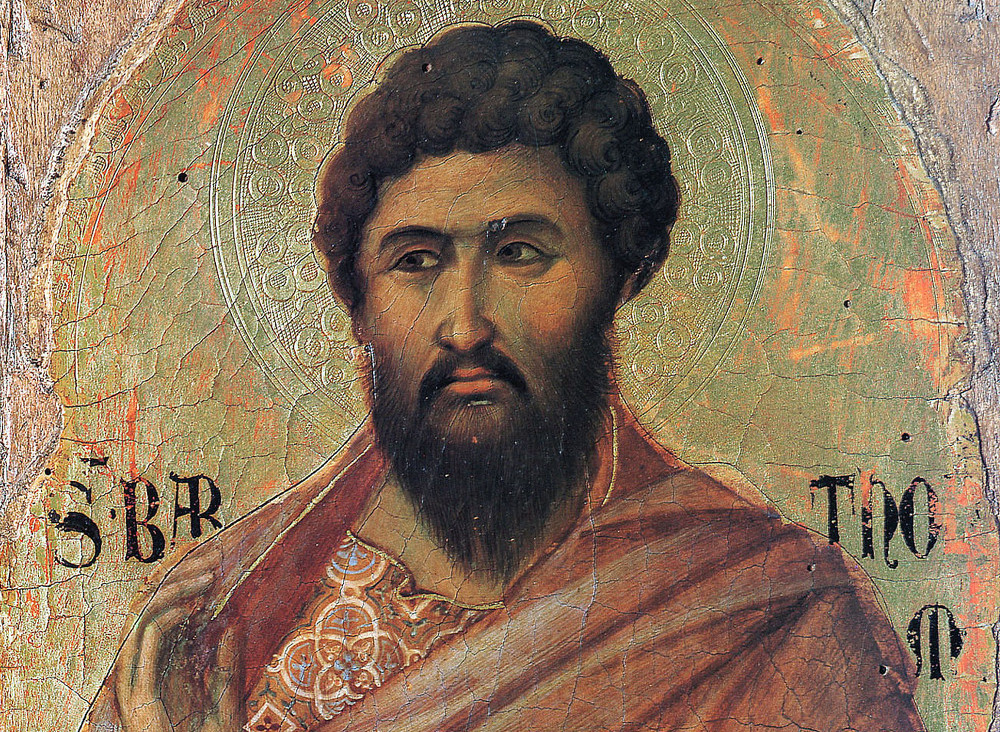
Their lives ended violently. With the exception of perhaps John, they were all put to death for the faith. “How” they were put to death reads something like a Stephen King novel – spears, swords, boiling oil, crucifixions – on and on. In the icons of Bartholomew, he is often seen holding a knife, because it is believed that he was flayed alive, but not before he had accomplished the work that Christ had commissioned him to do.

Certain sources indicate that there is a lost Gospel of Bartholomew. In addition, the Roman historian Eusebius reports that when others visited India, between 150 and 200, they “found there ‘the Gospel according to Matthew’ in Hebrew, which had been left behind by ‘Bartholomew, one of the Apostles.’”

Jesus said in our Gospel reading today, “The kings of the Gentiles lord it over them; and those in authority over them are called benefactors. But not so with you; rather the greatest among you must become like the youngest, and the leader like one who serves. For who is greater, the one who is at the table or the one who serves? Is it not the one at the table? But I am among you as one who serves.”

Bartholomew and the other Apostles were not looking to gain fame and fortune. There sole intent was to be among us as ones who serve. Ones who through passion and sacrifice served the Gospel.

Also in his letter to the Corinthians, Paul writes, “Now you are the body of Christ, and each one of you is a part of it.  And God has placed in the church first of all apostles, second prophets, third teachers, then miracles, then gifts of healing, of helping, of guidance, and of different kinds of tongues.  Are all apostles? Are all prophets? Are all teachers? Do all work miracles?  Do all have gifts of healing? Do all speak in tongues? Do all interpret?”

Then and now, the answer to Paul’s questions is “No.” Not all of us are Apostles or prophets. Not all of us are Bartholomew’s who go to India to preach the Gospel, but we all have God given gifts. Gifts that have been given to us by God to serve the Gospel. Gifts that should be used as passionately and sacrificially as Bartholomew and the others used theirs.

What gift is God calling  you to use for the sake of the Gospel?

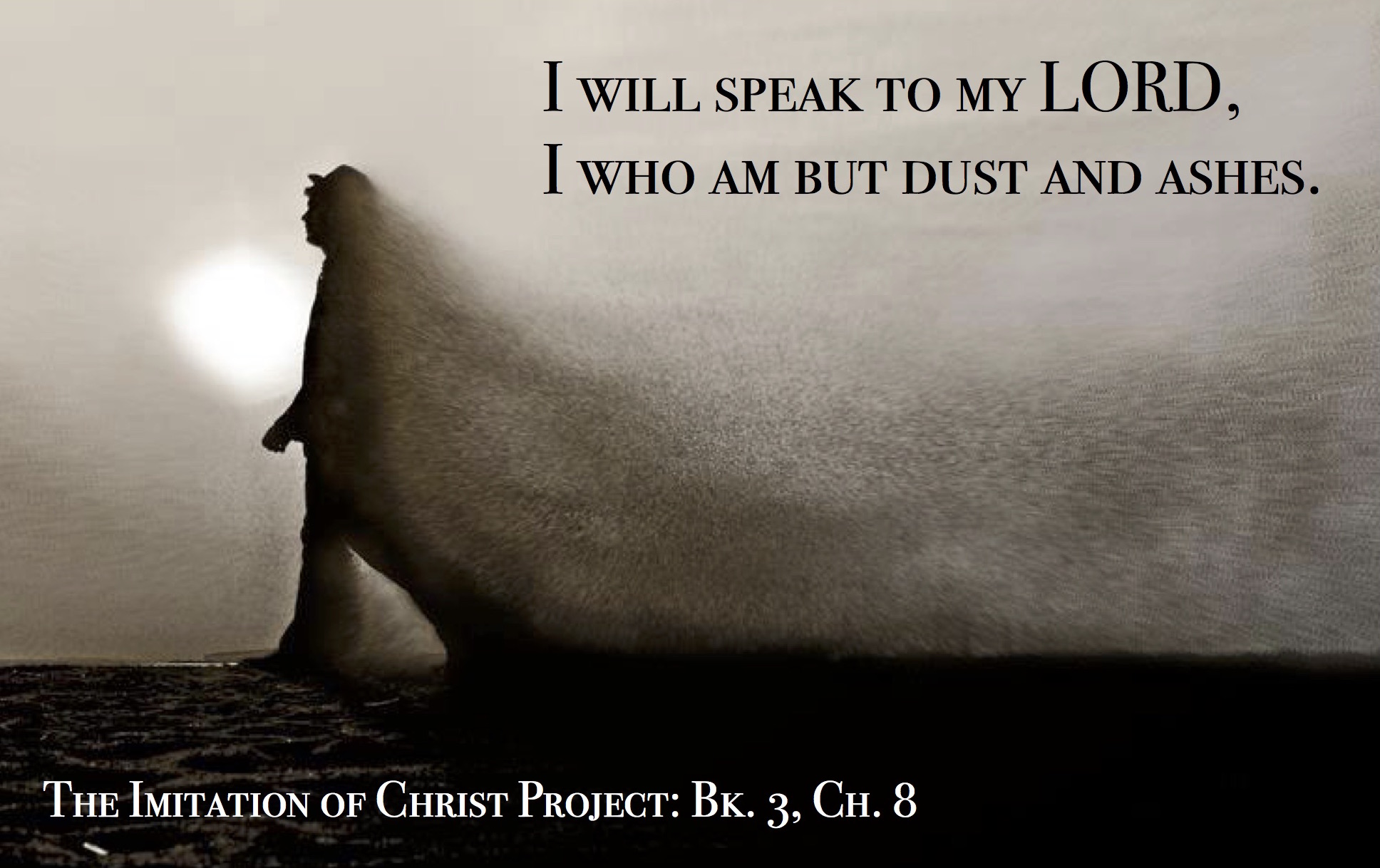
The Imitation of Christ Project: Bk. 3, Ch. 8

IOC 3.8

SELF-ABASEMENT IN THE SIGHT OF GOD –

THE DISCIPLE

I WILL speak to my Lord, I who am but dust and ashes. If I consider myself anything more than this, behold You stand against me, and my sins bear witness to the truth which I cannot contradict. If I abase myself, however, if I humble myself to nothingness, if I shrink from all self-esteem and account myself as the dust which I am, Your grace will favor me, Your light will enshroud my heart, and all self-esteem, no matter how little, will sink in the depths of my nothingness to perish forever.

It is there You show me to myself — what I am, what I have been, and what I am coming to; for I am nothing and I did not know it. Left to myself, I am nothing but total weakness. But if You look upon me for an instant, I am at once made strong and filled with new joy. Great wonder it is that I, who of my own weight always sink to the depths, am so suddenly lifted up, and so graciously embraced by You.

It is Your love that does this, graciously upholding me, supporting me in so many necessities, guarding me from so many grave dangers, and snatching me, as I may truly say, from evils without number. Indeed, by loving myself badly I lost myself; by seeking only You and by truly loving You I have found both myself and You, and by that love I have reduced myself more profoundly to nothing. For You, O sweetest Lord, deal with me above all my merits and above all that I dare to hope or ask.

May You be blessed, my God, for although I am unworthy of any benefits, yet Your nobility and infinite goodness never cease to do good even for those who are ungrateful and far from You. Convert us to You, that we may be thankful, humble, and devout, for You are our salvation, our courage, and our strength.

Sermon: Proper 16 / Pentecost 13 RCL B – “Armor of God”

Two hunting stories. Both of them true. Both of them involve your’s truly.

When I was growing up in Louisiana, I would always look forward to going squirrel hunting. I was a bit like Dug the Dog in the movie Up! – “Squirrel!” I remember when the season began my grandaddy would come wake us up well before light, load us up in the truck, and have us in the woods as the sun was rising.

The late part of squirrel season would overlap with the early weeks of deer season, and I’m not sure why, but it seems we would always continue with squirrel hunting with one addition to the morning preparation: putting on the orange hunting vest.

I hated that vest because I was convinced that it was bright enough to scare the squirrels off, but my grandfather insisted and so I wore it, with the exception of one day.

I had been hunting for an hour and had not seen a single squirrel. Convinced that it was the vest, I took it off and stuck it in my back pocket. I walked along peacefully for another half hour, when suddenly a war zone of rifle fire broke out around me. A couple of fellas started hollering at each other and then there were more shots. Deer hunters. There was another bit of silence and then another shot. That last bullet hit a tree about a foot away from me. It was then that I realized I was the “deer” they were shooting at. Fortunately for me, they were miserable shots or were just shooting in my general direction because they had seen movement.

At some point, they realized I wasn’t a deer. There was a bit more shouting and then they slinked off without showing themselves.

I was still frozen to the spot when, a short time later, my grandaddy showed up. He had my orange hunting vest in his hand. It must have fallen out of my pocket somewhere along the way. He knew exactly what had happened. He walked up to me and handed me that vest. His only comment, “You dropped this.” The subject of me not liking the orange vest during deer season was never brought up again.

Years later, when I was living in Montana, I had some friends that had a ranch up in the mountains.  It was a wonderful place to visit and go elk hunting.  Now I’ve never shot an elk, but on one particular afternoon during elk season, in another fruitless attempt, I headed out and decided to follow a fence line for a while.  It was on a slight incline up the side of the mountain, and there was only about six inches of snow on the ground, so it wasn’t a difficult walk.  It was in the late afternoon, so after about a mile or so it was time to turn back.

On the way up I had been looking around attempting to spot that elusive elk, but on the way back down it was getting dark, so I was more aware of my footing, even though I was following my same path back down.  I hadn’t gone but about twenty-five yards when I noticed another set of footprints placed perfectly inside mine.  No, they were not human tracks but were instead the tracks of a rather large mountain lion.

I immediately looked up to see if I could spot him, because he would have been very close, but he was no where in site.  For a good while I didn’t move, just kept looking, but after feeling a little more comfortable that this bold predator wasn’t going to attack, I continued down the mountain.  I thought maybe he had recently come across me, but all the way back down the mountain there were my tracks and there were the mountain lion’s.

He had started following me about the time I had entered the tree line, which was most of the trip.  In my mind, I was convinced that the entire time I was looking for an elk, the mountain lion had been trying to decide whether or not he could have me for supper.

Do you ever reflect back on your life in amazement that you are actually still alive? Anyhow…

In our Gospel reading today, Jesus is concluding the Bread of Life discourse, but in doing so, he angers many who were following him by telling them that he is this bread of life. They may have misunderstood and thought he was suggesting some form of cannibalism when he said, “Those who eat my flesh and drink my blood abide in me, and I in them.” Whatever their reasoning, they chose to leave at which point Jesus turned to the twelve, his closest followers, and asked, ”Do you also wish to go away?” Simon Peter answered him, “Lord, to whom can we go? You have the words of eternal life. We have come to believe and know that you are the Holy One of God.”

Those twelve and many others knew that Jesus was the Messiah, difficult teachings and all, and remained with Him. However, following his death, resurrection, and ascension it was left to these followers, under the guidance of the Holy Spirit, to discover how to go about following Jesus in their day-to-day lives. Getting shot at because of my stupidity and being tracked by a mountain lion illustrated to me in a very real setting what these followers learned.

When I consider the circumstances of that first event, squirrel hunting, I always think of the verse that we read today from Ephesians, “Put on the whole armor of God, so that you may be able to stand against the wiles of the devil.” Every time I think about that mountain lion in Montana, I am reminded of a particular passage from Peter’s first epistle, “Be sober, be vigilant; because your adversary the devil walks about like a roaring lion, seeking whom he may devour.” Now, I’m not one who sees the devil around every corner or behind every bush, but I also know, to quote 20th century Hollywood wisdom, “The greatest trick the devil ever pulled was convincing the world he doesn’t exist.” So when I think on those two events from my life and those two verses that they remind me of, then I weave them together in my head, which gives me a very practical stratagem and reason for learning how to follow Jesus: Put on the armor of God, because the devil is looking for opportunities to attack you.

By telling us to “Put on the whole armor of God,” Paul is wanting us to understand that there is a battle taking place around us and the victor’s prize is our soul. He uses these images of a warrior preparing for battle so that we will see and understand how serious this fight truly is. However, to put it on, we must understand each piece.

The first piece of Paul’s armor is the belt of truth. At the trial Pilate asked Jesus, “What is truth?” We know Jesus as the ultimate Truth, but we also know that we must seek to know the truth of God, not through some casual acquaintance with Him, but instead through a deep longing to understand his will.

The breastplate of righteousness is the righteousness we have through Jesus and not anything of our own making; and putting on the boots of the Gospel of peace is Paul’s way of telling us to fulfill the Great Commission, “Go therefore and make disciples of all nations.”

The shield of faith protects us against the temptations of sin that would drag us down; and the helmet of salvation gives knowledge of forgiveness and redemption.

Finally, Paul instructs us to take up the sword of the spirit, which is the word of God. Not only the “Instruction Manual,” but the words that God gives us to defend ourselves. Think of Jesus’ temptation in the desert. Three times the devil tempted him, three times Jesus responded. What were Jesus’ responses? Deuteronomy 8:3, 6:16, and 6:13.

Many have pointed out that there appears to be no armor for the back, which points to the necessity for Christian community. The 13th Warrior. Great film. The enemy is about to attack and Ibn is inexperienced in battle. Turning to one of the Norsemen on how they would defend their position, Herger the Joyous responds, “When they come, we form a circle in the center of the room, backs to one another.” We need one another for support, accountability, and fellowship. Our very lives provide armor to those around us.

I believe you know and understand these things, so I will tell you what I believe is the biggest mistake Christians make when it comes to the Armor of God: they wait until it’s too late, until they’re in the heat of battle to put it on, just like it was too late for me to put on my orange vest when those idiots started shooting at me. The battle for our souls is not an “if,” but a “when,” so be prepared by daily putting on the armor of God, because the devil is looking for opportunities to attack you.

Let us pray: Father in heaven, you have made us for yourself; our hearts are restless until they rest in you. Fulfill this longing through Jesus, the bread of life, so that we may witness to him who alone satisfies the hungers of the human family. By the power of your Spirit lead us to the heavenly table where we may feast on the vision of your glory for ever and ever. Amen.

Sermon: Bernard of Clairvaux

Born in the year 1090, Bernard of Clairvaux would grow to become a force to be reckoned with. Not only did he establish a monastery at Clairvaux, but through his teaching, sixty other monasteries would be founded and associated with Clairvaux. That in itself would be a great enough accomplishment, but he was also a poet and hymn writer, preacher of the Crusades, priest to the Knights Templar, and counselor to popes and kings. “By 1140, his writings had made him one of the most influential figures in Christendom.”

In his writings, particularly those to Pope Eugenius III, Bernard stressed moderation in all things. He wrote to the overburdened Pope, “As the Lord says, ‘What does it profit you to gain the whole world, but lose yourself alone?’ Now since everyone posses you, make sure that you too are among the possessors.” Yes, Bernard is saying, give yourself completely to the work the Lord has called you to, but do not forget the Lord or yourself in the process. However, if there was one area where Bernard would not preach such moderation, it would be in the act of “love,” for when it comes to love, Bernard knows no limits. For Bernard, this understanding of love comes partly from his meditations on our Gospel reading.

Jesus said, “If you abide in me, and my words abide in you, ask for whatever you wish, and it will be done for you.” Bernard understood, “in me,” in God, to mean, in love with God. To be in God is to be in love with God. He believes that we are called to be in love with God and were in fact created to do so, writing, “God hath endowed us with the possibility of love.” When someone asked him “Why should we love God?”, his answer was similar to the one we heard a few Sunday’s ago: “You want me to tell you why God is to be loved and how much. I answer, the reason for loving God is God himself; and the measure of love due to him is immeasurable love.” He concludes by asking, “Is this plain?” A more modern translation of “Is this plain?” could be something like, “Duh!”

Not only is our love to be extended to God, but also to one another. Perhaps one of his more famous quotes states, “Love me, love my dog.” If you are going to be in a relationship with someone, then you have to love everything about them, including the goofy dog with fleas and bad breath and all other unfortunate and annoying aspects of their character.

In living such a life of moderation and love, Bernard fulfilled his own definition of a holy person: “seen to be good and charitable, holding nothing for himself, but using every gift for the common good.”

Centuries later, St. Josemaría Escrivá wrote, “Lord: may I have due measure in everything… except in Love.” Escrivá wasn’t speaking directly of Bernard, but those words articulate clearly the pattern of life that Bernard of Clairvaux would call us each to: a life of moderation and perpetual, unrestrained love.

Sermon: Proper 14 / Pentecost 11 RCL B – “I Am”

A new priest came to town. The first Sunday he preached one of the best sermons folks had ever heard. Everyone was excited, believing that things were looking up for their church. They all complimented him on his wonderful and inspiring words. The following Sunday the new priest preached the exact same sermon, to the letter. Folks looked a bit bewildered, but it was so good, they all thought it was worth hearing a second time, just not two Sundays in a row. However, since he was new, no one said anything other than that they enjoyed the sermon. The third Sunday, once again the priest preached the exact same sermon. The Sr. Warden didn’t think they could take a fourth Sunday, so after everyone had exited the church he had a word with the priest. “Father,” he said, “that’s a good sermon you preached.” “Thank you,” he replied. “However,” continued the Senior Warden, “you have preached the same sermon three times now. We’ve all heard it and were wondering when you were going to go on to a different subject.” “Sir,” he responded, “when you all start acting like you’ve heard it, I’ll preach something else.”

O Lord! We installed him as rector yesterday and he’s going to turn into a tyrant today! Nope. That story has nothing to do with you all not hearing the message. Instead, it has to do with our Gospel reading, because after the next several weeks, you’re going to hear the Gospel reading and ask yourself, “Didn’t we just read this last week?” The answer is: almost.

Last week our Gospel reading ended with, ”I am the bread of life. Whoever comes to me will never be hungry, and whoever believes in me will never be thirsty.” This week it began with that exact same verse. Next week the Gospel will begin with, “I am the living bread that came down from heaven,” and the week after that Jesus will say, “The one who eats this bread will live forever.” This particular grouping of verses – John 6:22-59 – is known as the Bread of Life Discourse. So, with these four weeks focused on that one idea of Jesus saying, “I am the bread of life,” we should all get the idea that an important message is being conveyed. To fully understand what Jesus is saying, we must once again go back to the story of Moses.

We know that the Israelites were slaves in Egypt for four hundred years and that God selected Moses to lead them to their freedom. While kneeling before the burning bush, Moses hears the Lord’s plans. At one point in the dialogue, Moses asked the Lord:

If I come to the Israelites and say to them, ‘The God of your ancestors has sent me to you,’ and they ask me, ‘What is his name?’ what shall I say to them?”  God said to Moses, “I am who I am.” He said further, “Thus you shall say to the Israelites, ‘I am has sent me to you.’”  God also said to Moses, “Thus you shall say to the Israelites, ‘The Lord, the God of your ancestors, the God of Abraham, the God of Isaac, and the God of Jacob, has sent me to you’: This is my name forever, and this my title for all generations.

“I Am” is the name the Lord gives Himself.

Now, I would not normally give a lesson during a sermon on the Hebrew language, because a) it would be really boring and b) I barely passed Hebrew in seminary, but…

God says His name is “I Am.” The Old Testament was written in Hebrew and so you will read the Hebrew word for “I Am” translated in different ways: Yahweh, Adonai, and Elohim. For fear of taking the Lord’s name in vain, many later Jewish writings translate it as Ha-Shem, which translates as “the Name.” However, we will most often read it as “the Lord.” In case the question ever comes up in Trivial Pursuit, it appears 6,823 times in the Old Testament.

The New Testament was written in Greek, not Hebrew (and for the record, I did a little better in Greek than I did in Hebrew). Even so, the Name of God will appear many times as Jesus applies it to Himself. In particular, there are the seven great “I Am” statements that we are most familiar with: I am the Light of the World; I am the Door of the Sheepfold; I am the Good Shepherd; I am the Resurrection and the Life; I am the Way, the Truth and the Life; I am the True Vine; and the passage we read today, I am the Bread of Life.

Juliet said to Romeo, “What’s in a name? that which we call a rose by any other name would smell as sweet.” In any other case a name may not truly matter, but here – in the context of Jesus applying the Name of God to himself – the Name is everything. For as we said, when translated I Am can be Yahweh or Adonai or Ha-Shem, but it may also be interpreted as Jesus. With that understanding, those “I Am” statements of Jesus can be written as: Jesus is the Light of the World; Jesus is the Door of the Sheepfold; Jesus is the Good Shepherd; Jesus is the Resurrection and the Life; Jesus is the Way, the Truth and the Life; Jesus is the True Vine; and Jesus is the Bread of Life. Jesus is the Great I Am.

Is that accurate? Is that a misrepresentation of Scripture, forcing it to say what we want it to say? Absolutely not. Paul, speaking of Jesus in his letter to the Philippians (2:9-11) wrote:

Therefore God also highly exalted him
and gave him the name
that is above every name,
so that at the name of Jesus
every knee should bend,
in heaven and on earth and under the earth,
and every tongue should confess
that Jesus Christ is Lord,
to the glory of God the Father.

All of this goes to support Jesus’ claim that he is God, as he says in John 14, “He who has seen Me has seen the Father.” And in chapter 8, “Very truly, I tell you, before Abraham was, I am.”

If you believe this, Jesus is God, then what are the implications of such a claim when applied to our Gospel reading when Jesus said, “I am the bread of life… Whoever eats of this bread will live forever; and the bread that I will give for the life of the world is my flesh.”

Last week we said that in tasting Jesus we will be satisfied. So, if Jesus is truly God and if Jesus is truly the bread of life, then what is it to eat the Bread of Life? How do we go about being satisfied and nourished by God? Answer: We seek to feed our souls just as we feed our stomachs and that is not something you only do on Sunday, but multiple times each day. Aleksandr Solzhenitsyn said, “The belly is an ungrateful wretch, it never remembers past favors, it always wants more tomorrow.” Perhaps the soul isn’t quite that bad, but if we are not in the habit of feeding it on a daily basis, allowing it to taste God, then it will grow cold, isolated, and prone to sinful behavior. We have mealtime and we must also have soul time.

How do we nourish ourselves on God? We receive him physically through Holy Communion, truly the Body and Blood of Jesus, but we also feed on Him through the study of His Holy Word, prayer, and the other spiritual practices. Consider the questions we will ask as Derrick makes his Baptismal Covenant this morning and we renew our own. Each of them points to how we feed on God through repentance, fellowship, proclamation, giving, and serving. Jesus said in the Beatitudes, “Blessed are those who hunger and thirst for righteousness, for they will be filled.” Your soul hungers for Him, so seek Him where He can be found. Feed on Him through these various practices and be filled.

Jesus is the Great I Am. He is the Bread of Life. Understand that He is the only one who will satisfy the hunger of your soul; therefore, set aside time each day to provide nourishment for your soul.

So that Derrick might join us in our life with God by becoming a part of Christ’s one holy catholic and apostolic Church, the candidate for Holy Baptism will now be presented.