Sermon: Proper 6 RCL C – “What do you see?”

A young woman asked for an appointment with her pastor to talk with him about a besetting sin about which she was worried. When she saw him, she said, “Pastor, I have become aware of a sin in my life which I cannot control. Every time I am at church I begin to look around at the other women, and I realize that I am the prettiest one in the whole congregation. None of the others can compare with my beauty. What can I do about this sin?”

The pastor replied, “Mary, that’s not a sin, why that’s just a mistake!”

The stereoscope. I’ve never owned one, but I’ve seen and played with one. You may have also, but just didn’t know its name. The first one was invented in 1838. It looks a bit like a pair of binoculars with a stick running out the front of it and a bracket to place a card that has two images of the same setting side-by-side, but at just slightly different angles. By looking through the eyepieces at the photos, it plays a bit of a trick on the mind, making the image appear three dimensional. That little contraption has made quite a few advancements. Continue reading “Sermon: Proper 6 RCL C – “What do you see?””

Sermon: Proper 5 RCL C – “A Bear Comes a Calling”

A fella from Alaska was out deer hunting when a large grizzly bear charged him from about 50 yards away. The guy emptied his 7mm Magnum semi-automatic rifle into the bear and it dropped a few feet from him. The big bear was still alive so he reloaded and shot it several more times. The bear was just over 1,600 pounds. It stood 12′ 6′ high at the shoulder, 14′ to the top of his head. At the time, it was the largest grizzly bear ever recorded in the world.

Of course, the Alaska Fish and Wildlife Commission did not allow him keep it as a trophy, but the bear was stuffed and mounted, and placed on display at the Anchorage airport to remind tourists of the risks involved when in the wild. Based on the contents of the bears stomach, the Fish and Wildlife Commission established the bear had killed at least two humans in the 72 hours before it was killed including a missing hiker. Continue reading “Sermon: Proper 5 RCL C – “A Bear Comes a Calling””

Sermon: Justin Martyr

Do something new in the church for the first time and everyone thinks that it is a novel idea. Do something twice in a church and you have established a firm tradition. Do something three times in a church and you have created an event so sacred, that should you alter it in anyway, you’ll have a church fight on your hands.

Just a few weeks ago we talked about the Book of Common Prayer and how it has been handed down to us. The first was in 1549. Yet, even Thomas Cranmer and the other contributors were not simply making it up as they went along, because many of the traditions of the liturgy had been handed down to them. Continue reading “Sermon: Justin Martyr”

Sermon: Pentecost RCL C – “Burning”

photo by Peter John Maridable

A young man had a vision: he had been walking along a country road, enjoying the beautiful weather. As he passed a certain pasture he was astounded to see a ladder in the center of the field extending all the way to heaven. Determined to see more of this glorious thing, he approached and encountered an angel standing at the foot of the ladder. He watched, and as other people came to the ladder, the angel would hand them a piece of chalk, and then they would begin climbing.

Finally, gathering up his courage, the young man approached the angel and asked what was going on. The angel explained: the ladder leads directly to heaven and all you must do is climb it, but on each rung of the ladder, you must use this piece of chalk to write down one of your sins. When you have written them all down, then you may continue to heaven unimpeded. Following the explanation, the angel asked, “Would you like a piece of chalk?” “Certainly!” the young man declared. And so he began, with each rung of the ladder he wrote down one of the sins that he had committed in his life. Continue reading “Sermon: Pentecost RCL C – “Burning””

Sermon: “That They May be One”

In the six hundredth year of Noah’s life, on the seventeenth day of the second month—on that day all the springs of the great deep burst forth, and the floodgates of the heavens were opened. And rain fell on the earth forty days and forty nights. And every living thing that moved on the earth perished, except those who were saved through the ark.

The story of Noah’s ark is probably one of the first Bible Stories that children learn. It takes place in chapters 7-10 of the book of Genesis. Beginning with chapter 11 we learn of the tower of Babel. All the people of the earth had the same language, they came together to make a name for themselves, and built a great city. In this city they decided to build a tower that would reach the heavens. God comes down, takes a peek, and says, “This will not do.” He scatters them by introducing the various languages into the world. Continue reading “Sermon: “That They May be One””

Sermon: Easter 7 RCL C – “Temples”

When I was in college, my goal was to make Donald Trump look like a pauper.

I had a dorm room to myself, and everyday I would sit in there and devour the Wall Street Journal trying to learn all I could about making loads-o-cash. I didn’t have posters of scantily clad women on my walls (although if Scarlett Johanssen… never mind), instead I had full page ads of initial public offerings that were advertised in the Journal. If an IPO ad was anything less than a full page, I didn’t put it up – they weren’t worth my time if they couldn’t afford or were too cheap for the full page.

Favorite movies at the time: The Secret of My Success with Michael J. Fox, and Wall Street with Michael Douglas – “Blue Horseshoe loves Anacott Steel.” I probably had less than three dollars in my checking account, but give me some room and I’d make my own movie.

The summer I graduated from college, I took a trip to New York City and had a perfect stranger take my picture in front of my temple, Trump Tower. I thought a name change to Toles Tower was not too far out of my reach.

Obviously, none of that came to pass; however, other than not being Daniel Craig good looking, I’m not at all disappointed with my life. I know exactly how blessed I am. In many ways I feel like I do make Donald Trump look like a pauper, just not the way that I had originally planned.

I had spent a great deal of time building these temples all around me and I was a busy little priest running around satisfying the needs of those I worshipped, but over the course of the years, those temples began to crumble, eventually turning into these great piles of rubble.

This past week on Wednesday night, we watched the last episode of In the Dust of the Rabbi, and we were taken to Didyma where the great temple of Apollo is located. The temple was massive. One hundred twenty-two columns, each over 60 feet tall and 8 feet thick, supporting a roof that reached a height of over 90 feet, and covering an area of approximately 60,000 square feet. Massive. Considering they didn’t have the benefit of our modern machinery – and even if they had! – it was impressive.

Our tour guide, Ray Vander Laan, talked about how much time it took to build such place and the amount of money that it would have cost. And then he showed us what it must have been like to walk into such a place, how the size of the temple alone would radiate this sense of power and awe. What remains today? There’s a picture of it on the front of your bulletin. Some parts still stand, but basically it is all rubble.

We, as the human race, are good at building temples. They are all around us. Not only do they come in the form of our goals or buildings, but we turn people into temples as well. For example, you can Google the “Twitter Counter.” This fun little web site tells you who has the most followers on the social networking site Twitter. Coming in at number 100 on the top 100 is Kevin Durant (It is sad, but I had to Google him. He’s a basketball player for the OKC Thunder). He has 13.6 million followers. Just above him was Paris Hilton.

Coming in at number 3 was Taylor Swift and number 2 (Dear Lord, please save us!) was Justin Bieber. And numero uno with 88 million followers – any guesses? Katy Perry. There are 88 million people who not only want to know, but need to know when she sneezes. Yes, we will build a temple out of and to anything. We will go there to worship, we will make the appropriate sacrifices, and we will give to support it. Yet, like the temple of Apollo, these too will crumble and turn into nothing more than rubble.

No. I’m not trying to suck the fun out of life. Life is a riot and filled with things to see, experience, and enjoy; and I hope you do just that. My goodness, if you happen to be a Justin Bieber fan, then go buy his records and get yourself a front row seat at his concert, but don’t make him the recipient or place of your worship.

While Cyrus was emperor of the Persian empire, on the southern border of the empire, there lived a great chieftain named Cagular who tore to shreds and completely defeated the various detachments of Cyrus’ army sent to subdue him.

Finally the emperor, amassing his whole army, marched down, surrounded Cagular, captured him, and brought him to the capital for execution. On the day of the trial, Cagular and his wife were brought to the judgment chamber. He was a fine looking man of more than 6 feet, with a noble manner about him, described as a magnificent specimen of a man. So impressed was Cyrus with his appearance, that he said to Cagular: “What would you do should I spare your life?”

“Your Majesty, if you spared my life, I would return to my home and remain your obedient servant as long as I lived.”

“What would you do if I spared the life of your wife?”

“Your Majesty, if you spared the life of my wife, I would die for you.”

So moved was the emperor that he freed them both and returned Cagular to his province to act as governor. Upon arriving at home, Cagular reminisced about the trip with his wife.

“Did you notice,” he said to his wife, “the marble at the entrance of the palace? Did you notice the tapestry on the wall as we went down the corridor into the throne room? And did you see the throne on which the emperor sat? It must have been carved from one lump of pure gold.”

His wife could appreciate his excitement and how impressed he was with it all, but she only replied: “I really didn’t notice any of that.”

“Well,” said Cagular in amazement, “what did you see?”

His wife looked seriously into his eyes and said, “I beheld only the face of the man who said he would die for me.”

John writes, in the opening verses of his Gospel, “In the beginning was the Word, and the Word was with God, and the Word was God.  He was in the beginning with God.  All things came into being through him, and without him not one thing came into being.”

Towards the end of his Revelation, John writes, “Then I saw a new heaven and a new earth; for the first heaven and the first earth had passed away, and the sea was no more.  And I saw the holy city, the new Jerusalem, coming down out of heaven from God, prepared as a bride adorned for her husband.  And I heard a loud voice from the throne saying,
‘See, the home of God is among mortals.
He will dwell with them;
they will be his peoples,
and God himself will be with them;
he will wipe every tear from their eyes.
Death will be no more;
mourning and crying and pain will be no more,
for the first things have passed away.’”

Jesus was in the beginning before time began. When all things have passed away, when all things have turned to rubble, He will remain. As he said in our reading, “I am the Alpha and the Omega, the first and the last, the beginning and the end.”

Like Cagular’s wife, there is no harm in taking notice of the “temples” around us, but we don’t go to them to worship. And we must never get so caught up in it all that we no longer behold the face of the One who not only said that He would die for us, but did truly die for us and rose again.

Jesus is the Alpha and the Omega. He is the beginning and end of all things, and he is the beginning and end of each of us. Temples will always be built, but over time, even the greatest ones will fall into rubble. Therefore, behold the face of the One who is eternal. Behold the face of the One who died and rose for you. Behold the face of Jesus, our resurrected Savior.

Let us pray: Lord, we believe in you: increase our faith. We trust in you: strengthen our trust. We love you: let us love you more and more. We are sorry for our sins: deepen our sorrow. We worship you as our first beginning, and long for you as our last end; we praise you as our constant helper, and call on you as our loving protector. Guide us by your wisdom, correct us with your justice, comfort us with your mercy, and protect us with your power. Through Christ our Lord, the Alpha and Omega, we pray. Amen.

Sermon: Easter 6 RCL C – “Respond!”

Boudreaux was drunk and lay sprawled across three entire seats in the movie theater. When the usher came by and noticed him, the fumes of liquor just reeling off him, the usher leaned in and whispered, “Sorry sir, but you’re only allowed one seat.”

Boudreaux groaned but didn’t budge.

The usher became more impatient. “Sir, if you don’t get up from there, I’m going to have to call the police.”

Once again, Boudreaux just groaned.

The usher marched briskly back up the aisle and called the police.

The officer arrived, surveyed the situation, and asked, “All right, buddy, what’s your name?”

“Boudreaux,” he moaned.

“I’m Cajun too. Where ya come from, Boudreaux?”

With terrible pain in his voice, and without moving a muscle, Boudreaux replied, “Da balcony.”

We know that when the Greeks and then the Romans came into Judea, they brought with them their gods. There was a god for everything. One for good crops, one for fortune, one for war. In addition, there was also a benevolent god of healing: Asclepius. You may be familiar with two of his daughters, Hygieia (hygiene) and Panacea (universal cure). His symbol, known simply as the Rod of Asclepius, is a staff with a snake wrapped around it. You may recognize that from your doctors office.

At the time of Jesus, Asclepius was quite popular and the temples that were dedicated to him, Asclepions, served as hospitals for the sick and places for those who could not be healed to come and receive assistance.

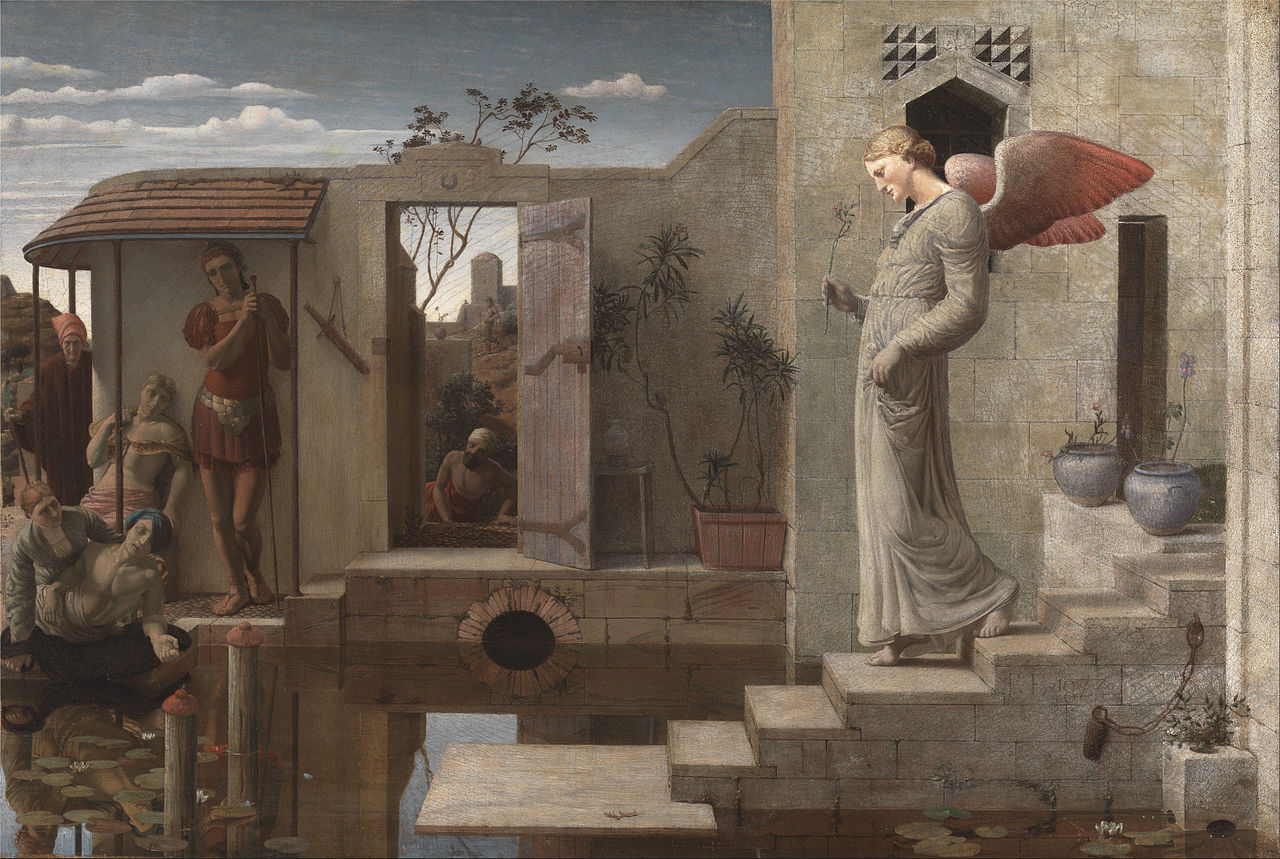
Our Gospel reading stated, “Now in Jerusalem by the Sheep Gate there is a pool, called in Hebrew Beth-zatha, which has five porticoes. In these lay many invalids– blind, lame, and paralyzed.” This pool of Beth-zatha / Bethesda was only a short distance from an Asclepion, a temple to the healing god, which has led many scholars to state that the pool of Bethesda was associated with this temple.

As Jesus is walking alone through this area of Jerusalem, he saw a man who had been lying by the pool for thirty-eight years. Jesus asked him, “Do you want to be made well?” The man responded by saying there was no one to help into the water when it was “stirred up.” Whether it was an underground pool bubbling up or water coming in from some other source, the water was “stirred.” The superstitious believed that the first one in the pool when it was stirred would receive the healing that was being presented.

As an aside: some of you may remember this story from years ago, but with one other detail. If you have a more contemporary version of the Bible you will see in John, chapter 5, the verse numbers go from 3 directly to 5. Verse 4 has been omitted. It reads, “for an angel of the Lord went down at certain seasons into the pool and stirred up the water.” Those who study these things say that this verse was added much later to provide some explanation as to what was happening, but that it was never in the original text. It is an interesting detail, but really has no bearing on the event. End of rabbit trail.

What is clear is that the man held to some superstitious belief associated with god Asclepius that if he got into the pool first, when it was stirred up, he would be healed. To him Jesus asked, “Do you want to be made well?” That is a loaded question.

Do you want to be made well? The smart aleck in me would want to pop up and say, “Well, duh! I’ve been trying for thirty-eight years! Of course I do.” But then again, maybe not.

In his book, Fuzzy Memories, Jack Handey writes, “There used to be this bully who would demand my lunch money every day. Since I was smaller, I would give it to him.

“Then I decided to fight back. I started taking karate lessons, but the instructor wanted $5 a lesson. That was a lot of money. I found that it was cheaper to pay the bully, so I gave up karate.”

The man had been sick for thirty-eight years. He was accustomed to, day after day, coming to the Asclepion where he would be fed and his needs taken care of. If he were made well, then he would have to begin taking responsibility for himself. Perhaps his life was difficult, but after thirty-eight years he may have been comfortable enough. Or, perhaps, after such a long time, he just didn’t care anymore. He was so beat up that he had given into despair. However, whatever the case, in order to be made well, the man had to respond to Jesus.

It is curious that the man does not answer directly. Instead, he says, “Sir, I have no one to put me into the pool when the water is stirred up; and while I am making my way, someone else steps down ahead of me.” Obviously Jesus took this as a “Yes,” and brings the desired result. “’Stand up, take your mat and walk.’ At once the man was made well, and he took up his mat and began to walk.”

We know that the words and actions of Jesus often contain more than one meaning. This holds true here. Jesus is using the man’s physical illness to speak to the wider problem of spiritual illness.

So the story, “in the middle of a pagan temple,” becomes “in the middle of a pagan world,” Jesus encounters a man who has been sick, who has been trapped in sin, for thirty-eight years—all his life, and asked him, “Do you want to made well?”

Like the physically ill man, this spiritually ill one had lived in sin a long time. He was accustomed to, day after day, living this life. If he were made well, then he would have to begin taking responsibility for himself. He would have to begin to follow the commands of God. Perhaps his life didn’t turn out the way he had planned, but he was comfortable enough. Or, perhaps like old Boudreaux, he had fallen off the proverbial balcony, he had lived in sin for so long, he just didn’t care anymore. He was so convinced that there was no hope for a ruined soul such as his, that he was defeated, that he simply gave up trying. Whatever the case, Jesus asked him, “Do you want to made well?” For Jesus to bring healing, the man must respond. Jesus said, “Listen! I am standing at the door, knocking; if you hear my voice and open the door, I will come in to you and eat with you, and you with me.” A response is required.

I can’t imagine anyone wanting to remain physically ill and I also have a hard time believing that there are many who want to remain spiritually ill. For most, there is a desire, a need, to be made well, to be holy as He is holy, but how and where to start. It is to these that Jesus asks, “Do you want to made well?” Funny, it is easy to think of Jesus asking this question to others, but always a bit disconcerting when we think He is asking us: “Do you want to be made well?”

In 1953, when Queen Elizabeth II was to be crowned, the invitations went out. For you and I, when we send out formal invitations we will mostly likely include a request: RSVP — “Respondez, s’il vous plait.” Please let us know if you are coming. However, when the Queen’s invitations to her coronation went out, they included the note: “All excuses ceasing.” There is no RSVP necessary. There are no excuses acceptable. The Queen has asked you and you will be there.

If you are one who cannot figure out how to be well, how to be holy, then if you will listen, you will hear the voice of Jesus asking, “Do you want to made well?” When you hear it, think of it as having that little addendum to it, “All excuses ceasing,” and set aside your concerns and those feelings of inadequacy, that you’ve fallen too far to be healed. Stop making excuses for the sins in your life, take responsibility for yourself, and then answer Him.

Jesus ask, “Do you want to made well? All excuses ceasing.”

You answer, “Yes.”

Jesus says, “Stand up, take your mat and walk.”

Some translations have “Stand up” translated as the word “rise.” “Rise” is used a number of times in the New Testament, but in several instances the word rise is used in some very exciting places. For example, when the women came to the empty tomb and the angel of the Lord spoke to them: “Do not be afraid, for I know that you seek Jesus who was crucified. He is not here; for He is risen.”

Jesus ask, “Do you want to made well? All excuses ceasing.”

“Yes.”

“Then stand up, rise, be resurrected, take your mat and walk.”

You being “made well” starts and ends with Jesus, but in order for that work to begin, you must answer Him. You must say, “Yes.”

Let us pray: Praised be the God and Father of our Lord Jesus Christ, He who in His great mercy gave us new birth, a birth unto hope which draws its life from the resurrection of Jesus Christ from the dead; a birth to an imperishable inheritance, incapable of fading or defilement, which is kept in heaven for you who are guarded with God’s power through faith; a birth to a salvation which stands ready to be revealed in the last days. Amen.


Sermon: “Do You Love Me?”

A sales rep had been struggling to meet the sales projections in his appointed region, so the manager called him in for a meeting. After a lengthy discussion the manager and the rep stood looking at a map on which colored pins indicated the company representative in each area. The manager finally said, “I’m not going to fire you, Wilson, but I’m loosening your pin a bit just to emphasize the insecurity of your situation.”

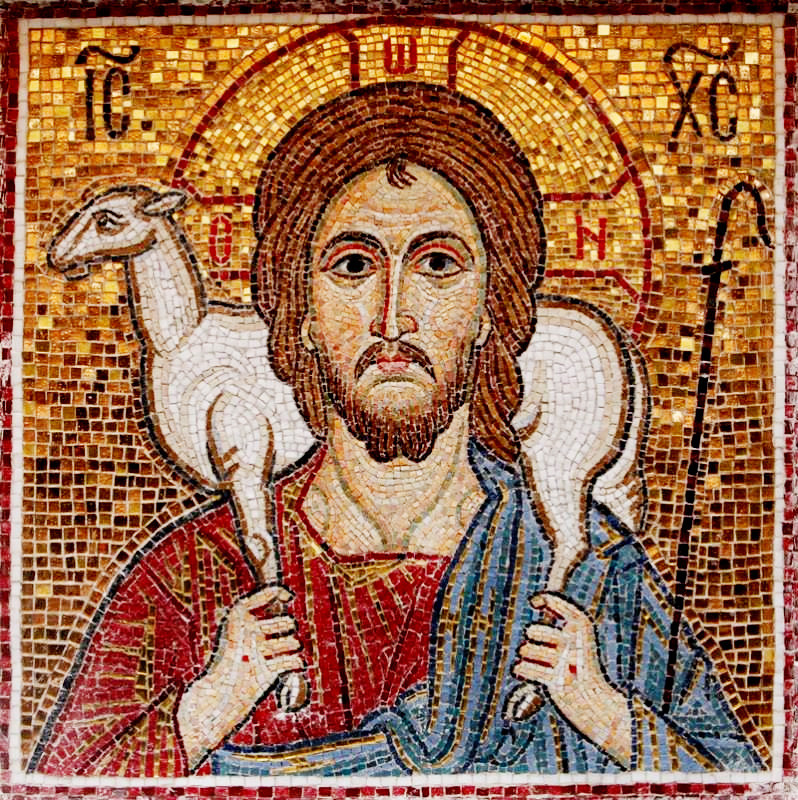
In Chapter 10 of John’s Gospel, Jesus says, “I am the good shepherd. The good shepherd lays down his life for the sheep.  The hired hand, who is not the shepherd and does not own the sheep, sees the wolf coming and leaves the sheep and runs away—and the wolf snatches them and scatters them.  The hired hand runs away because a hired hand does not care for the sheep.  I am the good shepherd.”

We also know that, on the night before he was crucified, Peter denied Jesus three times. In a way, he acted like the hired hand. The wolf came, there was trouble, and he spiritually fled from Jesus out of fear for his own life. We can’t criticize Peter for his actions, because that could have just as easily been anyone of us in a similar situation. But for Peter, by today’s standards, he would have had is pin pulled out of the map and ground to dust. Yet Jesus responded in a different way.

Today, we have Peter and Jesus walking alone. Peter denied him three times and we know that Jesus is now restoring him by asking him three times, “Do you love me?” Peter responds, “Yes, Lord; you know that I love you,” “Yes, Lord; you know that I love you,” and finally, “Lord, you know everything; you know that I love you.” Jesus doesn’t say, “OK. Good answer.” Instead, Jesus says, “Feed my lambs,” “Tend my sheep,” and finally, “Feed my sheep.”

Jesus is the Good Shepherd and by today’s standards, Peter should have been fired, but instead Jesus makes Peter a shepherd. Jesus is the Good Shepherd, but he is asking Peter to now share in this ministry of caring for God’s people, and he concludes by saying to Peter, “Follow me.” Do what I have been doing and don’t be afraid any longer.

What is Peter’s reward for obedience? Again, from the world’s perspective, it is a real winner: “‘Very truly… when you grow old, you will stretch out your hands, and someone else will fasten a belt around you and take you where you do not wish to go.’ (He said this to indicate the kind of death by which he would glorify God.)” Jesus is saying, “Be a shepherd of God’s people, follow me, and your reward will be that you shall die a most violent death.” Tradition holds that Peter was crucified upside down in Rome. And to that we all say, “Sign me up!” However, in saying to Peter, “Follow me,” Jesus is also saying, follow me in caring for the children of God, but also follow me through death, for death has been conquered once and for all. Follow me, for there is nothing to fear.” — “I tell you, my friends, do not fear those who kill the body, and after that can do nothing more.” (Luke 12:4)

The one that denied and should have been fired has been given a roll in the ministry and eternal life. That was then, this is now, but the task and reward are the same. Jesus says to each of us, “Feed my sheep. Follow me.” Without hesitation or fear, we are called to be like Peter. Care for the children of God and follow Jesus. We have been commissioned. Fear not.

Sermon: “Go!”

This sermon was preached at St. Stephen’s AME Church.

A man enters the Confessional box.  He notices on one side a fully equipped bar with Guinness on tap.  On the other wall is a dazzling array of the finest Cuban cigars. Then the priest comes in.  “Father, forgive me, for it’s been a very long time since I’ve been to Confession, but I must first admit that the Confessional box is much more inviting these days.”  The priest replies, “Get out! You’re on my side.”

It is quite interesting being a priest. You see the world from a different angle, because so often folks want you to see their “good side.” It’s not often that when you are all dressed up in a clerical collar that you can meet someone for the first time and come away actually knowing much about them. There are those rare occasions when someone begins talking and it seems they’ve lost the “Off” switch, but for the most part it comes down to respectful pleasantries.

You also get various reactions from people as you walk along. There’s always some who give you a hearty, “Hello, Father,” but there are others that avert their eyes. They don’t want to be seen by a priest or they have a certain disdain for clergy to the point that they won’t even recognize you as a person.

Some priests don’t think that it is necessary to walk around looking like a priest, but I do, whether the world accepts it or not. It is a way of constantly reminding folks that there is another way.

Of all the looks you get along the way, the oddest ones come from folks who have never really seen a priest up close. I was at the grocery store just a few weeks ago and the you man bagging my groceries asked, “Are you a pastor or something?” It was all because of the dog collar. Some will give you more than the once over and particularly stare at the dog collar. I mention this because I got this certain look while around several youth in their early teens. A girl – maybe fourteen – looked at me and my collar, then noticed the crucifix that I wear. Her eyes lit up a bit as she leaned in for a closer look. “Nice necklace,” she said, “it has a man on it.” “It has a man on it.” Now, it is one thing to not really know much about priest, but this girl – this fourteen year old girl – did not know that this man on my necklace was Jesus. She didn’t know the story or anything about Him. Her friend sitting next to her looked up and said, “Oh, that’s God” and I was thankful for her input, because at the time I was a bit too flummoxed to say anything.

The angel said to her, “Do not be afraid, Mary, for you have found favor with God. And now, you will conceive in your womb and bear a son, and you will name him Jesus. He will be great, and will be called the Son of the Most High, and the Lord God will give to him the throne of his ancestor David. He will reign over the house of Jacob forever, and of his kingdom there will be no end.” His name will be Jesus. He will be great. Son of the Most High. David’s ancestor. He will reign forever. He will be… a man on a necklace.

As long as Jesus is seen only as a good moral teacher, then there is no access to eternal life. As long as he is viewed simply as the epitome of enlightened humankind, then there is no sustaining Truth. As long as Jesus is only a man on a necklace, there is no salvation. As long as we, His disciples, do nothing, then we are not fulfilling his final commands: Go therefore and make disciples of all the nations, baptizing them in the name of the Father and of the Son and of the Holy Spirit, teaching them to observe all things that I have commanded you; and lo, I am with you always, even to the end of the age.”

The Apostle Paul wrote in his letter to the Romans, “‘Everyone who calls on the name of the Lord shall be saved.’ But how are they to call on one in whom they have not believed? And how are they to believe in one of whom they have never heard? And how are they to hear without someone to proclaim him?  And how are they to proclaim him unless they are sent?

So, what are we to do?

One of my favorite stories of the Desert Fathers – those men who lived in the deserts of North Africa during the 300s and dedicated their lives to God – tells of the time Abba Lot went to see Abba Joseph and said to him, ‘Abba as far as I can I say my little office, I fast a little, I pray and meditate, I live in peace and as far as I can, I purify my thoughts. What else can I do?’ Then the old man stood up and stretched his hands towards heaven. His fingers became like ten lamps of fire and he said to him, ‘If you will, you can become all flame.’

The founder of Opus Dei, St. Josemaría Escrivá, writes in his first saying in the book The Way, “Don’t let you life be sterile. Be useful. Blaze a trail. Shine forth with the light of your faith and of your love. With your apostolic life wipe out the slimy and filthy mark left by the impure sowers of hatred. And light up all the ways of the earth with the fire of Christ that you carry in your heart.”

The Episcopal Church has been around since 1789. Since then we have had 27 Presiding Bishops – the ecclesiastical head of our denomination. In 2015 we elected the 27th, The Right Reverend Michael Curry. He is the first African American to hold that position. If you were to ask him what is the most important aspect of the church, Bishop Curry would answer it in one word without hesitation: Jesus. He is passionate about this and believes the church is called to be the Jesus Movement in this world.

He spoke to us recently via an online video and began by recalling the words of the angel at the empty tomb of Jesus, “This Jesus of Nazareth whom you seek, he is not here, he has been raised as he said he would be and he has now gone ahead of you to Galilee.  There you will see him.  It is in Galilee that the Risen Lord will be found and seen for he has gone ahead of us.”

Bishop Curry goes on to say,

Galilee.  Which is a way of talking about the world.

Galilee.

In the streets of the city.

Galilee.

In our rural communities.

Galilee in our hospitals.

Galilee in our office places.

Galilee where God’s children live and dwell there.

In Galilee you will meet the living Christ for He has already gone ahead of you.

The church can no longer wait for its congregation to come to it, the church must go where the congregation is.

Now is our time to go.  To go into the world to share the good news of God and Jesus Christ.  To go into the world and help to be agents and instruments of God’s reconciliation.  To go into the world, let the world know that there is a God who loves us, a God who will not let us go, and that that love can set us all free.

Bishop Curry concludes, “This is the Jesus Movement, and we are The Episcopal Church, the Episcopal branch of Jesus’ movement in this world.”  Today I say to you, “We are the Jesus Movement. We are the Episcopal Church and the African Methodist Episcopal Church branches of the Jesus Movement in Enid, Oklahoma. Go. Light up all the ways of the earth with the fire of Christ that you carry in your heart. Go. Make disciples, baptizing them in the name of the Father and of the Son and of the Holy Spirit. Go. Teach them to obey everything that Jesus has commanded us. Go. And remember, He – the Great I Am – is with us always, to the very end of the age. Amen.