For us, when a person—or any living creature for that matter—dies, we understand the necessity for burial or cremation. The process of “ashes to ashes, dust to dust” just isn’t that pleasant. During the time of Jesus, within Jewish culture, cremation was not practiced, so everyone would buried in the ground or in a tomb that had been hewn out of the rock, but did you know that—according to legend—burial in the ground goes all the way back to Adam and Eve and the murder of Abel? The legend states:
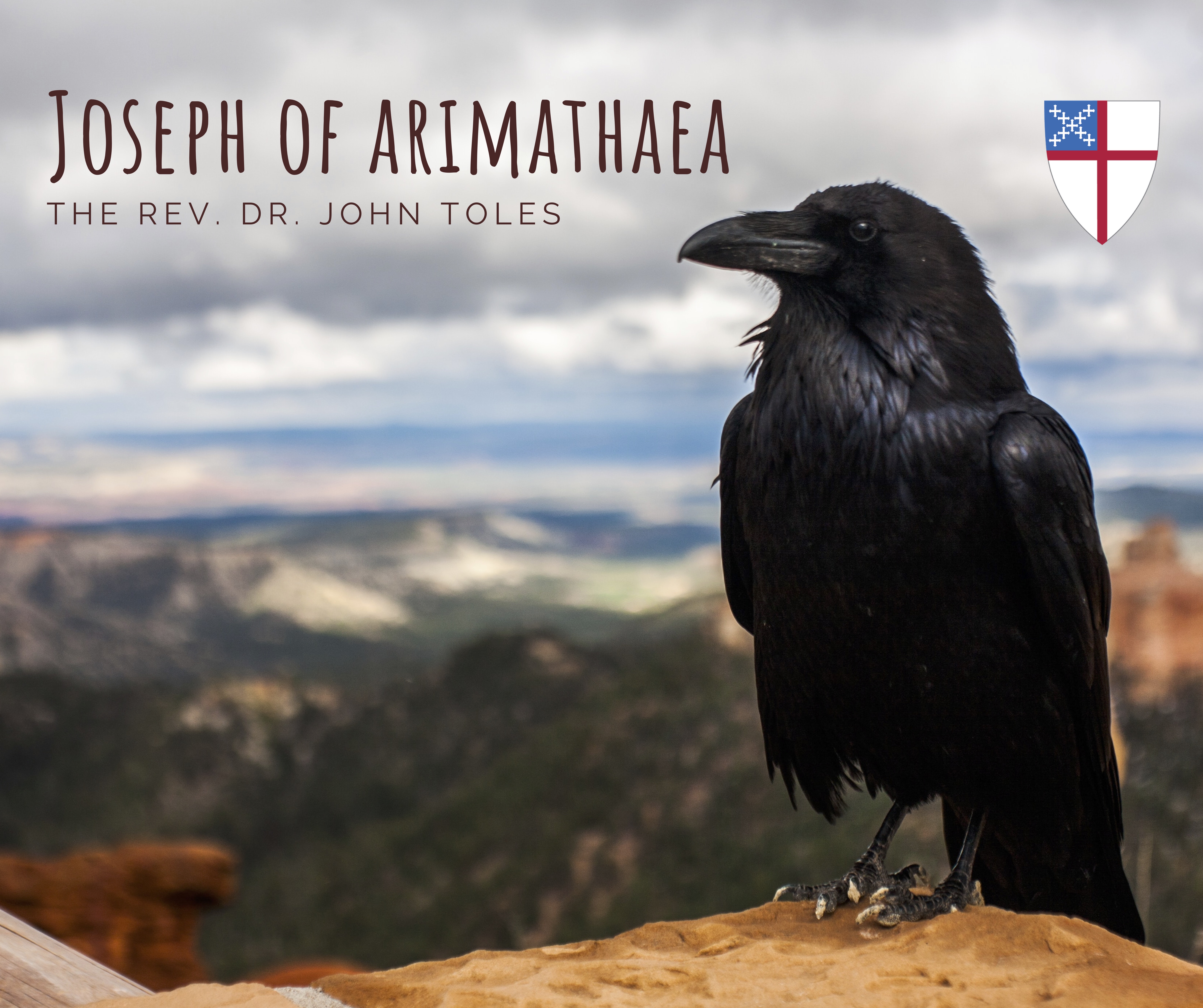
“Adam and [Eve] came and sat by the corpse [of their son Abel whom Cain had murdered], weeping and mourning for him – but they did not know what to do with Abel’s body. A raven whose companion had just died said: I will teach Adam what to do. The raven took his dead companion, dug the earth before the eyes of Adam and his mate, and buried him in it. Adam said: We will do as the raven.” And so the practice of burial began, based on the teachings of a Raven.
Within Holy Scripture, there appear to be many traditions and teachings with regard to the burial of the dead, but no specific laws dictating how it should be done, and most of these traditions were practiced in the burial of Jesus: the body anointed, wrapped, and then placed in a tomb. As we read today, the tomb that Jesus was buried in belonged to Joseph of Arimathaea, who had gone to Pilate and requested the body of Jesus so that it could be properly buried.
These are events which we are all familiar with. The crucifixion, death, and resurrection of Jesus. We talk about these things often. We also talk about how we will have eternal life through Jesus, and that there is a place prepared for us, but the one thing we will avoid talking about like we would avoid the plague—whether because of self preservation or simple denial—is the topic of our own death and burial. (And now you’re all depressed… sorry, but that’s not my intent.)
Ignatius of Loyola writes: To almost all the questions that might be asked about you the answer would be “perhaps.” Shall you have a large fortune, great talents, a long life? “Perhaps.” Will your last hour find you in the friendship of God? “Perhaps.” After this retreat, will you live long in a state of grace? “Perhaps.” Shall you be saved? “Perhaps.” But shall you die? “Yes. Certainly.”
We shall all die and someone will place us in the ground or a mausoleum or a niche in a columbarium. Because of this fact, the Saints will ask us to keep this event of our own death always before us. St. Benedict wrote in his Rule, “Remember to keep death before your eyes daily.” Not to dwell morbidly upon it, but as a reminder to remain vigilant watch over your soul, so that when that time does come, you are not caught unprepared.
A story from the desert monks: “News spread that an elder father lay dying in the desert of Skete. The brothers came, stood around his deathbed, clothed him and began to cry. But he opened his eyes and laughed. And he laughed again, and then again. The surprised brothers asked him, ‘Tell us, Abba, why do you laugh while we cry?’ He spoke, ‘I laughed at first because you fear death. Then I laughed because you are not ready. A third time I laughed because I am going from hard work to enter my rest – and you are crying about that!’ He then closed his eyes and died.”
Don’t be afraid to think of the “last things,” keep them before you, not with a heavy heart, but the heart of one who is persevering until the end and one who will receive the reward of joy and peace.
“HE WHO follows Me, walks not in darkness,” says the Lord. By these words of Christ we are advised to imitate His life and habits, if we wish to be truly enlightened and free from all blindness of heart. Let our chief effort, therefore, be to study the life of Jesus Christ.” Those words have been read by more people than any other words printed except those printed in the Holy Scriptures. They are the opening sentences of The Imitation of Christ by my 15th century friend, Thomas à Kempis. I would share with you my favorite passages of this great work, but then I would pretty much have to read the entire book to you.
Since it was first published in 1471, the year of Thomas’ death, there have been 6,000 different editions published. That’s one new edition, every month, for 500 years.
I’ve told you the story before: I’ve read all sorts of devotional / inspirational books. From Oswald Chambers to the more contemporary, but in every case, it took me less than about a month to become completely bored or frustrated with them. Oswald was probably the most compelling, but they seemed to all tell me what I wanted to hear, not what I needed to hear. They seemed more interested in giving the reader a warm fuzzy than in changing lives. Then one day, as I was walking through the library of Nashotah, I came to the shelves of free books. Ones that were dated or worn out and students could take what they wanted. It was there that I picked up this very book, and although I now have multiple editions, I’ve never set it down. Thomas is a true companion of my soul. And, clearly, I’m not the only one who feels this way.
St. Thérèse of Lisieux, who’s book, Story of a Soul, we just finished in book club writes, “If I open a book composed by a spiritual author (even the most beautiful, the most touching book), I feel my heart contract immediately and I read without understanding, so to speak. Or if I do understand, my mind comes to a standstill without the capacity of meditating. In this helplessness, Holy Scripture and the Imitation [of Christ] come to my aid; in them I discover a solid and very pure nourishment.”
If Thomas à Kempis and the Imitation have had such widespread and lasting effect on so many, then why is he still not SAINT Thomas à Kempis. There have been two attempts at his canonization, 1655 and 1911, but both failed. One theory for the failure states that Thomas was buried alive—when they exhumed his body as part of the examination process, they found scratch marks on the inside of the lid of his coffin, with splinters in his hands. Rules say that it cannot be known if he died in a state of grace, because—obviously—no one was present at his death, therefore he cannot be sainted. However, there is further evidence that suggests this is only a myth that developed over the years. The second theory is that the Imitation was not written solely by Thomas, but was a compilation of several authors and Thomas was the editor of the work. In either case or none of the above, the church has not elevated Thomas, but those who read him have.
He is one of the medals on my rosary, along with the Blessed Virgin Mary, St. Michael the Archangel, and St. Josemaría Escrivá. With these three, Thomas, and the Lord Jesus walking with me, I figure I’m in pretty good hands.
My former bishop would give me a hard time for reading the Imitation—“Too morbid, John.”—and I’ve had friends suggest that I pick up something more inspiring, so I know he is not for everyone, but if you’ve never picked up this little book, I recommend it to you, with this one warning: you may never put it down.
When Boudreaux and Clotilde were first married, Boudreaux laid down the law. “I’m the MAN of the house! Starting tomorrow, I want you to have a hot, delicious meal ready for me the minute I walk through that door. Then, while I’m watching ESPN and relaxing in my lazy boy, you’ll bring me my slippers and then run my bath. And when I’m done with my bath, guess who’s going to dress me and comb my hair?”
Said Clotilde, “The funeral director.”
From our Gospel reading, it would seem that Mary has taken a few plays from Boudreaux’s play book. Sit and chat while Martha does all the work, which leads Martha to complain to Jesus, “Lord, do you not care that my sister has left me to do all the work by myself? Tell her then to help me.” Yet, Jesus’ response indicates that he does not view Mary’s inaction as laziness: “Martha, Martha, you are worried and distracted by many things; there is need of only one thing. Mary has chosen the better part, which will not be taken away from her.”
Based on this response, we could say that Jesus is making a point about active and contemplative ministry. Martha, running around could point to the busy Christian, always taking part in various ministries, but never stopping to sit at the feet of Jesus, like Mary, who represents the contemplative Christian. That is one who sees the work of the Christian person residing in prayer and time with God. But, if we all sat around navel gazing, nothing would get done; and if we all ran about all the time, we would never really engage God in the work of the soul. So, if our Gospel is not about Mary being lazy or the debate over active and contemplative Christians, then what is it about?
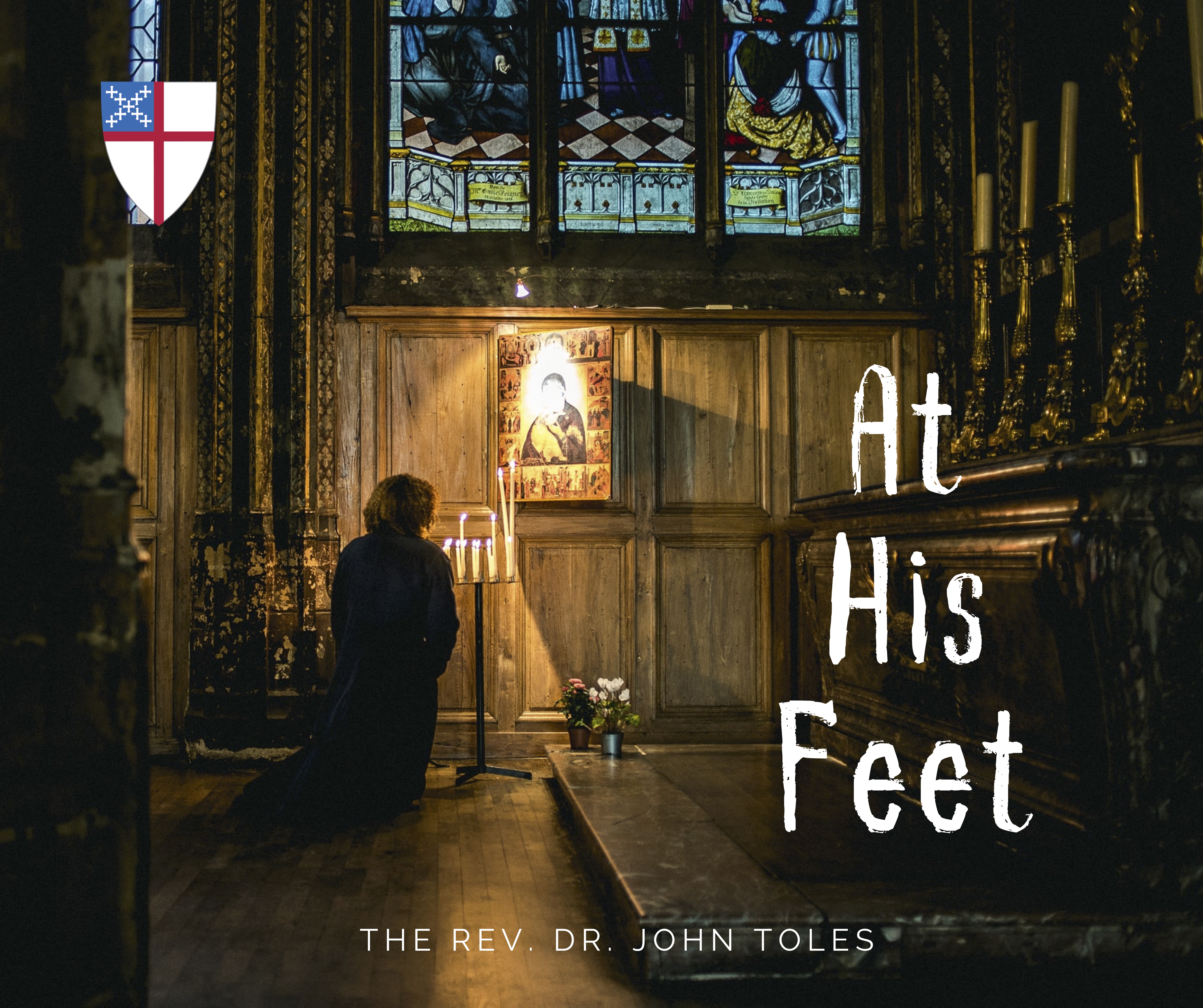
Martha is complaining about Mary not helping, but the real problem—in the words of my granny—Mary is acting like a hussy. That girl is out of line. Make her get up and help with (Lord forgive and protect me for saying this out loud) make her get up and help with “women’s work.” The problem is that Mary is acting like a man. The only time a woman might sit at the feet of a man would be in the bedroom with her husband, but out in public… hussy. Mary has broken cultural and social barriers. And not only is she acting like a man, but she is also acting like a disciple. One who sits at the feet of the rabbi and learns. Yet, Jesus isn’t just a rabbi, he is the Son of God, so what has Mary done? Mary has boldly come before Jesus, knelt before him, and entered into the very presence of God, hence, she “has chosen the better part, which will not be taken away from her.”
Remember the Temple complex: the outer area was the Court of the Gentiles. This is the area that Jesus entered and demonstrated a little righteous indignation, flipping tables and throwing out money changers. Moving further in we come to the Court of the Women, then the Court of the Priests, where the sacrifices took place. Entering into the Temple itself you first come to the Holy Place and before you is a curtain. Behind the curtain is the Holiest of Holies where the Ark of the Covenant resides. With regard to the Holy Place and Holiest of Holies, Scripture says, “The priests go regularly into the first section, performing their ritual duties, but into the second only the high priest goes, and he but once a year, and not without taking blood, which he offers for himself and for the unintentional sins of the people.” Only once a year would someone enter into the presence of God, but when Jesus died: “There was darkness over the whole land until the ninth hour, while the sun’s light failed. And the curtain of the temple was torn in two.” Mary sat at the feet of Jesus, she sat in the presence of God, and through his death, Jesus opened that same access to all who call on his name. As Jesus said, “Very truly, I tell you, I am the gate for the sheep. All who came before me are thieves and bandits; but the sheep did not listen to them. I am the gate. Whoever enters by me will be saved, and will come in and go out and find pasture.”
Mary was not the one who broke the barriers by sitting at the feet of Jesus. Jesus broke the barriers through his Incarnation. Emmanuel—God with us. Therefore, like Mary, we too can be bold, we can come into the very presence of God and sit as his feet, speaking to him and learning from him. As Paul said in his letter to the Hebrews, “Let us then with confidence… with boldness draw near to the throne of grace, that we may receive mercy and find grace to help in time of need.”
As my favorite passage of the Bible reads: “You have not come to what may be touched, a blazing fire and darkness and gloom and a tempest and the sound of a trumpet and a voice whose words made the hearers beg that no further messages be spoken to them. For they could not endure the order that was given, “If even a beast touches the mountain, it shall be stoned.” Indeed, so terrifying was the sight that Moses said, “I tremble with fear.” But you have come to Mount Zion and to the city of the living God, the heavenly Jerusalem, and to innumerable angels in festal gathering, and to the assembly of the firstborn who are enrolled in heaven, and to God, the judge of all, and to the spirits of the righteous made perfect, and to Jesus, the mediator of a new covenant.”
We’ve been given this tremendous access to the Creator of the Heavens and the Earth, so how do we enter? The answer is prayer and our Gospel reading can also help us to understand the kind of prayer that is needed. It is easier to understand this by looking at different types of communication that we practice, specifically, the difference between a text message and a phone call.
What I’ve discovered is that if I’m asking for specific information or giving it, text messaging and emails work just fine. “Do this.” “I’ll take care of that.” “6:30 works great.” But when it comes to actually having a conversation with someone… Well, I eventually give up on trying to make a point and give the person a call. And that’s just it, there is more to communication than words. There are words, inflection, emotion, etc. There is engagement. Martha had a text messaging conversation with Jesus. “Hey, Jesus. Tell my sister to help me with the chores.” She gave instruction. Mary, on the other hand, “picked up the phone” and entered into the presence of God. She engaged.
St. Thérèse of Lisieux writes, “For me, prayer means launching out of the heart towards God; it means lifting up one’s eyes, quite simply, to Heaven, a cry of grateful love from the crest of joy or the trough of despair; it’s a vast, supernatural force which opens out my heart, and binds me close to Jesus.” Prayer is an engagement of her spirit with the Spirit of God and drawing close, entering into the mystical presence of God.
We enter into this presence of God through prayer, but so often, we are like Martha: Jesus, do this and that. Jesus says to ask for anything, so this type of interaction is OK, but when it comes time to truly speak to the Lord and to listen to his teachings, then we must be still and sit at his feet. We must become like a disciple. We must become like Mary.
Let us pray:
The light of God surrounds us,
The love of God enfolds us,
The power of God protects us,
The presence of God watches over us,
Wherever we are, God is,
And where God is, all is well.
Help us Lord to enter into your presence,
Where we might sit at your feet
And find nourishment for our souls.
Amen.
A few weeks ago I told you about Alexa, the virtual assistant from Amazon. She’s a bit like Siri on an Apple device. Ask a question, she’ll give an answer. Order something from Amazon and she’ll even let you know when it has arrived, but did you know that you can actually order from Amazon through Alexa? Just say, “Alexa, order such and such,” and she will have such and such shipped to you.
Well, Phil Brookman, the pastor at Memorial Road Church of Christ in Oklahoma City was talking to his 1,000 member congregation about this very feature and how you could order what ever they wanted. As an example, he said, “Alexa, order toilet paper.” And that’s where it gets even more fun.
Turns out that Memorial Road Church of Christ live streams their service through the Internet and on that day, one of their members was home with a sick child so she tuned into the broadcast. She reports, immediately after Pastor Brookman said, “Alexa, order toilet paper,” she heard her own Alexa unit respond: “OK. I’ve added it to your cart.” Pastor Brookman inadvertently ordered 60 rolls of toilet paper for his church member. But wait, there’s more: having heard about the incident between services, Pastor Brookman tweaked his illustration. Instead of saying, “Alexa, order toilet paper,” he said, “Alexa, donate $500 to the Memorial Road Church of Christ.” (Source)
To that, I can only add, for those of you listening to the podcast of this sermon: “Alexa, donate $500 to St. Matthew’s Episcopal Church, 518 W. Randolph Ave, Enid, Ok 73701.” I’ll keep you posted on how that works out.
Assistants: they come along in different forms. There are Alexa and Siri who do pretty good for what they are designed to do. They make life a bit easier. When we ask for assistance, the reasons probably vary: we don’t know how to do something, we want help to do even more, or there is so much to do, that we can’t get it all done ourselves. In the days of the Exodus from Egypt, Moses found himself in that last category. There was too much to do, the people were being unreasonable, and he was pulling his hair out. The Lord seeing this, provided him with assistants.
You’ll recall that as the Israelites were wandering in the desert, they began to grumble because they were hungry, so God gave them manna—bread from Heaven; however, they were not satisfied, so they started grumbling again because there was no meat for their pots. Upon hearing this and fed up with the grumbling, Moses looked up to God and said, “Why have you dealt ill with your servant? And why have I not found favor in your sight, that you lay the burden of all this people on me? Did I conceive all this people? Did I give them birth, that you should say to me, ‘Carry them in your bosom, as a nurse carries a nursing child.’” A few verses on: “I am not able to carry all this people alone; the burden is too heavy for me. If you will treat me like this, kill me at once.” Just kill me. I can’t deal with these whiny people anymore. But instead of killing him, the Lord gives him help. The Lord says, “Gather for me seventy men of the elders of Israel, whom you know to be the elders of the people and officers over them, and bring them to the tent of meeting, and let them take their stand there with you.” Because the burden was too great for Moses, the Lord gave him seventy assistants to lighten the load, and a part of the Spirit that was on Moses, was passed onto these seventy to help in performing the work and caring for the people.
Moses was given seventy assistants because the burden of carrying all of God’s people was too much for him. As we read in our Gospel, Jesus also called seventy to assist him. Was this because, like Moses, it was too much for him? Would he have been unable to accomplish the mission without them? The answer is, of course, No. Jesus alone accomplished the work he set out to do, and not just for a single tribe like the Israelites, but for all of humanity: “He is the propitiation for our sins, and not for ours only but also for the sins of the whole world.” Jesus alone carried the burden of us all on the Cross. Yet, for the work of God to continue, others had to be enlisted, so the seventy were enlisted to go before Jesus and perform the work. The seventy are not assistants as Moses needed them. The seventy are apprentices, learning how to continue the work. And what was the work?
From our Gospel, Jesus said: “Whatever house you enter, first say, `Peace to this house!’” And then, “Whenever you enter a town and its people welcome you, eat what is set before you; cure the sick who are there, and say to them, `The kingdom of God has come near to you.’” The work: proclaim peace—share with them that there is now peace between God and humankind. The old sin brought on by Adam and Eve’s disobedience is being forgiven. Demonstrate this peace to them by the healing of the sick and possessed. Tell them that the Kingdom of God is near. That just like God called to Adam and Eve as they hid in the garden, he now calls to us again. He calls us into a life of holiness and righteousness with Him, made possible through His One and Only Son.
The seventy took nothing extra with them. They were at the mercy of those they encountered. Where Jesus is the Lamb of God, these seventy are Jesus’ enlisted chosen, his lambs of which he is the Shepherd, and as he did battle in the wilderness during the forty days following his baptism, he sends the seventy out into the wilderness, amongst the wolves, not to be devoured, but to proclaim this message of peace, forgiveness, and restoration. As Jesus was successful, these seventy were also victorious. “Lord, in your name even the demons submit to us!”
If it was as easy as saying, “Alexa, preach the Gospel to the ends of the earth,” then this work would be done. But the Lord prefers a more personal touch. He wants for us to go out and proclaim his message. He wants us to have this passion for souls. A desire to see others, not only enter into a relationship with Him, but to participate in this work of reconciliation between God and his children.
In our Saints’ Book Club, this is one of the common threads that I’ve seen amongst all the Saints we’ve read about, this passion for souls. A driving unrelenting desire, even beyond death, to bring others into the fold, whether through works or prayer. The one we are currently reading, Thérèse of Lisieux says, “After my death, I will let fall a shower of roses. I will spend my heaven doing good upon earth. I will raise up a mighty host of little saints. My mission is to make God loved… I want to spend my Heaven in doing good on Earth.”
My friend St. Josemaría Escrivá writes, “We are children of God. Bearers of the only flame that can light up the paths of the earth for souls, of the only brightness which can never be darkened, dimmed or overshadowed. The Lord uses us as torches, to make that light shine out… It depends on us that many should not remain in darkness, but walk instead along paths that lead to eternal life.” (The Forge #1) You are children of God. You have been given a mission to bring light into darkness, to make God loved. You are the seventy.
Immediately following our Gospel reading today, Jesus prayed, giving thanks to the Father for making these things known to his disciples, then he said, “Blessed are the eyes that see what you see! For I tell you that many prophets and kings desired to see what you see, and did not see it, and to hear what you hear, and did not hear it.” You have seen and heard what prophets and kings spent lifetimes searching for. Jesus said, “The harvest is plentiful, but the laborers are few; therefore ask the Lord of the harvest to send out laborers into his harvest.” But, don’t just ask the Lord to make others the laborers, have such a passion for souls that you ask him to make you one as well.
Let us pray: Father, hear our prayers for the salvation of the world. Grant Mercy to all souls that turned away from You. Open their hearts and minds with Your light. Gather Your children from the east and the west, from the north and the south. Have mercy O God on those who do not know You. Bring them out of darkness into Your light. You are our saving God Who leads us in our salvation. Protect us from evil. We put the world in Your hands; fill us with Your love. Grant us peace through Christ, our Lord. Amen.
As most are aware, freedom of speech was not a cherished commodity within the former Soviet Union and most all were afraid to speak out in public. One incident (true or not, makes the point): During his years as premier of the Soviet Union, Nikita Khrushchev denounced many of the policies and atrocities of Joseph Stalin. Once, as he censured Stalin in a public meeting, Khrushchev was interrupted by a shout from a heckler in the audience. “You were one of Stalin’s colleagues. Why didn’t you stop him?” Without hesitation, Khrushchev roared, ”Who said that?” An agonizing silence followed as nobody in the room dared move a muscle for fear of being implicated. Then Khrushchev replied quietly, “Now you know why.”
However, this fear did not stop people from speaking out in private or even making jokes. Armenia, a former state of the USSR, had Radio Armenia, a fictitious radio station, which was the setting of many jokes about the Soviet Union. Their slogan: “Ask us whatever you want, we will answer you whatever we want.” Example:
Radio Armenia was asked: “Is it true that the poet Mayakovsky committed suicide?”
Radio Armenia answered: “Yes, it is true, and even the record of his very last words is preserved: ‘Don’t shoot, comrades.’”
Another (this was during the time of Reagan):
Q: Is it true that there is freedom of speech in the Soviet Union, just like in the USA?
A: In principle, yes. In the USA, you can stand in front of the White House in Washington, DC, and yell, “Down with Reagan!”, and you will not be punished. Equally, you can also stand in Red Square in Moscow and yell, “Down with Reagan!”, and you will not be punished.
There are times when we are truly free and there are times, as in the former Soviet Union, when we know that our freedom has certain limits to it.
The same is true within our relationship with God (minus the threat of violence that we saw in the Soviet Union). The Apostle Paul teaches us, “For you were called to freedom, brothers. Only do not use your freedom as an opportunity for the flesh, but through love serve one another. For the whole law is fulfilled in one word: ‘You shall love your neighbor as yourself.’” And St. Peter writes, “Live as people who are free, not using your freedom as a cover-up for evil, but living as servants of God.” We are free from the captivity of sin so that we might worship and serve our God without fear and do so in holiness and righteousness.
Yet, there are times when we can act as though we are still captives in chains, even after Christ has set us free.
Harry Houdini, the famed escape artist issued a challenge wherever he went. He could be locked in any jail cell in the country, he claimed, and set himself free quickly and easily. Always he kept his promise, but one time something went wrong.
Houdini entered the jail in his street clothes; the heavy, metal doors clanged shut behind him. He took from his belt a concealed piece of metal, strong and flexible. He set to work immediately, but something seemed to be unusual about this lock. For thirty minutes he worked and got nowhere. An hour passed, and still he had not opened the door. By now he was bathed in sweat and panting in exasperation, but he still could not pick the lock.
Finally, after laboring for two hours, Harry Houdini collapsed in frustration and failure against the door he could not unlock. But when he fell against the door, it swung open! His jailer had forgotten to lock the cell!
Christ has set us free, but at times, we can still believe that we are chained. The result is that we look a good bit like the poor fella in our Gospel reading: “As Jesus stepped out on land, a man of the city who had demons met him. For a long time he had worn no clothes, and he did not live in a house but in the tombs… he was kept under guard and bound with chains and shackles, but he would break the bonds and be driven by the demon into the wilds.”
He was possessed, tormented by the demons. We too can be possessed, tormented by our own demons, those things that just won’t seem to let go of us. Those memories, sins, hurts, that follow us no matter where we go or what we do. They refuse to allow joy to be more than superficial. Just as we feel ourselves rising out of it, the devil reminds us of our past and pulls us back down.
The possessed man wore no clothes. Remember, back in the beginning, when Adam and Eve walked in the Garden, they were naked. Of this, Scripture says, “The man and his wife were both naked and were not ashamed.” But after they ate of the fruit, “the eyes of both were opened, and they knew that they were naked. And they sewed fig leaves together and made themselves loincloths.” And when God again walked in the Garden, they hid themselves from him. When God asked why they hid, Adam replied, “I heard the sound of you in the garden, and I was afraid, because I was naked, and I hid myself.” They were afraid. They were ashamed to appear before God, because of their nakedness, because of their sin.
Perhaps you’ve never had reason to, but I have felt shame for my sin to such an extent, that I didn’t want to pray. I didn’t want to have to come before God naked, in my sin. I don’t even want to look up, for fear that he will see my face.
Like the possessed man, haunted by his demons and running around naked, we too can be haunted by those sins that possess us and the shame we experience can drive us from God; and in the end, like the possessed man, through our fear and shame, we can find ourselves walking amongst the tombs, that is, walking as though we were still dead in sin, never realizing that we have been set free. We are Houdini, trying to break out of a prison that is already unlocked. And when Jesus comes to us and asks, ”What is your name?” We respond as the possessed man, “Legion.” We respond with the name of our own self condemnation. I am Legion. I am Sin. I am Pride. I am Lust. I am Greed. I am dead.
Why? Do you know what words you are least likely to believe coming from me, a priest? Perhaps I’ve shared this with you before, but during the Sacrament of Confession, following the confession and absolution (the assurance of God’s mercy and grace toward you), I will say to you, “The Lord has put away all your sins.” I would wager that most do not believe those words. “The Lord has put away all your sins.” And in our hearts, “If you say so Father, but we both know that’s not true.” The demon clings to us, we bow our heads in shame, and we declare, “I am Legion.” Captives even though we have been set free.
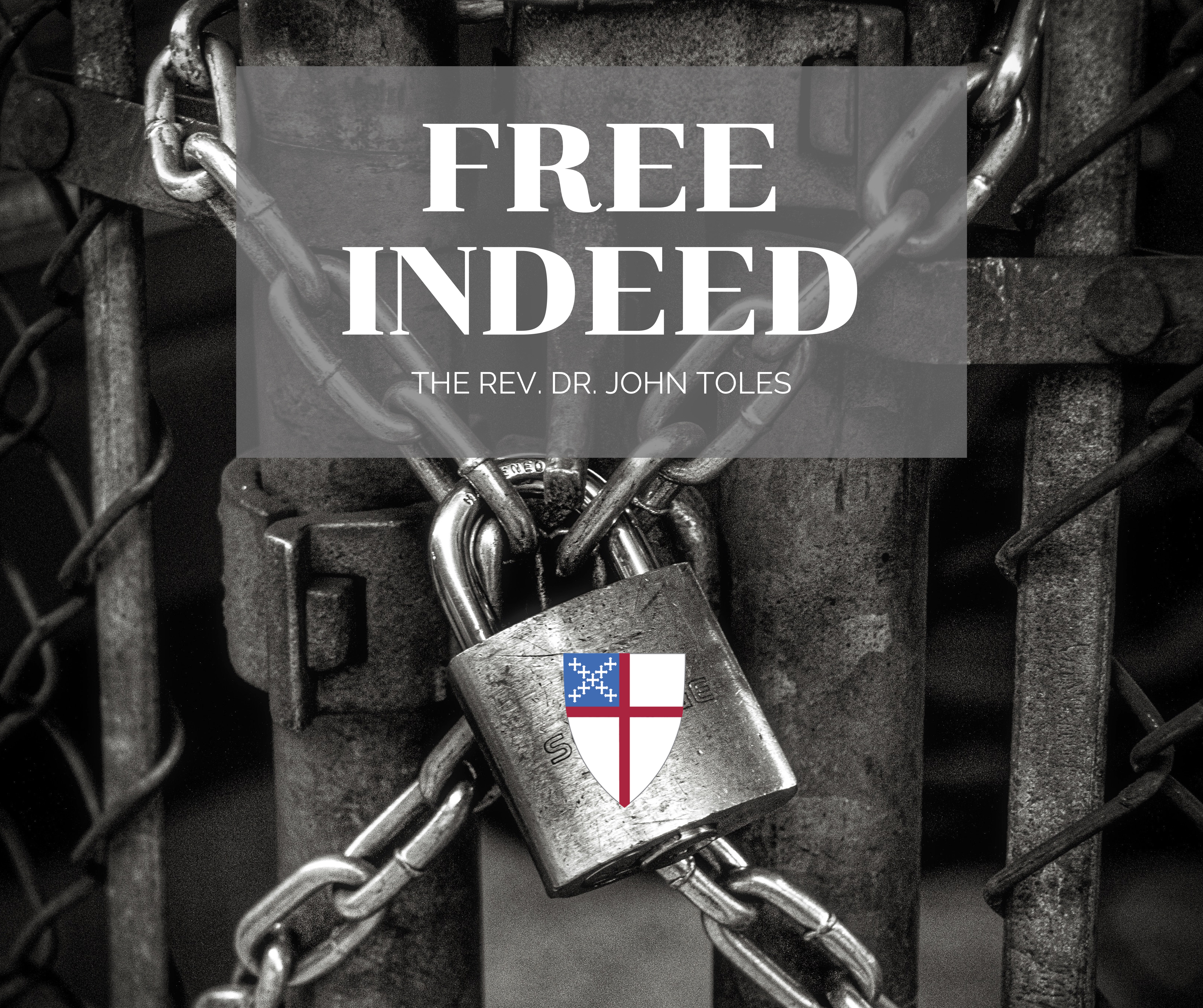
In John’s Gospel, Jesus told those who believed in him that if anyone practices sin, they are a slave to sin—that is, they are captives to sin, but that if they believed in the Truth, in Him, they would be set free, to which he adds, “If the Son sets you free, you will be free indeed.” “The Lord has put away all your sins.” You have not been set free by the priest, you have been set free by the Son: the very Son of God and your name is not Legion. Your name is Child of God.
Following the Great Fire of London, late in the 17th century, St. Paul’s Cathedral, designed by Sir Christopher Wren, was completed. On one occasion Wren was making a tour of the work in progress. He came upon a man at work and asked him: “What are you doing?” The man said: “I am cutting this stone to a certain size and shape.” He came to a second man and asked him what he was doing. The man said: “I am earning so much money at my work.” He came to a third man at work and asked him what he was doing. The man paused for a moment, straightened himself and answered: “I am helping Sir Christopher Wren build St. Paul’s Cathedral.”
The locks and chains that bound you have been cast off. You are free to serve your God without fear. When you are asked your name, do not give some half hearted answer or act as one still captive, but straighten yourself and in complete faith declare, I am Child of God.
Let us pray:
From the depths of our hearts
we thank You, Dear Lord,
for Your infinite kindness in coming to us.
How good You are to us!
With Your most holy Mother and all the angels,
we praise Your mercy and generosity toward us,
poor sinners.
We thank You for nourishing our souls
with Your Sacred Body and Precious Blood.
We will try to show our gratitude to You
in the Sacrament of Your love,
by obedience to Your holy commandments,
by fidelity to our duties,
by kindness to our neighbor
and by an earnest endeavor
To become more like You in our daily conduct.
Amen.
The signs most of us are accustomed to are the ones that are printed. Examples of some original signs:
Along a windy mountain road: “Speed Limit Enforced by Sniper.”
Wood County West Virginia: “Our citizens have concealed weapons. If you kill someone, we will kill you back. We have ‘0’ jails and 513 cemeteries. Enjoy your stay.”
At a pub: “We have beers as cold as your ex’s heart.”
A library parking lot: “Library parking only: Violators will be held in low esteem.”
“Beware of Dog” and in smaller print, “The cat is also shady.”
“There are two rules for success: 1) Never reveal all you know. 2) …….
And one of my favorites: “Whatever you do, always give 100%. Unless you’re giving blood.”
There are other kinds of signs and perhaps one of the most popular is a sign from God. For example, there is the fella that was trying to lose some weight, so vowed to God not to stop at the donut shop unless there was a free parking spot directly in front. Some days that worked out really well, but most days he had to drive around the block at least five times. And still, there are others that look for more significant signs from God.
During the summer of 1944 the crematoriums were working a record pace at the Nazi concentration camp in Auschwitz. The air was constantly filled with smoke and ash of the thousands that were being murdered. In May of that year, Elaine Seidenfeld arrived at the camp and immediately learned of the realities and hardness of life there.
Stepping upon the platform from the train, she and her husband were separated, she was stripped and her hair was shaved, all the normal treatment of the Nazis was efficiently administered. She was then sent to a barrack where she found room to sleep on the third tier of a bunk squeezed in with twelve other women. One of those women, pointing in the direction of the crematoriums said, “Today it is them, tomorrow it will be us.” However, Elaine protested, “Not I. I will survive. I want to live and find my husband.” The old timers scoffed and said she didn’t know what she was talking about. They told her that one day, she also would be selected to die.
During May through August of that summer, many were selected, but she was not, however, in late August she heard her name called and knew it was her time. So along with 3,000 other women, she was marched to the showers, told to undress, and enter. They did, but instead of gas coming out of the showers, it was water. They were showered and then told to dress again and then ushered to the train station once more.
Upon arrival, they were forced into the cattle cars—150 women per car. Elaine had hoped to get close to the wall so she could possibly look out, but there was no way, there were no windows, and even if there had been, they were packed so closely that they were all like vertical boards, unable to move. Throughout the entire ordeal Elaine never stopped repeating to herself, “I want to live.. I want to live.”
Finally, stuck in the middle of that dark cattle car, she prayed, “My God, I want to live. If only I could find some promising sign. Something I could believe in. Something. Anything. Something that will indicate that I will live.”
As the train began to move, it jolted, and a small crack appeared between two wall boards of the cars. Elaine was amazed, and as they traveled, she began to see the blue sky, and suddenly, in the middle of the blue sky was a straight pure-white line. She was overjoyed. In her heart, she knew this was her sign. It was God. She declared, “O God, you have given Noah a rainbow and me this white line in heaven. I too will survive this deluge of blood, for this is a sign from heaven that you have inscribed my name in your Book of Life.” And she did. She survived many other trials before she was liberated, but with each trial, in her mind, she saw that pure white line, and she knew that God was with her and that she would survive. Following the war, unlike millions of others, she was reunited with her husband and her family.
An interviewer would later ask what she thought that white line was. Elaine’s response, “Does it really matter? It could have been nothing more than fumes from a passing airplane, but whatever it was it was my sign from heaven.”
For Elaine Seidenfeld, a little white line in the sky on a blue day was not only a sign, it was God. God in all of his fullness, glory, faithfulness, and power.
A shorter story: Little Johnny and a group of his friends go on their first camping trip. They find a spot deep in the woods to set up camp, they eat the sandwiches their mom’s have prepared and as it gets dark, they spend their time telling ghost stories trying to scare one another. As their campfire dims, one by one they begin to fall asleep. Johnny is the last boy awake and is still a bit too nervous to close his eyes, so in the now pitch black night, he stares up at the sky and the millions of stars. While taking in the vastness of it all, he has a rather philosophical moment, which is quite rare for most young boys, but in that instant, he understands that he is not the center of the world. In the stars and the in the spaces between the stars and even beyond the stars, in all that there is, for the first time, Johnny sees God
Along with his buddies, he had always understood that he had to behave because God was watching his every move, but now, just as Elaine Seidenfeld saw God in all of his fullness, glory, faithfulness and power in that little white line in a blue sky, Johnny also sees God in all of his fullness, glory, faithfulness, and power in the vastness of creation itself.
Of these two experiences, which best expresses that fullness, glory, faithfulness, and power of God? The answer is both. Throughout history, the Lord has always made himself known in the way that he knows we can see him.
We are told that during the Exodus, the Lord went before the Israelites by day in a pillar of cloud to lead the way, and by night in a pillar of fire to give them light, so that they could travel by day and night.
Shadrach, Meshach, and Abed-Nego—also known as My-shack, Yo-shack, and Abungalow—were thrown into the furnace by King Nebuchadnezzar. The canticle we read today in place of the Psalm, was their song while in the furnace. However, as King Nebuchadnezzar watched them—not burning—he was astonished, rose in haste, and called out to his counselors, “Did we not cast three men bound into the midst of the fire?” They answered and said to the king, “True, O king.” “Then Look!” he answered, “I see four men loose, walking in the midst of the fire; and they are not hurt, and the form of the fourth is like the Son of God.” The three walked around in the burning furnace and with them was God.
Which of these experiences expresses the fullness, glory, faithfulness and power of God? Was it the pillar of fire or the fourth figure in the burning furnace? Again, it is both.
From a white line in a blue sky to a pillar of fire to the stars at night to a fourth figure dancing in the fire, God makes himself known in them all.
Today is Trinity Sunday. That day when we celebrate oneness of the Triune God. Mother Janie and I were discussing this and I’m pretty sure she has had to preach this sermon every year that I’ve been here—perhaps my subconscious way of not committing heresy. However, as I was thinking on this, we really cannot explain the Trinity of God with words—at least I can’t. We can only understand the Trinity in our experience of God. In the encounter.
My prayer for you is that you will encounter God: Father, Son, and Holy Spirit, and like so many others before us, know the same fullness, glory, faithfulness, and power of of the Triune God. When you do, may it bring you to your knees in worship and praise.
Let us pray:
Glory be to the Father,
Who by His almighty power and love created us,
making us in the image and likeness of God.
Glory be to the Son,
Who by His Precious Blood delivered us from hell,
and opened for us the gates of heaven.
Glory be to the Holy Spirit,
Who has sanctified us in the sacrament of Baptism,
and continues to sanctify us
by the graces we receive daily from His bounty.
Glory be to the Three adorable Persons of the Holy Trinity, now and forever.
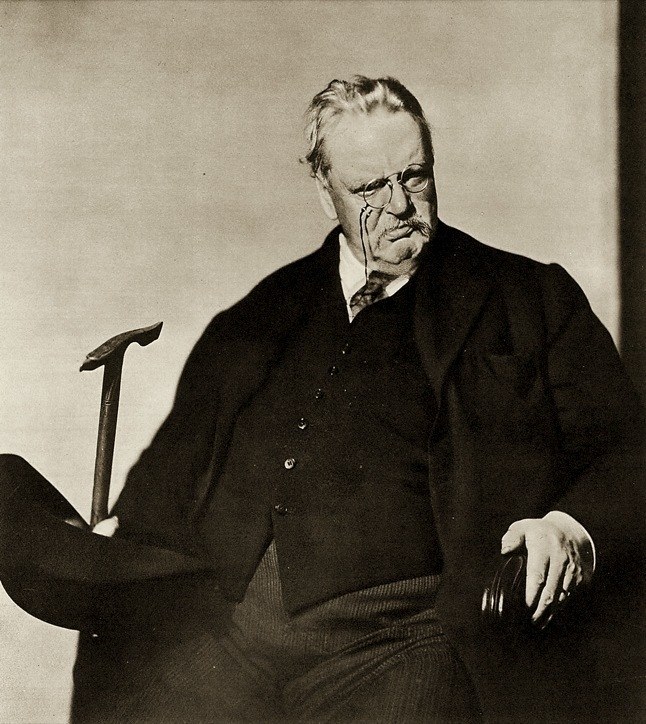
He wrote an essay that was published in London’s Illustrated News which inspired Mahatma Gandhi to transform all of India. His writings on the Christian faith were instrumental in the conversion of C.S. Lewis. George Orwell wrote the dystopian novel 1984, but the use of that year was inspired by the author of our saint for the day, Gilbert Keith Chesterton, more commonly referred to as G.K. Chesterton.
Chesterton wrote more than 80 books, contributed to hundreds more, he was a poet, novelist, essayist (having written over 4,000) and at his death, Pope Pius XI declared him a Defender of the Faith (although he did not convert to Catholicism until the end of his life, having been raised in the Church of England.).
He was a big man: six foot, four inches tall and some reports have him weighing in at nearly 400 pounds. He once said to his friend George Bernard Shaw, “To look at you, anyone would think a famine had struck England.” Shaw retorted, “To look at you, anyone would think you had caused it.” It is no wonder that he died early, at the age of 62, in 1936 and it was T.S. Eliot who wrote his obituary and remarked, Chesterton “did more than any man in his time … to maintain the existence of the [Christian] minority in the modern world.”
It seems what made him so influential wasn’t necessarily the volume of writing he put out, but the common sense of it all. A few examples:
“The Christian ideal has not been tried and found wanting; it has been found difficult and left untried.”
“These are the days when the Christian is expected to praise every creed except his own.”
“Most modern freedom is at root fear. It is not so much that we are too bold to endure rules; it is rather that we are too timid to endure responsibilities.”
“Art, like morality, consists of drawing the line somewhere.”
And one I hope to be able to work into a conversation some day: “You cannot grow a beard in a moment of passion.”
From our Gospel: Philip brought Nathanael to see Jesus. When Jesus saw Nathanael coming toward him, he said of him, “Here is truly an Israelite in whom there is no deceit!” When Jesus saw G.K. Chesterton walking toward him, Jesus said, “Here is an Englishman in whom there is no deceit!”
My friend Stephen King gives advice to writers: “Any word you have to hunt for in a thesaurus is the wrong word. There are no exceptions to this rule.” “…throw your thesaurus into the wastebasket.” I can say to you, ‘The Rosa hybrida is Japanese carmine,’ and most folks wouldn’t have a clue as to what I was talking about, or I could say to you ‘The rose is red,’ and everyone understands. Chesterton’s gift was that he spoke plainly with a great deal of common sense. We can learn to speak in a similar manner, plainly and truthfully, so that we can come into a deeper understanding of one another.
A defendant was on trial for murder. There was strong evidence indicating guilt, but there was no corpse. In the defense’s closing statement, the lawyer, knowing his client probably would be convicted, resorted to a trick.
“Ladies and gentlemen of the jury, I have a surprise for you all,” the lawyer said as he looked at his watch.
“Within one minute, the person presumed dead in this case will walk into this courtroom.” He looked toward the courtroom door. The jurors, somewhat stunned, all looked on eagerly. A minute passed. Nothing happened.
Finally the lawyer said, “Actually, I made up the previous statement; but you all looked on with anticipation. Therefore, I put to you that you have a reasonable doubt in this case as to whether anyone was killed and insist that you return a verdict of not guilty.”
The jury, clearly confused, retired to deliberate. A few minutes later, the jury returned and pronounced a verdict of guilty.
“But how?” inquired the lawyer. “You must have had some doubt; I saw all of you stare at the door.”
The jury foreman replied, “Oh, we looked, but your client didn’t.”
Mark Galli is the Editor in Chief for the magazine Christianity Today and has recently been writing a series under the heading the “Elusive Presence.” It is actually some of the best writing I’ve read on the state of the church in quite some time. Perhaps what makes it so good is the fact that he is so desperately honest about himself. For example, here he is, the Editor in Chief of one of the largest Christian magazines, but he writes about his own crisis of faith: “It occurred to me that I didn’t feel any love for God. I also realized that even though I prayed and read Scripture regularly, not much in my life would be different if I didn’t pray and read my Bible. That is, I was living as a practical atheist, meaning my personal relationship with God did not really affect much inside me.” Throughout the article he continues to wrestle with this doubt and the reason behind these feelings. His conclusion is simple and sad: “We have forgotten God.” (Source) That is some serious soul searching.
As part of his efforts to understand this, Galli went back through the history of the church in America to the Great Awakening, a series of revivals, that took place in the 1730s and 40s, where he found the writings of Jonathan Edwards (considered one of the greatest American preachers) who gave an account of the ‘atmosphere.’ Edwards writes, “In all companies… on whatever occasions persons met together, Christ was to be heard of, and seen in the midst of them. Our young people, when they met, were wont to spend the time in talking of the excellency and dying love of Jesus Christ, the glory of the way of salvation, the wonderful, free, and sovereign grace of God, His glorious work in the conversion of a soul, the truth and certainty of the great things of God’s word, the sweetness of the views of His perfections.” (Source) That reminded me of what they said about St. Dominic: “Wherever the Master was, he always spoke either to God or about God.”
I spend a good bit of my time talking about God, but I don’t recall a conversation when I sat around with others discussing the excellency and dying love of Jesus. I spend a good deal of time teaching about the nature of God, but the glory of the way of salvation is not one of those topics. I can spend time with family and friends, but I don’t ever recall getting together with others with the soul intent of talking about Jesus.
I remember the first time I heard the expression “whitewash.” It was in The Adventures of Tom Sawyer, when Tom got in trouble and was forced to whitewash a fence as punishment. Whitewashing is a cheap way to cover a surface to make it look a little better, but that’s about it and everyone knows, so something that has been whitewashed is generally associated with the poor, therefore the saying, “Too proud to whitewash and too poor to paint.”
I understand what Mark Galli was saying about himself. Would it really matter if I stopped praying, studying, etc. Do I even love God or is my faith simply whitewash? Those are hard but important questions to ask, and just to make it a bit more difficult, I read about one of the desert fathers, Abba Theodore.
He was made a deacon at Scetis but he refused to exercise the office and fled to many places from it. Each time the old men brought him back to Scetis, saying, ‘Do not leave your diaconate.’ Abba Theodore said to them, ‘Let me pray God that he may tell me for certain whether I ought to take my part in the liturgy.’ Then he prayed God in this manner, ‘If it is your will then I should stand in this place, make me certain of it.’ Then appeared to him a column of fire, reaching from earth to heaven, and a voice said to him, ‘If you can become like this pillar, go be a deacon.’ On hearing this he decided never to accept the office.
I worry about being a whitewash priest and Abba Theodore won’t even function as a deacon because he can not be a pillar of fire that reaches from earth to heaven.
I suspect that to one degree or another, depending on the day, the hour, or even the minute, we can all feel this way. And we’re in good company. The great Apostle Peter: “Go away from me, Lord, for I am a sinful man.” Paul: “O wretched man that I am! Who will deliver me from this body of death?” Mother Teresa: “Where is my faith? – even deep down, right in, there is nothing but emptiness and darkness.” Yet—and here is the Good News—even in the midst of these doubts, there is Pentecost. There is this Spirit of Fire, the very Spirit of God that has been placed in us all and it continually burns.
When I lived in Montana, I would help friends bail hay and then put it up in the barn for the winter. However, the hay had to have the right moisture content. Too dry and it lost all its nourishment. Too wet… at least once a year you would hear about someone who had put up their hay in the barn and when winter came along started using it. It would be stacked in bails as much as a dozen bails high or more. The outer rows would be fine, but after removing a few rows… completely burned up. The entire center, hundreds of bails, nothing but ashes. Why? The hay was too wet when they put it up, causing a chemical reaction that resulted in spontaneous combustion. The fire started at the center and burned very slowly outward, consuming everything. That’s not so good when when talking about hay barns, but it is the same idea when talking about this Spirit of God.
The Spirit is continually at work within us, burning away the impurities and leaving behind the pure image of God. When we are honest with ourselves and see how much work that remains, then we can doubt our worthiness and wonder if we really are just whitewashed Christians, and there is nothing wrong with these kinds of doubts, a much greater issue would be pride in thinking we’ve got it all worked out. There is no sin in the doubts, the only sin is when we truly give in and walk away. The doubts simply tell us of the work to be done, so instead of walking away, we call on the Triune God:
Come, Holy Ghost, our souls inspire, And lighten with celestial fire.
We call on God to fan the flames of Pentecost within our souls so that we may become those pillars of fire that reach to the heavens, so that the light of Christ and the fire of the Spirit may be seen by all.
You are no whitewashed Christians, even if you doubt. You are tabernacles of God Most High. His Spirit burns brightly within you all. On this day of Pentecost, ask the Lord to renew that Spirit within you and to let it burn even more brightly.
Let us pray: “Unless the eye catch fire, God will not be seen. Unless the ear catch fire, God will not be heard. Unless the tongue catch fire, God will not be named. Unless the heart catch fire, God will not be loved. Unless the mind catch fire, God will not be known.” (William Blake, “Pentecost”) Come, Holy Ghost, our souls inspire, And lighten our eyes, ears, tongues, hearts, and minds, That we may burn as pillars of fire As testaments to the work you perform in us. Amen.
Boniface was born in the year 675 and served as a missionary to Frisia (Netherlands) and later, Germany, where he would rise to the position of Archbishop. He was held in high esteem by the German princes and came often to give counsel, leading to one of his crowning achievements (no pun intended here) when he anointed Pippin as King of the Franks. Pippin’s son was Charlemagne, who’s efforts brought Christianity back to western Europe. Later, when Boniface retired as Archbishop, he returned to Frisia as a missionary. The following year, as he was waiting on a large group of converts to arrive for baptism and confirmations, he and his party were attacked by pagans and Boniface was martyred.
St. Willibald, Bishop in Germany, is the one who recorded much of Boniface’s life in a short book, The Life of St. Boniface. It is a fascinating read (you can find it online). In it, Willibald points to one of the primary reasons behind Boniface’s successes: the study of Holy Scripture. Willibald writes:
To such a degree was [Boniface] inflamed with a love of the Scriptures that he applied all his energies to learning and practicing their counsels, and those matters that were written for the instruction of the people he paraphrased and explained to them with striking eloquence, shrewdly spicing it with parables. His discretion was such that his rebukes, though sharp, were never lacking in gentleness, while his teaching, though mild, was never lacking in force. Zeal and vigor made him forceful, but gentleness and love made him mild. Accordingly he exhorted and reproved with equal impartiality the rich and powerful, the freedmen and the slaves, neither flattering and fawning upon the rich nor oppressing and browbeating the freedmen and slaves but, in the words of the apostle, he had “become all things to all men that [he] might by all means save some.” (Source)
Through his love and study of Scripture, Boniface learned that the most effective way to speak to people was through the language of God that he read in the Bible and the same can be true for us, but in order for this to happen, we need to pick up the Good Book. A recent “study found only 45 percent of those who regularly attend church read the Bible more than once a week. Over 40 percent of the people attending read their Bible occasionally, maybe once or twice a month. Almost 1 in 5 churchgoers say they never read the Bible—essentially the same number who read it every day.” (Source)
Even if it is only a short devotional, we all need to be in the Word daily. You don’t have to become a Bible scholar and you don’t have to memorize every verse. You only have to take the time and allow God to speak to you in his own words. What you will discover in the process is what Boniface discovered: the wisdom and grace you find within the Sacred Text will begin to find its way into your life and into your communication and relationships. You will become a greater reflection of God.