Sermon: Proper 7 RCL C – “Free Indeed”

The podcast is available here.


As most are aware, freedom of speech was not a cherished commodity within the former Soviet Union and most all were afraid to speak out in public. One incident (true or not, makes the point): During his years as premier of the Soviet Union, Nikita Khrushchev denounced many of the policies and atrocities of Joseph Stalin. Once, as he censured Stalin in a public meeting, Khrushchev was interrupted by a shout from a heckler in the audience. “You were one of Stalin’s colleagues. Why didn’t you stop him?” Without hesitation, Khrushchev roared, ”Who said that?” An agonizing silence followed as nobody in the room dared move a muscle for fear of being implicated. Then Khrushchev replied quietly, “Now you know why.”

However, this fear did not stop people from speaking out in private or even making jokes. Armenia, a former state of the USSR, had Radio Armenia, a fictitious radio station, which was the setting of many jokes about the Soviet Union. Their slogan: “Ask us whatever you want, we will answer you whatever we want.” Example:

Radio Armenia was asked: “Is it true that the poet Mayakovsky committed suicide?”
Radio Armenia answered: “Yes, it is true, and even the record of his very last words is preserved: ‘Don’t shoot, comrades.’”

Another (this was during the time of Reagan):
Q: Is it true that there is freedom of speech in the Soviet Union, just like in the USA?
A: In principle, yes. In the USA, you can stand in front of the White House in Washington, DC, and yell, “Down with Reagan!”, and you will not be punished. Equally, you can also stand in Red Square in Moscow and yell, “Down with Reagan!”, and you will not be punished.

There are times when we are truly free and there are times, as in the former Soviet Union, when we know that our freedom has certain limits to it.

The same is true within our relationship with God (minus the threat of violence that we saw in the Soviet Union). The Apostle Paul teaches us, “For you were called to freedom, brothers. Only do not use your freedom as an opportunity for the flesh, but through love serve one another. For the whole law is fulfilled in one word: ‘You shall love your neighbor as yourself.’” And St. Peter writes, “Live as people who are free, not using your freedom as a cover-up for evil, but living as servants of God.” We are free from the captivity of sin so that we might worship and serve our God without fear and do so in holiness and righteousness.

Yet, there are times when we can act as though we are still captives in chains, even after Christ has set us free.

Harry Houdini, the famed escape artist issued a challenge wherever he went. He could be locked in any jail cell in the country, he claimed, and set himself free quickly and easily. Always he kept his promise, but one time something went wrong.

Houdini entered the jail in his street clothes; the heavy, metal doors clanged shut behind him. He took from his belt a concealed piece of metal, strong and flexible. He set to work immediately, but something seemed to be unusual about this lock. For thirty minutes he worked and got nowhere. An hour passed, and still he had not opened the door. By now he was bathed in sweat and panting in exasperation, but he still could not pick the lock.

Finally, after laboring for two hours, Harry Houdini collapsed in frustration and failure against the door he could not unlock. But when he fell against the door, it swung open! His jailer had forgotten to lock the cell!

Christ has set us free, but at times, we can still believe that we are chained. The result is that we look a good bit like the poor fella in our Gospel reading: “As Jesus stepped out on land, a man of the city who had demons met him. For a long time he had worn no clothes, and he did not live in a house but in the tombs… he was kept under guard and bound with chains and shackles, but he would break the bonds and be driven by the demon into the wilds.”

He was possessed, tormented by the demons. We too can be possessed, tormented by our own demons, those things that just won’t seem to let go of us. Those memories, sins, hurts, that follow us no matter where we go or what we do. They refuse to allow joy to be more than superficial. Just as we feel ourselves rising out of it, the devil reminds us of our past and pulls us back down.

The possessed man wore no clothes. Remember, back in the beginning, when Adam and Eve walked in the Garden, they were naked. Of this, Scripture says, “The man and his wife were both naked and were not ashamed.” But after they ate of the fruit, “the eyes of both were opened, and they knew that they were naked. And they sewed fig leaves together and made themselves loincloths.” And when God again walked in the Garden, they hid themselves from him. When God asked why they hid, Adam replied, “I heard the sound of you in the garden, and I was afraid, because I was naked, and I hid myself.” They were afraid. They were ashamed to appear before God, because of their nakedness, because of their sin.

Perhaps you’ve never had reason to, but I have felt shame for my sin to such an extent, that I didn’t want to pray. I didn’t want to have to come before God naked, in my sin. I don’t even want to look up, for fear that he will see my face.

Like the possessed man, haunted by his demons and running around naked, we too can be haunted by those sins that possess us and the shame we experience can drive us from God; and in the end, like the possessed man, through our fear and shame, we can find ourselves walking amongst the tombs, that is, walking as though we were still dead in sin, never realizing that we have been set free. We are Houdini, trying to break out of a prison that is already unlocked. And when Jesus comes to us and asks, ”What is your name?” We respond as the possessed man, “Legion.” We respond with the name of our own self condemnation. I am Legion. I am Sin. I am Pride. I am Lust. I am Greed. I am dead.

Why? Do you know what words you are least likely to believe coming from me, a priest? Perhaps I’ve shared this with you before, but during the Sacrament of Confession, following the confession and absolution (the assurance of God’s mercy and grace toward you), I will say to you, “The Lord has put away all your sins.” I would wager that most do not believe those words. “The Lord has put away all your sins.” And in our hearts, “If you say so Father, but we both know that’s not true.” The demon clings to us, we bow our heads in shame, and we declare, “I am Legion.” Captives even though we have been set free.

In John’s Gospel, Jesus told those who believed in him that if anyone practices sin, they are a slave to sin—that is, they are captives to sin, but that if they believed in the Truth, in Him, they would be set free, to which he adds, “If the Son sets you free, you will be free indeed.” “The Lord has put away all your sins.” You have not been set free by the priest, you have been set free by the Son: the very Son of God and your name is not Legion. Your name is Child of God.

Following the Great Fire of London, late in the 17th century, St. Paul’s Cathedral, designed by Sir Christopher Wren, was completed. On one occasion Wren was making a tour of the work in progress. He came upon a man at work and asked him: “What are you doing?” The man said: “I am cutting this stone to a certain size and shape.” He came to a second man and asked him what he was doing. The man said: “I am earning so much money at my work.” He came to a third man at work and asked him what he was doing. The man paused for a moment, straightened himself and answered: “I am helping Sir Christopher Wren build St. Paul’s Cathedral.”

The locks and chains that bound you have been cast off. You are free to serve your God without fear. When you are asked your name, do not give some half hearted answer or act as one still captive, but straighten yourself and in complete faith declare, I am Child of God.

Let us pray:
From the depths of our hearts
we thank You, Dear Lord,
for Your infinite kindness in coming to us.
How good You are to us!
With Your most holy Mother and all the angels,
we praise Your mercy and generosity toward us,
poor sinners.
We thank You for nourishing our souls
with Your Sacred Body and Precious Blood.
We will try to show our gratitude to You
in the Sacrament of Your love,
by obedience to Your holy commandments,
by fidelity to our duties,
by kindness to our neighbor
and by an earnest endeavor
To become more like You in our daily conduct.
Amen.

Sermon: Trinity Sunday RCL C


Photo by Quentin Rey on Unsplash

The signs most of us are accustomed to are the ones that are printed. Examples of some original signs:

  • Along a windy mountain road: “Speed Limit Enforced by Sniper.”
  • Wood County West Virginia: “Our citizens have concealed weapons. If you kill someone, we will kill you back. We have ‘0’ jails and 513 cemeteries. Enjoy your stay.”
  • At a pub: “We have beers as cold as your ex’s heart.”
  • A library parking lot: “Library parking only: Violators will be held in low esteem.”
  • “Beware of Dog” and in smaller print, “The cat is also shady.”
  • “There are two rules for success: 1) Never reveal all you know. 2) …….
  • And one of my favorites: “Whatever you do, always give 100%. Unless you’re giving blood.”

There are other kinds of signs and perhaps one of the most popular is a sign from God. For example, there is the fella that was trying to lose some weight, so vowed to God not to stop at the donut shop unless there was a free parking spot directly in front. Some days that worked out really well, but most days he had to drive around the block at least five times. And still, there are others that look for more significant signs from God.

During the summer of 1944 the crematoriums were working a record pace at the Nazi concentration camp in Auschwitz. The air was constantly filled with smoke and ash of the thousands that were being murdered. In May of that year, Elaine Seidenfeld arrived at the camp and immediately learned of the realities and hardness of life there.

Stepping upon the platform from the train, she and her husband were separated, she was stripped and her hair was shaved, all the normal treatment of the Nazis was efficiently administered. She was then sent to a barrack where she found room to sleep on the third tier of a bunk squeezed in with twelve other women. One of those women, pointing in the direction of the crematoriums said, “Today it is them, tomorrow it will be us.” However, Elaine protested, “Not I. I will survive. I want to live and find my husband.” The old timers scoffed and said she didn’t know what she was talking about. They told her that one day, she also would be selected to die.

During May through August of that summer, many were selected, but she was not, however, in late August she heard her name called and knew it was her time. So along with 3,000 other women, she was marched to the showers, told to undress, and enter. They did, but instead of gas coming out of the showers, it was water. They were showered and then told to dress again and then ushered to the train station once more.

Upon arrival, they were forced into the cattle cars—150 women per car. Elaine had hoped to get close to the wall so she could possibly look out, but there was no way, there were no windows, and even if there had been, they were packed so closely that they were all like vertical boards, unable to move. Throughout the entire ordeal Elaine never stopped repeating to herself, “I want to live.. I want to live.”

Finally, stuck in the middle of that dark cattle car, she prayed, “My God, I want to live. If only I could find some promising sign. Something I could believe in. Something. Anything. Something that will indicate that I will live.”

As the train began to move, it jolted, and a small crack appeared between two wall boards of the cars. Elaine was amazed, and as they traveled, she began to see the blue sky, and suddenly, in the middle of the blue sky was a straight pure-white line. She was overjoyed. In her heart, she knew this was her sign. It was God. She declared, “O God, you have given Noah a rainbow and me this white line in heaven. I too will survive this deluge of blood, for this is a sign from heaven that you have inscribed my name in your Book of Life.” And she did. She survived many other trials before she was liberated, but with each trial, in her mind, she saw that pure white line, and she knew that God was with her and that she would survive. Following the war, unlike millions of others, she was reunited with her husband and her family.

An interviewer would later ask what she thought that white line was. Elaine’s response, “Does it really matter? It could have been nothing more than fumes from a passing airplane, but whatever it was it was my sign from heaven.”

For Elaine Seidenfeld, a little white line in the sky on a blue day was not only a sign, it was God. God in all of his fullness, glory, faithfulness, and power.

A shorter story: Little Johnny and a group of his friends go on their first camping trip. They find a spot deep in the woods to set up camp, they eat the sandwiches their mom’s have prepared and as it gets dark, they spend their time telling ghost stories trying to scare one another. As their campfire dims, one by one they begin to fall asleep. Johnny is the last boy awake and is still a bit too nervous to close his eyes, so in the now pitch black night, he stares up at the sky and the millions of stars. While taking in the vastness of it all, he has a rather philosophical moment, which is quite rare for most young boys, but in that instant, he understands that he is not the center of the world. In the stars and the in the spaces between the stars and even beyond the stars, in all that there is, for the first time, Johnny sees God

Along with his buddies, he had always understood that he had to behave because God was watching his every move, but now, just as Elaine Seidenfeld saw God in all of his fullness, glory, faithfulness and power in that little white line in a blue sky, Johnny also sees God in all of his fullness, glory, faithfulness, and power in the vastness of creation itself.

Of these two experiences, which best expresses that fullness, glory, faithfulness, and power of God? The answer is both. Throughout history, the Lord has always made himself known in the way that he knows we can see him.

We are told that during the Exodus, the Lord went before the Israelites by day in a pillar of cloud to lead the way, and by night in a pillar of fire to give them light, so that they could travel by day and night.

Shadrach, Meshach, and Abed-Nego—also known as My-shack, Yo-shack, and Abungalow—were thrown into the furnace by King Nebuchadnezzar. The canticle we read today in place of the Psalm, was their song while in the furnace. However, as King Nebuchadnezzar watched them—not burning—he was astonished, rose in haste, and called out to his counselors, “Did we not cast three men bound into the midst of the fire?” They answered and said to the king, “True, O king.” “Then Look!” he answered, “I see four men loose, walking in the midst of the fire; and they are not hurt, and the form of the fourth is like the Son of God.” The three walked around in the burning furnace and with them was God.

Which of these experiences expresses the fullness, glory, faithfulness and power of God? Was it the pillar of fire or the fourth figure in the burning furnace? Again, it is both.

From a white line in a blue sky to a pillar of fire to the stars at night to a fourth figure dancing in the fire, God makes himself known in them all.

Today is Trinity Sunday. That day when we celebrate oneness of the Triune God. Mother Janie and I were discussing this and I’m pretty sure she has had to preach this sermon every year that I’ve been here—perhaps my subconscious way of not committing heresy. However, as I was thinking on this, we really cannot explain the Trinity of God with words—at least I can’t. We can only understand the Trinity in our experience of God. In the encounter.

My prayer for you is that you will encounter God: Father, Son, and Holy Spirit, and like so many others before us, know the same fullness, glory, faithfulness, and power of of the Triune God. When you do, may it bring you to your knees in worship and praise.

Let us pray:
Glory be to the Father,
Who by His almighty power and love created us,
making us in the image and likeness of God.

Glory be to the Son,
Who by His Precious Blood delivered us from hell,
and opened for us the gates of heaven.

Glory be to the Holy Spirit,
Who has sanctified us in the sacrament of Baptism,
and continues to sanctify us
by the graces we receive daily from His bounty.

Glory be to the Three adorable Persons of the Holy Trinity, now and forever.

Amen.

Sermon: G.K. Chesterton

The podcast is available here.


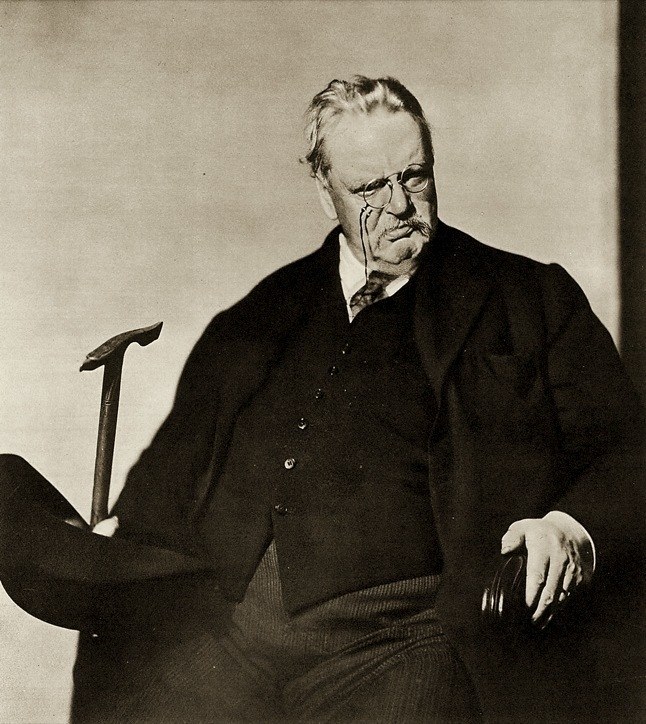
He wrote an essay that was published in London’s Illustrated News which inspired Mahatma Gandhi to transform all of India.  His writings on the Christian faith were instrumental in the conversion of C.S. Lewis.  George Orwell wrote the dystopian novel 1984, but the use of that year was inspired by the author of our saint for the day, Gilbert Keith Chesterton, more commonly referred to as G.K. Chesterton.  

Chesterton wrote more than 80 books, contributed to hundreds more, he was a poet, novelist, essayist (having written over 4,000) and at his death, Pope Pius XI declared him a Defender of the Faith (although he did not convert to Catholicism until the end of his life, having been raised in the Church of England.).

He was a big man: six foot, four inches tall and some reports have him weighing in at nearly 400 pounds.  He once said to his friend George Bernard Shaw, “To look at you, anyone would think a famine had struck England.” Shaw retorted, “To look at you, anyone would think you had caused it.”  It is no wonder that he died early, at the age of 62, in 1936 and it was T.S. Eliot who wrote his obituary and remarked, Chesterton “did more than any man in his time … to maintain the existence of the [Christian] minority in the modern world.”

It seems what made him so influential wasn’t necessarily the volume of writing he put out, but the common sense of it all.  A few examples: 

“The Christian ideal has not been tried and found wanting; it has been found difficult and left untried.”

“These are the days when the Christian is expected to praise every creed except his own.”

“Most modern freedom is at root fear. It is not so much that we are too bold to endure rules; it is rather that we are too timid to endure responsibilities.”

“Art, like morality, consists of drawing the line somewhere.”

And one I hope to be able to work into a conversation some day: “You cannot grow a beard in a moment of passion.”

From our Gospel: Philip brought Nathanael to see Jesus.  When Jesus saw Nathanael coming toward him, he said of him, “Here is truly an Israelite in whom there is no deceit!”  When Jesus saw G.K. Chesterton walking toward him, Jesus said, “Here is an Englishman in whom there is no deceit!”

My friend Stephen King gives advice to writers: “Any word you have to hunt for in a thesaurus is the wrong word. There are no exceptions to this rule.”  “…throw your thesaurus into the wastebasket.”  I can say to you, ‘The Rosa hybrida is Japanese carmine,’ and most folks wouldn’t have a clue as to what I was talking about, or I could say to you ‘The rose is red,’ and everyone understands.  Chesterton’s gift was that he spoke plainly with a great deal of common sense.  We can learn to speak in a similar manner, plainly and truthfully, so that we can come into a deeper understanding of one another.

Sermon: Pentecost RCL C

The podcast is available here.


Photo by Martin Adams on Unsplash

A defendant was on trial for murder. There was strong evidence indicating guilt, but there was no corpse. In the defense’s closing statement, the lawyer, knowing his client probably would be convicted, resorted to a trick.

“Ladies and gentlemen of the jury, I have a surprise for you all,” the lawyer said as he looked at his watch.

“Within one minute, the person presumed dead in this case will walk into this courtroom.” He looked toward the courtroom door. The jurors, somewhat stunned, all looked on eagerly. A minute passed. Nothing happened.

Finally the lawyer said, “Actually, I made up the previous statement; but you all looked on with anticipation. Therefore, I put to you that you have a reasonable doubt in this case as to whether anyone was killed and insist that you return a verdict of not guilty.”

The jury, clearly confused, retired to deliberate. A few minutes later, the jury returned and pronounced a verdict of guilty.

“But how?” inquired the lawyer. “You must have had some doubt; I saw all of you stare at the door.”

The jury foreman replied, “Oh, we looked, but your client didn’t.”

Mark Galli is the Editor in Chief for the magazine Christianity Today and has recently been writing a series under the heading the “Elusive Presence.” It is actually some of the best writing I’ve read on the state of the church in quite some time. Perhaps what makes it so good is the fact that he is so desperately honest about himself. For example, here he is, the Editor in Chief of one of the largest Christian magazines, but he writes about his own crisis of faith: “It occurred to me that I didn’t feel any love for God. I also realized that even though I prayed and read Scripture regularly, not much in my life would be different if I didn’t pray and read my Bible. That is, I was living as a practical atheist, meaning my personal relationship with God did not really affect much inside me.” Throughout the article he continues to wrestle with this doubt and the reason behind these feelings. His conclusion is simple and sad: “We have forgotten God.” (Source) That is some serious soul searching.

As part of his efforts to understand this, Galli went back through the history of the church in America to the Great Awakening, a series of revivals, that took place in the 1730s and 40s, where he found the writings of Jonathan Edwards (considered one of the greatest American preachers) who gave an account of the ‘atmosphere.’ Edwards writes, “In all companies… on whatever occasions persons met together, Christ was to be heard of, and seen in the midst of them. Our young people, when they met, were wont to spend the time in talking of the excellency and dying love of Jesus Christ, the glory of the way of salvation, the wonderful, free, and sovereign grace of God, His glorious work in the conversion of a soul, the truth and certainty of the great things of God’s word, the sweetness of the views of His perfections.” (Source) That reminded me of what they said about St. Dominic: “Wherever the Master was, he always spoke either to God or about God.”

I spend a good bit of my time talking about God, but I don’t recall a conversation when I sat around with others discussing the excellency and dying love of Jesus. I spend a good deal of time teaching about the nature of God, but the glory of the way of salvation is not one of those topics. I can spend time with family and friends, but I don’t ever recall getting together with others with the soul intent of talking about Jesus.

I remember the first time I heard the expression “whitewash.” It was in The Adventures of Tom Sawyer, when Tom got in trouble and was forced to whitewash a fence as punishment. Whitewashing is a cheap way to cover a surface to make it look a little better, but that’s about it and everyone knows, so something that has been whitewashed is generally associated with the poor, therefore the saying, “Too proud to whitewash and too poor to paint.”

I understand what Mark Galli was saying about himself. Would it really matter if I stopped praying, studying, etc. Do I even love God or is my faith simply whitewash? Those are hard but important questions to ask, and just to make it a bit more difficult, I read about one of the desert fathers, Abba Theodore.

He was made a deacon at Scetis but he refused to exercise the office and fled to many places from it. Each time the old men brought him back to Scetis, saying, ‘Do not leave your diaconate.’ Abba Theodore said to them, ‘Let me pray God that he may tell me for certain whether I ought to take my part in the liturgy.’ Then he prayed God in this manner, ‘If it is your will then I should stand in this place, make me certain of it.’ Then appeared to him a column of fire, reaching from earth to heaven, and a voice said to him, ‘If you can become like this pillar, go be a deacon.’ On hearing this he decided never to accept the office.

I worry about being a whitewash priest and Abba Theodore won’t even function as a deacon because he can not be a pillar of fire that reaches from earth to heaven.

I suspect that to one degree or another, depending on the day, the hour, or even the minute, we can all feel this way. And we’re in good company. The great Apostle Peter: “Go away from me, Lord, for I am a sinful man.” Paul: “O wretched man that I am! Who will deliver me from this body of death?” Mother Teresa: “Where is my faith? – even deep down, right in, there is nothing but emptiness and darkness.” Yet—and here is the Good News—even in the midst of these doubts, there is Pentecost. There is this Spirit of Fire, the very Spirit of God that has been placed in us all and it continually burns.

When I lived in Montana, I would help friends bail hay and then put it up in the barn for the winter. However, the hay had to have the right moisture content. Too dry and it lost all its nourishment. Too wet… at least once a year you would hear about someone who had put up their hay in the barn and when winter came along started using it. It would be stacked in bails as much as a dozen bails high or more. The outer rows would be fine, but after removing a few rows… completely burned up. The entire center, hundreds of bails, nothing but ashes. Why? The hay was too wet when they put it up, causing a chemical reaction that resulted in spontaneous combustion. The fire started at the center and burned very slowly outward, consuming everything. That’s not so good when when talking about hay barns, but it is the same idea when talking about this Spirit of God.

The Spirit is continually at work within us, burning away the impurities and leaving behind the pure image of God. When we are honest with ourselves and see how much work that remains, then we can doubt our worthiness and wonder if we really are just whitewashed Christians, and there is nothing wrong with these kinds of doubts, a much greater issue would be pride in thinking we’ve got it all worked out. There is no sin in the doubts, the only sin is when we truly give in and walk away. The doubts simply tell us of the work to be done, so instead of walking away, we call on the Triune God:

Come, Holy Ghost, our souls inspire,
And lighten with celestial fire.

We call on God to fan the flames of Pentecost within our souls so that we may become those pillars of fire that reach to the heavens, so that the light of Christ and the fire of the Spirit may be seen by all.

You are no whitewashed Christians, even if you doubt. You are tabernacles of God Most High. His Spirit burns brightly within you all. On this day of Pentecost, ask the Lord to renew that Spirit within you and to let it burn even more brightly.

Let us pray:
“Unless the eye catch fire, God will not be seen.
Unless the ear catch fire, God will not be heard.
Unless the tongue catch fire, God will not be named.
Unless the heart catch fire, God will not be loved.
Unless the mind catch fire, God will not be known.”
(William Blake, “Pentecost”)
Come, Holy Ghost, our souls inspire,
And lighten our eyes, ears, tongues, hearts, and minds,
That we may burn as pillars of fire
As testaments to the work you perform in us.
Amen.

Sermon: Boniface


The podcast is available here.


Photo by Bethany Laird on Unsplash

Boniface was born in the year 675 and served as a missionary to Frisia (Netherlands) and later, Germany, where he would rise to the position of Archbishop.  He was held in high esteem by the German princes and came often to give counsel, leading to one of his crowning achievements (no pun intended here) when he anointed Pippin as King of the Franks.  Pippin’s son was Charlemagne, who’s efforts brought Christianity back to western Europe.  Later, when Boniface retired as Archbishop, he returned to Frisia as a missionary.  The following year, as he was waiting on a large group of converts to arrive for baptism and confirmations, he and his party were attacked by pagans and Boniface was martyred.

St. Willibald, Bishop in Germany, is the one who recorded much of Boniface’s life in a short book, The Life of St. Boniface.  It is a fascinating read (you can find it online).  In it, Willibald points to one of the primary reasons behind Boniface’s successes: the study of Holy Scripture.  Willibald writes:

To such a degree was [Boniface] inflamed with a love of the Scriptures that he applied all his energies to learning and practicing their counsels, and those matters that were written for the instruction of the people he paraphrased and explained to them with striking eloquence, shrewdly spicing it with parables. His discretion was such that his rebukes, though sharp, were never lacking in gentleness, while his teaching, though mild, was never lacking in force. Zeal and vigor made him forceful, but gentleness and love made him mild. Accordingly he exhorted and reproved with equal impartiality the rich and powerful, the freedmen and the slaves, neither flattering and fawning upon the rich nor oppressing and browbeating the freedmen and slaves but, in the words of the apostle, he had “become all things to all men that [he] might by all means save some.” (Source)

Through his love and study of Scripture, Boniface learned that the most effective way to speak to people was through the language of God that he read in the Bible and the same can be true for us, but in order for this to happen, we need to pick up the Good Book.  A recent “study found only 45 percent of those who regularly attend church read the Bible more than once a week. Over 40 percent of the people attending read their Bible occasionally, maybe once or twice a month. Almost 1 in 5 churchgoers say they never read the Bible—essentially the same number who read it every day.” (Source)

Even if it is only a short devotional, we all need to be in the Word daily.  You don’t have to become a Bible scholar and you don’t have to memorize every verse.  You only have to take the time and allow God to speak to you in his own words.  What you will discover in the process is what Boniface discovered: the wisdom and grace you find within the Sacred Text will begin to find its way into your life and into your communication and relationships.  You will become a greater reflection of God.

Sermon: Eve of the Ascension

The podcast is available here.


Today we are celebrating the Eve of the Ascension. Preaching on the Ascension, St. Augustine of Hippo states: “Today our Lord Jesus Christ ascended into heaven; let our hearts ascend with him. Listen to the words of the Apostle: If you have risen with Christ, set your hearts on the things that are above where Christ is, seated at the right hand of God; seek the things that are above, not the things that are on earth. For just as he remained with us even after his ascension, so we too are already in heaven with him, even though what is promised us has not yet been fulfilled in our bodies.

“Christ is now exalted above the heavens, but he still suffers on earth all the pain that we, the members of his body, have to bear. He showed this when he cried out from above: Saul, Saul, why do you persecute me? and when he said: I was hungry and you gave me food. Why do we on earth not strive to find rest with him in heaven even now, through the faith, hope and love that unites us to him?”

Augustine is teaching us of two ‘states’ of the Ascension as they relate to our union with Christ, and he is basing this teaching on what we learn from St. Paul’s writings to the church in Corinth: “For just as the body is one and has many members, and all the members of the body, though many, are one body, so it is with Christ.” (1 Corinthian 12:12). What does this mean for us?

We are the Body of Christ and Christ is the head of the Body, so no matter where he is, he is with us always unto the end of the age, because we are one. Through his death and resurrection, we become members of him. Therefore, since he has ascended into heaven, we too have ascended into heaven. If we are on earth and we suffer, he is on earth suffering with us. We see Christ in everyone we meet, because he is in everyone we meet. We worship him as he sits at the right hand of the Father, because he is there also.

Bottom line: the Ascension is a mystery, that said, this is probably some sort of heresy, so just forget it after I’ve said it, but as I was thinking on this, I remembered Jacob and his ladder. You’ll recall that Jacob laid down, fell asleep, and had a dream: “there was a ladder set up on the earth, and the top of it reached to heaven. And behold, the angels of God were ascending and descending on it!  And behold, the Lord stood above it and said, “I am the Lord, the God of Abraham your father and the God of Isaac.” He then speaks to Jacob about the land that is promised and then says, “Behold, I am with you and will keep you wherever you go, and will bring you back to this land. For I will not leave you until I have done what I have promised you.” When Jacob woke, he said, “How awesome is this place! This is none other than the house of God, and this is the gate of heaven.”

Jesus said, “I am the gate; whoever enters through me will be saved. They will come in and go out, and find pasture.” Jesus also says, “‘Truly, truly I say to you, you will see heaven opened, and the angels of God ascending and descending on the Son of Man.'”

This is the possible heresy bit: it seems to me that the Ascension is the permanent placement and perfection of Jacob’s ladder, giving everyone access to the Gate of Heaven, to Jesus, following his departure. And it is through this ladder that we have access to the head of the Body, Jesus, and the very throne room of God. Maybe something to think on… or maybe not.

The Imitation of Christ Project: Bk. 3, Ch. 11

It has been several years since I’ve worked on this project, but…


THE LONGINGS OF OUR HEARTS MUST BE EXAMINED AND MODERATED

THE VOICE OF CHRIST

MY CHILD, it is necessary for you to learn many things which you have not yet learned well.

THE DISCIPLE

What are they, Lord?

THE VOICE OF CHRIST

That you conform your desires entirely according to My good pleasure, and be not a lover of self but an earnest doer of My will. Desires very often inflame you and drive you madly on, but consider whether you act for My honor, or for your own advantage. If I am the cause, you will be well content with whatever I ordain. If, on the other hand, any self-seeking lurk in you, it troubles you and weighs you down. Take care, then, that you do not rely too much on preconceived desire that has no reference to Me, lest you repent later on and be displeased with what at first pleased you and which you desired as being for the best. Not every desire which seems good should be followed immediately, nor, on the other hand, should every contrary affection be at once rejected.

It is sometimes well to use a little restraint even in good desires and inclinations, lest through too much eagerness you bring upon yourself distraction of mind; lest through your lack of discipline you create scandal for others; or lest you be suddenly upset and fall because of resistance from others. Sometimes, however, you must use violence and resist your sensual appetite bravely. You must pay no attention to what the flesh does or does not desire, taking pains that it be subjected, even by force, to the spirit. And it should be chastised and forced to remain in subjection until it is prepared for anything and is taught to be satisfied with little, to take pleasure in simple things, and not to murmur against inconveniences.

Sermon: Easter 6 RCL C – “Into the Unknown”

The podcast is available here.


Photo by: Marco Bianchetti and here

I am passing this on to you because it has definitely worked for me. By following the simple advice I read in an article, I have finally found inner peace.

The article read: “The way to achieve inner peace is to finish all the things you’ve started.” Such simple advice. So, I looked around to see all the things I started and hadn’t finished.

Today I finished one bottle of red wine, a bottle of Jack Daniel’s, my Prozac, a box of chocolates and a half gallon of rocky road ice-cream.

You have no idea how good I feel.

The words we hear from Jesus in our Gospel reading today take place at the very end of the Last Supper, on the night before he was crucified, and the first question that came to my mind: didn’t we just cover this? Didn’t we already hear this about six weeks ago? The answer is, Yes, but come this Thursday we have the Ascension and in two weeks we have Pentecost, so our lectionary readings have switched the focus from Easter and the Resurrection to Pentecost, which means we have to go backwards in the story. Therefore, leading up to our reading today is the discussion that took place around the table of the Last Supper following the foot washing and Passover meal.

Even though we are only hours away from Jesus’ arrest and his crucifixion we know that the disciples still do not understand what is about to take place. For example, a few minutes before, Jesus said, “I go and prepare a place for you, I will come again and will take you to myself, that where I am you may be also.  And you know the way to where I am going.” And Thomas asked, “How can we know the way?” And then Philip says, “Lord, show us the Father, and it is enough for us.” They don’t get it and Jesus is very much aware of their confusion and lack of understanding, and he knows that it is only through showing them—through his death and resurrection—that they’ll finally see. But he also knows that when the events unfold over the next several hours, they will be lost and afraid, so Jesus tells them, “The Advocate, the Holy Spirit, whom the Father will send in my name, will teach you everything, and remind you of all that I have said to you. Peace I leave with you; my peace I give to you. I do not give to you as the world gives. Do not let your hearts be troubled, and do not let them be afraid.” In saying these things, he is trying to reassure them that he is not leaving them alone and they should not be afraid.

Following this, he says, “And now I have told you this before it occurs, so that when it does occur, you may believe.  I will no longer talk much with you, for the ruler of this world is coming. He has no power over me; but I do as the Father has commanded me, so that the world may know that I love the Father.” And then, he says, “Rise, let us be on our way.” The Last Supper is over and they leave and make their way to the Garden of Gethsemane where Jesus will pray and ultimately be arrested.

When they make this final journey together, it is night, which is very symbolic of what is ahead for them all. Jesus to face his cross and the disciples to face the unknown world without Jesus. I think we can say with certainty that all experienced fear of what was coming. Remember Aristotle’s definition of fear: “Fear is pain arising from the anticipation of evil.” They are headed off into the darkness to face the fear and the evil.

We know how the story ends, we just walked this road with Jesus. Yet, for us, each day and with many of the choices we make, we are stepping out into the dark and traveling unknown roads, and each of those roads can produce a wide variety of outcomes. We may have our hopes and dreams as to where they may lead, but in truth, it is all unknown. This very moment is all that is known, and at times, that unknown can lead us to fear. Not a Stephen King kind of fear, but a fear that raises our anxieties and our blood pressure. A fear that brings on excessive worry and a disquietness in our souls. It is into this darkness and the fears that follow that Jesus speaks to us as he did the apostles: “Peace I leave with you; my peace I give to you. I do not give to you as the world gives. Do not let your hearts be troubled, and do not let them be afraid.” Jesus says, through the giving of the Holy Spirit, I am with you always, to the very end of the age. What does this kind of peace look like?

My friend St. Josemaría Escrivá: we read his biography, 40 Years with a Saint, Blessed Alvaro Del Portillo who wrote it, tells of an incident when Josemaría was not feeling well, turned ashen yellow, and passed out (related to his diabetes), so they called the doctor, who came, checked over the Saint and told them what needed to be done. When the doctor was finished, the Saint asked the doctor if he had had any lunch. The doctor said, No, so Josemaría insisted that he eat before he left. The doctor did so and they had a leisurely conversation. After the doctor left, the Saint said to Blessed Alvaro, “My son, I have gone blind; I can’t see a thing.” Alvaro asked him, “Father, why didn’t you tell the doctor?” The Saint responded, “I didn’t want to cause him any unnecessary worry; this might be just something temporary.” It was several hours before he began to recover his sight, all the while, looking very rough. When he could finally see a little, he looked into a mirror and said, “Now I know what I will look like when I’m dead.” In fact, that incident nearly was his death, yet in the midst of it all there was this peace… peace that said, “I would rather you have a nice lunch and a friendly conversation than worry about me going blind or dying.” All shall be well.

We can take the advice of the fella who downed all his Jack Daniels, Prozac and everything else in the house in order to feel peace (although what he felt was numb, not peace) or we can try something a bit less risky and much more sustainable: the Peace of Christ.

Like Josemaría, you have the knowledge of the Gospel, which has informed you of salvation and eternal life. You have also been filled with the Holy Spirit, which gives you access to the Holy Trinity of God—the throne room of God itself. And finally, you have been given choice, the opportunity to choose to accept this gift of peace. Pray on these things. Some of our anxieties and fears are real, but many are simply the devil’s way of robbing us. Set aside those unnecessary anxieties and fears and allow God to speak His peace into the others. “Do not let your hearts be troubled, and do not let them be afraid.” All shall be well.

Remember the words of that old hymn:

When peace like a river attendeth my way,
when sorrows like sea billows roll;
whatever my lot, thou hast taught me to say,
“It is well, it is well with my soul.”
Though Satan should buffet, though trials should come,
let this blest assurance control:
that Christ has regarded my helpless estate,
and has shed his own blood for my soul.
It is well with my soul;
it is well, it is well with my soul. (Horatio Gates Spafford / 1828-1888)

Claim that peace for yourself and let there be peace in your soul.

Let us pray: Gracious Father, fortify us with the grace of Your Holy Spirit and give Your peace to our souls that we may be free from all needless anxiety, solicitude and worry. Help us to desire always that which is pleasing and acceptable to You so that Your will may be our will. Amen.

Sermon: Easter 5 RCL C – “To be a Disciple”

The podcast is available here.


Photo by Leighann Renee

A soldier fighting over in Iraq received a letter from his girl friend that said she was breaking up with him. She also asked him to send the picture she had given him when he left because she needed it for her bridal announcement. The soldier was heart broken and told his friends of his terrible situation. After discussing it with them, he eventually just got angry about it.  So his whole platoon got together and brought all their pictures of their girlfriends and sisters, and put them in a box and gave them to him. So he put her picture in the box with the rest along with a note that said, “I’m sending back your picture to you.  Please remove it and send back the rest. For the life of me I can’t remember which one you are.”

If you were to ask a room full of people to provide you a Bible verse to use at a wedding, I’m guessing many would quote you 1 Corinthians 13 (4-8b) “Love is patient and kind; love does not envy or boast; it is not arrogant or rude. It does not insist on its own way; it is not irritable or resentful; it does not rejoice at wrongdoing, but rejoices with the truth.  Love bears all things, believes all things, hopes all things, endures all things.  Love never ends.”  And the bride and the groom look deeply into each others eyes and say, “I do.”

How was it that this bride and groom fell in love?  Robert Fulghum of All I Really Need to Know I Learned in Kindergarten also wrote, True Love.  In it, he tells how many brides and grooms come to find themselves standing in front of friends and family, declaring their love.  He writes, “We’re all a little weird. And life is a little weird. And when we find someone whose weirdness is compatible with ours, we join up with them and fall into mutually satisfying weirdness—and call it love—true love.”  I like that.  Go find someone who is your flavor of weird, fall in love, and be happy.  Not bad advice.

But those who have been in relationships for many years can tell us: It ain’t easy.  Why?  The love of Jesus is always patient, our love… not so much.  The love of Jesus bears all things, but forget to take out the garbage on garbage day… you in big trouble.  The love of Jesus never dies, but we know with certainty that our love can die, and it is never really pretty when it does.  From her diary, Anaïs Nin, friend of Henry Miller, writes, “Love never dies a natural death. It dies because we don’t know how to replenish its source. It dies of blindness and errors and betrayals. It dies of illness and wounds; it dies of weariness, of witherings, of tarnishings.” 

That is true with our most intimate relationships, our relationship with God, family, friends, and the world in general.  Love dies.  And just like in relationships, when it dies in all these other situations, it is not very pretty.  For what was once love has turned into bitterness.  What was compassion slides into indifference, kindness into cruelty, patience into intolerance, hope into despair.  

It is in the midst of all this: falling into love, being in love, the death of love—whether in relationships or in our work in the world—that Jesus speaks to us: “I give you a new commandment, that you love one another. Just as I have loved you, you also should love one another. By this everyone will know that you are my disciples, if you have love for one another.”  So how do we do this?  

Before we can begin, we must recognize that our ability to love one another does not start with us.  St. John teaches us in his first epistle: “Beloved, let us love one another, for love is from God, and whoever loves has been born of God and knows God.”  And then, a few verses further he states, “We love because he first loved us.”  The love that we have for one another does not begin with us.  It begins with God and it is a grace that he pours out on his people who love him in return for His love.  He loved us.  We love him.  He gives us the grace of love so that we might love others.  His love for us never dies, but ours… remember the words of Anaïs Nin, love “dies because we don’t know how to replenish its source. It dies of blindness and errors and betrayals. It dies of illness and wounds; it dies of weariness, of witherings, of tarnishings.”  Our love for others dies, because our love for God fades.

We enter into a relationship with Him and we experience this overwhelming goodness and love of God, but over time, we drift.  God doesn’t drift, but we do.  Through our indifference to his calling on our lives.  Through our neglect of maintaining a closeness with him through prayer, study, and meditation.  And finally through our sin, which tarnishes and breaks the relationship we have.  When we limit or cut ourselves off from the source—God—then we cut ourselves off from the replenishing grace of love.  When it dries up, not only are we no longer able to love God as we should, but we fail in our other relationships, because we no longer have the capacity, the grace, to love one another as Jesus has commanded.

So how do we begin?  How do we learn how to practice this commandment to love?  The only answer I have is to point to the cross.  A few chapters on in John’s Gospel, Jesus will restate this commandment to the disciples: “This is my commandment, that you love one another as I have loved you.”  Jesus then says, “Greater love has no one than this, that someone lay down his life for his friends.”  And he lived this greater love out on the Cross.  In order to love as Jesus commanded, we must ever keep this love, his cross, before us.

I think that this is one of the holy ironies of the Eucharist that we celebrate every week, but especially at the Great Vigil and during the Season of Easter, because no sooner have we said, “Alleluia, Christ is Risen” and then a short time later, within the context of the service we read those words, “He stretched out his arms upon the cross, and offered himself, in obedience to your will, a perfect sacrifice for the whole world.”  Alleluia, Christ is Risen… but remember, he was crucified.   We’re never allowed to forget—thanks be to God—that he died for us and in the process, we never forget the cross.  It is in keeping the singular event of the cross ever before us, that will allow us to love as we are commanded, because the moment we truly see it is the moment that we finally understand how to love.  And from there, if you will continually see the cross and understand it, then you will take that vision and understanding into every aspect and relationship of your life and your love will be patient, and kind, and filled with hope.

Jesus said, “I give you a new commandment, that you love one another. Just as I have loved you, you also should love one another. By this everyone will know that you are my disciples, if you have love for one another.”  Prove to all that you are his disciple.  Through the Cross of Christ, love one another.

Let us pray: God, our Father, You have promised to remain forever with those who do what is just and right. Help us to live in Your presence. The loving plan of Your Wisdom was made known when Jesus, your Son, became man like us. We want to obey His commandment of love and bring Your peace and joy to others. Keep before us the wisdom and love You have made known in Your Son. Help us to be like Him in word and deed.  Amen.