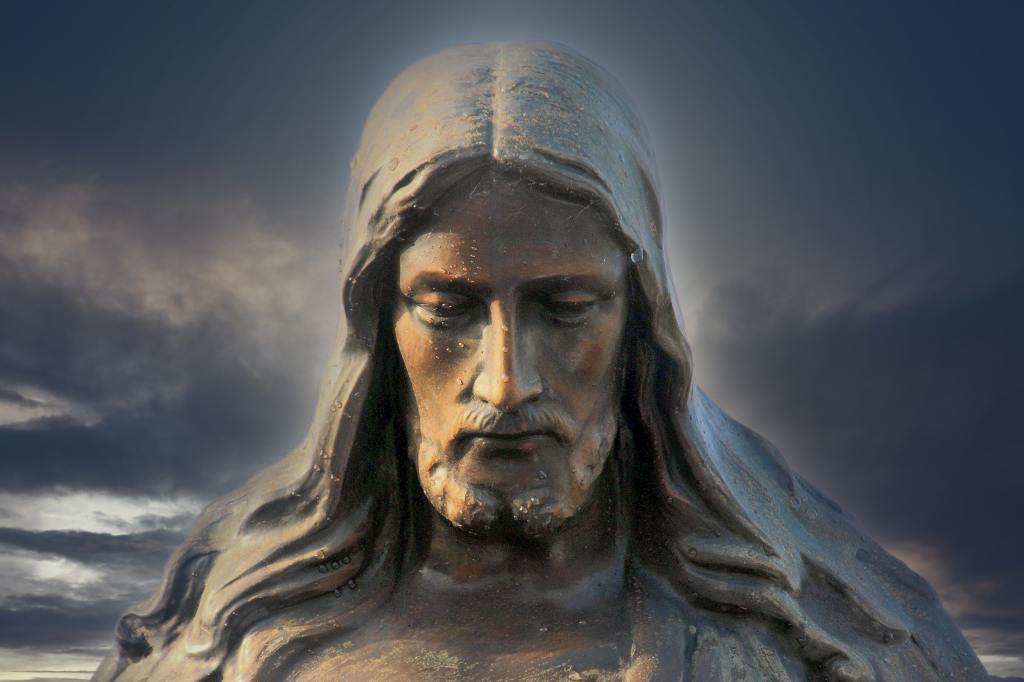
Today has so much happening without me being long winded, but I just wanted to share a thought with you. It comes back to that one line we read: “All of them deserted him and fled.”
It would be easy to criticize the Apostles for their actions on that night. They had been with Jesus for three years, witnessed the miracles, heard the teachings… just a few hours before they had shared the Passover meal with him, yet when things got difficult, “All of them deserted him and fled.”
We could criticize, because we want to say in our hearts that we would have never abandoned him. We would have been the one Apostle that died with him that day, if that’s what it came to, but… well, we know that’s just not true, because in big and small ways, we still desert him everyday. Every time we are disobedient to his commands we abandon him, just like the Apostles that night.
In the end, Jesus hangs alone on the cross. While walking the earth, he could hardly find a moment of peace: someone or some crowd was always looking for him and tracking him down, but when he entered his own suffering, he was left only with faith in his Father.
I would never suggest or even consider that someone could suffer as Jesus did, but in our own ways, we all do, whether it be through emotional, physical, or spiritual pain. We can try and share what we are feeling or experiencing with others, but we are often alone, even if we are surrounded by many, and crying to our Father as Jesus did: “Eloi, Eloi, lema sabachthani? …My God, my God, why have you forsaken me?”
Yet, as we discussed last week, Jesus took on our fear so that he might redeem it, he also takes on our suffering so that he might redeem it as well, but he also helps us through. My friend Thomas à Kempis explains how: “If you are infirm in body, or if you find that you are mentally weary and depressed, or if others despise you, or you lose the good graces of men because of your poverty or some inadequacy, do not give in to sadness or yield to anger. Rather, let this be your way of acting: choose this scene as your safe refuge and enter into conversation with Jesus, despised and hanging on his Cross and abandoned for a time by the Father, and reflect on what he meant when he uttered the words: “My God, my God, why have you forsaken me?” (On the Passion of the Christ: According to the Four Evangelists, p.121)
In that conversation with the crucified Lord, you will discover one who intimately aware of your pain and your sorrows, and one who will take you by the hand and walk with you through that valley of shadows. All may have abandoned him, but he will never abandon or forsake you. As the Lord says through the Prophet Isaiah:
“For I, the Lord your God, hold your right hand; it is I who say to you, ‘Fear not, I am the one who helps you.’”
Let us pray: Heavenly Father, let your blessing be on us as we pass through these holy days in which we remember the sufferings and death of our dear Lord. Set his example before us, that we may follow him in willing obedience, learn his gracious humility, and be filled with his love and spirit of self-sacrifice, and learn the lessons of a life pleasing to you and helpful to our neighbors; through him who loved us and gave himself for us, Jesus Christ our Lord. Amen.
“Why does God stay in heaven and not come down to earth to visit?”
A woman reported that her four-year-old got a bit confused when she taught him that God watches over us. The young boy asked, “Wait, so God is Santa Claus?”
Closely related to that: “Is Santa God’s really rich brother?”
And not related at all: “Is Jesus a zombie?”
An interesting observation: “If God saw that it was not good for Adam to be alone… how come He never made himself a wife?”
A good question: “If Jesus doesn’t have a sister, why do I need to have one?”
I would also like to sign up for lessons: “Did Jesus practice walking on water first? How can I do it?”
Finally, a woman reports that her three-year-old found a baby bird in the yard that had fallen from its nest. When she went to check on it the next morning, it had died. She says she took the kids to school and then removed the bird and placed it in the garbage. However, when he got home, the boy asked, “Mama, what happened to that baby bird?” Trying to avoid the issue, she responded, “Oh, you don’t have to worry about that baby bird, he lives with Jesus now.” The boy was thoughtful for a moment and then asked, “Jesus lives in the garbage?”
As we get older, we like to pretend that we know more of God than these children, but in truth, we just have larger vocabulary. For example: Child — is God Santa Claus? Adult — is God omniscient / all knowing. Child — is God in Heaven and on Earth? Adult — is God omnipresent / everywhere. Child — did Jesus have to practice walking on the water. Adult — is God omnipotent / all powerful. Child — Is Jesus a zombie? Adult — is God infinite. Yes, we have the same questions, just a larger vocabulary. God is immutable, merciful, wise, faithful, and so on.
Holy Scripture also tells us about our God: God is a consuming fire, God is my crag and my stronghold, God is a mighty fortress, God is one, God is love.
Not only do these attributes apply to God the Father, but in our understanding of the Holy Trinity, we also believe that these attributes apply to God the Holy Spirit and to God the Son, Jesus. From the Creed of St. Athanasius found in the Book of Common Prayer: “And the Catholic Faith is this: That we worship one God in Trinity, and Trinity in Unity, neither confounding the Persons, nor dividing the Substance.” In understanding the Father, the Son and the Holy Spirit we have all these tremendous and powerful ways, as adults and children, of understanding our God, which brings me to my point (Yes, Fr. John, a point please!)…
In our Gospel reading today, the Triumphal Entry into Jerusalem that we celebrate on Palm Sunday has just occurred, so we know that Jesus is in Jerusalem, therefore, we also know that the festival about to be celebrated is the Passover. Jew and non-Jews have come to celebrate and among them are Greeks / Gentiles, and they say to Philip, “Sir, we would see Jesus.” The Gentiles coming in search for him must have been a sign to Jesus that everything was in order, for instead of going to see these foreigners, Jesus said, “The hour has come for the Son of Man to be glorified.”
Then God—Jesus—the omnipotent, omnipresent, the consuming fire, the fortress, the merciful… then Jesus says, “Now my soul is troubled.” I know that Jesus, when he humbled himself at the Incarnation and became one of us, I know that he “set aside” some of the attributes of God so that he might be truly man, but he was still God and inside God… is one… who was troubled. That’s almost scary if you think about it too long, and if you didn’t know who is Dad is, then it really would be.
Jesus has come to Jerusalem, the Gentiles are searching for him, so he knows that his time has arrived and he knows what that means: he just spoke about a grain of wheat dying and in doing so, he knows that he is speaking of his own death and all the pain and horror that is to come before it is finally accomplished. Jesus is troubled. God is afraid.
Now, I know that there are some of you sitting out there shaking your heads and thinking, “Fr. John, you’ve crossed a line this morning,” but let me ask you: is Jesus God? Did he say he was troubled? How do you define “troubled”? The Greek defines it as fear, dread, pain, sorrow, anxiety. Feel free to pick one or all, but what we can’t escape is the fact that our omni-everything God… was afraid, and in his being troubled and his fear, he gathered up the humanity of us all, that he might take it to the Cross. He had to experience our fear so that he could redeem it. And what is our fear? Our fear is that on the day of our judgment we will be found wanting and in being found wanting, we will die eternally—that is our fear. Jesus took up our judgment, our death, our fear, our humanity—he took it all within, within the Godhead itself—the Holy Trinity—and declared: “Behold, I am making all things new.”
John tells us in his first epistle: “Whoever confesses that Jesus is the Son of God, God abides in him, and he in God. So we have come to know and to believe the love that God has for us. God is love, and whoever abides in love abides in God, and God abides in him….” …and here it is… “By this is love perfected with us, so that we may have confidence for the day of judgment, because as he is so also are we in this world. There is no fear in love, but perfect love casts out fear. For fear has to do with punishment, and whoever fears has not been perfected in love.” We have not been perfected in our own love. No. Our love is as flawed as our understanding of God, but we have been perfected in Jesus and his perfect love for us casts out our own fears of judgment and punishment that we might rejoice.
Through the Prophet Isaiah, the Lord said: “Fear not, for I am with you; be not dismayed, for I am your God; I will strengthen you, I will help you, I will uphold you with my righteous right hand.”
We joined with the Psalmist this morning in crying out to God: “Have mercy on me… cleanse me… purge me… wash me… block out my offenses… renew me… give me joy.” In all of this, we cry to Father in the same words that Jesus cried, “Father, glorify your name.” Glorify your Son’s name in me. And as the Father spoke to Jesus in the thunder, so He speaks to us: through the perfect love of my Son, “I have glorified it, and I will glorify it again” in you. Se aside your fear and rejoice. The Lord has heard your cries for mercy and He has redeemed you.
This morning, in closing, I would like for us to say together the Song of Zechariah. It is Canticle 16 on page 92 of the Book of Common Prayer. Would you please stand….
Blessed be the Lord, the God of Israel; * he has come to his people and set them free. He has raised up for us a mighty savior, * born of the house of his servant David. Through his holy prophets he promised of old, that he would save us from our enemies, * from the hands of all who hate us. He promised to show mercy to our fathers * and to remember his holy covenant. This was the oath he swore to our father Abraham, * to set us free from the hands of our enemies, Free to worship him without fear, * holy and righteous in his sight all the days of our life. You, my child, shall be called the prophet of the Most High, * for you will go before the Lord to prepare his way, To give people knowledge of salvation * by the forgiveness of their sins. In the tender compassion of our God * the dawn from on high shall break upon us, To shine on those who dwell in darkness and the shadow of death, * and to guide our feet into the way of peace.
Glory to the Father, and to the Son, and to the Holy Spirit: * as it was in the beginning, is now, and will be for ever. Amen.
Boudreaux been fish’n down da bayou all day and he done run outa night crawlers. He got reddy bout to leave when he seen a big snake wif a frog in his mouf. He knowed dat dem big bass fish like dem frogs, so he decided to steal dat frog. Dat snake, he be a cotton mouf water moccasin, so he had to be real careful or he’d git bit. He snuk up behin’ dat snake and grabbed him roun da haid. Dat ole snake din’t lak dat one bit. He squirmed and wrap hisself roun’ Boudreaux’s arm try’n to git hisself free. But, Boudreaux, he gotta real good grip on his haid, yeh.
Now, Boudreaux knows dat he cain’t let go dat snake or he’s gonna bite him good, but he had a plan. He reach into da back pocket of his bib overalls and pulls out a pint a moonshine licker. Den he pour some a’dat into da snake’s mouf. Well, dat snake’s eyeballs kinda roll back in his haid and he turned loose of dat frog and he started licking up dat moonshine licker.
Well, Boudreaux now got da frog, and den puts it in his bait can. Wit dat, Boudreaux toss dat snake into de bayou. Den, he goes back fish’n.
A while later, Boudreaux dun feel sumpin’ tappin’ on his barefoot toe. He slowly look down, and dare wuz dat big water moccasin, ‘wit two more frogs’!
The snake has been with us from the very beginning and just like ol’ Boudreaux’s drinking buddy, it has always been crafty.
In our first lesson, we read about he Israelites in the desert and they have begun their whining against Moses and the Lord. The Lord, not wanting to put up with that type of behavior, sends the snake as an instrument of punishment. A bit like, “If you think this is bad, let me show you how it can get even worse.” The snakes bit them and they died. They repented of their whining and came to Moses looking for salvation from the snakes, so the Lord told Moses to create a bronze snake and lift it up on a pole, so that when they are bitten, they may look upon the bronze snake and live. Put another way, after being bitten, the people had to look upon and face their own death—represented by the snake, lifted up on the pole… they had to face their own death, which was the consequence of their rebellion against God, in order to have life. In our Gospel reading, Jesus took that event, and applied it to himself. How does that work? In order to know the answer, we have to go back to the beginning to the first Adam and the original snake.
We are familiar with the story: “The serpent was more crafty than any other beast of the field that the Lord God had made.” And the snake deceived Eve with his words, and Eve, “saw that the tree was good for food, and that it was a delight to the eyes, and that the tree was to be desired to make one wise, she took of its fruit and ate, and she also gave some to her husband who was with her, and he ate.” When they ate the fruit, they were spiritually bitten by the snake. The snakes poison entered into them and with it came death. However, the poison was not limited to just Adam. St. Paul writes, “Sin came into the world through one man — Adam — and death through sin, and so death spread to all men because all sinned.” Through Adam’s sin, sin and death entered us all.
Jesus also encountered this same snake. The first time was shortly after his baptism: “If you are the Son of God, command these stones to become loaves of bread.” “If you are the Son of God, throw yourself down” from the pinnacle. Showing him all the kingdoms of the world, the snake said, “All these I will give you, if you will fall down and worship me.” When these attempts failed, we are told, that the snake departed from him “until an opportune time,” which came when the same snake slithered out in the Garden of Gethsemane on the night before Jesus was crucified. Scripture gives no indication as to what form this temptation took, but we know that the battle was great, for we are told that in his distress, Jesus sweat drops of blood. Yet, Jesus persevered and remained faithful to the Father: “Not my will, but yours be done.” The poison did not enter him.
The snake bit and poisoned the Israelites as they wandered in the desert. In order to live, they had to look upon their own death, the consequence of their rebellion against God. The snake bit and poisoned Adam and Eve, and through Adam’s sin, we have also been poisoned. The snake bit Adam and Eve, the Israelites, and please don’t force me to count the number of times I have been bitten. Therefore, like the Israelites, we too must look upon our own death, the consequence of our rebellion against God. As Jesus was the only one not poisoned, then he is the only one that we can look upon who can save us. From our Gospel, Jesus said, “Just as Moses lifted up the serpent in the wilderness, so must the Son of Man be lifted up, that whoever believes in him may have eternal life.”
Like the bronze serpent that was lifted up on the pole, Jesus is lifted up on the cross, and it is only by gazing upon him, looking at our own death, and believing in him, that we have eternal life.
Speaking of those who were gathered around the Cross, St. Augustine of Hippo wrote: “As they were looking on, so we too gaze on his wounds as he hangs. We see his blood as he dies. We see the price offered by the redeemer, touch the scars of his resurrection. He bows his head, as if to kiss you. His heart is made bare open, as it were, in love to you. His arms are extended that he may embrace you. His whole body is displayed for your redemption. Ponder how great these things are. Let all this be rightly weighed in your mind: as he was once fixed to the cross in every part of his body for you, so he may now be fixed in every part of your soul.”
The snake poisoned our flesh and our souls, bringing separation from God and eternal death; therefore, turn your eyes to Jesus lifted high upon the cross and live. St. Teresa of Avila said, “Reflect carefully on this, for it is so important that I can hardly lay too much stress on it. Fix your eyes on the Crucified and nothing else will be of much importance to you.” (Interior Castle)
Let us pray (Christaraksha, India): May the cross of the Son of God, which is mightier than all the hosts of Satan and more glorious than all the hosts of heaven, abide with you in your going out and in your coming in.
By day and by night, at morning and at evening, at all times and in all places may it protect and defend you. From the wrath of evildoers, from the assaults of evil spirits, from foes visible and invisible, from the snares of the devil, from all passions that beguile the soul and body: may it guard, protect and deliver you. Amen.
Most are aware that the Law of the Old Testament prohibits eating pork, however, there was a fella who had been a rabbi for many years and, all his life, he’d tried to be a good Jew. He obeyed the ten commandments, he read the Torah frequently and he kept kosher, but secretly, he’d always wanted to try pork.
Everybody made so much fuss about pork and bacon and ham and he always wanted to taste it, to see if it lived up to the hype.
So, one day, he said to himself, “I’m getting on in years, I’ve always done my best to be good, so if I do this one thing, I’m sure it won’t really matter.” And he went to a restaurant to try some pork.
Since it would be the first and last time he ever tried it, he thinks, “Might as well be hanged for a sheep as for a lamb” and orders the fanciest pig dish on the menu. A few minutes later, the waiter comes in with a tray carrying a whole roasted suckling pig with a big red apple lodged in its mouth.
He places it on the table and the rabbi picks up his fork and is about to tuck in when he hears a voice behind him, “Rabbi? Is that you?” He turns around to see one of the people from his synagogue. They both look at each other and then at the pig and then back at each other. The man says “Rabbi? What’s going on?” The rabbi says, “I know, disgusting isn’t it. I only ordered an apple and look how they’ve served it!”
All I can add to that is… bacon!
Keeping the Law. When we speak of law, we think courts and judges, physics, science, and speeding tickets. When we consider our Christian faith, there is also the Law of Moses—the one we hear about throughout both the Old and New Testament, but there is also more, and one that C. S. Lewis talks about in Mere Christianity is the Law of Nature. He states that within every society, there may be moral variances, but there is also—perhaps with the exception of the most extreme—a law of moral decency in that we have an innate ability to know right from wrong, and that we do in fact know when we are doing wrong. Continuing from there, he says there are two points he wants to make regarding the Natural Law. “First, that human beings, all over the earth, have this curious idea that they ought to behave in a certain way, and cannot really get rid of it—that is the Law of Nature—Secondly, that they do not in fact behave in that way. They know the Law of Nature; they break it. These two facts are the foundation of all clear thinking about ourselves and the universe we live in.”
Some might say, we are no longer under the Mosaic Law, the one the Rabbi was called to follow. That is true, we are under grace, but I would suggest to you that parts of the Mosaic Law, especially the top ten, are also a part of the Laws of Nature. They divulge our innate understanding of God and they show to us the way of right living that is applicable to all humanity.
For example, there may be some who do not understand God as we do, but who can’t look to the heavens and the world around them and not know that there is a God—“The invisible things of God are seen in his creation.” Whether you’ve been taught of God or not, you know that there is one who created and therefore you know that you should give honor. You also know by nature that you should not kill, or steal, etc. Even an atheist knows these things. No one has to tell you that these things are wrong. Yet, as Lewis pointed out, we break these natural laws.
So, if we have the Natural Law, that innate ability to know right from wrong, then why was the Mosaic Law given? Because even though the people had the Natural Law, they weren’t following it. God didn’t just randomly make up laws and say, “Do this and don’t do that.” He gave the Law because the people were violating the Natural Law they already knew, but in giving the Law, the people would no longer have an excuse. They couldn’t say, “We didn’t know it was wrong,” because God had now plainly told them that it was. However, with the Mosaic Law, the people ran into the same problem as they had with the Natural Law, the problem that Lewis pointed out: you know the Law, but you just keep breaking it. Our Rabbi knew the prohibition about eating pork, but at some point—regardless of that knowledge—he chose to place the order.
Now, rewind to last week, we talked about how the will of God is clear to us all: love God, love your neighbor, love yourself. That is the will of God for our lives and we also know that it is the new commandment that Jesus gave us. Unfortunately, we are really no better at keeping it than we are at keeping the Law of Nature or the Mosaic Law. As Lewis said about the Law of Nature, we know the commandment Jesus gave us, but we break it. It is the will of God, but we struggle to fulfill it.
Natural Law – failures. Mosaic Law – failures. Greatest Commandments of Jesus – failures.
St. Paul wrote to the Romans, “So I find it to be a law that when I want to do right, evil lies close at hand. For I delight in the law of God, in my inner being, but I see in my members another law waging war against the law of my mind and making me captive to the law of sin that dwells in my members. Wretched man that I am! Who will deliver me from this body of death?” (Romans 7:21-24) Who will deliver me, indeed! Who will deliver us? You know the answer: “Thanks be to God through Jesus Christ our Lord!” (Romans 7:25a)
In The Cost of Discipleship, Dietrich Bonhoeffer wrote, “It is Jesus himself who comes between the disciples and the law, not the law which comes between Jesus and the disciples.” (p.123) We are failures in fulfilling God’s will and His commandments, but if we will humble ourselves “under the mighty hand of God” and receive the Good News of Jesus Christ, then the Cross of Christ is placed between us and our failures, and through it we are saved. As St. Paul said to us this morning in our Epistle lesson, “The message about the cross is foolishness to those who are perishing, but to us who are being saved it is the power of God.” The message of the cross may sound like foolishness, but it is in fact the greatest expression of God’s radical love for his children that they may be with Him.
The Lord said through the Prophet Isaiah:
“Turn to me and be saved, all the ends of the earth! For I am God, and there is no other. By myself I have sworn; from my mouth has gone out in righteousness a word that shall not return: ‘To me every knee shall bow, every tongue shall swear allegiance.’” (Isaiah 45:22-23)
Humble yourself, bend your knee to the Lord, confess him as Savior, and have the cross of Christ as your guide and defense.
Let us pray: Holy Cross of Jesus, have pity on me. Holy Cross of Jesus, be my protector. Holy Cross of Jesus, take away all bitter pains. Holy Cross of Jesus, take away all evil. Holy Cross of Jesus, let me walk in the way of salvation. Amen.
When there is a popular TV show or movie, the names of characters can end up as children’s names. 2020 it turns out was no exception (well, 2020 was no exception to many things). So we have children now running around with names like Sansa from Game of Thrones and Katniss from The Hunger Games. Those are OK. They reflect our heroes, but other parents… other parents bring out my less than charitable side, because they’ve hung an albatross of a moniker around their children’s necks. For example, can you imagine the life of the children whose names are Facebook, Moxie Crimefighter, Hashtag, or Yoga? Or, if there were twins, you could do like a couple in New Zealand and name them Fish and Chips (the government actually stepped in on that one and said, “No.”) All I can figure is that these names must have been conceived while under the influence of Vodka (also a child’s name) and can best be described as Smellie (yes, another child’s name and one who will require massive amounts of therapy to overcome poor self-esteem.) These parents should have heard the command of English poet and priest, George Herbert, “Admit no vain or idle names.”
Why would parents do such a thing? I think it comes down to not placing any significance on a name: “a rose by any other name is still a rose” and a child by any other name—even if that name is Nutella—is still a child. However, Eugene Peterson, wonderful theologian and author of Run with Horses, understands the name with far greater significance. He writes, a “name addresses the uniquely human creature…. The meaning of a name is not in the dictionary, not in the unconscious, not in the size of the lettering. It is in relationship—with God.” He says that when he is baptizing a child and asks the Godparents, “‘What is the Christian name of this child?’ I am not only asking, ‘Who is this child I am holding?’ but also, ‘What do you want this child to become? What are your visions for this life?’” “Anything other than our name—title, job description, number, role—is less than a name.” (p.27-32) In other words, a person’s name defines a relationship with God and purpose in life. That relationship and that purpose then, can be understood as the will of God, which perhaps helps us understand why God changed peoples name. Take for example our first lesson from today: Abram and Sarai.
God came to Abram and made the Covenant with him—“your descendants shall be more than the stars in the skies”—and so God changed Abram’s name to Abraham. Abram means, “high father” and Abraham means, “father of a multitude.” God gave him a new name and changed the purpose of his life. In doing so, God defined his will for Abraham: one who is to fulfill the covenant. As Abraham could not do this alone, God changed the name / purpose of his wife. Sarai, which means, “my princess” to Sarah, meaning “mother of nations.” She too had her name and purposed redefined. We know of others. Jacob, meaning “supplanter” because he stole his brother’s birthright, became Israel, “having power with God.” Simon, “God has heard,” became Peter, “the rock.” Name and purpose, which defined God’s will for each of their lives. Only trouble, on the surface, it doesn’t seem that God changes people’s names anymore, so how can we know our purpose, but that is the surface. Going deeper, we realize that God has changed everything about us for the fulfillment of his will.
St. Paul: “If anyone is in Christ, he is a new creation; old things have passed away; behold, all things have become new.” (2 Corinthians 5:17)
St. Peter: “Once you were not a people, but now you are God’s people; once you had not received mercy, but now you have received mercy.” (1 Peter 2:10)
St. John: “Beloved, now we are children of God.” (1 John 3:2)
Jesus: “No longer do I call you servants, for the servant does not know what his master is doing; but I have called you friends.” (John 15:15)
God has not changed our names, he has transformed who we are into a completely new creation: his people, his beloved, his children, and maybe more important than all that… his friend; and in doing so, he has given us the purpose of our lives and shown to us his will—and don’t hate the messenger—but you know what that will is. Yes, you do: love—to love God and to love neighbor, the rest…
Do you know what a spaghetti junction is? You really only have them in cities, but they are where many interstates and roads come together and are intertwined with bridges and tunnels, on-ramps and off-ramps, big arching loops and tight circles. They look like a plate of spaghetti. I think they are a pretty good example of life—not just a single junction, but one after the other. A constant discernment of the various decisions of our lives. It often times is a mess that not even Siri can get you through, but what is impossible with man is possible for God, for if you will look at the road before you, you will know the one that God has designed for you—even with all its loops and weavings. How? There are many roads we can take, but there is only one that is ordered by love. If you will follow the road that allows you to love God and to love neighbor—as crazy as that road may look—then you are fulfilling the will of God and the purposes for which you were created.
Imagine your life when the decisions are before you and instead of asking, “What can I get out of this? What will benefit me? How will this make me look?”; instead of asking those questions, imagine your life when the decisions are placed before you and you ask, “How can I fulfill the purpose of God… the will of God?”, which is just another way of asking, “How can I love?” With the decision before me, “How can I love God and a my neighbor?” It will not always be an easy choice and you may be the one who “loses” according to the world’s standards, but you will hear those words, “Well done, good and faithful… friend.”
Eugene Peterson said, that when he asks for the name of the child to be baptized that he’s not only asking, what is this child to be called, but is also asking, “What do you want this child to become? What are your visions for this life?” Those are also questions that we ask God for ourselves. What do you want me to become? What is your visions for my life? The answer: follow the road of love.
God has given his son a name which is above every name and you have been called according to that name. You have been called to the fulfillment of love.
Let us pray: Most holy Trinity, Father, Son, and Holy Spirit, Our first beginning and our last end: You have made us In accord with your own image and likeness. Grant that all the thoughts of our minds, All the words of our tongues, All the affections of our hearts, And all the actions of our being may always be conformed to your holy will, so that on the last day, we may enter your eternal kingdom and live in your glory. Amen.
Today we celebrate St. Matthias and our reading from the Acts of the Apostles that we heard is all we really know about him. He is believed to have been one of the seventy-two that Jesus sent out, but when it came time to replace Judas Iscariot as an Apostle, he won the position by the casting of lots. Tradition holds that he ministered in and around Judea and would eventually be martyred for the faith. However, as I was thinking and praying on the message for today, it wasn’t Matthias that I kept thinking on. The passage said, “they proposed two, Joseph called Barsabbas, who was also known as Justus, and Matthias.” The casting of lots made Matthias an Apostle, but what about Joseph Barsabbas?
Can you imagine: soon after the death and resurrection of Jesus, the eleven remaining Apostles come together, have a conversation, and decide that Judas needs to be replaced. So, they sort through all the resumés and you and this other fella, Matthias, are up for the job. Then Peter grabs the dice, points at you and says, “Even number the job is your’s, odd it goes to Matthias.” And it is over that quick: Peter rolls a five, claps you on the back, and turning to Matthias, ushers him into the inner circle. You know, Jesus called Peter the Rock, but if I had been in Joseph’s sandals, I would have to liked to hit him with one! So close!
Back in 1858, Abraham Lincoln was running against Stephen Douglas for a seat in the Illinois legislature. Lincoln actually won the popular vote, but due to an obscure state statue, the seat was awarded to Douglas (which only goes to prove that we’ve never been able to hold a proper election!… anyhow…) A friend came to Lincoln and asked him how he felt. He is reported to have responded, “Like the boy who stubbed his toe: I am too big to cry and too badly hurt to laugh.”
I wouldn’t be surprised in the slightest if that is how Joseph felt, but apparently he demonstrated no ill feelings. St. John Chrysostom writes, “The other candidate (Joseph) was not annoyed, for the apostolic writers would not have concealed failings of their own, seeing they have told of the very chief apostles, that on other occasions had indignation, and not only once, but again and again.” If Joseph had been upset at losing, Luke would have recorded it. He did not, and Joseph went on to become a bishop, martyr and Saint.
We can look to the Apostle Matthias—also a martyr and saint—and understand that if God chooses a specific roll for our lives, his will will be accomplished, but we can also look at Joseph and see that although there are disappointments, God’s will is still accomplished.
When the disappointments come our way, which they most certainly will, then we must say with the Psalmist, “Why are you cast down, O my soul, and why are you in turmoil within me? Hope in God; for I shall again praise him, my salvation and my God.” Why are you disappointed and cast down? God’s purposes will be fulfilled in us all.
Portland, Oregon: they have 222 days with what is considered heavy cloud cover and only 68 days that are considered clear, the other days being moderately cloudy; and it rains, on average, 164 days a year. Oklahoma gets 84 on average. With that in mind…
A fella dies and finds himself in line for judgment. As he watches, he sees some being ushered into Heaven and others directed to the Devil who is off to the side waiting for the wicked. As the guy watched, he saw Satan immediately throw some folks into hell, while a few he pitched over unto a pile. After watching Satan do this several times, the fellow’s curiosity got the better of him. He strolled over and tapped Old Nick on the shoulder.
“Excuse me, there, Your Darkness,” he said. “I’m waiting in line for judgment, and I couldn’t help wondering why you are tossing some people aside instead of flinging them into the fires of hell with the others?”
“Ah,” Satan said with a grin. “Those are Portlanders. I’m letting them dry out so they’ll burn.”
On Ash Wednesday, we talked about how the last twelve months have really seemed a bit like Lent with all the isolation, “fasting” from life, and denial of the lives we had. Continuing with that thought, we can use what lead up to our Old Testament lesson, the great flood, as an analogy for what has been happening. How? Well it’s been raining. As my Granma would say, It’s been raining cats and dogs. More than even in Portland. In fact, it’s almost comical at this point: pandemic, elections, masks, isolation, elections, Arctic blast, and that earthquake Friday morning was a real kicker! When it was over, I just kinda busted out laughing. With everything that has been thrown at us, the only thing I’m missing on my “This is Your World” Bingo card is Velociraptors, and based on what I read about some ridiculous cloning experiments… it wouldn’t surprise me! Yes. It is raining and I for one—and I know I’m not alone in saying this—am ready to dry out, I’m ready to see the rainbow. That sign of a storm passing and of peace. I know that God’s not going to wipe us out again like with what happened in the flood, but we could all use a reprieve; however, this is where we are and for now, it is still raining, and as Dolly Parton says, “If you want the rainbow, you gotta put up with the rain.” If this is the case, the where are we to find safety between the two, between the rain and the rainbow?
I think most are aware of this: the area in the church where you all sit is called the nave. These two side areas are called transepts and this area in the center is called the crossing. The entire area up here is called the chancel, which is broken down into the choir and the sanctuary, the area of the high altar.
Between the sanctuary and the chancel with the transepts, we have the cruciform shape, with the altar, Christ as the head. Now, the word “nave” is quite similar to the word “navy” and they both have as their Latin root word navis, which means ship, which comes from the Greek word naus, also meaning ship. Not only that, but looking up—and the architecture St. Matthew’s does this marvelously—you see the form of a ship, as though you were looking at it from above.
Where are we to find safety between the rain and the rainbow? This ship… Noah’s Ark… the Church. Yet we know that the church is not just this building, but is the Body of Christ and Christ is the head; and it is only through that Body, that community of the faithful—both lay and ordained—that we find our salvation from the rain and storms while we wait on the glorious appearing of the rainbow, which is the coming of our Lord.
My friend, St. Josemaría Escrivá says, “No later than the second century, Origen wrote: If anyone wants to be saved, let him come to this house so that he can obtain salvation… Let no one deceive himself: outside of this house, that is outside of the Church, no one will be saved. Of the deluge – the great flood – Saint Cyprian says: If someone had escaped outside of Noah’s ark then we would admit that someone who abandoned the Church might escape condemnation.” (In Love with the Church, 2.24) But the truth is, no one, other than the eight on the Ark, survived, and they only by the grace of God.
While it is raining out, know in your heart and mind—and I’m not going to speak for other churches—but know in your heart that the community of St. Matthew’s is an ark where you can find fellow passengers who are here to give comfort and support and who need you for the same reason. Know that we are a church where you can find sanctuary from the storm so that your soul might know and feel the peace of God. In this ship, you can receive food for your soul, the Body and Blood of Christ. This church is a place where you can know that even when it is raining, the rainbow is present and reflected through God’s people as they continue to witness to the protective covenant that God made to his people.
Let us pray: O Lord, our God, You called Your people to be Your Church. As we gather together in Your Name, may we love, honour, and follow Your Son to eternal life in the Kingdom He promised. Let our worship always be sincere, and help us to find Your saving Love in the Church and its Sacraments. Fill us with the Spirit of Christ as we live in the midst of the world and its concern. Help us by our work on earth to build up Your eternal Kingdom. May we be effective witnesses to the Truth of the Gospel and make Your Church a living presence in the midst of the world. Increase the gifts You have given Your Church that we, Your faithful people, may continue to grow in holiness and in imitation of Your Beloved Son. Amen.
Wisdom according to Bill Murray, “Whatever you do, always give 100%. Unless you’re donating blood.”
Here in a few minutes, I’m going to speak the following words to you: “I invite you, therefore, in the name of the Church, to the observance of a holy Lent, by self-examination, and repentance; by prayer, fasting, and self-denial; and by reading and meditating on God’s holy Word.” After the past twelve months, I kinda feel like we’ve done a fair amount of “fasting” and “self-denial.” In fact, it seems that we’ve come close to giving 100% of all we’ve got to give and so I’ve been asking myself, “When will it be enough?” But I also wonder if maybe we’ve been so focused on what we’ve lost, that we haven’t been able to focus on anything else.
One of the best books I know on loss and grief is A Grief Observed by C.S. Lewis. The book is a series of reflections on grief and loss that Lewis wrote following the death of his wife after only three years of marriage. Towards the beginning of the book he speaks about how everything revolves around what was lost: “I once read the sentence ‘I lay awake all night with a toothache, thinking about the toothache an about lying awake.’ That’s true to life. Part of every misery is, so to speak, the misery’s shadow or reflection: the fact that you don’t merely suffer but have to keep on thinking about the fact that you suffer. I not only live each endless day in grief, but live each day thinking about living each day in grief.” (p.9)
We experience loss, then we think about the loss, and then we think about thinking about our loss. A horrible cycle that as it draws us into ourselves, it pushes everything else out. Lewis then speaks about grief and loss in terms of fear and suspense, which I think aptly describes where so many have been: “grief still feels like fear. Perhaps more strictly, like suspense. Or like waiting; just hanging about waiting for something to happen. It gives life a permanently provisional feeling. It doesn’t seem worth starting anything. I can’t settle down. I yawn, I fidget, I smoke too much. Up till this I always had too little time. Now there is nothing but time. Almost pure time, empty successiveness.” (p.33)
Sound familiar? In the past twelve months, we have lost everything from the opportunity to go on a cruise in the Bahamas to those we have loved the most. What do we do in our grief and our loss? We pace the house. We get bored. We eat too much. Drink to much. We binge watch TV too much. We’ve got more time on our hands than we’ve ever had before, and we’ve know idea what to do with it, even when we have things to do! So again, how can I stand up here and encourage you to self-reflect—when that’s all you’ve been able to do, to fast—when we’ve been fasting from life, to practice self-denial—because there’s not much left to deny? I can ask you to do these things—and perhaps it’s just me and this is a public confession—but in the midst of our loss and grief, we’ve, on occasion, lost the most important thing: we’ve lost our sense of God.
He just doesn’t seem as close as he use to be. We don’t talk to him as much as we did. We don’t sit with him in silence, enjoying the beauty of creation. We’ve drifted. You would think with all the isolation, fasting, and self-denial that we’ve done, we would have drawn closer, but, in many cases, the opposite is true. Why? Because we’ve been doing all the self-denial, etc., because we’ve been forced to do it, but when we do them for God, we do them out of love—that we might draw nearer to God, by placing our faith and needs in his hands. Therefore, I am going to ask you and myself to observe this holy Lent, with all of its practices, but to adhere to them—not because you are forced—but because of your love for the One True God. And if you don’t feel that love, then pray that he will show you, for he has not forgotten his people.
As a father cares for his children, so does the Lord care for those who fear him. For he himself knows whereof we are made; he remembers that we are but dust.
And in remembering, he will never leave or forsake us.
The Crucible by Arthur Miller: a story of the Salem witch trials and the false accusations that flew. John Proctor, although not an innocent man, is silent until his wife, Elizabeth, is accused and arrested of being a witch. The preacher questions John about his wife and “if” she is innocent. John becomes angry, especially at the girls, Parris and Abigail, who are doing the accusing:
“If she is innocent! Why do you never wonder if Parris be innocent, or Abigail? Is the accuser always holy now? Were they born this morning as clean as God’s fingers? I’ll tell you what’s walking Salem—vengeance is walking Salem. We are what we always were in Salem, but now the little crazy children are jangling the keys of the kingdom, and common vengeance writes the law!”
I came across a story about a middle school class of teens that were learning about the Salem Witch Trials, and their teacher told them they were going to play a game.
“I’m going to come around and whisper to each of you whether you’re a witch or a regular person. Your goal is to build the largest group possible that does not have a witch in it. At the end, any group found to include a witch gets a failing grade.”
The teens dove into grilling each other. One fairly large group formed, but most of the students broke into small, exclusive groups, turning away anyone they thought gave off even a hint of guilt.
“Okay,” the teacher said. “You’ve got your groups. Time to find out which ones fail. All witches, please raise your hands.” No one raised a hand.
The kids were confused and told him he’d messed up the game. “Did I? Was anyone in Salem an actual witch? Or did everyone just believe the lie?”
No proof… Vengeance. It was not what they knew of one another, but what they had come to believe, because if enough people believe it, then it must be true. Right?
A man with an unclean spirit entered the synagogue in Capernaum. Seeing Jesus, the unclean spirit cried out: “What have you to do with us, Jesus of Nazareth? Have you come to destroy us? I know who you are, the Holy One of God.” But Jesus wasn’t having any of that nonsense and rebuked the spirit, “Be silent, and come out of him!”
When I read that passage, I can hear the fearful squeaking of the unclean spirit’s voice when it speaks to Jesus and I hear the complete authority of Jesus’ voice when he rebukes that unclean spirit: “Be silent, and come out of him!” However, there are days when I hear the words of the unclean spirit spoken, but it is not that fearful squeaking voice. It is a voice that is full of confidence and sarcasm and vengeance. At times it speaks to me about others. Essentially it is just a variation of the message spoken in Salem. “I know that one, he’s a liar. And that one over there, look how different they are, definitely the wrong sort. Heck. Why care? They aren’t even Christian.” For my part, if I don’t rebuke that voice as Jesus did, then I’ll come to believe it and like those teens did with their classmates, I’ll turn them away.
At other times, that same voice speaks to me, but this time it is filled with condemnation: “I know who you are, ____.” Depending on the day, I can fill in that blank with any number of accusations: “I know who you are, a fraud… hypocrite… bigot… loser… racist, and on and on, and in the end, it all comes down to the cardinal accusation: “I know who you are, a sinner.” And in those words and with that tone, I start to believe it.
There is a political / propaganda tool known as the “big lie” and it has several primary components: – The more outrageous the lie, the more weight it will carry. – Strongly assert the lie. – Repeat, repeat, repeat. – Massage available data to “prove” the lie as being true. – Reframe any vigorous denial as proof of guilt.
Does it work? “The rabid, impudent bias and persistence with which this lie was expressed took into account the emotional, always extreme, attitude of the great masses and for this reason was believed ” (Adolf Hitler) “If you tell a lie big enough and keep repeating it, people will eventually come to believe it. (Joseph Goebbels, Hitler’s Minister of Propaganda) Does the big lie work? Absolutely. It worked during the Salem witch trials, the rise of the Third Reich, and so many other times in history; and the evil spirit is so very good at using it on humanity, both as a whole and individuals.
That evil spirit takes our faults and expands on them or it pulls one piece of our history and reminds us of some sinful behavior, then it elaborates on it to prove what horrible people we are and constantly places it before us; as the Psalmist says, “My sin is ever before me.” We try to convince ourselves that we are forgiven through the very blood of Christ, but our defense is twisted and restated as a sign of our continued guilt. “I know you… you are a sinner. You always have been and you always will be.” We hear those words time and time again and we begin to believe them.
Hitler and so many others knew this technique because they learned it from the greatest liar of all. Jesus said, “[The devil] was a murderer from the beginning, and does not stand in the truth, because there is no truth in him. When he lies, he speaks out of his own character, for he is a liar and the father of lies.”
I know that we aren’t supposed to talk about the devil. We are supposed to be too enlightened for such “boogey men”, but in my opinion, to say there is no devil is another of the big lies that we’ve all been conditioned to believe, and it is he that speaks those words in our ears: “I know who they are… I know you, you are….” To that, I say, “Don’t you believe it! For God so loved the world, that he gave his only Son, that whoever believes in him should not perish but have eternal life.”
Don’t you believe the big lies that seek to push others away who are different or rob you of your joy by convincing you that you are unworthy. Both these actions damage our souls and draw us away from God. Don’t you believe it. With Jesus beside you and within you, rebuke that evil spirit as Jesus did: “Be silent!” Be silent, for we were all created in the image of God. Be silent, for I am a child of God. Then… then say to God, “Speak, for your servant is listening” and allow God to speak the truth.
Let us pray: Father in Heaven, You made us Your children and called us to walk in the Light of Christ. Free us from darkness and keep us in the Light of Your Truth. The Light of Jesus has scattered the darkness of hatred and sin. Called to that Light, we ask for Your guidance. Form our lives in Your Truth, our hearts in Your Love. Through the Holy Eucharist, give us the power of Your Grace that we may walk in the Light of Jesus and serve Him faithfully. Amen.