Sermon: Feast (Eve) of Corpus Christi

Photo by Mateus Campos Felipe on Unsplash

The Church Year is something that liturgical churches are very aware of. In it we have the various seasons: Advent, Christmas, Epiphany, Lent, Holy Week, Easter, Pentecost, and the season after Pentecost. We also know that contained within those seasons are various other feast days and celebrations, for example, this past Sunday was Trinity Sunday. We also know that within Holy Week, there are other significant days: Maundy Thursday, Good Friday, etc. and it is on Maundy Thursday that we celebrate the giving of the Holy Eucharist, because it was on the Thursday before his crucifixion that Jesus celebrated the Eucharist for the first time with his disciples in the upper room. With that in mind…

In the year 1192, a young girl, Juliana, was born in Belgium, and she later had a younger sister Agnes; however, their parents died and the two were left orphans, so they were taken to an Augustinian monastery to be raised. Later, Agnes died leaving Juliana alone with the Augustinian sisters. At the age of 16, Juliana began to have the same vision over and over, both during the day and at night: she saw a bright moon with a dark spot on it, but she did not understand its meaning until Jesus explained it to her.

Jesus said that the moon represented the Church Year and that the dark spot was a missing feast day that he wanted to see instituted: a feast day in celebration of the Holy Eucharist. As there was already Maundy Thursday, Juliana asked why another was needed and was told that people would soon begin to forget or disbelieve the Real Presence of Jesus in the Sacrament and that there was also to be a joyous celebration—not something that could take place during Holy Week—of the sacrament. Hearing this, Juliana went on a mission to establish the feast, but the idea was not popular and she only saw it celebrated once in her lifetime. But, if God wills it… as it turns out, one of Juliana’s friends whom she consulted about the entire matter before her death was Jacques Pantaléon, who would later be known as Pope Urban IV. It is good to have friends elevated to such high positions and Pope Urban would eventually establish the Feast of Corpus Christi across the Church and it would continue in the Church of England, even after the split from Rome.

There are few Protestants who believe in the Real Presence and there are many within the catholic tradition who simply believe that the bread and wine remain bread and wine, but… they are wrong. From St. Justin Martyr’s First Apology (FYI: his feast day was yesterday): “We call this food Eucharist, and no one else is permitted to partake of it, except one who believes our teaching to be true and who has been washed in the washing which is for the remission of sins and for regeneration [i.e., has received baptism] and is thereby living as Christ enjoined. For not as common bread nor common drink do we receive these; but since Jesus Christ our Savior was made incarnate by the word of God and had both flesh and blood for our salvation, so too, as we have been taught, the food which has been made into the Eucharist by the Eucharistic prayer set down by him, and by the change of which our blood and flesh is nurtured, is both the flesh and the blood of that incarnated Jesus.” And Jesus could not have been any more clear: “Whoever feeds on my flesh and drinks my blood has eternal life, and I will raise him up on the last day.  For my flesh is true food, and my blood is true drink.  Whoever feeds on my flesh and drinks my blood abides in me, and I in him.” (John 6:54-56) In the past, Christians were put to death as cannibals for believing and saying such, but we as God’s people know that the Real Presence of our Savior is truly present, hidden within the bread and the wine; therefore, let us always approach this most wonderful sacrament with joy and awe and wonder and fear, for it is Jesus himself that is being given to us.

Sermon: Trinity Sunday RCL B – “Nicodemus Hour”

Photo by Aron Visuals on Unsplash

A young mom brought her two boys to church. The boys were old enough to know that they needed to sit quietly during the service and young enough to not quite be able to pull it off. As the sermon began, the fidgets set in. About half way through, the boys were about to enter into full on youngsters, so mom leaned over and quietly spoke to them. Next thing you know, the two boys were sitting quietly, with their hands in their laps. Following the service, another mom, who had witnessed the exchange, but who had not been as successful came up to the mom of the two boys, with admiration in her voice, asked what she had said to settle the boys down so quickly. “I just reminded them,” she said, “that if they weren’t quiet, Fr. John would lose his place and have to start all over again.”

Listening to someone talk can at times be completely engaging and at other times… bring on the fidgets. I always thought it would be nice to have Professor Slughorn’s hourglass to judge these things by.

For those who don’t know Professor Slughorn, he was Harry Potter’s potions professor at Hogwarts School of Witchcraft and Wizardry, and in his office he had a most peculiar hourglass. It is not in the books, only the movie, but the professor describes it to Harry by saying, “A most intriguing object, the sand runs in accordance with the quality of the conversation. If it is stimulating the sand runs slowly, if it is not….” Well, he doesn’t finish the sentence and I won’t spoil the movie, but you get the idea. At the end of that scene, the sand isn’t running at all. I suppose that would be a useful tool in preaching.

As I think on such an hourglass and consider some of the conversations I’ve had, I can see the sand flowing freely with some and at other times, not even a whisper of movement. What’s interesting though, is the time of day when most of those conversations occur. Have you ever noticed? Early in the morning, I don’t even talk to the cat. In the middle of the day, I can be a bit keyed up. I try to slow down when I’m with folks, but there’s always that invisible hand on my back, pushing me just a bit to get to the next thing. That’s probably true for most, but at night, when we’ve met our responsibilities and filled our duties for the day, then it seems we can get down to the real business of actually living and having those deep, intimate conversations where the sand in the hourglass slows perceptibly, because the world and our minds are just a bit more hushed.

Think of those conversations you’ve had with one you love. You can stay up all night talking and feel more rested in the morning than if you’d had eight hours of sleep. Later at night is the time when we speak most intimately to one another and I believe that it is also the time when we speak most intimately with God.

I am not suggesting that you start laying in bed at night to pray, because 9.9 times out of ten, you’ll just fall asleep, but in the evening, when the day is done, it really is a good time to settle in with God to have one of those intimate conversations. Those conversations with God, at that time of the day, even have a name: the Nicodemus Hour. (Source: Behold, God’s Son, Christoph Cardinal Schönborn, p.165)

“There was a Pharisee named Nicodemus, a leader of the Jews. He came to Jesus by night and said to him, ‘Rabbi, we know that you are a teacher who has come from God; for no one can do these signs that you do apart from the presence of God.’”

There is so much to learn from the words of Jesus that follow. He expresses the deepness, even unto death, of God’s love for us, but today, instead of looking at the words, I want us to look at the setting and the event.

Christoph Cardinal Schönborn says that Nicodemus came at night for one of two reasons: he was afraid of being found out or because he understood that this was the time of day when individuals can finally sit together, mostly uninterrupted and have those intimate conversations. Perhaps he came for one reason or the other or both, but it is the intensity of the conversation, the revelation of God’s truths, the exploration and explaining of the mysteries of God that are the most important, and it demonstrates to us that if we hope to even to begin to understand those mysteries ourselves, then we too need those Nicodemus Hours with Jesus.

Take for example today: this is Trinity Sunday. I’ll never forget Melba Marshall. She lived in Deer Lodge, Montana and I met her my first year out of seminary. In the midst of a very pleasant conversation, she casually said, “Explain to me the Holy Trinity.” My answer today is probably no better than it was sixteen years ago, and it wasn’t very good then. Why? Because the Holy Trinity is not something you explain. The Holy Trinity is only something you know and you only know It because you’ve spent a Nicodemus Hour, that intimate time with Jesus. Billy Graham said, “Can you see God? You haven’t seen him? I’ve never seen the wind. I see the effects of the wind, but I’ve never seen the wind. There’s a mystery to it.” It is in that intimate time with Jesus that the mysteries of God take on flesh and blood, so that we can at least ‘feel’ them, get a sense of them and perhaps for a moment or two, know them.

Today, I encourage you: spend a Nicodemus Hour with one another. Get to know each other outside of the busyness of the day, so that you might be more intimately bound together as the Body of Christ. But I also encourage you to spend that Nicodemus Hour with Jesus, for it is there that you may truly encounter God. Perhaps you will spend the night talking or maybe you’ll spend time, hunkered down in the stillness of the night, just being together, for the pure joy of each other’s company, but one thing is certain… the sand in the hourglass will stop flowing.

Let us pray:
Glory be to the Father,
Who by His almighty power and love created me,
making me in the image and likeness of God.

Glory be to the Son,
Who by His Precious Blood delivered me from hell,
and opened for me the gates of heaven.

Glory be to the Holy Spirit,
Who has sanctified me in the sacrament of Baptism,
and continues to sanctify me
by the graces I receive daily from His bounty.

Glory be to the Three adorable Persons of the Holy Trinity,
now and forever.

Amen.

Sermon: Pentecost RCL B – “Truth”


Samantha came home from a date, rather sad.

She told her mother, “David proposed to me an hour ago.”

“Then why are you so sad?” her mother asked.

“Because he also told me he is an atheist. Mom, he doesn’t even believe there’s a Hell.”

“Marry him anyway,” mom replied. “Between the two of us, we’ll show him how wrong he is.”

There have been many who have been proven wrong on some very large scales:

In 1934, the president of IBM said, “I think there is a world market for maybe five computers.” And in 1977, the founder of DEC said, “There is no reason anyone would want a computer in their home.” On that same note, in 1966 it was predicted that remote shopping (online shopping) would flop because “women like to get out of the house, like to handle the merchandise, like to be able to change their minds.” Hello, Amazon. In 1876, the telephone was said to have “too many shortcomings to be seriously considered as a means of communication” and as late as 1981 it was predicted that cell phones would absolutely not replace landlines. The list goes on. In many respects, it seems that making a prediction or stating what you consider to be a truth is a bit like daring someone to prove you wrong… and there are more than enough folks who will take you up on the dare. The same is true with our faith. How so?

Today, we will say the Nicene Creed: “I believe in God, the Father Almighty…”, then we will say the Confession and receive the absolution that is promised by God, and a bit later we will receive the Body and the Blood of Christ, food for the soul and for our salvation; we will speak all these things that are truths, and in doing so, we are daring the devil and the world to prove those truths wrong. And you know what? The devil and the world go to work on us immediately. No sooner have we walked out the doors, than they both go on full assault.

It can begin by the insertion of events that may not cause you to full on doubt, but that do rob you of a little bit of peace that you experienced while here. It can come in the form of small questions to what we believe: “Ya know, that ‘born of the Virgin Mary’ business seems just a bit too far fetched. It’s nice at Christmas, but… eh.” Then we run up against some of the bigger problems: “Forgive us our trespasses as we forgive those who trespass against us.” “Good… all except for Bob, because God and all the angels know that Bob is unforgivable.” And then there is the one that trips most everyone up: “Almighty God have mercy on you, forgive you all your sins….” Absolution of our sins. We can never really believe that one.

You know the game Jenga? It is the one with the stack of blocks built into a tower. The objective is to strategically remove blocks from the tower to destabilize it without making it fall in hopes that those you are playing against will make a mistake and bring the entire thing down.

We’ve come in here and we’ve spoken the truth about who we are and what we believe, but no sooner have we left the building—if not sooner!—than the devil and the world begin to play Jenga with our lives. Like Samantha and her mom who intended to prove there was a hell to the unsuspecting David, those that would come against us have taken the dare and one piece at a time they will seek to bring us down, but… the only way they can truly accomplish this is if we believe them instead of believing the truth spoken by the God who created us, and we know this truth because our Creator has given us a part of Himself. God has given us His Holy Spirit. Jesus said, “When the Spirit of truth comes, he will guide you into all the truth.”

I believe that I’ve shared this with you before. It was said by, the Patriarch of Antioch, Ignatius IV of the Greek Orthodox Church while speaking to the World Council of Churches in 1968: “Without the Holy Spirit God is far away. Christ stays in the past. The Gospel is simply an organization. Authority is a matter of propaganda. The Liturgy is no more than an evocation. Christian loving is a slave mentality. But in the Holy Spirit, the cosmos is resurrected and grows with the birth pangs of the Kingdom. The Risen Christ is here. The Gospel is the power of life. The Church shows forth the life of the Trinity. Authority is a liberating service. Mission is a Pentecost. The Liturgy is both renewal and anticipation. Human action is deified.” This is the Spirit that was given to us by God and it is this Spirit that speaks the truth into our souls and minds. Those that would sow seeds of doubt into our beliefs and our faith are very much aware of this Spirit. They know of the strength and courage that this Spirit provides to us, therefore, they enter in to crush that truth. They cannot destroy the truth, so they spread lies, whisperings that take hold within us, causing us to question the things we hold most dear and the promises of Christ. So what are we to do?

Remember Peter: he and the others are out on the lake when they see Jesus walking on the water. They think it is a ghost, but Jesus says, “Take courage! It is I. Don’t be afraid.” Jesus has spoken a truth. So Peter says to Jesus, “If it’s you, tell me to come to you on the water.” Jesus said, “Come.” So Peter stepped out of the boat and he too walked on the water, but then the wind blew and the waves rolled and the doubt entered in. Peter began to sink. Yet Peter kept enough sense about him to turn to and call out to the only one who could save him, “Lord… Jesus.. save me!” We know that he did and I can imagine Jesus laughing and smiling broadly when he said to Peter, “You of little faith, why did you doubt?”

Through the gift of the Holy Spirit, we have been given the truth about our faith and the truth about who we are—sons and daughters of God—when you begin to sense those seeds of doubt being planted, like Peter, call out, “Lord, save me.” Lord, save me from those who would seek to hide the truth from me by spreading lies within my soul. Lord, save me by kindling the fire of your Spirit that is within me, so that all doubts are burned away. Pray, “Lord, save me,” and he who died for you will hear you and he will reach out his hand and snatch you out of the grasp of those who would come against you.

Let us pray (a prayer of St. Augustine):
Breathe into us, Holy Spirit,
that our thoughts may all be holy.

Move in us, Holy Spirit,
that our work, too, may be holy.

Attract our hearts, Holy Spirit,
that we may love only what is holy.

Strengthen us, Holy Spirit,
that we may defend all that is holy.

Protect us, Holy Spirit,
that we may always be holy.

Amen.

Sermon: Julian of Norwich


In the last two verses of our Psalm, we read:

Hearken to my voice, O Lord, when I call;
have mercy on me and answer me.
You speak in my heart and say, “Seek my face.”
Your face, Lord, will I seek.

I love to read, but I’ll occasionally go through a phase when I don’t even want to pick up a book, so I’ll end up binge watching something on the TV for a few weeks. Then I’ll get tired of that and go back to a book. It’ll happen with other things as well, but… the Psalmist said, “You speak in my heart and say, ‘Seek my face.’ Your face, Lord, will I seek.” Have you ever gone through a phase when you just didn’t feel like seeking His face? I’m not going to ask you to raise your hand if you have, because that is not the kind of thing that good Christian folk like to confess, but do you occasionally find yourself a bit tired of seeking him, wondering about His will, and all that? As I said, I won’t ask you to confess, but if you said you’ve never experienced those types of feelings then I would say you need to go to confession for fibbing. It is something that we all experience at times and it is those times where our faith is truly demonstrated.

A mature Christian will continue on with their faith and their practices, knowing that these are times of wilderness, but not abandonment by God. However, others will begin to drift away and perhaps one of the first things to go is prayer. When it just seems like we’re filling the air with words that are unheard and accomplish nothing, then why bother, but it is the prayers in the wilderness that will see us through, because it is through them that we maintain the relationship with the Father.

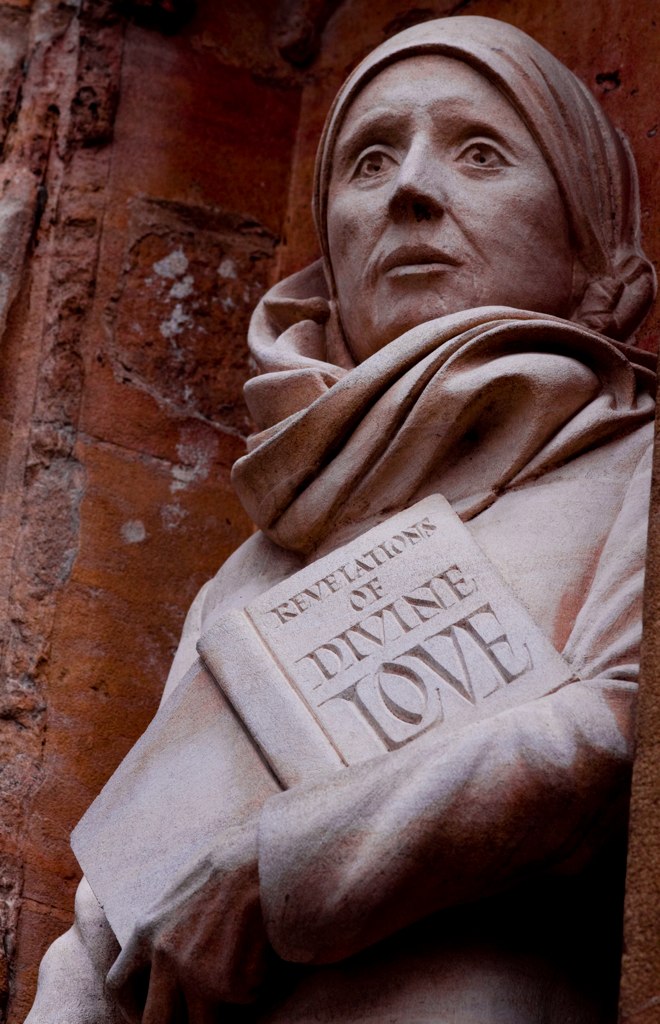
Julian of Norwich, who we celebrate today, spoke about this in the second part of her fourteenth revelation that is contained in her Revelations of Divine Love. “Our Lord is very glad and happy that we should pray, and he expects it and wants it… for this is what [the Lord] says, ‘Pray earnestly even though you do not feel like praying, for it is helping you even if you do not feel it doing you any good, even if you see nothing, yes, even if you think you cannot pray; for in dryness and in barrenness, in sickness and weakness, then your prayers give me great pleasure, even if you feel that they are hardly pleasing to you at all. And it is so in my sight with all your trustful prayers.’” Julian says, “God accepts the good intentions and the effort of those who serve him, whatever we are feeling.” (p.100)

To us, it may seem fruitless, but in a time of barrenness, that feeling of the absence of God, to stop praying is to break off from the relationship, so regardless of how we feel, we must stay engaged, because it is through our faithfulness and this engagement that we will once again feel the presence of God.

If you say, “I just don’t feel like praying. I don’ t have anything to say,” then take that good advice of Archbishop Michael Ramsey, “Pray that you could pray,” but don’t stop praying.

Sermon: Easter 5 RCL B – “The Vineyard”


Photo by Daniel Salgado on Unsplash

Little Johnny was getting ready for his first day of school and was a little bit nervous. Of course his parents were nervous too – their little boy, all grown up.

Johnny’s mother and father both went to pick him up at school, eager to find out how his first day of school was.

“So Johnny, how was your first day of school?” his father asked. “What did you learn?”

Johnny responded. “Not enough. Because apparently I have to go back tomorrow!”

Let’s talk wine! As many of you know, I’ve started making my own wine. As some of you know… it ain’t all bad. Now, I don’t do the Lucille Ball thing of stomping out my own grape juice, that part is already prepared, but I do mix in the yeast, oak chips, and other vintner secret ingredients. It’s just fun to take the time putting it all together, watching it ferment and then waiting to see how things work out. There is a good bit of science behind the making of the wine, but there is also a good bit of science in growing the grape.

Here’s a bit of trivia for you (and it really depends on the region, type, etc. and who you ask), but how many average size grapes does it take to make a glass of wine? Answer: 75-100, which is about the number of grapes on each cluster of grapes on a vine. Given that each vine produces about 40 clusters means that a single vine can produce about 10 bottles of wine, which tells us that a lot goes into producing all the wine that is consumed worldwide on an annual basis. How much wine would that be? About 40 billion bottles a year. Given that there are only 7.8 billion people on the planet tells me that some of you are doing more than your fair share of consumption! It takes a lot of land, people and other resources in order to keep up with such demand, and a great deal of care must be given to the vine: acidity of soil, amount of moisture, sunlight, etc. Growing takes the longest amount of time, but second to that and perhaps the most labor intensive part is the pruning of the vine, which must be done each year for optimal production and flavorful grape.

There are many different parts of the actual vine, but it is only the branches that are one year old that produce grapes, so if not properly pruned, the vine just gets bigger, but produces little to no fruit. As it is a vine, it will continue to grow, but will become much more thin, fragile and susceptible to disease. At that point, all the energy is going into producing vine and little is left for producing grapes. And, if there are too many branches and too many leaves, then the sunlight can’t reach the grapes that do manage to mature, preventing them from ripening.

The bottom line is that there is a very fine balancing act that is taking place so that the vine is able to be the most productive. Left to its own, it becomes wild and unmanageable, producing little and what it does manage to produce is low quality. Pruned improperly, cutting off too much, and there is nothing that remains in order to grow the fruit. Done properly with expert skill, and it does seem counterintuitive, but the pruning—up to 90% of the vine—will actually produce a healthier more productive vine than when left to its own. Therefore, for his or her part, the vinegrower, the one who prunes, must know the plants very well. Where are they in their production? How and where were they pruned the previous year? What diseases are they susceptible to? What type of fertilizer is required? All this and so much more the vinegrower must know in order to properly care for the vines.

At this point, you may be thinking I’ve spent a great deal of time this morning talking about wine and winemaking, but the truth is, we haven’t really been talking about wine at all and you know that.

For the most part, during the time of Jesus, Israel was a very agrarian culture and grapes—wine—were a staple. It was safer to drink the wine than it was the water, so wine was livelihood and life. Therefore, Jesus speaking about vines and pruning would have made perfect sense to the disciples. When Jesus said to his disciples, “I am the true vine, and my Father is the vinegrower. He removes every branch in me that bears no fruit. Every branch that bears fruit he prunes to make it bear more fruit,” the disciples would have clearly understood the imagery that Jesus was using. We just had to do a bit of homework in order for it to me made more clear for us.

It is through Jesus that we have life and it is through the care given by the vinegrower, the Father, that we are given those things and tended in such a way that allow for and cause fruitful lives. Jesus, as the vine, provides us with the nourishment we need through word and sacrament, and the Father oversees it all.

In this image, we are the branches that come from the vine and it is the branch that produces the fruit. So what is the fruit? Jesus actually tells us in the very next verses that were not included in this week’s Gospel lesson: “As the Father has loved me, so I have loved you; abide in my love.” And a few verses on, “This is my commandment, that you love one another as I have loved you.” St. John reiterated this point in our Epistle lesson this morning: “Those who say, ‘I love God,’ and hate their brothers or sisters, are liars; for those who do not love a brother or sister whom they have seen, cannot love God whom they have not seen. The commandment we have from him is this: those who love God must love their brothers and sisters also.” The fruit that we are to produce begins with the relationships we have with God and with one another. Everything else is a product of those relationships, that love. As John states, it is not enough to say, “I love God,” because you must also be able to say, “I love my enemy.” Have you reached that level of perfection in your life?

There are many things that prevent us from progressing towards this, but at the heart of it all is our pride. Our need to be right or to get even or to simply hold a grudge. Before we can make progress in love, we must allow God to prune away the pride that holds us back, so that we make room for new and fruitful growth.

I’ve been reading Love in the Time of Cholera by Gabriel Garcia Marquez. When an uncle found himself angry with his nephew for not following through in a job, the uncle found peace. Marquez writes, the uncle “allowed himself to be swayed by his conviction that human beings are not born once and for all on the day their mothers give birth to them, but that life obliges them over and over again to give birth to themselves.” Jesus said, that we must be “born again… of water and spirit.” Perhaps Little Johnny said it the simplest when asked what he learned at school: “Not enough. Because apparently I have to go back tomorrow!”

If we have not learned to love God, our neighbor, and our enemies, then we apparently have to go back to school again tomorrow and be pruned a bit. Fortunately, I do not believe that the God who created us will completely prune us out of the vine as long as we are ever striving to fulfill his commandments, however, we must learn to allow God to prune out those parts that prevent us from producing good fruit. It is then that we can make progress in our relationship with God and with one another.

Let us pray: Come Holy Spirit, fill the hearts of your faithful and kindle in them the fire of your love. Send forth your Spirit and they shall be created. And You shall renew the face of the earth. Amen.

Catherine of Siena


Catherine of Siena was born in 1347, the twenty-fourth of her parents twenty-five children. At the age of seven, she vowed her life to Christ. At the age of fifteen, she cut her hair in disobedience to her parents who were fighting for her to be married. At the age of eighteen she became a part of the Dominicans. At the age of twenty-one she had a mystical experience where she became spiritually espoused to Christ. Those events alone are enough, but through her work and particularly her writings, she became a force in her community and elsewhere and even with Popes.

In her letters and her Dialogue, perhaps the greatest of her writings, she recounts a souls journey through the mystical experience of God. There is much we can discuss about her writings, so I’ll just focus on one idea: she writes out a prayer to Christ, speaking to him about his great love for God’s people and asking him what could drive the Creator of all to pursue his creation so recklessly.

“O priceless Love! You showed your flamed desire when you ran like a blind and drunk man to the opprobrium [the disgrace] of the cross. A blind man can’t see and neither can a drunk man when he is fast drunk. And thus he [Christ], almost like someone dead, blind and drunk, lost himself for our salvation.” Continuing this theme of drunkenness in her Dialogue, she says, “O mad lover! Why then are you so mad? Because you have fallen in love with what you have made! You are pleased and delighted over her within yourself, as if you were drunk for her salvation. She runs away from you and you go looking for her. She strays and you draw closer to her. You clothed yourself in our humanity, and nearer than that you could not have come.”

Continuing elsewhere, she writes, “O unutterable love, even though you saw all the evils that all your creatures would commit against your infinite goodness, you acted as if you did not see and set your eye only on the beauty of your creature, with whom you fell in love, like one drunk and crazy with love. And in love you drew us out of yourself giving us being.”

I am certain that we’ve all been in love before, or at least thought we were, and in that state I feel certain we have all done some pretty stupid things. I’m also fairly certain that most have overly partaken of some intoxicating beverage and done some rather stupid things then as well. If you have had the fortune (or misfortune) of being both in love and intoxicated, then the level of stupidity can reach even higher levels, but that is how Catherine says that Jesus loves us, as though he was drunk and in stupid love with us. That may sound crazy and, to some, irreverent if not blasphemous, but how would you describe a love that lays down his life for you? Logic can’t explain it. Duty doesn’t come close. I suppose we could just say he was crazy, but if we have faith, if we believe that it is the Father’s desire that all should be saved even if we are wicked, then we must at least consider that Catherine was onto something: a love that appears to be a drunken insanity, but which is in fact pure and true.

You don’t have to agree with Catherine’s images of God’s love for us, but take some time to think on that love. Jesus was not intoxicated on wine, but how would you describe and explain his actions? You might just discover that a crazy drunken lover is the best you can do.

Sermon: Easter 4 RCL B – “Shepherd King”


A group of Americans were on a tour of Israel and as they travelled through the countryside they passed a large herd of sheep. The shepherd was out front and the sheep were following. The guide explained to the tourists that the shepherd did not follow the sheep, pushing them along, but instead led them and they followed the sound of his voice. As Jesus said, “The sheep hear [the shepherd’s] voice, and he calls his own sheep by name and leads them out.”

There were some in the tour group who doubted this and snickered and they believed their doubts were confirmed when a short time later they saw a man behind a herd of sheep pushing them along by poking and prodding them with a stick. One of the tourist called out to the guide, “I thought you said the shepherds here always lead the sheep. Why is that man walking behind and driving them forward?” The guide looked over to see what was taking place, then answered, “That man isn’t the shepherd. He’s the butcher.”

We know that the Judges, like Deborah and Gideon, ruled over Israel prior to the kings, and we know that one day the people came to the Prophet Samuel and said, “We want a king like everybody else.” It was then that Samuel said, “You don’t really want one, but if you insist…,” but before giving them the king, he warned them why it was a bad idea: the king will take your sons and daughters from you to serve him, he’ll take the best of everything you have and then some, he’ll send you off to die in wars, it’ll be a real mess, but the people persisted and God gave them what they asked for.

The first king was Saul. Saul was a bit on the crazy side and that didn’t work out so well. When Saul died, the people came to David—as in David and Goliath—and proposed to make him their king. They said to him, “Behold, we are your bone and flesh.  In times past, when Saul was king over us, it was you who led out and brought in Israel. And the Lord said to you, ‘You shall be shepherd of my people Israel, and you shall be prince over Israel.’” You shall be shepherd / prince, you shall be king. This is the first time in scripture that the word shepherd was used as a way of referring to the king, but it is one that endured throughout.

David was better at the job than Saul, but he wasn’t without his faults. Following him were both good and bad kings, but ultimately, after roughly 500 years, it declined to such a state that God was infuriated, so he called on the Prophet Ezekiel to prophesy against the kings, against the shepherds: “Ah, shepherds of Israel who have been feeding yourselves! Should not shepherds feed the sheep?  You eat the fat, you clothe yourselves with the wool, you slaughter the fat ones, but you do not feed the sheep.  The weak you have not strengthened, the sick you have not healed, the injured you have not bound up, the strayed you have not brought back, the lost you have not sought, and with force and harshness you have ruled them.” Everything Samuel said the kings would do, they did. The people were lost and scattered and sent into exile. The kings were not the shepherds of the people, leading them along with their voice and their words. The kings were the butchers, poking and prodding the people and leading them to their deaths.

However, the Lord may punish the shepherds, but he had no plans to forsake his people, the sheep, for he also said through Ezekiel, “Behold, I, I myself will search for my sheep and will seek them out… I will feed them with good pasture, and on the mountain heights of Israel shall be their grazing land. There they shall lie down in good grazing land, and on rich pasture they shall feed on the mountains of Israel…. I will seek the lost, and I will bring back the strayed, and I will bind up the injured, and I will strengthen the weak, and the fat and the strong I will destroy. I will feed them in justice.”

In those words, did you hear Psalm 23?

The Lord is my shepherd…
He makes me lie down in green pastures…
[He] guides me along right pathways…
[He spreads] a table before me in the presence of those who trouble me…

In those words, did you hear the feeding of the 5,000, when with just a few loaves of bread and a couple of fish, Jesus fed the multitude?

In those words of Ezekiel, did you hear Jesus saying, I will “bind up the brokenhearted” and “For the Son of Man came to seek and to save the lost.”

Today, in our Gospel, Jesus said, “I am the good shepherd. The good shepherd lays down his life for the sheep.” Today, in our Gospel, Jesus said, “I am the good King. The King lays down his life for his people.” By his life and death, Jesus fulfilled Ezekiel’s prophecy and became the true shepherd and our King.

Today, we have many shepherd kings that surround us. Some are actual leaders in various capacities, but they also come in other forms. These may be our goals and ambitions, whether they be for our health or wealth or jobs, and still others might be for recognition or perfection in some area. They are people and aspects of our lives that seek to guide and, in some cases, control us. This does not make them bad, per se, but whatever they might be, we should examine them and ask ourselves, “In pursuing _, am I hearing and following the voice of the Good Shepherd King or am I being deceived and being poked and prodded along by the butcher?” Ask yourself that question and also see where it leads you. Through your involvement, are you experiencing the promises of God? Put into the words of our readings today: do you experience the green pastures and still waters or does it bring hardship and pain? Ask yourself those questions and put those parts of your life to the test. In doing so, you will either discover the Good Shepherd King leading you or the butcher that should be removed from your life.

The Lord is my shepherd. The Lord is my King. In all things, allow his leading voice to be what rules in your life.

Let us pray: Sovereign God, ruler of all creation, you sent Jesus to testify to the truth: that you alone are the Lord of life. Help us to listen always to his voice so that we may proclaim his realm of justice, peace, and endless love; through Christ, who reigns forever. Amen.

Sermon: Easter 3 RCL B – “Oneness”


Boudreaux was talking to his buddy, Thibodeaux, “I’ve been doing a lot of thinking recently and based on many years of marriage, I’ve come to a remarkable conclusion.”

“This I want to hear already,” says Thib. “So tell me about your wonderful conclusion.”

“I’ve discovered,” says Boudreaux, “that if I only slightly upset Clotile, it’s almost certain that she will shout at me. Fair enough! But if I really upset her, she won’t shout louder but instead will give me the silent treatment.”

Thibodeaux almost immediately starts nodding his head and says, “I understand. To get a little peace, it’s sometimes worth putting in a little extra effort.”

Boudreaux would define peace as Clotile not yelling at him, but if we were to go around the room, I’m sure we would find a variety of answers. Peace is the lack of noise. Peace is sitting on a beach. Peace is being in the arms of one you love. All of these answers are correct, but they are really only highlighting a certain aspect of peace.

Webster’s defines peace as tranquility, quiet, freedom from civil disturbance, harmony, and so forth. The biblical understanding of peace takes these things into account, but it brings them all under an overarching idea that I can best describe as “oneness.”

The Hebrew word for peace is shalom, and the Greek is eirene (ir-ray-nay). Eirene / peace is a noun, but the Greek word has at its root a verb: eiro. Eiro means “to join or bind together that which has been separated,” therefore, peace is not just the absence of Clotile yelling at Boudreaux or some other noise or trouble, but is instead a brining about of oneness that transcends the noise or trouble.

Jim Walton was a missionary and linguist in the jungles of Columbia and he took on the task of translating portions of the New Testament into the local language. In the process, he found that he lacked the native vocabulary to be able to translate the word peace.

At some point, Jim was scheduled to take a local chief to a village that was a three days walk or a twenty minute plane ride, however, because of an error, the chief missed the flight and he became very angry. Finding Jim, he launched off into angry rant and Jim noticed that the chief kept repeating the same phrase. He did not understand it at the time, but translating it later he discovered that when the chief was angry, he kept saying, “I don’t have one heart.” The chief did not have oneness in his heart, there was something broken—he didn’t have peace.

I know that I quite often come back to this passage of scripture, so bear with me… on the night before he was crucified, we hear the great priestly prayer of Jesus and what does he pray for? He prays that those who the Father has given him “may all be one.” He tells the Father, “The glory that you have given me I have given to them, that they may be one even as we are one, I in them and you in me, that they may become perfectly one, so that the world may know that you sent me and loved them even as you loved me.” He is praying that we have one heart with each other and one heart with the Father and he is praying that through him that one heart might be attained.

Now, do you remember the two disciples that were on the Road to Emmaus and the stranger (a.k.a. Jesus) joined them and how they were talking about all the things that happened with Jesus and the crucifixion and that when evening had come Jesus sat with them and broke bread and their eyes were opened and they recognized him? Well, at that point, Jesus vanished from their sight and those two disciples hightailed it back to Jerusalem to tell the others. At this point, Scripture tells us, “As they were talking about these things…”…as they were in the upper room, talking with the other disciples about what had happened—and this is where our Gospel reading picks up today—“Jesus himself stood among them, and said to them, ‘Peace to you!’”

In the times before Jesus, the Israelites had wandered in the desert, then they came to the land flowing with milk and honey, but before they crossed the Jordan River into this promised land, the Lord renewed the Covenant with them: “Choose you this day whom you will serve,” and the people chose God, so God promised that he would be with them if they kept his commandments, but just as they wandered in the desert, they wandered in their faith and went after other gods, breaking the One True God’s Laws and his Commandments; therefore, God did not break the Covenant with them—there would always be a remnant—but he did take from them the peace, the oneness, that had been established between them. Speaking through the Prophet Isaiah, the Lord said:

“I am the Lord your God,
    who teaches you to profit,
    who leads you in the way you should go.
Oh that you had paid attention to my commandments!
    Then your peace would have been like a river,
    and your righteousness like the waves of the sea;
your offspring would have been like the sand,
    and your descendants like its grains;
their name would never be cut off
    or destroyed from before me.”

All the things that could have been, but in their wickedness, they turned from God and they were left separated, broken from God and from one another as they were carried off into exile, and that brokenness remained until it was healed on the cross and proclaimed to the disciples and to us in the upper room when “Jesus himself stood among them, and said to them, ‘Peace to you!’” St. Paul teaches us, “Since we have been justified by faith, we have peace with God through our Lord Jesus Christ.” Through Christ Jesus, we again have oneness with God.

When you and I exchange The Peace, it is this hope, this oneness that we are extending to one another. That we might be of one heart with each other and with God, but it doesn’t end there. Jesus said, “Thus it is written, that the Messiah is to suffer and to rise from the dead on the third day, and that repentance and forgiveness of sins is to be proclaimed in his name to all nations, beginning from Jerusalem. You are witnesses of these things.” In saying “that repentance and forgiveness of sins is to be proclaimed,” Jesus is saying that peace—between God and man—is to be proclaimed and that we are the proclaimers, we are the witnesses of oneness with God, a oneness and peace that is made available to all.

He who is the Prince of Peace is sending us into the world to proclaim the restoration of our oneness with God. How do we do that? Perhaps St. Francis said it best in a prayer…

Lord, make me an instrument of your peace:
where there is hatred, let me sow love;
where there is injury, pardon;
where there is doubt, faith;
where there is despair, hope;
where there is darkness, light;
where there is sadness, joy.

O divine Master, grant that I may not so much seek
to be consoled as to console,
to be understood as to understand,
to be loved as to love.
For it is in giving that we receive,
it is in pardoning that we are pardoned,
and it is in dying that we are born to eternal life.
Amen.

Sermon: Easter Sunday RCL B


The priest was working in his office one day when the church secretary came scurrying through the door, out of breath.

“Father, Father, I have news!” she said, trying to regain her composure.

“Well, what’s the news?” asked the perplexed priest.

“Jesus is coming. He is back and he’s coming here right now. What should we do?”

The priest suddenly became flustered and wringing his hands, turned back to his computer and answered, “Look busy.”

St. Peter said to Cornelius and the other gentiles, “They put him to death by hanging him on a tree; but God raised him on the third day and allowed him to appear, not to all the people but to us who were chosen by God as witnesses, and who ate and drank with him after he rose from the dead.” Jesus died and rose again on the third day. That is the Easter proclamation: the resurrection, but why? Why did Jesus die and rise again? Answer: so that we would look busy. We must be busy little Christians or we’re not really Christians at all. Right?

I was reading a devotional by Bishop Robert Barron (he’s Roman Catholic, so don’t tell our friends across the street that I quoted him) and Bishop Barron was reflecting on the calling of St. Matthew. He pointed out something that I hadn’t noticed before: what is the first thing that Jesus and Matthew did after Matthew was called? Multiple choice quiz: A) heal a leper, B) feed the 5,000, or C) have a party? Jesus “saw a man named Matthew sitting at the tax collector’s booth. ‘Follow me,’ he told him, and Matthew got up and followed him. While Jesus was having dinner at Matthew’s house, many tax collectors and sinners came and ate with him and his disciples.” The answer is C). The first thing Jesus and Matthew did after the calling of Matthew: they had a party.

Skip ahead: the house of Mary and Martha. There is busy Martha scurrying about the house making all the preparations, while her sister Mary is sitting at Jesus feet enjoying his company. Busy Martha gets irritated with Lazy Mary and complains to Jesus: “Make her help me,” cries Busy Martha. Jesus says, Busy “‘Martha,’ the Lord answered, ‘you are worried and upset about many things, but few things are needed—or indeed only one. Mary has chosen what is better, and it will not be taken away from her.’”

Returning to today’s reading again: what did Jesus and the disciples do following the resurrection? Peter said, “They put him to death by hanging him on a tree; but God raised him on the third day and allowed him to appear, not to all the people but to us who were chosen by God as witnesses, and who ate and drank with him after he rose from the dead.”

Do you see a pattern? Party. Sitting at Jesus feet. Having a meal with friends.

In his reflection, Bishop Barron quoted from a book by a Trappist Monk, Fr. Simeon (I know, two Romans Catholics in one sermon, oy!). Fr. Simeon wrote, “The deepest meaning of Christian discipleship is not to work for Jesus but to be with Jesus.” I thought that was so simple, but brilliant, that I had to find the book and read more. Fr. Simeon, speaking to those whom Jesus calls, says, “Jesus is inviting those he chooses to forsake worldly concerns and busyness, a circular routine of habits and prejudices leading nowhere, in order to recline with him and his friends in the joy of breaking bread with the eternal Word…. All by itself, working for Jesus would be a call to a higher servility.” (Source: Fire of Mercy, Heart of the Word, Vol. 1 by Fr. Simeon, formerly Erasmo Leiva-Merikakis). We are chosen by Jesus, not to be busy Christians, but so that we might recline with him and break bread with him and his friends. Don’t get me wrong: I am not saying that there is no work for us to do—there is more than enough and there always will be, but… Jesus did not die on a cross and rise on the third day so that we would be busy. He died and rose so that we might be with him and have fellowship with him and one another and break bread together.

Have you been doing it wrong?

For me, the answer is: most likely. Why? Well, as nice as it sounds to simply be with Jesus, it is a whole lot easier to work for him, to be busy for him. You see, fellowship with Jesus and his friends isn’t like, “Party at JC’s Place!” with the BeeGees playing Saturday Night Fever in the background—You should be dancing…. (you can tell I don’t get out much). Fellowship with Jesus isn’t like that. Do you remember your first love: how you ached for them and when you saw them, you wanted every part of them. You couldn’t bear the thought of being separated from them. You would lay awake at night thinking of them, anxiously waiting to be with them again… my goodness, I can still smell her perfume! Anyhow, that is fellowship with Jesus, the thing is, that’s not how we always feel about him, but it is how he always feels about us; and to be loved so intently will either consume you, scare you away, or cause you to put up barriers—like being busy; and we put up those barriers so that we can hold onto something of ourselves, afraid that all will be lost if we don’t, never realizing that we have everything to gain.

Today, if you have been scared away, I invite you to come back, for our God is faithful and just, and if you confess your sins he will forgive you and cleanse you of all unrighteousness; but if you have put up a barrier of busyness or some other barrier, then I invite you to allow God to tear it down and then I invite you to be consumed by his love for you.

Jesus did not conquer death so that you could be busy for him. He conquered death so that you might be consumed by him and become one with him as he and the Father are one.

Let us pray:
Draw us forth, God of all creation.
Draw us forward and away from limited certainty
into the immense world of your love.
Give us the capacity to even for a moment
taste the richness of the feast you give us.
Give us the peace to live with uncertainty,
with questions,
with doubts.
Help us to experience the resurrection anew
with open wonder and an increasing ability
to see you in the people of Easter.
Amen.