Sermon: Proper 15 RCL B – “Bread of Heaven, Part III”

Photo by James Coleman on Unsplash

A Rabbi was sitting next to an atheist on an airplane. Every few minutes, one of the Rabbi’s children or grandchildren would inquire about his needs for food, drink, or comfort. The atheist commented, “The respect your children and grandchildren show you is wonderful. Mine don’t show me that respect.” The Rabbi responded, “Think about it. To my children and grandchildren, I am one step closer in a chain of tradition to the time when God spoke to the whole Jewish people on Mount Sinai. To your children, you are one step closer to being an ape.”

When it comes to how we were created, whether you hold to the story of creation or the theory of evolution, it is still going to be a mystery. As the Psalmist states, “I praise [God] because I am fearfully and wonderfully made” and it all is a great mystery. Think about your breathing: maybe I’m just a bit on the weird side, but if I think about my breathing, about having to take a breath, then I find I have to keep thinking about it. It is like the automatic process stops, because I made it a conscious action rather than allowing it to remain a sub-conscious function. Speaking of our brains: our brains are able to process 11 million bits of information per second, of which only 40 to 50 can we be consciously aware. A lot happens in the background that we never give a thought to. Imagine if you had to make a conscious decisions to take every 22,000 breaths that a human averages every single day or the 100,000 times per day the heart beats… “beat, beat, beat, breathe, beat, beat…,” then Scarlett Johansson walks by “(fast) beat, beat, beat, beat, beat…. breathe.” I’m sure scientist can explain parts of it, but behind it all is a great mystery.

Today, we continue with the Bread of Heaven / Life discourse from John’s Gospel and in today’s verses we find some of the most difficult passages of Scripture (and I want to read this part for you again): Jesus said, “Very truly, I tell you, unless you eat the flesh of the Son of Man and drink his blood, you have no life in you. Those who eat my flesh and drink my blood have eternal life, and I will raise them up on the last day; for my flesh is true food and my blood is true drink. Those who eat my flesh and drink my blood abide in me, and I in them.” As we will read next week, this teaching was a show-stopper for many. Jesus goes too far. We’re not cannibals. We’re not vampires. And for the Jews, for meat to be kosher, there can be no blood. Jesus manages to offend everyone and he knows it, because he will ask, “Does this offend you?” I’ve no doubt that it still offends many today, but here is the truth: each Sunday when we partake of the Holy Eucharist, we truly receive the body and blood of Christ.

Over the years and still today, there are many who want to ease this teaching, to make it easier on the stomach, by stating that the bread and the wine are merely symbolic of the body and the blood, but it is our belief that this is an error. Why? Because Jesus did not say, “Take eat, this a symbol / representation of my body” or “Drink this wine (and he certainly didn’t use Welch’s!) Drink this wine and pretend it is my blood.” No. Jesus said, “This is my body… this is my blood.” Why? Because a symbol cannot bring you forgiveness of sins nor can a representation give you life eternal. If it is not the body and the blood, then we are simply participating in a charade. It is true, the consecrated bread and wine maintain their appearance, but through the Holy Spirit (at the epiclesis—when the priest holds his hands over the bread and the wine), they are no longer only bread and wine, but are transformed into the body and the blood.

We’ve discussed this before: Jesus told the disciples, at the institution of the Holy Eucharist on that first Maundy Thursday, to do these things “in remembrance of me.” That word remembrance is translated from the word anamnesis, which means to “make present.” “Take, eat: This is my Bod, which is given for you. Do this for the remembrance of me.” “Do this for the anamnesis of me… do this and make me present.” Not a representation or a memorial of me, but a making present. A true and real presence.

The big question: how does this happen? How does the bread and the wine become the body and the blood? How were we created? How does the mind work? How can you regulate your breathing or beating of your heart? How can we know the depths of the sea or the heights of the heavens? The astrophysicist Neil deGrasse Tyson said, “There’s no shame in admitting what you don’t know. The only shame is pretending you know all the answers.” How does the bread and the wine become the body and the blood? I don’t know. I only know that it does. How do I know that? Grace and faith. I’m going to let my friend Thomas à Kempis help me out here:

“God can do more than man can understand… Many have lost devotion because they wished to search into things beyond them. Faith is required of you, and a sincere life, not a lofty intellect nor a delving into the mysteries of God. If you neither know nor understand things beneath you, how can you comprehend what is above you? Submit yourself to God and humble reason to faith, and the light of understanding will be given you so far as it is good and necessary for you… Be not disturbed, dispute not in your mind, answer not the doubts sent by the devil, but believe the words of God, believe His saints and prophets and the evil enemy will flee from you…. Go forward, then, with sincere and unflinching faith, and with humble reverence approach this Sacrament. Whatever you cannot understand commit to the security of the all-powerful God, Who does not deceive you…. If all the works of God were such that human reason could easily grasp them, they would not be called wonderful or beyond the power of words to tell.” (TAK IOC Bk IV.18)

I don’t know how the bread and wine become the body and the blood, but through grace and faith in God we know that they do. We do not need to know how everything works in order to believe that they are true.

Finally, I know for some of you, I’m preaching to the choir, but I’m not so naïve as to believe that this teaching is contrary to what others of you hold to be true. Therefore, today I only ask that we all truly and faithfully meditate upon the words of Jesus and the teachings of the church and of those that have gone before us, for that act alone signifies that what we do in the Eucharist is far more than simply eating a wafer of bread and having a sip of wine.

Let us pray:
Jesus, our God,
You art infinitely good and perfect.
We love You above all things
and with all our hearts.
We desire to receive You in Holy Communion
that we may love You more and serve Thee better.
Come to us and strengthen us,
so that we may never be separated from You on earth
and that we may live with You eternally in heaven.
Amen.

Sermon: Proper 14 RCL B – “Bread of Heaven, Part II”

Sermon: Proper 13 RCL B – “Bread of Heaven, Part I”

Needs vs Wants: it seems basic enough, but just so we’re all on the same page—a need is something that is required in order to survive whereas a want is something we do not need, but desire. A few examples:

  • I want to look like brad Pitt in Fight Club, but I need chicken fried steak and mashed potatoes.
  • I want to read more books, but I need to get through all 147 episodes of The Walking Dead.
  • I want to go to bed at a decent hour, but I need to scroll through social media until 2:00 a.m.

Maybe I’m missing the point. Let’s try a couple more:

  • I want a fancy car, but I need reliable transportation to and from work.
  • I want to be popular, but what I need are strong stable relationships.

You see the difference. And this is where we left off last week in our discussion on the Bread of Life. Our wants (we talked about cravings last week) are not always what we need, because what we need more than anything else and the only thing that will satisfy and fulfill our physical and spiritual hearts is this Bread of Life. If that is true, what purpose does it serve? What does this Bread of Life do for us?

Today in our lesson from 1 Kings, we read about the Prophet Elijah, but it is one of those lessons that drops us down in the middle of a story without much explanation on either end. It began, “Elijah went a day’s journey into the wilderness, and came and sat down under a solitary broom tree.” That’s nice, but why did he go off into the wilderness and why did he say to the Lord, “I’m done, just kill me now?”

At the time, Ahab was king over Israel and his wife was Jezebel. Ahab and Jezebel did evil in the eyes of the Lord by worshiping the gods Baal and Asherah. Unable to tolerate this, Elijah said to King Ahab, “summon the people from all over Israel to meet me on Mount Carmel. And bring the four hundred and fifty prophets of Baal and the four hundred prophets of Asherah, who eat at Jezebel’s table.” Ahab did and it was on Mount Carmel that we have the episode of the dueling prophets.

Elijah challenged the prophets: he and they would both have the opportunity to sacrifice a bull, but then—and this is where it gets interesting—each was to call down fire from their god/God to consume the sacrifice. So the prophets of Baal did just that. They set up the altar, sacrificed the bull, and started calling out to Baal. Nothing happened. Elijah taunted them, “Shout louder! Surely he is a god! Perhaps he is deep in thought, or busy, or traveling. Maybe he is sleeping and must be awakened.” Still nothing. After awhile, Elijah said, “Step aside, boys.” He set up the Lord’s altar, placed the sacrificed bull upon it, drowned it in water, then called on God, and “the fire of the Lord fell and burned up the sacrifice, the wood, the stones and the soil, and also licked up the water in the trench.” The people were amazed and feared the Lord and when Elijah called on them to kill the false prophets, all four hundred and fifty of them, they did. Yet, all this mighty display of power did nothing to turn the hearts of Ahab and Jezebel. She called for the death of Elijah and Elijah ran… now we are at our reading today.

Elijah ran for a day into the wilderness, fell down under a tree, and asked the Lord to kill him. He had done all he knew to do, had demonstrated the power of God, yet the people did not turn, but instead sought his life. He was done and could not go on, yet the Lord was not done with him. The Lord wanted to see him on Mount Horeb, the mountain of the Lord.

Mount Horeb is also known as Mount Sinai, the mountain where Moses encountered God in the burning bush and where he also received the Ten Commandments, but in order to travel for forty days in the wilderness, Elijah needed food for the journey, so twice an angel of the Lord brought him bread and water. When he arrived at Mount Horeb, he went into a cave and rested for the night, but the following day, the Lord called to him: “Go out and stand on the mountain in the presence of the Lord, for the Lord is about to pass by.” Then there was a great wind, followed by an earthquake, followed by a fire, but the Lord was not in any of those. Then “came a gentle whisper” and Elijah encountered God.

What purpose does the Bread of Life serve? What does it do for us? Just as the Lord fed the bread to Elijah to sustain and prepare him for the journey, the Lord feeds us with the Bread of Life. It is food for the journey to sustain us in the wilderness while we seek to encounter our God on the mountain. It is what provides us with a supernatural spiritual strength in the face of the enemy that seeks to destroy us. And this Bread is Jesus.

“I am the bread of life…. This is the bread that comes down from heaven, so that one may eat of it and not die. I am the living bread that came down from heaven. Whoever eats of this bread will live forever; and the bread that I will give for the life of the world is my flesh.”

I want to stay home in bed, drawing the sheets up over me because I just can’t go back out into the wilderness of a world that seems to care so little… I want to hide, but what I need is the Bread of Life that will nourish my soul and my body, giving me strength and courage in knowing that my God allows me to truly make Him a part of myself. It’s not just me against the Jezebel’s and forces of evil of the wilderness. It is the power of God working in me.

I want to close my eyes to the injustices I see around me because there is nothing I can do about it, but I need to be an instrument of transformation in my world, my community, my family, my own life, but to do this, I need the Bread of Life to fortify my resolve and provide the daily sustenance I so desperately need.

I want to climb under a broom tree and just have it all go away, but my God needs me to go further than I ever thought I could and to be renewed into the image of His Son, so God gives me himself and makes it possible.

Sir, give us this Bread. Give us this food for the journey. Give us yourself that we may have abundant life in this world and eternal life in the world to come. And God does give us all this and more. When we hold out our hands to receive him in the Eucharist, God speaks to our soul and says, “Take, eat: This is my Bod, which is given for you… given that you may have food for the journey. Given that you may have abundant life. Given that you may have life eternal.”

Let us pray: Lord Jesus, you are the bread of life, the manna which sustains us in the wilderness of our daily lives. Without you, we hunger for righteousness but will forever be found wanting. Sustain us, O Lord, and keep us in your graces through the vessel of your most holy body and blood. Amen.

Sermon: Proper 13 RCL B – “Bread of Heaven, Part I”

Photo by Nadya Spetnitskaya on Unsplash

While visiting a big city, Betsy, who suspected her husband of cheating on her snuck off to visit a fortune teller of some local repute.

In a dark and hazy room, peering into a crystal ball, the mystic delivered grave news. “There’s no easy way to say this, so I’ll just be blunt: Prepare yourself to be a widow. Your husband will die a violent and horrible death this year.”

Visibly shaken, Betsy stared at the woman’s lined face, then at the single flickering candle, then down at her hands. She took a few deep breaths to compose herself. She simply had to know. She met the fortune teller’s gaze, steadied her voice, and asked her question. “Will I be acquitted?

When it came time to preach this sermon, I just couldn’t tell that joke: adultery, murder, divination… no. Not good sermon material.

Jesus had been teaching and performing miracles in Jerusalem at the Temple and from there he made his way north to the lands surrounding the sea of Galilee. If he went all the way up to Capernaum on the north shore, he would have travelled about eighty miles. After some time, he crossed over the sea and it is there that we have the feeding of the 5,000. Following this, the disciples—without Jesus—take a boat back to Capernaum, but on the way they encounter a storm and it is then they see Jesus walking on the water.

The following day, the people wake up and look for Jesus, thinking that he should still be nearby, but when they can’t find him, they also cross over to Capernaum where they do find him. This is where our Gospel reading begins today with the people saying to Jesus, “Umm… you were over there with no way of getting over here. How’d you do that?” Jesus doesn’t answer that question, but only tells them why it is they were looking for him: “Very truly, I tell you, you are looking for me, not because you saw signs, but because you ate your fill of the loaves.”

These words are the beginning of what is known as the Bread of Life Discourse, consisting of thirty-seven verses. It is such an important teaching, that we will hear from these verses for three more Sundays.

It begins with the people asking Jesus a series of questions: how did you get here? What is the work of God? What sign will you give us? What work are you performing? And then someone says, “Our ancestors ate the manna in the wilderness; as it is written, ‘He gave them bread from heaven to eat.’” In saying this, they are throwing down the gauntlet on Jesus. If you want us to believe you, why don’t you pull this particular rabbit out of the hat. To that challenge, Jesus said, “Very truly, I tell you, it was not Moses who gave you the bread from heaven, but it is my Father who gives you the true bread from heaven. For the bread of God is that which comes down from heaven and gives life to the world.” And the people are like, “Yeah, yeah…give us that bread.”

The people are still thinking about their empty stomachs and Jesus could have given them what they wanted, but Jesus did not need a crystal ball to tell them what would happen if he did. He only needed to look at their history.

The Israelites had made the exodus out of Egypt and were wandering in the desert. They grew hungry and complained against God, so the Lord said, “I will rain down bread from heaven for you.” And he did. He gave them manna to eat.

Our Psalm today speaks of all of this and concluded with:

They ate and were well filled,
for he gave them what they craved.
(Psalm 78:29)

God gave them everything they craved, but they weren’t ever happy. They weren’t ever satisfied.

“The rabble with them began to crave other food, and again the Israelites started wailing and said, ‘If only we had meat to eat! We remember the fish we ate in Egypt at no cost—also the cucumbers, melons, leeks, onions and garlic.  But now we have lost our appetite; we never see anything but this manna!’” (Numbers 11:4-6)

Yes, Jesus says to those listening. Moses did feed them with the bread from heaven, but after awhile, they weren’t satisfied. So he gave them quail, but guess what? They eventually weren’t satisfied with that either. Moses could have gone on and given them cucumbers, melons, Kobe beef, and Jamaican Blue Mountain Coffee, but in the end they would still be grumbling and would always want more.

No. Jesus did not need a crystal ball to know how it would all play out. So, he says, instead of seeking after something that you will later be dissatisfied with, why not seek after that which will satisfy you now and for all eternity. Seek after the bread which will give you life eternal. And what is this bread? Jesus said, “I am the bread of life. Whoever comes to me will never be hungry, and whoever believes in me will never be thirsty.” Jesus said, I—God—am the one thing that will satisfy you completely. Follow me and believe in me.

Like the Israelites in the wilderness, God can give and fulfill our every craving, but like the Israelites, we will grow tired of it, because what we crave is not what we need. It is not what will sustain or fulfill us. If you think about it, you know it’s true. We may occasionally find some peace, but there is a restlessness within us. An itch. A craving. However you want to refer to it, and it is really never satisfied. What is the remedy for such cravings? In the first paragraph of his Confessions, St. Augustine of Hippo, speaking to God, wrote, “Thou hast made us for thyself, O Lord, and our heart is restless until it finds its rest in thee.”

When he says that our heart is restless, I believe he is referring to both our physical and spiritual heart, our entire being which will remain restless until it rests in God alone. And it is a restlessness, a craving, that can only be satisfied and nourished with the true Bread of Heaven. Our response in hearing this can be the same response as those who were listening to Jesus: “Sir, give us this bread always.”

And Jesus does. “I am the bread of life.” We receive this bread of life physically in the Eucharist and spiritually through our faith. If we can truly receive this bread then we are truly free. Free from the empty cravings that draw us away from God.

I would like to tell you that I have reached such a level of perfection, but I think we all know that would be a lie. It is not easy and it is always a struggle. It is God’s grace alone that fills in the gap, but that does not mean that we don’t work to lessen that gap. Strive, body and soul, to be satisfied with God alone. Seek to find peace in him. Yes, Lord, give us this bread always that we might find rest in you.

Let us pray: Father in heaven, you have made us for yourself; our hearts are restless until they rest in you. Fulfill this longing through Jesus, the bread of life, so that we may witness to him who alone satisfies the hungers of the human family. By the power of your Spirit lead us to the heavenly table where we may feast on the vision of your glory for ever and ever. Amen.

Sermon: Johann Sebastian Bach

Photo by Weston MacKinnon on Unsplash

In 1722 a composer applied for a music director job in Leipzig. There were five other candidates. The city council seemed to be looking for a college education, which this composer lacked. They offered the job to two other candidates, who both declined.  One councilman commented when they were calling the third candidate, “Since we cannot get the best, we will have to be satisfied with a mediocre one.”  That mediocre candidate turned out to be Johann Sebastian Bach.

The great composer Johannes Brahms wrote to a friend about a composition by Bach, “The man writes a whole world of the deepest thoughts and most powerful feelings. If I could picture myself writing, or even conceiving, such a piece I am sure that the extreme excitement and emotional tension would have driven me mad.”

It would seem that a driving factor for Bach and the music he composed was God.  He says, “All music should have no other end and aim than the glory of God and the soul’s refreshment; where this is not remembered there is no real music but only a devilish hub-bub.”  Bach’s works are so explicitly biblical that the famous missionary doctor Albert Schweitzer, who was also an expert on Bach, called him “the Fifth Evangelist.” 

As part of his duties in one position, Bach was to provide an original composition for each Sunday’s church service, as well as various feast days. Bach thus set about composing a five-year cycle of cantatas, amounting to 60 cantatas a year, for a total of 300 works of an average duration of 25 minutes, so on average he produced more than one cantata a week during that five year period. 

He lived until age 65 and died in 1750 and neither he nor his contemporaries had any idea that his music would last throughout the ages.  In fact he was obscure for a century after his death until he was rediscovered by Felix Mendelssohn.  It is likely that many of those hundreds of compositions were simply lost, but on those that do survive there is an interesting notation on some: in Bach’s own handwriting, the letters J.J. at the beginning of each and S.D.G. at the end.  They are abbreviations for the Latin, Jesu Juva (Jesus Help Me!) at the beginning and Soli Deo Gloria (To the Glory of God Alone!) at the end.

We often say that things are done to the glory of God, but it was my friend, St. Josemaría Escrivá who helped me to understand the meaning of the phrase: “Dei omnis gloria—All glory to God.  It is an emphatic confession of our nothingness.  He, Jesus, is everything.  We, without him, are worth nothing: Nothing.  Our vainglory would be just that: vain glory; it would be sacrilegious theft; the ‘I’ should not appear anywhere.” (The Way #780)  Like Bach, that is definitely something to consider the next time we say, “to the Glory of God.”  However, there is a consolation: we may be ‘nothing,’ but we are God’s nothing and in the end… that is really something!

I can’t sing it, but I’ll share the words of one of Bach’s most famous hymns (surprisingly, it is not in our hymnal!)

Jesu, joy of man’s desiring,
Holy wisdom, love most bright;
Drawn by Thee, our souls aspiring
Soar to uncreated light.

Word of God, our flesh that fashioned,
With the fire of life impassioned,
Striving still to truth unknown,
Soaring, dying round Thy throne.

Through the way where hope is guiding,
Hark, what peaceful music rings;
Where the flock, in Thee confiding,
Drink of joy from deathless springs.

Theirs is beauty’s fairest pleasure;
Theirs is wisdom’s holiest treasure.
Thou dost ever lead Thine own
In the love of joys unknown.

Sermon: Mary Magdalene

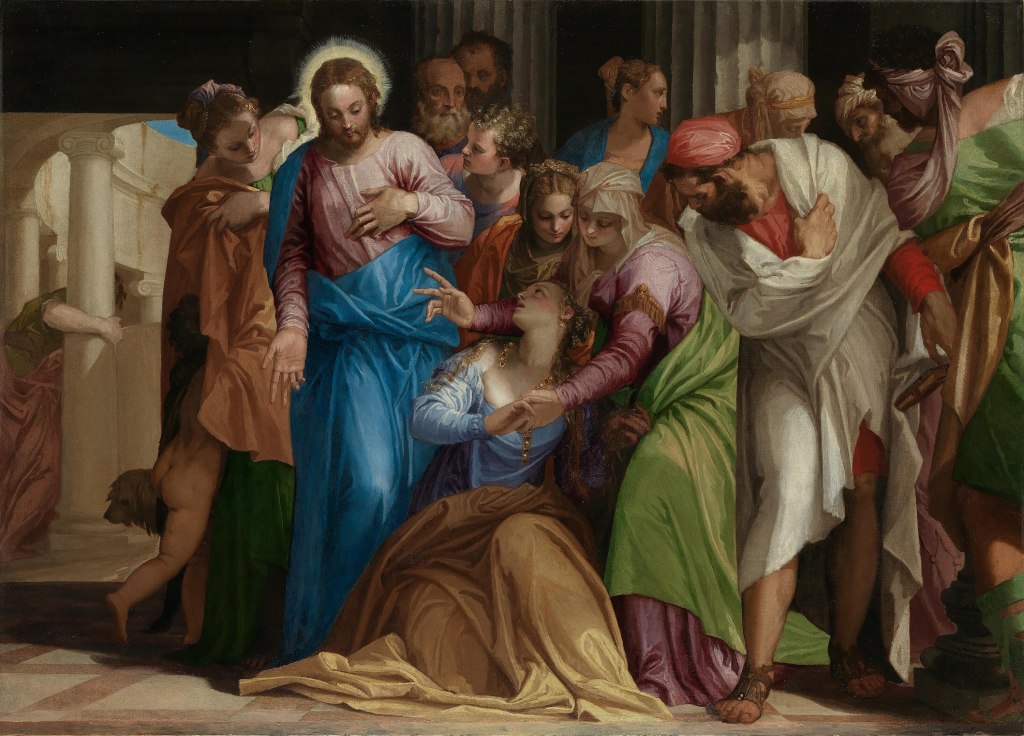
The Conversion of Mary Magdalene (1545-1548) by Paolo Veronese

In the Gospel of John, Jesus says, “If you belonged to the world, it would love you as its own. As it is, you do not belong to the world, but I have chosen you out of the world.”

If you belong to the world, it would love you as its own. There was a time in Mary Magdalene’s life that she belonged to the world and the world loved her as only the world could. It gave her all it had to offer and then some.

How did the world love her and what did it give her? By subjecting her to evil spirits and infirmities. Scripture tells us that Jesus casts seven evil spirits out of her. What were they? We can only imagine: lust, greed, anger, depression… and they all loved her dearly.

There is the movie 300, about the 300 Spartans who took on the entire Persian army. It appeared that the Spartans would be victorious until a traitor went to Xerxes, the Persian King, and betrayed the Spartans. Xerxes makes his case to persuade the traitor to give up the needed information by saying, “Your gods were cruel. The Spartans too were cruel. But I am kind. Everything you could ever desire, every happiness you can imagine, every pleasure your fellow Greeks and your false gods have denied you, I will grant you for I am kind. Embrace me as your king and as your god. Lead my soldiers and your joys will be endless.” The traitor agrees and Xerxes responds, “You will find I am kind. I require only that you kneel.” The traitor knelt and the Spartan army was destroyed.

At a point in her life, the world said to Mary Magdalene, “I am kind. I will grant you every pleasure, every joy. I require only that you kneel.” Like the Spartan traitor, she knelt before the false gods and empty promises, but instead of possessing the world, she was possessed by it. It brought her to a state of utter misery. Yes, the world loved Mary Magdalene with great passion and its sole intent was to keep her from the love of God.

“If you belonged to the world, it would love you as its own.” Yet Jesus went on to say, “As it is, you do not belong to the world, but I have chosen you out of the world.”

At some point early in his ministry, Jesus looked upon this woman Mary Magdalene. He saw her misery and her loneliness, but because of his great love for all of God’s children, he called out of her those seven spirits that possessed her, declaring, “No more. You can’t have her. She is mine. I love her and I have chosen her.”

Today we celebrate Saint Mary Magdalene. We celebrate her for many reasons, but the first of those reasons is the same for each of us. Jesus said, “I choose you.” She responded, “Yes, Lord.” Her actions that followed were in line with anyone’s who had been so clearly touched by God, because she was not only a witness to the death and resurrection of Jesus as attested to in our Gospel today, she was also a witness to the death and resurrection of her own life. Her life demonstrated her thankfulness through a life of service to our Lord and those she witnessed to.

The Apostle Paul wrote, “Since, then, you have been raised with Christ, set your hearts on things above, where Christ is seated at the right hand of God. Set your minds on things above, not on earthly things. For you died, and your life is now hidden with Christ in God.”

Mary Magdalene knew these words in her heart even before Paul had encountered the Risen Lord; by living them out, Saint Mary Magdalene demonstrates for us what it means to be chosen by God.

Sermon: Proper 11 RCL B – “Signs and Wonders”

Photo by Jason Yu on Unsplash

A particular bishop brought in a consultant group to work with each individual church. They were reported to do wonders for any church who was willing to put in the effort. The only issue was that the consultants were all cannibals, so when the bishop hired them, he made them promise not to eat anyone. They all agreed.

After meeting with almost forty churches, things were going splendidly and each of those churches was growing and thriving, but then one day, the leader of the cannibal consulting group got a phone call from the bishop. Seems the secretary at the last church had gone missing and he wanted to make sure that it wasn’t the cannibals doings. Once he got off the call with the bishop, he asked his fellow workers if anyone had something to do with the missing secretary. One cannibal sheepishly raised his hand.

“You fool!” said the leader. “For weeks we’ve been eating clergy and no one noticed anything, but no, you had to go and eat someone important!”

Today, our Gospel reading was from Mark 6:30-34 and then we skipped to 53-56. What I immediately wanted to know is what went on in verses 35-52. Turns out, we skipped right over the feeding of the 5,000 and Jesus walking on water. Huh? Why on earth would we skip those two events? They seem kind of important to me, but the more I thought on it, I realized that I was falling into the same mindset as so many during the time of Jesus. Jesus even pointed this out in John’s Gospel when someone came looking for a miracle. Jesus said, “Unless you see signs and wonders you will not believe.” (John 4:48) Yes. We give thanks for the miracles that occurred then and continue to occur today, but they also serve a very specific purpose outside of those who benefit from them.

Let’s say that St. Matthew’s becomes a place of miracles. Now, I believe we see them all the time, we just don’t recognize them as such, but let’s say that they are undeniable: someone who is blind… born blind comes to our church, they receive the sacrament of healing and prayer and… they see. And then there is someone who has never walked in their life and they are prayed over and they walk. After a couple of events like this, word starts getting around: people are getting healed at St. Matthew’s. Others begin to arrive, slowly at first, to check things out and see what all the fuss is about, but I guarantee you this, if that begins to happen, after a short while, you won’t be able squeeze in here with a shoehorn and not just on Sundays. This will be wall-to-wall people. Some coming to worship, some bringing others in search of a miracle, some bringing themselves in search of the same, and even some who will come to criticize and tear down, but what is the purpose of this all? Episcopalians be like: as long as no one sits in my pew, it’s all good, but seriously, in all that is taking place, what is the purpose? Is it solely for the healings / miracles? Those are important and amazing, but they are not the purpose. Is it that more people are coming to church? Again, good, but not the purpose. How about those whom the healings are taking place through? Yes, yes, and yes. All good, but the purpose behind it all is so that the Good News can be proclaimed. The miracles, the feeding of the 5,000, walking on water, site for the blind are like beacons in a dark night, guiding people to a place where they can encounter God and hear the message. What is the message? Jesus is Lord. Forgiveness of sins. Salvation. Eternal life. The miracles occur so that this message, which is the Good News, can be proclaimed. Miracle: Lazarus was raised from the dead. It got a lot of people’s attention, but Lazarus is going to die again. Good News: Lazarus may die again, but through the forgiveness of sins and his faith in Jesus Christ, Lazarus will rise again, but this time he will rise to eternal life. The miracles demonstrate Jesus’ authority, so that we might believe his teaching and his word: salvation has come to all who believe.

The miracles then are like a beacon, calling out to those who would see and know God. Before Jesus, that beacon was to be God’s chosen people, the Israelites. Speaking through the prophet Isaiah, God said:

“You are my servant,
    Israel, in whom I will be glorified.”
(Isaiah 49:3)

And a few verses further:

“It is too light a thing that you should be my servant
    to raise up the tribes of Jacob
    and to bring back the preserved of Israel;
I will make you as a light for the nations,
    that my salvation may reach to the end of the earth.”
(Isaiah 49:6)

The Lord is saying, it is not just the Israelites that I want to hear of my salvation, but all of humankind, so you will lead them. You will be a beacon to the world, but our reading today from Jeremiah tells us that they did not succeed: “Woe to the shepherds who destroy and scatter the sheep of my pasture!… It is you who have scattered my flock, and have driven them away, and you have not attended to them.” The shepherds might as well have been eaten by cannibals, because no one would have even noticed if they were gone. To be honest, I don’t believe it was a task that could have ever been fulfilled through human hands, but they were still the chosen ones, so when they failed, God said, If you want something done right, you just have to do it yourself. Continuing to speak through the Prophet Jeremiah, God said, “I myself will gather the remnant of my flock out of all the lands where I have driven them, and I will bring them back to their fold, and they shall be fruitful and multiply. I will raise up shepherds over them who will shepherd them, and they shall not fear any longer, or be dismayed, nor shall any be missing, says the Lord.”

And here is where our Gospel reading comes in. Jesus and the apostles had been doing the work, but Jesus also recognized their need for rest, so they tried to get away for a short time, but the crowds found them. Jesus could have pushed on and said, “Enough! We’re on vacation,” but that was not Jesus. Instead, “As he went ashore, he saw a great crowd; and he had compassion for them, because they were like sheep without a shepherd; and he began to teach them many things.” Israel was to be the beacon and the shepherd of God’s people, but when they failed, God said, “I myself will gather the remnant of the flock…”… I myself will be the beacon and the Shepherd. And Jesus said, “I am the good shepherd.” (John 10:11). “And I, when I am lifted up from the earth, will draw all people to myself.” (John 12:32)

The miracles that were performed by Jesus and the Apostles acted as a beacon, so that the world would be drawn in to hear the teachings and the message of salvation. And now we, as the Church, have been entrusted with the task of continuing that great work, but where are the miracles? Where are the beacons? Answer: sitting in the pews. You are the miracle. Your very life is a beacon, a testimony of God’s great work in this world and your life is a testimony that needs to be heard. You are a miracle that the world would in fact know was missing; therefore, through both words and deeds, live into your calling as witnesses to the Good News of God and then watch in joy and amazement as the miracle that is you, takes place in others.

Let us pray:
Loving God,
Send us out to draw others to You,
into Your peace,
into the Church,
into lives dedicated to the Gospel.
May our voices speak of hope and welcome to all.
May our hands lift high the torch of new life in You.
May our hearts yearn for justice and truth.
Renew in us the courage and strength
to reach out to the neediest in our midst.
United in faith and prayer, with Mary,
keep us ever steadfast in Your love
as we strive for Your vision of a world renewed.
We ask this through Christ, Our Lord.
Amen.

Sermon: Proper 10 RCL B – “Silencing God”

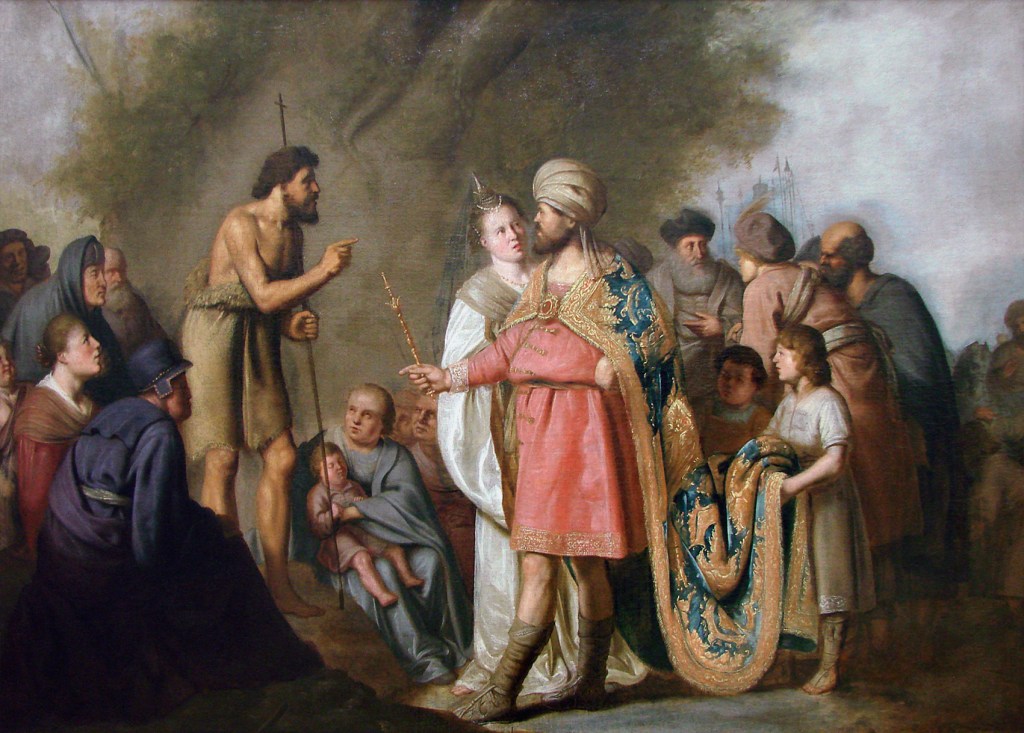
Saint Jean Baptiste prêchant devant Hérode Antipas by Pieter de Grebber

Hibbard “Hib” Johnson was an associate of Thomas Edison and was a partner in the organization that is now General Electric. He is also the Father of the Electric Christmas Tree Light. Given all that, he was fairly well off, being worth about $30M in today’s dollars, which means he could have what he wanted and he wanted a house built by Frank Lloyd Wright and… he got it. Only problem, the roof leaked, and one evening when Johnson was entertaining distinguished guests for dinner, and after several attempts to repair, it leaked again, dripping steadily onto Hibbard’s head. It is reported that Hib, irate, called Wright in Phoenix, Arizona. “Frank,” he said, “you built this beautiful house for me and we enjoy it very much. But I have told you the roof leaks, and right now I am with some friends and distinguished guests and it is leaking right on top of my head.” Wright’s reply, supposedly heard by all: “Well, Hib, why don’t you move your chair?”

I’m sure I can be stubborn at times, but not so pig-headed as to not move the chair. However, when we get our minds set on something, we can get a bit stubborn, whether we know we are right or wrong. Why? Because we want to get our way. We want what we want. After thinking on our Gospel lesson, I believe that was what was behind Herodias’ desire to have John put to death.

A little background, which is the story of three Herods. There was Herod the Great. He was the Herod that the three wisemen came to visit and that had all the young children in Bethlehem put to death. Then there was Herod II, son of Herod the Great. Herod II was heir apparent to the throne and married to Herodias; however, just days prior to Herod the Great’s death, Herod II fell out of favor with dad and it was Herod Antipas (we’ll call him Antipas) who was Herod II’s brother by another mother, that became king. Clear as mud? So, Herod II is married to Herodias and Antipas is married to a foreign princess. Herod II loses the throne to Antipas, and this is where things get really complicated. Antipas and Herodias, have a little thing on the side and both end up divorcing their spouses and marrying one another. Some might say they fell in love, but it would seem to me that Herodias just wanted to be queen, no matter what. She got it and was determined to remain so, but then, along comes John the Baptist, calling them out on their sin: you can’t marry your brother’s wife.

That would certainly be enough to get John in trouble, but as Herod was king and Herodias queen, they would have received criticism from many, and if those critics get too loud, you get rid of them, but there was something about John that was different from those other critics. Our reading said, “Herodias had a grudge against him, and wanted to kill him. But she could not, for Herod feared John, knowing that he was a righteous and holy man, and he protected him. When he heard him, he was greatly perplexed; and yet he liked to listen to him.”

Enter the dancing daughter. Must have been a fine dance, because Herod offers her half the kingdom. Being the devoted daughter, she asks momma: “Momma, we can have half the kingdom. What should I ask for?” She could have had so much, but instead she asked for John’s death. Why? I think part of the answer lies in the fact that Herod “liked to listen to” John. And what if, in all his talking that Herod like to listen to, one day, John was able to finally convince Herod that he shouldn’t be married to Herodias? Herodias understood that. Herod could as easily divorce her as he did his first wife. She could have had anything she wanted, but she could have lost what she so stubbornly went after: being queen. So, she had eliminated the one that might bring about her demise. “Well, Hib, why don’t you move your chair?” “Well, Herodias, why don’t you stop being so pig-headed and listen to God?”

This incident tells us about the lives of the king and queen and the death of John, is a microcosm of the world that Jesus entered into. A world where those who rule, both civilly and religiously, are corrupt and sinful. A world that does whatever it wants in order to get whatever it wants, whether it be right or wrong. A world that will put to death those who try to speak the word of God into the sinfulness. It is a story about how the world goes about silencing God. The entire incident, therefore, is a foreshadowing of what is to happen with Jesus, for like John, Jesus is going to call them all out on their sinfulness and as we know, they will silence him as well.

Today… today we also silence God. From taking prayer out of schools to perverting God’s word to suit our purposes, whether using it as a weapon against those who are different or by reinterpreting the difficult bits so that we no longer call sin sin. These and in so many other ways we silence God. But not only do we see the silencing of God in the world around us, but we silence him in our own lives as well.

Think of Herod and Herodias and John calling them to repentance. John was performing the same function that the Holy Spirit performs in our lives. With the king and queen, he spoke to them, showing them the errors they were making, and then showing them the path of righteousness. The same is true with the workings of the Holy Spirit in our own lives, and like Herod and Herodias, when that voice in the wilderness speaks to us, pointing out our errors and showing us the path of righteousness, we can become stubborn in our sin and effectively tune out and silence the Spirit. If we persist, then we put ourselves in danger of no longer even recognizing that voice, and then we really are in trouble, but we are not lost. Our God is one that seeks out the lost.

They brought to Jesus “a man who was deaf and had a speech impediment, and they begged him to lay his hand on him.  And taking him aside from the crowd privately, he put his fingers into his ears, and after spitting touched his tongue. And looking up to heaven, he sighed and said to him, ‘Ephphatha,’ that is, ‘Be opened.’ And his ears were opened, his tongue was released, and he spoke plainly.” (Mark 7:32-35)

We can silence God to the point where we become deaf to God, but if we will allow it by not being stubborn in our sin, if we will accept his corrections, then he can once again open our ears and our spirits to the voice of the Spirit of God, that we might walk in paths of righteousness. Consider the first verse of our Psalm:

“I will listen to what the Lord God is saying,
for he is speaking peace to his faithful people
and to those who turn their hearts to him.”
(Psalm 85:8)

Don’t be the one who is too stubborn to move your chair when the water is pouring on you. Don’t be the one who silences God when God is trying to correct you. Pray that the ears of your heart will be opened, then turn your heart to him and listen to what the Lord God is saying and he will be faithful to you and lead you along the path of righteousness.

Let us pray: Come Holy Spirit, fill the hearts of your faithful and kindle in them the fire of your love. Send forth your Spirit and they shall be created. And You shall renew the face of the earth. Amen.

Sermon: Eva Lee Matthews


Eva Lee Matthews was born in 1862. Her father was a US Senator who would later go on to become a Supreme Court justice. She was a debutante. It would seem such a life would have created another woman of society; however, the Lord had different plans for Eva and she was obedient to God’s call.

She was a devout Episcopalian and for a number of years served the poor in Omaha, Nebraska and Cincinnati, Ohio. However she and a coworker, in 1898, did something quite remarkable: they founded a new religious order within the Episcopal Church: The Community of the Transfiguration. It was a house that was to be based in the lives of Mary and Martha. Mother Eva Mary, as she came to be known, believed that the Christian was to be a servant of God and that the light of Christ should flow through them. She once said, “The vision of the King is his beauty and is given that the light may shine through us and guide others to know, love, and glorify him.”

She was fond of writing short poems, one of which she wrote shortly after she and her friend took their final vows of profession.

Life for Life—Yea, Lord, so let it be,
My life for Thine as Thine was given for me,
How could I think a lesser gift to bring,
Some broken, useless, fragmentary thing?

Nay, let it be the perfect crystal, Lord,
Offered up whole, unbroken, and unmarred,
No part kept back for self or sin or strife,
But laid at Thy feet, the full price of a life.

Men see the work which is the outer shell,
The humble vessel, be it ill or well,
That holds the life elixir for a space
‘Ere it be poured from its discarded vase.

They only see the outside of the cup,
Thou seest within the Life that’s offered up.
The heart of love in penitence immersed
Drink, Lord of Life, and quench Thy loving thirst.
(Source)

In our gospel reading today, the woman in Bethany anointed Jesus body. It was to prepare him for his burial that was to come. Speaking of her, Jesus said, “Truly I tell you, wherever this good news is proclaimed in the whole world, what she has done will be told in remembrance of her.”

There are many men and women throughout the world, like the woman in Bethany and Mother Eva Mary, who go quietly about the business of serving Jesus. They don’t ask for recognition or accolades, but they are remembered by God. They hand themselves over to God’s will and ask to be used by him in whatever manner he chooses. We can all learn from them.

In our Saints Book Club we are reading In this House of Brede. Early on, one of the nuns tells another, “What is really apostolic, what really speeds God’s glory, is not the time given to work, but the holiness of the worker.” That too is our calling whether in great ways known by all or the simple quiet ways of serving a single soul. In either case, we serve Jesus by serving them and the glory of God, the holiness of God is revealed to others through our works, and it draws them into closer relationship with their Savior.

Sermon: Proper 9 RCL B – “Ripples”

Photo by Lucas Newton on Unsplash

In a Charlie Brown comic strip, Linus, not looking at all happy, is sitting, holding his blanket, with his thumb in his mouth. He then asks Lucy, his sister, “Why are you always so anxious to criticize me?” Lucy smugly replies, “I just think I have a knack for seeing other people’s faults.” Throwing his hands in the air, Linus shouts, “But what about your own faults?!” Without missing a beat, Lucy responds, “I have a knack for overlooking them.”

Lucy, well, Lucy can just be a rather unpleasant person, but why does Linus even care? Shouldn’t he just be able to let the criticisms go and move on? And wouldn’t it be nice if Linus wasn’t the only one that the negative comments actually effected. Wouldn’t it be nice if we were immune to them as well. The crazy thing is… science has demonstrated how we are more or less hardwired to hear and internalize the negative far more so than the positive. It is referred to as the negativity bias. It is the negative things that people say about us personally or in general—about society, life, other people—that sticks. That criticism about us personally can have long term negative effects, but if that negative is about someone else, it has a way of cheering us up, especially if it is about someone famous.

A 2015 study published in Social Neuroscience demonstrated that the “reward center in the brain, was activated in response to negative gossip about celebrities; subjects seemed to be amused or entertained by salacious celebrity scandals.” (Source) That helps explain why so many are captivated by tabloid news and “royals” on Oprah. Are you susceptible? Here’s a test: according to federal statistics, 600,000 individuals are released from prison and some 9 million rotate in and out of local jails on an annual basis. (Source) If I was to ask 99.99% of the people in USA to name one of those individuals, who would it be? Bill Cosby. The news media know of our fancy for this type of thing, so they feed it to us in large doses. Not because its really news, but because it sells advertising. {rabbit trail… sorry} The point: it is the juicy gossip, the scandal, the fall of the famous, that draw us in and in order to be included in society, we join in. If my friends—or those I want to be friends with—are scandalized by the scandal, then I too will be scandalized in order to be a part of the group. The gossip or criticism, the negativity bias came into play, and we can all point our finger together, and the person we are all pointing at loses all credibility and all status. They become the scapegoat for all the things we see that are wrong with the world.

“Jesus came to his hometown, and his disciples followed him. On the sabbath he began to teach in the synagogue, and many who heard him were astounded. They said, ‘Where did this man get all this? What is this wisdom that has been given to him? What deeds of power are being done by his hands! Is not this the carpenter, the son of Mary and brother of James and Joses and Judas and Simon, and are not his sisters here with us?’” Hello. We know this guy and he’s know Messiah. Didn’t his mamma get pregnant before she was married? Don’t you remember that? My goodness… and Joseph married her anyhow. Can you say, ‘guilty conscious’? Enquiring minds want to know.

Jesus went to Nazareth, his hometown, and the people criticized and scandalized. The negativity bias almost infected the entire community, because we are told that only a few of the sick were healed. However, no sooner had he and the disciples left Nazareth that Jesus began to send the disciples out two-by-two, having given “them authority over the unclean spirits.” What was the result? “They went out and proclaimed that all should repent. They cast out many demons, and anointed with oil many who were sick and cured them.” They had not been infected by the criticism of Nazareth. They continued in faith, believing in Jesus and believing in the authority that he had given them. Nazareth—only a few, but out in the world, at the hands of those who kept the faith—many demons were cast out and many sick were healed.

I’m not talking about having a positive mental attitude. That’s not part of the discussion. What we’re seeing in the disciples is faith—a deep and abiding knowledge in the one who sent them and belief in the authority he had given them. And it is through the giving of the Holy Spirit that this knowledge and authority have been handed down through the generations to God’s Church and to you, his chosen people and royal priesthood. (cf. 1 Peter 2:9) Before he ascended into heaven, Jesus gave the Great Commission: “Go and make disciples of all nations, baptizing them in the name of the Father and of the Son and of the Holy Spirit, and teaching them to obey everything I have commanded you.” (Matthew 28:19-20a) And within you is the potential to fulfill that commission, but what is potential? Merriam-Webster defines it as, “existing in possibility: capable of development into actuality.” Poise your finger above the smooth surface of the water and you have the potential, the possibility of causing ripples that will reach further than you could have imagined, but the ripples will not actually appear until you act and touch. Within you is the possibility, but only the possibility, and the capability given through the Holy Spirit to cause the ripples, that will bring about the fulfillment of the Great Commission, but one of the greatest hinderances to this work will be falling in with the people of Nazareth and allowing the negative to seep in: Jesus was only a really good person. God doesn’t heal like he use to. There are no more miracles. I don’t know how to do this. I’m not good enough. This is too much religion. If I do that, I’ll look like some freak and then… then people will start talking about me. Jesus said, “If the world hates you, keep in mind that it hated me first.” (John 15:18) If they criticized him, they will criticize you.

The story is told of a judge who had been frequently ridiculed by a conceited lawyer. When asked by a friend why he didn’t rebuke his assailant, he replied, “In our town lives a widow who has a dog. And whenever the moon shines, it goes outside and barks all night.” Having said that, the magistrate shifted the conversation to another subject. Finally someone asked, “But Judge, what about the dog and the moon?” “Oh,” he replied, “the moon went on shining—that’s all.” What did my friend St. Josemaría Escrivá say: “Don’t waste your time and your energy — which belong to God — throwing stones at the dogs that bark at you on your way. Ignore them.” (The Way, #14)

Through Christ Jesus, you have great potential to do amazing work. If the dogs bark, let them bark. If the critics criticize, ignore them. You… you continue to shine.

I give you this blessing today:
May God give you more than you can ever think or ask;
May He use you far beyond the boundary of your task.
May God lead you further than your vision can yet see;
May He mould you, day by day, more perfectly.
May God guide you and keep you in the way He sees best;
And may he bless you—Father, Son, and Holy Spirit—so that every life you touch is blessed.
Amen.