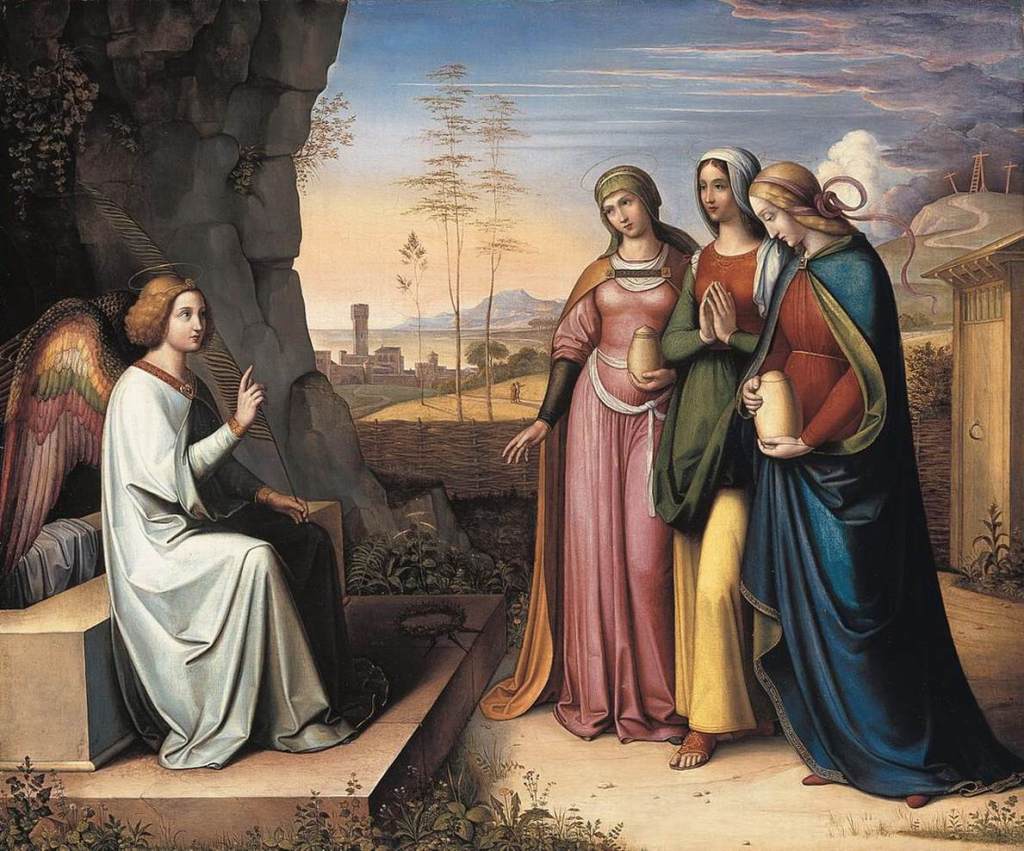
Within the Orthodox Church, the Third Sunday of Easter is celebrated as the Sunday of the Holy Myrrhbearers, those women who came to anoint Jesus’ body following his burial. It falls on our calendar tomorrow.
Today, we read of Mary Magdalene, and Mary the mother of James, and Salome, but in reading the other Gospels, you will find different lists of names—eight in total: the Virgin Mary, Jesus’ mother; “the mother of James and Joses” (reportedly, these are the sons of Joseph by a previous marriage, and she was, therefore, their step-mother); Mary Magdalene; Mary, the wife of Clopas; Joanna, wife of Chouza, a steward of Herod Antipas; Salome, the mother of the sons of Zebedee; Mary and Martha, the sisters of Lazarus; and Susanna. (Source)
It is not believed that the Gospel writers got it wrong when listing the women; instead, it seems to indicate that different groups went separately and had varying experiences at the empty tomb. Whatever the case, because of their great love for him, they all went to the tomb to anoint the Body of Jesus, only to discover that the tomb was empty. But, if there was no Body, did that end their work?
In a sermon, St. John Damascus (d.749) wrote for the Easter Season—“When You [Jesus] did descend unto death, O Life Immortal, then did You slay Hades with the lightening of Your Divinity. And when You did also raise the dead out of the nethermost depths, all the power in the Heavens cried out: O Life-giver, Christ our God, glory be to You. Glory to the Father, and to the Son, and to the Holy Spirit. The noble Joseph, taking Your immaculate body down from the Tree, and having wrapped it in pure linen and spices, laid it for burial in a new tomb. But on the third day You did arise, O Lord, granting great mercy to the world. Now and forever, and unto the ages of ages. Amen. Unto the myrrh-bearing women did the Angel cry out as he stood by the grave: Myrrh-oils are meet for the dead, but Christ has proved to be a stranger to corruption. But cry out: The Lord is risen, granting great mercy to the world.”
They could not anoint His Body because He had risen, but there was still work to be done; therefore, “cry out: The Lord is risen, granting great mercy to the world.”
Their love for Jesus extended into the grave, giving them the courage to go out into the world and proclaim His resurrection. How far does your love for Jesus carry you? Once you learned that He was risen, how did you respond to the angel’s charge to go and tell?
Our work is not nearly done; therefore, as Peter said in our first reading, let everyone “know with certainty that God has made him both Lord and Messiah, this Jesus whom” was crucified.
There is an old legend of a swan and a crane. A beautiful swan alighted by the banks of the water in which a crane was wading about seeking snails. For a moment, the crane viewed the swan in stupid wonder and then asked, “Where do you come from?”
“I come from heaven!” replied the swan.
“And where is heaven?” asked the crane.
“Heaven!” said the swan, “Heaven! Have you never heard of heaven?” And the beautiful bird went on to describe the grandeur of the Eternal City. She told of streets of gold, and the gates and walls made of precious stones, of the river of life, pure as crystal, upon whose banks is the tree whose leaves shall be for the healing of the nations. In eloquent terms, the swan sought to describe the hosts who live in the other world but without arousing the slightest interest on the part of the crane.
Finally, the crane asked, “Are there any snails there?”
“Snails!” repeated the swan. “No! Of course not.”
“Then,” said the crane, as it continued its search along the slimy banks of the pool, “you can have your heaven. I want snails!”
“Jesus put before the crowds another parable: ‘The kingdom of heaven is like…’”… a pond with slimy banks and lots of snails (which, for the record, is snail hell, but that’s another sermon.)
As I thought about these statements of Jesus and the Kingdom of Heaven, I wondered what a first-century Jewish person would have thought. What was their perception of Heaven?
If you go way back to the beginning, it would be easy to see how the Garden of Eden might be the first image of Heaven. “Now the Lord God had planted a garden in the east, in Eden; and there he put the man he had formed. The Lord God made all kinds of trees grow out of the ground—trees that were pleasing to the eye and good for food. In the middle of the garden were the tree of life and the tree of the knowledge of good and evil. A river watering the garden flowed from Eden; from there it was separated into four headwaters.” (Genesis 2:8-10)
It sounds glorious, but early Jews did not have an understanding of Heaven or life after death. It was enough to “sleep with your fathers” and to have your name kindly remembered by others.
However, as the Israelites began to suffer at the hands of their enemies and be hauled off into exile, the prophets began to point to a time when God would redeem His people, and they would live in peace. The Prophet Daniel wrote, “There will be a time of distress such as has not happened from the beginning of nations until then. But at that time your people—everyone whose name is found written in the book—will be delivered. Multitudes who sleep in the dust of the earth will awake: some to everlasting life, others to shame and everlasting contempt.” (Daniel 12:1b-2)
The people waited, but the persecutions and occupations continued, so around 500 BC, the idea of òlam ha-ba began to take precedence. This world, òlam ha-ze, was understood as an ante-chamber (a narthex or entry room) that leads to the Òlam ha-ba, “the world to come.” This understanding made attaining heaven/“the world to come” a more personal matter. The things you do right and wrong in this world determine whether or not you make it out of the ante-chamber and into the next world or are kicked out altogether. This view brings us back to the beginning because the world to come was known as Gan Eden, the Garden of Eden. Perhaps a bit confusing, but I found it fascinating.
As we know, in the time of Jesus, not everyone was convinced of the resurrection to the world to come. The Pharisees said, “Yes,” but the Sadducees, who were in charge of the Temple and the sacrificial system, were a negative. Ultimately, for those who believed, there was no definite answer. Perhaps the closest came early in the second century.
Rabbi Joshua ben Levi’s son, Joseph, died but was somehow restored. “His father asked [Joseph], ‘What did you see?’ Joseph replied, ‘I beheld a world the reverse of this one; those who are on top here were below there, and vice versa.’ He [Joshua ben Levi] said to him, ‘My son, you have seen a corrected world.’” You have seen a world turned upside down. A world that is far different from the one we live in now.
It is into this debate on the existence and understanding of Heaven that Jesus walks. Jesus said, “I praise you, Father, Lord of heaven and earth, because you have hidden these things from the wise and learned, and revealed them to little children. Yes, Father, for this is what you were pleased to do.” (Matthew 11:25-26)
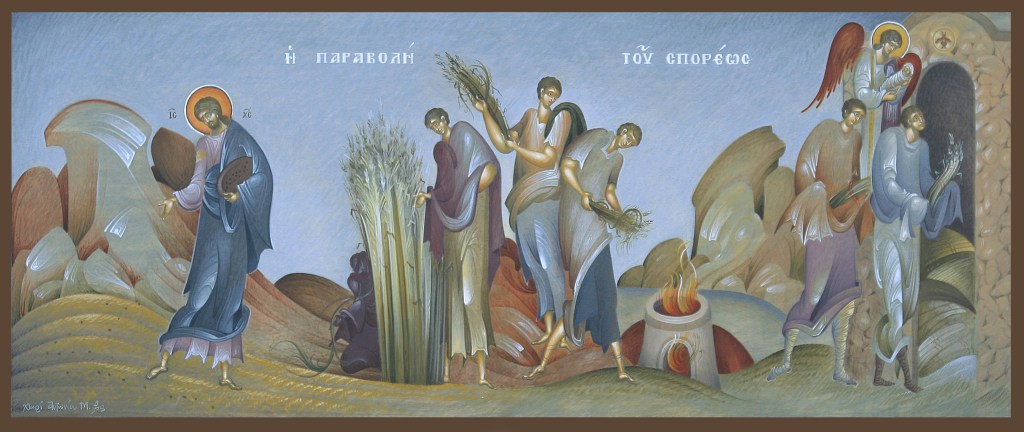
Jesus has just told the parable of the wheat and the tares/weeds and told those listening that the good and evil will grow together. It will not be until the last day when they are separated, but on that day, the Lord will send out the angels to reap the harvest, saying, “First collect the weeds and tie them in bundles to be burned; then gather the wheat and bring it into my barn.” (Matthew 13:30b)
The scriptures read: “Gather the wheat and bring it into my barn.” And then immediately afterward, we hear our lesson for today, “Jesus put before the crowds another parable: ‘The kingdom of heaven is like….’”
The parable of the wheat and tares spoke of judgment and blessing. Judgment for those who do not believe and blessing, that is, the Kingdom of Heaven, òlam ha-ba, Gad Eden, the world to come, for those who do. But why did Jesus say the Kingdom of Heaven was like so many different things? Mustard seed, leaven, treasure, pearl, and so on? If we go through the list, we learn many things.
With the mustard seed, we learn that the Kingdom will grow from something small and become something that makes room for all the birds of the air—all the peoples of the Earth. The leaven tells us it will be everywhere and a part of everything. The hidden treasure is about how we must work to gain it, and the costly pearl speaks of sacrifice. The separating of the great catch reminds us that not everyone will be allowed entry but will instead be cast out. By telling us all these things, Jesus is telling us that there is a Kingdom that is not of this world and that in that place, our God reigns.
I imagine a rush of words as Jesus spoke about these things, and because of so many parables, he is expressing how incomparable and indescribable.
Have you ever been to the Grand Canyon? The immensity of it is overwhelming. In the movie Grand Canyon, Danny Glover’s character, Simon, talks about sitting on the rim and looking out. “I felt like a gnat that lands on the [backside] of a cow that’s chewing its cud next to the road that you ride by on at 70 miles an hour.” Professor of Psychiatry Mark Goulston said, “I can still remember my first experience standing at the edge of the Grand Canyon and looking into it. It was so awesome. It took a fair amount of restraint to prevent me from jumping into it because I was certain I could fly.”
As Jesus was telling these parables of the Kingdom of Heaven, I can imagine him having this vision of heaven in His mind, much like Simon and Goulston’s vision of the Grand Canyon in theirs as they spoke. It could all be summed up, not in a word, but an expression: “Whoa!” So much more than you could ever imagine. A world turned upside down compared to this one, full of God’s riches. By comparison, this world is insignificant.
Rabbi Hofetz Chaim (d.1933) was very influential. A story tells of how he had an American visitor to his home in Poland. The Rabbi’s home was very austere. A simple room, books, a table, and a bench.
The visitor asked, “Rabbi, where is your furniture?”
“Where is yours?” replied the rabbi.
“Mine?” asked the puzzled American. “But I’m a visitor here. I’m only passing through.”
“So am I,” said the Rabbi.
The people in the time of Jesus had a very limited view of the Kingdom of Heaven. They thought of it in terms of the crane looking for snails along the slimy banks of a pool, but it is so much more. It is worth working for and sacrificing for as we pass through this ante-chamber. Therefore, in the words of St. Augustine (or Ignatius, depending on who you believe said it), “Pray as though everything depended on God. Work as though everything depended on you.” The reward far exceeds any price or sacrifice.
Let us pray (a short prayer that is recited at the end of each decade of the Rosary, known as the Fatima Prayer): O my Jesus, forgive us our sins, save us from the fire of hell, lead all souls to heaven, especially those who are in most need of Thy mercy. Amen.
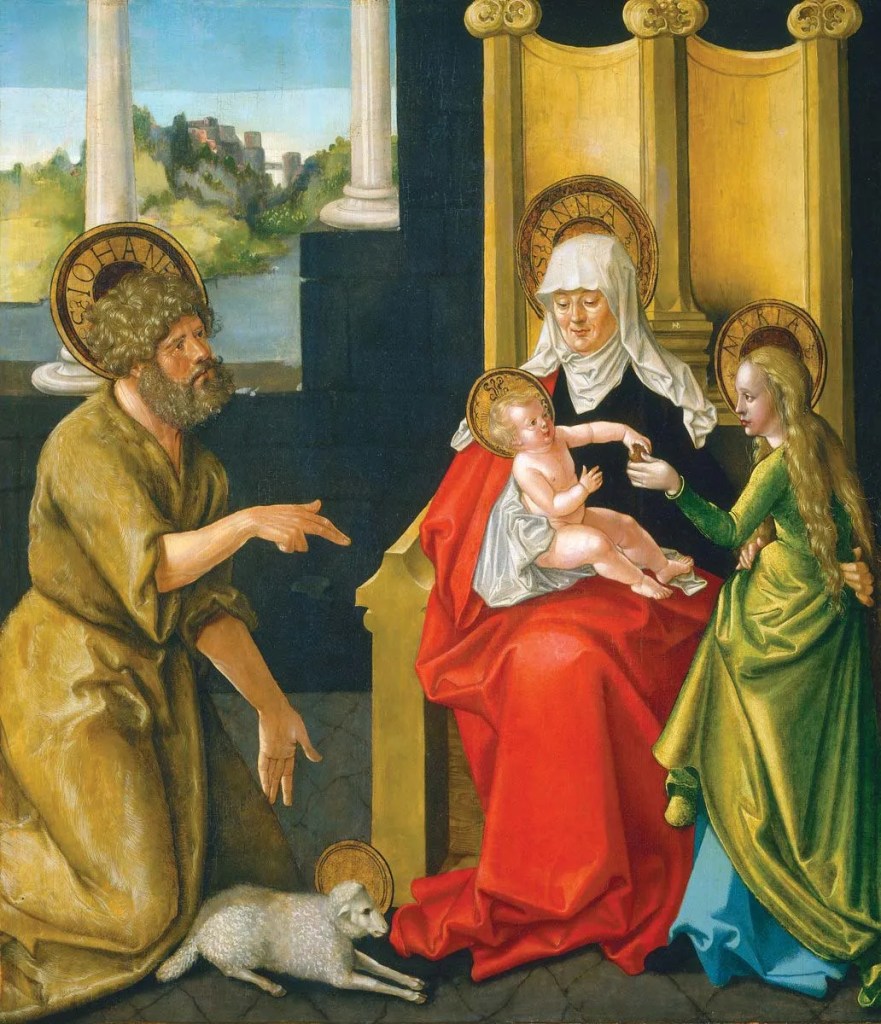
Saint Anne with the Christ Child, the Virgin, and Saint John the Baptist, oil on hardboard transferred from panel by Hans Baldung, c. 1511
Today is one of those not so well known holy days, but it is on the Episcopal calendar: The Parents of the Blessed Virgin Mary. For the record, there is nothing in all of Holy Scripture about them. Still, early in the second century, there was one who wanted to work out a better understanding of Mary’s life. So they wrote The Protoevangelium of James, which begins, “The Birth of Mary the Holy Mother of God, and Very Glorious Mother of Jesus Christ.”
Anna and Joachim are believed to be Mary’s parents and Jesus’ earthly grandparents. This passage is a bit long but helps us understand the feast day.
“And, behold, an angel of the Lord stood by, saying: Anna, Anna, the Lord has heard your prayer, and you shall conceive, and shall bring forth; and your seed shall be spoken of in all the world. And Anna said: As the Lord my God lives, if I beget either male or female, I will bring it as a gift to the Lord my God; and it shall minister to Him in holy things all the days of its life. And, behold, two angels came, saying to her: Behold, Joachim your husband is coming with his flocks. For an angel of the Lord went down to him, saying: Joachim, Joachim, the Lord God has heard your prayer. Go down hence; for, behold, your wife Anna shall conceive. And Joachim went down and called his shepherds, saying: Bring me hither ten she-lambs without spot or blemish, and they shall be for the Lord my God; and bring me twelve tender calves, and they shall be for the priests and the elders; and a hundred goats for all the people. And, behold, Joachim came with his flocks; and Anna stood by the gate, and saw Joachim coming, and she ran and hung upon his neck, saying: Now I know that the Lord God has blessed me exceedingly; for, behold the widow no longer a widow, and I the childless shall conceive. And Joachim rested the first day in his house.
“And on the following day he brought his offerings, saying in himself: If the Lord God has been rendered gracious to me, the plate on the priest’s forehead will make it manifest to me. And Joachim brought his offerings, and observed attentively the priest’s plate when he went up to the altar of the Lord, and he saw no sin in himself. And Joachim said: Now I know that the Lord has been gracious unto me, and has remitted all my sins. And he went down from the temple of the Lord justified, and departed to his own house. And her months were fulfilled, and in the ninth month Anna brought forth. And she said to the midwife: What have I brought forth? And she said: A girl. And said Anna: My soul has been magnified this day. And she laid her down. And the days having been fulfilled, Anna was purified, and gave the breast to the child, and called her name Mary.”
Why is this history important? There are many Roman Catholic Churches that are named Immaculate Conception. I would wager that almost everyone, including Catholics, believes this speaks of Jesus’s conception. However, it is speaking of the conception of Mary. It is believed that the conception of Mary without sin is a part of how Jesus was born without sin.
Is your salvation dependent upon believing this teaching? Not at all. It does, however, help us to see how others attempted to work out their faith. Perhaps, we too should be so interested in our faith that we seek more profound answers. It doesn’t mean we’ll always get it right, but it does mean we are seeking our God.
Mark it up as an urban legend or an actual event; whatever the case may be, the myth persists: on June 26, 1963, President John F. Kennedy, while visiting West Berlin, gave one of the finest speeches of the Cold War. He said, “Two thousand years ago, the proudest boast was civis romanus sum [I am a Roman citizen]. Today, in the world of freedom, the proudest boast is ‘Ich bin ein Berliner! [I am a Berliner]. All free men, wherever they may live, are citizens of Berlin, and therefore, as a free man, I take pride in the words ‘Ich bin ein Berliner!’”
According to the legend, Kennedy was supposed to say, “Ich bin Berliner!” Not “Ich bin ein Berliner!” In the first, Kennedy is, in fact, saying, “I am a Berliner.” In the second, he proudly proclaims, “I am a jelly doughnut!”
I mention this in recognition that we all make mistakes, and hope you will show me compassion for the one I made during last week’s sermon.
For whatever reason, I got it in my pointy little head that the Parable of the Sower—seeds that fell on rocky ground, the road, etc.—was the only time we benefitted from Jesus’ explanations of the parables. If you were just listening to the Gospel, you would have heard I was mistaken. Please accept this as my apology for that misinformation… I am a jelly doughnut. Moving on.
There is a good bit of speculation on what heaven will actually be like and quite a bit more speculation on who actually gets in, but I was wondering, would you allow me to choose for you?
When we were younger, I suppose we all had to endure that humiliating ritual of choosing sides, especially when it came to sporting events during recess or P.E. The teacher always chose the captains of the teams, and it seemed that the captain was always Mr. Jock and he always had his jockettes that he would choose first. When the good picking was over, you knew he and his buddies were no longer choosing who they wanted on their team. Instead, they were deciding who they would rather be stuck with. If it were up to them, they would likely not choose the losers but force them to sit on the sideline, which they did anyways because there was no way on God’s green earth they intended to jeopardize the balance of world power which hung on the outcome of this particular bout of dodge ball.
Now, perhaps you wouldn’t mind me picking or not picking you for a dodgeball game, but again I ask you, would you allow me to choose whether or not you get to go to heaven? If you are smart, you will answer that question with a resounding “NO!” I am so desperately in need of God’s grace myself that I don’t want anyone or anything getting between me and it; however, what I find so curious, is that we don’t want someone to choose for us, but we are more than willing to choose for others.
In our parable today, Jesus tells us that he is the sower of the seed and that the seeds represent the righteous—the children of God. The weeds sown with the good seed are the unrighteous—the children of the father of lies. And on God’s appointed day, He will send his angels to clear the field of weeds and throw them into the fire.
When we get a bit too big for our britches, we mistakenly believe that we are either God or an angel, that we have the knowledge, the right, and by golly, the responsibility to go into that field and pull some weeds because we know who they are. If God is too busy taking care of other business, we will happily step in. Sometimes we step in for what we consider to be noble reasons, “That person is a heretic! Burn them at the stake!” While at other times, our reasons aren’t quite so noble.
You won’t like this story—Stephen Covey, the author of The 7 Habits of Highly Effective People and other books, tells of the time on a lovely quiet Sunday afternoon when he was taking the subway through New York City. There were a few other passengers in the car with him, but not many, and all were enjoying the peace of the day. However, at the next stop, a man and his two sons burst onto the train, and the boys created all sorts of havoc. They ran absolutely wild up and down the car, screaming, shouting, wrestling—destroying the peace of that Sunday afternoon. I guess Covey thought the father of these two terrorists was a weed that needed pulling, so after a particularly noisy moment, he turned to the father and said, “Sir, perhaps you could restore order here by telling your children to come back and sit down.”
Have you ever been in that place? So confident that you were right and the other person wrong? That you could look at someone with all confidence and judge them? Of course, you have. We all have. We believe we have God’s infinite knowledge and wisdom to make these sorts of snap decisions, but how often are we wrong?
After Covey told this weed to get the terrorist under control, the weed said, “I know I should do something. We just came from the hospital. Their mother died an hour ago. I just don’t know what to do.” Covey had not snatched out some weed worthy of the fires of hell. Instead, he had only further bruised a broken heart that was in desperate need of the love of God.
Consider the fact that Jesus knew all along that Judas Iscariot was going to betray him. He knew that Judas was a weed among the wheat, but Jesus never threw him out. Instead, Jesus washed Judas’ feet, just as he had washed Peter’s, James’, John’s, and all the rest. Judas betrayed Jesus unto death, yet Jesus never condemned him and allowed Judas to participate in the Lord’s Supper. Question: how many have we renounced for far more trivial offenses by comparison?
In the parable, Jesus tells us we are neither God nor angels. Because we are not God, then we are not the judge. Because we are not angels, we are not the ones called to go into the fields and pull the weeds. We are, however, the grain of wheat, and if our work is not to judge or reap, then what is it? Jesus says, “Very truly I tell you, unless a kernel of wheat falls to the ground and dies, it remains only a single seed. But if it dies, it produces many seeds.”
What is our work? Jesus said, “This is to my Father’s glory, that you bear much fruit, showing yourselves to be my disciples.” Jesus says, “You did not choose me, but I chose you and appointed you so that you might go and bear fruit—fruit that will last.” One of the desert fathers said, “If a man settles in a certain place and does not bring forth the fruit of that place, the place itself casts him out, as one who has not borne its fruit.” For me, this brings to mind a rather unpleasant thought: if we are not producing good fruit, could it be that we are the weeds? We won’t entertain that one.
St. Josemaría Escrivá writes, “The Lord’s field is fertile and the seed he sows of good quality. Therefore when weeds appear in this world of ours, never doubt that they spring up because of a lack of correspondence on the part of men, Christians especially, who have fallen asleep and have left the field open to the enemy—Don’t complain, for there’s no point; examine your behaviour, instead.” If the weeds are truly growing amongst the wheat, we must consider that the fault might be ours and that we may be acting like a weed when we should be working on producing good fruit.
Only God chooses who goes to heaven, and thanks be to God for that! But we do have a role to play, and that is to produce good fruit. The person you’ve discounted, cast off, considered a weed in this world that must be yanked out, might just need someone—and not just any someone—but you. They just might need you to help them produce the fruit in their own life; therefore, be brave, have patience, and persevere in loving them, bringing glory to Our Father in Heaven.
St. Francis stated this best in a prayer. Let us pray: “Lord, make me an instrument of Your peace. Where there is hatred, let me sow love; where there is injury, pardon; where there is doubt, faith; where there is despair, hope; where there is darkness, light; where there is sadness, joy. O, Divine Master, grant that I may not so much seek to be consoled as to console; to be understood as to understand; to be loved as to love; for it is in giving that we receive; it is in pardoning that we are pardoned; it is in dying that we are born again to eternal life. Amen.”
I do enjoy reading. I’ve got my theology books that keep me company, but when it comes to relaxing, I’m all about fiction. I particularly like how the authors develop and describe the characters.
J.K. Rowling described Harry Potter: “Harry had a thin face, knobbly knees, black hair, and bright green eyes. He wore round glasses held together with a lot of Scotch tape because of all the times Dudley had punched him on the nose. The only thing Harry liked about his appearance was a very thin scar on his forehead that was shaped like a bolt of lightning.” In The Girl with the Dragon Tattoo (not that I would ever read such a book!), Stieg Larson described Lisbeth Salander as “an information junkie with a delinquent child’s take on morals and ethics.”
If the author is good, when we read these descriptions, we start to get images in our head of what these characters look like and what they are all about, just like when you visit on the phone with someone you’ve never met. You get this idea of what they will look like, even though that often turns out to be completely wrong (I made that mistake on a few blind dates). Even so, we get these images in our heads and will cling to them until proven wrong.
Similarly, the apostles and others who were with Jesus thought they knew who he was. As we’ve discussed, some thought he would be this great king, a military leader come to free them from the oppressive Romans, while others saw him as a prophet or great rabbi. Even though they may occasionally get it right – Peter said, “You are the Christ, the Son of the Living God.” – they still didn’t fully understand; therefore, they had these ideas about who Jesus was that weren’t always correct, so before the Good News could be taken into the world, that image they held had to be corrected.
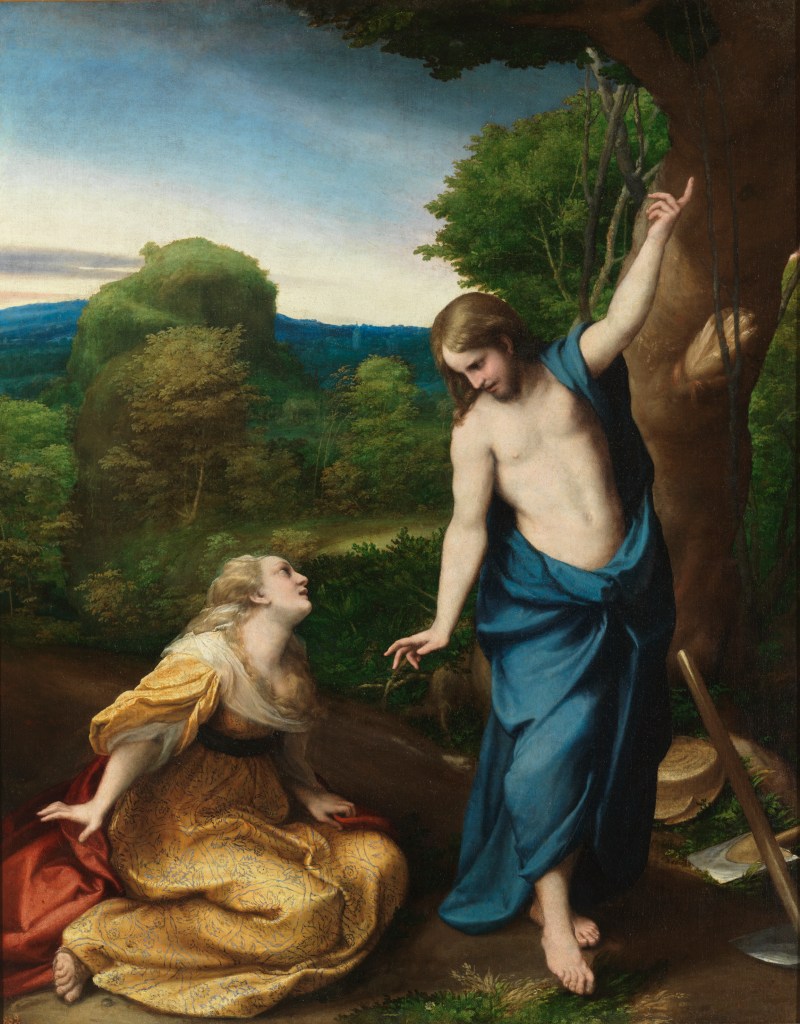
Our Gospel reading begins this process of correction and greater understanding. At the tomb, on the day of the resurrection, Mary Magdalene turned and recognized Jesus, “Rabbouni!” (which means Teacher). Jesus told her, “Do not hold on to me, because I have not yet ascended to the Father.”
“Do not hold on to me” is sometimes seen as Jesus saying, “Do not touch me,” but in the very next chapter, we have Jesus telling Thomas, “Reach your hand out and put it into my side.” So, “Do not touch me” doesn’t fit. Instead, what we see happening is Mary Magdalene projecting onto the Risen Lord the image she has of him in her mind, that of Rabbi and Teacher. And Jesus, by saying, “Do not hold on to me,” is saying, “Do not cling to the limited image you have of me. Things are different now.” As Paul said in our epistle, “If anyone is in Christ, there is a new creation: everything old has passed away; see, everything has become new!”
Mary was clinging to her understanding of Jesus before his death and resurrection. She was holding on to a world where, through sin, humankind was separated from the Father. But through his death and resurrection, that relationship has been made new:
Once you were not a people, but now you are God’s people; once you had not received mercy, but now you have received mercy. (1 Peter 2:12)
This is why Jesus was able to say to her and the apostles, “I am ascending to my Father and your Father, to my God and your God.” No longer is it, “In my Father’s house there are many rooms,” but now, “In Our Father’s house.”
You have read about Jesus. You’ve heard preaching about his nature and attributes. Like Mary Magdalene – the Apostle to the Apostles – you have this image of Jesus in your mind. Question: Is that image an accurate portrayal of the Risen Lord, or are you holding onto an image that is – perhaps not wrong – but too small? Limited?
We will never fully understand God, but by asking the Holy Spirit to help us let go of what we think we know, that understanding can be broadened so that we might more fully know the God and Father of us all.
The Archbishop of Canterbury was making arrangements to visit the United States. Before his plane landed, one of his advisors recommended that the Archbishop be cautious with the scandal-mongering press. “Be discreet: be very discreet, but with a smile.”
On arrival, he was hijacked by a bevy of pressmen clamoring for a story.
One reporter asked, “What do you think of the nightclubs in New York?” Remembering to be discreet, with a smile, the Archbishop ironically responded, “Are there any nightclubs in New York?”
Headlines next day: Archbishop’s first question on landing, “Are there any nightclubs in New York?”
Near the beginning of our Gospel reading, we read that Jesus “told them many things in parables.” Next Sunday and the following, our Gospel reading will begin, “Jesus put before the crowd another parable.” Three Sundays of parables. Why parables? Jesus answered that question, but we skipped over it.
If you look at your bulletin, you’ll notice that our Gospel for today was Matthew 13:1-9, 18-23. In verses 10-17, Jesus answered the question.
The disciples asked him, “Why do you speak to the people in parables?”
He replied, “Because the knowledge of the secrets of the kingdom of heaven has been given to you, but not to them. Whoever has will be given more, and they will have an abundance. Whoever does not have, even what they have will be taken from them. This is why I speak to them in parables:
“Though seeing, they do not see; though hearing, they do not hear or understand.”
Jesus goes on speaking in this same vein, referencing back to the Prophet Isaiah. His answer is almost as confusing as the parables. Jesus is saying that He speaks in parables because some will be receptive to His message, who will understand it, and who will live. At the same time, there will be many others who believe they already know what God is doing and have no need for this message that Jesus is bringing. The parable is a message of mercy and redemption to those who will hear and believe, but it is also a message of judgment on those who refuse Him.
When it comes to the parable we hear today—known as the Parable of the Sower—we benefit from Jesus’ private explanation to his disciples, but all the others who heard it that day did not. What would you have thought had you been one of the others?
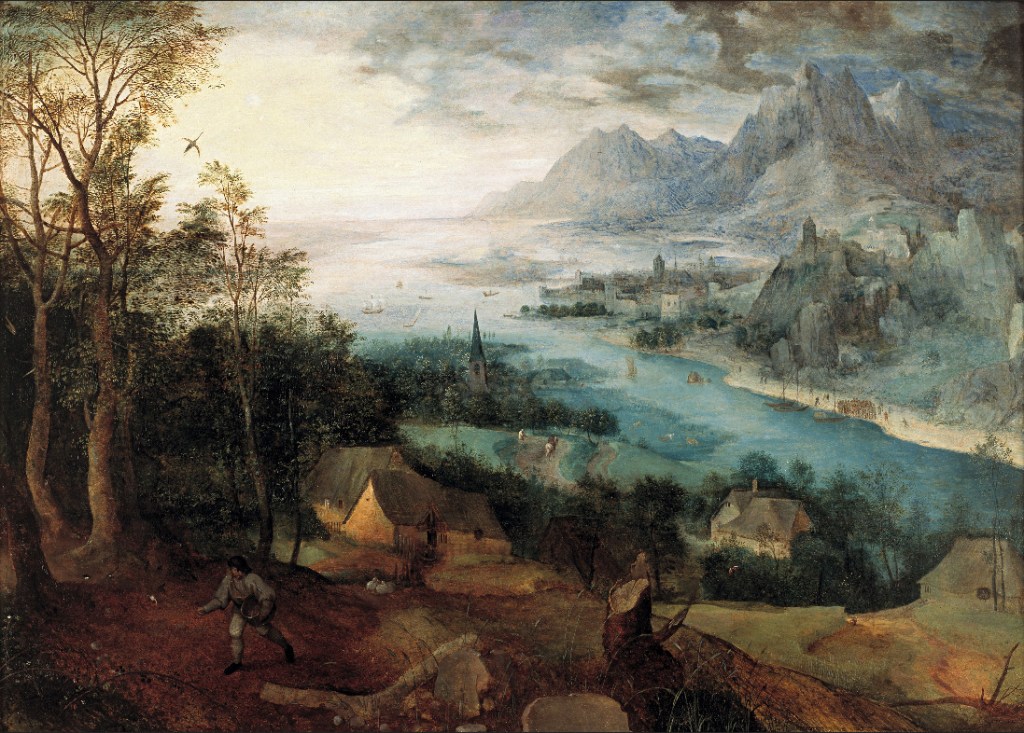
You watch as Jesus walks through the crowd and gets into the boat, then after pushing out a way, he sits and faces you and the others. Then, without laying any groundwork, he speaks: “A farmer went out to sow his seed. As he was scattering the seed, some fell along the path, and the birds came and ate it up. Some fell on rocky places, where it did not have much soil. It sprang up quickly, because the soil was shallow. But when the sun came up, the plants were scorched, and they withered because they had no root. Other seed fell among thorns, which grew up and choked the plants. Still other seed fell on good soil, where it produced a crop—a hundred, sixty or thirty times what was sown. Whoever has ears, let them hear.”
After He has given this short message, He rows back in and walks off with his disciples. All you have are those few words. Your mission, should you choose to accept it—without the explanation Jesus provided privately to His disciples—is to interpret what He has said.
In putting myself in that position, my first thought was to try and understand why Jesus told that parable at that particular time. What prompted it?
From earlier in Matthew’s Gospel, we know that Jesus has already called his disciples and even sent them out to proclaim the message of the Kingdom of God, for “The harvest is plentiful, but the workers are few.” Also, John the Baptist was arrested and sent some followers to ask if Jesus was the Messiah. Shortly before our reading, Jesus demonstrated that he was the Lord of the Sabbath by healing the man, but the religious leaders call him Beelzebub—the devil. Jesus has been rejected by some of the people and has condemned those towns where there was such unbelief. Finally, last week, we heard him say, “No one knows the Son except the Father, and no one knows the Father except the Son and those to whom the Son chooses to reveal him.” (Matthew 11:27) All these things and today, he tells the Parable of the Sower. It began, “That same day Jesus went out of the house and sat by the lake. Such large crowds gathered around him that he got into a boat and sat in it, while all the people stood on the shore.”
What prompted Jesus to tell the parable? He went in the boat out on the lake and sat. The large crowd stood on the shore. Jesus watches them, and, like any large crowd, He sees the movement of the crowd. At times, the crowd almost appears as a single organism, flowing and moving. We’ve all witnessed the same thing at sporting events or concerts. The crowd shifts and sways, cheers and groans together. I can understand how Jesus may have looked at this crowd and saw their movement as that of a wheat field blowing in the wind. And, considering all that had taken place before—those who believed and followed, but also those who rejected him, who turned away when things became more difficult, who cursed Him… looking out on this wheat field of people and knowing their hearts, He began, “A sower went out to sow. And as he sowed….”
So, back to our original question, you do not have the benefit of Jesus’ private explanation of this parable. All you have are the words he has spoken from the boat. What do you think it means? What would it have meant to you?
The key to our understanding is Jesus’ first statement, “A farmer went out to sow his seed.” A farmer does not walk out on a piece of land and start scattering seeds. No. First, the farmer must clear the land of all that is there: rocks, trees, bushes, and other debris. Then he must prepare the land to receive the seed, plow the field and turn the soil. Then, when it is the right season, he will go out and scatter the seed.
Jesus, through the parable, is telling the listeners that everything has been prepared and that the ground is now ready to receive the seed. The farmer then goes out and scatters the seed. He does so by hand. He tells the crowd where the seed landed, and not all of it landed in the prepared soil, but instead, it fell in unproductive areas: the road and among the rocks and thorns. That does not mean the farmer was careless; it’s just the nature of farming.
In hearing this, it is easy to focus on the farmer and the viability of the soil, but what Jesus is focusing on is the fate of the seed. The farmer has done all he can for the success of the seed. So, did the seed produce good fruit or not?
“Are there any nightclubs in New York?” Regarding the parables Jesus told, the exact meaning is not always clear. They were intended that way (today’s parable being the exception when Jesus tells the disciples what it means.) So, the parables require a bit of work on our part. We must wrestle with them. They are also timeless because they force us to ask the same questions as those standing by the lake who initially heard this one had to ask themselves. Finally, what makes the parables absolutely brilliant is their ability to speak to everyone and to the individual, each person having to discern for themselves how they fit into this story of God.
Today, we can look at this parable corporately. What does it say about us as a church, the Body of Christ? Have we withered? Have we been snatched away? Have we been choked off by other concerns other than the Gospel? Or are we producing good fruit? These are questions that we should ask ourselves regularly, but they also apply to us as individuals. Is the seed of God’s Word producing good fruit in me? When Jesus looks out over that field of wheat that he has planted, how does He see me?
The parable does not provide tidy little answers that can be framed and placed on the mantle. Instead, they provide us with questions about who we are in the workings of God. Today’s: God has sown the Word of His Kingdom within you—individually and collectively—how is that seed doing? How do you answer that question?
Within the Church, there are blessings for just about anything, including one for farmers for when the seeds they have sown are beginning to sprout. It seemed appropriate as a prayer. Let us pray: To Thee, O Lord, we cry and pray: bless this sprouting seed, strengthen it in the gentle movement of soft winds, refresh it with the dew of heaven, and let it grow to full maturity for the good of body and soul. Amen.
A guy walks into a bar and orders a round of drinks for everyone. He announces, “I just made my last mortgage payment, and we’re celebrating!”
“Congratulations on paying off your mortgage,” another patron says.
The man shakes his head. “Oh, don’t get me wrong, I still owe $422,378. But today’s payment was the last one I’m gonna make.”
Mortgage is a French word. It combines two Old French words, mort meaning “death,” and gage, meaning “pledge.” There’s your happy thought for today: signing a mortgage means signing a death pledge. It was named this as a mortgage only ends when the loan has been paid off or when you die. Congratulations on owning a home.
Concerning the mortgage, the author, Calvin Trillin, says, “Among married couples, the person who actually makes out the mortgage check is likely to be more cautious about spending money than the person who doesn’t. There is something sobering about sending away that much money every month in the knowledge that, rain or shine, you’ll have to come up with the same amount of money the next month and the month after that.”
You would think this sobering effect would give us pause. Still, it seems that as soon as someone’s financial position improves—a new job, raise, etc.—instead of remaining where they are and being able to breathe a bit more easily financially, they sell what they’ve got and go out and get themselves an even bigger mortgage, which is partially why the average mortgage in the year 2000 was $152,100 and, as of June this year, is $428,000. (Source)
I remember living in Wisconsin when I was in seminary. Originally, Nashotah House was out in the middle of nowhere, surrounded by corn fields. That all changed with the suburban sprawl of Milwaukee. New neighborhoods were going in all around, and some of the houses were massive. The funny thing, people were living in them, but when you went by at night and could catch glimpses of the inside—there was no furniture! They had such large mortgage payments that they couldn’t afford to furnish them. What do I know? The upside: they could sell those houses today for three or four times the amount they paid for them.
Anyhow… the mortgage—the death pledge—only ends when it is paid off, or you die. If those death pledges were only on our homes, it would be one thing, but we strap ourselves with all sorts of death pledges; they just come by different names. The Bible refers to them as yokes.
The yoke was a wooden device placed across the shoulders of a pair of oxen so they could work together in plowing a field. It worked out well if the yoke was fitted correctly and the animals were equal. If they were poorly fitted, the animals would get sores as the wood of the yoke rubbed up against them. If they were unequally yoked, the weaker of the animal would be carried along to wherever the stronger one led.
Remember last week? We talked about the Prophet Jeremiah. He said to the king of Jerusalem, “Bring your necks under the yoke of the king of Babylon, and serve him and his people and live.” (Jeremiah 27:12) Jeremiah was telling the king that, for a time, he and the people must submit to the rule of the Babylonians. The Babylonians were much stronger, so Israel would have to go where they led, but by submitting, the Israelites would live.
Ultimately, the Israelites refused to listen to Jeremiah and attempted to throw off the Babylonians. For these actions, the Prophet said to them, “By breaking a wooden yoke, you forge an iron yoke!” (Jeremiah 28:13) The Prophet said, “If you think things are bad now, just you wait!” Through their refusal to heed God’s word to them, like us in taking on an even greater mortgage, they took on an even greater death pledge and became even more firmly yoked to their enemy.
These types of yokes exist in the world outside of ourselves, but they exist within as well. Our souls can become yoked with those iron yokes, and we can be spiritually led—dragged, kicking, and screaming—where we do not want to go. St. Paul said it best, “For I do not do what I want, but I do the very thing I hate…. I can will what is right, but I cannot do it. For I do not do the good I want, but the evil I do not want is what I do. Wretched man that I am!” You can almost hear him scream with frustration as he writes those words. The iron yoke around his soul leads him to commit deeds he did not want to commit and to speak words he would later regret, and we would all like to think that it is only Paul that this can happen to, but we know better. We all know the yoke that is strapped to our souls. And we can come to believe that it is a death pledge—something we will never be rid of until we are dead.
Here’s a question (and I don’t expect you to be shouting out the answer): what is the spiritual yoke in your life? What death pledge have you made that no matter how hard you try to overcome it, it remains? And, if it seems you’ve finally defeated it, it only comes back worse than before. You’re like the person Jesus spoke about: “When the unclean spirit has gone out of a person, it passes through waterless places seeking rest, but finds none. Then it says, ‘I will return to my house from which I came.’ And when it comes, it finds the house empty, swept, and put in order. Then it goes and brings with it seven other spirits more evil than itself, and they enter and dwell there, and the last state of that person is worse than the first.” (Matthew 12:43-45) We all fall prey to this cycle. Like the Israelites and the Babylonians, a person in such a place has exchanged a wooden yoke for a yoke of iron. They join Paul in his frustration and say, “Wretched man that I am! Who will rescue me from this body of death?”
To this, Jesus replies, “Come to me, all you that are weary and are carrying heavy burdens, and I will give you rest. Take my yoke upon you, and learn from me; for I am gentle and humble in heart, and you will find rest for your souls. For my yoke is easy, and my burden is light.”
St John Chrysostom understood how Jesus might expand on those words by saying, “Come, not to give an account but to be freed of your sins. Come, because I don’t need the glory you can give me: I need your salvation… Don’t fear if you hear me talk of a yoke, it is sweet; don’t fear if I speak about a burden, it is light.”
Jesus put it another way, “If anyone would come after me, let him deny himself and take up his cross and follow me. For whoever would save his life will lose it, but whoever loses his life for my sake will find it. For what will it profit a man if he gains the whole world and forfeits his soul?” (Matthew 16:24-25a)
“Take my yoke” is just another way of saying, “Take up your cross.” The yoke and the cross are the loving means of your salvation. If otherwise, Jesus would not say He is “gentle and humble of heart.” Instead, he would say, “Take my yoke and slave your life away.” “Take my yoke and die under my driving whip.” No. “Take my yoke and find rest.” Find peace. It is no guarantee that things will become rosy and without a care in the world, but it is a promise of comfort in the assurances of Christ; know that regardless of the difficulties, you are yoked to the One who can and will see you through.
You may not ever have a house mortgage, but every one of us will wear a spiritual yoke, so, in the words of Joshua, “Choose this day whom you will serve.” (Joshua 24:15) Will you struggle under the iron yoke of this world and forfeit your soul, or will you submit to the yoke of Christ and live? Say with Paul, “Thanks be to God through Jesus Christ our Lord!” Choose the yoke of Christ and find your soul’s only place of rest.
Let us pray: God, our Father, You redeemed us and made us Your children in Christ. Through Him, You have saved us from death and given us Your Divine life of grace. By becoming more like Jesus on earth, may we come to share His glory in Heaven. Give us the peace of Your kingdom, which this world does not give. By Your loving care, protect the good You have given us. Open our eyes to the wonders of Your Love so that we may serve You with a willing heart. Amen.
Boudreaux dies and arrives at the Gates of Heaven, where he sees a huge wall of clocks behind him.
He asks St. Peter, “What are all those clocks?”
St. Peter says, “Those are Lie Clocks. Everyone on Earth has a Lie Clock. Every time you lie, the hands on your clock will move.”
“Oh,” says Boudreaux, “whose clock is that?”
“That’s Jesus’ clock,” Peter answered. “It has never moved, showing that he never told a lie.”
“Incredible,” says Boudreaux. “And whose clock is that one?”
Peter responds, “That’s Abraham Lincoln’s clock. The hands have moved twice, telling us that Abe told only two lies in his entire life.”
“So where’s my clock?” asks Boudreaux.
“Your clock is in God’s office. He uses it as a ceiling fan.”
In his book Phaedrus, Plato wrote, “An alliance with a powerful person is never safe.” The same is true with alliances between nations. The history of Israel, during the time of the prophets, makes the point.
In 609 BC, Josiah was the King of Judah (The King of the South). At that time, the Egyptians were marching north for battle with another kingdom, but Josiah decided to attack them for unknown reasons. That did not go well, and Josiah was killed in battle. Judah then became a vassal of Egypt and had to pay them a handsome tribute. Josiah’s son, Jehoahaz, ascended the throne, but Egypt didn’t like him as king, fearing that he would seek vengeance for his father, so the Egyptians removed him and installed Jehoiakim as king.
That relationship was rocky but was working as planned until along came the Babylonians, who won a decisive victory against Egypt in 605 BC. Jehoiakim, wanting to save his own backside, switched his allegiance to Babylon and paid them tribute, including some of the holy items from the Temple. As you would imagine, this did not go over well with everyone, including Prophet Jeremiah.
Jeremiah had been close to Josiah, but he saw Jehoiakim as a wicked king—which he was—and denounced him.
Although strong, the Babylonians could not fully control the Egyptians and the surrounding area. In 597 BC, thinking that the Babylonians had been so weakened that he could do as he liked, Jehoiakim stopped paying them tribute and once again allied himself with the Egyptians. But remember, “An alliance with a powerful person is never safe,” because—as you may remember from last week—there’s always someone looking to be king of the mountain.
When Jehoiakim stopped paying tribute to Nebuchadnezzar, the King of the Babylonians, returned and laid siege to Jerusalem. He conquered the city, killed Johoiakm, took some Israelites into captivity, and installed a new king. If you think Jehoiakim wasn’t all that bright, meet Zedekiah.
Like Jehoiakim, Zedekiah played along with the Babylonians, but after ten years, it became increasingly clear that he wanted to stop paying tribute. Many were with him, but others, including that nagging prophet, Jeremiah, opposed.
Jeremiah told the people that the Babylonians were essentially the hand of God, working God’s judgment against them for their sins. As a visual aid, the Lord said to Jeremiah, “Make yourself straps and yoke-bars, and put them on your neck.” (Jeremiah 27:2) The yoke said to the people, “For a time, this must be you. You must be under the yoke of the Babylonians while God exacts His punishment on you for your misdeeds.” Jeremiah said, to King Zedekiah, “Bring your necks under the yoke of the king of Babylon, and serve him and his people and live.” (Jeremiah 27:12) As hard as he tried, the king and the people opposed, and even some that claimed to be prophets were against him, one of which we heard about today, Hananiah.
Hananiah, claiming to speak for God, said, “I have broken the yoke of the king of Babylon. Within two years I will bring back to this place all the vessels of the Lord’s house, which Nebuchadnezzar, king of Babylon, took away from this place and carried to Babylon.” (Jeremiah 28:3) Hananiah was calling the people to rebuke Nebuchadnezzar and the prophecies of Jeremiah and to believe that they would be free within two years. This is where our reading from today came in. In responding to him, Jeremiah said, “Amen! May the Lord do so; may the Lord make the words that you have prophesied come true.” Jeremiah said, “Those are nice words, and I pray they come true.” Hananiah then broke the yoke that Jeremiah had fashioned for himself and declared that the yoke of Nebuchadnezzar would be broken similarly. Jeremiah heard these things and then went his way, and the people and King Zedekiah remained in their sin. Two months later, the prophet—the false prophet—Hananiah died, and the Babylonians completely sacked Jerusalem.
Thomas Sowell is an author, economist, and social commentator.
He wrote, “When you want to help people, you tell them the truth. When you want to help yourself, you tell them what they want to hear.” (The Thomas Sowell Reader, p.398) Jeremiah was speaking the truth, but Hananiah was simply telling the people what they wanted to hear. Like ol’ Boudreaux, Hananiah had told many lies, and he paid for his sin.
Jeremiah said, “As for the prophet who prophesies peace, when the word of that prophet comes true, then it will be known that the Lord has truly sent the prophet.” The Prophet who preached peace was Jesus. St. Paul tells us in his letter to the Ephesians that Jesus “came and preached peace to you who were far off and peace to those who were near. For through him we both have access in one Spirit to the Father.” (Ephesians 2:17-18) And the peace that Jesus was preaching was not about the peace between nations, but the everlasting peace between God and His children—between God and us.
If that were the end, then all would be well, but throughout the New Testament, we hear of those who will come and spread lies like Hananiah. In his first Epistle, St. John tells us, “Beloved, do not believe every spirit, but test the spirits to see whether they are from God, for many false prophets have gone out into the world.” (1 John 4:1) Just so you know how bad these false prophets are, John declares they have “the spirit of the antichrist.” (1 John 4:3) St. Peter also warns us, “Be sober-minded; be watchful. Your adversary the devil prowls around like a roaring lion, seeking someone to devour.” (1 Peter 5:8) Jesus has prophesied and brought peace between God and humankind, it is ours for the asking. Still, some would seek to destroy that peace, so we must be on our guard against them. It can, however, get a little tricky. Why?
Paul wrote to Timothy, “The time is coming when people will not endure sound teaching, but having itching ears they will accumulate for themselves teachers to suit their passions, and will turn away from listening to the truth and wander off into myths.” (2 Timothy 4:3-4) Like Hananiah, these false prophets will tell us what we want to hear instead of what we need to hear. The heart of the false message is the same as it has always been. The same as it was in the beginning when the snake—the greatest of false prophets—tempted Eve and said things like, “Did God really say…” and “You will not surely die.” The false prophet’s message is confusing, for it contains half-truths and subtle lies, but they are there, and many believe.
So there are various false prophets in the world, and there is the snake, but there is one other false prophet that runs a close second to it. My friend, Stephen King, said it best, “We lie best when we lie to ourselves.” (It, p.445)
If we pay attention and stay true to the teachings of the Gospel, then I believe we have a good chance of not falling prey to the Hananiahs of the world, but when it comes to lying to ourselves, we are experts. We know all our own arguments and weaknesses, and strategies and the Hananiah within can play us like a fiddle. St. John told us to “test the spirits to see whether they are from God,” so we must also test our own spirit and those things we believe to be true. Are we simply telling ourselves those things we want to believe, or are they consistent with the teachings of Jesus? If we are lying to ourselves, then we’ve already lost. As The Bard wrote:
“This above all: to thine own self be true, And it must follow, as the night the day, Thou canst not then be false to any man.”
(Hamlet, Act 1, Scene 3)
Jesus said, “If you abide in my word, you are truly my disciples, and you will know the truth, and the truth will set you free.” (John 8:31-32) You are Jesus’ disciples. Do not listen to or tolerate the lies from outside yourself or from within, but seek to discern the truth.
Let us pray: O Mary, Mother of Mercy, watch over all people that the Cross of Christ may not be emptied of its power, that humankind may not stray from the path of the good or become blind to sin, but may put their hope ever more fully in God who is “rich in mercy.” May we carry out the good works prepared by God beforehand and so live completely “for the praise of his glory.” Amen.
Question: There are ten of them, and if you add up the length of each, they would measure 28 feet, 5 inches. What are they? Answer: Lee Redmond’s fingernails.
World records.
3.46 inches is the longest nose and adorns a fella’s face in Turkey.
The highest-paid musician over twelve months is Taylor Swift. She earned $186 million over twelve months in 2018-2019.
The tallest man is 8 feet 3 inches, and the shortest woman is just over two feet (only weighing nine pounds more than she did when she was born.)
The loudest recorded cat purr is 67.8 decibels. That’s the equivalent of an alarm clock.
There is even a world record for holding the most world records. That would be Ashrita Furman. He holds over 800, including one for climbing Mount Fuji on a pogo stick.
The thing about most world records, especially the more relevant ones—land speed records, high jumps, etc.—is that someone is always gunning for you. With all my singing talent, I’m working on the Taylor Swift one.
We like to have records for all sorts of things, from the tallest building to the tallest mountain. However, we begin to get ourselves into trouble when we say that a particular event was the biggest, strongest, or worst. Nassim Taleb makes the point in his book, Antifragile. Taleb uses Fukushima nuclear reactor to prove the point. He says this mistake can be seen “in the Fukushima nuclear reactor, which experienced a catastrophic failure in 2011 when a tsunami struck. It had been built to withstand the worst past historical earthquake, with the builders not imagining much worse—and not thinking that the worst past event had to be a surprise, as it had no precedent.” Taleb calls this the Lucrecian Problem.
Lucretius was “the Latin poetic philosopher who wrote that the fool believes that the tallest mountain in the world will be equal to the tallest one he has observed.” Applied to the world today, Taleb says, “Professionals look in the past for information on the so-called worst-case scenario and use it to estimate future risks – this method is called ‘stress testing.’ They take the worst historical recession, the worst war, the worst historical move in interest rates, or the worst point in unemployment as an exact estimate for the worst future outcome. But they never notice the following inconsistency: this so-called worst-case event, when it happened, exceeded the worst [known] case at the time.” (Source) Such occurrences have taken place throughout history.
In 701 BC, the Assyrian army invaded and conquered the Northern Kingdom of Israel, taking many Israelites into captivity. Afterward, that same army moved south and laid siege to Jerusalem.
Several estimates as to the size of the army are given, and they go as high as 300,000 fighting soldiers, so they should have been able to destroy Jerusalem quickly. However, Hezekiah was King of the South and Jerusalem and was considered a very righteous king, so when he prayed, the Lord answered. “That very night the angel of the Lord set out and struck down one hundred eighty-five thousand in the camp of the Assyrians.” (2 Kings 19:35)
Later, about 100 years, the Babylonians laid siege to Jerusalem, but at this time, the Israelites had begun to worship false gods, and their kings were seen as wicked, so the prophets spoke against them, calling them back to the Lord. Jeremiah, whom we heard from this morning, was one of the prophets.
Our reading is a bit out of context, so it is difficult to understand whom Jeremiah is speaking to, but with a bit of work, we discover that he is speaking against the priests in the Lord’s Temple. He is speaking against the Israelites. Why? Because Jeremiah had just preached a sermon where he told them that the Lord, using the Babylonians, was about to destroy Jerusalem and all its inhabitants. Those priests didn’t much care for this message, so they beat Jeremiah and threw him in the stocks. After his release, Jeremiah spoke those words we heard today: “They will be greatly shamed, for they will not succeed.”
Near the end, the Israelites tried to do right, but it was too little, too late. The Lord had decided. The city would be destroyed, and it was. Many factors ushered in that destruction, but I think one of them was the Lucrecian Problem—they believed “that the tallest mountain in the world will be equal to the tallest one they have observed.” In their arrogance, they believed that they had already faced the tallest mountain, the Assyrians, and defeated them; therefore, they believed they were indestructible; after all, they were God’s Chosen People. They could do what they liked and stand against any enemy, but the Lord said, “Allow Me to introduce you to the Babylonians.” A much larger mountain that fell upon them and utterly destroyed them in its power. The Lucrecian Problem—it works on a large scale, but also small.
If you were to think back over your life, do you know which—of all your days—was the worst? I think many people do. Mine is very vivid, and perhaps I’ll share that with you someday, but when we think of that day, we might say something to the effect of, “Things couldn’t be any worse.” If you say that aloud, someone might respond, “Don’t say that!” Because the truth is, they can be. There can always be a bigger mountain out there, just over the horizon.
For many—maybe all of us—that is a terrifying thought. So, how can we prepare ourselves so that when it arrives, we are not the ones who are utterly destroyed?
First, we can take to heart the words of Jesus, “Do not fear those who kill the body but cannot kill the soul; rather fear him who can destroy both soul and body in hell. Are not two sparrows sold for a penny? Yet not one of them will fall to the ground apart from your Father. And even the hairs of your head are all counted. So do not be afraid; you are of more value than many sparrows.”
To overcome the fear of the next mountain in our life is to recognize Whom we belong to and our worth in His eyes. We are the Lord’s possession, we are His children, and He loves us so much that He gave His one and only Son that we might be saved, so do not give into the fear that rises up within you when you first see that mountain. Look it in the proverbial eye and tell it to Whom you belong. Not in arrogance, but in faith, for if you have faith like a grain of mustard seed, you will say to this mountain, ‘Move from here to there,’ and it will move, and nothing will be impossible for you.” In other words, “Do not fear, for the mountain will not overcome you, but God will overcome it for you.”
Second, we prepare ourselves by practicing our faith, not just when the mountain looms above us but also when the path is relatively easy. Last week, St. Paul said to us in his letter to the Romans, “Suffering produces endurance, and endurance produces character, and character produces hope, and hope does not disappoint us, because God’s love has been poured into our hearts through the Holy Spirit that has been given to us.” Through our daily walk, we build up our endurance, strengthen our character, and through our faith, as we overcome smaller obstacles, we build up our hope, our confidence in God’s love for us.
If you are sitting here, congratulations, you have survived your worst day—so far. To not succumb to the Lucrecian Problem, realize that more bad days will come, but by not fearing those days—those mountains—because you belong to God, and by developing confidence in God’s love, you will be able to stand and face those things that come against you, regardless of their size.
Let us pray: Lord Jesus Christ, we believe in You as our God and Savior. Make us more faithful to Your Gospel and commandments. By sharing in the Eucharist, may we come to live more fully in the life You have given us. Keep Your Love alive within our hearts and soul so that we may become worthy of You. Teach us to value and be thankful for all of Your Gifts. Please help us to strive for eternal life. Amen.