
The Imitation of Christ Project: Bk. 1, Ch. 22

IOC 1.22THOUGHTS ON THE MISERY OF MAN –

WHEREVER you are, wherever you go, you are miserable unless you turn to God. So why be dismayed when things do not happen as you wish and desire? Is there anyone who has everything as he wishes? No — neither I, nor you, nor any man on earth. There is no one in the world, be he Pope or king, who does not suffer trial and anguish.

Who is the better off then? Surely, it is the man who will suffer something for God. Many unstable and weak-minded people say: “See how well that man lives, how rich, how great he is, how powerful and mighty.” But you must lift up your eyes to the riches of heaven and realize that the material goods of which they speak are nothing. These things are uncertain and very burdensome because they are never possessed without anxiety and fear. Man’s happiness does not consist in the possession of abundant goods; a very little is enough.

Living on earth is truly a misery. The more a man desires spiritual life, the more bitter the present becomes to him, because he understands better and sees more clearly the defects, the corruption of human nature. To eat and drink, to watch and sleep, to rest, to labor, and to be bound by other human necessities is certainly a great misery and affliction to the devout man, who would gladly be released from them and be free from all sin. Truly, the inner man is greatly burdened in this world by the necessities of the body, and for this reason the Prophet prayed that he might be as free from them as possible, when he said: “From my necessities, O Lord, deliver me.”

But woe to those who know not their own misery, and greater woe to those who love this miserable and corruptible life. Some, indeed, can scarcely procure its necessities either by work or by begging; yet they love it so much that, if they could live here always, they would care nothing for the kingdom of God.

How foolish and faithless of heart are those who are so engrossed in earthly things as to relish nothing but what is carnal! Miserable men indeed, for in the end they will see to their sorrow how cheap and worthless was the thing they loved.

The saints of God and all devout friends of Christ did not look to what pleases the body nor to the things that are popular from time to time. Their whole hope and aim centered on the everlasting good. Their whole desire pointed upward to the lasting and invisible realm, lest the love of what is visible drag them down to lower things.

Do not lose heart, then, my brother, in pursuing your spiritual life. There is yet time, and your hour is not past. Why delay your purpose? Arise! Begin at once and say: “Now is the time to act, now is the time to fight, now is the proper time to amend.”

When you are troubled and afflicted, that is the time to gain merit. You must pass through water and fire before coming to rest. Unless you do violence to yourself you will not overcome vice.

So long as we live in this fragile body, we can neither be free from sin nor live without weariness and sorrow. Gladly would we rest from all misery, but in losing innocence through sin we also lost true blessedness. Therefore, we must have patience and await the mercy of God until this iniquity passes, until mortality is swallowed up in life.

How great is the frailty of human nature which is ever prone to evil! Today you confess your sins and tomorrow you again commit the sins which you confessed. One moment you resolve to be careful, and yet after an hour you act as though you had made no resolution.

We have cause, therefore, because of our frailty and feebleness, to humble ourselves and never think anything great of ourselves. Through neglect we may quickly lose that which by God’s grace we have acquired only through long, hard labor. What, eventually, will become of us who so quickly grow lukewarm? Woe to us if we presume to rest in peace and security when actually there is no true holiness in our lives. It would be beneficial for us, like good novices, to be instructed once more in the principles of a good life, to see if there be hope of amendment and greater spiritual progress in the future.
The Imitation of Christ Project: Bk. 1, Ch. 21

IOC 1.21

SORROW OF HEART –

IF YOU wish to make progress in virtue, live in the fear of the Lord, do not look for too much freedom, discipline your senses, and shun inane silliness. Sorrow opens the door to many a blessing which dissoluteness usually destroys.

It is a wonder that any man who considers and meditates on his exiled state and the many dangers to his soul, can ever be perfectly happy in this life. Lighthearted and heedless of our defects, we do not feel the real sorrows of our souls, but often indulge in empty laughter when we have good reason to weep. No liberty is true and no joy is genuine unless it is founded in the fear of the Lord and a good conscience.

Happy is the man who can throw off the weight of every care and recollect himself in holy contrition. Happy is the man who casts from him all that can stain or burden his conscience.

Fight like a man. Habit is overcome by habit. If you leave men alone, they will leave you alone to do what you have to do. Do not busy yourself about the affairs of others and do not become entangled in the business of your superiors. Keep an eye primarily on yourself and admonish yourself instead of your friends.

If you do not enjoy the favor of men, do not let it sadden you; but consider it a serious matter if you do not conduct yourself as well or as carefully as is becoming for a servant of God and a devout religious.

It is often better and safer for us to have few consolations in this life, especially comforts of the body. Yet if we do not have divine consolation or experience it rarely, it is our own fault because we seek no sorrow of heart and do not forsake vain outward satisfaction.

Consider yourself unworthy of divine solace and deserving rather of much tribulation. When a man is perfectly contrite, the whole world is bitter and wearisome to him.

A good man always finds enough over which to mourn and weep; whether he thinks of himself or of his neighbor he knows that no one lives here without suffering, and the closer he examines himself the more he grieves.

The sins and vices in which we are so entangled that we can rarely apply ourselves to the contemplation of heaven are matters for just sorrow and inner remorse.

I do not doubt that you would correct yourself more earnestly if you would think more of an early death than of a long life. And if you pondered in your heart the future pains of hell or of purgatory, I believe you would willingly endure labor and trouble and would fear no hardship. But since these thoughts never pierce the heart and since we are enamored of flattering pleasure, we remain very cold and indifferent. Our wretched body complains so easily because our soul is altogether too lifeless.

Pray humbly to the Lord, therefore, that He may give you the spirit of contrition and say with the Prophet: “Feed me, Lord, with the bread of mourning and give me to drink of tears in full measure.”

The Imitation of Christ Project: Bk. 1, Ch. 20

IOC 1.20THE LOVE OF SOLITUDE AND SILENCE –

SEEK a suitable time for leisure and meditate often on the favors of God. Leave curiosities alone. Read such matters as bring sorrow to the heart rather than occupation to the mind. If you withdraw yourself from unnecessary talking and idle running about, from listening to gossip and rumors, you will find enough time that is suitable for holy meditation.

Very many great saints avoided the company of men wherever possible and chose to serve God in retirement. “As often as I have been among men,” said one writer, “I have returned less a man.” We often find this to be true when we take part in long conversations. It is easier to be silent altogether than not to speak too much. To stay at home is easier than to be sufficiently on guard while away. Anyone, then, who aims to live the inner and spiritual life must go apart, with Jesus, from the crowd.

No man appears in safety before the public eye unless he first relishes obscurity. No man is safe in speaking unless he loves to be silent. No man rules safely unless he is willing to be ruled. No man commands safely unless he has learned well how to obey. No man rejoices safely unless he has within him the testimony of a good conscience.

More than this, the security of the saints was always enveloped in the fear of God, nor were they less cautious and humble because they were conspicuous for great virtues and graces. The security of the wicked, on the contrary, springs from pride and presumption, and will end in their own deception.

Never promise yourself security in this life, even though you seem to be a good religious, or a devout hermit. It happens very often that those whom men esteem highly are more seriously endangered by their own excessive confidence. Hence, for many it is better not to be too free from temptations, but often to be tried lest they become too secure, too filled with pride, or even too eager to fall back upon external comforts.

If only a man would never seek passing joys or entangle himself with worldly affairs, what a good conscience he would have. What great peace and tranquillity would be his, if he cut himself off from all empty care and thought only of things divine, things helpful to his soul, and put all his trust in God.

No man deserves the consolation of heaven unless he persistently arouses himself to holy contrition. If you desire true sorrow of heart, seek the privacy of your cell and shut out the uproar of the world, as it is written: “In your chamber bewail your sins.” There you will find what too often you lose abroad.

Your cell will become dear to you if you remain in it, but if you do not, it will become wearisome. If in the beginning of your religious life, you live within your cell and keep to it, it will soon become a special friend and a very great comfort.

In silence and quiet the devout soul advances in virtue and learns the hidden truths of Scripture. There she finds a flood of tears with which to bathe and cleanse herself nightly, that she may become the more intimate with her Creator the farther she withdraws from all the tumult of the world. For God and His holy angels will draw near to him who withdraws from friends and acquaintances.

It is better for a man to be obscure and to attend to his salvation than to neglect it and work miracles. It is praiseworthy for a religious seldom to go abroad, to flee the sight of men and have no wish to see them.

Why wish to see what you are not permitted to have? “The world passes away and the concupiscence thereof.” Sensual craving sometimes entices you to wander around, but when the moment is past, what do you bring back with you save a disturbed conscience and heavy heart? A happy going often leads to a sad return, a merry evening to a mournful dawn. Thus, all carnal joy begins sweetly but in the end brings remorse and death.

What can you find elsewhere that you cannot find here in your cell? Behold heaven and earth and all the elements, for of these all things are made. What can you see anywhere under the sun that will remain long? Perhaps you think you will completely satisfy yourself, but you cannot do so, for if you should see all existing things, what would they be but an empty vision?

Raise your eyes to God in heaven and pray because of your sins and shortcomings. Leave vanity to the vain. Set yourself to the things which God has commanded you to do. Close the door upon yourself and call to you Jesus, your Beloved. Remain with Him in your cell, for nowhere else will you find such peace. If you had not left it, and had not listened to idle gossip, you would have remained in greater peace. But since you love, sometimes, to hear news, it is only right that you should suffer sorrow of heart from it.

Imitation of Christ Project: Bk. 1, Ch. 19

IOC 1.19THE PRACTICES OF A GOOD RELIGIOUS –

THE life of a good religious ought to abound in every virtue so that he is interiorly what to others he appears to be. With good reason there ought to be much more within than appears on the outside, for He who sees within is God, Whom we ought to reverence most highly wherever we are and in Whose sight we ought to walk pure as the angels.

Each day we ought to renew our resolutions and arouse ourselves to fervor as though it were the first day of our religious life. We ought to say: “Help me, O Lord God, in my good resolution and in Your holy service. Grant me now, this very day, to begin perfectly, for thus far I have done nothing.”

As our intention is, so will be our progress; and he who desires perfection must be very diligent. If the strong-willed man fails frequently, what of the man who makes up his mind seldom or half-heartedly? Many are the ways of failing in our resolutions; even a slight omission of religious practice entails a loss of some kind.

Just men depend on the grace of God rather than on their own wisdom in keeping their resolutions. In Him they confide every undertaking, for man, indeed, proposes but God disposes, and God’s way is not man’s. If a habitual exercise is sometimes omitted out of piety or in the interests of another, it can easily be resumed later. But if it be abandoned carelessly, through weariness or neglect, then the fault is great and will prove hurtful. Much as we try, we still fail too easily in many things. Yet we must always have some fixed purpose, especially against things which beset us the most. Our outward and inward lives alike must be closely watched and well ordered, for both are important to perfection.

If you cannot recollect yourself continuously, do so once a day at least, in the morning or in the evening. In the morning make a resolution and in the evening examine yourself on what you have said this day, what you have done and thought, for in these things perhaps you have often offended God and those about you.

Arm yourself like a man against the devil’s assaults. Curb your appetite and you will more easily curb every inclination of the flesh. Never be completely unoccupied, but read or write or pray or meditate or do something for the common good. Bodily discipline, however, must be undertaken with discretion and is not to be practiced indiscriminately by everyone.

Devotions not common to all are not to be displayed in public, for such personal things are better performed in private. Furthermore, beware of indifference to community prayer through love of your own devotions. If, however, after doing completely and faithfully all you are bound and commanded to do, you then have leisure, use it as personal piety suggests.

Not everyone can have the same devotion. One exactly suits this person, another that. Different exercises, likewise, are suitable for different times, some for feast days and some again for weekdays. In time of temptation we need certain devotions. For days of rest and peace we need others. Some are suitable when we are sad, others when we are joyful in the Lord.

About the time of the principal feasts good devotions ought to be renewed and the intercession of the saints more fervently implored. From one feast day to the next we ought to fix our purpose as though we were then to pass from this world and come to the eternal holyday.

During holy seasons, finally, we ought to prepare ourselves carefully, to live holier lives, and to observe each rule more strictly, as though we were soon to receive from God the reward of our labors. If this end be deferred, let us believe that we are not well prepared and that we are not yet worthy of the great glory that shall in due time be revealed to us. Let us try, meanwhile, to prepare ourselves better for death.

“Blessed is the servant,” says Christ, “whom his master, when he cometh, shall find watching. Amen I say to you: he shall make him ruler over all his goods.”

The Imitation of Christ Project: Bk. 1, Ch. 18

IOC 1.18THE EXAMPLE SET US BY THE HOLY FATHERS –

CONSIDER the lively examples set us by the saints, who possessed the light of true perfection and religion, and you will see how little, how nearly nothing, we do. What, alas, is our life, compared with theirs? The saints and friends of Christ served the Lord in hunger and thirst, in cold and nakedness, in work and fatigue, in vigils and fasts, in prayers and holy meditations, in persecutions and many afflictions. How many and severe were the trials they suffered — the Apostles, martyrs, confessors, virgins, and all the rest who willed to follow in the footsteps of Christ! They hated their lives on earth that they might have life in eternity.

How strict and detached were the lives the holy hermits led in the desert! What long and grave temptations they suffered! How often were they beset by the enemy! What frequent and ardent prayers they offered to God! What rigorous fasts they observed! How great their zeal and their love for spiritual perfection! How brave the fight they waged to master their evil habits! What pure and straightforward purpose they showed toward God! By day they labored and by night they spent themselves in long prayers. Even at work they did not cease from mental prayer. They used all their time profitably; every hour seemed too short for serving God, and in the great sweetness of contemplation, they forgot even their bodily needs.

They renounced all riches, dignities, honors, friends, and associates. They desired nothing of the world. They scarcely allowed themselves the necessities of life, and the service of the body, even when necessary, was irksome to them. They were poor in earthly things but rich in grace and virtue. Outwardly destitute, inwardly they were full of grace and divine consolation. Strangers to the world, they were close and intimate friends of God. To themselves they seemed as nothing, and they were despised by the world, but in the eyes of God they were precious and beloved. They lived in true humility and simple obedience; they walked in charity and patience, making progress daily on the pathway of spiritual life and obtaining great favor with God.

They were given as an example for all religious, and their power to stimulate us to perfection ought to be greater than that of the lukewarm to tempt us to laxity.

How great was the fervor of all religious in the beginning of their holy institution! How great their devotion in prayer and their rivalry for virtue! What splendid discipline flourished among them! What great reverence and obedience in all things under the rule of a superior! The footsteps they left behind still bear witness that they indeed were holy and perfect men who fought bravely and conquered the world.

Today, he who is not a transgressor and who can bear patiently the duties which he has taken upon himself is considered great. How lukewarm and negligent we are! We lose our original fervor very quickly and we even become weary of life from laziness! Do not you, who have seen so many examples of the devout, fall asleep in the pursuit of virtue!

Imitation of Christ Project: Bk. 1, Ch. 17

IOC 1.17MONASTIC LIFE –

IF YOU wish peace and concord with others, you must learn to break your will in many things. To live in monasteries or religious communities, to remain there without complaint, and to persevere faithfully till death is no small matter. Blessed indeed is he who there lives a good life and there ends his days in happiness.

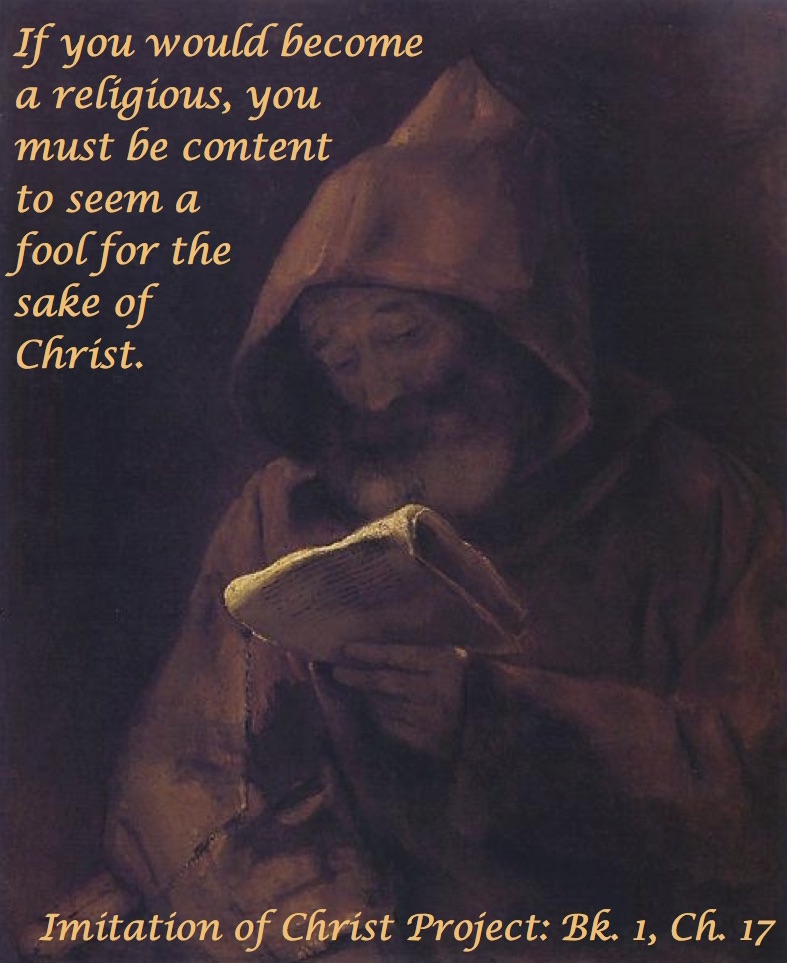
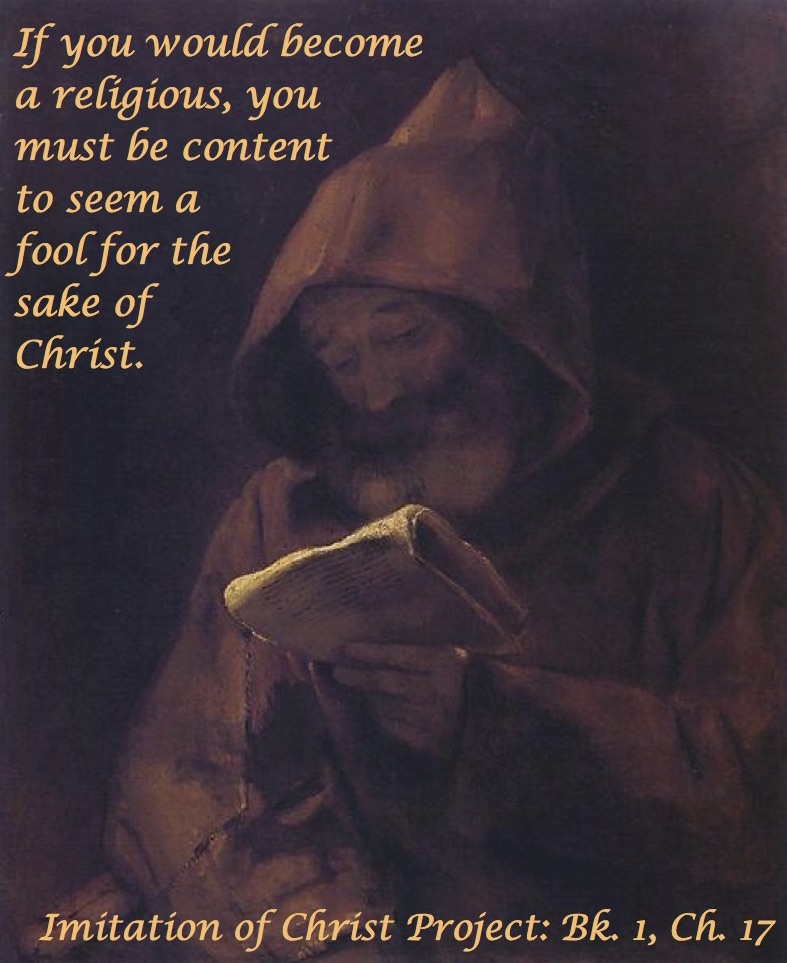
If you would persevere in seeking perfection, you must consider yourself a pilgrim, an exile on earth. If you would become a religious, you must be content to seem a fool for the sake of Christ. Habit and tonsure change a man but little; it is the change of life, the complete mortification of passions that endow a true religious.

He who seeks anything but God alone and the salvation of his soul will find only trouble and grief, and he who does not try to become the least, the servant of all, cannot remain at peace for long.

You have come to serve, not to rule. You must understand, too, that you have been called to suffer and to work, not to idle and gossip away your time. Here men are tried as gold in a furnace. Here no man can remain unless he desires with all his heart to humble himself before God.

Imitation of Christ Project – Bk. 1, Ch. 16

IOC 1.16BEARING WITH THE FAULTS OF OTHERS –

UNTIL God ordains otherwise, a man ought to bear patiently whatever he cannot correct in himself and in others. Consider it better thus — perhaps to try your patience and to test you, for without such patience and trial your merits are of little account. Nevertheless, under such difficulties you should pray that God will consent to help you bear them calmly.

If, after being admonished once or twice, a person does not amend, do not argue with him but commit the whole matter to God that His will and honor may be furthered in all His servants, for God knows well how to turn evil to good. Try to bear patiently with the defects and infirmities of others, whatever they may be, because you also have many a fault which others must endure.

If you cannot make yourself what you would wish to be, how can you bend others to your will? We want them to be perfect, yet we do not correct our own faults. We wish them to be severely corrected, yet we will not correct ourselves. Their great liberty displeases us, yet we would not be denied what we ask. We would have them bound by laws, yet we will allow ourselves to be restrained in nothing. Hence, it is clear how seldom we think of others as we do of ourselves.

If all were perfect, what should we have to suffer from others for God’s sake? But God has so ordained, that we may learn to bear with one another’s burdens, for there is no man without fault, no man without burden, no man sufficient to himself nor wise enough. Hence we must support one another, console one another, mutually help, counsel, and advise, for the measure of every man’s virtue is best revealed in time of adversity — adversity that does not weaken a man but rather shows what he is.

Imitation of Christ Project: Bk. 1, Ch. 15

IOC 1.15WORKS DONE IN CHARITY –

NEVER do evil for anything in the world, or for the love of any man. For one who is in need, however, a good work may at times be purposely left undone or changed for a better one. This is not the omission of a good deed but rather its improvement.

Without charity external work is of no value, but anything done in charity, be it ever so small and trivial, is entirely fruitful inasmuch as God weighs the love with which a man acts rather than the deed itself.

He does much who loves much. He does much who does a thing well. He does well who serves the common good rather than his own interests.

Now, that which seems to be charity is oftentimes really sensuality, for man’s own inclination, his own will, his hope of reward, and his self-interest, are motives seldom absent. On the contrary, he who has true and perfect charity seeks self in nothing, but searches all things for the glory of God. Moreover, he envies no man, because he desires no personal pleasure nor does he wish to rejoice in himself; rather he desires the greater glory of God above all things. He ascribes to man nothing that is good but attributes it wholly to God from Whom all things proceed as from a fountain, and in Whom all the blessed shall rest as their last end and fruition.

If man had but a spark of true charity he would surely sense that all the things of earth are full of vanity!

Imitation of Christ Project: Bk. 1, Ch. 14

IOC 1.14AVOIDING RASH JUDGMENT –

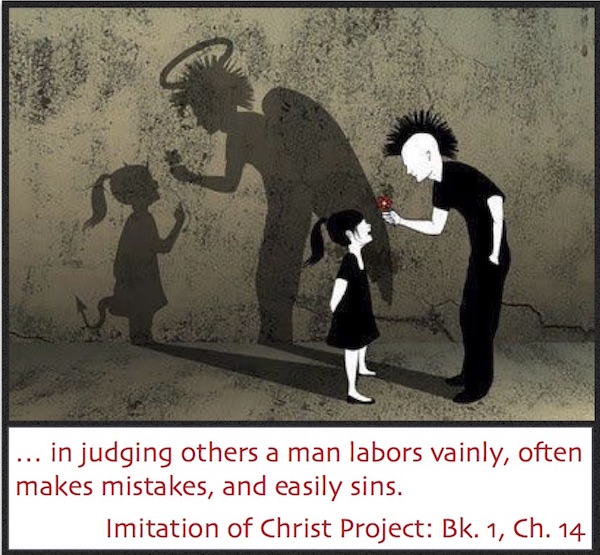
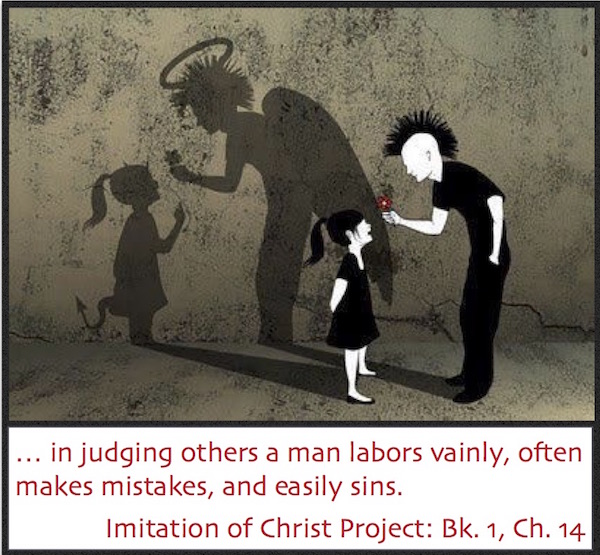
TURN your attention upon yourself and beware of judging the deeds of other men, for in judging others a man labors vainly, often makes mistakes, and easily sins; whereas, in judging and taking stock of himself he does something that is always profitable.

We frequently judge that things are as we wish them to be, for through personal feeling true perspective is easily lost.

If God were the sole object of our desire, we should not be disturbed so easily by opposition to our opinions. But often something lurks within or happens from without to draw us along with it.

Many, unawares, seek themselves in the things they do. They seem even to enjoy peace of mind when things happen according to their wish and liking, but if otherwise than they desire, they are soon disturbed and saddened. Differences of feeling and opinion often divide friends and acquaintances, even those who are religious and devout.

An old habit is hard to break, and no one is willing to be led farther than he can see.

If you rely more upon your intelligence or industry than upon the virtue of submission to Jesus Christ, you will hardly, and in any case slowly, become an enlightened man. God wants us to be completely subject to Him and, through ardent love, to rise above all human wisdom.