Sermon: Lent 1 – Series: The Heavenly Virtues


From the 6th to the 12th century, when the Church was seeking consistency in teaching and other matters of faith, it developed the Penitentials. These were specifically designed for confession. They outlined all the various sins and prescribed the appropriate penance. A few examples: “He who steals from a church shall do penance for one year; if from a layman, forty days,” “He who destroys another by slander shall fast seven days,” and “If a monk is drunk, he shall fast for three days on bread and water”—depending on how drunk the monk was, that may be more of a blessing than penance.

From these and other teachings that emerged, such as those from the Puritans and the Holiness Movement, many came to believe that the Church’s primary function was to tell people, “Thou shalt not,” “Don’t do this or that,” or, more simply, “No!” while wagging the finger.

The question might be, “Why did the Church go down this path?” There are long, complicated answers, but perhaps the most charitable is that the Church sought to help people live virtuous lives, lives that were holy and righteous in the eyes of God. That is not a bad thing. In fact, it is a very good thing; however, along the way, as with many good things, it was hijacked, and the desire to help people was transformed into a desire to control and manipulate them. At that point, the idea of living a virtuous life became a matter of ridicule and scorn. Elizabeth Taylor said, “The problem with people who have no vices is that generally you can be pretty sure they’re going to have some pretty annoying virtues.” And, speaking of a political rival, Winston Churchill wrote, “He has all the virtues I dislike and none of the vices I admire.” 

In his autobiography, The Seven Storey Mountain, Thomas Merton wrote, “The word virtue: what a fate it has had in the last three hundred years! The fact that it is nowhere near so despised and ridiculed in Latin countries is a testimony to the fact that it suffered mostly from the mangling it underwent at the hands of Calvinists and Puritans. In our own days, the word leaves on the lips of cynical high-school children a kind of flippant smear, and it is exploited in theaters for the possibilities it offers for lewd and cheesy sarcasm. Everybody makes fun of virtue, which now has, as its primary meaning, an affectation of prudery practiced by hypocrites and the impotent—that is, those who rely on a holier-than-thou approach instead of actually living the call of the virtues.

I tell you all this because, during this Season of Lent, I don’t want to stand up here and say, “Thou shalt not” or “Don’t do that.” Instead, I would like to walk us through a study of the Seven Heavenly Virtues. Why? Because a virtuous life is really not boring or something to laugh at. Concerning such a life, Merton went on to say, “I was never a lover of Puritanism. Now, at last I came around to the sane conception of virtue-without which there can be no happiness, because virtues are precisely the powers by which we can come to acquire happiness: without them, there can be no joy, because they are the habits which coordinate and canalize—channel—our natural energies and direct them to the harmony and perfection and balance, the unity of our nature with itself and with God, which must, in the end, constitute our everlasting peace.” (The Seven Storey Mountain, p.203)

This Lent, let’s see if he is correct. Let’s see if we can discover happiness and everlasting peace in living a virtuous life.

To begin, where do the Seven Heavenly Virtues come from, and what are they? You might think they originated with the Church, but that is only partially true.

Writing in the first century, the Roman philosopher Cicero used the term “Cardinal Virtues” to identify the four virtues that Plato had already codified some five centuries earlier. The word “cardinal,” in this context, means hinge. According to the philosopher, the virtuous life hinges on or pivots around the observation of the four Cardinal Virtues. 

The first of these virtues is prudence or wisdom, which is the combination of knowledge, discernment, and right action. Second is justice, seeking the harmony and peace of the whole society. Third is fortitude or courage, grounded in internal strength, and fourth is temperance or self-control.

Later, Christian writers such as Thomas Aquinas would define these virtues from a Christian perspective. Through this lens, prudence is the discernment of God’s will and the acting accordingly; justice is the application of “love your neighbor as you love yourself,” without asking who your neighbor is; fortitude is the courage to face trials and evil without wavering; and, finally, temperance is moderation or balance.

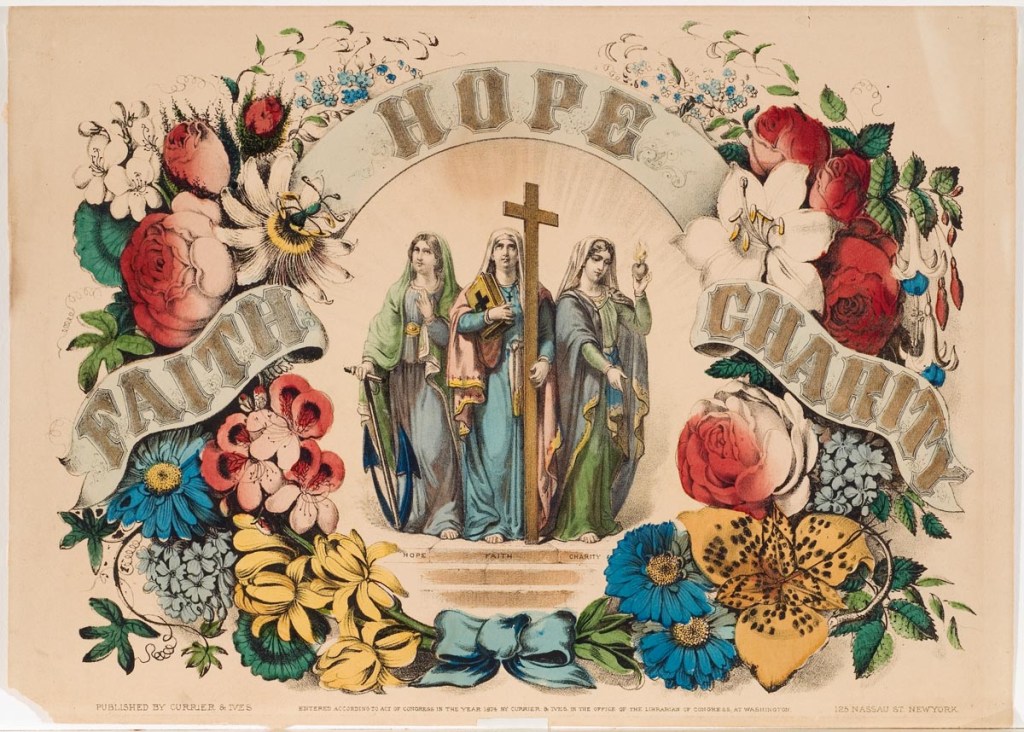
These four Cardinal Virtues provide us with the first of the seven Heavenly Virtues. The remaining three are the Theological Virtues, and, as the name implies, they come to us through Holy Scripture. I suspect many of you know the verse from St. Paul’s definition of love in his first letter to the Corinthians—“So now faith, hope, and love abide, these three; but the greatest of these is love” (1 Corinthians 13:13).

Faith, hope, and love—we’ll look at them more closely in the coming weeks, but for now, faith gives us the grace to see the path that leads to God, hope is the grace to desire God, and love is the grace that enables us to participate in a life with God.

By combining the Cardinal Virtues of prudence, justice, fortitude, and temperance with the Theological Virtues of faith, hope, and love, we arrive at the seven Heavenly Virtues. However, before we can practice any of these, one other element is required. It can be considered a virtue in itself, but it is the root of all the others—humility. Humility is the grace God gives us, enabling us to know who we are and who God is (without confusing the two), combined with the ability to have a relationship with others without the involvement of ego or destructive self-criticism. Humility is about peacefully knowing our place.

Marcus Aurelius, considered one of the Five Good Roman Emperors, ruled the Empire in the late second century. In his personal journal, he wrote to himself, “Waste no more time arguing what a good man should be. Be one.” Grounded in humility, my prayer is that over the course of this Season of Lent, we will learn more about and begin to put into practice these Heavenly Virtues so that we can do just that and attain the true happiness and everlasting peace that Merton speaks of.

Let us pray: God, our Father, You redeemed us and made us Your children in Christ. Through Him, You have saved us from death and given us Your Divine life of grace. By becoming more like Jesus on earth, may we come to share His glory in Heaven. Give us the peace of Your kingdom, which this world does not give. By Your loving care, protect the good You have given us. Open my eyes to the wonders of Your Love that we may serve You with a willing heart. Amen.

Sermon: Ash Wednesday


Pope St. Clement wrote in a letter to the church in Corinth on the topic of repentance. He said, “If we review the various ages of history, we will see that in every generation the Lord has offered the opportunity of repentance to any who were willing to turn to him. When Noah preached God’s message of repentance, all who listened to him were saved. Jonah told the Ninevites they were going to be destroyed, but when they repented, their prayers gained God’s forgiveness for their sins, and they were saved, even though they were not of God’s people.

“Under the inspiration of the Holy Spirit, the ministers of God’s grace have spoken of repentance; indeed, the Master of the whole universe himself spoke of repentance with an oath: As I live, says the Lord, I do not wish the death of the sinner but his repentance. He added this evidence of his goodness: House of Israel, repent of your wickedness. Tell the sons of my people: If their sins should reach from earth to heaven, if they are brighter than scarlet and blacker than sackcloth, you need only turn to me with your whole heart and say, ‘Father,’ and I will listen to you as a holy people.”

God makes these promises to us in so many different ways, but when it comes to repentance, I believe we can make two big mistakes. The first is to say we have no sin to repent of. St. John swats that away as the silliness it is. “If we say we have no sin, we deceive ourselves, and the truth is not in us… If we say we have not sinned, we make him a liar, and his word is not in us” (1 John 1:8, 10). I think we are all smart enough to agree with him on that point, so the second mistake is even greater, and that is believing that our sin is too great or has been committed so many times that God cannot or will not accept our repentance. St. Paul says, “I do not do the good I want, but the evil I do not want is what I do.” We say, “Yes! That’s it exactly. I have done such great evil or so much evil that I’m damned. I am lost.” This is a great error, for it falls into what is known as spiritual pride (a far greater sin than basic pride).

When we say such a thing, we are saying to God the Father, “My sin is so great or so frequent that it cannot be redeemed by the shed blood and death of your one and only Son, Jesus, on the Cross.” It says that everything Jesus did was wasted on you. It declares the promises of God invalid and inapplicable. St. John says, “If we confess our sins, he is faithful and just to forgive us our sins and to cleanse us from all unrighteousness” (1 John 1:9), and we add a footnote that reads, “This promise is null and void when it comes to me.” That is spiritual pride. Don’t go there.

Take to heart St. Clement’s words—“Tell the sons of my people: If their sins should reach from earth to heaven, if they are brighter than scarlet and blacker than sackcloth, you need only turn to me with your whole heart and say, ‘Father,’ and I will listen to you as a holy people.”

If you say those are only the words of a man, then take the words of Holy Scripture, for King David wrote,

“Have mercy on me, O God,
according to your steadfast love;
according to your abundant mercy
blot out my transgressions.
Wash me thoroughly from my iniquity,
and cleanse me from my sin!
Purge me with hyssop, and I shall be clean;
wash me, and I shall be whiter than snow.”
(Psalm 51:1-2, 7)

Believe the words when you hear them—“Your sins are forgiven”—and then, “Go, and from now on sin no more” (John 8:11).

Sermon: Epiphany Last RCL A – “Becoming”


Have you heard of the up and coming rock-n-roll star Larry Underwood? His rising single is Baby, Can You Dig Your Man.

“Bay-yay-yaby you can tell me if anyone can,
Baby, can you dig your man?
He’s a righteous man,
Tell me baby, can you dig your man?”

It gets stuck in your head once you’ve heard the tune, but it is also a fictional song from my favorite novel, The Stand, by—you guessed it!—Stephen King.

No spoilers here, but I can tell you that at the beginning of the book, Captain Trips, a souped-up version of the flu, kills about 98% of the world’s population. Larry and a woman named Rita Blackmoor are in New York City, and they decide it’s best to get out of the city, which has essentially become a morgue. Very uplifting story, I can tell you. Circumstances lead them to the Lincoln Tunnel, which will take them to New Jersey.

For an even more pleasant scene, the Lincoln Tunnel is a parking lot. So many had the same idea of escaping the city, but the tunnel got jammed, and people simply died in their cars, with no one to clean up the aftermath. Even so, Larry and Rita must get through. They set out. Their only source of light was Larry’s Bic lighter. Note to self: if it is the end of the world, don’t forget your flashlight.

“It was much blacker inside than [Larry] had imagined it would be. At first, the opening behind him cast dim white light ahead and he could see yet more cars, jammed in bumper to bumper (it must have been bad, dying in here, he thought, as claustrophobia wrapped its stealthy banana fingers lovingly around his head and began to first caress and then to squeeze his temples, it must have been really bad, it must have been… horrible).” Larry enters the tunnel, and we are told that as he “negotiated the first slow, banked curve, bearing gently to the right, the light grew dimmer until all he could see were muted flashes of chrome. After that the light simply ceased to exist at all.”

Further on, “The solid darkness provided the perfect theater screen on which the mind could play out its fantasies,” of all that was going on around him. However, they push on. Stumbling in darkness over all sorts of terrors—you really should read this one—then, after struggling for what seemed hours, “Rita stopped short. ‘What’s the matter?’ Larry asked. ‘Is there something in the way?’ ‘No. I can see, Larry! It’s the end of the tunnel!’ He blinked and realized that he could see, too. The glow was dim, and it had come so gradually that he hadn’t been aware of it until Rita had spoken. He could make out a faint shine on the tiles, and the pale blur of Rita’s face closer by.” They had made it through the blackness and the terror. Larry is so excited that he reports, “New Jersey never smelled so good.”

Every year, on the Sunday before Ash Wednesday, our Gospel reading is the account of the Transfiguration. Back in the day, when I really didn’t know what I was doing as a priest (I still don’t, but I’m much better at faking it… please don’t tell the Bishop), but before, I thought of this day as the Feast of the Transfiguration. However, one year in early August, I realized we were celebrating it again. We don’t do that. August 6th is the fixed day for the feast, so I got to wondering why we read about it today. The answer is two-part. The first part is because of what lies behind us—the events in the life of Jesus that are considered at the Epiphany and the season after, which today is the last.

The Epiphany, January 6th, is the revelation of Jesus to the Gentiles through the visitation of the wise men. In the season after the Epiphany, we continue to encounter the person of Jesus and who He is.

There is Jesus’ presentation and later teaching in the Temple when He was a young boy. This is followed by the Baptism of Jesus, when the Spirit descends, and God speaks, “This is my Son, whom I love; with Him I am well pleased.” Later comes the temptation in the wilderness and the first miracle at the wedding in Cana. We also have the Confession of Peter, “You are the Christ, the Son of the Living God.” All of these are revelations—revealings of who Jesus is. So the Transfiguration is another revealing moment, perhaps the most dramatic, for it shows Jesus in all his glory. Origen, writing in the third century, said, “He was transfigured before them. It is not that He then became what He was not before; rather, He showed to His disciples what He was, opening their eyes and giving sight to the blind.”

Up to that moment, the Jesus the disciples knew was walking around as though wearing camouflage. His true nature was hidden. At the Transfiguration, He took off the camouflage and revealed his true self. It was the greatest and most exact of the epiphanies, and it was what all the other epiphanies were leading up to. Like the disciples, we can now see Him transfigured, which helps us understand the second reason the Transfiguration occurs now. Luke’s Gospel helps us begin our understanding.

Very soon after the Transfiguration, Luke tells us, “The days drew near for [Jesus] to be taken up, he set his face to go to Jerusalem” (Luke 9.51). Following the Transfiguration, Jesus began His final journey to Jerusalem and the cross.

The Transfiguration, placed at this point in Jesus’s life and ministry, was intended to encourage the disciples, for the days ahead were about to turn very dark. St. John Chrysostom tells us that Jesus “brings them to the mountain and shows them His glory, that when they should see Him crucified, they might not be troubled.” In the Transfiguration, Jesus was saying to the disciples, “This is who I truly am,” but in order to accomplish the work the Father has set before me, I must first pass through the darkness, this tunnel where there is no light. Only then will I again be able to attain the glory I once had. What you disciples are about to witness will be scary, surrounded by death, but remember this moment. Remember this light and be encouraged.

For us today, liturgically, the Transfiguration, assigned to this Sunday, offers reassurance of Jesus’ ultimate victory over death. After all, we are about to walk that dark tunnel with him. We will see so many turn against him, betray Him, and abuse Him. We will watch as He is arrested, flogged, and crucified. We will witness His death and His being placed in the tomb. We know how the story ends, but if we didn’t, how awful all this would be. We would be like those first disciples, huddled in the upper room, afraid of everything and everyone. However, with the knowledge of the Transfiguration, we may be in the bowels of that dark tunnel, but we will have the residual glow of that moment on the mountain, which will give us hope. That is Jesus’ true nature, and no amount of darkness will overcome Him. We have hope; yet the liturgy of the church year points to something even greater. It is pointing to our very lives.

You see, the Transfiguration is not just revealing who Jesus is. It is also revealing who we are to become. St. Paul tells us, “We all, with unveiled face, beholding the glory of the Lord, are being transformed into the same image from one degree of glory to another” (2 Corinthians 3:18). The Church Fathers have understood this to mean that “Jesus was made man, that we might be made god.” Not the all-powerful divinity, like Jesus, but transformed into the Image of God. Yet, this is only possible if we are willing to walk through the same dark tunnel that Jesus walked before us. Jesus said, “If anyone would come after me, let him deny himself and take up his cross and follow me. For whoever would save his life will lose it, but whoever loses his life for my sake will find it” (Matthew 16:24-25). We take up our cross that we might be crucified with Christ, so that we might travel where He has led the way.

Larry Underwood had his Bic lighter to help guide him through the Lincoln Tunnel. What will we have? Answer: “The true light, which gives light to everyone” (John 1:9). We will have Jesus and the light He revealed to us at the Transfiguration. It is that light which will guide us and encourage us.

Think of it this way: the Transfiguration took place on Mount Tabor. The crucifixion took place at Golgotha, a hill outside Jerusalem. Connecting these two places is not a path of light but a tunnel of darkness. As with our friend Larry, that is a fearful place. It is a place of death, yet to reach the other side, we must pass through it. As we go, with the hope of the light of the Transfiguration, we pray, “Even though I walk through the valley of the shadow of death, I will fear no evil, for you are with me (Psalm 23:4).”

As we stand on the threshold of another Lent, another reminder of the path we all must eventually travel, look to the Transfigured Lord and see the glory of your future. I promise you, it is even better than New Jersey.

Let us pray: Loving Jesus, You were transfigured on the Mountain, showing Your Disciples as much of Your glory as they could hold. Let Your eternal light shine also upon us sinners, through the prayers of the Mother of God, O Giver of Light, glory to You. Amen.

Sermon: Scholastica


Most would agree that twins share a very special bond, and our Saint for today, Scholastica, helped prove that point. Her twin and only brother was none other than Saint Benedict.

They grew up in a wealthy family, yet early on they both felt a calling to a more austere, holy life. Benedict was the first to leave home and would eventually form a monastery based on his Rule—the Rule of St. Benedict. Witnessing such a life, Scholastica sought and received approval to form a convent, following the rule established by her brother. It was the first Benedictine Convent and was located about five miles from her brother’s monastery. 

I’m certain they exchanged many letters, but as close as they were—in proximity and relationship—they only met once a year. Pope Saint Gregory the Great records their last meeting. 

“Scholastica, the sister of Saint Benedict, had been consecrated to God from her earliest years. She was accustomed to visiting her brother once a year. He would come down to meet her at a place on the monastery property, not far outside the gate.

“One day she came as usual and her saintly brother went with some of his disciples; they spent the whole day praising God and talking of sacred things. As night fell they had supper together.

Their spiritual conversation went on and the hour grew late. The holy nun said to her brother: “Please do not leave me tonight; let us go on until morning talking about the delights of the spiritual life.” “Sister,” he replied, “what are you saying? I simply cannot stay outside my cell.”

“When she heard her brother refuse her request, the holy woman joined her hands on the table, laid her head on them and began to pray. As she raised her head from the table, there were such brilliant flashes of lightning, such great peals of thunder and such a heavy downpour of rain that neither Benedict nor his brethren could stir across the threshold of the place where they had been seated. Sadly he began to complain: “May God forgive you, sister. What have you done?” “Well,” she answered, “I asked you and you would not listen; so I asked my God and he did listen. So now go off, if you can, leave me and return to your monastery.”

Reluctant as he was to stay of his own will, he remained against his will. So it came about that they stayed awake the whole night, engrossed in their conversation about the spiritual life.

“It is not surprising that she was more effective than he, since as John says, God is love, it was absolutely right that she could do more, as she loved more.

“Three days later, Benedict was in his cell. Looking up to the sky, he saw his sister’s soul leave her body in the form of a dove, and fly up to the secret places of heaven. Rejoicing in her great glory, he thanked almighty God with hymns and words of praise. He then sent his brethren to bring her body to the monastery and lay it in the tomb he had prepared for himself.

“Their minds had always been united in God; their bodies were to share a common grave.”

St. Paul begins his famous passage on love by saying, “If I speak in the tongues of men or of angels, but do not have love, I am only a resounding gong or a clanging cymbal. If I have the gift of prophecy and can fathom all mysteries and all knowledge, and if I have a faith that can move mountains, but do not have love, I am nothing. If I give all I possess to the poor and give over my body to hardship that I may boast, but do not have love, I gain nothing… Love never fails.” And it did not fail Scholastica. She said, “I asked you [Benedict] and you would not listen; so I asked my God and he did listen.” 

Through the pure love of God and her brother, Scholastica asked that God hear her prayer. God did. When you pray, ask yourself, “Am I asking out of pure love, or do I have some other motive?” I would suggest that by answering that question, you have a very good chance of knowing how God will answer your prayer.

Sermon: Epiphany 5 RCL A – “Conform”


A fable passed down for generations tells of an elderly man traveling with a boy and a donkey. As they walked through a village, the man led the donkey, and the boy walked behind. The townspeople called the old man a fool for not riding, so to please them, he climbed onto the animal’s back. When they reached the next village, the people said the old man was cruel to let the child walk while he rode. So, to please them, he got off, set the boy on the animal’s back, and continued on his way. In the third village, people accused the child of being lazy for making the old man walk, and someone suggested they both ride. So the man climbed on, and they set off again. In the fourth village, the townspeople were indignant at the cruelty to the donkey because he was made to carry two people. The frustrated man was last seen carrying the donkey down the road.

In the 1950s, the Polish-American psychologist Solomon Asch conducted a series of conformity experiments. The tests were simple, but the results were profound. Since then, the tests have been replicated numerous times. What doesn’t change are the results.

The test was administered to college men and billed as a vision/eyesight test, but it was much more.

Asch created an image with three vertical lines of varying length and labeled them A, B, and C. He then brought in a group of individuals and asked which of the three lines was the longest. Simple enough, but there was a twist. If there were eight individuals in the room being tested, seven of them—known as confederates—were in on the experiment. The odd man out was the subject. The questioning would then begin. “Which of the three lines is the longest?” The confederates always answered first, and the subject last.

At first, the confederates would give the correct answer, but after a few rounds, they would all intentionally choose the wrong answer.

You’ve got lines A, B, and C. A is the longest, and everyone chooses A. All is well. Then you are shown a new set of lines in which C is the longest, but all seven confederates say B is the longest. When it’s the subject’s turn to answer, and he plainly sees that C is the longest, how will he answer? Will the subject be truthful, regardless of what everybody else has said, and choose C (the longest), or will he cave to social pressure and go along with the confederates’ choice of B? Remember, the subject thinks this is a vision test, so there’s no pressure to “get along.” Nothing high-stakes about the choice. Yet, of all the subjects tested, only about 25% never conformed, giving in to social pressure. 75% conformed at least some of the time, and 33% gave in to peer pressure 100% of the time, even though the answer was clearly wrong.

The big question then is “Why?” Asch concluded there were several factors—a desire to be accepted, fear of being different, and conflict avoidance. People would rather be wrong than be ostracized.

Because the experiment was conducted on college students, Asch concluded, “The tendency to conformity in our society is so strong that reasonably intelligent and well-meaning young people are willing to call white black. This is a matter of concern. It raises questions about our ways of education and about the values that guide our conduct.”

He made that statement about young people, but I would be willing to make a substantial wager that it applies to us all. True? I believe so. Ever go along with something you didn’t feel was right, but participate because everybody else was doing it? Yeah. Everybody nod your head.

Social conformity exerts great pressure on us all, leading us to conform to the person others expect us to be rather than the person we truly are. This is a good thing when it comes to taking a bath or brushing your teeth. However, in other situations, it can take a very bad turn. Consider what happened to the average German citizen during the 1930s and the rise of Nazism.

A week or so ago, I came across a quote but was unable to identify the author. I liked it enough to include it in my journal. It is on the New Age side of things, but bear with me. It reads, “You will never be free until you realize this. It was never about what they think. It was always about whether you listen to yourself. We spend so much of life chasing approval, fitting into shapes that were never ours, walking paths paved by other people‘s expectations. But have you noticed? The more you chase what pleases them, the further you drift from what fulfills you. The universe gave you a compass, not in your pocket but in your chest. Your intuition is the echo of the cosmos whispering through you. And yet, how often do we trust our fear more than we trust that quiet knowing? Do not fear walking alone. Do not fear growing alone. Because to stand in your own light is to remember the truth.”

It sounds like Asch. We chase approval, fit into shapes that are not our own, and follow paths that are not ours—we conform. We chase or believe in things that don’t fulfill us, and have nothing to do with who we want to become, yet we do it to get along. Mustn’t go against the grain. However, within us is a voice that speaks truth. A voice that will guide us along a path that will fulfill us and even transform us into the person we were created to be.

Today, we read from St. Paul’s first letter to the Corinthians. He said, “For what human being knows what is truly human except the human spirit that is within? So also no one comprehends what is truly God’s except the Spirit of God. Now we have received not the spirit of the world, but the Spirit that is from God, so that we may understand the gifts bestowed on us by God.”

Paul is saying that no one can truly know another person simply by looking at them or even by being in relationship with them. A part remains hidden, perhaps even from themselves. Since that is true, if we can’t even know another person, then knowing God is even less possible, unless—and there is the key—unless we have the Spirit of God within. Through the Spirit, God chooses to reveal Himself to His children. Still, we live in the world, and the spirit of the world can influence our lives. It is this spirit that wants us to conform, to chase approval, walk paths that are not our own, and turn from God. Therefore, in his letter to the Romans, Paul writes, “I appeal to you therefore, brothers, by the mercies of God, to present your bodies as a living sacrifice, holy and acceptable to God, which is your spiritual worship. Do not be conformed to this world, but be transformed by the renewal of your mind, that by testing you may discern what is the will of God, what is good and acceptable and perfect.” (Romans 12:1-2)

Paul implores us not to listen to the spirit of this world but to look to the Compass within our chest, our soul, and to listen to the whisperings of God’s Holy Spirit. Such actions may bring on the feelings Asch described in his experiment, primarily fear of being different and of being ostracized, but “Fear not,” Jesus says. “You will not have to walk alone, for I am with you.”

Jesus says, “Don’t be afraid to be different. Why? Because I created you to be different. I created you to be the salt of the Earth. I set you on a path not to be conformed to this dark world but to be the light of the world. Therefore, ‘let your light shine before others, so that they may see your good works and give glory to your Father in heaven.’”

Will such a life make a difference?

In his experiments, Asch introduced a variable. What if one of the confederates dissented and chose the truth? In almost every case, the subject, seeing an ally—someone they could stand with—chose the truth. The truth doesn’t need a majority, just company.

If you become the light, you will give others the courage to do the same. You may or may not be able to change the world around you, but by living out the truth, by shining the light of Christ, by not conforming, by not ending up carrying the stupid donkey, and ultimately by living according to the Spirit of God, you will fulfill the will of God in your life (which, by the way, is far more important than winning the battle).

The author of Proverbs writes,
“The way of the wicked is like deep darkness;
    they do not know over what they stumble.”
“But the path of the righteous is like the light of dawn,
    which shines brighter and brighter until full day.”
(Proverbs 4:19 & 18)

Walk the path of righteousness and be that light. It is why God, in His infinite wisdom, created you.

Let us pray (Hymnal 1982 #656 by John Keble):
Blest are the pure in heart,
for they shall see our God;
the secret of the Lord is theirs,
their soul is Christ’s abode.

The Lord, who left the heavens
our life and peace to bring,
to dwell in lowliness with us
our pattern and our King;

He to the lowly soul
will still himself impart and
for his dwelling and his throne
will choose the pure in heart.

Lord, we thy presence seek;
may ours this blessing be;
give us a pure and lowly heart,
a temple fit for thee.

EWC Roll Call – “Harassing Bigfoot”


150 words.


We parked at the Honobia Community Park in Honobia, along the Little River in southeast Oklahoma. We set the five hound dogs loose and traveled north. The dogs picked up the scent. They moved fast through the dense forest, and we, racing behind, barely kept up. After thirty minutes, the dogs’ baying told us they had somehow managed to bring our prey to a halt, either trapped or treed. Coming into a small clearing, the muddy remains of an old, dried-up cow pond at its center, we saw him. He was furious and bellowing, stuck in the mud. At every attempt to free himself, he became more and more bogged down. We called the newspaper and reported it to the authorities, and that’s how we ended up in jail. We did not know that in Honobia, Oklahoma, it is, in fact, illegal to harass Bigfoot.


Shared the prize…


Sermon: Manche Masemola and Other Martyrs


Today, Thursday, and Friday, we celebrate three martyrs. Today, we remember Manche Masemola, an Anglican woman from South Africa who, in 1928, was put to death by her parents at age 15 for converting to Christianity and refusing to renounce her faith. She was unbaptized, but she declared she would be baptized in her own blood. Tomorrow is the Feast Day of St. Agatha, who, in 251 AD, was put to death at age 19 for refusing to renounce her faith and marry a Roman prefect. Shortly before her death, she prayed, “You Lord, who have created and guarded me from my childhood, and made me to act with manly strength, have taken from me the love of the passing world, who kept my body from contamination, who made me overcome the torments of the executioner, the iron, the fire, and the chains, who gave me in torment the virtue of patience! Please accept my spirit now, for it is already time that I should leave this world by your command and reach your mercy.” She is the patron saint of breast cancer patients, which points to some of the torture she endured. And, finally, Friday is the Feast Day of St. Paul Miki and his companions, who were missionaries in Japan in the 1500s and were put to death for proclaiming the Good News. Before he died, he said, “The only reason for my being killed is that I have taught the doctrine of Christ. I certainly did teach the doctrine of Christ. I thank God it is for this reason I die.”

Those are three of the estimated 70 million Christian martyrs since the time of Christ. Even today, 5,000 to 10,000 people are estimated to be martyred each year—people who died for the same cause as Manche, Agatha, and Paul Miki.

On her feast day, Saint Methodius of Sicily spoke of Agatha. The words he shared are true for Agatha and for all who have stood upon the solid rock of their faith in Christ Jesus. Methodius writes, “The woman who invites us to this banquet is both a wife and virgin. To use the analogy of Paul, she is the bride who has been betrothed to one husband, Christ. A true virgin, she wore the glow of pure conscience and the crimson of the Lamb’s blood for her cosmetics. Again and again she meditated on the death of her eager lover. For her, Christ’s death was recent, his blood was still moist. Her robe is the mark of her faithful witness to Christ. It bears the indelible marks of his crimson blood and the shining threads of her eloquence. She offers to all who come after her these treasures of her eloquent confession.

“Agatha, the name of our saint, means “good.” She was truly good, for she lived as a child of God. She was also given as the gift of God, the source of all goodness to her bridegroom, Christ, and to us. For she grants us a share in her goodness.

“Agatha, her goodness coincides with her name and way of life. She won a good name by her noble deeds, and by her name she points to the nobility of those deeds. Agatha, her mere name wins all men over to her company. She teaches them by her example to hasten with her to the true Good. God alone.”

My prayer is that none of us ever has to experience what these and so many others have gone through. My prayer is that if we do, we can stand as firmly in our faith as they did. My prayer is that we can look to their lives and their deaths and find the courage to live our faith in the smallest of details. As St. Josemaría Escrivá tells us, “‘Great’ holiness consists in carrying out the ‘little duties’ of each moment.” (The Way, #817)

Evolution of a Sermon

I put this together for myself, but thought it was fun for a post. It shows my preparation for the sermon on Sunday, February 1, 2026.


The inspiration…


Working it out…


Manuscript (I don’t read my sermons, but I do prepare a full manuscript) and final preparation…


Proclamation…


You can read the full text here.

Sermon: Epiphany 4 RCL A – “God’s Wisdom”


The study of wisdom in Scripture is fascinating, and I’d like to delve into it more deeply, but at its core is the fact that wisdom is a grace given to us by God in order to live according to God’s will. However, wisdom is only knowledge until it is applied. For example, “Knowledge is knowing that a tomato is a fruit. Wisdom is knowing not to put it in a fruit salad.” As author Terry Pratchett noted, “Wisdom comes from experience. Experience is often a result of a lack of wisdom.”

Our readings for today provide an excellent lesson on the application of wisdom and its absence, beginning with our Old Testament lesson. I’ll share with you a different translation of the lesson from Micah, as it will help clarify what is being said. The Lord says,

“Come, present [My] case before the mountains,
And let the hills hear you pleading.
Hear, you mountains, the case of the LORD
You firm foundations of the earth!
For the LORD has a case against His people,
He has a suit against Israel.
“My people!
What wrong have I done you?
What hardship have I caused you?”

Why is God pleading a case against His people, accusing them? Micah has outlined three major offenses elsewhere: social injustice and the oppression of the poor, the corruption of religious and political leaders (who were essentially the same people), and the worship of false gods. Micah cries out against all these sins, all of which arise from the people looking to their own understanding and wisdom and choosing what they believe is better over the wisdom of God and what God said is better. Therefore, God is not happy, and He is making a case against His people. At this point, God even challenges the people to make a case against Him, but before they attempt such a foolish endeavor, He reminds them of what He has already done for them, saying,

“Testify against Me.
In fact,
I brought you up from the land of Egypt,
I redeemed you from the house of bondage,
And I sent before you
Moses, Aaron, and Miriam.
‘My people,
Remember what Balak king of Moab
Plotted against you,
And how Balaam son of Beor
Responded to him.
[Recall your passage] From Shittim to Gilgalb—
And you will recognize
The gracious acts of the LORD.’”

We are familiar with the events in Egypt—how the Israelites were held in captivity for 400 years. Yet when God heard the cries of His people, He came to their rescue. He sent them “Let My People Go, Moses.” There were the ten plagues, the release, and the parting of the Red Sea. Then, at Mount Horeb, God gave them the Law, He gave them His wisdom, so they would know how to live and do so without excuse. This was God’s wisdom spelled out for the people; however, they sinned because they still relied on worldly wisdom, which cost them dearly, and they spent the next 40 years wandering in the desert. Finally, God allowed them into the Promised Land.

As they were going, they encountered many obstacles, including King Balak and the Moabites that Micah mentioned.

Balak had witnessed the Israelites’ progress through the lands and seen how they conquered all, and he was terrified. In an attempt to defeat them, he applied his version of wisdom and sent emissaries to Balaam. Balaam was a sorcerer of sorts, renowned for his ability to bless and to curse. Although not an Israelite, he could speak to God.

The emissaries of Balak came to him and asked him to curse the Israelites so that Balak’s armies could defeat them. Balaam spoke to the Lord, but the Lord said, “Don’t even think about it.” Two more times the emissaries asked Balaam to curse, and two more times God said, “No.” However, wanting to get paid and relying on his own wisdom, Balaam set out anyway, riding his donkey, to see these Israelites. It turned out the donkey was far wiser than Balaam.

As they were going, the donkey saw an angel of the Lord holding a sword that blocked their path, and the donkey turned aside. Balaam, unable to see the angel, beats the animal. After the third time and the third beating, donkey turns to Balaam and, impersonating Eddie Murphy, says to Balaam, “I just know that before this is over, I’m gonna need a whole lot of serious therapy.” (Shrek, 2001)

No, that’s not it. The donkey essentially says, “Fool, can’t you see that angel standing right there?” At which point the angel reveals himself. Long story short, Balaam blesses the Israelites instead of cursing them. He wises up for at least a moment. It is believed that Balak was later killed in battle, and we know that Balaam was executed for his treachery.

In His case against the Israelites, the Lord makes one final appeal to His wisdom and the good it brings when He says the people should remember what happened at their passage from “Shittim to Giglgal.” This is a reference to the miraculous crossing of the Jordan River, when the waters backed up, and the people crossed into the Promised Land on dry ground.

God accused the people because, using their own wisdom, they oppressed the poor, their religious and political leaders were corrupt, and the people worshiped false gods. God furthered His case by showing how good He had been to them by defeating those who would hold them captive, attempt to conquer them, or curse them. God demonstrated the foolishness of the “wisdom”—the wickedness—of these mortal kings and the people by showing how He had loved and protected them. How His way was so much better. Yet, the people were disobedient and sinned against Him and one another. The wisdom of God far exceeded the wisdom of the Israelites and their enemies, but the people were not obedient.

All this was a demonstration of what Paul, quoting Isaiah, said to the Corinthians. “I will destroy the wisdom of the wise, and the discernment of the discerning I will thwart.” Note that Paul is being sarcastic about the wisdom of the wise and the discerning. He is laughing at the “wise” who apply earthly wisdom instead of God’s.

So Paul asks, “Where is the one who is wise? Where is the scribe? Where is the debater of this age? Has not God made foolish the wisdom of the world?” Paul answers his own question by telling us that God has flipped the script. Those who think they are wise, He shows to be fools. “God chose what is foolish in the world to shame the wise; God chose what is weak in the world to shame the strong; God chose what is low and despised in the world, things that are not, to reduce to nothing things that are.” Just as He has always done, God is turning things upside down.

God chose a young peasant girl instead of the Emperor’s daughter. God chose a baby in a manger instead of a king in a palace. God chose 12 men—tax collectors, fishermen, ordinary sinners—instead of scholars to be His disciples. Finally, God chose to be enthroned on a cross instead of a throne of gold lined with soft cushions. God chose the foolish, the weak, the lowly, and the despised. The greatest act of foolishness was when God chose a Cross to defeat all His enemies. And, to the world around us, it is the greatest insanity when we do the same, choosing the cross so that we can defeat those who come against us, seeking to separate us from our God. How do we persevere in the face of this opposition? Micah explains,

“He has told you, O man, what is good,
And what the LORD requires of you:
Only to do justice
And to love goodness,
And to walk modestly with your God;
Then will your name achieve wisdom.”

We achieve true wisdom when we choose the wisdom of God, when we choose the Cross and the ways of God, as exemplified in Jesus Christ. This is not the wisdom of the world or our own. In fact, it is quite the opposite. For it is not the way of the rich, the fat and happy, or the powerful. No. The wisdom of the Lord says,

“Blessed are the poor in spirit, for theirs is the kingdom of heaven.
“Blessed are those who mourn, for they will be comforted.
“Blessed…” and wise are those who live by these words of God.

“The message about the cross is foolishness to those who are perishing, but to us who are being saved, it is the power of God.” We are blessed when we live according to the wisdom of God.

Today, where do you find wisdom? In other words, what or who do you trust and place your faith in?

Do you place your faith in people—political or religious leaders? The Lord says,

“Cursed is he who trusts in man,
Who makes mere flesh his strength,
and turns his thoughts from the Lord.”
(Jeremiah 17:5)

Do you put your faith in this world? Jesus says, “Do not lay up for yourselves treasures on earth, where moth and rust destroy, and where thieves break in and steal” (Matthew 6:19).

How about those idols of your own creation—your strength, your resources, position, talents? Jonah said,

“Those who pay regard to vain idols
    forsake their hope of steadfast love.” (Jonah 2:9)

You get the point. Blessed are the poor, the meek, the peacemaker. Blessed are those who seek and follow the wisdom of God. Jeremiah says,

“Blessed is the man who trusts in the Lord,
    whose trust is the Lord.
He is like a tree planted by water,
    that sends out its roots by the stream,
and does not fear when heat comes,
    for its leaves remain green,
and is not anxious in the year of drought,
    for it does not cease to bear fruit.” (Jeremiah 17:7-8)

The world may view your trust and the wisdom you live by as foolishness, but it is the wisdom of God, given only to His beloved children. “Do not swerve to the right or to the left; turn your foot away from evil” (Proverbs 4:27), and choose the wisdom of God. It takes time to learn, but it is not hidden from anyone who seeks it. As St. James tells us, “If any of you lacks wisdom, let him ask God, who gives generously to all without reproach, and it will be given him.” (James 1:5)

Let us pray: (from St. Thomas Aquinas)
Grant us, O Lord our God,
a mind to know you,
a heart to seek you,
wisdom to find you,
conduct pleasing to you,
faithful perseverance in waiting for you,
and a hope of finally embracing you.
Amen.